A delightful account of the seasons in a North Fork cottage and its garden, in a domestic idyll of hardy plants and neighbors, love and loss, and acceptance of the life we've made
The deliciously book-length story of "The Vineyard" is set in and around the little house in Oyster Ponds where the poet spends the summer months. In freeflowing lines and pages that turn with the calendar, the poem unspools impressions that seem confided rather than written, as Galassi observes the "pretend peace'' of this quiet village house and garden, his oasis in the great swirl of dailiness. Themes and imagery recur, swerve, and transform as he watches the vineyard next door come alive, thrive, and die away, only to return the next year, different but the same, in our time of plague, climate threat, and a culture that too often seeks to tear down what is most beautiful and lasting.
But this book is not a complaint or a raging against the dying of the it is an honest record of dailiness, of gratitude, of finding one's center. From the wisteria vines that drop suckers on the lawn to the history of farms and businesses around the village, it becomes an ample container for Jonathan's we're having a chat with him about all he sees and dreams, about tending the plants and cooking and gossiping, about loving men and growing older, about his mother and Vita Sackville-West and bike-riding and having daughters and regrets. The narrative swells and touches us in its surprising turns; sometimes whole poems swim up and hold a page in the midst of its narrative, reminding us how writing practice anchors the quotidian.
This intimate, unhurried, and unpretentious life poem will stand as the central work of Jonathan Galassi's career.
Jonathan Galassi born 1949 in Seattle, Washington, is the President and Publisher of Farrar, Straus and Giroux, one of the eight major publishers in New York. He began his publishing career at Houghton Mifflin in Boston, moved to Random House in New York, and finally, to Farrar, Straus & Giroux. He joined FSG as executive editor in 1985, after being fired from Random House. Two years later, he was named editor-in-chief, and is now President and Publisher.
Galassi is also a translator of poetry and a poet himself. He has translated and published the poetic works of the Italian poets Giacomo Leopardi and Eugenio Montale. His honors as a poet include a 1989 Guggenheim Fellowship, and his activities include having been poetry editor for The Paris Review for ten years, and being an honorary chairman of the Academy of American Poets. He has published poems in literary journals and magazines including Threepenny Review, The New Yorker, The Nation and the Poetry Foundation website.
Galassi graduated from Phillips Exeter Academy where he became interested in poetry, writing and literature, and from Harvard College in 1971. He was a Marshall Scholar at Christ's College, Cambridge. He realized while attending Christ’s College that he wanted a career in book publishing. Galassi was born in Seattle (his father worked as an attorney for the Justice Department), but he grew up in Plympton, Massachusetts. He lives in Brooklyn.
These poems ring with idyllic charm as Galassi gives an honest look at life and decay. His tone throughout ebbs and flows between reflective, appreciative, regretful, hopeful and poignantly observant. The Vineyard urges the reader to slow down in order to see the world around us and ourselves in this ordinary, extraordinary life.
A Life Poem in Three Movements: How “The Vineyard” Makes Dailiness Feel Like Destiny By Demetris Papadimitropoulos | February 27th, 2026
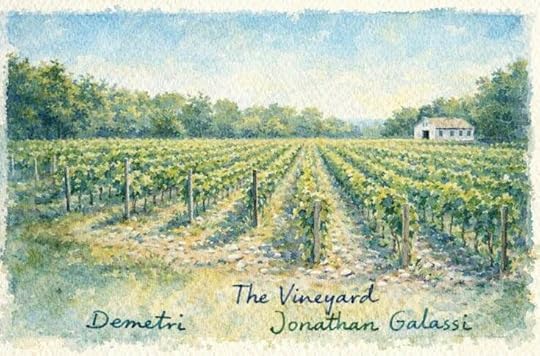
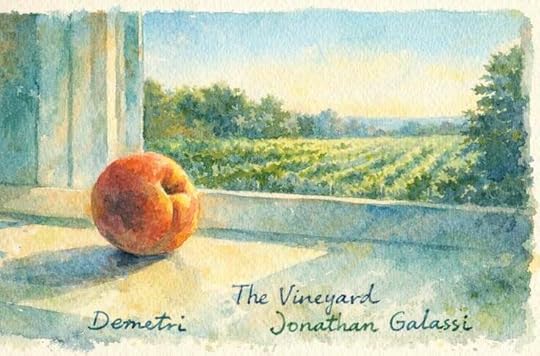
Watercolor Piece by Demetris Papadimitropoulos
In Jonathan Galassi’s “The Vineyard,” the oldest literary seduction – the pastoral promise that if you go far enough out of town the world will finally stop – is offered, examined, punctured, and then, in a late turn of generosity, offered again in a new key. This is not a book that believes in innocence, least of all its own. It is a “life poem,” a long, calendar-turning conversation set in and around a small North Fork cottage in Oyster Ponds, where a modest vineyard next door becomes both metronome and mirage: a field that keeps time, a screen that catches our projections, a daily performance of growth and retreat that makes the human appetite for permanence look both touching and faintly ridiculous.
Galassi begins with a line that contains the whole argument, compressed to fruit: ripeness, already tipping into over-ripeness; pleasure, already haunted by its end. From there the poem opens outward, not by dramatic escalation but by accumulation – of neighborly lore, botanical longing, local history, domestic comedy, and the kind of self-interrupting intelligence that insists on telling you what it just forgot and what it has only just remembered. The voice is crucial: confiding rather than declaiming, educated without being strenuous about it, capable of pivoting from the Latin name of a plant to the price of a chicken to an anxious thought about rising water without changing tone. The effect is less “lyric rapture” than “spent afternoon with someone whose mind keeps finding doors in the walls.”
The vineyard itself is the book’s steadying image, but it is also its cleverest feint. “The vineyard was always better than the grapes,” Galassi remarks early – a throwaway that becomes an aesthetic credo. Product is secondary to spectacle; consumption is less interesting than seasonality; the thing is not the wine but the watching. This is a poem of looking: the narrator at his desk, at his kitchen window, at the edge of his property line where the mesh fence makes a suggestion of boundaries but not a conviction. The book’s pleasures are the pleasures of attention, of inventory as devotion. Trees are named like confidants. Perennials are greeted like returning characters in a serial. A dead branch “spoils the view” and is cut away with the sly satisfaction of someone who has “righted a wrong,” even as he knows – and the poem keeps insisting we know – that the urge to tidy is one of the most respectable forms of domination.
If “The Vineyard” were only a garden book, it would already be a good one: Galassi has an amateur’s zeal for the homely name and a professional’s itch for the exact one, and his running comedy about who gets to be fluent – in Latin, in local lore, in the unspoken etiquette of land and class – is one of the poem’s quiet, bracing truths. The garden here is never just botany; it is a social field. It is where taste is displayed, where control is attempted, where failure is inevitable, and where envy occasionally sneaks in wearing the mask of horticultural critique. He is refreshingly candid about the limits of his competence, the waste of plants, the fiascos of transplants that “don’t take,” the humiliations of deer, the constant improvisation. (“A gardener’s life is full of woe,” someone remarks, and the line lands not as a proverb but as the book’s low-level drone.) Yet the garden is also his method for living. It is how he turns dread into task, how he translates moral unease into something he can do with his hands.
The poem’s middle movement expands the frame, as if the speaker has walked a few steps back and discovered that his beloved view is not, in fact, natural. Here the book grows bolder – and darker – about the ethics of “pretend peace.” Galassi loves this place, and the poem’s best passages are not shy about beauty: long light, vivid wind, the vineyard’s stripes fluttering like a flag, the late-summer blaze of crape myrtle, the daily theater of birds. But he repeatedly refuses to let beauty pass for absolution. Incomers arrive; money arrives; the illusion of simplicity arrives; the landscape is re-graded, replanted, made to look like what it never quite was. If you hear, behind Galassi’s breezy asides, the moral percussion of “The Rings of Saturn,” it is because the book shares Sebald’s instinct that a walk is never only a walk – it is a stroll across buried stories. Galassi is less mournful, more gossip-friendly; his narrative is warmer, more social. But he, too, keeps tripping over history in the grass.
That history includes the gentle, devastating reality that the vineyard next door belonged to a particular man – Dr. Held, brusque and private, a local eccentric with a project – and that when the man dies, the project becomes vulnerable. The family wants to preserve the vineyard, the poem tells us, but the fact remains: they cannot be him. The wine will be sold off, the fruit folded into someone else’s vat. The narrator realizes he has missed his chance to taste this place as its maker intended. It’s a small regret, but Galassi understands that small regrets are the ones that build a life, and that the most painful losses are often the ones you could have prevented with a single day of courage. He makes that missed bottle of wine stand in for a whole category of lost chances: the question not of what disappears, but of what you never quite claimed while it was available.
The book’s contemporary relevance is not bolted on; it is weather, and like weather it keeps changing the meaning of the scene. The manuscript’s “time of plague” is not a melodramatic backdrop so much as a subtle reframing of domestic rituals: the house becomes islandish, the neighborhood’s generator chorus becomes a new kind of community, the desire for an oasis becomes both understandable and faintly suspect. Climate threat is even more pervasive. It surfaces in concrete local observations – warm water and missing bay scallops, droughty lawns, storms and flooding, the repeated anxiety that the causeway will wash away – and also in the poem’s deeper awareness that what we call “season” is no longer stable enough to be trusted. In that sense “The Vineyard” belongs with the best recent books of attention under pressure: not just “Pilgrim at Tinker Creek” and “A Sand County Almanac,” but also the more contemporary genre of lyric ethics represented by “Braiding Sweetgrass,” where love of place is inseparable from responsibility.
And yet Galassi’s chief gift is that he refuses the easy posture of righteous witness. He keeps admitting his own complicity. “As always, we’re the problem,” he suggests, with a self-scouring honesty that saves the book from both pastoral complacency and scold’s delight. This is not a poem in which the narrator stands outside the story, pointing at developers, tourists, new houses, tasteless renovations. He is one of the incomers. He has designs on the view. He wants a hidden garden, an Eden behind a hedge, a world arranged to his imagination. He knows exactly how much that desire resembles the very impulses he critiques. He is, in other words, a credible moral voice – not because he is pure, but because he is not pretending to be.
The poem’s structure – three numbered movements, with titled interludes that surface like songs breaking through conversation – gives it a loose but purposeful architecture. Those interludes matter. “Orient Epithalamion,” for instance, offers a wedding-blessing that doubles as a hymn to a community, a season, a set of ordinary local details made luminous by repetition. It’s a communal breath in a poem that can otherwise feel like a private monologue, and it ends with a prayer that is both tender and terrifying: let the tide not overwhelm the causeway. The line is not a slogan; it is a wish so modest it becomes enormous. You feel, in that moment, the book’s true subject: not simply a garden, not simply a village, but the human need to bless what we suspect we are about to lose.
Late in the book, the mood deepens into a kind of unshowy reckoning. The voice that has been so companionable – so fond of lists, of digressions, of small jokes about misremembered names – begins to take stock of larger debts. Galassi begins asking what it means to live in a place whose history has been curated, whose burial grounds have been labeled and relabeled, whose “truth” depends on which sign is left standing. He asks, with quiet insistence, who is underneath the vineyard; who is buried where; who is remembered and who is tidied away. It is here that the book’s pastoral becomes political in the only way politics matters in art: not as topical reference, but as the insistence that beauty has a ledger.
At the same time, the poem’s intimacy sharpens. The second-person address – often to “Tityrus” – becomes more than a charming classical flourish; it becomes the book’s emotional anchor. Love here is not performed as romantic climax. It is lived as routine: music through the wall, shared jokes, the daily negotiations of work and rest, the speaker’s awareness that he is being, in some sense, permitted to live. There is a particular tenderness in the way Galassi writes domestic partnership as a form of ethical companionship – not the grand love story of plot, but the quiet love story of attention sustained.
One of the pleasures of “The Vineyard” is that it does not punish you for reading it like a person. Many contemporary long poems, in their anxiety to be taken seriously, make seriousness a kind of tax. Galassi’s poem is serious the way life is serious: by being funny, distracted, petty, fussy, occasionally vain, and then suddenly – without warning – pierced by memory. The book contains elegies, dreams, portraits of friends and figures, and, in its best pages, a late-style clarity about aging that is neither sentimental nor cruel. The self here is not offered as exemplary; it is offered as recorded. That’s why the poem’s occasional moments of self-mockery – the “Dad bod,” the indulgences, the irritations – don’t feel like charm tactics. They feel like the texture of a person refusing to turn himself into a statue.
So why, finally, does “The Vineyard” work as well as it does? Because it is a poem that understands the danger of its own genre and keeps stepping around it. The danger of the pastoral is that it becomes an instrument of denial: a way to aestheticize privilege, to treat land as backdrop, to make peace look like nature rather than like policy. Galassi keeps saying “pretend peace” as if to shake the glitter off the word peace and show the mechanism underneath. And still he allows peace to exist, provisionally, as something like a practice: not a state granted by the world, but a stance adopted in full knowledge of what is wrong. The book’s intelligence is not only analytic; it is temperamental. It has decided, after all the necessary admissions, to continue to tend.
A quibble, because no serious review should refuse the pleasure of one: the book’s abundance occasionally threatens to become sprawl. Galassi’s digressive charm is part of his allure, but it can also soften the sense of inevitability; some passages feel poured rather than shaped, as if the poem trusts the reader’s affection to do what structure might have done more firmly. And yet that looseness is also the book’s point. This is not a poem pretending to be marble. It is a poem pretending to be a chat – and then, in the best passages, revealing that the chat has been building an architecture all along.
If the ideal score, 100, belongs to the rare book that seems to have invented its own necessity, “The Vineyard” comes close enough to be impressive: a long poem that makes dailiness feel like a form, that turns the garden into both solace and moral instrument, and that allows the contemporary world – plague, climate, the brittle politics of memory – to enter not as reference but as atmosphere. My rating for the book is 91 out of 100.
The fact what seems eternal’s not eternal makes it all the more lovely. from The Vineyard by Jonathan Galassi
I loved this poem, this celebration of the ephemeral, the short lived beauty of this world, our selves. How we carefully tend the brevity of garden blooms, luxuriate in vistas of green vineyard vines or ocean, embrace lovers and friends knowing forces will separate us, that someday the sea will undulate the land we love, and the meadows will become abodes of the wealthy.
If I look our this window from this height the vineyard’s like a flag by Johns fluttering its long yellow-green stripes, dark crevices between the sunstruck ones. … The vineyard leaves reach up like dancing hands while the grapes hang down… from the Vineyard by Jonathan Galassi
“Is a little temporary permanence/too much to ask?” Galassi asks. A bower of flowers to shelter against the waning years, the impending future that will erase what is now? The inevitable alteration of time and the changes we have wrought that will alter this world? The vineyard was here, the fact remains, even after it is gone.
In some ways, age has brought peace and acceptance. Youth was full of rage against the cruel world. Now he is old and free, his conscience clear. Or is it?
Tityrus tells me when I moan about the world watching the daily cataclysms on TV, tsunamis, famine, murders, rapine, statues pulled down, people disappeared, families dissected, freedoms vaporized. Was every time as terrible as this, but people didn’t know it? … But what is there to do but lament, decry, resist, protest? And hope somehow to be forgiven for everything we haven’t done (and, maybe, more, for what we have), while we fret in our caves?
from the Vineyard by Jonathan Galassi
I look forward to rereading this poem for the reward of connecting to it with new insights, for the beauty of its images and message, for the way it lifted me and made me contemplate its ideas.
A poetic tribute to one’s home, this is an elegant long form semi-fictional poem of a vineyard on the Nork Fork and the seasons that transform the environment around it. Jonathan Galassi has created that meander into the dreamworld of what a refuge a vineyard provides. He muses on the various flora and fauna, the changes wrought by climate change, and how human history has cruelly marked the soil where certain plants can no longer flourish. It’s an elegy that celebrates the beauty marked by change and the impression received by a place one calls home. Galassi narrates this poem with a gravelly, unfussy air; his aged voice gives gravitas as he describes a slow acceptance of his beloved vineyard transforming. As with purposeful poetry recitations, Galassi appropriately pauses after phrasing to let the listener experience the wind on the back porch with him, to smell the wisteria vines and feast the eyes on the forsythia branches to remind him to appreciate the world as it is, not how he wishes it would be. The slower cadence of Galassi’s phrasing becomes a rather hypnotic experience for both nature and poetry lovers alike. A feast for the literary senses, this short narrative is recommended for fans of Mary Oliver, Wendell Berry, or Joy Harjo.
I fear that I am woefully unqualified to evaluate poetry in any academic sense as I read so little of it, but for whatever it’s worth, I thought this was lovely.
I have previously loved Jonathan Galassi’s prose, so I decided to give this a whirl despite it being outside my usual reading interests structurally, and I wasn’t disappointed.
This poem (or collection of interconnected poems, if you prefer) is highly location specific and does a tremendous job of evoking sense of place. I could smell this poem. I could taste this poem. It touched all five of my senses, and perhaps also that elusive sixth that always feels like slowly drowning in the best way.
Themes of ephemerality and mortality loom large here, but the tone is pleasantly thoughtful and often joyful, ruminating on a determination to revel in and celebrate the things we cannot keep.
Four seasons of a year, four seasons of many years, or the seasons of a lifetime, Galassi reminds us to pause, to absorb, and to savor.
*I received an ARC of this book in exchange for an honest review.*
I don't read much poetry, but this has me thinking that I should! I'm sure some of the narrative was lost on me, but the rhythm of the main story being broken up by small snippets of related poems matched with the seasonality that Galassi is going through. One section in particular about "cultivating your garden" as the world around us slips into further & further chaos caught me completely off-guard & had me re-reading the page several times because of how hard it hit me emotionally. However, the majority of this was too observational for me & the shifting people being addressed frustrated me. Maybe I'm just dense when it comes to poetry, but I wanted to know who these people were & wanted the "story" to come back around for each of them.
Thank you to the publisher, Knopf, for the beautiful copy!
The Vineyard is a long form poem that engulfs unpretentious records of seeing everyday as an imagery that is both mundane and transformative at the same time.
It has glimpses of loved places, brings, ssearch fir oneself, peace, and gratitude. The entire poem is in free verse form and gives room for experiences leading from observing the vineyard- each year through its ups and downs.
The verses are as if you keep turning a calendar date wise, and feels like a poet’s journal through the metaphor of vines.
I typically enjoy reading poetry, especially anything nature related. I don't know that I've ever read a long form poem, so this sounded interesting. An accounting of the seasons, the cottage, the garden, and well life. Of love, loss, yearning, acceptance. The book is very reflective. It is lyrical in that poetic sort of a way, the perfect balance between a poem and a short story. The Vineyard seems to be urging us to slow down, to appreciate, and to reflect. How the ordinary can sometimes be the extraordinary. How the little moments can sometimes be the big moments. Thoroughly enjoyable 😊
I don’t think I have ever been the first to leave a review. Guess there is a first time for everything. This poem just might be the most scenic I’ve ever read. It also has a rhythm and imagery to it that leaves you thinking of it once it is over. I just started to read and appreciate poetry more, and reading this beautiful work makes me want to pick up Galassi in the future. Loved it. Truly a special piece. Thank you netgalley for the advance read.
I found this volume to be overwhelmingly shallow, as if the beauty of Long Island has left Galassi with only the most superficial platitudes and observations about the passage of time and bodily decay, where a queer utopia is comfort and gardening, but where the volume itself is insulated from the necrotic ghosts of suburban consumption and greed.
Thank you to Knopf for sending me a copy of this collection.
This longform poetry is such a charming, heartwarming read. I loved the nature writing and observations on time, the places we live, and our relationships to others. While it is about getting older it was also the kind of poetry that invoked joy, nostalgia, grief and a sense of hope for life as it is, and the potential it still hold. Highly recommend if you’re looking for something like this to lean into in the Spring.