

What do you think?

The Power of Beliefs: How Strengthening Seven Core Beliefs Predicts Greater Success and a Better Life
The internationally bestselling author of The Happiness Advantage and Big Potential illuminates how harnessing our beliefs can influence our success in the real world.
Same world. Different beliefs. Different outcomes.
The greatest predictor of your future is the beliefs you hold about the world. In this extraordinary book, world-renowned researcher and author Shawn Achor illuminates how beliefs change the math about what is possible and probable in our lives. And by changing the math, beliefs change our path.
Drawing on two decades of research, as well as his work with NASA, the NFL, and over a third of the Fortune 100 companies, Shawn has discovered that the predictive power of beliefs has increased significantly. Beliefs about ourselves, money, the world, politics, faith, and work do more than shape the lens through which we see the world. They shape what happens next. Scientifically speaking, beliefs don’t just reflect reality. Beliefs bend reality.
Unfortunately, our beliefs can be empowering or they can be destructive. During what Achor calls the Great Drift, we have seen the staggering rise of the Four Horsemen of the Modern World: burnout, anxiety, loneliness, and depression. We are underperforming our true potential. But there is hope. Stunning new research in this book reveals the seven most predictive “core beliefs” that alter our future health, success, wealth, and education. Scientifically, these core beliefs take the cap off our potential, enrich us, strengthen us, and heal us.
Shawn explores the six main ways of changing your and others’ beliefs using research-based strategies he has tested everywhere from Wall Street to impoverished schools in Africa, from Camp Pendleton to Camp David:
• The Disaster Elevator: change what part of the brain processes the world.
• The Memory DeLorean: change the memory.
• Stopping Negative Mantras: change the language.
• Creating a Neural Tribe: change the sources.
• Starting the Wave: change the contagious actions.
• Common Texts, Common Action: change the texts.
The Power of Beliefs shows how seven core beliefs predict your present, bend the probability of future success, and, in the modern world, are the key to creating a better life for you and for others.
Same world. Different beliefs. Different outcomes.
The greatest predictor of your future is the beliefs you hold about the world. In this extraordinary book, world-renowned researcher and author Shawn Achor illuminates how beliefs change the math about what is possible and probable in our lives. And by changing the math, beliefs change our path.
Drawing on two decades of research, as well as his work with NASA, the NFL, and over a third of the Fortune 100 companies, Shawn has discovered that the predictive power of beliefs has increased significantly. Beliefs about ourselves, money, the world, politics, faith, and work do more than shape the lens through which we see the world. They shape what happens next. Scientifically speaking, beliefs don’t just reflect reality. Beliefs bend reality.
Unfortunately, our beliefs can be empowering or they can be destructive. During what Achor calls the Great Drift, we have seen the staggering rise of the Four Horsemen of the Modern World: burnout, anxiety, loneliness, and depression. We are underperforming our true potential. But there is hope. Stunning new research in this book reveals the seven most predictive “core beliefs” that alter our future health, success, wealth, and education. Scientifically, these core beliefs take the cap off our potential, enrich us, strengthen us, and heal us.
Shawn explores the six main ways of changing your and others’ beliefs using research-based strategies he has tested everywhere from Wall Street to impoverished schools in Africa, from Camp Pendleton to Camp David:
• The Disaster Elevator: change what part of the brain processes the world.
• The Memory DeLorean: change the memory.
• Stopping Negative Mantras: change the language.
• Creating a Neural Tribe: change the sources.
• Starting the Wave: change the contagious actions.
• Common Texts, Common Action: change the texts.
The Power of Beliefs shows how seven core beliefs predict your present, bend the probability of future success, and, in the modern world, are the key to creating a better life for you and for others.
208 pages, Hardcover
Published May 5, 2026
About the author
Shawn Achor
44 books817 followersShawn Achor is an American educator, author, and speaker known for his advocacy of positive psychology. He is best known for his research reversing the formula of success leading to happiness—his research shows that happiness in fact leads to success. Achor spent 12 years studying what makes people happy at Harvard University. He later authored The Happiness Advantage and founded the Institute of Positive Research and GoodThinkInc. His TEDx talk "The Happy Secret to Better Work" is one of the 20-most viewed TED talks.
Ratings & Reviews
Friends & Following
Create a free account to discover what your friends think of this book!
Community Reviews
Displaying 1 - 30 of 56 reviews

May 5, 2026
Thanks to Netgalley and Crown for the pre-release copy of The Power of Beliefs by Shawn Achor. Below is my honest review.
I'll be honest here: I don't read a lot of non-fiction. It's just not my jam. But the description of this one seemed interesting to me, and I'm glad it did.
This talks about the science behind how beliefs (of the more generic definition, not really religious, though that's touched on a brief bit) can have actual real massive effects on our lives. It identifies core beliefs that, when strengthened and reinforced, will have a positive impact on our happiness and healthiness, and their negative counterparts that cause burnout, loneliness, etc.
My favorite part is that they all were easy to understand AND he provided some simple ways to strengthen them, even giving examples of how those tiny pebbles can make big waves.
I'm going to implement a few of them and see how it goes.
Worth a read, if just for some ideas to create some positivity and happiness growth in your life and mental health.
Four stars!
I'll be honest here: I don't read a lot of non-fiction. It's just not my jam. But the description of this one seemed interesting to me, and I'm glad it did.
This talks about the science behind how beliefs (of the more generic definition, not really religious, though that's touched on a brief bit) can have actual real massive effects on our lives. It identifies core beliefs that, when strengthened and reinforced, will have a positive impact on our happiness and healthiness, and their negative counterparts that cause burnout, loneliness, etc.
My favorite part is that they all were easy to understand AND he provided some simple ways to strengthen them, even giving examples of how those tiny pebbles can make big waves.
I'm going to implement a few of them and see how it goes.
Worth a read, if just for some ideas to create some positivity and happiness growth in your life and mental health.
Four stars!

July 3, 2026
I have long been a fan of Achor because he approaches life, the world, and his work from such a hopeful, optimistic stance — rather than naming problems ad nauseam, he brings insights, solutions, and surfaced strengths to light.
This book is a continuation of that stance, showing us how we can change our lives by becoming aware of our beliefs and shifting them to be in more alignment with our hopes and goals. It’s a deceitfully simple thesis — but backs it up with research, narrative, and impactful examples. It may be simple, but it’s also real science.
This book is a continuation of that stance, showing us how we can change our lives by becoming aware of our beliefs and shifting them to be in more alignment with our hopes and goals. It’s a deceitfully simple thesis — but backs it up with research, narrative, and impactful examples. It may be simple, but it’s also real science.

September 15, 2026
/Audiobook/
A practical reminder that our beliefs shape the reality we experience. Basically, the key point for this book for me was that you can change your beliefs to be who you want to be and to do what you want to do. And make you a better person. It wasn't just about "think positively", but goes beyond that.
Interestingly, I realized that there are quite a lot of things that I had figured out myself or am acting in a certain way, but I think it was a great summary of all of this and something to keep in mind.
Somewhat of a spoiler, but the key points from the book that I want to remember both for my own behavior and for how to treat others:
* My behavior matters - what I do can change what happens aka believing your behavior matters makes you more likely to act, experiment, and not become a passive bystander.
* I matter - having value beyond achievements and productivity. Feeling that you're important to others; being depended upon, being appreciated. Basically, understanding that you have an effect on other people and that supports in contributing more.
* I am not alone - connections and belonging. Being actually connected changes your behavior: to ask for help, take risks, collaborate. Creating your tribe is essential!
* This work is meaningful. Finding meaning and purpose in your work makes you more motivated and increases the enjoyment of the actual job.
* I have things to be grateful for - training our attention towards what is good now. Understanding and noticing that there are things to be grateful in the present. Thus, not pushing enjoying life to the unknown future once you achieve this or that, but actually enjoying and appreciating everything you are doing and having now.
* I have something to give. Finding the contribution that you can give aka understanding your value. This could be knowledge, attention, connections, time. Understanding and acting on it creates a positive loop of contributing, creating value, feeling useful and thus believing that I have something to give and wanting to do it all over again.
* There is something greater than me. The greater cause or mission that you feel that you support that is bigger than the individual concern. Could be a god for some reason, but doesn't have to. Just that there is something bigger than just you.
The author argues that beliefs affect our perception, which makes us behave in a certain way that will create certain outcomes. The outcome of the same situation can be different for two people based on their beliefs. However, beliefs are not a fixed personality trait.
The author also gave really good tools to change your beliefs:
* The Disaster Elevator - change how you process an anxiety-provoking situation.
* The Memory DeLorean - deliberately reshape which memories you retrieve and reinforce.
* Stopping Negative Mantras - change the language you repeatedly use.
* Creating a Neural Tribe - change the people and information sources influencing you.
* Starting the Wave - use repeated behavior to create contagious positive behavior.
* Common Text, Common Action - use shared language and shared actions to create collective beliefs.
In summary, an interesting read; some ideas repeat, but nevertheless a great, comprehensive overview of how to think about and change your beliefs.
A practical reminder that our beliefs shape the reality we experience. Basically, the key point for this book for me was that you can change your beliefs to be who you want to be and to do what you want to do. And make you a better person. It wasn't just about "think positively", but goes beyond that.
Interestingly, I realized that there are quite a lot of things that I had figured out myself or am acting in a certain way, but I think it was a great summary of all of this and something to keep in mind.
Somewhat of a spoiler, but the key points from the book that I want to remember both for my own behavior and for how to treat others:
* My behavior matters - what I do can change what happens aka believing your behavior matters makes you more likely to act, experiment, and not become a passive bystander.
* I matter - having value beyond achievements and productivity. Feeling that you're important to others; being depended upon, being appreciated. Basically, understanding that you have an effect on other people and that supports in contributing more.
* I am not alone - connections and belonging. Being actually connected changes your behavior: to ask for help, take risks, collaborate. Creating your tribe is essential!
* This work is meaningful. Finding meaning and purpose in your work makes you more motivated and increases the enjoyment of the actual job.
* I have things to be grateful for - training our attention towards what is good now. Understanding and noticing that there are things to be grateful in the present. Thus, not pushing enjoying life to the unknown future once you achieve this or that, but actually enjoying and appreciating everything you are doing and having now.
* I have something to give. Finding the contribution that you can give aka understanding your value. This could be knowledge, attention, connections, time. Understanding and acting on it creates a positive loop of contributing, creating value, feeling useful and thus believing that I have something to give and wanting to do it all over again.
* There is something greater than me. The greater cause or mission that you feel that you support that is bigger than the individual concern. Could be a god for some reason, but doesn't have to. Just that there is something bigger than just you.
The author argues that beliefs affect our perception, which makes us behave in a certain way that will create certain outcomes. The outcome of the same situation can be different for two people based on their beliefs. However, beliefs are not a fixed personality trait.
The author also gave really good tools to change your beliefs:
* The Disaster Elevator - change how you process an anxiety-provoking situation.
* The Memory DeLorean - deliberately reshape which memories you retrieve and reinforce.
* Stopping Negative Mantras - change the language you repeatedly use.
* Creating a Neural Tribe - change the people and information sources influencing you.
* Starting the Wave - use repeated behavior to create contagious positive behavior.
* Common Text, Common Action - use shared language and shared actions to create collective beliefs.
In summary, an interesting read; some ideas repeat, but nevertheless a great, comprehensive overview of how to think about and change your beliefs.
This entire review has been hidden because of spoilers.

August 5, 2026
No, I don’t want to go back to college but that doesn’t mean I think I’m done learning and this was one of the best nonfiction books I’ve read this year. I will also admit I don’t give out many five star reviews because a book really has to make an impression to do that.
This is the kind of book that hooks you with an intro chapter that mentions sports and our assumptions about home field advantage and keeps you having “aha moments” (as Oprah called them) all the way until you turn the last page. I found myself telling my teen to read the chapter about college and encouraged my husband to start reading it when I finished. It’s really that good.
I took lots of notes, and I gained a new appreciation for the power of belief. What you believe can greatly impact all aspects of your life from health to achievement to relationships. If you don’t believe me, don’t worry there is plenty of scientific research to prove it.
This is the kind of book that hooks you with an intro chapter that mentions sports and our assumptions about home field advantage and keeps you having “aha moments” (as Oprah called them) all the way until you turn the last page. I found myself telling my teen to read the chapter about college and encouraged my husband to start reading it when I finished. It’s really that good.
I took lots of notes, and I gained a new appreciation for the power of belief. What you believe can greatly impact all aspects of your life from health to achievement to relationships. If you don’t believe me, don’t worry there is plenty of scientific research to prove it.

July 27, 2026
To the point, engaging writing, relevant and practical examples and tips. Doesn't over indulge in it's own ideas like some books in this genre do. Perfect length and great ideas 💡✨

Review of advance copy received from NetGalley
Belief as Maintenance
Shawn Achor’s “The Power of Beliefs” is less about wishing harder than about rebuilding the conditions under which hope can survive.
By Demetris Papadimitropoulos | May 3rd, 2026

A solitary figure, an empty chair, and a room crossed by angled color – an image of belief becoming practice in the quiet interval before private thought turns outward toward connection, memory, and shared life in Shawn Achor’s “The Power of Beliefs.”
Belief, in Shawn Achor’s “The Power of Beliefs,” is not a scented candle placed beside the stubborn furniture of reality. It is not positive thinking in a blazer, not manifesting with better citations, not the old self-help command to smile until the universe straightens its tie. Achor is most precise when he treats belief less as wish than as mechanism: something that changes what the mind notices, what the body prepares for, what a person attempts, and what other people help sustain. The book’s boldest phrase is that beliefs “bend reality.” Its wiser claim is smaller, sturdier, and more interesting: beliefs bend the path by which reality is met.
That distinction keeps the book balanced on its narrow ridge. On one side is an insight one can watch happen in a corridor, classroom, kitchen, or staff meeting: hidden convictions shape attention, behavior, memory, stress response, friendship, work, faith, and endurance. On the other is the mud where hope becomes blame, where hardship is quietly returned to the sufferer as a failure to believe well enough. Achor usually keeps one boot on the ground. He does not claim that gratitude excuses harm, prayer guarantees the requested outcome, illness yields to optimism, or an internal sense of control should become self-blame with cleaner stationery. Those cautions are not decorative. They are the difference between hope and scolding.
Achor organizes the book around what he calls “The Great Drift,” his name for the fraying of the places where people rehearse meaning together: community, religion, work, ritual, and face-to-face life. Into that fraying, he places a set of assumptions that wear away agency: behavior does not matter; everyone else is elsewhere having a better life; one is unimportant, depleted, alone, stuck in meaningless work, and cut off from anything larger. His answer is a set of counter-beliefs built around agency, gratitude, worth, contribution, belonging, meaningful work, and transcendence.
This could have become a color-coded cubby system for human pain. Each ache gets its opposite. Each wound gets its laminated affirmation. What saves it from becoming a closed cabinet is that Achor is better than the symmetry he builds. The most convincing pages do not simply announce that belief is powerful. They show how a conviction becomes reachable, or unreachable, in daily choreography: hospital corridors, dining halls, escalators, inboxes, phones, family videos, staff meetings, book clubs, and rooms where no one quite knows whether it is safe to sound hopeful aloud.
The book’s finest miniature is the broken hospital door. During Covid, a motion-sensor door stops opening automatically, and exhausted surgeons, nurses, and administrators spend two days treating it as unusable. People detour through elevators and hallways because everyone accepts the new lesson: behavior no longer works on this door. Then a lost patient pushes it open. The sensor was broken; the door was not. It is a small story, almost a joke, and also a perfect demonstration of the book’s argument. Once people believe their actions cannot matter, they stop trying even the obvious handle.
Achor’s best examples work this way. The hospital door explains apathy without embalming it in theory. A dangerous family hike on Franconia Ridge, ending with Achor, his wife Michelle, and their eight-year-old son Leo huddled overnight in a freezing emergency hut, becomes a chapter on anchor points and the startling speed with which beliefs can change. The “Memory DeLorean” turns family photos and videos into a practice of rewatching the evidence the brain forgets. The “Disaster Elevator” asks an anxious person to write feared outcomes from worst to least-worst, not because the list fixes the crisis, but because the act of weighing possibilities recruits the part of the brain that can think instead of merely sound the alarm. These names are glossy. One can hear the slide click in the next room. But several of them earn their polish because the metaphor leaves the reader with something to try.
The prose has the rhythm of a speaker who knows when the room is about to drift: story, joke, study, pivot, takeaway, callback. Achor’s sentences are mostly clean, medium-length, and built for recall. His diction is plain without being slack, energetic without panting. When he reaches for imagery, he tends to choose figures that explain mechanisms: hills that look steeper when one feels alone, fireflies that succeed by lighting together, waves moving through stadiums, anchors deepened by repetition, shared texts synchronizing groups. The language is built for memory, and occasionally built so well that one can see the bolts.
Its readiness to be underlined is the prose’s main cost. Achor likes memorable refrains: beliefs change the math; beliefs change the path; same world, different beliefs, different outcome. The repetition helps the book lodge in the mind. It also gives certain passages the shine of a conference-room screen. The prose is rarely dull, but it sometimes arrives having already met the audience, shaken hands, checked the microphone, and located the nearest branded water bottle.
Then Achor does what saves him from too much polish: he lets himself look foolish. He misunderstands a Seahawks roster situation and accidentally comforts players who have not, in fact, been cut. He nearly sets his childhood bedroom on fire trying to make electricity visible because “Ghostbusters” had given him ideas, a reminder that cinema plus wires is not always education. He accidentally sends a shirtless photograph of himself to a men’s Bible study group, then panics and blames his toddler daughter, a maneuver unlikely to be endorsed by any major faith tradition. This self-deprecation lets the book breathe. Achor is earnest, but not airless. He is not presenting himself as a completed specimen of optimism. He is anxious, jealous, embarrassed, spiritually searching, sometimes frightened, and occasionally ridiculous. The voice earns trust because it lets the author be caught in the act of being human.
The design favors steadiness over surprise, which is both its method and its wager. Part I makes the case for belief as a measurable force, moving through placebo and nocebo effects, home-field advantage, AI, money beliefs, stereotype threat, probability, possibility, cognitive dissonance, anchor points, and post-traumatic growth. Part II develops the seven core beliefs. Part III offers six strategies for strengthening them, from the Disaster Elevator and Memory DeLorean to shared texts and neural tribes. The book moves from problem to names to exercises, which is exactly the journey it wants the reader to make. It is not formally adventurous, but it is intelligently built for use. The architecture does not astonish; it steadies the hand.
Its most durable move is to carry belief out of the weather system of private mood and into the scaffolding of daily life: dinners, meetings, texts, praise, rituals, repeated phrases, shared books, and the people who teach us what is normal to hope for. A lesser book would have remained inside the individual brain: your mindset, your choices, your success, your morning routine, your attractively lit mug of resolve. Achor keeps widening the frame. Beliefs are shaped by fans in stadiums, friends in classrooms, spouses who put down their phones, nurses who begin meetings with gratitude, families who watch old videos together, employees who send praise, readers gathered around a common text, congregations and spiritual circles that make transcendence socially palpable, and neighbors who risk the tiny civic flamboyance of waving first. We do not simply hold beliefs. We inherit them, rehearse them, forget them, revive them, transmit them, and catch them from other people.
That is why the chapters that linger are less about achievement than relation. “I matter” is not treated as a mirror affirmation but as something built through importance, attention, dependence, and appreciation. A stranger on an escalator tells Achor that one of his books saved his life at the exact moment Achor is privately convinced he matters less than his more visible peers. The timing is almost too neat, but life occasionally allows itself a heavy-handed editor. The scene works because mattering arrives not as self-esteem but as message: someone else has to carry it across the room.
“I have something to give” is more careful than the usual abundance sermon. Achor does not insist that everyone has enough. Some people plainly do not. His better point is that even when a person lacks enough money, time, energy, certainty, or institutional power, they may still have something: a word, a gesture, an hour, a skill, a kindness, a witness, a hand on the shoulder, a text that says I remembered. That distinction keeps the chapter from insulting the very people it wants to encourage. It also keeps the book’s optimism from turning acquisitive. The goal is not to convince the reader that scarcity is imaginary. It is to ask whether scarcity has been allowed to describe more of the self than it should.
“I am not alone” may be the richest of the seven beliefs because it links connection not to sentimentality but to perception and physiology. Hills look less steep with support. Stress softens when another hand is present. Teams perform differently when members believe they belong to one another. Achor’s fireflies, lighting together in the dark, could have been too sweet by half. Instead, the image clarifies one of the book’s central claims: some forms of flourishing are not merely improved by company; they are structurally impossible without it.
The chapter on “There is something greater than me” is one of the book’s more interesting risks. Achor knows some readers will welcome it as the obvious center of the matter, while others will feel a science-facing book has wandered into church with its shoes still wet. He tries to define the belief broadly enough to include God, faith traditions, nature, fate, karma, energy, or any coherent meaning structure larger than the self. The result will not satisfy everyone. But the chapter matters because it makes explicit what is often implicit in the rest of the book: belief is not only cognitive. It is devotional, communal, ritualized, and often inherited. Achor is at his best here when he refuses the transactional version of prayer. He writes about miscarriages, fear, and not receiving the outcome he wanted. Prayer, in his telling, does not bend the world into obedience. It helps the person praying remain connected, accompanied, and morally oriented when control has run out.
The book is most credible when its optimism lowers the lights and lets qualification do its work. Achor distinguishes possibility from certainty, and that distinction saves the argument from a great deal of foolishness. A child who believes he will definitely play in the NBA may be living inside an unqualified fantasy; a child who believes there is a possibility, and that his behavior can alter the odds, may be living inside a useful path made of practice, discipline, friends, and continued effort. A cancer patient’s belief does not guarantee remission, but it may alter treatment adherence, courage, connection, and the quality of the time ahead. Prayer does not guarantee the answer one wants. Gratitude does not make danger acceptable. Internal control does not mean every bad outcome is secretly one’s fault. Here the book is not hedging. It is becoming responsible.
The seams show when the catchiest phrase is asked to carry more than a phrase can responsibly hold. “Beliefs bend reality” is terrific and dangerous. Much of the time, Achor means something precise: beliefs shape perception, action, memory, stress response, motivation, and social reinforcement. But the phrase can sound larger than that, and the support beneath it is not all of one kind. The notes draw on peer-reviewed psychology, medical studies, workplace research, author-linked interventions, business reporting, popular books, institutional surveys, and Achor’s own earlier work. Many of these sources are useful; they are not interchangeable. A study, a corporate case, a workplace statistic, a personal anecdote, and a prior consulting intervention can all illuminate a pattern. They do not prove the same thing in the same way.
“The Great Drift” carries the same overfilled suitcase. It is a strong lantern for the book’s concerns: loneliness, religious disaffiliation, remote work, social media comparison, workplace disengagement, civic thinning, anxiety, depression, burnout, and the loss of shared rituals. But a lantern is not a map. These problems are related, not identical. The frame helps the reader see connections; it also makes jagged terrain look more navigable than it is. Reality does not always arrange itself into seven negative beliefs waiting politely for seven positive replacements.
Still, the book keeps its shoes on by returning, again and again, to something a reader might actually do. The conclusion wisely refuses to make the chandeliers tremble. Achor does not ask the reader to transform everything. He hopes for one lived change: a family watches videos on Wednesday nights; a team begins meetings with gratitude; someone stops repeating “I’m so busy”; someone joins a book club or Bible study; someone rereads the book because ideas recede unless returned to. This modesty is not a retreat from the argument. It is the argument in its most usable form. Belief survives by maintenance.
Among its neighbors, “The Power of Beliefs” shares territory with Carol S. Dweck’s “Mindset,” Kelly McGonigal’s “The Upside of Stress,” Vivek H. Murthy’s “Together,” and James Clear’s “Atomic Habits,” but Achor’s emphasis is his own: he is asking how a life becomes believable to the person living it. That is a subtler question than how to become happier, richer, more productive, or more successful. It is also more haunting. A life becomes unbelievable not only through catastrophe, but through attrition: one ignored message, one missed dinner, one sour phrase repeated too often, one memory left unrehearsed, one room where nobody looks up.
That question gives the book its quiet force. Beneath the studies, strategies, percentages, and cheerful names, this is a book about the moment people begin to disappear from their own lives. They stop pushing the door. They stop eating with classmates. They stop asking for help. They stop noticing the good that is already present. They stop believing their work matters. They stop offering what they have because it is not enough. They stop feeling accompanied. Achor’s answer is imperfect and sometimes too neatly packaged, but it is not shallow. He understands that despair is often procedural before it is dramatic. It enters through repeated language, neglected memory, missing rituals, bad sources, absent praise, and rooms where no one looks up.
My final rating: 84/100, corresponding to 4/5 stars on a whole-star Goodreads scale. The score fits the experience: sturdy virtues, visible seams.
“The Power of Beliefs” is not a flawless book about belief. It is a generous book about rebuilding the conditions under which belief can survive. Its best image may be neither the brain scan nor the corporate workshop nor even the mountain. It may be that ordinary door in the hospital corridor, declared broken by exhausted people until someone finally pushes it open. Achor’s book is most convincing when it does not promise that every door will open. It asks something humbler and harder to refuse: before walking the long way around, try the handle.
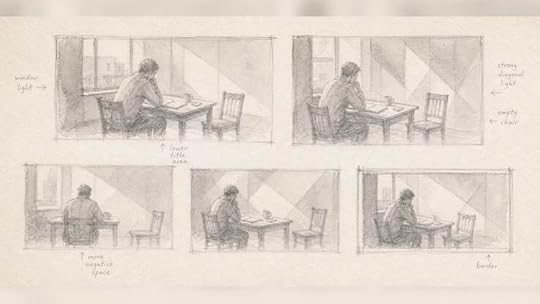
Early compositional studies for “The Room Before the Ripple,” testing how figure, table, empty chair, window-light, and negative space could hold the review’s central tension between isolation and possible connection.

The first full underdrawing establishes the room’s quiet geometry – the seated body, the waiting chair, the table plane, and the spare interior architecture before belief enters the image as color.

Cover-palette watercolor tests translate the book’s vivid oranges, teals, violets, creams, greens, and rose tones into softer washes of interior light, shadow, and emotional atmosphere.

A focused study of angled light and faceted color explores how the book-cover palette can become psychological architecture rather than decoration or literal symbolism.

Border tests develop a quiet notebook-like margin – part frame, part record, part ritual – so the finished image feels held by reflection rather than ornament.

The first wash begins to fuse drawing and atmosphere, letting the room, figure, empty chair, and cover-derived color fields breathe into one suspended emotional field.

A restrained object study clarifies the symbolic economy of the final image – notebook, turned-over phone, mug, and empty chair as small signs of attention, choice, and relation without explanatory clutter.

A gathered process sheet brings together thumbnail, underdrawing, posture study, palette, border, and first wash, showing the final image as an accumulation of small choices rather than a single decorative flourish.
All watercolor illustrations by Demetris Papadimitropoulos.
Shawn Achor’s “The Power of Beliefs” is less about wishing harder than about rebuilding the conditions under which hope can survive.
By Demetris Papadimitropoulos | May 3rd, 2026
A solitary figure, an empty chair, and a room crossed by angled color – an image of belief becoming practice in the quiet interval before private thought turns outward toward connection, memory, and shared life in Shawn Achor’s “The Power of Beliefs.”
Belief, in Shawn Achor’s “The Power of Beliefs,” is not a scented candle placed beside the stubborn furniture of reality. It is not positive thinking in a blazer, not manifesting with better citations, not the old self-help command to smile until the universe straightens its tie. Achor is most precise when he treats belief less as wish than as mechanism: something that changes what the mind notices, what the body prepares for, what a person attempts, and what other people help sustain. The book’s boldest phrase is that beliefs “bend reality.” Its wiser claim is smaller, sturdier, and more interesting: beliefs bend the path by which reality is met.
That distinction keeps the book balanced on its narrow ridge. On one side is an insight one can watch happen in a corridor, classroom, kitchen, or staff meeting: hidden convictions shape attention, behavior, memory, stress response, friendship, work, faith, and endurance. On the other is the mud where hope becomes blame, where hardship is quietly returned to the sufferer as a failure to believe well enough. Achor usually keeps one boot on the ground. He does not claim that gratitude excuses harm, prayer guarantees the requested outcome, illness yields to optimism, or an internal sense of control should become self-blame with cleaner stationery. Those cautions are not decorative. They are the difference between hope and scolding.
Achor organizes the book around what he calls “The Great Drift,” his name for the fraying of the places where people rehearse meaning together: community, religion, work, ritual, and face-to-face life. Into that fraying, he places a set of assumptions that wear away agency: behavior does not matter; everyone else is elsewhere having a better life; one is unimportant, depleted, alone, stuck in meaningless work, and cut off from anything larger. His answer is a set of counter-beliefs built around agency, gratitude, worth, contribution, belonging, meaningful work, and transcendence.
This could have become a color-coded cubby system for human pain. Each ache gets its opposite. Each wound gets its laminated affirmation. What saves it from becoming a closed cabinet is that Achor is better than the symmetry he builds. The most convincing pages do not simply announce that belief is powerful. They show how a conviction becomes reachable, or unreachable, in daily choreography: hospital corridors, dining halls, escalators, inboxes, phones, family videos, staff meetings, book clubs, and rooms where no one quite knows whether it is safe to sound hopeful aloud.
The book’s finest miniature is the broken hospital door. During Covid, a motion-sensor door stops opening automatically, and exhausted surgeons, nurses, and administrators spend two days treating it as unusable. People detour through elevators and hallways because everyone accepts the new lesson: behavior no longer works on this door. Then a lost patient pushes it open. The sensor was broken; the door was not. It is a small story, almost a joke, and also a perfect demonstration of the book’s argument. Once people believe their actions cannot matter, they stop trying even the obvious handle.
Achor’s best examples work this way. The hospital door explains apathy without embalming it in theory. A dangerous family hike on Franconia Ridge, ending with Achor, his wife Michelle, and their eight-year-old son Leo huddled overnight in a freezing emergency hut, becomes a chapter on anchor points and the startling speed with which beliefs can change. The “Memory DeLorean” turns family photos and videos into a practice of rewatching the evidence the brain forgets. The “Disaster Elevator” asks an anxious person to write feared outcomes from worst to least-worst, not because the list fixes the crisis, but because the act of weighing possibilities recruits the part of the brain that can think instead of merely sound the alarm. These names are glossy. One can hear the slide click in the next room. But several of them earn their polish because the metaphor leaves the reader with something to try.
The prose has the rhythm of a speaker who knows when the room is about to drift: story, joke, study, pivot, takeaway, callback. Achor’s sentences are mostly clean, medium-length, and built for recall. His diction is plain without being slack, energetic without panting. When he reaches for imagery, he tends to choose figures that explain mechanisms: hills that look steeper when one feels alone, fireflies that succeed by lighting together, waves moving through stadiums, anchors deepened by repetition, shared texts synchronizing groups. The language is built for memory, and occasionally built so well that one can see the bolts.
Its readiness to be underlined is the prose’s main cost. Achor likes memorable refrains: beliefs change the math; beliefs change the path; same world, different beliefs, different outcome. The repetition helps the book lodge in the mind. It also gives certain passages the shine of a conference-room screen. The prose is rarely dull, but it sometimes arrives having already met the audience, shaken hands, checked the microphone, and located the nearest branded water bottle.
Then Achor does what saves him from too much polish: he lets himself look foolish. He misunderstands a Seahawks roster situation and accidentally comforts players who have not, in fact, been cut. He nearly sets his childhood bedroom on fire trying to make electricity visible because “Ghostbusters” had given him ideas, a reminder that cinema plus wires is not always education. He accidentally sends a shirtless photograph of himself to a men’s Bible study group, then panics and blames his toddler daughter, a maneuver unlikely to be endorsed by any major faith tradition. This self-deprecation lets the book breathe. Achor is earnest, but not airless. He is not presenting himself as a completed specimen of optimism. He is anxious, jealous, embarrassed, spiritually searching, sometimes frightened, and occasionally ridiculous. The voice earns trust because it lets the author be caught in the act of being human.
The design favors steadiness over surprise, which is both its method and its wager. Part I makes the case for belief as a measurable force, moving through placebo and nocebo effects, home-field advantage, AI, money beliefs, stereotype threat, probability, possibility, cognitive dissonance, anchor points, and post-traumatic growth. Part II develops the seven core beliefs. Part III offers six strategies for strengthening them, from the Disaster Elevator and Memory DeLorean to shared texts and neural tribes. The book moves from problem to names to exercises, which is exactly the journey it wants the reader to make. It is not formally adventurous, but it is intelligently built for use. The architecture does not astonish; it steadies the hand.
Its most durable move is to carry belief out of the weather system of private mood and into the scaffolding of daily life: dinners, meetings, texts, praise, rituals, repeated phrases, shared books, and the people who teach us what is normal to hope for. A lesser book would have remained inside the individual brain: your mindset, your choices, your success, your morning routine, your attractively lit mug of resolve. Achor keeps widening the frame. Beliefs are shaped by fans in stadiums, friends in classrooms, spouses who put down their phones, nurses who begin meetings with gratitude, families who watch old videos together, employees who send praise, readers gathered around a common text, congregations and spiritual circles that make transcendence socially palpable, and neighbors who risk the tiny civic flamboyance of waving first. We do not simply hold beliefs. We inherit them, rehearse them, forget them, revive them, transmit them, and catch them from other people.
That is why the chapters that linger are less about achievement than relation. “I matter” is not treated as a mirror affirmation but as something built through importance, attention, dependence, and appreciation. A stranger on an escalator tells Achor that one of his books saved his life at the exact moment Achor is privately convinced he matters less than his more visible peers. The timing is almost too neat, but life occasionally allows itself a heavy-handed editor. The scene works because mattering arrives not as self-esteem but as message: someone else has to carry it across the room.
“I have something to give” is more careful than the usual abundance sermon. Achor does not insist that everyone has enough. Some people plainly do not. His better point is that even when a person lacks enough money, time, energy, certainty, or institutional power, they may still have something: a word, a gesture, an hour, a skill, a kindness, a witness, a hand on the shoulder, a text that says I remembered. That distinction keeps the chapter from insulting the very people it wants to encourage. It also keeps the book’s optimism from turning acquisitive. The goal is not to convince the reader that scarcity is imaginary. It is to ask whether scarcity has been allowed to describe more of the self than it should.
“I am not alone” may be the richest of the seven beliefs because it links connection not to sentimentality but to perception and physiology. Hills look less steep with support. Stress softens when another hand is present. Teams perform differently when members believe they belong to one another. Achor’s fireflies, lighting together in the dark, could have been too sweet by half. Instead, the image clarifies one of the book’s central claims: some forms of flourishing are not merely improved by company; they are structurally impossible without it.
The chapter on “There is something greater than me” is one of the book’s more interesting risks. Achor knows some readers will welcome it as the obvious center of the matter, while others will feel a science-facing book has wandered into church with its shoes still wet. He tries to define the belief broadly enough to include God, faith traditions, nature, fate, karma, energy, or any coherent meaning structure larger than the self. The result will not satisfy everyone. But the chapter matters because it makes explicit what is often implicit in the rest of the book: belief is not only cognitive. It is devotional, communal, ritualized, and often inherited. Achor is at his best here when he refuses the transactional version of prayer. He writes about miscarriages, fear, and not receiving the outcome he wanted. Prayer, in his telling, does not bend the world into obedience. It helps the person praying remain connected, accompanied, and morally oriented when control has run out.
The book is most credible when its optimism lowers the lights and lets qualification do its work. Achor distinguishes possibility from certainty, and that distinction saves the argument from a great deal of foolishness. A child who believes he will definitely play in the NBA may be living inside an unqualified fantasy; a child who believes there is a possibility, and that his behavior can alter the odds, may be living inside a useful path made of practice, discipline, friends, and continued effort. A cancer patient’s belief does not guarantee remission, but it may alter treatment adherence, courage, connection, and the quality of the time ahead. Prayer does not guarantee the answer one wants. Gratitude does not make danger acceptable. Internal control does not mean every bad outcome is secretly one’s fault. Here the book is not hedging. It is becoming responsible.
The seams show when the catchiest phrase is asked to carry more than a phrase can responsibly hold. “Beliefs bend reality” is terrific and dangerous. Much of the time, Achor means something precise: beliefs shape perception, action, memory, stress response, motivation, and social reinforcement. But the phrase can sound larger than that, and the support beneath it is not all of one kind. The notes draw on peer-reviewed psychology, medical studies, workplace research, author-linked interventions, business reporting, popular books, institutional surveys, and Achor’s own earlier work. Many of these sources are useful; they are not interchangeable. A study, a corporate case, a workplace statistic, a personal anecdote, and a prior consulting intervention can all illuminate a pattern. They do not prove the same thing in the same way.
“The Great Drift” carries the same overfilled suitcase. It is a strong lantern for the book’s concerns: loneliness, religious disaffiliation, remote work, social media comparison, workplace disengagement, civic thinning, anxiety, depression, burnout, and the loss of shared rituals. But a lantern is not a map. These problems are related, not identical. The frame helps the reader see connections; it also makes jagged terrain look more navigable than it is. Reality does not always arrange itself into seven negative beliefs waiting politely for seven positive replacements.
Still, the book keeps its shoes on by returning, again and again, to something a reader might actually do. The conclusion wisely refuses to make the chandeliers tremble. Achor does not ask the reader to transform everything. He hopes for one lived change: a family watches videos on Wednesday nights; a team begins meetings with gratitude; someone stops repeating “I’m so busy”; someone joins a book club or Bible study; someone rereads the book because ideas recede unless returned to. This modesty is not a retreat from the argument. It is the argument in its most usable form. Belief survives by maintenance.
Among its neighbors, “The Power of Beliefs” shares territory with Carol S. Dweck’s “Mindset,” Kelly McGonigal’s “The Upside of Stress,” Vivek H. Murthy’s “Together,” and James Clear’s “Atomic Habits,” but Achor’s emphasis is his own: he is asking how a life becomes believable to the person living it. That is a subtler question than how to become happier, richer, more productive, or more successful. It is also more haunting. A life becomes unbelievable not only through catastrophe, but through attrition: one ignored message, one missed dinner, one sour phrase repeated too often, one memory left unrehearsed, one room where nobody looks up.
That question gives the book its quiet force. Beneath the studies, strategies, percentages, and cheerful names, this is a book about the moment people begin to disappear from their own lives. They stop pushing the door. They stop eating with classmates. They stop asking for help. They stop noticing the good that is already present. They stop believing their work matters. They stop offering what they have because it is not enough. They stop feeling accompanied. Achor’s answer is imperfect and sometimes too neatly packaged, but it is not shallow. He understands that despair is often procedural before it is dramatic. It enters through repeated language, neglected memory, missing rituals, bad sources, absent praise, and rooms where no one looks up.
My final rating: 84/100, corresponding to 4/5 stars on a whole-star Goodreads scale. The score fits the experience: sturdy virtues, visible seams.
“The Power of Beliefs” is not a flawless book about belief. It is a generous book about rebuilding the conditions under which belief can survive. Its best image may be neither the brain scan nor the corporate workshop nor even the mountain. It may be that ordinary door in the hospital corridor, declared broken by exhausted people until someone finally pushes it open. Achor’s book is most convincing when it does not promise that every door will open. It asks something humbler and harder to refuse: before walking the long way around, try the handle.
Early compositional studies for “The Room Before the Ripple,” testing how figure, table, empty chair, window-light, and negative space could hold the review’s central tension between isolation and possible connection.
The first full underdrawing establishes the room’s quiet geometry – the seated body, the waiting chair, the table plane, and the spare interior architecture before belief enters the image as color.
Cover-palette watercolor tests translate the book’s vivid oranges, teals, violets, creams, greens, and rose tones into softer washes of interior light, shadow, and emotional atmosphere.
A focused study of angled light and faceted color explores how the book-cover palette can become psychological architecture rather than decoration or literal symbolism.
Border tests develop a quiet notebook-like margin – part frame, part record, part ritual – so the finished image feels held by reflection rather than ornament.
The first wash begins to fuse drawing and atmosphere, letting the room, figure, empty chair, and cover-derived color fields breathe into one suspended emotional field.
A restrained object study clarifies the symbolic economy of the final image – notebook, turned-over phone, mug, and empty chair as small signs of attention, choice, and relation without explanatory clutter.
A gathered process sheet brings together thumbnail, underdrawing, posture study, palette, border, and first wash, showing the final image as an accumulation of small choices rather than a single decorative flourish.
All watercolor illustrations by Demetris Papadimitropoulos.

Review of advance copy received from Publisher
I first met Shawn Achor in Abu Dhabi years ago when we were both invited to speak to the Royal Family of the United Arab Emirates. I got there a few days early as requested—doing dress rehearsals, long dinners with the organizing team, meeting various extended family members—but Shawn was the rock star. He flew in, crushed it onstage, dropped research studies like he’d memorized all of Google Scholar, and then immediately flew out. I was like: Who was that masked man!? We became friends over the years and he was kind enough to blurb ‘The Happiness Equation: Want Nothing + Do Anything = Have Everything’ after selling a million copies of his wonderful book ‘The Happiness Advantage: The Seven Principles of Positive Psychology That Fuel Success and Performance at Work’. And then: Where did he go? Why did Shawn sort of just ... disappear? I got my answer on Page 79 of this book. Shawn shares that after his second child Zöe was born three months early—spending 50 days in the NICU!—he “made a decision to take my foot off the gas at work so I could be home with my young kids. For the next six years, I said no to all media, stopped doing international talks, and didn’t write another book until this one.” Six years!? Completely unplugging! Wow, I thought I was doing a decent job when I deleted the Instagram app off my phone. But this guy just … stopped posting completely. Superdad! But, you know, Shawn’s also still Shawn. Still an amiable son of an English teacher and neuroscience professor, with multiple Harvard degrees, and a witty research-centric form of writing that is precise and uniquely warm. That’s what makes his new book such a jaw-dropping wow. I know I will be handing out copies of this book for years because the research it presents is solid, the advice simple, and the power to alter a life astonishing.
The whole thing begins with a bizarre observation Shawn made while being presented with different drug options for Zoe while she was in the incubator. He was reviewing a 2002 study where 180 patients who had suffered with severe knee osteoarthritis for years were offered a free knee surgery … but, unfortunately, only two thirds were actually going to get it. One third was going to receive a “sham surgery” where an incision would be made on their knee under anesthesia, leaving a similar scar, so the patients would have no way of knowing if they really got the surgery. (Crazy study! Who approved this!) Annnnnnnd: What happened six months later? Patients who received the “sham surgery” showed the same improvement in pain, inflammation, and mobility. The same! Even though they got nothing! What about a year later? Two years later? Same thing! Whaaaaat? Shawn tells us this is doubly fascinating because “osteoarthritis is a progressive condition that naturally gets worse over time, not better.” Then Shawn falls further down the rabbit hole and finds that the power of beliefs (see what I did there) is not only so strong … but it’s actually growing! He then tells us about a study showing that the placebo effect has actually doubled in twenty years. Doubled! Seriously. And that’s just the introduction. We’re going on a ride here. And the amount of research studies you are going to learn about is like… hundreds. Endless. It could be overwhelming if not for the tiny, sweet, digestible dosage he dispenses them with. Shawn is the gumball machine of research studies. And he tells us early that, “Beliefs are real, even when they are not true” so then … wouldn’t it make sense to know which ones can help us most and make sure we’re doing everything to grow those? It would! It does! And this book shows us how. The Seven Core Beliefs from Page 17 are:
My behavior matters, I am grateful, I matter, I have something to give, I am not alone, This work is meaningful, There is something greater than me. But did you know research shows “strengthening these core beliefs can help double the rate of promotion, potentially extend life more than 7.5 years, increase the likelihood of surviving cancer, and improve test scores by almost 25 percent.” This book isn’t just a listicle and piles of facts, though. Each belief is explained and supported through research, generous personal stories, and teaching which makes it a kind of textbook, too. Shawn is a natural professor. On Page 37, he tells us that “If, as a parent of a child starting a new school, you tell your kid ‘You’re going to love it here!’ you’ve just provided a meager meal for the brain. Much better would be: ‘You’re going to love it here because you started at a new school three years ago and ended up loving it [warrant]. And you are great at making friends like you did on your soccer team [specific warrant]. So, if you work hard and are kind [qualifiers], I believe you’re going to love it here, too.” Helpful, right? Doesn’t mean it’s easy! Shawn gets vulnerable and expresses a lot of ways in which he’s failed and how he’s learning to grow. Then, the last third of the book gives specific ways on how we can grow these beliefs. There are things he calls “The Disaster Elevator” or “The Memory DeLorean” where he gets into detail on how his family shares a ‘favorite family picture’ for Wednesday night viewing ceremonies. I took three pages of notes. So many highlights, so many dog ears. I think the six years Shawn took “off” were clearly more productive than most people’s six years on. Out of the cave, he's blinking into the light and giving us a book so desperately needed today. For you, for your spouse, for your kids, for your CEO, for your team, this is a book everyone will gain tremendous value in reading.
The whole thing begins with a bizarre observation Shawn made while being presented with different drug options for Zoe while she was in the incubator. He was reviewing a 2002 study where 180 patients who had suffered with severe knee osteoarthritis for years were offered a free knee surgery … but, unfortunately, only two thirds were actually going to get it. One third was going to receive a “sham surgery” where an incision would be made on their knee under anesthesia, leaving a similar scar, so the patients would have no way of knowing if they really got the surgery. (Crazy study! Who approved this!) Annnnnnnd: What happened six months later? Patients who received the “sham surgery” showed the same improvement in pain, inflammation, and mobility. The same! Even though they got nothing! What about a year later? Two years later? Same thing! Whaaaaat? Shawn tells us this is doubly fascinating because “osteoarthritis is a progressive condition that naturally gets worse over time, not better.” Then Shawn falls further down the rabbit hole and finds that the power of beliefs (see what I did there) is not only so strong … but it’s actually growing! He then tells us about a study showing that the placebo effect has actually doubled in twenty years. Doubled! Seriously. And that’s just the introduction. We’re going on a ride here. And the amount of research studies you are going to learn about is like… hundreds. Endless. It could be overwhelming if not for the tiny, sweet, digestible dosage he dispenses them with. Shawn is the gumball machine of research studies. And he tells us early that, “Beliefs are real, even when they are not true” so then … wouldn’t it make sense to know which ones can help us most and make sure we’re doing everything to grow those? It would! It does! And this book shows us how. The Seven Core Beliefs from Page 17 are:
My behavior matters, I am grateful, I matter, I have something to give, I am not alone, This work is meaningful, There is something greater than me. But did you know research shows “strengthening these core beliefs can help double the rate of promotion, potentially extend life more than 7.5 years, increase the likelihood of surviving cancer, and improve test scores by almost 25 percent.” This book isn’t just a listicle and piles of facts, though. Each belief is explained and supported through research, generous personal stories, and teaching which makes it a kind of textbook, too. Shawn is a natural professor. On Page 37, he tells us that “If, as a parent of a child starting a new school, you tell your kid ‘You’re going to love it here!’ you’ve just provided a meager meal for the brain. Much better would be: ‘You’re going to love it here because you started at a new school three years ago and ended up loving it [warrant]. And you are great at making friends like you did on your soccer team [specific warrant]. So, if you work hard and are kind [qualifiers], I believe you’re going to love it here, too.” Helpful, right? Doesn’t mean it’s easy! Shawn gets vulnerable and expresses a lot of ways in which he’s failed and how he’s learning to grow. Then, the last third of the book gives specific ways on how we can grow these beliefs. There are things he calls “The Disaster Elevator” or “The Memory DeLorean” where he gets into detail on how his family shares a ‘favorite family picture’ for Wednesday night viewing ceremonies. I took three pages of notes. So many highlights, so many dog ears. I think the six years Shawn took “off” were clearly more productive than most people’s six years on. Out of the cave, he's blinking into the light and giving us a book so desperately needed today. For you, for your spouse, for your kids, for your CEO, for your team, this is a book everyone will gain tremendous value in reading.

August 1, 2026
Shawn Achor’s book, The Power of Beliefs, published in 2026, takes the reader on a profound journey into the human mind, arguing that our beliefs do much more than simply reflect the reality we live in—they actually have the power to bend it. Drawing on two decades of research in over fifty countries, as well as his extensive work with NASA, the NFL, and Fortune 100 companies, Achor expands upon his earlier work in positive psychology. He proposes that the lens through which we view the world, forged by our conscious and unconscious beliefs, is the single greatest predictor of our future. When we change the mathematical probabilities of what we believe is possible, we fundamentally alter the path we take. Achor explains that human belief is not a soft or secondary skill; instead, it is an ascendant force that dictates our health, happiness, relationships, and success.
The book is uniquely timely, written as a response to a modern phenomenon that Achor identifies as the "Great Drift." In today’s highly connected yet deeply isolated world, society is experiencing a staggering rise in what he calls the Four Horsemen of the Modern World: burnout, anxiety, loneliness, and depression. During this Great Drift, many people have slowly lost their sense of agency, leading to a pervasive feeling of apathy—which Achor describes as the true opposite of happiness. Apathy is the tragic loss of the belief that change is possible and that our behavior still matters. Because of this drift, we are collectively underperforming our true potential. However, Achor offers a deeply hopeful counter-narrative, presenting scientific evidence that our beliefs are more predictive and more healing today than they were even twenty years ago. We possess an incredible, innate ability to pull ourselves out of this drift by consciously reshaping our internal narratives.
To guide this transformation, Achor introduces seven Core Power Beliefs that act as the foundation for a thriving life. Rather than vague platitudes, these are scientifically backed mindsets that dictate positive outcomes across all aspects of human existence. The first and most critical belief is the conviction that our behavior matters, which restores our sense of agency. This is closely followed by the belief that we inherently matter as individuals, and the vital understanding that we are not alone in our struggles. The remaining core beliefs include the realization that our work and efforts are meaningful, the ability to recognize things to be grateful for in the present moment, the empowering feeling that we always have something of value to give to others, and finally, the comforting certainty that there is something in the universe greater than ourselves. Achor argues that these seven specific beliefs are currently under threat in the modern world, and the extent to which we can consciously embrace and defend them is the strongest indicator of how successful and fulfilling our lives will be.
Understanding these core beliefs is only half the battle; the real magic lies in learning how to adopt them. To address this, the final portion of the book serves as a practical manual for rewiring our minds, outlining six distinct strategies to shift destructive narratives into empowering ones. Achor introduces fascinating psychological tools, such as the Disaster Elevator, which helps shift the part of the brain processing information by visualizing different tiers of worst-case scenarios to find a viable, productive path forward. He also discusses the Memory DeLorean, a technique used to re-encode and alter the core memories upon which limiting beliefs are built. The other strategies involve stopping negative mantras by actively changing our internal language, creating a "Neural Tribe" by consciously choosing the sources of information and the people we surround ourselves with, starting a wave of contagious positive actions, and finally, utilizing common texts and shared narratives to build collective resilience. Together, these tools prove that we are not permanently stuck with our current worldview.
Ultimately, The Power of Beliefs is both an optimistic roadmap and a rigorous scientific exploration of human potential. It teaches us that happiness is the joy we feel while moving toward our potential, and that this joy actually fuels success rather than resulting from it. Since you love the convenience of carrying a large personal library on your devices and prefer digital formats for quick searchability, this is definitely a title you might enjoy downloading as an ebook or sampling first on Google Books. Reading it on your Kindle would allow you to easily highlight his practical frameworks and quickly locate specific cognitive exercises—like the Memory DeLorean—whenever you need a quick mental reset. Achor’s writing serves as a powerful reminder that by intentionally crafting the stories we tell ourselves, we can take the cap off our potential, heal our minds, and create a profoundly better life for ourselves and the communities around us.
The book is uniquely timely, written as a response to a modern phenomenon that Achor identifies as the "Great Drift." In today’s highly connected yet deeply isolated world, society is experiencing a staggering rise in what he calls the Four Horsemen of the Modern World: burnout, anxiety, loneliness, and depression. During this Great Drift, many people have slowly lost their sense of agency, leading to a pervasive feeling of apathy—which Achor describes as the true opposite of happiness. Apathy is the tragic loss of the belief that change is possible and that our behavior still matters. Because of this drift, we are collectively underperforming our true potential. However, Achor offers a deeply hopeful counter-narrative, presenting scientific evidence that our beliefs are more predictive and more healing today than they were even twenty years ago. We possess an incredible, innate ability to pull ourselves out of this drift by consciously reshaping our internal narratives.
To guide this transformation, Achor introduces seven Core Power Beliefs that act as the foundation for a thriving life. Rather than vague platitudes, these are scientifically backed mindsets that dictate positive outcomes across all aspects of human existence. The first and most critical belief is the conviction that our behavior matters, which restores our sense of agency. This is closely followed by the belief that we inherently matter as individuals, and the vital understanding that we are not alone in our struggles. The remaining core beliefs include the realization that our work and efforts are meaningful, the ability to recognize things to be grateful for in the present moment, the empowering feeling that we always have something of value to give to others, and finally, the comforting certainty that there is something in the universe greater than ourselves. Achor argues that these seven specific beliefs are currently under threat in the modern world, and the extent to which we can consciously embrace and defend them is the strongest indicator of how successful and fulfilling our lives will be.
Understanding these core beliefs is only half the battle; the real magic lies in learning how to adopt them. To address this, the final portion of the book serves as a practical manual for rewiring our minds, outlining six distinct strategies to shift destructive narratives into empowering ones. Achor introduces fascinating psychological tools, such as the Disaster Elevator, which helps shift the part of the brain processing information by visualizing different tiers of worst-case scenarios to find a viable, productive path forward. He also discusses the Memory DeLorean, a technique used to re-encode and alter the core memories upon which limiting beliefs are built. The other strategies involve stopping negative mantras by actively changing our internal language, creating a "Neural Tribe" by consciously choosing the sources of information and the people we surround ourselves with, starting a wave of contagious positive actions, and finally, utilizing common texts and shared narratives to build collective resilience. Together, these tools prove that we are not permanently stuck with our current worldview.
Ultimately, The Power of Beliefs is both an optimistic roadmap and a rigorous scientific exploration of human potential. It teaches us that happiness is the joy we feel while moving toward our potential, and that this joy actually fuels success rather than resulting from it. Since you love the convenience of carrying a large personal library on your devices and prefer digital formats for quick searchability, this is definitely a title you might enjoy downloading as an ebook or sampling first on Google Books. Reading it on your Kindle would allow you to easily highlight his practical frameworks and quickly locate specific cognitive exercises—like the Memory DeLorean—whenever you need a quick mental reset. Achor’s writing serves as a powerful reminder that by intentionally crafting the stories we tell ourselves, we can take the cap off our potential, heal our minds, and create a profoundly better life for ourselves and the communities around us.

Review of advance copy received from NetGalley
I have enjoyed Shawn Achor's work for many years, ever since I first watched his TED Talk (my favorite talk!). Therefore, I was really excited to see this on NetGalley and be given an opportunity to read his latest work. While his premises are based on scientific studies, Shawn's writing is very accessible and filled with humor. This book is needed now to fight against the "Four Horsemen of the Modern World" aka burnout, anxiety, loneliness, and depression. The book is broken into 3 parts.
Part one explains how powerful our beliefs are... even if they aren't true. He says, "Beliefs don't just shape our perceptions; they scientifically change the probabilities of our actions." A person can change their health, wealth, and future based on what they hold to be true. Do you believe you're stupid and can't get a job? That will likely become true because you won't put in the effort to learn skills that could get you a good job. Alternatively, if you believe you can learn and grow and that you have the potential to be great, you have a much better chance of having a fulfilling life. He shares the science behind placebos and "nocebos" - a false negative belief (a term I learned from the book). Later in the book, he also defines a "vericebo" where you use true information to change the belief.
Once you understand the importance of your beliefs, part two goes into depth on each of the 7 core power beliefs:
- My behavior matters - this is super empowering because you have the power to change outcomes
- I am grateful- studies have shown how gratitude can improve health outcomes and increase happiness
- I matter- especially to someone who depends on you. To show someone else they matter, give them your attention, which leads to
- I have something to give - it doesn't have to be money or material goods
- I am not alone - when this is a strong belief, "we see more possibilities, rebound faster from setbacks, and take smarter, bolder actions."
- This work is meaningful - by understanding the purpose in your work, you are more likely to find stress to be invigorating instead of debilitating
- There is something greater than me - studies have shown that if you hold a spiritual belief, it will significantly improve the quality of your life
Finally, in part three, he provides 6 practical methods for combating the Four Horsemen and strengthening the 7 core power beliefs. Have you ever felt yourself spiraling out of control as your thoughts drag you into the pits of despair and the eventual destruction of all you hold dear? Try using the Disaster Elevator to help you stop spiraling. Want to train your brain to be happier? Schedule a time to look at photos of times that you enjoyed and share those with others. Do you talk to yourself in ways you would never talk to a friend? (I'm such an idiot! No one likes me. I can't do anything right?) Those are 3 of the top 12 negative mantras that people tell themselves, which your brain will believe even if they are not true. You can improve life for everyone around you by starting a wave of positivity, as beliefs are contagious. (Sadly, this is true for negative beliefs as well.) One way to do this would be to have a common text that is meaningful to you and a group of peers. The final strategy is to find a "positive neural tribe," which includes eliminating the negative people from your life as you are able. He rightly points out that the people you've never met but who spin you up on social media are the easiest to cut out.
I found this book to be easy to understand, funny, and highly applicable. I plan on sharing it with friends and a group I'm in with others who need to hear that they matter and what they do matters. I'm hoping to even do a book club.
If you are struggling with depression, loneliness, anxiety, or burnout, or simply want to be happier, I highly recommend this book!
I want to thank the author, Shawn Achor, the publisher, Crown Publishing, and NetGalley for providing me with early access to this book.
Part one explains how powerful our beliefs are... even if they aren't true. He says, "Beliefs don't just shape our perceptions; they scientifically change the probabilities of our actions." A person can change their health, wealth, and future based on what they hold to be true. Do you believe you're stupid and can't get a job? That will likely become true because you won't put in the effort to learn skills that could get you a good job. Alternatively, if you believe you can learn and grow and that you have the potential to be great, you have a much better chance of having a fulfilling life. He shares the science behind placebos and "nocebos" - a false negative belief (a term I learned from the book). Later in the book, he also defines a "vericebo" where you use true information to change the belief.
Once you understand the importance of your beliefs, part two goes into depth on each of the 7 core power beliefs:
- My behavior matters - this is super empowering because you have the power to change outcomes
- I am grateful- studies have shown how gratitude can improve health outcomes and increase happiness
- I matter- especially to someone who depends on you. To show someone else they matter, give them your attention, which leads to
- I have something to give - it doesn't have to be money or material goods
- I am not alone - when this is a strong belief, "we see more possibilities, rebound faster from setbacks, and take smarter, bolder actions."
- This work is meaningful - by understanding the purpose in your work, you are more likely to find stress to be invigorating instead of debilitating
- There is something greater than me - studies have shown that if you hold a spiritual belief, it will significantly improve the quality of your life
Finally, in part three, he provides 6 practical methods for combating the Four Horsemen and strengthening the 7 core power beliefs. Have you ever felt yourself spiraling out of control as your thoughts drag you into the pits of despair and the eventual destruction of all you hold dear? Try using the Disaster Elevator to help you stop spiraling. Want to train your brain to be happier? Schedule a time to look at photos of times that you enjoyed and share those with others. Do you talk to yourself in ways you would never talk to a friend? (I'm such an idiot! No one likes me. I can't do anything right?) Those are 3 of the top 12 negative mantras that people tell themselves, which your brain will believe even if they are not true. You can improve life for everyone around you by starting a wave of positivity, as beliefs are contagious. (Sadly, this is true for negative beliefs as well.) One way to do this would be to have a common text that is meaningful to you and a group of peers. The final strategy is to find a "positive neural tribe," which includes eliminating the negative people from your life as you are able. He rightly points out that the people you've never met but who spin you up on social media are the easiest to cut out.
I found this book to be easy to understand, funny, and highly applicable. I plan on sharing it with friends and a group I'm in with others who need to hear that they matter and what they do matters. I'm hoping to even do a book club.
If you are struggling with depression, loneliness, anxiety, or burnout, or simply want to be happier, I highly recommend this book!
I want to thank the author, Shawn Achor, the publisher, Crown Publishing, and NetGalley for providing me with early access to this book.

June 14, 2026
Another self help book about the power of positive thinking, surrounding yourself with positive people, positive self talk/affirmations, etc. It’s interesting how seemingly every self help book I read comes back to these same ideas. I will summarize the key points here to help me remember the lessons of this particular book:
The Power of Beliefs by Shawn Achor explores how our core beliefs function as powerful “predictive engines” that don’t just reflect reality — they actively shape it. Building on positive psychology research, the book shows that strengthening key beliefs can dramatically improve performance, resilience, relationships, health, and overall success.
Main Thesis
Beliefs influence what we notice, how we interpret events, the actions we take, and even our physiological responses. In today’s challenging environment (marked by burnout, anxiety, loneliness, and disconnection), empowering beliefs act as a lever to “take the cap off” our potential. They bend probabilities in our favor and help us achieve better outcomes. Importantly, beliefs are not fixed — they can be intentionally changed through practical, research-tested methods.
The Seven Core Beliefs
These beliefs are the most predictive of positive life and work outcomes. Strengthening them creates a foundation for greater motivation, connection, and fulfillment:
1. My Behavior Matters — The belief that your actions influence results, which builds ownership, effort, and agency instead of a victim mindset.
2. I Matter — A deep sense of inherent self-worth, independent of achievements or external validation.
3. I Am Not Alone — Feeling connected to others and supported, which combats loneliness and builds psychological safety.
4. This Work Is Meaningful — Seeing purpose in your daily efforts, which sustains long-term motivation and resilience.
5. I Have Things To Be Grateful For — Appreciating the present moment, which shifts focus from scarcity and FOMO to abundance and well-being.
6. I Have Something to Give — Believing you can contribute value to others, enhancing fulfillment and impact.
7. There Is Something Greater Than Me — A sense of connection to a larger purpose, community, or higher power that provides perspective and endurance.
Key Lessons
• Beliefs are far more powerful than most people realize. They rewire how the brain processes information, memories, language, and social cues.
• Small mindset shifts can lead to significant improvements in real-world metrics like performance, recovery from setbacks, engagement, and happiness.
• You have more control than you think. Limiting beliefs can be replaced with empowering ones, expanding what becomes possible in your life.
• These principles apply broadly — to individuals, leaders, teams, schools, and organizations across diverse fields (from business to education and high-pressure environments like NASA or the NFL).
Practical Strategies
Achor provides actionable tools for changing beliefs, including:
• Reframing negative experiences and memories.
• Changing self-talk and stopping harmful mental mantras.
• Surrounding yourself with positive influences and “neural tribes.”
• Using positive contagion (starting waves of uplifting actions).
• Leveraging shared stories and texts for collective belief change.
Overall, the book delivers a hopeful, science-backed message: by cultivating these seven beliefs, you can create better results, stronger relationships, and a more meaningful life even amid uncertainty and adversity. It combines research with practical applications for lasting personal and professional growth.
A couple practical applications that I am going to try:
- I am going to try to curate my Twitter feed to be more positive and/or make conscious effort to doom scroll less
- I am going to limit time with the negative people in my life and seek more time with positive people
- I am going to make conscious effort to complain less and instead practice more gratitude
- I am going to read this author’s other books starting with “The Happiness Advantage: How a Positive Brain Fuels Success in Work and Life”
The Power of Beliefs by Shawn Achor explores how our core beliefs function as powerful “predictive engines” that don’t just reflect reality — they actively shape it. Building on positive psychology research, the book shows that strengthening key beliefs can dramatically improve performance, resilience, relationships, health, and overall success.
Main Thesis
Beliefs influence what we notice, how we interpret events, the actions we take, and even our physiological responses. In today’s challenging environment (marked by burnout, anxiety, loneliness, and disconnection), empowering beliefs act as a lever to “take the cap off” our potential. They bend probabilities in our favor and help us achieve better outcomes. Importantly, beliefs are not fixed — they can be intentionally changed through practical, research-tested methods.
The Seven Core Beliefs
These beliefs are the most predictive of positive life and work outcomes. Strengthening them creates a foundation for greater motivation, connection, and fulfillment:
1. My Behavior Matters — The belief that your actions influence results, which builds ownership, effort, and agency instead of a victim mindset.
2. I Matter — A deep sense of inherent self-worth, independent of achievements or external validation.
3. I Am Not Alone — Feeling connected to others and supported, which combats loneliness and builds psychological safety.
4. This Work Is Meaningful — Seeing purpose in your daily efforts, which sustains long-term motivation and resilience.
5. I Have Things To Be Grateful For — Appreciating the present moment, which shifts focus from scarcity and FOMO to abundance and well-being.
6. I Have Something to Give — Believing you can contribute value to others, enhancing fulfillment and impact.
7. There Is Something Greater Than Me — A sense of connection to a larger purpose, community, or higher power that provides perspective and endurance.
Key Lessons
• Beliefs are far more powerful than most people realize. They rewire how the brain processes information, memories, language, and social cues.
• Small mindset shifts can lead to significant improvements in real-world metrics like performance, recovery from setbacks, engagement, and happiness.
• You have more control than you think. Limiting beliefs can be replaced with empowering ones, expanding what becomes possible in your life.
• These principles apply broadly — to individuals, leaders, teams, schools, and organizations across diverse fields (from business to education and high-pressure environments like NASA or the NFL).
Practical Strategies
Achor provides actionable tools for changing beliefs, including:
• Reframing negative experiences and memories.
• Changing self-talk and stopping harmful mental mantras.
• Surrounding yourself with positive influences and “neural tribes.”
• Using positive contagion (starting waves of uplifting actions).
• Leveraging shared stories and texts for collective belief change.
Overall, the book delivers a hopeful, science-backed message: by cultivating these seven beliefs, you can create better results, stronger relationships, and a more meaningful life even amid uncertainty and adversity. It combines research with practical applications for lasting personal and professional growth.
A couple practical applications that I am going to try:
- I am going to try to curate my Twitter feed to be more positive and/or make conscious effort to doom scroll less
- I am going to limit time with the negative people in my life and seek more time with positive people
- I am going to make conscious effort to complain less and instead practice more gratitude
- I am going to read this author’s other books starting with “The Happiness Advantage: How a Positive Brain Fuels Success in Work and Life”
This entire review has been hidden because of spoilers.

May 27, 2026
Drawing on two decades of research and his work with organizations ranging from NASA to the NFL to a third of the Fortune 100, Shawn Achor makes a compelling case that our beliefs don't merely reflect reality — they bend it.
At roughly 180 pages, The Power of Beliefs is a brisk and accessible read, yet it carries real weight for positive change. The book is organized into three parts. The first lays essential groundwork, exploring how beliefs function as predictive engines for our health, success, wealth, and relationships. The second and meatiest section examines what Achor identifies as the seven core beliefs most predictive of a flourishing life:
1. My behavior matters — The foundational belief that your actions shape your outcomes, preventing a victim mentality.
2. I matter — Recognizing your inherent self-worth independent of external achievement or validation.
3. I am not alone — Understanding your deep connection to community, which builds psychological safety and combats loneliness.
4. This work is meaningful — Finding intrinsic purpose in your daily labor, which fuels long-term motivation and resilience.
5. I have things to be grateful for in the present — Choosing a baseline of abundance and appreciation rather than chasing what is missing.
6. I have something to give — Believing you possess valuable gifts, skills, or kindness to contribute, reinforcing agency.
7. There is something greater than me — Connecting to a higher purpose or collective human experience that transcends individual worries.
The third section addresses "the Great Drift" — the alarming rise of what he terms the Four Horsemen of the Modern World: burnout, anxiety, loneliness, and depression. This is where the book turns practical, offering six research-tested strategies for changing beliefs at the individual and communal level:
1. The Disaster Elevator — Change what part of the brain processes the world.
2. The Memory DeLorean — Change the memory.
3. Stopping Negative Mantras — Change the language.
4. Creating a Neural Tribe — Change the sources.
5. Starting the Wave — Change the contagious actions.
6. Common Texts, Common Action — Change the texts.
Throughout, Achor balances rigorous science with vivid storytelling, drawing on his work everywhere from Wall Street to impoverished schools in Africa, from Camp Pendleton to Camp David. That blend of anecdote and research makes for a compelling read that never feels dry or academic.
If I'm being honest, the final section felt slightly less satisfying than the first two — it's where the book's brevity shows most. But even there, the strategies are actionable and worth adopting. I was particularly drawn to The Disaster Elevator and Creating a Neural Tribe, both of which I intend to put into practice in my own life.
In a world where anxiety and disconnection feel increasingly unavoidable, The Power of Beliefs offers something rare: genuine, evidence-based hope — and a clear path forward.
A big thank you to Shawn Achor for providing an advanced reader copy in exchange for an honest review.
At roughly 180 pages, The Power of Beliefs is a brisk and accessible read, yet it carries real weight for positive change. The book is organized into three parts. The first lays essential groundwork, exploring how beliefs function as predictive engines for our health, success, wealth, and relationships. The second and meatiest section examines what Achor identifies as the seven core beliefs most predictive of a flourishing life:
1. My behavior matters — The foundational belief that your actions shape your outcomes, preventing a victim mentality.
2. I matter — Recognizing your inherent self-worth independent of external achievement or validation.
3. I am not alone — Understanding your deep connection to community, which builds psychological safety and combats loneliness.
4. This work is meaningful — Finding intrinsic purpose in your daily labor, which fuels long-term motivation and resilience.
5. I have things to be grateful for in the present — Choosing a baseline of abundance and appreciation rather than chasing what is missing.
6. I have something to give — Believing you possess valuable gifts, skills, or kindness to contribute, reinforcing agency.
7. There is something greater than me — Connecting to a higher purpose or collective human experience that transcends individual worries.
The third section addresses "the Great Drift" — the alarming rise of what he terms the Four Horsemen of the Modern World: burnout, anxiety, loneliness, and depression. This is where the book turns practical, offering six research-tested strategies for changing beliefs at the individual and communal level:
1. The Disaster Elevator — Change what part of the brain processes the world.
2. The Memory DeLorean — Change the memory.
3. Stopping Negative Mantras — Change the language.
4. Creating a Neural Tribe — Change the sources.
5. Starting the Wave — Change the contagious actions.
6. Common Texts, Common Action — Change the texts.
Throughout, Achor balances rigorous science with vivid storytelling, drawing on his work everywhere from Wall Street to impoverished schools in Africa, from Camp Pendleton to Camp David. That blend of anecdote and research makes for a compelling read that never feels dry or academic.
If I'm being honest, the final section felt slightly less satisfying than the first two — it's where the book's brevity shows most. But even there, the strategies are actionable and worth adopting. I was particularly drawn to The Disaster Elevator and Creating a Neural Tribe, both of which I intend to put into practice in my own life.
In a world where anxiety and disconnection feel increasingly unavoidable, The Power of Beliefs offers something rare: genuine, evidence-based hope — and a clear path forward.
A big thank you to Shawn Achor for providing an advanced reader copy in exchange for an honest review.

Review of advance copy received from Goodreads Giveaways
What makes this book especially compelling is how it expands on a simple but powerful idea: same world, different beliefs, different outcomes. Shawn Achor explains how the beliefs we hold about ourselves and the world do not just shape how we see reality, they actively influence what happens next. He explains that beliefs are not just abstract thoughts, but measurable predictors of performance, health, and connection. The concept that beliefs do not just reflect reality, but can bend it is both fascinating and motivating.
A major strength of the book is how it addresses the challenges of the modern world. He describes what he calls the Great Drift, marked by rising burnout, anxiety, loneliness, and depression. Rather than leaving you stuck in those realities, he offers hope through research backed insights. He introduces seven core beliefs that strongly predict outcomes related to health, success, and overall well being, and explains how strengthening these beliefs can unlock greater potential.
This book also stands out for its practical tools with six research based strategies to help reshape beliefs, including techniques like the Disaster Elevator, the Memory DeLorean, and building what he calls a Neural Tribe. These ideas are not just theoretical. They are actionable and tested across a wide range of environments, from corporate settings to schools and communities around the world.
At 178 pages, organized into three parts and 19 chapters, the book is structured in a way that makes it easy to follow and quick to read. This was my first time reading anything by Shawn Achor, and I can clearly see why he is considered one of the leading voices on the link between positive thinking and positive outcomes. This is a book every person needs to read. Finishing it left me eager to explore more of his work and to start applying his ideas in everyday life by adopting a more positive perspective on the world around me.
Thank you Crown Publishing Group and Penguin Random House for my gifted ARC!
(ARC received for free via a Crown Publishing Group giveaway on Goodreads)
A major strength of the book is how it addresses the challenges of the modern world. He describes what he calls the Great Drift, marked by rising burnout, anxiety, loneliness, and depression. Rather than leaving you stuck in those realities, he offers hope through research backed insights. He introduces seven core beliefs that strongly predict outcomes related to health, success, and overall well being, and explains how strengthening these beliefs can unlock greater potential.
This book also stands out for its practical tools with six research based strategies to help reshape beliefs, including techniques like the Disaster Elevator, the Memory DeLorean, and building what he calls a Neural Tribe. These ideas are not just theoretical. They are actionable and tested across a wide range of environments, from corporate settings to schools and communities around the world.
At 178 pages, organized into three parts and 19 chapters, the book is structured in a way that makes it easy to follow and quick to read. This was my first time reading anything by Shawn Achor, and I can clearly see why he is considered one of the leading voices on the link between positive thinking and positive outcomes. This is a book every person needs to read. Finishing it left me eager to explore more of his work and to start applying his ideas in everyday life by adopting a more positive perspective on the world around me.
Thank you Crown Publishing Group and Penguin Random House for my gifted ARC!
(ARC received for free via a Crown Publishing Group giveaway on Goodreads)

May 24, 2026
The Power of Beliefs- Shawn Achor
- Beliefs bend reality. The lens through which people view the world changes what happens next. They affect our outcomes.
- AI can calculate the odds, but it can never believe you will beat them.
- Beliefs are real, even when they aren’t true. And by strengthening the most predictive positive beliefs, we can dramatically improve our happiness and success.
- Positive belief does not guarantee outcome, but it does propel us towards them. Positive lens changes our neurochemistry.
- The Great Drift - beliefs becoming untethered from community, religion, and occupation.
- 7 Core Beliefs:
1/ My behavior matters
2/ I am grateful
3/ I matter
4/ I have something to give
5/ I am not alone
6/ This work is meaningful
7/ There is something greater than me
- Beliefs change our paths because they change the paths we see.
- Beliefs with qualifiers and warrants improve the likelihood of changing the math and thus changing the path.
- Beliefs are adjusted all the time based on new anchors. The anchor must be strong enough. We can drive anchors deep by keep hammering away at them over time.
- Unhappiness can fuel great change.
- You can’t create positive change without believing your behavior matters.
- Unfairness shapes the starting line, but belief that our behavior matters change the finish line.
- Remove the sting of FOMO with gratitude.
- Mattering: importance, attention, dependence, appreciation.
- Loneliness is not the absence of people. It’s the absence of believing you have a meaningful effect on others.
- Why people work: to help others, to help themselves, growth, income
Reframe beliefs
- Disaster Elevator is a tool to disarm rising anxiety… write down the worst that can happen from 10 to 1.
- Where our words go, so go our brains
- Focus all your energy on the new, not fighting the old
- Common text
- Beliefs bend reality. The lens through which people view the world changes what happens next. They affect our outcomes.
- AI can calculate the odds, but it can never believe you will beat them.
- Beliefs are real, even when they aren’t true. And by strengthening the most predictive positive beliefs, we can dramatically improve our happiness and success.
- Positive belief does not guarantee outcome, but it does propel us towards them. Positive lens changes our neurochemistry.
- The Great Drift - beliefs becoming untethered from community, religion, and occupation.
- 7 Core Beliefs:
1/ My behavior matters
2/ I am grateful
3/ I matter
4/ I have something to give
5/ I am not alone
6/ This work is meaningful
7/ There is something greater than me
- Beliefs change our paths because they change the paths we see.
- Beliefs with qualifiers and warrants improve the likelihood of changing the math and thus changing the path.
- Beliefs are adjusted all the time based on new anchors. The anchor must be strong enough. We can drive anchors deep by keep hammering away at them over time.
- Unhappiness can fuel great change.
- You can’t create positive change without believing your behavior matters.
- Unfairness shapes the starting line, but belief that our behavior matters change the finish line.
- Remove the sting of FOMO with gratitude.
- Mattering: importance, attention, dependence, appreciation.
- Loneliness is not the absence of people. It’s the absence of believing you have a meaningful effect on others.
- Why people work: to help others, to help themselves, growth, income
Reframe beliefs
- Disaster Elevator is a tool to disarm rising anxiety… write down the worst that can happen from 10 to 1.
- Where our words go, so go our brains
- Focus all your energy on the new, not fighting the old
- Common text

October 7, 2026
What pulled me to this book was the interesting placebo example highlighted in the first chapter. In a famous research trial, patients with severe knee arthritis were split into groups. Some had actual surgery, while others received a fake placebo operation where the surgeon made a cut that looked like surgery, but did nothing to the joint. The result? 1/3 of the patients who had the fake surgery reported the exact same pain relief and mobility as those who had the real operation.
Some Favourite Key Takeaways:
1) Beliefs do not just reflect the world, it can change our biology, performance, and trajectory.
2) High stress does not automatically produce burnout, meaningless stress does. When employees believe their work is meaningful, productivity rises by over 30% despite elevated hardship.
3) There was a hospital where all the staff took a long detour for days because an automatic door sensor stopped working, they assumed it was broken until someone (a patient) simply pushed it open. When you believe your actions won't work, you stop trying the easiest solutions.
4) Superstitions are placebos. Michael Jordan always wore his college shorts under his NBA uniform. The shorts calmed his nerves and sharpened his focus.
5) Positive expectations can heal, negative thinking drains energy and triggers stress. Cynical assumptions don't protect you, they just blind you to real opportunities in life.
My favourite quote:
"Scientifically speaking, beliefs don't just reflect reality. Beliefs bend reality."
Some Favourite Key Takeaways:
1) Beliefs do not just reflect the world, it can change our biology, performance, and trajectory.
2) High stress does not automatically produce burnout, meaningless stress does. When employees believe their work is meaningful, productivity rises by over 30% despite elevated hardship.
3) There was a hospital where all the staff took a long detour for days because an automatic door sensor stopped working, they assumed it was broken until someone (a patient) simply pushed it open. When you believe your actions won't work, you stop trying the easiest solutions.
4) Superstitions are placebos. Michael Jordan always wore his college shorts under his NBA uniform. The shorts calmed his nerves and sharpened his focus.
5) Positive expectations can heal, negative thinking drains energy and triggers stress. Cynical assumptions don't protect you, they just blind you to real opportunities in life.
My favourite quote:
"Scientifically speaking, beliefs don't just reflect reality. Beliefs bend reality."

July 13, 2026
2nd Read:
I followed his advice subconsciously and read it again within a year. And I did the elevator exercise he recommended.
More Notes:
Positive belief propels us towards outcomes.
Our beliefs have been mostly shaped by community, religion, and occupation but we are becoming untethered from all three.
The seven core power beliefs are: my behavior matters, I am grateful, I matter, I have something to give, I am not alone, this work is meaningful, there is something greater than me.
The lens through which you view the world predicts what happens next.
CS Lewis said there are those that look from miracles and find them and those that don't believe in them and never see one.
If you believe your behavior doesn't matter, you stop taking action.
Unfairness shapes the starting line, belief shapes the finish line.
A religious belief should significantly impact work and life outcomes across multiple domains. Otherwise are you truly converted?
Even if your prayer isn't answered the way you want it or that you feel like you have little control over what you're praying for, praying helps you feel that you are not alone and that you matter and your behavior mattered. Believing that there is something greater than you improves your ability to discern meaning and suffering and cope with stress and grief in adaptive ways.
The Disaster Elevator is a neat concept that I've been subconsciously doing for a few years. ChatGPT it.
Beliefs about what is valued shape what is repeated.
1st Read:
One of my favorite nonfiction authors. Plus he looks like Patrick Wilson.
Notes:
Where belief meets behavior is where the magic happens. Belief + behavior can bend the probability of a future reality.
There are two main kinds of beliefs: 1) our belief about the world as it is (general beliefs) and 2) our belief about what's possible (possible beliefs).
Beliefs need to have qualifiers and warrants. Qualifiers and Warrants are the reason we hold a belief. It is the "because" of a belief.
The better our warrants for a belief the better the relationship between our belief and reality. For example, if you tell your kid who is starting a new school "You're going to love it here," you won't be giving the kid much to go on. If instead you say, "You're going to love it here because you started at a new school three years ago and ended up loving it (warrant), and you are great at making friends like you did on your soccer team (specific warrant). So if you work hard and are kind (qualifier), I believe you are going to find out you love it here, too."
Others beliefs can change the trajectory of our lives if we adopt them. It's easy to get caught up in probably instead of possibility.
Sometimes the weights we use for our mental scale are too light because we lack experience. When we change the anchor, we create a new belief about the world. Beliefs are adjusted all the time based on new anchors. I think this is what draws me into the endurance events and other hard things. I want to set new anchors. Repetition can drive an acre deep.
Combat FOMO with gratitude of the present. Every moment of FOMO is a mental blindness to the good things in life. FOMO is a fantasy that trades off with gratitude.
Our beliefs are based upon our memories of previous experience, which provide anchor points as we discern present and future steps. If we could find a way to travel back to previous positive memories and help the brain better encode them, we would have an effective way not only to change our beliefs of the present but also the outcomes of our future.
There are four main cognitive buckets of what makes our work meaningful. First, my work helps someone. Second, I have friends at work. Third, my work helps me grow. And fourth my job will support someone I love.
The further you are from people it helps, the less meaningful your work feels.
I followed his advice subconsciously and read it again within a year. And I did the elevator exercise he recommended.
More Notes:
Positive belief propels us towards outcomes.
Our beliefs have been mostly shaped by community, religion, and occupation but we are becoming untethered from all three.
The seven core power beliefs are: my behavior matters, I am grateful, I matter, I have something to give, I am not alone, this work is meaningful, there is something greater than me.
The lens through which you view the world predicts what happens next.
CS Lewis said there are those that look from miracles and find them and those that don't believe in them and never see one.
If you believe your behavior doesn't matter, you stop taking action.
Unfairness shapes the starting line, belief shapes the finish line.
A religious belief should significantly impact work and life outcomes across multiple domains. Otherwise are you truly converted?
Even if your prayer isn't answered the way you want it or that you feel like you have little control over what you're praying for, praying helps you feel that you are not alone and that you matter and your behavior mattered. Believing that there is something greater than you improves your ability to discern meaning and suffering and cope with stress and grief in adaptive ways.
The Disaster Elevator is a neat concept that I've been subconsciously doing for a few years. ChatGPT it.
Beliefs about what is valued shape what is repeated.
1st Read:
One of my favorite nonfiction authors. Plus he looks like Patrick Wilson.
Notes:
Where belief meets behavior is where the magic happens. Belief + behavior can bend the probability of a future reality.
There are two main kinds of beliefs: 1) our belief about the world as it is (general beliefs) and 2) our belief about what's possible (possible beliefs).
Beliefs need to have qualifiers and warrants. Qualifiers and Warrants are the reason we hold a belief. It is the "because" of a belief.
The better our warrants for a belief the better the relationship between our belief and reality. For example, if you tell your kid who is starting a new school "You're going to love it here," you won't be giving the kid much to go on. If instead you say, "You're going to love it here because you started at a new school three years ago and ended up loving it (warrant), and you are great at making friends like you did on your soccer team (specific warrant). So if you work hard and are kind (qualifier), I believe you are going to find out you love it here, too."
Others beliefs can change the trajectory of our lives if we adopt them. It's easy to get caught up in probably instead of possibility.
Sometimes the weights we use for our mental scale are too light because we lack experience. When we change the anchor, we create a new belief about the world. Beliefs are adjusted all the time based on new anchors. I think this is what draws me into the endurance events and other hard things. I want to set new anchors. Repetition can drive an acre deep.
Combat FOMO with gratitude of the present. Every moment of FOMO is a mental blindness to the good things in life. FOMO is a fantasy that trades off with gratitude.
Our beliefs are based upon our memories of previous experience, which provide anchor points as we discern present and future steps. If we could find a way to travel back to previous positive memories and help the brain better encode them, we would have an effective way not only to change our beliefs of the present but also the outcomes of our future.
There are four main cognitive buckets of what makes our work meaningful. First, my work helps someone. Second, I have friends at work. Third, my work helps me grow. And fourth my job will support someone I love.
The further you are from people it helps, the less meaningful your work feels.

Review of advance copy received from Netgalley
This book is classic Shawn Achor. Optimistic, science grounded, and genuinely fun to read. The Power of Beliefs takes decades of research and turns it into ideas you can actually use without feeling overwhelmed. It is incredibly digestible, full of humor, and backed by solid data from workplaces, healthcare systems, and global organizations. I have read Achor’s previous work and was excited going in, and this one may be my favorite. It clearly shows how beliefs are not fluffy thoughts but measurable predictors of performance, health, and connection.
What made this book especially timely for me is that I am studying burnout prevention and imposter thoughts, and the overlap is striking. The reframing tools around worst case thinking, meaning making, and shared beliefs at work felt immediately relevant. The research on burnout, loneliness, and belief contagion mirrors what I am seeing in both the literature and real life. Thank you to NetGalley and Crown Publishing for the advanced copy. This is one of those books that feels hopeful without being naive. Everyone should read it. Highly recommend.
What made this book especially timely for me is that I am studying burnout prevention and imposter thoughts, and the overlap is striking. The reframing tools around worst case thinking, meaning making, and shared beliefs at work felt immediately relevant. The research on burnout, loneliness, and belief contagion mirrors what I am seeing in both the literature and real life. Thank you to NetGalley and Crown Publishing for the advanced copy. This is one of those books that feels hopeful without being naive. Everyone should read it. Highly recommend.
Review of advance copy received from Goodreads Giveaways
The Power of Beliefs: How Strengthening Seven Core Beliefs Predicts Greater Success and a Better Life
by Shawn Achor
Thank you to Crown Publishing for the ARC.
The Power of Beliefs is an optimistic, research driven look at how the beliefs we hold can shape our behavior, choices, and outcomes. Shawn Achor writes in an accessible way, using studies, examples, and practical tools to make the material easy to follow.
The strongest parts of the book focus on burnout, anxiety, loneliness, and the ways our internal narratives can either keep us stuck or help us move forward. Achor’s strategies are clear and usable, especially when he focuses on reframing negative thought patterns, building supportive communities, and changing the language we use with ourselves.
That said, the faith and religion elements were not for me. While they may resonate with some readers, I found myself less engaged when the book moved in that direction. I preferred the sections grounded more firmly in psychology, behavior, and everyday application.
Overall, this is a quick, encouraging read with useful takeaways, even if not every angle worked for me.
3.5 stars.
by Shawn Achor
Thank you to Crown Publishing for the ARC.
The Power of Beliefs is an optimistic, research driven look at how the beliefs we hold can shape our behavior, choices, and outcomes. Shawn Achor writes in an accessible way, using studies, examples, and practical tools to make the material easy to follow.
The strongest parts of the book focus on burnout, anxiety, loneliness, and the ways our internal narratives can either keep us stuck or help us move forward. Achor’s strategies are clear and usable, especially when he focuses on reframing negative thought patterns, building supportive communities, and changing the language we use with ourselves.
That said, the faith and religion elements were not for me. While they may resonate with some readers, I found myself less engaged when the book moved in that direction. I preferred the sections grounded more firmly in psychology, behavior, and everyday application.
Overall, this is a quick, encouraging read with useful takeaways, even if not every angle worked for me.
3.5 stars.

May 10, 2026
Achor breaks down seven different beliefs/attitudes and how they change the way an individual interacts with the world.
Why I started this book: Loved Achor's Ted talk and his previous books.
Why I finished it: Good reminder that our brains filter the world for us, and we need to clean our filters. Solid reminder with practical suggestions for taking care of the basics. Scanning for good, celebrating memories, stop negative self-talk, etc.
Pair with: The Power of Agency: The 7 Principles to Conquer Obstacles, Make Effective Decisions, and Create a Life on Your Own Terms
Why I started this book: Loved Achor's Ted talk and his previous books.
Why I finished it: Good reminder that our brains filter the world for us, and we need to clean our filters. Solid reminder with practical suggestions for taking care of the basics. Scanning for good, celebrating memories, stop negative self-talk, etc.
Pair with: The Power of Agency: The 7 Principles to Conquer Obstacles, Make Effective Decisions, and Create a Life on Your Own Terms

June 2, 2026
Shawn Achor’s first book, The Happiness Advantage, was one of the first books I read when I became a “reader”, and I loved it. It really got me interested in non-fiction books written by various types of researchers. Unfortunately, I eventually learned about the replication crisis and how it plagues the realm of psychological research, but oh well. I still enjoyed this book.
This book is fantastic, discussing how our beliefs can help make our lives better. It’s something I used to know, but as I’ve gotten older, I don’t have the same optimism that I used to have. Regardless, this book had some great reminders about how our beliefs can motivate us and improve our relationships.
While Shawn Achor doesn’t take the full neoliberal approach, telling the reader that all anyone in any situation has to do is “believe”, it gets pretty close. I think it was just one line in a random chapter where he acknowledges that some people are victims of circumstance or discrimination, but I would have liked it a bit more if there were a chapter dedicated to this topic. Overall, I think this book is worth reading.
This book is fantastic, discussing how our beliefs can help make our lives better. It’s something I used to know, but as I’ve gotten older, I don’t have the same optimism that I used to have. Regardless, this book had some great reminders about how our beliefs can motivate us and improve our relationships.
While Shawn Achor doesn’t take the full neoliberal approach, telling the reader that all anyone in any situation has to do is “believe”, it gets pretty close. I think it was just one line in a random chapter where he acknowledges that some people are victims of circumstance or discrimination, but I would have liked it a bit more if there were a chapter dedicated to this topic. Overall, I think this book is worth reading.
May 6, 2026
I haven’t read one of Shawn Achor’s books before, but I have watched videos of some of his speeches and liked what I saw. I was grateful to have the opportunity to read this ARC ebook from NetGalley and Crown Currency publishers. I really enjoyed this book. The author’s voice is incredibly readable. He expertly blends research from both scientific and divinity studies along with personal experiences to prove his points. I found myself highlighting so much, and I can’t wait to read this again at a slower pace—trying to focus on one core belief at a time for a longer period of time. This book will appeal to a wide variety of ages and professions. It is not just applicable to business, but also to life. I highly recommend reading Shawn Achor’s The Power of Beliefs.

July 14, 2026
This book presents a scientific view on the arguments found in the secret. Overall, it's easy to read and makes the points clearly and strongly enough. However, there was much to be wanting from the book. First, he writes a LOT about himself which makes his arguments weak and distracting. He also glosses over a lot of research in almost a condescending way. From a content perspective, the beliefs he advocates are very self-centered. Even the focus on being social is for someone to benefit themselves rather than others. Finally, he seems to advocate a pretty extreme toxic positivity, ignoring real problems or thoughts. The way he describes his family's life and rules seems straight out of The Giver. I am glad I read the book, but I think it has a lot of problems.

August 29, 2026
Won this as a goodreads giveaway. This is probably the only single self help book I have read where I started actually putting some of it to practice. The formatting is laid out simple and easy to follow along. The case studies are surface level and not uber-technical to understand. And the writing style is whimsical and funny at times. Clearly it needs more SNL references. WAY more cowbell.
I have not read his other book that I am aware of but it is def now on my library list.
After my last review of a self help book to this one, its night and day. Honestly this was a much better read overall.
I have not read his other book that I am aware of but it is def now on my library list.
After my last review of a self help book to this one, its night and day. Honestly this was a much better read overall.
July 7, 2026
As a rule, I don't typically read self help books. I find a lot of them to be either patronizing, or an obvious cash grab. However, I loved this book a lot. As someone trying to find joy in a life that I don't see much good in, this book reframed things in a way that made total sense. I don't have to abandon truths about the world to see that there is still hope for the future. It inspired me to try to be a happier person. (Minus one star because I felt like the chapter about religion was a little bit close-minded and you can tell a Christian wrote it).

May 15, 2026
I was generously offered a free copy of this book because I’m on the author’s mailing list. I was able to get the audiobook and finished listening to it this morning. The Power of Beliefs is positive, actionable, the right length, and thought-provoking. The insights are powerful and make strong points about how what we believe about ourselves matters and shapes our lives. I recommend it, and it’s now on my audiobooks list in bold (meaning it’s a favorite)!

September 29, 2026
This book changed my view of books with "The Power of" in the title. It is well-researched with studies and it moderates its claims with intentional qualifiers and warrants. It counters the 'Four Horseman of the Modern World' (anxiety, loneliness, depression, and burnout) with 7 core beliefs - I matter, my work matters, my behavior matters, connection, giving, gratitude, and something bigger than you. Funny, tactful, and inspiring. Recommended.

June 2, 2026
For those who have read the author's books before, there is nothing earth shattering. That said, it provides a very practical guide to improving your life and the impact you can have on the world. I highly recommend you read this if only to reinforce the positive things you do.
If you are unfamiliar with this space, this is a perfect introduction.
If you are unfamiliar with this space, this is a perfect introduction.
August 15, 2026
The Power of Belief was an enjoyable and thought-provoking read. I don’t read many self-help books, but this one resonated with me. I especially appreciated the research Shawn Achor used to support his ideas. I’ve seen in my own life how much my thoughts and beliefs—both positive and negative—can shape my experiences, which made his message feel particularly meaningful.
Review of advance copy received from Goodreads Giveaways
Enjoyable read! I think everyone can benefit from reading this book. Shawn uses wonderful examples to illustrate his points and adds humor while also providing bite sized actionable tips and tricks.

May 5, 2026
The Power of Beliefs is not only another home run for Shawn Achor, but it’s also a win for all of us, no matter our age or circumstance. Read my full review: https://booksuplift.com/the-power-of-...
May 12, 2026
I can only say this: Read this book … then read it again … and read it again third time. I won’t say it’s life-changing. I will say that it will change you in many ways. Backed by research, clearly written, and filled with interesting anecdotes, THE POWER OF BELIEFS by Shawn Acher is outstanding!
Displaying 1 - 30 of 56 reviews