

What do you think?
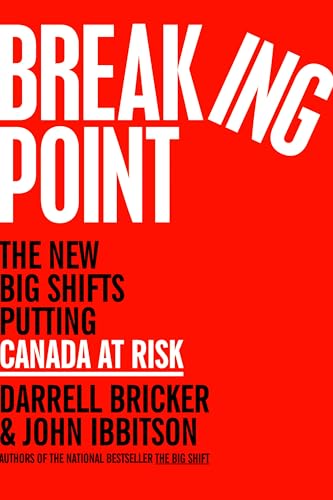
Breaking Point: The New Big Shifts Putting Canada at Risk
From the authors of The Big Shift and Empty Planet, a timely and provocative exploration of the seismic forces reshaping Canada’s political, cultural, and economic landscape.
Darrell Bricker and John Ibbitson’s explosive new polemic, arrives in the midst of the greatest political crisis Canada has ever faced. The country stands at risk. Even before Donald Trump returned to the U.S. presidency, brandishing tariffs and threats of annexation, Canada had started to crack. Year after year of decisions deferred, problems ignored, and cans kicked carelessly down the road have created dangerous fissures.
Stifling regulations drag down the economy. Younger people feel angry and alienated by dizzying housing prices and gig jobs. Regional tensions threaten unity in both Quebec and the Prairies. The immigration system is broken. And Canada stands alone, having failed to pay the cost of defending itself.
Canadians elected a former bank governor to fix all this. But can the Liberals get us out of the mess they helped get us into? What future awaits the progressive and conservative coalitions? Will the Laurentian elites continue to misgovern, or are there alternatives? The country is at a breaking point. Canadians must act to save it before they lose it.
Provocative, urgent, and unapologetically candid, Breaking Point will ignite debate, dominate political discourse, and become the definitive guide to understanding what is shaping up to be one of the most turbulent eras in Canadian history.
Darrell Bricker and John Ibbitson’s explosive new polemic, arrives in the midst of the greatest political crisis Canada has ever faced. The country stands at risk. Even before Donald Trump returned to the U.S. presidency, brandishing tariffs and threats of annexation, Canada had started to crack. Year after year of decisions deferred, problems ignored, and cans kicked carelessly down the road have created dangerous fissures.
Stifling regulations drag down the economy. Younger people feel angry and alienated by dizzying housing prices and gig jobs. Regional tensions threaten unity in both Quebec and the Prairies. The immigration system is broken. And Canada stands alone, having failed to pay the cost of defending itself.
Canadians elected a former bank governor to fix all this. But can the Liberals get us out of the mess they helped get us into? What future awaits the progressive and conservative coalitions? Will the Laurentian elites continue to misgovern, or are there alternatives? The country is at a breaking point. Canadians must act to save it before they lose it.
Provocative, urgent, and unapologetically candid, Breaking Point will ignite debate, dominate political discourse, and become the definitive guide to understanding what is shaping up to be one of the most turbulent eras in Canadian history.
240 pages, Hardcover
Published October 28, 2025
Ratings & Reviews
Friends & Following
Create a free account to discover what your friends think of this book!
Community Reviews
Displaying 1 - 26 of 26 reviews

November 22, 2025
2.5 stars. the word “polemic” needs to be painted as brightly on the cover as the rest of the title. that’s my mistake, i suppose.
here’s some points in this book that made me rip my hair out of my head:
- the Stephen Harper nostalgia-bait (everywhere)
- that supporting a free Palestine is fuelled by “Jew hatred” and not by disagreement with the Israeli government committing a genocide (ch.2)
- that nuclear power is green energy (ch.3)
- that housing prices are “not the product of an unrestrained free market” and is only being caused by zoning laws and government standards (ch.4)
- that the Canadian Deputy Commander of NORAD was implied to be partially responsible for not stopping 9/11 since he was “in the command chair” (and criticism of the rate at which the Canadian gov’t is spending a 20-year air defence budget within the first 2 years of its existence) (ch.6)
- that Canada is not spending enough on military + discontent that Canada spent big money on military subs that they haven’t needed to use yet, calling it “a failure” (ch.6)
- that “Trudeau should have called a federal election as soon as Trump won” to avoid being vulnerable, when that would have been the most identifying vulnerable move possible (ch.7)
- that Liberals committed “theft of the Conservative platform” by considering matters of economics and defense, two basic political sectors (ch.7)
- that Poilievre had openly made several campaign vows in support of the “base of the base” supporters, but was also “by no means a member of the base of the base.” (ch.8)
- that Prairie Conservatives have “adopted a centre-right approach that emphasizes the centre as much as the right” which is a straight-up lie (ch.8)
- that only “conspiracy theorists” spread anti-vaccine rhetoric and not legitimate Conservative politicians (ch.9)
- that the solution to our market stagnation is to “eliminate every possible regulation, short of endangering public safety” as if that won’t lead to monopoly and strain on small businesses (ch.10)
- that the solution to the housing crisis is “to focus less on protecting greenbelts and agriculture”, even though there are 1.3M vacant houses owned for investment in canada (ch.10)
- that Canadian seniors should model themselves after Sweden who “ties retirement age with life expectancy”, which is sort of just sad (ch.10)
- that premiers should be allowed regional vetoes on federal bills and legislation, thus destroying the purpose of federal bills and legislation (ch.10)
- that the Senate should be abolished and replaced with the Council of Federation for the sake of more diverse opinion, as if you aren’t removing 92 representatives from this equation (ch.10)
it wasn’t all bad though. here’s some points i was happy to encounter:
- that issues in this country are not partisan but systemic in nature
- that the Canadian gov’t’s interference with legacy media hinders them more than helping them (ch.5)
- that slow bureaucratic moves are often the reason budgets go unspent (ch.6)
- that Carney has been operating as a Liberal with a Conservative platform (ch.7)
- that provinces should have the regional power and sway they are built for, although the way it’s expressed as a separation of the capital into federal departments across the country is stupid as fuck (ch.10)
- most of The Big Fix in regard to national unity and identity
tldr; i used this book as a sounding board for the authors’ conservative politics and confirmed my stance on canada. it had me thoughtful which i appreciate.
here’s some points in this book that made me rip my hair out of my head:
- the Stephen Harper nostalgia-bait (everywhere)
- that supporting a free Palestine is fuelled by “Jew hatred” and not by disagreement with the Israeli government committing a genocide (ch.2)
- that nuclear power is green energy (ch.3)
- that housing prices are “not the product of an unrestrained free market” and is only being caused by zoning laws and government standards (ch.4)
- that the Canadian Deputy Commander of NORAD was implied to be partially responsible for not stopping 9/11 since he was “in the command chair” (and criticism of the rate at which the Canadian gov’t is spending a 20-year air defence budget within the first 2 years of its existence) (ch.6)
- that Canada is not spending enough on military + discontent that Canada spent big money on military subs that they haven’t needed to use yet, calling it “a failure” (ch.6)
- that “Trudeau should have called a federal election as soon as Trump won” to avoid being vulnerable, when that would have been the most identifying vulnerable move possible (ch.7)
- that Liberals committed “theft of the Conservative platform” by considering matters of economics and defense, two basic political sectors (ch.7)
- that Poilievre had openly made several campaign vows in support of the “base of the base” supporters, but was also “by no means a member of the base of the base.” (ch.8)
- that Prairie Conservatives have “adopted a centre-right approach that emphasizes the centre as much as the right” which is a straight-up lie (ch.8)
- that only “conspiracy theorists” spread anti-vaccine rhetoric and not legitimate Conservative politicians (ch.9)
- that the solution to our market stagnation is to “eliminate every possible regulation, short of endangering public safety” as if that won’t lead to monopoly and strain on small businesses (ch.10)
- that the solution to the housing crisis is “to focus less on protecting greenbelts and agriculture”, even though there are 1.3M vacant houses owned for investment in canada (ch.10)
- that Canadian seniors should model themselves after Sweden who “ties retirement age with life expectancy”, which is sort of just sad (ch.10)
- that premiers should be allowed regional vetoes on federal bills and legislation, thus destroying the purpose of federal bills and legislation (ch.10)
- that the Senate should be abolished and replaced with the Council of Federation for the sake of more diverse opinion, as if you aren’t removing 92 representatives from this equation (ch.10)
it wasn’t all bad though. here’s some points i was happy to encounter:
- that issues in this country are not partisan but systemic in nature
- that the Canadian gov’t’s interference with legacy media hinders them more than helping them (ch.5)
- that slow bureaucratic moves are often the reason budgets go unspent (ch.6)
- that Carney has been operating as a Liberal with a Conservative platform (ch.7)
- that provinces should have the regional power and sway they are built for, although the way it’s expressed as a separation of the capital into federal departments across the country is stupid as fuck (ch.10)
- most of The Big Fix in regard to national unity and identity
tldr; i used this book as a sounding board for the authors’ conservative politics and confirmed my stance on canada. it had me thoughtful which i appreciate.
This entire review has been hidden because of spoilers.

December 1, 2025
As a longtime fan of John Ibbitson and listening to him yet again talk to Steve Paikin about this new book, I was excited to read his and Darrell Bricker's more in depth thoughts about Canada's current challenging predicament.
Unfortunately, while the book looked to be a bullseye, it only ended scoring a single 20 point.
I can't tell if the book was simply rushed to be one of the first to talk about the '25 election, or if Bricker and Ibbiston really did put all they had to say in this book. They missed speaking about the Coquitlam decision in BC by a few weeks it seems.
This point is important because in the very first chapter they say that basically everything Trudeau did was poor, except for
1. His Covid response
2. Reconciliation
But this is a book about Canada at the brink. These two items they give Trudeau credit for are fundamental instruments in the problems that they otherwise acknowledge. Indeed the second of which may actually rip apart private property rights of an entire province.
Other issues include correctly diagnosing that there are problems with our immigration system in one chapter. Then in the very next chapter saying we need more immigrants into the Atlantic provinces and Quebec. It comes off disjointed and confused.
I also find that this book feels much more "yappy" than prior works/talks by the two. There's less footnotes, less research, less establishing this and that. Instead they repeat "young people are locked out of homes" "the West(s) feel alienated" and these criticisms make it into every chapter without the depth they deserve.
Overall, they missed the mark. I can't shake the sense that they went into this book with rose-tinted glasses (or even beer goggles) about how Canada is. Instead of looking at Canada in 2025 with a more sober lens, their romantic attachment to the Canada of old prevented a more fundamental and challenging analysis.
Unfortunately, while the book looked to be a bullseye, it only ended scoring a single 20 point.
I can't tell if the book was simply rushed to be one of the first to talk about the '25 election, or if Bricker and Ibbiston really did put all they had to say in this book. They missed speaking about the Coquitlam decision in BC by a few weeks it seems.
This point is important because in the very first chapter they say that basically everything Trudeau did was poor, except for
1. His Covid response
2. Reconciliation
But this is a book about Canada at the brink. These two items they give Trudeau credit for are fundamental instruments in the problems that they otherwise acknowledge. Indeed the second of which may actually rip apart private property rights of an entire province.
Other issues include correctly diagnosing that there are problems with our immigration system in one chapter. Then in the very next chapter saying we need more immigrants into the Atlantic provinces and Quebec. It comes off disjointed and confused.
I also find that this book feels much more "yappy" than prior works/talks by the two. There's less footnotes, less research, less establishing this and that. Instead they repeat "young people are locked out of homes" "the West(s) feel alienated" and these criticisms make it into every chapter without the depth they deserve.
Overall, they missed the mark. I can't shake the sense that they went into this book with rose-tinted glasses (or even beer goggles) about how Canada is. Instead of looking at Canada in 2025 with a more sober lens, their romantic attachment to the Canada of old prevented a more fundamental and challenging analysis.

February 5, 2026
Boring recap of the last 10 years of Canadian politics you get from just reading CBC headlines, decent final chapter giving some suggestions for the future.

November 16, 2025
I really enjoyed learning such nuances of Canada's past, present and the pathways for the future. We witness events unfold around us, watch the news, but we don't see what transpires behind the curtains which this book reveals, and eloquently at that. Astute commentary, thoroughly researched - I learnt so much!

May 25, 2026
Thank you Penguin Random House Canada for sending me this book for our book club discussion.
“A timely and provocative exploration of the seismic forces reshaping Canada’s political, cultural, and economic landscape.”
This book examines the major political, economic, and social pressures currently shaping Canada. The authors argue that the country is facing significant structural challenges, including housing affordability, economic stagnation, immigration policy, regional tensions, and Canada’s place in the world, framing these as signs of a broader national “breaking point.”
This book definitely generated a lot of discussion in April’s book club meeting. At times, I found it unsettling to read, as the authors argue that Canada is not in a strong position right now and will not be moving forward unless things change. As a parent, that perspective naturally brough up some anxiety about the future and what it might mean for the next generation.
At the same time, our group was able to recognize the clear ideological lens shaping the book’s arguments, which helped us engage with it more critically rather than accepting its conclusions at face value.
The author’s conservative viewpoint is evident throughout the writing and strongly influences how the issues are framed.
Overall, while I didn’t love it, still found parts of it thought-provoking and it definitely sparked some meaningful conversation at book club.
“A timely and provocative exploration of the seismic forces reshaping Canada’s political, cultural, and economic landscape.”
This book examines the major political, economic, and social pressures currently shaping Canada. The authors argue that the country is facing significant structural challenges, including housing affordability, economic stagnation, immigration policy, regional tensions, and Canada’s place in the world, framing these as signs of a broader national “breaking point.”
This book definitely generated a lot of discussion in April’s book club meeting. At times, I found it unsettling to read, as the authors argue that Canada is not in a strong position right now and will not be moving forward unless things change. As a parent, that perspective naturally brough up some anxiety about the future and what it might mean for the next generation.
At the same time, our group was able to recognize the clear ideological lens shaping the book’s arguments, which helped us engage with it more critically rather than accepting its conclusions at face value.
The author’s conservative viewpoint is evident throughout the writing and strongly influences how the issues are framed.
Overall, while I didn’t love it, still found parts of it thought-provoking and it definitely sparked some meaningful conversation at book club.

January 8, 2026
The spirit of the book can be summed up from this passage in the concluding chapter:
"Donald Trump's contention that Canada makes no sense and should disappear from the map as a nation may in hindsight a blessing. Either he is right or he is wrong. Let's prove him wrong.
Canada has always been an improbable country - scattered across six time zones, with two official languages, a plethora of cultures, and no obvious reason for why it should all hold together, except for the determination of its people to make it work. Canada works because enough people believe in it. But that belief must be perpetually renewed. For too long we have coasted on the effort and sacrifice of those who came before us. if we want the country to endure, we must build again."
Darrell Bricker and John Ibbitson offer a solid assessment of the state of Canada and its people and the challenges at this time. However, it was in some of the suggested solutions that I was left feeling that the some proposed solutions failed to recognize complexities. If the solutions are to "steamroll" rights, such as indigenous rights, in order to build then we have failed to learn from the past. Surely we can nation build, building quickly as the crisis of our time warrants, but include people and their rights in those nation building projects. Building a nation includes infrastructure, defence and people.
"Donald Trump's contention that Canada makes no sense and should disappear from the map as a nation may in hindsight a blessing. Either he is right or he is wrong. Let's prove him wrong.
Canada has always been an improbable country - scattered across six time zones, with two official languages, a plethora of cultures, and no obvious reason for why it should all hold together, except for the determination of its people to make it work. Canada works because enough people believe in it. But that belief must be perpetually renewed. For too long we have coasted on the effort and sacrifice of those who came before us. if we want the country to endure, we must build again."
Darrell Bricker and John Ibbitson offer a solid assessment of the state of Canada and its people and the challenges at this time. However, it was in some of the suggested solutions that I was left feeling that the some proposed solutions failed to recognize complexities. If the solutions are to "steamroll" rights, such as indigenous rights, in order to build then we have failed to learn from the past. Surely we can nation build, building quickly as the crisis of our time warrants, but include people and their rights in those nation building projects. Building a nation includes infrastructure, defence and people.

November 18, 2025
A book that made me think hard about the country I live in.
We all have our political biases and too often look for the stories that support them. This for me was different. With the use of polling data overlayed with Statscan census data, it builds a solid case for a country that has had the potential to be as economically and financially successful as Norway, but prefers to focus on issues that may be important, but too often aren’t urgent.
The authors paint a picture of a country who has chosen to make the easy choices that are popular rather than the ones that hurt now but pay off for the long term. Canada is the kids who give in and eat the one marshmallow they are given now, foregoing the three if they wait.
While it’s easy to blame the Liberal party who has presided over much of this thinking, the Conservative Party is equally to blame for their inability to choose a leader who truly represents Conservative principles and policy, but also speak to the rest of the country as their leader.
What this book left me with, was a single question: what if the party who has the ideas we absolutely need for our country, is lead by someone who can’t deliver. Do we vote for the party (and hope it works out) or for the personality, and risk more of the same?
A must read for any Canadian who is willing to look beyond the comfort zone we love so much.
We all have our political biases and too often look for the stories that support them. This for me was different. With the use of polling data overlayed with Statscan census data, it builds a solid case for a country that has had the potential to be as economically and financially successful as Norway, but prefers to focus on issues that may be important, but too often aren’t urgent.
The authors paint a picture of a country who has chosen to make the easy choices that are popular rather than the ones that hurt now but pay off for the long term. Canada is the kids who give in and eat the one marshmallow they are given now, foregoing the three if they wait.
While it’s easy to blame the Liberal party who has presided over much of this thinking, the Conservative Party is equally to blame for their inability to choose a leader who truly represents Conservative principles and policy, but also speak to the rest of the country as their leader.
What this book left me with, was a single question: what if the party who has the ideas we absolutely need for our country, is lead by someone who can’t deliver. Do we vote for the party (and hope it works out) or for the personality, and risk more of the same?
A must read for any Canadian who is willing to look beyond the comfort zone we love so much.
February 21, 2026
This is a book about Canada's recent history, particularly the failings of the 9.5 years that Justin Trudeau was Prime Minister. Given the time frame in which the book was written, I think more emphasis should have been given to the disastrous result of Canadians having, for too long, trusted the United States, in matters of defense, on trade, and on that "special relationship" that really never existed. The United States never had respect for Canada's sovereignty … and the trust relationship was betrayed; it's true that there is no enemy like a friend betrayed.
Of that "special relationship", the authors wrote:
Of that "special relationship", the authors wrote:
Whatever remained of the "special relationship" between Canada and the United States evaporated in March 2025, when Donald Trump announced sweeping tariffs on Canadian goods: Not after consultation. Not as part of a negotiation. Simply as an act of blunt force. The United States had decided to “monetize its hegemony,” as Mark Carney said in June 2025.

November 11, 2025
This is an excellent book covering recent Canadian politics with a focus on the Trudeau administration, the election of 2025 -what progressive and conservative parties can learn from it-, and, in the latter half, grievances western provinces have with the federal government.
The authors rightfully critique the Trudeau administration where they failed but don't over do it as some other commentators do.
As a central Canadian unfamiliar with western alienation, this book was really eye opening. The authors make a compelling case that the federal government's actions have ignored the concerns of western Canada.
This is also not a book of exclusively complaining. At the end, the authors present their solutions to the problems we face today and paint an optimistic vision of the future.
The authors rightfully critique the Trudeau administration where they failed but don't over do it as some other commentators do.
As a central Canadian unfamiliar with western alienation, this book was really eye opening. The authors make a compelling case that the federal government's actions have ignored the concerns of western Canada.
This is also not a book of exclusively complaining. At the end, the authors present their solutions to the problems we face today and paint an optimistic vision of the future.

July 25, 2026
There is a fair amount of ground covered at a pretty good clip. It doesn't hurt to read this either literally or figuratively. Thinking about who we are as a country. Why we should be concerned. And some actions to think about.
There may be a couple of sidelines of topics we are quite familiar with, but I don't mind the refresher. There certainly have been changes, and from this vantage point maybe some of the choices could have been reviewed earlier.
Right now, Canada has some choices to make. Maybe, just maybe decentralization is a solid option, because standalone Ottawa doesn't seem to be reaching far and wide.
I do agree that too many years of what we've done wrong might have been better served with compassion over blame.
There may be a couple of sidelines of topics we are quite familiar with, but I don't mind the refresher. There certainly have been changes, and from this vantage point maybe some of the choices could have been reviewed earlier.
Right now, Canada has some choices to make. Maybe, just maybe decentralization is a solid option, because standalone Ottawa doesn't seem to be reaching far and wide.
I do agree that too many years of what we've done wrong might have been better served with compassion over blame.
November 14, 2025
Incisive and bold look at the threats and opportunities Canada faces by two of the leading voices on Canadian public affairs. Pulls no punches about our current state in the world, and proposes some step-changes to pivot to the country we need to become. I absolutely consumed it over three days - couldn't put it down. The chapter "The Big Fix" is the Big Read of the book. As Bricker and Ibbitson write, if the discussion about the future paths of Canada is not messy, then maybe people don't care enough. Highly recommended - and hope you disagree and debate with friends and family.
March 12, 2026
This is an interesting book. It is more or less about current events. It is like a magazine article stretched out to 200 pages. It is a manifesto written by a journalist and a pollster. It talks about what's wrong with Canada and how to fix it. If it was written by a politician, it would be more practical. All we hope is that elected officials read it and implement the suggestions.
It is well written and a quick read. I enjoyed reading it and learned from it.
We need to make changes.
It is well written and a quick read. I enjoyed reading it and learned from it.
We need to make changes.

August 11, 2026
I expected a conservative slant but this read like a tantrum. I’m surprised it’s only a year old, he seemed to miss The Carney Affect. Ironically, ibbitson calls himself a “pragmatic conservative”, yet he is unable to congratulate Carney, who rules as a pragmatic conservative. It’s laughable that he thinks the prairies are governed by centre right political parties but I imagine this definition is what blinds him to Carneys conservative pragmatism.
This entire review has been hidden because of spoilers.

November 18, 2025
Well researched and bang on! The authors describe the difficult political/economic situation in Canada today as well as provide an explanation for how we have allowed our magnificent country to become fractured. Although the authors describe our problems in great detail they offer few suggestions on how to fix the mess!
January 10, 2026
A good overview of the contemporary Canadian political landscape, however the authors' conservative bias permeates all. Also, a tad shrill. The title says it. In the authors' view, Canada will collapse if it continues with misguided big-government policies. Inconsistencies abound, e.g. "identity politics bad" vs. "Canada needs to address the legitimate grievances of young, white men with limited education." Or "establishment (read Laurentian Elite) institutions are too powerful, out of touch and need to be diminished" vs. "military and defense, a major institution and budget line item, should be better funded and more powerful."

February 1, 2026
My Dad got me this book for Christmas. I really enjoyed it. Written in 2025 after the election, it discusses, in lemans terms,the relevant history of how we got to this Canada. The Canada at its breaking point after the terrible Trudeau decade. With opinions on what we can do to change the future of Canada.
April 7, 2026
Much food for thought and action here. The authors clearly care about the future of Canada. They are generally knowledgeable but sometimes their language is over the top and polemical. A very weak federation does not need further weakening. The federal public service is drawn from all over the country. It serves the government of the day. Its advice is mostly ignored. It executes as instructed.

January 12, 2026
A must read for everyone to understand where Canada’s position is today and what it can be to make Canada a better place on the world stage.
A must read in terms of understanding the provinces and the primary seated location. I’m very helpful in sight of trying to make Canada inclusive country.
A must read in terms of understanding the provinces and the primary seated location. I’m very helpful in sight of trying to make Canada inclusive country.
March 12, 2026
(audio book) A very relevant and interesting book. Listened to it with my husband and 2 adult sons and it generated alot of good discussion about the times we are living in and the challenges we Canadians are facing.

March 28, 2026
A clear and easy to read account of what needs to be done to keep Canada together. Taking us up to the end of 2025 and so many more of Mark Carney's promises have come true since then...... looking like we are on the right track
November 27, 2025
One of those books that makes you think critically about the state of the country.

February 27, 2026
Many great points, but a little too eager to say "leave it to the market" as the best possible solution.
March 20, 2026
Fine primer on the Canadian political landscape, but nothing groundbreaking.

Read
April 11, 2026Exactly what you'd expect from John Ibbitson.

April 27, 2026
An excellent look at current problems in Canadian politics and policy, and potential solutions to those problems.

May 27, 2026
Can’t argue with any of it.
We have challenges, many self inflicted in the last ten years.
We have challenges, many self inflicted in the last ten years.
Displaying 1 - 26 of 26 reviews