I'm conflicted about this novel. I really am.
On one hand, "East of the Sun, West of the Moon" is one of my favorite fairy tales and this isn't a bad retelling of it.
On the other hand, there are several parts to this novel that don't quite gel.
Let's nickpick.
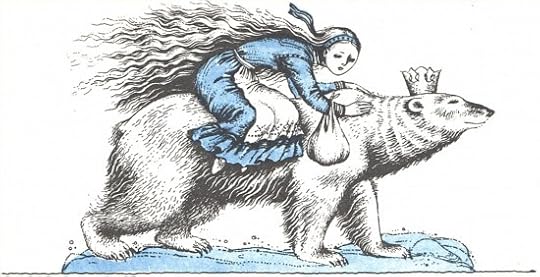
But first, in case you don't know, "East of the Sun, West of the Moon" is a wonderful fairy tale. It is why I love polar bears. It is a Northern version of Cupid and Psyche, but instead of some silly boy with iddy biddy wings, it has a POLAR BEAR!
ROAR!!!!
So in short, polar bear is really a prince who has to be saved by a girl who screws up once, but redeems herself and her love by saving them both in the end.
Now, to the nitpick.
My first problem, my first nitpicking problem, is the names. Most of the whole family has English names - Neddy, Eugenia - yet they are basically Norwegians. Did I miss something? And why is an Inuit woman named after a place in Sweden?
Second nitpicking problem - I've seen better world building. However, in all fairness, I've seen worse, much worse.
Third nitpicking problem - The emotional bond between Beauty (called Rose in this novel) and her Beast just doesn't seem real. I get she is kind, but love?
Fourth nitpicking - Rose is one those too perfect and too different cliché heroines.
All the nitpicking aside, there are some interesting bits in this book, but here's where the conflict comes from, at least for me. It's like something that looks and sounds really good, but somehow doesn't come off really well, kinda like an apple omelet. I also can't promise I make sense for the rest of the review because I'm trying to puzzle this out.
Pattou does something very interesting when she retells this tale, and that is to use multiple viewpoints. Her narrators are Rose (the heroine), the Bear (the enscrolled human), Rose's Father, Neddy (Rose's brother), and finally, the Troll Princess (Rose's rival and the evil witch).
This is also slightly disturbing. Most of the voices are male. It's true this is a YA book, but it seems to be geared towards young women and girls more than young men and boys. Then why, I have to wonder, are the men given more place? Why do we not get the view of Rose's mother or her sister? One of whom comes off as silly, cruel, and silly again; the other is simply someone who needs help. Wouldn't it be more interesting to hear from the sister who was aided by Rose's going with the bear instead of hearing how silly the mother is, how husband and son seem to reject her?
It also is slightly disturbing because Rose is far closer to the male members of her family than her sisters. I understand this YA, and I understand that YA novel geared towards girls is going to have a mother/daughter rift. What teenage girl doesn't feel like an outcast from her family, or that her mother doesn't understand her? I get that, I get it's a trope. But if Rose shares a bed with her sister (or sisters) wouldn't she be a little close to one of them? Wouldn't her agreeing to go off with the bear make more sense if the reader saw her interact with members of her family other than her brother and father? (I'm discounting her damaged relationship with her mother).
Malmo, the Inuit woman, is the only truly older woman (i.e. old enough to be a parent of an adult) that is shown in a good light. Every other older woman is shown to be stupid, silly, or cruel (or all three). While Rose does form a type of relationship with Malmo and two other females, none of these relationships seems as deep as the ones with her father and brother. It seems like the women are more tools (they are, basically, the helper figures of the fairy tale). It is also telling that when Rose decides to make friends with the Bear's servants, it is the male servant she reaches out to. Malmo is also interesting because Rose thinks that she works with the older woman like a long married husband and wife. Funny, considering some of those Inuit stories about women romancing their daughter-in-laws.
Yet, despite this, Rose succeeds because she can sew, because she knows material. This knowledge she gained from her mother and an older neighbor. Additionally, Rose's book knowledge and small language knowledge comes from her mother. This seems to indicate that the mother did spend time with her, so why aren't we shown this? Additionally if Rose was always running off, how did she get these lessons?
It's true that Rose isn't the only female voice of the novel. The Troll Princess gets to have her say as well. Like Rose, the Troll Princess has an older woman as quasi helper. Like Rose, the Troll Princess' closest relationship seems to be with the male member of her family (her father; her sin is not respecting him. Rose is better because Rose respects her father). But the Troll Princess, too, is part of the problem. Princess and Rose are too similar. When she gets to the Troll kingdom, Rose describes the other humans there with the troll word for human, soft skin. She sets herself apart from them. She sees herself as better (she also is the best slave ever). Like the Troll Princess, Rose uses someone and then spares no thought for his fate (and it is a sad fate). It is hard to see this as much better than the Troll Princess and her version of inhumanity. At least, the Princess has an excuse. She's a troll.
So I'm conflicted about this book. It's not good, but it's not bad.
And at least it has polar bears