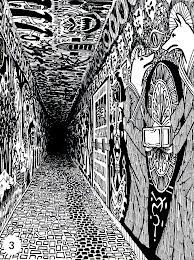
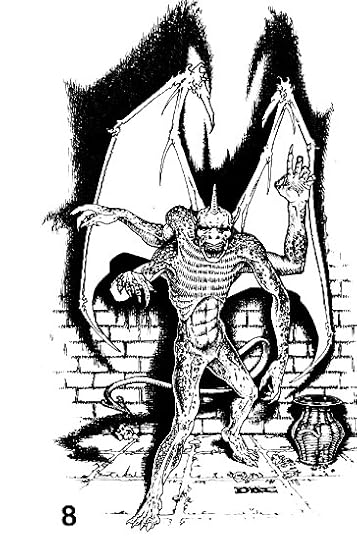
This module was originally used for the Official DUNGEONS & DRAGONS tournament at Origins I. The author wishes to express his thanks to Mr. Alan Lucien who was kind enough to submit the ideas for this dungeon. This version has been revised and updated to conform to ADVANCED DUNGEONS & DRAGONS. Included herein are background information for players, including the Legend of the Tomb - as is true of all TSR DUNGEON MODULES, the location of this area is upon the Map of the World of Greyhawk (WORLD OF GREYHAWK by TSR) - DM notes, level map and matrix, player character statistics for varying numbers of participants, and over two dozen special illustrations to graphically enhance your players' enjoyment of the adventure, as the drawings are keyed to various scenes and encounters iin the Tomb.
This should be called Die! Die! Die!, because that's what happens, a lot of dying. Be prepared, the good-guy body count shall be high!
And that was Gary Gygax's intention. Tomb of Horrors is an adventure centered around survival. Getting through it alive takes skill and a whole lotta luck.
Gygax eschewed the usual D&D style of game with its background story often involving some little village on the edge of the wilderness that is being tormented by baddies. There is almost no background story in Tomb of Horrors. It's a tomb and inside there are horrors.
And check out them horrors!
Half of this booklet is pictures, and when I was a kid they scared the crap out of me. They are very demonic. But remember Christian Soldiers, we D&D players were cleansing these satanic-ish places….well, to be honest, we were hoping to find booty (the gold and silver kind, get your mind out of the gutter). Killing the ultimate evil was just something we did to get to the loot.
In its early stages, Tomb of Horrors was one of D&D's crowning jewels, used as a tournament game I believe. It quickly became infamous and every kid had to have a copy. And while most of us look back on it with nostalgia, it is a fondness bereft of sentimentality, because there was no love in this module. It chewed up and spit out characters mercilessly. Gygax even strongly urged the use of expendable, pre-rolled characters instead of risking beloved, hand-raised ones. It's good advice, because not only is this module dangerous, but it is at many times a random danger, and that's part of its problem. Randomized, irrevocable death lies around every other corner. Traps, traps, everywhere traps! The whole frickin' place is trapped! Ceilings collapse on a regular basis. There are spiked pits every few feet it seems. Floors tilt away and drop the characters into fiery chasms. And the problem is that for many of these traps there's no detection. No amount of care can be taken to prevent at least heavy damage, if not death, in many cases. And honestly, there's not a lot of ingenuity going on here. There's a puzzle or two to solve, but mostly it's just "whoops, you've fallen onto something pointy."
Great fun, definitely an excellent tournament game, but not really very good for campaign inclusion.
If you're interested in some more visuals of Tomb of Horrors, artist Jason Thompson has a whole D&D series that show you a party of warriors, wizards, etc going through each module. They are fun, light-hearted takes on these gruesome adventures. Here is a zoom-in-able page of Tomb of Horrors
This is the quintessential killer-horror module for Old School AD&D fans. If your group went into this and came out with low casualties your GM was fudging rolls on your behalf. Gary Gygax, a co-founder of Dungeons & Dragons RPG, designed this module at the first Origins convention and it is rumored he pulled this out for expert players who believed they could handle any type of challenge. In those days killing characters off was okay, not like today for the New School D&D players so much.
This type of module can be a humbling or fun experience for players. It's recommended you don't bring your beloved characters into this module as they're likely to not only die but permanently. The module was set up to have 33 encounters and then the horrifying almost impossible to win Boss Battle. A separate picture booklet comes with the module. I would advise you don't use the pregens in the module as they aren't up to the task. This game is best mechanically used for Old School D&D but its been updated for the latest D&D edition and it could probably be adapted for other game settings that allow no saving throws and thus you die models. Several of the traps are like this in the game.
Like I said, this is very Old School and an attempt by Gygax to humble even the cockiest of gamers. If you're going to GM this for New School gamers be sure to tell them that there are death traps that when set don't allow a saving throw and thus it comes out to last person standing or being clever or just lucky.
CONCEPT: A minus to A; DESIGN: A minus to A; OLD SCHOOL FEEl: A to A plus; OBSTACLES/TRAPS DESIGN: A minus; WHEN REVIEWED (last played): March 2012 (early 2000 so I'm up for another run through)(revised review 07/31/2012; revised a smidgen on 11/10/2012); OVERALL GRADE: A minus to A.
WIKI COMMENTS/REVIEWS
Interesting critiques per Wiki of this module (I did something like the cattle drive when I played this a second time around).
Tomb of Horrors was ranked the 3rd greatest Dungeons & Dragons adventure of all time by Dungeon magazine in 2004.[18]Dungeon Master for Dummies, which lists Tomb of Horrors as one of the ten best classic adventures, posits that many of the adventure's traps would kill a character just for making poor choices.[10] Lawrence Schick, in his 1991 book Heroic Worlds, calls the adventure "A very difficult scenario".[3]
Don Turnbull reviewed Tomb of Horrors in issue No. 13 of the magazine White Dwarf, and gave the module a rating of 10 out of 10. Turnbull commented on the adventure's difficulty, noting that the dungeon is "sprinkled extensively with subtle, insidious and carefully laid traps, and it will be a fortunate adventurer who manages to avoid them".[5] He felt that the illustration booklet would add a great deal to the adventure's atmosphere and felt that the pre-generated character roster was useful. Turnbull noted that the module is "very hard and will be hard for the DM to learn in advance, though this is an essential prerequisite of running it properly for it is much more subtle than the G or D modules", and he said that this module has in common with those modules an "excellent format, for instance, and the comprehensive way in which the scenario is introduced. TSR's high quality has not been in any way compromised, and in S1 it has even been improved upon."[5]
Wayne MacLaurin of SF Site describes the module as "a classic" and a "must have" for gamers, saying that when he played the game in high school, most of his group's characters quickly died. MacLaurin explains that Tomb of Horrors is a classic not because of its difficulty, but because it was the first module that did not involve killing large amounts of monsters; it was a "collection of puzzles and maps." Its focus on traps rather than monsters was a surprise to gamers at the time.[19] One technique some players used to get past the deathtraps was to drive cattle ahead of them, which Lore jöberg of Wired described as "a bit less than heroic", noting that in Lord of the Rings Gandalf did not send "50 head of cattle into the Mines of Moria to serve as Balrog bait."[17]
As I recall, it was $8.00. And I played it "wrong."
That's chump change these days, of course. Coffee for two at Starbucks. A single day's parking fees at the airport. A happy-meal-and-a-half.
But back in 1979, living in rural Oregon under the semi-benevolent despotism of my parents, who thought $0.50 a perfectly adequate weekly allowance, it was a modest fortune. There was only one place in town that sold any D&D materials - Presto Print, which mostly did business as a copy store for local businesses - so they could have theoretically set any price they wanted. Working against that was the fact that the market for RPG materials was, shall we say, limited. In our entire county of approximately 30,000, there is not a doubt in my mind that, tender age or not, I was the most knowledgeable (and eager) customer they could muster. So $8.00 was out of my immediate reach, but I at least had the consolation that there would be no competition for the title. It would wait.
I worked weekends for three weeks - mowing the lawn ($0.50), weeding the rose hedges ($0.25 each), vacuuming ($0.25), splitting wood for the fireplaces ($1.00 for a pile as tall as me). I worked like a fiend, and spent not a precious quarter at the pizza parlor arcade, tempting though it was. At last, I had my small fortune amassed, and badgered my mother until she agreed to drive me into town to claim my prize.
It was gone. While I'd been tearing my young, gloveless hands open on rose bushes, some wretched, sneaking *unworthy* thief had purchased the only copy. Gollum in his agonies could not have hated the Baggins more than I hated that nameless parasite who had dared to steal away with my prize. I went mad. I demanded that the store owner tell me who had bought it. I burst into adolescent tears, frustrated rage and shame at the spectacle I knew I was making of myself both coursing through my overwrought brain. My mother drove me home. Eventually I calmed down enough to call the store and ask them - ever so professionally, polite but firm, stupidly thinking they wouldn't know it was the little freak who'd gone crazy in their store on the line - to order another copy.
Two weeks later, I was at the store when it opened, and there it was: the module, only my third, reputed by my few out-of-town D&D contacts to be the wickedest ever created.
I could barely wait. The cover enchanted me. The fold-out illustrations compelled me. The design: a compendium of trips and traps, a slow-paced, perfect dungeon crawl which would demand the most careful scrutiny for players to survive, was a thing of genius. I ran my brothers through the module within the week. Then they did it again. Then I brought it to school and badgered those few friends who had a passing interest in the game to go through the Tomb, sacrificing precious recess time. I went further afield and dragged in anyone I could persuade to the game table, bribing them sometimes, just for the opportunity to experience the Tomb from their perspective once more.
Over the next eight years, before I moved on to college and (foolishly, FOOLISHLY) left behind my Dungeons & Dragons obsession for "more mature" pursuits, the Tomb of Horrors was easily the star player of my stable of modules. I must have DMed the adventure for fifteen different groups.
And I never killed anyone.
At least not permanently. Oh certainly a few characters were temporarily ground to paste by falling rocks or lost an arm to a Wall of Annihilation, but these were routinely dealt with by convenient clerics who wandered the ruins with resurrection spells handy, just in case. You see, I knew - and know - all about the module's reputation as a killer dungeon. I saw immediately how easy it would be for even normally cautious players to be blasted to atoms by the ridiculously unfair conditions. I ignored those design flaws which are obvious to me now: the ludicrous false entrances, the bragging riddle on the floor, the impossible final encounter. A lover in the first gidddy stages of infatuation, I had already absorbed the most important rule of D&D: simply alter what doesn't work, make it up on the fly, deliver your lies with confidence and, from the other side of the DM screen, the players will have no idea that what you're telling them isn't exactly as written. And I wasn't interested in "winning" the game over the players. Any moron DM could declare "rocks fall, everyone dies" in a fit of pique, and many have. I wasn't at war with the players. Playing through a module with them wasn't an act of hatred. It was love. I loved the game. I loved the story we were creating together. I loved the sense of shared purpose, the comfort of an understandable rules system, the assurance of knowing my function. That was heady, delicious, and all too rare for a lonely boy who knew, during the course of most days, how weird he appeared to most of his peers, and how little they thought of him. During the course of the game, I wasn't a wrathful God, out for revenge...I was God's benevolent avatar, achieving reconciliation with all the hurt I couldn't admit to myself at the time, and which fantasy drove away, at least temporarily, into the dark corners.
So yeah, I played it "wrong." I fudged dice rolls, I gave broad hints, I re-arranged rooms to lead the players from encounter to encounter, a showman trying to give the audience the most for their money. And they were happy, and I was happy. So up yours, rules lawyers. Acererak was my wingman, and the Tomb of Horrors was my perfect playground. I found more concentrated joy in those thirty or so pages than I would find until I was much older, and had finally found a way out of loneliness. Thank you, Gary. It made me happy.
Un modulo iper-famoso per Dungeons and Dragon. Se avete letto Ready Player One (letto, non visto il film) non potete fare a meno di leggere questo modulo. Se invece siete dei giocatori di ruolo, il modulo merita una giocata.
This is the worst, most evil, spiteful module ever made. Don't ever try to run it, it's horrific. But it's a great resource to steal from in judicious amounts.
And now, it is time for one of the most iconic adventures to be reviewed: Tomb of Horrors, the first entry in the S (for Special) series of adventure modules majorly written by Gygax. Originally designed as a tournament module for Origins 1975, Gygax was inspired by another module called Tomb of Ra-Hotep, designed by Alan Lucien (one of the early AD&D playtesters) and sent to Gary for the Origins convention. Gary liked the dungeon and started work on his own version, which would give rise to one of the most iconic adventure modules of all time, and as such, one of the most influential dungeons ever… yet one must wonder, is that influence any good? Or did this module irrevocably changed adventuring for the worse? A rather unpopular thought but bear with me.
The Tomb of Horrors is probably the main culprit behind the idea that anything old-school is "super deadly" and that you can die with a few rolls like nothing. Some tend to not consider it part of the philosophy behind OSR, if there is such a thing, while others embrace it as a prime example of good ol' gold. Truth be told, S1 was born in 1975, when AD&D was still a few years in development, with Basic being the main line, and Gygax himself, one of the most influential figures in the industry, was very prone to creating highly challenging encounters and foster the idea of DM vs players. It is ironic considering that whenever he actually writes advice and guides to DMing, he never recommends to shit on your players and make them suffer, yet the majority of the adventures he wrote (and that I've read) present a rather high chance for failure, and Total Party Kills are not out of the question. Yet, what makes S1 truly, so dangerous and grim? Ironically, it not the monsters, but the traps, oh god, the goddamn traps. This is probably the origin of the infamous "ten-foot pole" meme, which is usually used to describe adventures that have way too many hidden traps that are critical to the survival or death of the party. Simply having high perception or good eyes is not enough here, as failure WILL happen, that is a given. Someone will die. Why? Because Gygax wanted to create an adventure that challenged the wits of the players, yet if find this to be either pretentious or just misguided. This dungeon is not about being smart, is about having luck and a fuck ton of patience, and notes, notes, notes.
S1 has no random monster encounters, which is, wow, a huge deviation from some of the classics, back when randomness was one of the main tropes of modules. As a matter of fact, there's very little, to none, combat, for a few selected encounters. Instead, Gygax tries to design encounters around puzzles, traps, and hidden paths and doors. How well does he succeed? Huh, not so well in my opinion. It's already pretty hard as DM trying to describe physicals puzzles and rooms in a dungeon, but the problem here is that it doesn’t really matter how you approach the tomb, there are traps that are just there to kill your players, doesn’t even matter if they are quick witted or smart. Actually, I don't think this dungeon is as smart as it just seems to be. It is a seamless collection of "gotcha!" moments designed to punish. You do something right? Wrong! There's always a second trap waiting for you. You've managed to avoid all the dangerous rooms and reach the room of the BBEG? Wrong! It is also a trap and one that will trap you into your own doom! You’ve found the hidden door behind the fake brick wall? Wrong! It's another dead end. This goddamn dungeon is a killing machine designed with so called "smart" puzzles that are just illogical, and stupid at times whenever you realize that it doesn’t matter if you win; you lose still.
But of course, as with almost anything in the world, not everything is bad. There are some good things that are worth reading and checking out from S1. First, the ambience, it is amazing, and not because of Gygax dry writing, but because of the beautiful interior artwork that was designed to better illustrate the complex intricacies of the dungeon. There's various full-page b&w drawings that are exceptionally evocative, lovely too look at and a perfect tool to engage you as a reader. This is dark fantasy, grim D&D. It is precocious, obscure, and dangerous. That is pretty cool.
The dungeon can be run as a one-shot, and even says so in the introductory pages. It lacks any major background and has pretty much no story. It is there just because yes. You have an excuse to send your party into their sure demise with the hopes of finding, something? Treasure, I guess. Truth be told, there's nothing particularly moving that might push your party into this tomb. The dangers far outweigh the reward. Sure, if you actually manage to survive the dungeon there's a huge ass reward in XP, but chances are that your main PCs are dead, and it's very unlikely a full party will reach the end. There are a lot of gold and electrum pieces, and a lot of random pricey shit to find, like a gold couch worth 50,000 gp, but good luck trying to get that shit out of the tomb, and this room is also full with other interesting pieces of treasure, but guess what! This is the room where Acererak, one of the strongest liches ever, is found! BUT GUESS WHAT AGAIN, he's actually an illusion, and in reality a weak zombie! BUT GUESS THE FUCK WHAT, the room is collapsing and in ten seconds it will come down and kill everything inside. Funny enough, Gygax tells you to take your time describing the room coming down, despite the fact that your players have ten real-life seconds to get the fuck out.
Boy, and that's just the first rooms. So yeah, my critique towards S1 is just that it's not a dungeon for everyone, as a matter of fact, it is designed for a very special kind of party in mind, and it would be a real dick move to include in an already on-going campaign. If I have gotten something out of this, is that tournament modules in general were badly designed, just created for the reason of making things hard and time consuming. S1 includes a list of pregenerated characters, and it's probably a better idea to use them then to run the dungeon with a previous party. Death here feels cheap, to just die to a random pit or get your arm bitten by something inside a hole in a wall, or a random ceiling collapse. While there's not a lot of combat, the few encounters that exist are exceptionally dangerous. By the time you actually face against the real Acererak, you will discover that he's not just a lich, he's a goddamn demi-lich, more than capable of wrecking your party in a few shots. Acererak is a mad bastard, yet, he has a fairly complete list of various weaknesses that are rather oddly placed and feel almost arbitrary. It seems that your best bet is to have a PC capable of using the Word Spell Kill, which seems to just end him and there's that.
What level is this dungeon even targeting? In the original print, there's no disclaimer about the targeted level or anything like it at the start of the module like in previous manuscripts. Either Gygax designed it be played by all kinds of parties, or he didn't care. But the fact that Acererak is a demi-lich, it must mean that it was at least made for high level parties in mind. The only description for a recommended level is in one of the last notes, where Gygax seems to base the difficulty of the dungeon based around the items the party is carrying. The list of premade PCs is actually very varied, from level 4 to 14 at the highest. A little confusing, it seems.
In conclusion, Tomb of Horrors is the fingerprint of a different design philosophy, that one of unnecessary danger and random failure. Is it fun? It wouldn’t be for me, but I could see it working as a simple one-shot experience rather than a fully fledged adventure. There's really nothing to fledge here, as the sole purpose of the tomb is to challenge the party. In that last aspect, it succeeds. It is a massive challenge to even complete this thing.
Ultimately, Tomb of Horrors, despite its iconic and almost divine reputation among some circles, is a letdown to my eyes. It encapsulates everything I dislike about gaming: save-or-death, failure despite success, overly complicated and illogical puzzles just for the sake of puzzles, hidden paths and confusing progression, dry writing (albeit complete and detailed), and a loose sense of adventuring that promotes checkpoints (ala Dark Souls) over continuous advancement. This is the kind of module where your party will beg you to just stop and breath.
I ran this once back in the day as the capstone to a longer campaign and it made for an OK long session. Reading it now and it's, well, it's kind of a mess. First, as with the other modules of the time period they were presented to the DM as a mystery in the first read - you didn't get to know the villains plans and motivations until you reached the descriptions of the final rooms. I don't know why such a presentation was ever part of the DM experience, but there you go.
Second, OK, I get that the module is designed as a static, trap and undead filled location, but the nigh absence of anyone to interact with (saving the Sirine who is enchanted to not directly answer questions) makes things more of a slog than they ought to be - if your PCs are all in on puzzles and traps, this is a great evening. If they are playing for other reasons, not so much.
Third, there's no continuity between the puzzles, save where there's a false pattern set up to hose the PCs later. Yes, it makes sense for the malevolently evil entity guarding its existence to not play fair, but that also means each puzzle has to be taken as a blank slate, and any attempt to carry over knowledge from the prior ones is going to mess you up. This, to me at least, is unsatisfying as it makes the Tomb feel deeply disjointed. It's difficult to get engaged without any sort of through-line either in personalities or theme.
Finally, all of this is so much easier if you're already used to the early Gygax style - the puzzles that require the players to repeat the same set of actions 3 times with no effect so that the next time produces a benefit is nonsensical unless you're used to a DM doing just that sort of thing or the DM nudges you along. The number of problems that can only be resolved by a very small set of spells or actions (which don't make a lot of logical sense; nothing earlier in the module or even in prior modules would lead you to guess that using large gemstones as sling bullets will do anything special) means they aren't so much puzzles as guessing games.
This is the quintessential 1st edition advanced dungeons and dragons tournament adventure. It is hard to read without cackling evilly; but though very hard, it is possible to complete in play. The artwork and writing are wonderfully old-school, and the backstory is brief but sufficient. You just have to make sure the players have the right expectations going in, and don't send any beloved characters inside. I think an interesting way to run this would be to present the players with the 20 pre-generated characters and tell them they can use them all to explore the dungeon, and they 'win' if any are left at the end. They can send all 20 in at once, send half in and leave half in reserve, or any combination.
Without any doubt, Gygax was at his meanest when he designed this dungeon. No sane player, having a slight idea of what (s)he is going to encounter there, will play it. It's a long exercise in masochism trying to get to the end. Only the most debased and sadistic DMs are going to run it. That said, IT'S FU€£ing AWESOME!!!
The Tomb of Horrors. The ultimate player character meat grinder. Gygax's most enduring hell.
It's really trendy to hate these days.
I can reasonably confidently say that any youtuber whining about the Tomb of Horrors didn't bother reading it. Gygax's introduction to the module is even faithfully reproduced in the 5E version of the Tomb. The Tomb of Horrors tells you exactly what it is. It tells that you that there are more traps than monsters and that kick-down-the-door-fight-orc groups will be unhappy. The Tomb was initially a tournament adventure so you have dozens of tables in a room running the same adventure to see who can get the furthest. It might be tempting to think that doesn't translate to a home one-shot but the module has accounted for that.
The Tomb is lethal to an almost silly degree. But that's kind of the point. You came for the Tomb of Horrors not the Tomb of Mild Inconvenience. Plus, that seems to be accounted for. The AD&D 1st Edition copy of the module even comes with 20 pregenerated characters to use. It's the 1981 version of a DCC Funnel Adventure for high level characters. The Tomb is about careful methodical dungeon delving and meticulous risk management. This is all about breaking out your 10' pole and checking each flag stone before you dare put weight on it. A lot of the traps are on a timer in which you begin ominously counting up and if the players don't note that they are getting out of dodge then they suffer the full consequences of the trap. Noting that the ceiling of the cave is rumbling and starting to count will get them moving.
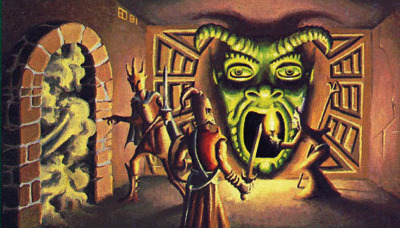
One of the key perks for this copy of the module is the separate handout for the all of the art. Almost every encounter is lovingly accompanied by a large illustration (many of them full-page) done in all the glory 70s and 80s early RPG art can offer. The image of demon mouth statue hiding a nasty Sphere of Annihilation has endured for decades. It's a memorable moment and there are tons of stories of characters lost to it.
The Tomb of Horrors is legendary for a reason. It has moments that have been passed down in the history of the game. It's devious and punishes errors pretty severely. But it really rewards outside-the-box thinking. There's a story about an epic conclusion to the module. There is a trap or puzzle in the game involving a crown and a scepter. Placing the crown on has some deleterious effects but you are given the knowledge that touching the scepter to the crown will let you take it off. One end of the scepter allows for easy removal, the other end obliterates the crown wearer. At one convention some players got the idea to put the crown on the final boss and touch the scepter to the crown. The judge of the tourney was floored and even went so far as to call Gygax himself for a ruling. Gygax shrugged and said that there was no reason it wouldn't work. Those are the kind of stories people remember 40 years on. I would probably not drop the Tomb of Horrors in to an on-going campaign but for a memorable one-shot? It's perfect for that. Give your players each a fistful of high-power character sheets and give them something that level 10+ characters rarely experience: A challenge.
Rated as one of the all time best DnD adventures, Tomb of Horrors was also one of the very first TSR published (I think preceded by the G and D series and B1 in glorious monochrome. It's all the more peculiar because it carries a very different flavour to most DnD modules: it's deadly, antagonistic, and unfair in places. It's origins were (ironically) from the Origins 1 convention where Gary Gygax created an adventure essentially designed to take his veteran gamers down a few pegs, as they had been bragging about how their characters could handle anything thrown at them. He credits Alan Lucien for many ideas in creating ToH. Indeed, there's a replica of both the original typed tournament module from 1975, and Alan Lucien's prior Tomb of Ra-Hotep included in the deluxe edition of Arts and Arcana. So does it deserve the accolades? Many early AD&D adventures had a degree of lethality, as some failed saves (e.g. poison) resulted in death, as did some traps or environmental things (in S2 and S4 for example). Yet ToH really ramps up the instant death: poison spikes; spheres of annihilation; tilting corridors into a furnace. The resilience and capability of high level PCs is tested by ability nerfs, some traps being immune to magic solutions, or requiring highly specific spell solutions, by multiple secret doors, portals, false doors, crawlways etc. It's a fairly linear dungeon with little pre-amble, a style common to the earlier modules derived from tournaments (such as C1, C2, A1-4). There's some flexibility on how you could feasibly progress through the first half (to avoid player frustration at bottlenecks). The finale, should they get that far and not fall for the false Acererak, is the first appearance of a demi-lich, although the creature is described in the text rather than as a MM style entry in an appendix. Ace can manifest two ways, either as a ghost, or as a demi-lich death skull. In this latter form he can only be defeated,incapacitated, or delayed by particular spells or left-field attacks all whilst sucking out souls. Really tough stuff. ToH has some iconic areas that were made moreso by the illustration booklet. Drawn by Dave Trampier and David Sutherland they are such a vital part of the modules vibe. The classic green demon face with gaping mouth became synonymous with the module, and appeared as an Erol Otus back cover on the second printing (I have the first). That trap is most notorious, but we also have the misty archways, the tilting corridor, the lethal temple, the hammer horror mithril door spewing blood, floating character traps, and sceptres that turn you into 'fetid powder' if used wrongly. It would only suit games of a certain approach and a certain style, and would be both fun and a challenge for any 1e players that had that mind-set. Utterly different to anything else at the time, it was definitely toned down in the 5e update. It inspired many other adventures, not least Tomb of Annihilation, but this original is still worth a look at. Iconic.
This entire review has been hidden because of spoilers.
Revenge is a dish best served cold. Had I a group of 6 hated enemies I would spend years lovingly DMing their party and developing their characters in deeply meaningful ways, until they are truly attached to their characters and then... only then... would pop out Tomb of Horrors and play it straight out of the page, with no hand holding. They would be scarred for life.
This is actually the second version of Tomb of Horrors, with the first one, from 1975, being used at the Origins convention that year (i've reviewed it here before), but this is the first commercial printing of the module by TSR. It's a clear improvement from the original module, with better descriptions and much better art. It's still a meat grinder though, and that's really how it should be.
I would honestly suggest that if your players aren't your nemeses, and/or you do not wish to lose the few friends you have, you should run this with characters created specifically for this dungeon, it can be a fun run but the permadeath that will invariably be the fate of some of the PCs won't feel as harsh. Another option would be to tone this down, but that would be defeating the purpose of the dungeon, this is a test, for a test to be effective the real chance of failure with real consequences has to be present, this is also supposed to be horror, the characters should be afraid of dying and that is only enhanced by seeing their friends die before them. A truly evil dungeon, Acererak didn't want to make his tomb an amusement park, he wanted to fucking kill anyone who came in.
There are two kinds of roleplayers in the world, I think: the younger, newer folk who know little of the game's history, little of the ultra-careful ten-foot-pole dungeon-crawling style, and enjoy their combat and deep stories; and the greybeards, the old guard, the ones that played the game before any of us were even born, who have had more characters die than the rest of us have rolled.
Throwing this module to the former type would be unnecessarily harsh and most likely lose you some friends; throwing it to the latter would make for boring play because most of them have already experienced it, run it, or otherwise read through it, and know exactly how to get through all its tricks and traps.
It has an important part in the history of the hobby - some would say detrimental - and is of course written as well as anything else Gygax ever wrote, with some evocative and imaginitive traps and tricks in it, but... I honestly don't think it could make for very good gameplay nowadays. It is a relic of the old times, with little place in the present day other than as a curiosity and a history lesson.
This is the kind of nutso, anything goes adventure that TSR wasn't afraid to publish in the early days of Dungeons and Dragons. There isn't really anything balanced about a skull lich that can merely look at a character and turn them into a moldering heap, trapping their soul in its skull eye or tooth, without a hit roll or saving throw. I wonder how many thousands of characters died attempting to conquer this tomb of horror...
Tomb of Horrors is an adventure module written by Gary Gygax for the role-playing game Dungeons & Dragons (D&D). It was originally written and used in the 1975 Origins 1 convention.
A classic! It was better than most of the earlier published adventure modules I've read so far. Yes, it's absolutely OP and some of the "puzzle" are not really puzzle at all but just lucky guess you can hope to make, and than hope the dices don't kill you. I'm happy to have read it, and I don't think I'lll use any part of it as inspiration tbh
Down-to-earth, no-BS campaign. Gary didn’t care how you felt or how fragile your mind was. Use your brain, endure the pain, trek through the traps, curb your greed, make prompt decisions, correct your non-lethal mistakes quickly, and you might stand a chance to survive. Gary even sarcastically asked failed players, “Do you feel this dungeon is too hard?
“You are not special. You're not a beautiful and unique snowflake. You're the same decaying organic matter as everything else. We're all part of the same compost heap.”
When D&D was deadly. And good. Not the softball stuff they peddle these days.
Read this long after my playing days were over, unfortunately. What a difficult dungeon! It would have been very frustrating, but rewarding, to have played it.
The Platonic Form of puzzle dungeon. He might be long gone, but I swear I can still hear Gygax snickering with glee everytime I read over some of the more unexpected traps.
Run this module many years ago after reading 'Ready Player One': lotsa laughs, bad jokes, excitement and too many unhealthy snacks ... My old college buddies are veteran players and almost entirely explored this infamous Tomb. Although the first time one dwarven player got obliterated by Acererak and the others got teleported, they returned a second time and destroyed him in a way that was most inventive ( no spoilers :). When you still talk about certain memorable moments from the game after all those years, you know you played something special. Highly recommended
This is a classic module for the Dungeons and Dragons roleplaying game. Now, in my opinion, it’s either terribly badly written, or it demonstrates a fundamental flaw in the ideology of the early game. Basically it’s designed as a meat grinder: the characters have virtually no hope of success.
Now, people may say that it is grimly realistic, in the sense that if there were necromancers and you tried to rob the tombs of said mancers of the necro, you’d wind up dead pretty quickly. My counter is that, were this true, then the adventurers you have created to run through said meat grinder would, in this world, not be so foolish as to choose their profession in the first place. The conceit of the game is that adventurers aren’t suicidal idiots. This game only has impact because it takes the standard difficulty of the setting, and winds it up past “fun” and “challengingly fun” to ”let’s have fun watching your characters die pointlessly.”
I can’t see how playing casualties left over after you are sliced to pieces by the defences in a necromancer’s lair could be fun for anyone, and so, and I know this is a big call because he was the co-inventor of D&D and everything: this module is worse than broken, it’s deliberately and intentionally broken. It’s designed to achieve total party kill, while pretending to fairness because it is all written down in advance.
Since its available for free, roleplayers should check it out, just to see how far we’ve come in terms of collaborative storytelling technique.