

What do you think?

Eve
Exiled to a desolate and harsh New Earth, in this
Paradise Lost retelling, Eve faces relentless toil, pain, and the resentment of Adam, who blames her for shattering their Paradise.
But even in this barren world, Eve's curiosity only grows. When Eve and Adam discover a thriving civilization in the fertile valleys of Mesopotamia, Adam is able to find peace, while Eve fights an irresistible pull further. She yearns to understand why she was created, to understand the god that made and abandoned her.
Can Eve find contentment with the vestiges of Eden that remain? Or will she dare to taste the fruit forbidden to her, once more?
In the end, Eve seeks to know the limits to her own power, to sate her hunger, once and for all. Navigating loves, betrayals, and the duties of motherhood from Nippur to the coastal city of Canaan and across the Aegean Sea to Cyprus, Eve will go as far as it takes.
But how many Edens will she forsake, along the way, to discover who creates them?
Will Eve cross the threshold from dust to divinity, at last? Or will she return to the river valley, empty-handed, a fractured family left in her wake?
For who before Eve has known the minds of the gods?
322 pages, Paperback
First published March 3, 2026
About the author
B.K. O'Connor
1 book71 followersB.K. O’Connor is an educator and author. With over a decade of travel writing for award-winning publications, B.K. has roamed extensively, honing a curious, passionate voice–seeking to know and understand the world through its stories, to unearth why we exist at all. O’Connor has a B.A. in English from University of Texas at Austin and an M.A. in English Studies from Arizona State University. This is her first novel.
Ratings & Reviews
Friends & Following
Create a free account to discover what your friends think of this book!
Community Reviews
Displaying 1 - 30 of 140 reviews

September 30, 2025
4 / 5 Stars
“To all Eves, unable to shake the urge to know.”
Wow, my brain is on fire (in a good way) after reading this book. “Eve: A Novel” is a reimagining of the story of Adam and Eve. It creates connective tissue for the tale, pondering the why behind Eve eating the forbidden and then being exiled and then creates its own story as Eve intersects with other civilizations and deities. Adam, Eve, their creator, their children, and Lucifer are fully formed, complex, flawed characters each serving the story in new, redefined ways. The book defends Eve’s choice to know and her innate longing for knowledge. Eve is a feminist character filled with feminine rage about the world that punishes her for wanting to understand it, tries to make her submissive, and tethers her to her motherhood as a weapon. It is political in many ways without being overtly so. It was a fascinating read that I will likely be digesting for a while.
You will probably like this book if you like:
A reimaging of well-known Biblical story
Feminist musings in prose
Complex relationships between humans and between humans and deities
Knowledge as power
The prose was beautiful and created vivid scenery and visceral emotions. For me, the pacing on the last half was much faster because that is when it became its own story and I was no longer trying to map certain plot points onto what I know from the Biblical story. Eve goes on a long quest which was the most gripping part of the story.
The book ponders big themes like: contentment versus curiosity; roles for women in society; the expectations of mothers versus fathers; the idea of free will and freedom; the concept of love and what binds us in relationships (note that in exploring this there is infidelity which I know can be a trigger for folks, so just a heads up); the meaning of life (that one is a doozy). The message about Eve’s desire for knowledge as a means of freedom and power was super clear. I felt like some of the other themes were a bit more unclear like the concept of love and partnerships and there are some relationships that I feel like I am still mulling over in my head. And you could honestly write a dissertation on each of the characters portrayed here because there is so much meat on each of their bones. It sometimes felt like a philosophy class (and sometimes I was like "what the heck is happening?"), but if you are along for the ride or if you love philosophical pondering, you will love this book.
Ignorance was not bliss for the Eve portrayed in this book and understanding the why behind things was essential to her. Sometimes the answers were a bit confusing but I will definitely be thinking about this book for a while to come.
Thank you Histria Books and NetGalley for providing this eARC.
Publication Date: February 10, 2026
______________________________
Pre-Read Thoughts: Very excited for this book. It’s Adam and Eve from Eve's perspective. It sounds fascinating.
“To all Eves, unable to shake the urge to know.”
Wow, my brain is on fire (in a good way) after reading this book. “Eve: A Novel” is a reimagining of the story of Adam and Eve. It creates connective tissue for the tale, pondering the why behind Eve eating the forbidden and then being exiled and then creates its own story as Eve intersects with other civilizations and deities. Adam, Eve, their creator, their children, and Lucifer are fully formed, complex, flawed characters each serving the story in new, redefined ways. The book defends Eve’s choice to know and her innate longing for knowledge. Eve is a feminist character filled with feminine rage about the world that punishes her for wanting to understand it, tries to make her submissive, and tethers her to her motherhood as a weapon. It is political in many ways without being overtly so. It was a fascinating read that I will likely be digesting for a while.
You will probably like this book if you like:
A reimaging of well-known Biblical story
Feminist musings in prose
Complex relationships between humans and between humans and deities
Knowledge as power
The prose was beautiful and created vivid scenery and visceral emotions. For me, the pacing on the last half was much faster because that is when it became its own story and I was no longer trying to map certain plot points onto what I know from the Biblical story. Eve goes on a long quest which was the most gripping part of the story.
The book ponders big themes like: contentment versus curiosity; roles for women in society; the expectations of mothers versus fathers; the idea of free will and freedom; the concept of love and what binds us in relationships (note that in exploring this there is infidelity which I know can be a trigger for folks, so just a heads up); the meaning of life (that one is a doozy). The message about Eve’s desire for knowledge as a means of freedom and power was super clear. I felt like some of the other themes were a bit more unclear like the concept of love and partnerships and there are some relationships that I feel like I am still mulling over in my head. And you could honestly write a dissertation on each of the characters portrayed here because there is so much meat on each of their bones. It sometimes felt like a philosophy class (and sometimes I was like "what the heck is happening?"), but if you are along for the ride or if you love philosophical pondering, you will love this book.
Ignorance was not bliss for the Eve portrayed in this book and understanding the why behind things was essential to her. Sometimes the answers were a bit confusing but I will definitely be thinking about this book for a while to come.
Thank you Histria Books and NetGalley for providing this eARC.
Publication Date: February 10, 2026
______________________________
Pre-Read Thoughts: Very excited for this book. It’s Adam and Eve from Eve's perspective. It sounds fascinating.
Review of advance copy received from Netgalley
⭐⭐⭐.5
Pre-Read Notes:
I'm a little obsessed with the Adam and Eve story so this was an obvious choice for me. Delightfully surprised to find myself 6000 years in the past, with Eve giving birth in the desert. That is one great way to start a story!
"She closes her eyes and pictures the world from afar. Its groups of people scattered , building their own worlds from these starts. This era is the start of a world, a foundation for culture, society, with habits that will persist well beyond these years." p240
Final Review
(thoughts & recs) This was a really interesting treatment of the Eve character from the Christian creationist story.
It's essentially an allegory that describes how Christianity build itself on the bodies and corpses of women. The author built this story from religious texts like the Bible and Quran, as well as archeological scientific findings. I think the concept here is bold and subversive. The concept here hit me as fresh and welcome and I'm a Christian reader.
The characters discuss concepts that didn't exist in the time of the story. It could be explained by certain magical components of but I still find it to be a bit lazy. I find most aspects of the Bible and the literature it inspires to be preposterous as a characteristic, not as a criticism, and this book did not disappoint.
I liked the concept honestly; the expansion of the biblical myths really works for me. But unfortunately I did not connect well with the style, which is why I gave it 3.5 instead of 4.5 stars. The style isn't offensive or anything, just a little vague.
I recommend this book to fans of Madeline L'Engel, in particular MANY WATERS.
My Favorite Things:
✔️ Best dedication ever: "To all Eves, Unable to shake the urge To know" p2
✔️ This is probably best describes as a "myth retelling" of the story of Eve. Much of what occurs in this book lives in the crevasses between the story pieces we inherited in the Bible.
Notes: gr*pe, banishment, gender based power difference, animal death, childbirth,
Thank you to B. K. O'Conn, Histria Books, and NetGalley for an accessible digital arc of EVE. All views are mine.
Pre-Read Notes:
I'm a little obsessed with the Adam and Eve story so this was an obvious choice for me. Delightfully surprised to find myself 6000 years in the past, with Eve giving birth in the desert. That is one great way to start a story!
"She closes her eyes and pictures the world from afar. Its groups of people scattered , building their own worlds from these starts. This era is the start of a world, a foundation for culture, society, with habits that will persist well beyond these years." p240
Final Review
(thoughts & recs) This was a really interesting treatment of the Eve character from the Christian creationist story.
It's essentially an allegory that describes how Christianity build itself on the bodies and corpses of women. The author built this story from religious texts like the Bible and Quran, as well as archeological scientific findings. I think the concept here is bold and subversive. The concept here hit me as fresh and welcome and I'm a Christian reader.
The characters discuss concepts that didn't exist in the time of the story. It could be explained by certain magical components of but I still find it to be a bit lazy. I find most aspects of the Bible and the literature it inspires to be preposterous as a characteristic, not as a criticism, and this book did not disappoint.
I liked the concept honestly; the expansion of the biblical myths really works for me. But unfortunately I did not connect well with the style, which is why I gave it 3.5 instead of 4.5 stars. The style isn't offensive or anything, just a little vague.
I recommend this book to fans of Madeline L'Engel, in particular MANY WATERS.
My Favorite Things:
✔️ Best dedication ever: "To all Eves, Unable to shake the urge To know" p2
✔️ This is probably best describes as a "myth retelling" of the story of Eve. Much of what occurs in this book lives in the crevasses between the story pieces we inherited in the Bible.
Notes: gr*pe, banishment, gender based power difference, animal death, childbirth,
Thank you to B. K. O'Conn, Histria Books, and NetGalley for an accessible digital arc of EVE. All views are mine.

October 15, 2025
Drawing from Paradise Lost, Eve is a thoughtful and compelling attempt at reinterpreting Eve's character from the Bible. It is told almost in the style of a folktale that suits its Biblical inspirations, so the novel sometimes feels understandably less than realistic. The dialogue is especially absurd. But Eve's decisions and motivations are still relatable, and she should resonate with anyone who hungers to understand theology, philosophy, and nature. Other perspectives are examined here as well (especially Adam's, but also Lucifer's, God's, Gabriel's, Cain's, Abel's, and a few others), but Eve is the real highlight. Every time we spend time in someone else's head, I found myself wanting to return to her.
Being raised in a religion obsessed with hermeneutics and exegesis probably hampered my enjoyment of this book, at least a little bit. I've analyzed Genesis in depth through a million different lenses, so a book like Eve isn’t going to blow my mind as much as it's probably intended to. Additionally, the Christian paradigms of Paradise Lost and other popular conceptions and interpretations of the Garden of Eden aren't something I need to actively question or unlearn, because as someone who was never Christian, they aren't my own paradigms, conceptions, or interpretations to begin with. (This book seeks to redeem Eve, turning her into complex but heroic figure, whereas I grew up learning that according to some readings of the Bible, Eve didn't technically sin at all, so she doesn't need redemption.)
However, for people who have a more casual relationship with the Bible, I think this book could potentially be eye opening in terms of the questions asked about Eve's story, specifically focusing on topics like creation, free will, sin, divine image, companionship, childbirth, exile, gender, life and death, good and evil, knowledge and language, and agency and regret. Even I can admire how all these ideas are introduced without ever making the book feel like an essay (or—as I'm more accustomed to—a Rabbi's sermon). Though it's the sort of novel that has ambitious messages, the plot and character development are never sacrificed for the sake of getting a point across (except arguably at the very end when things feel a bit rushed). All the cerebral ideas cohere organically into a textured story about a woman wrestling with mortality, power dynamics, relationships, and existence in an ostensibly perfect place that was not built by or for her.
The novel eventually diverges from the Biblical narrative, which allows Eve to take on a life of her own. It also allows the story the freedom to touch on newer ideas. I especially enjoyed seeing how Eve's marriage transforms after she meets Lucifer, after she disobeys Adam, after both of them are punished for it, and after they become aware of their bodies. I also enjoyed how neatly questions about the meaning of life tie into issues around feminism.
There are certain artistic liberties taken at this point. Some readers might find a couple of changes puzzling or unnecessary. For example, I have no idea why Eve's first daughter is called Sara when apocryphal texts say she was named either Awan or Calmana. (I believe Muslim and Eastern Orthodox traditions also have names for her, but none of them call her Sara.)
I'm not an expert, so maybe there's a text out there that I'm unaware of that names Eve's first daughter Sara. Either way, I'm nitpicking at this point. The artistic liberties don't ruin the story. They don't disrupt immersion. They sometimes even add to the story (like the inclusion of Ashera). And when they don't add anything, they at least never get in the way of what this novel is trying to be at its core, which is a deeply curious and tender character study of a woman struggling with fundamental questions about humanity, existence, freedom, meaning, gender, and the universe. Some of her questions get repetitive and heavy handed when it turns out they can't be answered, at least not without becoming an immortal god, but her longing to learn is achingly and exquisitely human.
I recommend this one to people who like unique retellings like Till We Have Faves or The Red Tent. I think readers who enjoy Ancient Near Eastern mythology might also be interested. I saw some small parallels with The Epic of Gilgamesh, and it's just generally refreshing to see modern portrayals of deities like Enlil and Baal, even if they don't get all that much page time here.
~Thank you to NetGalley and the publisher for a Digital ARC. All opinions are my own.~
Being raised in a religion obsessed with hermeneutics and exegesis probably hampered my enjoyment of this book, at least a little bit. I've analyzed Genesis in depth through a million different lenses, so a book like Eve isn’t going to blow my mind as much as it's probably intended to. Additionally, the Christian paradigms of Paradise Lost and other popular conceptions and interpretations of the Garden of Eden aren't something I need to actively question or unlearn, because as someone who was never Christian, they aren't my own paradigms, conceptions, or interpretations to begin with. (This book seeks to redeem Eve, turning her into complex but heroic figure, whereas I grew up learning that according to some readings of the Bible, Eve didn't technically sin at all, so she doesn't need redemption.)
However, for people who have a more casual relationship with the Bible, I think this book could potentially be eye opening in terms of the questions asked about Eve's story, specifically focusing on topics like creation, free will, sin, divine image, companionship, childbirth, exile, gender, life and death, good and evil, knowledge and language, and agency and regret. Even I can admire how all these ideas are introduced without ever making the book feel like an essay (or—as I'm more accustomed to—a Rabbi's sermon). Though it's the sort of novel that has ambitious messages, the plot and character development are never sacrificed for the sake of getting a point across (except arguably at the very end when things feel a bit rushed). All the cerebral ideas cohere organically into a textured story about a woman wrestling with mortality, power dynamics, relationships, and existence in an ostensibly perfect place that was not built by or for her.
The novel eventually diverges from the Biblical narrative, which allows Eve to take on a life of her own. It also allows the story the freedom to touch on newer ideas. I especially enjoyed seeing how Eve's marriage transforms after she meets Lucifer, after she disobeys Adam, after both of them are punished for it, and after they become aware of their bodies. I also enjoyed how neatly questions about the meaning of life tie into issues around feminism.
There are certain artistic liberties taken at this point. Some readers might find a couple of changes puzzling or unnecessary. For example, I have no idea why Eve's first daughter is called Sara when apocryphal texts say she was named either Awan or Calmana. (I believe Muslim and Eastern Orthodox traditions also have names for her, but none of them call her Sara.)
I'm not an expert, so maybe there's a text out there that I'm unaware of that names Eve's first daughter Sara. Either way, I'm nitpicking at this point. The artistic liberties don't ruin the story. They don't disrupt immersion. They sometimes even add to the story (like the inclusion of Ashera). And when they don't add anything, they at least never get in the way of what this novel is trying to be at its core, which is a deeply curious and tender character study of a woman struggling with fundamental questions about humanity, existence, freedom, meaning, gender, and the universe. Some of her questions get repetitive and heavy handed when it turns out they can't be answered, at least not without becoming an immortal god, but her longing to learn is achingly and exquisitely human.
I recommend this one to people who like unique retellings like Till We Have Faves or The Red Tent. I think readers who enjoy Ancient Near Eastern mythology might also be interested. I saw some small parallels with The Epic of Gilgamesh, and it's just generally refreshing to see modern portrayals of deities like Enlil and Baal, even if they don't get all that much page time here.
~Thank you to NetGalley and the publisher for a Digital ARC. All opinions are my own.~

November 10, 2025
Oh, don't you love it when an independent author sends you a book that is actually really good? It makes me so happy when I get to say nice things.
A feminist retelling of Paradise Lost - this was such an interesting mix of historical fiction, mythology, philosophy, and feminism. The story starts with Adam and Eve's creation in paradise, but quickly moves to their exile and years spent living in Mesopotamia. I loved how the author dealt with the similarities and contradictions between what the Bible says happened, what ancient Mesopotamian myth says happened, and what archaeology says happened. It was so cool to see Adam and Eve live amongst real people in Nippur and Canaan. And I LOVED learning about all the different gods.
Eve was also a really compelling character. So often blamed for man's exile from Eden, this novel takes Eve's decision to take a bite of the forbidden fruit and turns it on its head. She is a woman who thirsts for knowledge, who deals with issues like leaving her own children to travel the world and understand more about what it means to live. It actually made me think so much about myself as a woman - I was honestly reflecting on so many things I hadn't really even thought about before.
Besides all of that, the writing in this book is wonderful. The chapters are short, I really liked the different POVs that are incorporated, and all of the characters really came to life. It's a poetic, artsy sort of book, leaning much more into the literary fiction genre than historical fiction, I would say. But I really really enjoyed it.
Definitely recommend picking it up when it comes out in February! And thanks to the author for the early copy.
A feminist retelling of Paradise Lost - this was such an interesting mix of historical fiction, mythology, philosophy, and feminism. The story starts with Adam and Eve's creation in paradise, but quickly moves to their exile and years spent living in Mesopotamia. I loved how the author dealt with the similarities and contradictions between what the Bible says happened, what ancient Mesopotamian myth says happened, and what archaeology says happened. It was so cool to see Adam and Eve live amongst real people in Nippur and Canaan. And I LOVED learning about all the different gods.
Eve was also a really compelling character. So often blamed for man's exile from Eden, this novel takes Eve's decision to take a bite of the forbidden fruit and turns it on its head. She is a woman who thirsts for knowledge, who deals with issues like leaving her own children to travel the world and understand more about what it means to live. It actually made me think so much about myself as a woman - I was honestly reflecting on so many things I hadn't really even thought about before.
Besides all of that, the writing in this book is wonderful. The chapters are short, I really liked the different POVs that are incorporated, and all of the characters really came to life. It's a poetic, artsy sort of book, leaning much more into the literary fiction genre than historical fiction, I would say. But I really really enjoyed it.
Definitely recommend picking it up when it comes out in February! And thanks to the author for the early copy.

September 29, 2025
⭐️⭐️⭐️⭐️
4/5
With many thanks to NetGalley and Histria books for the ARC
Eve is a feminist reimagining of the Adam and Eve narrative, told entirely through Eve’s perspective. She is not presented as a passive figure but as a thinking, questioning mind who interrogates the world she inhabits, the role she has been assigned, and the possibility of her own purpose beyond it. In doing so, the novel opens space for urgent and timeless feminist questions.
The prose is exquisite. When I first read the description, I wondered how O’Connor might approach such a monumental subject and whether a feminist retelling could be sustained without feeling heavy-handed. To my surprise, the execution is seamless. The narrative never feels contrived; it unfolds with a natural rhythm, drawing the reader into Eve’s consciousness. At times, I found myself echoing her questions, and at others, reacting almost viscerally to the text and especially to Adam. This novel kept me thinking, and will continue to for a long time.
For me, it is a solid 4/5 and a book I would gladly recommend to friends.
4/5
With many thanks to NetGalley and Histria books for the ARC
Eve is a feminist reimagining of the Adam and Eve narrative, told entirely through Eve’s perspective. She is not presented as a passive figure but as a thinking, questioning mind who interrogates the world she inhabits, the role she has been assigned, and the possibility of her own purpose beyond it. In doing so, the novel opens space for urgent and timeless feminist questions.
The prose is exquisite. When I first read the description, I wondered how O’Connor might approach such a monumental subject and whether a feminist retelling could be sustained without feeling heavy-handed. To my surprise, the execution is seamless. The narrative never feels contrived; it unfolds with a natural rhythm, drawing the reader into Eve’s consciousness. At times, I found myself echoing her questions, and at others, reacting almost viscerally to the text and especially to Adam. This novel kept me thinking, and will continue to for a long time.
For me, it is a solid 4/5 and a book I would gladly recommend to friends.

November 28, 2025
I was given an advanced copy of this book to read in exchange for a review, thank you to Histria Books for the complementary copy.
In short, this book was good, not great. It’s a decent debut novel with the potential for great works in the future. The prose was lovely and the story concept was interesting - a modern feminist retelling of paradise lost.
My main issues involve pacing and depth. The first half of the book felt like it absolutely drug on, while the final third of the book went too fast. The passage of time felt completely out of whack - when they basically came out and said that Eve had been gone for years (I estimate 10-15 based on how much Cain and Abel grew up?), it felt confusing. Within that, each of her relationships completely lacked development. Everyone fell in love with her instantly and I wasn’t convinced. Had we spent less time with arguably needless plot points, I would have liked to see more detail and depth in both these relationships and characters.
Additionally, the themes this book wanted to tackle felt 1) too numerous and 2) too deep for what it was able to actually do. Part of this was because it relied too heavy on telling, rather than showing, giving a very surface level experience to the book. Part of this was due to lack of development, as pointed out above. Several moments in this book could have had major emotional impact, but because it wasn’t as fleshed out as it could have been, it fell flat for me.
All in all, it’s an interesting concept with lovely prose. With greater attention to characterization and development, this author has the potential to put out some truly beautiful work as she grows in her writing.
EDIT: I also can’t stand third person omniscient POV
In short, this book was good, not great. It’s a decent debut novel with the potential for great works in the future. The prose was lovely and the story concept was interesting - a modern feminist retelling of paradise lost.
My main issues involve pacing and depth. The first half of the book felt like it absolutely drug on, while the final third of the book went too fast. The passage of time felt completely out of whack - when they basically came out and said that Eve had been gone for years (I estimate 10-15 based on how much Cain and Abel grew up?), it felt confusing. Within that, each of her relationships completely lacked development. Everyone fell in love with her instantly and I wasn’t convinced. Had we spent less time with arguably needless plot points, I would have liked to see more detail and depth in both these relationships and characters.
Additionally, the themes this book wanted to tackle felt 1) too numerous and 2) too deep for what it was able to actually do. Part of this was because it relied too heavy on telling, rather than showing, giving a very surface level experience to the book. Part of this was due to lack of development, as pointed out above. Several moments in this book could have had major emotional impact, but because it wasn’t as fleshed out as it could have been, it fell flat for me.
All in all, it’s an interesting concept with lovely prose. With greater attention to characterization and development, this author has the potential to put out some truly beautiful work as she grows in her writing.
EDIT: I also can’t stand third person omniscient POV

January 22, 2026
Thank you, NetGalley, for the ARC.
How can a few lines ever do justice to the beauty and quiet magnificence of this retelling of a story we grew up with? The author breathes new life into Eve, reshaping her not as a symbol of shame or sin, but as a seeker, driven by curiosity, courage, and an enduring hunger for knowledge.
This is no longer a story about downfall, but about possibility. About what could have been, and what still might be. I devoured this book entirely, right through the appendix and beyond, lingering over every note, reflection, and source. The author’s research only deepened my admiration for the care and thought that went into this work.
I especially loved how the desire to learn is portrayed, not as a flaw, but as something that expands us, a continuation of our mortal souls reaching outward. Eve’s curiosity feels fully justified here, and once you meet this version of her, it’s impossible to unsee her.
A truly striking and thoughtful reimagining.
How can a few lines ever do justice to the beauty and quiet magnificence of this retelling of a story we grew up with? The author breathes new life into Eve, reshaping her not as a symbol of shame or sin, but as a seeker, driven by curiosity, courage, and an enduring hunger for knowledge.
This is no longer a story about downfall, but about possibility. About what could have been, and what still might be. I devoured this book entirely, right through the appendix and beyond, lingering over every note, reflection, and source. The author’s research only deepened my admiration for the care and thought that went into this work.
I especially loved how the desire to learn is portrayed, not as a flaw, but as something that expands us, a continuation of our mortal souls reaching outward. Eve’s curiosity feels fully justified here, and once you meet this version of her, it’s impossible to unsee her.
A truly striking and thoughtful reimagining.

Review of advance copy received from Netgalley
4.5 ⭐
Loved this one.
It was beautifully written and was a wonderful retelling of Adam and Eve. With, obviously, the main focus on Eve. It focuses on her thirst for knowledge and her journey to gain that knowledge. I absolutely love how it brought in other gods (and goddesses) and different beliefs.
This book was a very feminist retelling, and I'm here for it.
» Thank you to Histria Books | NetGalley for an eARC of this book! «
❗ Expected Publication Date: February 10, 2026
Loved this one.
It was beautifully written and was a wonderful retelling of Adam and Eve. With, obviously, the main focus on Eve. It focuses on her thirst for knowledge and her journey to gain that knowledge. I absolutely love how it brought in other gods (and goddesses) and different beliefs.
This book was a very feminist retelling, and I'm here for it.
» Thank you to Histria Books | NetGalley for an eARC of this book! «
❗ Expected Publication Date: February 10, 2026

Did Not Finish
March 21, 2026once again, this ended up being a case of a book simply not being for me. the prose was gorgeous, but i could tell that i personally wasn’t going to LOVE this.

September 24, 2025
https://deviantquillbookreviews.wordp...
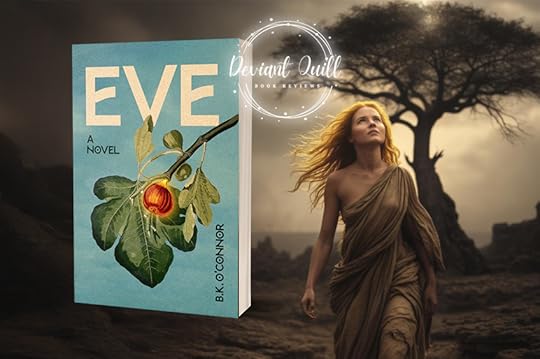
The story of Eve has always been told to keep women small. This novel rips that story apart. Eve is a bold, unflinching story of curiosity, rebellion, and intellect.
Eve is a gut punch to the tired, patriarchal version of the world’s oldest story. This isn’t a gentle retelling of Genesis. It’s Eve, fully alive, fully awake, fully unwilling to stay in the cage that history built for her. She’s curious, questions, leaves, learns, and in doing so, she drags the whole narrative of “original sin” kicking and screaming into the modern era. The old story treats women like cautionary tales. “It was her fault.” “Women caused humanity to fall.” This one treats them like humans with brains, desires, and power. The novel doesn’t shy away from the costs of autonomy. Exile isn’t necessarily a punishment here, but more of selfhood being born through fire and loss. Eve’s relationships, her wanderings, the lonely weight of motherhood are all there, brutal and real. And the book doesn’t punish her for wanting more. It honors the complexity of being a woman in a world that still tries to define what that should mean.
What makes Eve crackle is how the story becomes political without ever being preachy. Her search for knowledge, her defiance, and her attempts to create spaces where women can learn and exist freely are mirrors of every fight for rights, recognition, and voice that’s happening right now. The echoes are loud: controlling women starts with controlling stories, and reclaiming them is revolutionary. It’s a very important novel being published when it’s needed the most. The times we live in might be modern in theory, but women’s rights are being suppressed again, and the literary world needs more Eves to fight back with words and stories.
This book isn’t subtle. It’s angry, smart, and unapologetic. Eve is a force, and reading her story is a reminder that myth, like history, is only as truthful as the people who get to tell it. By the time you finish, you’re left thinking about everything: power, freedom, motherhood, identity, and how much of the world is still waiting for its Eve to stand up.
Let’s be honest: this isn’t a book for Christians looking for comfort in familiar texts, or for anyone who prefers the Bible served in neat, unquestioned packages. If your instinct is to protect the “sanctity” of Genesis or to defend traditional interpretations without question, Eve will make you squirm. It challenges dogma, tears apart inherited narratives, and shows that the first woman (like every woman after her) was never meant to be obedient or invisible.
If you want myth served neat, move along. This is a necessary book for thinkers, rebels, and anyone ready to question everything they thought they knew.
Tropes & Vibes
Reimagined biblical figure
Feminist reclamation of origin stories
Exile as self-discovery
Forbidden knowledge as empowerment
Motherhood complicated by autonomy
Quest for learning and agency
Transformation through loss and choice
Moral ambiguity and personal ethics
Urgent, contemporary resonance
Empowering, raw, and visionary
Quietly radical critique of tradition
Review copy provided by Histria Books @ Net Galley
The story of Eve has always been told to keep women small. This novel rips that story apart. Eve is a bold, unflinching story of curiosity, rebellion, and intellect.
Eve is a gut punch to the tired, patriarchal version of the world’s oldest story. This isn’t a gentle retelling of Genesis. It’s Eve, fully alive, fully awake, fully unwilling to stay in the cage that history built for her. She’s curious, questions, leaves, learns, and in doing so, she drags the whole narrative of “original sin” kicking and screaming into the modern era. The old story treats women like cautionary tales. “It was her fault.” “Women caused humanity to fall.” This one treats them like humans with brains, desires, and power. The novel doesn’t shy away from the costs of autonomy. Exile isn’t necessarily a punishment here, but more of selfhood being born through fire and loss. Eve’s relationships, her wanderings, the lonely weight of motherhood are all there, brutal and real. And the book doesn’t punish her for wanting more. It honors the complexity of being a woman in a world that still tries to define what that should mean.
What makes Eve crackle is how the story becomes political without ever being preachy. Her search for knowledge, her defiance, and her attempts to create spaces where women can learn and exist freely are mirrors of every fight for rights, recognition, and voice that’s happening right now. The echoes are loud: controlling women starts with controlling stories, and reclaiming them is revolutionary. It’s a very important novel being published when it’s needed the most. The times we live in might be modern in theory, but women’s rights are being suppressed again, and the literary world needs more Eves to fight back with words and stories.
This book isn’t subtle. It’s angry, smart, and unapologetic. Eve is a force, and reading her story is a reminder that myth, like history, is only as truthful as the people who get to tell it. By the time you finish, you’re left thinking about everything: power, freedom, motherhood, identity, and how much of the world is still waiting for its Eve to stand up.
Let’s be honest: this isn’t a book for Christians looking for comfort in familiar texts, or for anyone who prefers the Bible served in neat, unquestioned packages. If your instinct is to protect the “sanctity” of Genesis or to defend traditional interpretations without question, Eve will make you squirm. It challenges dogma, tears apart inherited narratives, and shows that the first woman (like every woman after her) was never meant to be obedient or invisible.
If you want myth served neat, move along. This is a necessary book for thinkers, rebels, and anyone ready to question everything they thought they knew.
Tropes & Vibes
Reimagined biblical figure
Feminist reclamation of origin stories
Exile as self-discovery
Forbidden knowledge as empowerment
Motherhood complicated by autonomy
Quest for learning and agency
Transformation through loss and choice
Moral ambiguity and personal ethics
Urgent, contemporary resonance
Empowering, raw, and visionary
Quietly radical critique of tradition
Review copy provided by Histria Books @ Net Galley
October 26, 2025
Thank you to Netaglley and the publisher for an advanced readers copy in exchange for an honest review. This book started out super strong but fell flat super fast for me. I understand that it was supposed to be a feminist retelling of the story of adam and eve but this book felt like it was trying to do entirely too many things and it did none of them well. If you are familiar with the bible story then you might want to pick this up because it could be semi interesting but this is not a book I would recommend to many people.
Review of advance copy received from Netgalley
Eve is a stunning debut novel by B.K. O'Connor, her writing style captured me and placed me into the Garden of Eden immediately. This book is a one of a kind in how it expands the story of Adam and Eve beyond the biblical narrative from Genesis. It's important to note that this book does not reflect accurate biblical theology and instead has placed a more modern theme of today's current culture on the creation story, specifically in Eve. I will definitely be waiting for the next book by B.K. O'Connor!

Did Not Finish
July 5, 2026Noped out at the bunny killing scene

October 26, 2025
Eve is Homer meets Genesis, with exile, adventure, and at the heart of the story, a fierce heroine who refuses to play the role history wrote for her. Sorry Drake, this isn't God's plan.

June 10, 2026
Trash + disgusting distortion of the Bible and Yahweh’s story. I cannot stand the twisting of scripture - you have a million stories to choose from to write about, why chose one from the bible?
Phony heretic twisting sacred words to fit woke agendas that are more palatable to ~2026 progressive peeps~. The implications of leading those astray by rewriting Gods story quite literally has ETERNAL consequences. I pray no one is led astray by these blasphemous ideas that corrupt the true God of the Bible.
Phony heretic twisting sacred words to fit woke agendas that are more palatable to ~2026 progressive peeps~. The implications of leading those astray by rewriting Gods story quite literally has ETERNAL consequences. I pray no one is led astray by these blasphemous ideas that corrupt the true God of the Bible.

October 3, 2025
Thank you NetGalley and Histria Books for the Arc!
Eve is an interesting retelling of the story of the first woman and man through Eve’s point of view. From her creation to her exile from Eden– and how she sees it less and less of an exile the more that she gets to live. Eve asks the questions that everyone wonders and challenges everything that she does not understand. Eve breaks from the mold of her creator and becomes something more than, traveling throughout the land and experiencing everything, and moving the Gods that she meets along the way. Halfway through the book is where I feel O’Connor really got the chance to shine, as it slowly transitioned from a retelling to more of a continuation.
B.K. O’Connor writes in such a poetic prose, while not getting too lost. Eve is perfect for people who were raised in the church but always had a few extra questions and a few connections that didn't quite make sense.
Eve is an interesting retelling of the story of the first woman and man through Eve’s point of view. From her creation to her exile from Eden– and how she sees it less and less of an exile the more that she gets to live. Eve asks the questions that everyone wonders and challenges everything that she does not understand. Eve breaks from the mold of her creator and becomes something more than, traveling throughout the land and experiencing everything, and moving the Gods that she meets along the way. Halfway through the book is where I feel O’Connor really got the chance to shine, as it slowly transitioned from a retelling to more of a continuation.
B.K. O’Connor writes in such a poetic prose, while not getting too lost. Eve is perfect for people who were raised in the church but always had a few extra questions and a few connections that didn't quite make sense.
September 23, 2025
Men are not to be trusted - the novel. I honestly enjoyed this a lot more than I thought I would.
This is a feminist retelling of Paradise Lost. When Adam and Eve are thrown out of paradise once she bites the fruit and convinces Adam to do so as well, they must find a new way to live. Eve asks God why he didn't show himself to her before throwing them out, as he did to Adam. No answer is given. In the wider world, Eve's curiosity grows, wondering what else may be out there in existence, as Adam finds peace, and another woman in Mesopotamia. Eve decides to leave her children and Adam behind to explore the world and learn what exists and what life is. It raises a lot of feminist questions (Why can a mother not leave when a father can? Why does a woman have to be subservient, but a man doesn't) and uses the first woman to ask them.
Thank you to NetGalley for an eARC of this novel.
This is a feminist retelling of Paradise Lost. When Adam and Eve are thrown out of paradise once she bites the fruit and convinces Adam to do so as well, they must find a new way to live. Eve asks God why he didn't show himself to her before throwing them out, as he did to Adam. No answer is given. In the wider world, Eve's curiosity grows, wondering what else may be out there in existence, as Adam finds peace, and another woman in Mesopotamia. Eve decides to leave her children and Adam behind to explore the world and learn what exists and what life is. It raises a lot of feminist questions (Why can a mother not leave when a father can? Why does a woman have to be subservient, but a man doesn't) and uses the first woman to ask them.
Thank you to NetGalley for an eARC of this novel.
September 11, 2025
An incredible and captivating read! Eve brings a feminist lens to the story of the often-flattened biblical Eve and builds a compelling character with depth, flaws, curiosity, and agency. You won't want to put this book down! I got hooked wanting to see where her curiosity and passion takes her, who she encounters along the way, and where her story goes. The writing brings to life an ancient world and characters with endearing and thought-provoking complexity that stays with you well after you finish.

September 1, 2025
A richly imagined retelling of the story of Adam and Eve. Philosophical, engaging, and sexy stuff. Read this if you loved Circe and The Penelopiad. This is an exciting debut and I can’t wait to see what B.K. O’Connor writes next!

January 19, 2026
“To all the Eves, unable to shake the urge to know.”
I have never read Paradise Lost, but I loved this feminist retelling of Eve’s story, her journey of discovery, and her thirst for knowledge. The prose was beautiful and the exploration of the themes of agency, self determination, and feminine rage were interesting. This was a very character driven story with sections on motherhood, the divine feminine, and Eve’s relationship with Adam. I found Eve’s experiences with motherhood the most fascinating, especially around birth.
“How many bites of bitter fruit must she take to truly know? How many men will keep worlds hidden from her?”
After the fall in Eden, I never really thought about Satan/Lucifer/the serpent, but this story also reimagined him as giving fire as a gift, as an act of asking for forgiveness for leading Eve astray and the suffering she endures after leaving the garden of Eden. Like in Greek mythology, when Prometheus stole fire from the gods and gave it to humanity, empowering them with warmth, cooking, technology, and creating the foundation for civilization. However, unlike Prometheus incurring the wrath of Zeus, Lucifer had already fell from heaven so God seemed unconcerned with this series of events.
“Always, take the fruit.”
Adam as the original adulter was maddening, but satisfying. I feel like in story of Adam and Eve, we always villainize Eve. However I enjoyed a softer, more balanced view of Adam and Eve as both flawed and curious and desiring more (although maybe not knowing what that “more” is and still both hurting each other).
“To be a woman in this world, she knows, is dangerous. There is no freedom in a women’s body before a man alone. If only she were not a woman. No, she laments, if only men did not make her womanhood a liability.”
I took a course called Revolutionary Women in college and even though this book was fiction, I think it would have fit right in with the intention of the syllabi. Eve was a short, but meaningful read that will stick with me for a while.
“The idea that one group, one heart should dominate over the other is faulty; God’s curse does not reach me where I’ve gone. This will be my daughter’s inheritance.”
✨4 stars.
Thank you NetGalley and Histria Books for this e-arc. Eve comes out February 10, 2026.
I have never read Paradise Lost, but I loved this feminist retelling of Eve’s story, her journey of discovery, and her thirst for knowledge. The prose was beautiful and the exploration of the themes of agency, self determination, and feminine rage were interesting. This was a very character driven story with sections on motherhood, the divine feminine, and Eve’s relationship with Adam. I found Eve’s experiences with motherhood the most fascinating, especially around birth.
“How many bites of bitter fruit must she take to truly know? How many men will keep worlds hidden from her?”
After the fall in Eden, I never really thought about Satan/Lucifer/the serpent, but this story also reimagined him as giving fire as a gift, as an act of asking for forgiveness for leading Eve astray and the suffering she endures after leaving the garden of Eden. Like in Greek mythology, when Prometheus stole fire from the gods and gave it to humanity, empowering them with warmth, cooking, technology, and creating the foundation for civilization. However, unlike Prometheus incurring the wrath of Zeus, Lucifer had already fell from heaven so God seemed unconcerned with this series of events.
“Always, take the fruit.”
Adam as the original adulter was maddening, but satisfying. I feel like in story of Adam and Eve, we always villainize Eve. However I enjoyed a softer, more balanced view of Adam and Eve as both flawed and curious and desiring more (although maybe not knowing what that “more” is and still both hurting each other).
“To be a woman in this world, she knows, is dangerous. There is no freedom in a women’s body before a man alone. If only she were not a woman. No, she laments, if only men did not make her womanhood a liability.”
I took a course called Revolutionary Women in college and even though this book was fiction, I think it would have fit right in with the intention of the syllabi. Eve was a short, but meaningful read that will stick with me for a while.
“The idea that one group, one heart should dominate over the other is faulty; God’s curse does not reach me where I’ve gone. This will be my daughter’s inheritance.”
✨4 stars.
Thank you NetGalley and Histria Books for this e-arc. Eve comes out February 10, 2026.

December 23, 2025
Eve is a bold and thoughtful reimagining that treats its source material not as something to correct, but as something to question. This Eve is curious, restless, and unwilling to accept simple answers—about creation, obedience, love, or divinity and that curiosity is what gives the novel its momentum.
The prose leans lyrical without losing clarity, and the story balances big philosophical ideas with an accessible, often quietly playful tone. I especially enjoyed how the novel allows Eve to move beyond the familiar confines of Eden and into a wider world, where myth, history, and human experience begin to blur together.
This is the kind of book that invites conversation rather than closure. It doesn’t hand you conclusions; it asks better questions. Readers who enjoy literary retellings, mythological reframing, and stories that trust their audience to think will find a lot to admire here.
Thank you @netgallery for the arc
The prose leans lyrical without losing clarity, and the story balances big philosophical ideas with an accessible, often quietly playful tone. I especially enjoyed how the novel allows Eve to move beyond the familiar confines of Eden and into a wider world, where myth, history, and human experience begin to blur together.
This is the kind of book that invites conversation rather than closure. It doesn’t hand you conclusions; it asks better questions. Readers who enjoy literary retellings, mythological reframing, and stories that trust their audience to think will find a lot to admire here.
Thank you @netgallery for the arc
April 16, 2026
Thank you to NetGalley and the publisher for this ARC.
This was definitely a case of "it's not you, it's me". Technically this book has everything I like, and falls squarely into one of my preferred genres - (feminist) myth retellings. Still, I just wasn't able to get into the story at all, and I really can't dsy why because objectively, there was nothing wrong with this book. It was just the right amount of philosophical, it was well written, the plot was an interesting spin on the story of Eve, and yet... it just didn't work for me, which is a pity. I might pick it up again at a later time, to see if maybe my mood just wasn't right now. Definitely would still recommend this to readers that enjoy feminist retellings of myths and similar stories, because again, nothing was actually wrong with this book at all.
This was definitely a case of "it's not you, it's me". Technically this book has everything I like, and falls squarely into one of my preferred genres - (feminist) myth retellings. Still, I just wasn't able to get into the story at all, and I really can't dsy why because objectively, there was nothing wrong with this book. It was just the right amount of philosophical, it was well written, the plot was an interesting spin on the story of Eve, and yet... it just didn't work for me, which is a pity. I might pick it up again at a later time, to see if maybe my mood just wasn't right now. Definitely would still recommend this to readers that enjoy feminist retellings of myths and similar stories, because again, nothing was actually wrong with this book at all.

Did Not Finish
March 14, 2026DNF at 25%, which genuinely pains me, because the dedication alone had me fully on board: "To all Eves, unable to shake the urge to know." And the FMC? Loved her immediately.
But the writing style wasn't fully clicking for me, and the MMC was such a spectacular wet towel that I couldn't push through, which, honestly, is a compliment to the author. He's clearly written exactly as intended. He just happened to be exactly the kind of character I have no patience for.
The premise is genuinely interesting, and I don't doubt this will be the right book for someone. It just isn't for me.
But the writing style wasn't fully clicking for me, and the MMC was such a spectacular wet towel that I couldn't push through, which, honestly, is a compliment to the author. He's clearly written exactly as intended. He just happened to be exactly the kind of character I have no patience for.
The premise is genuinely interesting, and I don't doubt this will be the right book for someone. It just isn't for me.

August 18, 2026
A fantastic retelling of a character who is commonly silenced and vilified even today!
I loved the exploration of what the forbidden fruit truly was, and I very much enjoyed the ways other ancient cultures and pantheons intersected with Eve's story. Amidst the narrative, there were so many moments of reflection, and the final moments of the book provided a wonderful message!
The author clearly did her research and wrote a lovely book that gives a voice to Eve and treats her as the hero of the story.
I loved the exploration of what the forbidden fruit truly was, and I very much enjoyed the ways other ancient cultures and pantheons intersected with Eve's story. Amidst the narrative, there were so many moments of reflection, and the final moments of the book provided a wonderful message!
The author clearly did her research and wrote a lovely book that gives a voice to Eve and treats her as the hero of the story.

Did Not Finish
March 1, 2026I think I am the wrong audience for this book. It seemed like it would be interesting based on the premise, but once I got into it I was bogged down by the idea. I’ve never read Paradise Lost, I’m an atheist, and I haven’t read much feminist literature so it was a stretch for me.
DNF 20%
Thank you BK O’Connor for the gifted copy and swag box.
DNF 20%
Thank you BK O’Connor for the gifted copy and swag box.

May 10, 2026
Beautifully written! Each sentence feels like poetry. From page one, I was completely captivated by the vivid imagery. Remember that this is a story, and if you approach it with an open mind, you’ll be transported into the whimsical world O’Connor has so masterfully crafted for readers to immerse themselves in.
Review of advance copy received from Netgalley
Real feel: 3.5⭐️

May 17, 2026
4.2
VERY different book for me but i loved it. old testament got some bangers of stories
VERY different book for me but i loved it. old testament got some bangers of stories

January 19, 2026
imagine pushing out the first baby in existence and immediately pass out from exhaustion and then when you wake up you find out your husband’s already named it

November 26, 2025
This book blew me away! Absolutely stunning and thought-provoking. I often wonder about what history has not told us. The Bible only has a few chapters about Eve, but what about all the other experiences she had? This book leaves nothing out! I don't agree with most of the storyline because it's not the biblical worldview. However, I really enjoyed the book anyway because it allowed me to learn what others believe or theorize about Eve. If you like historical fiction, feminist literature, or alternative theories to the Bible, this is the book for you. Thank you, LibraryThing for my ARC!
Displaying 1 - 30 of 140 reviews