A Solution-Driven Handbook for Workplace Relationships Why is it so difficult to collaborate with that one coworker? Why can't your boss understand where you're coming from? We all want to experience a healthy, flourishing work environment, but interpersonal conflicts and miscommunications often make work feel frustrating, overwhelming, and maybe even toxic. With the Enneagram as her guide, Joey Schewee provides a holistic, empowering approach to relating to one another in the workplace, as she helps you foster behavioral consciousness through awareness of motivational differences. She provides practical explanations of a dynamic wisdom for immediate application using anecdotes gained from seventeen years of consulting in professional environments. Drawing from her work with thousands of employees and hundreds of teams, Schewee introduces new concepts such as processing centers, reference points, and focus shifts, Enneagram advancements shared in this book for the first time. In When Working Together Doesn't Work, you'll learn how differing motivations or types can affect employee cohesiveness and productivity, how managers can engage individuals by type, so that employees feel understood and valued, and how to significantly reduce the perception of personal slights and pave the way for understanding, trust, and collaboration. While many personality typing systems focus on behavior, they often fail to address the core motivations behind it—something the Enneagram does exceptionally well. When Working Together Doesn't Work is designed to equip you, at any level of business, to improve workplace dynamics. By applying the proven approach outlined in this book, you'll significantly reduce misunderstandings, build trust, and encourage collaboration at work. As you grow in your understanding of your coworkers, you'll experience improved employee engagement and shape your work culture in powerful and lasting ways. Start transforming your workplace today!
JOEY SCHEWEE has been a student of the Enneagram for 30 years. She is a sought-after theorist with bone level understanding of the unique motivations that inform human behavior. As the eldest daughter of renowned teacher, Suzanne Stabile, Joey is an Enneagram 8 who has been on the journey to self-discovery using the Enneagram since she was a teenager. She is distinctively equipped to break the traditional model of Enneagram understanding and present readers with a uniquely tailored application of this wisdom for use in daily life. She continues to advance the historic insight of the Enneagram for modern consumption and practical application, working as a management consultant for business cultures and an executive coach for leaders. Joey and her husband, Billy live in Texas with their two sons and enjoy contributing to meaningful conversation surrounding marriage and parenting through the Enneagram lens.
Easily one of the most helpful books I've read about the Enneagram. Joey does not mince words. For my type, I found it equal parts validating and challenging. In learning about other types, it has significantly improved my understanding of how they see. The book has been very useful in navigating relationships in my marriage, with family, friends and co-workers.
A fantastic, concise read on the Enneagram at work in 192 pages. When Working Together Doesn't Work is designed to improve workplace dynamics through relational understanding.
Why Your Team Keeps Replaying the Same Conflict: “When Working Together Doesn’t Work” and the Invisible Machinery of Pace, Control, Questions, and Silence By Demetris Papadimitropoulos | February 19th, 2026
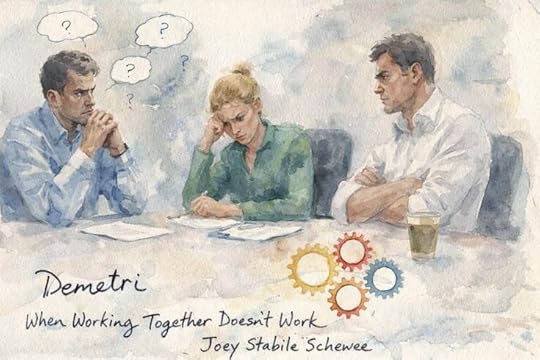
Watercolor Piece by Demetris Papadimitropoulos
“When Working Together Doesn’t Work” arrives with the weary clairvoyance of a book written by someone who has watched the same argument replay itself in a hundred conference rooms – and has finally stopped believing the participants are arguing about what they think they’re arguing about. The meeting is never “about” the agenda item. It is about pace. It is about whose questions count as diligence and whose count as sabotage. It is about whether silence is prudence or passive aggression, whether intensity is leadership or threat, whether the person who keeps the mood buoyant is a culture-carrier or a derailment artist. In other words: it is about the invisible machinery of personality colliding with the visible machinery of work.
The author’s wager is that the Enneagram, handled with seriousness and used less as a party trick than as a lens for cause and effect, can make that machinery legible. Not because it turns people into tidy labels, but because it insists on a distinction many workplaces have forgotten how to make: between behavior and motivation. “When Working Together Doesn’t Work” is at its best when it treats typology not as identity, but as troubleshooting – a way to ask, with less moral heat, what each person is reaching for when they reach for control, approval, certainty, autonomy, harmony, competence, intensity. The book does not pretend that every conflict can be solved with understanding. It does something both humbler and more useful: it teaches you where understanding changes the temperature enough for a decision to happen.
A lesser book would open with the seduction of self-recognition and stay there, flattering the reader with accurate descriptions and a sprinkling of bromides. This one has a more combative streak. The author writes like a coach who has seen “self-awareness” weaponized – used as an alibi for bad habits, or as a velvet rope that keeps feedback out. She repeatedly drags the Enneagram back to the workplace, back to consequences, back to the way a small pattern becomes a team’s weather system. Her core framework is built around the three Centers of Intelligence – doing, feeling, thinking – and the ways each type draws from them, resists them, or borrows from them under stress and security. It is a tidy architecture, but it doesn’t feel merely abstract, because she keeps pinning it to the daily indignities of office life: the slack thread that becomes a tug-of-war, the harmless joke that becomes a paper trail, the “quick question” that is really a referendum on authority.
What gives the book its particular flavor is the author’s insistence on pairs: how you see yourself versus how others can see you. These call-and-response portraits – often delivered with a brisk, unsentimental rhythm – are where the work becomes eerily accurate. You are principled; you are rigid. You are loyal; you are resistant to change. You are decisive; you are reckless. You are collaborative; you are conflict-avoidant. The point is not to shame, but to reveal the gap between intent and impact – the gap where most workplace resentment grows mold. In an era when office life is increasingly mediated by screens and snippets, when tone is inferred from punctuation and delays, the book’s emphasis on impact feels less like etiquette and more like risk management.
The author’s risk management is not theoretical. She writes with the granular specificity of someone who has actually sat with executives and VPs and bookkeepers long enough to learn what they confess when the door is closed. Her case studies and anecdotes – a Six who, after two missed calls, plans a funeral down to the catering before learning the issue is a minor insurance-card glitch; a phobic Six COO who would rather drive for hours than fly because the ground offers more controllable scenarios; a counterphobic Six bookkeeper who mistypes as an Eight and will not soften her delivery even when she understands how she lands – are not merely colorful. They demonstrate the book’s thesis that the Enneagram is less about who you are in a vacuum than about what you do when the world is blowing up next to you.
If that phrase sounds melodramatic, it is because the book is quietly attuned to the melodrama of modern work. Even when it does not name them, the book’s scenes carry the pressure of our moment: the churn of reorganizations, the low-grade panic of layoffs, the culture of surveillance disguised as productivity tooling, the way hybrid work has turned “responsiveness” into a moral category. It is hard to read the author’s counsel to publish agendas ahead of time, to create time and space for questions, to avoid “public teasing” as a management tactic, without thinking of how often our workplaces now litigate trust in writing – in a group chat, in a shared document, in a forwarded thread. The book’s warning to Sevens – do not put your comedic whims in writing – sounds like a line pulled from the transcript of a reputational crisis.
There is a shrewdness, too, in the author’s attention to the ecology of different stances: Independent (Three, Seven, Eight), Solitary (Four, Five, Nine), Responsive (One, Two, Six). This triad, and the needs attached to it – consistency, latitude, affirmation – becomes one of the book’s most portable tools. It is also where the author’s voice sharpens into something like managerial liturgy: be consistent with expectations, follow-through, consequences. Ask for input from the Solitary stance, agree on timelines, and then do not smother them with check-ins. Do not take a Six’s questions personally. Bound the time. Anticipate the questions and answer them in advance. There is a paradox here that the author handles well: the more you personalize workplace friction, the harder it is to fix; the more you depersonalize it into patterns, the more you can intervene without shame.
And yet – because the author is writing from conviction and not from academic timidity – she sometimes pushes this depersonalization too far. The book likes its absolutes. “Sixes do not move forward, with speed, into unknown territory. Ever.” The word “ever” is a dare: useful as emphasis, but also an invitation for the reader to find the counterexample and dismiss the system. The Enneagram is not psychology in the empirical, peer-reviewed sense, and the book occasionally forgets to signal that distinction. It is careful to say that mistyping is common, that online tests are unreliable, that behavior is a noisy indicator. But in the heat of her own clarity, the author can sound as though she has invented a taxonomy with the inevitability of anatomy.
Still, the book’s clarity is also its gift. In a market saturated with personality frameworks that feel like horoscope apps with a corporate expense account, “When Working Together Doesn’t Work” has an unusually adult relationship to its own tool. It is less interested in charming you than in correcting you. Its guidance is often framed as a series of small dignities: let hard things be said in private. Don’t hold others hostage with your energy withdrawal. Don’t confuse camaraderie with loyalty. Don’t mistake a barrage of questions for insubordination. Bring the people you want input from into the same room to avoid triangulation. Circle back once you’ve made the decision. The book knows how teams get sick: not by one catastrophe, but by tiny ruptures that never get repaired.
The chapter on Sixes – presented late, “for a reason” – may be the book’s most impressive demonstration of this repair instinct. The author treats the Six not as a stereotype of anxiety, but as a living contradiction: dominant thinking values carried into feeling processing; preparedness mistaken for fear; devotion to authority mistaken for distrust of it; “devil’s advocate” thinking mistaken for obstruction. Her key line, repeated like a mantra, is “It’s not personal, it’s Sixness.” As a phrase, it risks becoming a cute catchall. As an intervention, it can be profound, because it asks managers to stop interpreting the Six’s questions as a referendum on their legitimacy. The author’s portrait of Sixes controlling time with questions is both funny and uncomfortably true. So is her observation that earning the role of trusted advisor does not mean the Six will do what you suggest – it means the Six trusts you enough to ask.
The author’s best pages have this double quality: they feel like a relief to the person who finally has language for themselves, and like a relief to the coworker who finally has permission not to moralize what they have been experiencing. This is why the book has kinship with “Crucial Conversations” and “Difficult Conversations,” with “Radical Candor” and “The Coaching Habit,” even with older parables like “The Five Dysfunctions of a Team.” It belongs to that lineage of workplace books that understand the true unit of organizational life is not the strategy deck but the conversation that never quite happens. It also sits, obviously, in the Enneagram shelf – near “The Wisdom of the Enneagram” and “The Road Back to You” – though its tone is more operational than spiritual, more meeting than monastery.
Where the book becomes most distinctive is in its attention to the moralization traps that modern organizations fall into. The author is alert to how “culture” can become a polite form of coercion. A combative climate – show no weakness, put work first, dog-eat-dog – creates silence, and silence creates futility, and futility creates a workforce that stops trying to correct itself. Read those pages and you can’t help thinking of the last few years’ public reckonings: the corporate statements that did nothing, the internal backlash cycles, the quiet quitting headlines that misdiagnosed disengagement as laziness rather than as a learned response to inconsistency. The book’s insistence that leaders must model speaking up – and must create conditions where speaking up is not punished – lands as more than personality advice. It is governance.
Yet the book also has blind spots – or, more accurately, it has the blind spots of a system. Typology can become a euphemism. It can help you see patterns, and it can help you excuse them. The author fights this tendency, but she cannot fully outrun it. A manager armed with type language can easily slip from empathy into manipulation – dangling carrots, engineering affirmation, calibrating meetings like a lab experiment – and call it “understanding.” The author warns against performative servant leadership, against making a show of taking on thankless tasks, but the risk remains: any framework that promises access to human motivations can be used as a crowbar.
There is also the question of power, which the book touches but does not fully interrogate. A book that teaches you how to manage types can assume the reader has managerial authority, or at least social leverage. But many workplace conflicts are not simply mismatches of processing styles; they are mismatches of status, pay, precarity. The Six who wants context may be asking because they’ve watched people get cut without warning. The Nine who delays may be delaying because they are doing three jobs quietly, the organizational version of the “do more with less” mantra. The Seven who uses humor may be trying to survive a culture that punishes vulnerability. The Eight’s intensity may be the only tool they have ever been rewarded for. Personality is always interacting with incentives. The author knows this – her examples often imply it – but the book’s confidence sometimes makes it seem as though the right language can dissolve the wrong structure.
And yet, to demand structural analysis from this book would be to ask it to be a different book. It is not “Bullshit Jobs.” It is not “Work Won’t Love You Back.” It is not “The Burnout Society.” It is something more tactical: a set of lenses you can hold up to yourself and others before you do the thing that ruins trust – assuming malice where there is pattern, assuming laziness where there is fear, assuming disrespect where there is difference in tempo. In that sense, the book is quietly humane. It argues that most people are not intentionally making work harder. They are repeating a strategy that once kept them safe.
The writing mirrors this philosophy. The author’s sentences often move like a decisive manager: short, declarative, corrective. She likes a clean turn of phrase, a well-placed tagline. She is not afraid of intensity, and she does not apologize for telling the reader what to do. That directness will delight some and alienate others. Readers who prefer the gentle ambiguity of “Quiet” or the research-heavy architecture of “Thinking, Fast and Slow” may find her certainty abrasive. But the book is not trying to be a study. It is trying to be useful.
Usefulness, in this case, is not a small thing. A genuinely useful workplace book is rare because it must do two incompatible tasks at once: it must honor complexity, and it must offer simplifications that can survive contact with Monday morning. “When Working Together Doesn’t Work” walks that line better than most. Its final section on mistyping is an honest acknowledgment of human self-deception. The author points out that we often choose the type we admire, or the one that fits how we want to be seen at work. Her three questions – How do I behave under stress? Am I conscious of my fueling emotion? How do I react when the world is blowing up next to me? – are not just typing tools. They are invitations to a less flattering self-portrait.
Perhaps the book’s most quietly radical claim is that balance among thinking, feeling, and doing has been a philosophical project for centuries – and that the workplace is one of the few places we are forced to attempt it daily. In a time when work has become, for many, the primary theater of identity, this is both comforting and troubling. The author is not interested in telling you to quit. She is interested in telling you how to stay – and how to stay without calcifying into your own coping mechanism.
If I have reservations, they are the reservations of someone who has seen frameworks become fashions. The Enneagram is having a moment, and moments pass. What will endure from this book is not the numbering, but the discipline it demands: listen longer than your instinct. Name the need beneath the behavior. Be consistent. Don’t turn humor into a weapon. Don’t put the hardest truths on blast. Treat questions as processing, not rebellion. Treat silence as data, not consent. Those are not typological tips. They are the elementary ethics of collaboration.
Keep it nearby, not as a mirror, but as a wrench – something you reach for when friction returns and you’re tempted to narrate coworker as villain. The book is strongest as a pause button, choosing response over reflex.
A book that leaves you with ethics – rather than merely with labels – has earned its place on the shelf. My rating: 87/100.
📍An Enneagram Guide to Better Workplace Relationships!
A workplace psychology and personality book that uses the Enneagram system to explain why intelligent and capable people often struggle to collaborate effectively. Rather than focusing only on behavior, the book argues that understanding motivation is the key to improving communication, teamwork, leadership, conflict resolution, and productivity.
The book introduces the idea of three Centers of Intelligence: Doing (Gut), Feeling (Heart), and Thinking (Head) and explains how different Enneagram types naturally prioritize action, emotion, or analysis. From there, it explores how those internal patterns influence workplace decisions, leadership styles, communication habits, stress responses, and team dynamics.
One of the strongest ideas in the book is the shift from asking “What are people doing?” to “Why are they doing it?” The author argues that observable behavior can look similar while underlying motivations are completely different.
The explanation of the Doing, Feeling, and Thinking Centers stood out: • Doing (Gut): action, implementation, execution, practicality. • Feeling (Heart): relationships, emotional awareness, interpersonal connection. • Thinking (Head): analysis, information, objectivity, planning.
The book also introduces the Enneagram triads: • Types 8–9–1 (Gut): action-driven and intuitive. • Types 2–3–4 (Heart): relationship and emotion-oriented. • Types 5–6–7 (Head): analytical and security/information-oriented.
A practical insight was that two employees can produce the same results but require completely different environments, communication styles, or responsibilities because their motivation differs.
Perfect for managers, team leaders, HR professionals, coaches, entrepreneurs, consultants, and anyone working in collaborative environments. Also valuable for readers interested in personality systems, self-awareness, organizational psychology, leadership development, and communication frameworks. Especially useful if you’ve ever thought: “Why do competent people still misunderstand each other?”
I love both faith and the Enneagram, but not all of my colleagues share my faith. That’s why I was excited to find an Enneagram book focused on working well together in a professional setting.
One of the hardest parts of any Enneagram study is understanding the numbers at the center—3, 6, and 9, referred to by Schewee as primary types. These numbers filter through feeling, thinking, and doing, but quickly shift to process through a different center. This book does a fantastic job of explaining that dynamic in a way that is clear and practical.
I especially appreciated how Schewee addresses mistyping, showing that behaviors that look similar across types can come from very different motivations. The “gray” boxes are also a great feature—they break up the content and make key insights easier to grasp.
Schewee walks through each number, exploring both self-perception and how each type may be seen by others in the workplace, offering helpful guidance from both perspectives. This is the Enneagram book I’ve been looking for to share with my team and colleagues—and it absolutely lived up to my expectations. #AllTheStars
"When Working Together Doesn't Work" is a great title for working with and better understanding of different numbers of the Enneagram. Just under 200 pages, the book covers many helpful areas, including:
- How people in the various enneagram numbers work and relate to others at work (helps to better understand them). - Tips for manager on how to manage people of various enneagrams. - Includes helpful charts and tables for describing topic being covered. - Includes a good introduction on what motivates people of the different enneagrams. - For each enneagram, shows how the person views themself at work and how others can view them. - Helpful questions to ask yourself to help avoid mistyping people. - Includes a helpful appendix for more reflection questions.
The book is easy to read and understand and includes helpful information for better understanding people of various personalities and motivations. Great tool for the workplace. Recommended.
I was given a copy by IVP in exchange for a fair review and appreciate the opportunity.
When Working Together Doesn’t Work offers a practical and accessible approach to navigating workplace relationships through the lens of the Enneagram. Joey Stabile Schewee focuses on motivation rather than just behavior, helping readers better understand why people respond the way they do in professional settings.
The strength of this book lies in its application. Drawing from years of consulting experience, Schewee provides concrete tools and frameworks that can be used right away to improve communication, reduce conflict, and build trust within teams. The focus on awareness and perspective-taking is especially helpful for both managers and team members.
For readers already familiar with the Enneagram, this book offers a useful extension into the workplace. For those new to it, it serves as a practical entry point for thinking differently about collaboration and conflict.
Thanks to NetGalley for a copy of this book for review.
Some really helpful insights about how the Enneagram is connected to the workplace that I'd never heard or read before, but overall the book was disorganized and hard to follow. There were many insights about certain numbers embedded in the chapters about other numbers, which made it hard to keep straight. Additionally, there were some unfamiliar concepts to me (and I've read quite a bit on this topic) that were barely explained or maybe presumed to be common knowledge (ex: the processing divide, processing centers). The infographics were clear and helpful, and I wish more of the book followed that format, Overall, I think the information was helpful, but it'll take a second read for me to sort it out, and I wish the author's editor would have helped more with the organization and clarity.
This book relies heavily on 9 numbered types of the Enneagram. The author seems to have grown up with knowledge of these types and starts referring to them before he even explains them. It mostly feels like trying to read a code that one doesn't understand. This makes it feel like the reader has to do homework to understand the book. It is also impractical because one has to have tested the other people and one's self in order to apply the system. This is further complicated because the author points out that a lot of people are falsely classified. This book is more targeted towards high ranking management in white collar fields than towards someone who just wants to work better with others.
If I could give this book six stars, I would. I wish I had written it. It’s an amazing, concise guide to the enneagram in the workplace. It reviews the major concepts throughout the book, referring back to them and reminding us how those major concepts (Centers of Intelligence, stances) affect the specifics of each number during the breakdowns of each number. Leaders who want to improve their interactions with and leadership of their teams would greatly benefit from taking in this teaching and allowing it to guide their own inner work and decision making.
This book is so important for the enneagram-verse. Joey is enhancing the ancient wisdom and helping it to translate to more people. She has a keen eye for this tool and communicates it in such a no-nonsense way. Whether you are seasoned in enneagram or brand new — this book is for you!
Concise, practical advice one can actually utilize in the workplace. I love how Schewee gives practical examples for both the employee and the leader. This is not a beginner enneagram book; I do think having some basic knowledge of the enneagram helps someone get the most out of this book.
Coworker friction gets an Enneagram lens here. The author uses concepts like processing centers and focus shifts to explain differing motivations and reduce perceived slights. It's a solid pick for teams that want practical application.
I sat and read the bulk of this through in 24 hours though I was hesitant to get started. This is a source for new and necessary information. A must read, and will be a reread.
Incredible! Added insights and nuances to the Enneagram I’ve never encountered before. This is now one of my top 5 resources on the Enneagram. HIGHLY recommend.
Fantastic insights, especially in the context of work.
But one disclaimer: this author is a Type 8 😂 And she gives 8s rosy treatment, and even all the grace for 4s, 5s, 6s, 7s and 9s. But she absolutely ROASTS 3s. You may feel more bias here than other enneagram books.
That said, there are SO many good observations here, and you can glean plenty of genuinely helpful insights.
My other perception is the organization. If you’re reading a chapter dedicated to Type 1, you probably don’t need paragraphs discussing Type 8. A mashup would be better suited for a summary chapter or an Instagram post than a chapter devoted to one type. 😂
👉Overall, this is a GREAT Enneagram book with some really valuable insights. Take the gems, keep the caveats in mind, and you’ll still walk away with plenty to think about.
When Working Together Doesn’t Work: An Enneagram Guide to Productive Relationships with Coworkers by Joey Stabile Schewee a 4 / 5 stars. I received an early copy, and it is exactly what I was looking for. The structure is refreshingly simple and effective, divided into two distinct parts: a short foundational understanding of the Enneagram followed by a practical look at how each type interacts within a professional environment.
Simple, effective, easy to use totally recommend this book if you’re into enneagram. It’s more of a guide than a book which took off a star for me, but I think that’s the purpose! What type are you? I’m 9w1