Molly Irani, the visionary cofounder of the James Beard Award–winning restaurant Chai Pani, shares the story—“part memoir, part love story, part leadership guide, from the queen of hospitality herself” (Garden & Gun)—of building a thriving business that puts people first.
Growing up in the restaurant business, Molly understood the power of service but also had a keen understanding of the industry’s challenges. When her husband Meherwan wanted to open an Indian restaurant in their small mountain town, Molly thought he was crazy. And yet, the couple turned this unlikely dream into a vibrant reality. Chai Pani would eventually win the James Beard Award for Most Outstanding Restaurant in America, and be named one of 50 Favorite Restaurants in America by The New York Times.
In Service Ready, Molly takes readers on their “inspirational” (The Wall Street Journal) journey to the heights of culinary and professional success. While she and her husband learned their way into running a business, Molly shaped their work culture. They have fostered a loyal team and legions of fans, and have since launched multiple Chai Pani locations, the fast-growing spin-off, Botiwalla, and the popular spice business, Spicewalla.
Molly shares the ten core principles that have shaped their path, offering essential lessons for any industry. She opens up about the challenges and rewards of being business partners with your life partner and shares how she and Meherwan learned to merge their strengths. Her story celebrates the power of female leadership in a traditionally male-dominated field. “A must-read for all future restaurateurs—and current ones, too” (Kerry Diamond, Cherry Bombe) Molly offers lessons in resilience and innovation that can apply to any business.
This was such a unique book. I could smell the spices and craved Indian food as I read this book. I learned a lot about Chai Pani but also about hospitality and that says a lot about Molly the author. She describes things in a way you can envision them and feel as if you are there.
Easily one of the best books I’ve read on hospitality and game changing leadership. It was a gift, and honestly, I didn't realize how much I needed it. 100% recommend!
I recently visited Asheville for a solo trip. Chai Pani was listed as a must-visit place on many tourist/vacationing sites, so of course, I stopped there for lunch. It was everything the book portrayed. The atmosphere was lovely, the service was exceptional, and the food did not disappoint. Later that same day, I picked up my (signed!) copy of this book at Malaprop's (a must-visit bookstore in Asheville). I'm glad I got to learn about the origin story of Chai Pani, along with personal accounts from the owners and employees, showcasing the hard work, values, cultural experiences, dedication to community, and sacrifices over the years (through hell and high water) that made it the restaurant it is today.
Chad and I discovered this restaurant on our honeymoon in 2022, and we've been loyal fans ever since. I really enjoyed hearing Molly share with her own voice about the origin of the restaurant and how people-focused it was from the very very beginning in the late 2000's. I think this book balanced personal storytelling with lessons learned from the business world in a really fresh way
When a Restaurant Becomes a Lifeboat: What “Service Ready” Taught Me About Culture, Crisis Leadership, and the Quiet Power of Feeding People By Demetris Papadimitropoulos | February 18th, 2026
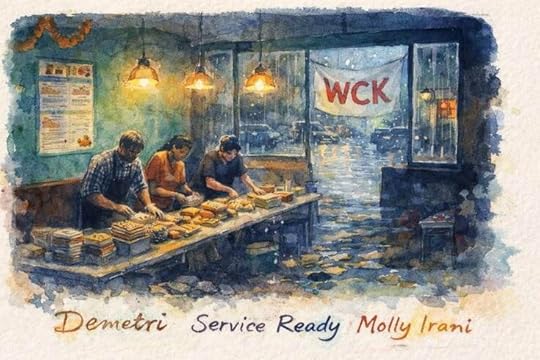
Watercolor Piece by Demetris Papadimitropoulos
“Service Ready” arrives disguised as a business book, but it reads like what it insists a restaurant must be: a room built to hold strangers together long enough for something human to happen. Molly Irani – cofounder of Chai Pani and Spicewalla, partner to the chef Meherwan Irani, and, in these pages, the steady pulse behind an improbable small-business odyssey – writes about hospitality the way some writers approach faith: not as a set of beliefs, but as a practiced attention to the living. Her subject is a restaurant group that grows from scrappy beginnings into a nationally celebrated machine; her deeper subject is the invisible infrastructure that makes any machine worth running. Culture, she argues, is not what you tack on after success. It is the primary ingredient.
The book’s opening movement establishes the voice that will carry it: intimate without being confessional, pragmatic without going cold, spiritually curious without turning pious. Irani can make a spreadsheet feel like a love letter and make a love letter function as an operational tool. She believes, with the bright-eyed fatalism of someone who has watched service collapse under pressure, that the world is always on the verge of “things falling apart.” It’s a line she borrows, explicitly, from Pema Chödrön’s “When Things Fall Apart,” but the book’s wisdom is more occupational than doctrinal. If you’re invested in certainty, Irani says, you’ve chosen the wrong planet; the restaurant planet is permanently unstable, a place where any Saturday night can become a minor apocalypse and where the skill that matters most is the ability to keep people safe while the floor tilts.
Then 2020 arrives and the metaphor becomes a biography.
Irani recounts the early pandemic with a clarity that feels earned rather than retrospective. A familiar marital debate – security versus reinvestment, retirement accounts versus expansion – turns, in a few paragraphs, into a universe-level punchline. “Hold my beer,” the cosmos seems to say. The scene that follows, with an executive team gathered around a conference table trying to guess how long they’ll be closed, is as tense as any war room sequence in contemporary nonfiction. Two weeks? Three? The numbers sound quaint now, but the book refuses to scold its past selves. There is, instead, a kind of compassion for the naïveté that allows action. Irani understands what we’ve learned in the years since: if we could see the full catastrophe in advance, we might never move.
The moral axis of “Service Ready” is established in those early days: take care of your people, even if it ruins you. The book’s most persuasive argument is how consistently it shows that this is not sentimental rhetoric. It’s a decision system. It means stopping paychecks at the top. It means begging landlords, building emergency funds, auctioning whatever can be auctioned, giving away food and supplies before they spoil. It means turning the restaurant – the place designed for pleasure – into a place designed for triage.
And it means, in one of the book’s defining passages, letting vulnerability sit down at the table.
Leadership literature is full of calls for “authenticity,” a word that has come to sound like a corporate perfume sprayed over power. Irani’s version is messier, more bodily. She notices, mid-meeting, that no one is breathing. She sees grief in a colleague’s eyes, distress on another’s face, and she interrupts the tactical rush long enough to name what is happening. The move is small, almost domestic: a hand on an arm; a request that her husband not bolt. But the effect is seismic. One person sobs, then others do, then breath returns to the room. The team doesn’t become less competent because it cries; it becomes more coordinated because it stops wasting energy pretending it isn’t afraid. In an era that has made a fetish of stoicism – a decade of grind culture followed by the public burn-out of the pandemic years – Irani’s insistence on feeling as a leadership tool lands with particular force.
Her best scenes are like that: operational, emotional, and slightly mythic at the same time. A “think tank” of restaurateur friends forms to swap information and share despair; they call it “Shitnado,” because humor is sometimes the only breathable air. A marketing director writes “family letters” to staff, not as a brand play, but as a bridge – a way to keep a culture intact when the world has scattered its people into separate rooms. A daily chai ritual anchors a household and, eventually, becomes content – a video series called “Chai Time” filmed in the kitchen, with dogs barking at the mailman and a college freshman drifting through Zoom calls in the background. Irani is sharp about how these gestures function. They are not cute add-ons. They are the methods by which an organization refuses to turn into a machine that eats its own.
Even when the book moves into the language of frameworks – “Go Forward Plans,” “Profit from the Core,” “highly aligned but loosely coupled,” “context over control,” the OODA loop – the writing keeps returning to its real obsession: the moment when abstraction meets a body. A neighbor who can’t dine in because he’s working alone across the street wants takeout; the kitchen is at capacity; the policy is no. Isaac, the ever-calm operator in Irani’s ecosystem, hand-delivers a meal anyway, packed with “extra abundance,” not because anger deserves reward but because the complaint contains truth. The scene is brief, almost throwaway, and yet it explains more about Irani’s theory of hospitality than a chapter of metrics could. The point is not that the guest is always right. The point is that service begins where you recognize the other person’s constraints as real.
Later, another truth arrives disguised as a potato. The James Beard attention that crowns Chai Pani also crushes it. Lines wrap around blocks; takeout is turned off; locals can’t get tables; tourists arrive with pilgrimage expectations; the kitchen implodes under volume. In the walk-in, produce bins stack on pallets, and one stray potato sits wedged between boxes like a joke with a blade. A manager snarls, “There literally is not another square inch… to put that damn potato!” It is funny and grim and perfect: the moment when success reveals itself as a kind of failure of systems. “Service Ready” is especially good on this paradox. Growth is not a victory lap. It is a new weather pattern, requiring new structures, new boundaries, and new forms of care.
Irani’s gift is that she rarely treats the restaurant as a self-contained world. She keeps showing how porous it is – how economic shocks, supply chains, public health mandates, delivery-app ecosystems, and the mood of a cranky tourist become part of the dining room. Her description of the post-shutdown landscape, with health codes changing daily and staff sweating through masks while customers complain about wearing one for five minutes, is both specific and quietly political. You can hear, behind her sentences, the larger story of labor that has defined the past few years: the “Great Resignation,” wage pressures, the competition for staff, the exhaustion of being asked to perform cheerfulness inside a traumatized society. Irani’s answer is not a utopian fix. It is a set of commitments, repeated until they become muscle: care, excellence, showing up, creating magic, meaningful growth. She writes them on a poster and hangs them near a conference table like a secular prayer.
The book’s middle sections widen into something like cultural anthropology. Irani takes the reader to India, not as a travelogue indulgence, but as an argument for why a restaurant’s story matters. The staff trips – scrimped for through a frugality lesson about lost pens – are a sly inversion of typical corporate perks. Instead of a retreat designed to reward, they are pilgrimages designed to teach. In Mumbai, the team walks through Dharavi, enters a family’s eight-by-ten room, and is asked, with innocent pride, “Do you like my home?” Irani doesn’t sentimentalize poverty, and she doesn’t exploit it either. She uses the moment to expose an American blind spot: we confuse dignity with square footage. Indian hospitality, in her telling, is not dependent on abundance; it is a stance toward the guest. The scene leaves the team undone, and Irani wants that. She wants their hearts broken open so that the food they serve back home carries a truer weight.
This is where “Service Ready” brushes against other books – “Setting the Table,” “Unreasonable Hospitality,” “Kitchen Confidential” – but Irani’s tone is gentler than Bourdain’s swagger and more spiritual than the polished TED-talk register of much contemporary management writing. She is interested in what happens when service becomes a moral practice rather than a performance. The restaurants are her canvas, yes, but they are also her laboratory for belonging. She believes, unabashedly, in restaurants as “third spaces,” the places Americans still gather when we’ve lost the habit of the public square. In the current decade, when screens have trained us into isolation and politics has trained us into suspicion, her insistence that a shared meal can do civic work doesn’t feel naïve. It feels like a proposal.
What complicates the book – and saves it from becoming a fable – is how often love requires a hard no.
Irani’s signature question, the one she teaches managers to ask, is deceptively soft: Where does the love lie? In “Finding Where the Love Lies,” she frames mistakes as data, borrowing from Stephen Nachmanovitch’s “Free Play.” Love, here, is not indulgence. It is discernment. It is the courage to close a beloved concept (“bright shiny things” must sometimes be released), to reorganize a space, to return to the core, to admit that diversification can become distraction. She writes “FIND THE LOVE” on a whiteboard while planning a closure, and suddenly the checklist of logistical cruelty shifts into a checklist of care: determine a timeline that best supports the team; find roles for people before announcing endings. The lesson is one that lands beyond hospitality. In an age when organizations love to talk about “values” while practicing disposability, Irani is proposing a different kind of rigor: operationalize compassion.
The final sections – the hurricane epilogue – are the book’s most startling proof of concept. Hurricane Helene comes to Asheville and turns the mountains into a disaster zone. Irani writes the event not as a cinematic climax but as a real rupture: power down, water down, cell towers down, trees inside kitchens, a city cut off by landslides. The neighborhood becomes a chain-saw commune; a grocery store parking lot becomes a communications hub; a radio station becomes the voice of the region. In the middle of this, Irani and her team do what they know how to do: they feed people. World Central Kitchen calls, and the old restaurant space – the origin point of the company – becomes, again, an engine of improvisation. They salvage product, build a sandwich assembly line, cheer when helicopters arrive, hang a WCK flag in the window, and later hang an opening banner in the same place. The restaurant is no longer merely a business. It is infrastructure. It is social service. It is a place for charging stations, FEMA forms, hugs disguised as work.
A renegade plumber from New Orleans shows up with a twinkle in his eye and a willingness to cut holes in walls. “Baby, I can hook up a water tank hanging off a cliff in Nepal,” he says, and Irani cries – not because the line is charming (though it is), but because it represents the sudden return of possibility. Throughout “Service Ready,” the notion of jugaad – the Indian art of ingenious workaround – functions as both method and philosophy. You can feel how much Irani loves it: the permission to improvise, to reimagine, to tear down the wall so the oven can get in. In the epilogue, jugaad becomes survival.
If there is a critique to make, it is that the book occasionally overexplains its own wisdom. Irani loves a named principle, a bulleted list, a borrowed framework. Sometimes the narrative is so alive that the management-book scaffolding feels redundant, as if the author doesn’t fully trust the reader to notice what the story already proves. There are also moments when the rhetoric of “magic” risks smoothing over the brute realities of cost, burnout, and structural inequity – realities the book, to its credit, often acknowledges. But these are minor frictions in a work whose fundamental seriousness is never in doubt.
The book’s real achievement is tonal. It manages to be tender without being soft, instructive without being managerial, spiritual without being escapist. It treats leadership as a relational art and culture as something you make every day, not something you announce. It treats restaurants as a mirror of society – and, more daringly, as a place where society might learn to practice being a society again.
Reading “Service Ready” in 2026, with its aftershocks still humming – from public health trauma to climate volatility to labor churn to the quiet loneliness that has settled into so many lives – you feel how deliberately Irani has written a book for this moment. Her refrain is simple enough to sound sentimental until you watch it survive catastrophe: people want to feel cared for. The feeling of being cared for is psychological safety. Psychological safety is the precondition for excellence. Excellence, in turn, is what makes care credible. It is a loop, a system, a way of being.
Near the end, Irani describes the hospitality industry as a tribe that makes “this place beautiful,” echoing Maggie Smith’s “Good Bones.” It is an audacious claim for a world that often feels at least half terrible. And yet the book keeps showing you the small, stubborn evidences: a hand on an arm in a meeting; a pot of chai at 3 p.m.; a fifty-dollar check from an older customer; a storeroom turned into a staff welcome center that feels like a hug; a rickshaw procession through Asheville like a Bollywood wedding; a flag in a window that draws strangers into service; a question written on a whiteboard that changes the moral geometry of a decision.
Irani’s story is a story of restaurants, but it is also a story of what it means to build a life that can take a hit and still offer warmth. The book does not pretend that love solves everything. It suggests something harder: that love – practiced, operationalized, made into systems and rituals and standards – is what allows people to keep working when the world does not stop falling apart. That is why “Service Ready” earns its 89/100 – not because it is flawless, but because it is alive, and because it makes a convincing case that care is not the garnish on the plate. It is the meal.
You close the book hungry – for food, yes, but more for the rare sensation of being in a room where everyone belongs again.
Had never heard of the author but the title and cover intrigued me. I enjoy stories of starting up businesses or what it's like to work in the restaurant industry (especially for people who previously had little to no experience and/or it was not something they were planning to do) so this seemed like a good fit. Part memoir, part "how to", Irani describes how she and her husband started up their James Beard Award–winning restaurant.
Irani describes her early life, how she grew up with parents who owned a restaurant, etc. How she met her husband, their courtship and marriage. They eventually make their way to Ashville, North Carolina, where their restaurant Chai Pani is located. And of course comes along the highs and lows, from the obvious risks to eventually becoming an acclaimed restaurant. Irani also discusses what she learned with advice/self-help tidbits.
I won't lie: this was very dull. There were some interesting anecdotes here and there throughout the book but what sounded very compelling really was not. Problem is that it has no idea what it was trying to be: I thought it was a memoir but it also is partially a business advice/self-help book too. Which can work but does not here.
I think if you're a fan, have been to the restaurant, enjoy these types of stories, etc. this could be a good read. But I do think there are other books that have done this story before and done it better.
I’ve read many food/restaurant/hospitality books and this unfortunately did not hit the mark. The book would highly benefit from a good editor: not just for content but also spelling and grammar. However, my main issue is that most of the book was veering heavily into a self-help type book with life mantras bolded throughout. There were some glimpses of a promising read with some fun anecdotes at the launch of her restaurant but the motivational themes punctured any hope of enjoyment and felt gimmicky. I finished it not knowing if it was meant to be about the restaurant industry, a personal memoir or a self help book.
3.7 we read this book for our Book Club. This normally wouldn’t have been a book that I had picked up, but it was interesting to me to read about the famous James Beard winners and owners of Chai Pani and Botiwella and a spice place(Spicewalla) here in Asheville, North Carolina, and their expansion into other cities too. I decided to get the audiobook and that was a wonderful decision. I highly recommend because Molly Irani herself narrates the book,and she has a genuinely warm personality and a true passion and heart for the restaurant industry. She is a born natural storyteller and narrator. She has found her calling in the restaurant industry,pulling her previous knowledge and experience as a psychology major and professional organizer. She co-owns with her husband whose Indian culture and love of food came up with the idea of an Indian street food restaurant. This book is part memoir and a 10 core principles guide for business owners. For me I enjoyed the memoir and especially hearing about how they met, why they made the decision to move to Asheville and open a restaurant, the family, financial and personal sacrifices that were made along the way. They dealt with recession, covid and finally hurricane Helene and survived all with true resilience and ultimately following the philosophy, that loving your community, instilling workplace respect/connection and genuine hospitality helped to overcome all the obstacles their marriage and business faced. For anyone in business this book would be 5 stars for how well done it is. Just doesn’t pertain to me. On a side note we decided as a book club we must field trip and experience one of the restaurants here and we chose Botiwalla it was top notch and the Indian cuisine was sooo good so was the service.
Thank you to Scribner and Simon Audio for the gifted copies of Service Ready! I’d recommend it to anyone who loves Asheville, Indian food, restaurants in general, or is in a client/customer facing role and wants to level up their approach to service.
The author is the cofounder of the Chai Pani Restaurant Group, which includes the James Beard award winning Chai Pani in Asheville. I didn’t know anything about Chai Pani going in, but I love Asheville so I was curious. Turns out I’ve actually been to one of their former restaurants (rip Buxton Hall Barbecue). They also have a restaurant here in Charlotte that I’m hoping to visit soon!
I don’t typically visit Indian restaurants because I have a cashew allergy and that can be tricky, but after reading this book I feel like their team would *happily* help me find something safe to eat… and that really sums up what the book (and their service philosophy) is all about.
Overall, I really enjoyed it. It’s always fun to learn about different cultures and traditions through books, and the lessons about hospitality and service are *fantastic*. I annotated the book so I can go back to some of my favorite parts (and will definitely be taking some of the customer service tips into my client work!).
🎧: I started with the print copy but had trouble focusing (it’s a me problem), so I switched to the audiobook a few weeks later and that was the right move. Molly narrates it herself, which adds SO much heart to the story. You can really hear how much she cares about her work, her community, and her people. I’d definitely recommend this one on audio!
Service Ready is a heartfelt memoir that blends hospitality, entrepreneurship, and personal reflection into a cohesive story of building a restaurant driven business rooted in people-first values. Molly Irani offers an inside look at how she and her husband transformed a bold idea into the award-winning restaurant Chai Pani, eventually expanding into a broader food and hospitality ecosystem.
A major strength of the book is its emphasis on culture as a competitive advantage. Rather than focusing solely on culinary innovation or business mechanics, Irani highlights the importance of building a workplace grounded in empathy, inclusion, and long-term team sustainability. This perspective gives the narrative depth beyond typical restaurant memoirs.
The book also stands out for its dual perspective on partnership, both marital and business. It explores how complementary strengths between founders can shape not just operational success but also organizational identity. The interplay between food creation and business structure adds a layered dynamic to the storytelling.
Irani’s reflection on challenges such as economic downturns, the pandemic, and natural disasters reinforces the resilience required in the hospitality industry. These moments are used not just as setbacks but as learning points that shaped the evolution of the business philosophy.
Overall, Service Ready is an inspiring and grounded memoir that will resonate with restaurateurs, entrepreneurs, and anyone interested in leadership built on care, culture, and community. It presents hospitality not just as service, but as a deeply human-centered business philosophy.
Reading 2026 Book 25: Service Ready: A Story of Love, Restaurants, and the Power of Hospitality by Molly Irani
Thank you #NetGalley for an advanced copy of this book in exchange for my review. Read this on my Kindle. Service Ready is part memoir, part self-help, part business guide, and part candy for foodies. I need a trip to Ashville, NC now to take in the culture and the food of Chai Pani.
Synopsis: Molly Irani, visionary cofounder of the James Beard Award–winning Indian restaurant Chai Pani, shares her journey of how she and her husband turned their passion for next-level food and hospitality into a thriving business that puts people first.
Review: Service Ready is a lot of things all wrapped up in one book. If you go into this book looking for tips on how to build a successful business, it is all there. If that was all you wanted this may not be the book for you. If you wanted a great memoir, it is all there. If that was all you wanted this book may not be for you. I went in with no expectations, though I watch a lot of food TV, so I was excited to read about a James Beard Award winning restaurant. I loved the memoir parts and the trials and tribulations of running a restaurant during the Covid lockdown and flood devastation. I enjoyed the focus on the people you hire in a business and on their development. There were so many nuances in the book that I did not expect, little rabbit holes to explore. My only detractor of the book was that it felt redundant on topics especially in the business parts of the book. My rating 4.25⭐️
Service Ready is an inspiring story of passion, resilience, and the transformative power of hospitality, showing how you turned a bold vision into a people-first business that redefines success. I’d love to help your story leap off the page with a Cinematic video, a visually engaging way to showcase your journey, the heart behind Chai Pani, and the impact of your leadership philosophy.
Why authors choose Cinematic videos:
Captures attention instantly on social media, Amazon, and email campaigns Lets viewers experience the inspiration, challenges, and success before reading Highlights the uniqueness and emotional depth of your journey Supports book launches, promotions, and audience engagement Makes your book unforgettable and highly shareable
Where it can be used:
Amazon author page Social media reels & posts YouTube channels Email campaigns and book launches Author website or landing page
Instead of only reading about your journey, viewers can see and feel the passion, culture, and impact of your story, increasing connection and curiosity.
If this aligns with your vision for Service Ready, reply “I’m interested”, and I’ll share a personalized concept highlighting the inspiration, growth, and human connection at the heart of your story.
This book is a story of how to make a family restaurant successful and all the superhuman stress of balancing personal life and business. You can tell that Molly Irani loves her husand with all her heart and soul. I have been to a Chinese family restaurant and the love that they took for the dishes what just like in this book. I used to go to Buddhist Chinese Restaurant went by the same principles that drive the restaurants that Molly and her husband strived for. Unfortunately the latter had to close and the community lost so much love and caring with that closure.
Molly and her husband, family, friends, and the community in Asheville, North Caroline threw themselves into reshaping the greasy spoon restaurant that they leased to make it bloom. There was so much work! I am tired when I think of it. But everyone contributed, including her mother making curtains for the restaurant windows out of Indian saris.
I held my breath when I read about when Co-vid hit, so many small restaurants where I live had to close their doors forever. But they endured and also fed so many people when floods hit the town.
Molly Irani gives an honest and truthful telling of the story of their restaurants and the love great food and the community.
“Service Ready” is a memoir by Chai Pani Restaurant Group co-founder Molly Irani. I went into this book thinking I was getting a foodie memoir but it’s actually much more about her marriage (to her co-founder and Chai Pani chef Meherwan Irani) and lessons on leadership, particularly female leadership.
I devoured this book. First of all, Molly’s life has been so unusual, starting with growing up in an Indian spiritual community in South Carolina, so it’s just interesting to hear about her path and story.
Then the portion of the book where she shares her thoughts on leadership – it’s exactly what I wish I’d been able to read early on in my career. She talks about a heroine’s journey vs a hero’s journey and the distinctly female qualities that she believes have made her a successful leader.
I wholeheartedly recommend this book to female leaders, men looking to lead with more empathy, as well as fans of Chai Pani restaurants. I’ll be thinking about this book for a long time to come and know it will make my list of favorite books of 2026.
PS: Thank you to NetGalley and Scribner for providing me with an Advanced Reading Copy in exchange for an honest review. All thoughts and opinions are my own!
This book was magnificent. Lately, I’ve been debating what my “calling” is. I have always described myself as a giver—someone who enjoys giving and making others happy. I often overextend myself for others; not because I expect anything in return but because it brings me joy to make others feel loved. In a strange way, it makes me feel loved too. It fills me up. Molly Irani’s book was able to put into words what I have struggled to say for so long. The power of hospitality, albeit restaurant speak, is how I would define my “why.” I’ve recently loved indulging in fine-dining cooking shows (The Bear) and interviewing people at work who have cooked in Michelin-starred kitchens because I think I’ve realized that deep down, I see myself in them. I am someone who I think might thrive in a kitchen, because at its core, a kitchen is about making someone’s day every single day. What more noble pursuit is there beyond caring for others? That’s the thesis of Irani’s book, and she argues it well. A must read for anyone questioning their “why.”
Service Ready is much more than just a book about the restaurant industry; it’s a masterclass in human connection and the art of hospitality. Dustin Canter does a brilliant job of blending storytelling with actionable insights, showing how the principles of "service" can be applied to build stronger relationships in any business or life setting. What resonated with me most is the focus on the "power of hospitality" as a mindset rather than just a task. The narrative is engaging and moves at a great pace, making it a very accessible read for anyone looking to improve their customer experience or leadership skills. It’s a refreshing take on how empathy and preparation can transform every interaction. Whether you are in the service industry or just someone interested in the dynamics of care and excellence, this book is highly recommended.
Service Ready is a memoir by @chaipanimom who, along with her husband @meherwanirani founded the Indian street food restaurant Chai Pani. When the couple moved to Asheville NC and suddenly found themselves needing to pivot, career-wise, they decided to reinvent themselves by starting a restaurant that would make the food that Meherwan loved as a child growing up in India. I loved reading about their journey from launching their first location with nothing but determination & love, to winning the James Beard award for best restaurant 15 years later. Part memoir and part business manual for managing in the hospitality industry, I thoroughly enjoyed reading about their progression as leaders in the industry, surviving Covid, and supporting their community during Hurricane Helene and the aftermath of the flood. Now I kind of want to work for them 😆
a stellar, beautifully written restaurateur memoir with the heart and soul of Unreasonable Hospitality, and a whole lot of grit and jugaad (i'm gonna start using this turn of phrase now!). i'm personally a huge fan of Chai Pani and Botiwalla, which makes the Irani's inspirational story all the sweeter. this book is essentially a guideline and manifesto for any aspiring gold-standard community restaurant, and it absolutely tugs at your heart strings in the process, making you wish more business owners were as dedicated and compassionate. love this book and love this restaurant group. thank you to netgalley for the ARC!
Listen to the audiobook. Narration was OK. For some reason this book seem longer than 300 pages. This might sound odd but after about the 50% mark, I started to tire of the constant sugary sweet, too positive, everything is just perfect, everyone loves everyone and everything falls into place scenario. It was almost it’s too good to be true. Yes it was about community and people coming together and I think the way they ran their small business worked because it was a teeny tiny business, but all of her life lessons wouldn’t work in most companies and corporations. And while I did find some stories interesting and uplifting, others were just too much at the same thing.
This was such a warm and inspiring read, especially for anyone who loves food, restaurants, or the energy of hospitality. The stories throughout the book felt personal and heartfelt while also showing how much passion goes into creating meaningful experiences for people. I really enjoyed the balance between the behind-the-scenes restaurant moments and the more emotional reflections on relationships and purpose. The writing made the fast-paced world of hospitality feel both exciting and deeply human at the same time. By the end, I came away with a new appreciation for the people who work so hard to make others feel welcome.
Service Ready is an inspiring and insightful memoir that blends entrepreneurship, hospitality, and leadership into a compelling story of perseverance and purpose.
Molly Irani shares the journey of building Chai Pani with honesty and warmth, offering valuable lessons about creating a people-first culture while navigating the realities of business growth. Her reflections on leadership, resilience, and community make the book both practical and deeply personal.
Overall, it is an excellent read for entrepreneurs, business leaders, hospitality professionals, and anyone interested in building meaningful success through empathy, innovation, and care for others.
Listen to the audiobook. Narration was OK. For some reason this book seem longer than 300 pages. This might sound odd but after about the 50% mark, I started to tire of the constant sugary sweet, too positive, everything is just perfect, everyone loves everyone and everything falls into place scenario. It was almost it’s too good to be true. Yes it was about community and people coming together and I think the way they ran their small business worked because it was a teeny tiny business, but all of her life lessons wouldn’t work in most companies and corporations. And while I did find some stories interesting and uplifting, others were just too much at the same thing.
Service Ready: A Story of Love, Restaurants, and the Power of Hospitality by Molly Irani is an inspiring memoir about building a restaurant business rooted in empathy, culture, and community.
The book highlights the journey behind Chai Pani, showing how strong values, leadership, and teamwork helped transform a bold idea into an award winning hospitality brand.
Overall, it’s a heartfelt and practical read for anyone interested in entrepreneurship, restaurant culture, and people centered leadership.
This was a love letter to the industry. This book truly made me want to work for this company and made me believe in hospitality more than I already did. It truly gave a personal perspective on how the Chai Pani team built a successful culture and business from the start and through all of the challenges. As a person who built a career in the food industry, this book gave hope and restoration for a future in food service, the right way.
I thought this was fantastic and such a delight. I have a deep love and appreciation for the service industry, so I went into this book knowing I'd like it. What I didn't expect, and really loved, were all of the ways this also doubled as a professional development book, and almost a crash course in hospitality. Molly has SO much heart, and I loved hearing her story. I can tell she loves not only her restaurants, but every single person that has helped shape her journey. Loved it!
So dull. It’s not really a story, it’s more of a how-to business guide. I loved Spicewalla and Botiwalla when I visited Asheville so I was looking forward to reading it but it was disappointing. I feel like Molly should’ve stuck to either writing a memoir or a how-to book instead of what she wrote.
Absolutely incredible memoir by Irani, a passionate and driven businesswoman who founded Chai Pani, an incredibly popular, James Beard Award-winning restaurant in Asheville, NC! There's also a location in DC that I've been meaning to go to, and this might just be the push I needed.