Jump to ratings and reviews
Rate this book

The Eastern Front #2

Germany Ascendant: The Eastern Front 1915

Rate this book
While millions of men died in France and Belgium in 1915, battles equally as large and bloody were being fought on the Eastern Front, as Imperial Germany, Hapsburg Austria-Hungary, and Tsarist Russia clashed on a scale greater than anything seen on the Western Front. These massive offensives were shocking in their scale and intensity, and hugely important. Yet they are largely ignored in the West. Now, with the work of internationally renowned Eastern Front expert Prit Buttar, this story of the unknown side of World War I is finally being told.

In Germany Ascendant, Buttar examines the critical year of 1915, when Germany launched the great Gorlice-Tarnow Offensive, lead by Field Marshal Mackensen. The move, which started as a minor German operation to relieve their Austro-Hungarian allies, ultimately resulted in the utter collapse of Russian forces from all of Poland and Gallacia, and came tantalizingly close to knocking Russia out of the war altogether. Next the Germans led the invasion of Serbia, leading Britain and France to intervene with ground troops, an operation that ultimately failed.
 
Yet despite this unbroken string of successes, Germany was still hamstrung by a two-front war. Her every attempt to knock Russia out of the war--military and diplomatic--has failed. The stage was then set for the next phase of the war when Russia launched its own counter-offensive that nearly brought the Central Powers to their knees.

464 pages, Hardcover

First published July 21, 2015

77 people are currently reading
454 people want to read

About the author

Prit Buttar

19 books116 followers
Prit Buttar studied medicine at Oxford and London before joining the British Army as a doctor. After leaving the army, he has worked as a GP, first near Bristol and now in Abingdon. He is extensively involved in medical politics, both at local and national level, and served on the GPs’ Committee of the British Medical Association. He appears from time to time on local and national TV and radio, speaking on a variety of medical issues. He contributes regularly to the medical press. He is an established expert on the Eastern Front in 20th century military history.

Ratings & Reviews

What do you think?
Rate this book

Friends & Following

Create a free account to discover what your friends think of this book!

Community Reviews

5 stars
94 (37%)
4 stars
122 (48%)
3 stars
30 (12%)
2 stars
2 (<1%)
1 star
1 (<1%)
Displaying 1 - 30 of 39 reviews
Profile Image for Abeselom Habtemariam.
58 reviews73 followers
June 27, 2023

‘’It was 1915. The beginning of a new year. The beginning of new hopes. The old hopes, the glorious ones of 1914, were buried in the mud and clay of warfare. The Schlieffen plan, plan XVII and the Russian steamroller, in the hangover of this cold dawn of 1915, were only but memories of the time when all of Europe had been drunk on the wine of quick victory’’

The Great War TV series, Episode 07, ‘’We Await the Heavenly Manna‘’

Germany Ascendant: The Eastern Front 1915 is the second book in Prit Buttar’s, The Eastern Front Series. The first book, Collision of Empires: The War on the Eastern Front in 1914, deals with the military doctrines of the armies in the years prior to the first world war, The July Crisis, The major battles that took place in 1914 on the Eastern Front, the ramifications of a year’s worth of engagements and the prospects of the belligerents for 1915. This second book starts where the first left off, January 1915.

The Russian Army, was organized into two commands, the Northwest Front and Southwest Front. The former lined-up to face the German Army, while the latter squared against The Austria-Hungary Army. The Germans ended 1914 in a somewhat ambivalent state. They won a stunning victory at Tannenberg, broke Russian lines on their way to Łódź, failed to defeat Russian defences in Warsaw by October and after a brief hiatus again suffered a major set back by The Vistula. Conrad’s insistence on frontal attacks and logistical problems had considerably weakened the Habsburg army as the new year beckoned. Coupled with the stalemate in the western front, the state of the three armies in the eastern front meant that the new year was unlikely to deliver on the promise of a quick and decisive victory.

This book covers the Galician campaign of 1915, which was a massive military campaign in terms of scope, Army sizes and the number of casualties. The primary objectives of the campaign were recapturing the Przemyśl fortress and the Galician capital, Lemberg. The Gorlice–Tarnów offensive was initially slated to be a minor German offensive to alleviate the pressure applied by the Russian army on the Austro-Hungarians and to temporarily eliminate the threat of Russia so that Germany can concentrate on France and Britain in the west. Instead, it became the definitive offensive operation of the year on this particular front. The offensive came at a time when in The Western Front the second battle of Ypres and in Turkey the Gallipoli campaign were still raging on. I must say, the level of detail you can find on the battles from Gorlice–Tarnów to Lemberg in this book is of a top-tier quality. The narration is accompanied by August von Mackensen and Hermann Von François’ perceptive memoirs and letters.

description

Mackensen was assigned to be the commander of the newly assembled joint German-Habsburg Army (the Eleventh Army), after his exploits with the XVII Corps of the Eighth Army the previous year at Gumbinnen and Tannenberg. Unlike Ludendorff and Hindenburg, he was well liked by the Kaiser and Falkenhayn. A veteran of the Franco-Prussian war and an accomplished Calvary commander, at age 65 Makensen was a very respected figure in the German army. Later on in the year, he would also lead the coalition of German, Habsburg and Bulgarian armies in the Serbian Campaign.

François, who was also on the naughty books of Ludendorff and Hindenburg, was in charge of XLI Reserve Corps in the Eleventh Army. After continually distinguishing himself, he would receive the Pour le Mérite, Germany's highest military decoration, on 14 May 1915 while still commanding his Corps in the San Valley. The success achieved by the Eleventh army showed Falkenhayn and Makensen’s mastery of planning and execution at the operational level, as well as the effectiveness of the German staffing and command system. As Buttar relates;

‘’At a time when Falkenhayn devised, planned and executed the redeployment of the troops that would form Makensen’s army in less than two weeks, the Russians proved unable to move III Caucasian Corps from one end of Galicia to the other.’’


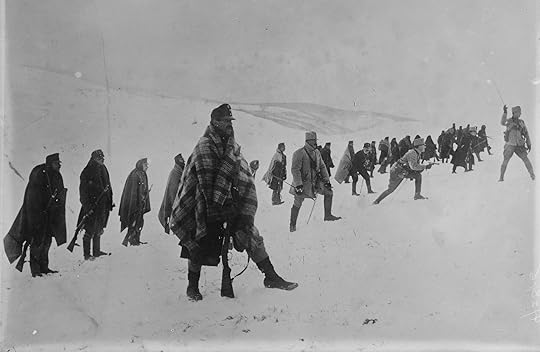
Prior to 1914, The Austro-Hungarian army (K.U.K), in anticipation of future mountain warfare, had excellently trained and equipped mountain divisions. However, by 1915 most of these divisions suffered huge losses and were considerably weaker after the brutal Serbia campaign. The Carpathian Mountains can remain covered in deep snow up to mid-spring, which then give way to freezing rain and sleet through abrupt rises in temperature, resulting in widespread flooding in the valleys below. A diary entry by the Austria-Hungary artillery officer Georg Weith quoted in the book perhaps illustrates the brutality of the Carpathian campaign;

‘’At the end of January, there was a sudden thaw in the rain. Everyone was soaked to the bone, with no opportunity to dry themselves. In addition, men’s cloths froze to their bodies overnight, like an icy suit of armour. Then the Russian counterattack struck. The soldiers retreated in listless resignation to their starting positions. By now, even the enemy had had enough of fighting. There we were, where we had started in the middle of January; but in the intervening time, another army had perished’’


This book doesn’t shy away from going over atrocities committed by the three powers against civilians. Civilians, such as the Jewish population of Eastern Galicia, Ruthenians in Southern Poland and Germans in East Prussia, were under constant threat of summary justice with minimal legal procedures and at times even that was refused to them. Frequently, officers turned a blind eye towards ill-discipline within soldiers. Some of the personal accounts mentioned in this book can be quite gruesome.

With the Russians in constant retreat towards the east, subsequent battles lasted until June 1915 around the River San. After recapturing Przemyśl, Makensen would be awarded the Oak Leaves to his Pour le Mérite by the Kaiser. After the fall of Russian occupied Lemberg, in a letter included in this book, the Kaiser wrote to Mackensen;

‘’I wish to show my royal thanks and the high regard I have for you and all troops under your command by promoting you to Field Marshal. May God, who steers all battles, accompany you further on your campaigns’’


description

Although 1915 was a shockingly dreadful year for the Tsar’s Army, it didn’t decisively knock them out of the war yet. The Russians retreated to a line that stretched for 1,450 km from Riga to the Romanian border. With the fate of Napoleon’s Grande Armée a century earlier in his mind, Falkenhayn was wary of pursuing the Russians further than he needed to. He wanted to conclude a separate peace with Russia to concentrate on the Western Front, and in the process allow Conrad to shift his troops to Italy. The Tsar was having none of that.

1915 ended with all three empires suffering huge losses. Decisive strategic victories were at a premium. Successful offensives were usually suspect to being overturned by effective counterattacks. Reserves were utilized much more often than the Armies would’ve liked to. Przemyśl, Kovno and Novogeorgievsk showed that fortress defence was obsolete in 1915 due to advances in artillery technology. Tsar Nicholas entered the fray as the supreme commander of his army in the autumn of 1915. Serbia finally was effectively eliminated from the war, and Italy was clearly going to influence the military landscape in the year to come. It was increasingly clear that 1916 will not see a thaw in the fighting.

Buttar carries the strength of the first book over to this book as well. First-hand accounts from military attachés, politicians, commanders, soldiers on the front lines, military doctors and civilians are quite abundant throughout the book. The analysis of the strategic and operational realities on the ground is one of the best I’ve ever read on the Eastern Front. At times, events are dissected along divisional or regimental levels and for bigger operations it zooms out to the Corps and Army level.

One thing that this book didn’t improve up on the first book is the scarcity of maps. Given the vast and unstable nature of the frontlines in the Eastern Front, the inclusion of polished maps would’ve been very helpful. Consistent with the theme of the rest of the book, the maps when available are technical military maps.

This is not a book for the faint-hearted when it comes to reading military history books. It’s a fairly thick, jargon heavy, information stacked and highly technical book. It has plenty intricate delineation of on-field war manoeuvres compared to the first book in this series (and that’s no mean feat). This is of course understandable as with each progressive year, the first world war was getting even more tangled in diplomatic, strategic and technological knots. If you are someone looking to deepen your knowledge base on the Eastern Front, then happy days! But if not, this will not be a smooth read by any stretch of the imagination. This is a very solid, serious and scholarly book.
Profile Image for Geevee.
453 reviews340 followers
January 11, 2025
In the second of his four titles covering the Eastern Front in WWI, Prit Buttar tackles 1915. It is a story well told and, for those who wish to explore this theatre, a detailed, solidly researched and, to my mind, a fair and balanced account of all participants.

In The Eastern Front 1915, we see the realisation on the Axis powers (Germany & Austria-Hungary) and Russia that the scale of the war and the destructive nature of this modern warfare being fought is having serious impacts on countries' manpower and munitions. Like the Western Front, the strategies, tactics and battle plans are aggressive, and highly planned but hampered by fierce fighting (notably artillery and machine gun; the WWI mass killers) and especially on the Eastern Front, over terrain that is treacherous (Carpathian mountains, marshes and sizeable rivers).

The fighting covers significant territory stretching from the Baltic coast south to distant Czernowitz in Bukovina in the Austro-Hungarian empire (now modern Chernivtsi in Ukraine). For the Germans 1915 is a successful military year, although it is hindered by its ally, Austria-Hungary's ability to command, supply and motivate its army, which all impacts the fighting ability and progress of the multi-ethnic, multi-language Imperial and Royal army.

The German army is able to push eastwards from May onwards against Russian troops of varying quality, and like Austria-Hungary, the Russian army has very serious shortages of trained manpower, munitions, arms and equipment, including basics such as boots and rifles. However, Erich von Falkenhayn, the Chief of the German General Staff, also has to continually support the Austro-Hungarian army with troops and wider logistical support. He also has to carefully and forcefully manage the Austro-Hungarian Chief of the General Staff Franz von Hötzendorf Conrad, whose ideas and tactics fall far below the capabilities of his army and the conditions they are fighting under.

Logistics and supply plays a significant part. Notably the scarcity of railways, metalled roads (or even distinct tracks in much of the front), and the rivers that require bridging or mountains that need crossing, all of which challenge troops and equipment movement, ammunition and food supply and the communications required to direct and report positions, progress and requirements.

The key battles in the Carpathian mountains, the Serbian front (included in the Eastern Front theatre), the battle for the fortress city of Przemyśl and the bold advance through Poland and Western Russia are all covered and provide a clear view of what happened and why, and where it all ended at the year's close.

The final chapter, The Burden of War, is very interesting as it covers the impact on the home-fronts: how industry fared and delivered; how raw materials impacted decisions and supply; and some considerations on future strategy for 1916 on both fronts, notably the Allied decision of attritional warfare to, simply put, destroy more Germans than the numbers of allied troops are killed, and the German attritional strategy to bleed the French dry at Belfort and/or Verdun. Conrad, who again in this volume, shows how he damaged his country and his army with his ideas and command decisions, also has grand designs on Italy.

As, I said at the start of my overview, this is a very good account, especially with the first-hand accounts from both commanders and men at the front, and the authors clear-sighted writing, but I would caution that if you are not one for reading about how the armies, corps, divisions operated then this may not be for you.

There are some excellent black and white plates with 31 photos. The are 20 maps that are adequate and whilst this is welcome and they are cleanly drawn, they could be much better detailed as when reading one doesn't see all the relevant towns, features or even troops mentioned. There is also an excellent dramatis personae for all armies including the Serbs and Bulgarians.

Overall, a fulfilling and enlightening read.

My copy is a Osprey paperback published in 2017.
Profile Image for Bryan Alexander.
Author 4 books318 followers
October 4, 2015
This is an excellent book for anyone looking into World War I, or for the general military history reader.

Germany Ascendant covers a very important and criminally neglected part of WWI: the Eastern front, an epic war between the German, Austria-Hungarian, and Russian empires. I've found most English-language writing on WWI focuses overwhelmingly on the Western front. Which is just foolish, given that the Russian war was at least as important, not to mention bigger in scale.

This book is the second of a series that helps fix that problem. Prit Buttar's first volume (my review) addressed events in 1914, which were extraordinary. Three huge armies clashed, and the results included one of WWI's most complete victories (the Battle of Tannenberg). In this sequel Buttar explores what happened next, through the year of 1915.

1915 saw Russia defeated, simply put. Germany, with not much help with its Austro-Hungarian ally, pushed the tsar's forces out of Poland and other areas. The very well planned Gorlice-Tarnow Offensive shattered the Russian line. In response to that and continuous Central Powers pressure the Russian command conducted the Great Retreat, after which it licked the wounds of a shrunken, undersupplied, and increasingly despairing army.

That much I knew about, and so appreciated Buttar's excellent description in great, well sourced detail. He does a terrific job of laying out the decision-making process of each command structure. I didn't know about the spectacularly horrible, and failed, Austro-Hungarian winter offensive against the Russian army in early 1915, when Vienna sent exhausted, ill-led, and ill-trained forces against an enemy dug into mountains. Yeah, that went about as well as you might expect. (Check (this amazing photo from the Carpathian battles) I didn't know about another Austro-Hungarian disaster, the failed "Black-Yellow" offensive of fall 1915 (chapter 10). I've never seen the fall of Serbia described in such solid detail (chapter 13).

I appreciated little scenes and stories which bring the time to life, especially given the sheer size and complexity of operations. For example, in a parallel to the classic Western front Christmas in the trenches, "Easter Sunday fell on 4 April, and on quiet sectors of the long Eastern Front soldiers from both sides exchange gifts" (152; also 175). Or this little character sketch:
[Bulgarian Tsar Ferdinand was not] particularly enamored of the ruler of the Austro-Hungarian Empire, once describing Franz Joseph as 'that idiot, that old dotard.' In an era of haughty aristocracy, Ferdinand was a colorful figure, and annoyed [German Kaiser] Wilhelm by playfully slapping the kaiser on the bottom during a state visit... (367)
Or in a classic piece of wartime black humor, Russian soldiers besieging the Austro-Hungarians within a vast fortress mocked the latter's desperate slaughter of their horses:
"What is the difference between the heroes of Troy and those of Przemysl? In Troy, the warriors were in the belly of a horse, while in Przemysl, the horse is in the belly of the warriors!" (60)

Or the spectacular fall of Vladimir Sukhomilov, who went from being Russia's minister of war during 1914-1915 to trial, prison, exile, and dying of exposure, homeless, on a Berlin bench (280).

Or this desperate speech to troops, by a Serbian commander:
"At precisely 3 pm, the enemy will be crushed by your fierce charge, destroyed by your grenades and bayonets... Our regiment has been sacrificed for the honor of Belgrade and the Fatherland. Therefore, you no longer need worry about your lives; they no longer exist. So forward to glory! Long live Belgrade!" (375)


Once again I'm stunned by the sheer horror and human devastation the first World War brought about. "The [AH] Army lost nearly 1.8 million men on the Russian Front in 1915" (360). In one campaign we learn of a command starting off with "a little under 135,000 men; by the end of the first week of February, nearly 89,000 were dead, wounded, or prisoners." (77) A primary source describes German forces caught between freezing and starving to death:

It drove you to despair, and there was no way out; we were threatened either by death, injury, and frozen limbs or by being taken captive. There was an incredible lack of courage among the soldiers, and it was only the terrible force of circumstances which fired us to bear it. (135)

All three armies regularly killed civilians or took them as hostages (170, 387, etc.). And here's how one Austro-Hungarian leadership team envisioned occupying a defeated Balkan state:
the Serbian intelligentsia was to be eliminated and the rest of the Serbian population reduced to peasantry, with the area resettled by German, Austrian, and Hungarian farmers. (387)

And there is the horror, including anticipatory horror, in reading about antiSemitic acts carried out in these lands, especially by Russians. There's even this grim bit, when Central Powers forces recaptured a great fortress town from the retreating Russians: "In view of the history of Central Europe in the decades that followed, it is particularly striking that the residents of Przemysl who showed particular enthusiasm for the arrival of the Germans were the Jews."(230)

Are there weaknesses in Germany Ascendant? Not really, given its carefully constructed scope and extensive work. I would have liked to see the war against Turkey integrated, but that really would double the book's size. Readers might want more diplomatic, social, or cultural history, but, again, this is a work of purely military history. Some reviewers have complained about too much detail, but I'm hungry for this stuff and devoured every paragraph.

The only issue I had was that some of the maps were occasionally hard to work with. Most of the maps are very good, being clear and well connected to the text. Yet some are only half-page in size, and perhaps my eyeballs aren't what they used to be, but I needed close inspection under a bright light to work 'em. Some towns and rivers mentioned as key locations in the text didn't appear (unless I just missed them). Overall, this book did far, far better than most WWI books with maps. And the photos were much appreciated.

Overall, a major contribution to the topic, and well worth the time of the WWI-interested reader. Military history buffs will also learn a great deal from Germany Ascendant. Prit Buttar provides powerful context for the rest of 1915, giving us essential history to lay alongside Gallipoli and the Second Battle of Ypres .
Profile Image for Jerome Otte.
1,915 reviews
May 8, 2022
A solid and detailed history of the war on the eastern front in 1915.

Buttar ably covers the campaigns and their political implications, the inability of the western allies to influence events much, and the difficult relationship between the Germans and Austrians. The narrative is easy to follow for the most part, and Buttar makes great use of firsthand accounts.

Buttar does a good job describing the effect of weather and how commanders often expected their men to pull through no matter how terrible conditions were. He also describes how the Central Powers were slowed by the death of Austrian professional officers and NCOs and how the Habsburgs soon became a junior partner to Germany.

Some better maps would have helped. Still, a readable and thorough work.
87 reviews2 followers
December 28, 2018
WWI’s Eastern Front had remained a lamentable area of ignorance on my part so I looked forward to Dr Buttar’s 4 book series. Typically, I blundered and read the second book (1915) first. Whoops. Anyway, first the negatives. I have never understood the Brits’ approach to maps. Inevitably there will be repeated references to some town or feature, which doesn’t appear on any of the maps. Also, his enumerating the specific division involved in particular actions was excessive for me and slowed down the flow of the book. But that is a very personal objection, and I would imagine I would be shouted down by the vast majority of serious military historians.
Those same military historians would enjoy this book but I also think the general reader would as well. WWI was such an epochal event with such continuing resonance that it seems a worthy area of at least some reading and Dr. Buttar’s book(s) is (are) thoroughly researched and informative. In the space of 4 years, 4 well established dynasties were swept away; the Hapsburg (600 years), Hohenzollern (500 years), the Romanov (300), and the Ottoman (600). The casualties were unimaginable to us. By my calculations, were the US to suffer proportionately the same casualties as the Austrian-Hungarians and Germans in 1915 alone, our numbers would be over 17 million!!! And the incompetence and sheer idiocy of the leaders is equally stupefying, e.g., the Russian logistics were so bad that one estimate had over 300,000 men on the Southwestern Front without rifles, resulting in some attacks launched with grenades and clubs. One Russian Army Commander’s relationship with his Chief of Staff was so bad that they only communicated by written notes, even when in the same room! And the Austrian Chief of Staff’s astonishing indifference to his army’s casualties defies reason.
The scale of the slaughter is depressing, but the explanation of the political situation(s) and repercussions is excellent, and I look forward to the other three books, especially the final book which covers up to and beyond the official end of the way, e.g., 1918 – 1925.
Profile Image for Jonathan.
545 reviews68 followers
September 18, 2024
The second volume of Dr. Buttar's excellent series on the Eastern Front of the First World War, this book covers the various battles that took place in the Carpathians, Galicia, Lithuania, Volhynia, Central Poland and Serbia. All of these campaigns were Central Powers' victories, as depicted in the title, with the German Army taking center stage as the only true competent combatant in this region. The year 1915 saw a series of offensives that drove the Russian Army out of Poland but, as the German CGS Falkenhym consistently pointed out, it was impossible to destroy the Russian Army outright because of the vast spaces they could retreat into, Napoleon's Russian campaign was an everlasting warning to those who would attempt an invasion. Aside from the length of the front, the lack of roads and railroads in the region made it difficult to move and supply the enormous armies deployed by the combatants. All in all, a very thorough and professional history of the second year of the Ostfront in WWI. I am looking forward to reading the next volume.
481 reviews5 followers
April 19, 2019
This is the second of four volumes on the history of WWI on the Eastern front. In the West most attention is paid to the Western front which was quite different from the East. Unlike the stalemate in the West, the East was a war of maneuver. Many overall histories of WWI notice the East through the Battle of Tannenberg and then neglect it until Brusilov's offensive and the Russian revolution. Yet in 1915, the scope of this book, there were many extremely bloody battles. The description of the winter fighting in the Carpathian mountains left me with the question of how anyone could have survived,
Indeed although the Central Powers were successful in 1915 because they had Russia on the run, but lengthy supply lines prohibited them from pursuing a defeated enemy and closing out that front.
There is a lot of new information in this book and it is well-researched. However, at times the prose seems somewhat dense. There are many maps but they are way too small to read. Hence, the reader flies through the battles with a limited sense of the geography.
Profile Image for Hunter.
201 reviews3 followers
April 5, 2023
The book is very well executed for what it is, but I can't quite call it a great book all the same. I feel like as I get older, and read more military history, I just am losing my patience for books which amount to "This unit went here and did this. Then that commander thought this and talked to the other commander, and they decided to to the other thing". It gets tedious and just isn't as interesting as it once seemed... The book is very good for what it is, and if that is what you want, Buttar executes it successfully... but all the same it has a certain dryness...
4 reviews
January 7, 2018
Germany Ascendant Osprey Publishing,2017,488 pp.,$18.00
Prit Buttar ISBN 978-1-4728-1937-6

Logan Fort, 8th Grade
Pennridge South Middle School
Perkasie PA

In 1914 the great war has just begun on two fronts; the east and west. The book Germany Ascendant is about the lesser known eastern front. In the east, Russia is facing off an invasion from the Germans and the Hungarians. Germany has much success in the north but the Hungarians face fierce resistance in the south. Germany and Hungary are allied to fight Russia. The book explains the deterioration of events over time that eventually leads to the end of the war in the east.
The book is a nonfiction informative book set on describing the events surrounding the eastern front in World War One. The book has no sequel nor a prequel and it is not a part of a series. I noticed that the book is very descriptive in the brutalness of the battles and the tension between high powered commanders who all want to go their own way. I thought that this book had a bit too much detail, which unnecessarily lengthens the book. At times I felt bored as I read the book, but I was also surprised and deeply invested in the book. The book is nonfiction so there are no themes to be seen. I would recommend this book to people who have a deep interest in World War One and those who have a decent vocabulary. This book would be appropriate for someone who is 14 years and older.
The author of the book Germany Ascendant is Prit Buttar. Prit studied medicine at Oxford and London and later joined the British army. He has appeared on local and national TV and radio. The writing has a rich vocabulary and is filled with over-the-top juicy details. I haven’t seen a book written like this before so I can’t make any comparisons. Do you think you would enjoy this type of historical book?
The author uses a third person voice in his writing. The author occasionally flashes back to explain the decisions made that got to the current events. I would recommend this book to anyone who is willing to sit for awhile and learn about the eastern front in World War One.
Profile Image for John.
240 reviews57 followers
December 29, 2015
The Eastern Front in World War One is often overlooked in favour of the Western Front, at least if you are British. Tannenberg is fairly well known, but aside from that only really the Brusilov Offensive of 1916 and the Revolution of 1917 make much of an impression.

As a result of this ignorance, Prit Buttar's four volume history of the war on the Eastern Front, of which this is the second, is to be welcomed. Collision of Empires was excellent but this, because it deals with less well known events, is even better. 1915 was the year the Russians were almost knocked out of the war, when Mackensen made a name for himself as a general, when the Russian army recovered from the catastrophes of early summer well enough to thrash the Austro-Hungarian army late in the season, and when Serbia was finally crushed.

I look forward to the remaining two volumes of this excellent endeavour.
Profile Image for Bob Willis.
137 reviews4 followers
May 16, 2017
Excellent book. Little slow getting started and understanding the different leaders and units involved. Having read several books on WW-I, all on the western front and the Gallipoli Campaign, I was struck by the amount of death and hardship on Eastern Front. Great book for a different perspective on WW-I.
Profile Image for Andreas.
149 reviews2 followers
August 4, 2021
The first sixty pages are more or less a repetition of his first book "Collision of Empires" which is somewhat excessive considering the book having around 400 pages.
The utter disregard of Conrad for his soldiers was the most appalling aspect of the book. He sacrificed hundreds of thousand of soldiers in futile winter offensives in the Carpathian mountains. His plans were made without any consideration of actual strength of his units, weather conditions, supply situations and terrain. The German South Army deployed in the same area did not fare much better than the Austro-Hungarian units, reinforcing the viewpoint that it were the conditions rather than the fighting spirit, that caused widespread failure to break through the Russian Front. Conrad also never learned to concentrate his forces but rather attacked on the entire front and even if a local breakthrough happened, no reserves were available to exploit it.
Next the breakthrough of Mackensen's 11th Army and the advance through Galicia of the combined German and Austro-Hungarian forces all the way to Lemberg and into Russian Poland is described in great detail. Followed by the retreat of the Russian Army east towards the river Bug, in which the Germans failed to encircle any large numbers of soldiers. The overall fighting in 1915 though nearly destroyed the fighting capabilities of the Russian Army, but it did not knock out Russia out of the war as it was hoped by the Germans.
The book ends with a chapter on the fighting in Serbia, which like the chapter in his first book on the same topic should not have been part of the book in my opinion.
There was still the problem with the maps mentioned about the first book though a small number of them were actually full page this time.
Overall a solid book worth reading.
2,149 reviews21 followers
June 20, 2022
(Audiobook) A main reason I am continuing this work is that I am looking to see if some theories about the Eastern Front in WWI can apply to today’s conflicts. The war of maneuver and attrition dominate the story of 1915 in the East. On this front, the German forces rose to the top, dominating the conflict and action. Austro-Hungarian forces play, but they are regulated to minor player. The Russians still hold a large amount of resources, but they will make the mistakes that will cost them the war and the Tsar’s crown.

The book somewhat holds to my theories, in that there was some more maneuver than in the West and that munition shortages in both sides play a major role. This is a theater that is not so well known in the West and works like this will do much to change that. Would recommend the book, especially if there are plays/maps to show the lines/progress, as many Western readers won’t easily identify the places and names, many of which have changed.

Will likely move on to the next one for reference.
1,285 reviews16 followers
February 7, 2021
As someone with a particular interest in WWI, I found this to be an interesting and enjoyable read. One thing that was interesting but also somewhat frustrating is how slow military and political leaders are to adapt to changing circumstances. This is the way we have fought wars for decades, and so this is the way we will fight now; even though technology and circumstances have changed. While all of the participants were guilty of this, the Austro-Hungarian Empire was probably the worst, which helped explain their struggles on the battlefield. It is also an example that no matter how much things change, they stay the same. The same arrogance, pride, stubbornness displayed by the military and political leaders in WWI can still be found in political and military leaders today when faced with war, especially the failure of many governments to adequately adapt to the irregular warfare that has become more prominent in recent decades, especially since 9-11.
Profile Image for Donato Colangelo.
140 reviews7 followers
May 28, 2024
I won’t run the risk of repeating what I have wrote in my review of the first book, “Collision of Empires”. The author has done an amazing job at writing a huge story with careful attention to details and painstaking research of testimonies and diaries entries. It’s history in its best form, objective, and appalling in this case.
I don’t reccommend it to people who want to just “know something more” about the Eastern Front, simply because the author doesn’t just write “something”. For casual readers, the book might be boring and confusing. If, on the other hand, you need some serious source, this book represents one amazing summary of events, with a long list of further references at the end. A comprehensive list of maps gives additional insights into the “mechanics” and the logistics of the war effort, and allows to answer many questions.
I am loving this series of books, seriously. As a history lover it’s a much needed opera!
4 reviews5 followers
March 11, 2017
Germany Ascendant: The Eastern Front 1915 by Prit Buttar is an essential and long time coming addition to the study of the First World War. The Eastern Front is often over looked as the "real"action on the Western Front has occupied historians for many decades. In this the second volume of his exhaustive study of the battles of the Eastern Front, Buttar illuminates the politics, strategy and tragedy of the armies of Russia, Germany, and Austria Hungary as they staggered to find their military footing after the opening action of 1914. The devastating Carpathian winter campaign of 1915, Mackensen's breakthrough of the Russian line, the abandonment of Poland and ultimately the great retreat of the Russian army, pushed all of the forces to nearly the breaking point. Buttar emphasises the importance of the Eastern Front and the profound effects it had on the action in the west, as Germany sought desperately to deliver a blow strong enough to force Russia out of the war in order to concentrate all of its strength on France. As on the Western Front, the enormous casualties in 1915 also precipitated the transformation of the combatants armies from professional forces lead by aristocrats and career officers to forces made up largely of conscripts lead by newly minted officers drawn from the middle classes. The consequences of this shift would begin to put pressure on the already fragile Austrian and Russian Empires, creating political tremors just as their armies were beginning to recover at the start of 1916. Buttar's Germany Ascendant: is an exceptional though traditional history book. While level of military minutiae will most likely put the casual reader off, those who wish to immerse themselves in this little explored and thoroughly fascinating theatre of WWI will be rewarded for their endurance.
Profile Image for Jack.
32 reviews
June 13, 2025
Almost DNF’d this, wound up just taking 18 months to finish it instead. You can really tell Buttar was an army man, his writing is so so very dry.

The quality of the work is quite good, even if one could be forgiven for mistaking it for a description of a map a dude saw one time. Buttar drills down to the detail corps and battalion deployments, but the detail stops there. you feel as though the formations under discussion are faceless pieces on a board moving around at the whims of some unseen hand. it’s not a style of history, particularly military history, that i prefer
Profile Image for Jason.
1,204 reviews20 followers
January 27, 2020
A well-researched but occasionally dry primer that does what it seeks to do. I appreciated, in particular, the work done to understand the Austro-Hungarian approach to the war: the author comes out deeply criticizing Austro-Hungarian strategy and Conrad von Hotzendorf in general, something that feels long, long overdue among mainstream military history of World War I.
69 reviews
October 19, 2023
Buttar’s series is good. This volume suffers a bit compared to those detailing 1914 or 1917-1921. There was less politico-military history occurring in 1915. The Brusilpv offensive, the flashiest fight of the Eastern Front was a year off. A high quality military history, but ultimately detailing one of the duller parts of the Great War.
Profile Image for Greg.
565 reviews14 followers
August 28, 2025
Very detailed analysis of the fighting on the Eastern Front in World War 1. Blow by blow with lots of maps. Quite easy to follow but well annotated and includes lots of quotes from the people involved (famous and not famous). This is volume 2 of a series. Can be read as part of the series or as a stand-alone book as the author does not assume prior knowledge of volume 1.
Profile Image for Piotr.
625 reviews51 followers
November 15, 2025
Yet another captivating book in the series; definitely I shall complete the whole!
Calls for better editorial effort - number of errors in names of (especially Polish and Ukrainian) towns and cities, rivers… is really shameful for any decent publisher.
Tremendous asset of the book are numerous quotations, from various sources, not only from top commanders. Worth of reading.
Profile Image for Greg.
484 reviews
September 29, 2019
Deep, fascinating mostly higher-level (generals' eyes) view of the war but one that doesn't ignore the conflict's cost to civilians in the occupied territories, or the effects of the heavy losses on the combatants.
Profile Image for Alex Van Houdt.
106 reviews
November 3, 2023
Excellent history. Again, much like the previous book in the series, it’s not going to be particularly riveting to anyone not interested in very detailed accounts of division-level tactics sourced from first-hand accounts.
Profile Image for Michael.
107 reviews1 follower
June 3, 2025
Another well written book in the series. Packed full of details and first hand accounts. Overall another good entry again the only let down are the maps. More and better maps would help the reader track the conflict better.
Profile Image for Taylor G.
317 reviews
July 26, 2024
3.5/5

Audiobook is good at increased speeds.

Informative but very detailed.
Displaying 1 - 30 of 39 reviews

Can't find what you're looking for?

Get help and learn more about the design.