Dawn Jewell is fifteen. She is restless, curious, and wry. She listens to Black Flag, speaks her mind, and joins her grandmother’s fight against mountaintop removal mining almost in spite of herself. “I write by ear,” says Robert Gipe, and Dawn’s voice is the essence of his debut novel, Trampoline. Jagged and honest, Trampoline is a portrait of a place struggling with the economic and social forces that threaten and define it. Inspired by oral tradition and punctuated by Gipe’s raw and whimsical drawings, it is above all about its heroine, Dawn, as she decides whether to save a mountain or save herself; be ruled by love or ruled by anger; remain in the land of her birth or run for her life.
Paddling faster doesn't help if the banjo is coming from inside the house.
Dawn Jewell is fifteen years old. In a small town in rural Kentucky, she and her family, scattered throughout the town to the point Dawn doesn't usually spend two nights in a row in the same bedroom, struggle to have normal lives. Canard County is in serious economic decline. Drugs and illegally distilled alcohol are everywhere. The only thing that can save Canard County, coal mining on Blue Bear mountain, is trying to destroy it.
Strip mine explosions can easily crack the foundation of a decently built house. What do you think they can do to a trailer on wooden beams? The Oklahoma City bombing is still fresh in everyone's memories. And the very same explosives could be put to work right in Canard County.
Dawn's Mamaw, Cora, leads the charge against strip mining on Blue Bear. But, the mining employs many people in Canard County, and people are quick to defend the miners' good names. Others are quick to act against Cora and her 'treehugger' crusade.
Dawn, angry at the nay-sayers who slander her grandma, jumps to her defense.
I stood up. I pointed back at the woman. I said, "Listen, you little heifer, " I said, "You don't need to be telling my mamaw what her business is. You don't know my mamaw." "Young lady," the state man said, "you are speaking out of turn." I wasn't done. "What do you want us to say? 'Go ahead and tear up the world. We'll just get out of the way while you destroy ever thing our friends ever had? Here, take my house; I'll just live in this hole in the ground. Yeah, go ahead and set that big yellow rock on our heads. We'll be fine'. "
And, simple as that, Dawn's an activist against strip mining.
Younger and older than her fifteen years at the same time, Dawn struggles to stand in the right place at the right time. Her family, fragged apart as it may be, does still mean something to her.
But Canard County is a small place.
And even though- This was before cell phones, before Facebook, and a person not knowing what happened the night before was possible, particularly if a person is up early enough.
is true, word does get around.
Dawn's outburst was taped and shared with radio DJ Willet Bilson, who hosts a rock show playing Black Flag where Merle Haggard is still the standard, and her words are shared across the airwaves.
"You are kickass. Pure kickass." he said.
People are backing Dawn. She just has to decide whether or not to back herself.
That wasn't nothing but the devil.
Part S.E. Hinton and darkly, delightfully part Shel Silverstein, Trampoline is a gritty book with stark rays of hope throughout.
Being different in a close-knit area can be difficult, but Gipe, a resident of where he's writing about, does acknowledge that, even if you're different, someone's still going to care about you. Dawn's family, for the most part, doesn't reject her for her views. They still hold her up, offer couches and beds to sleep on, hot meals. This sadly isn't the case for everybody, but like I said, Trampoline can raise your spirits as much as it crushes them. Written in a conversational, rambling tone, the book is engaging and easy to get into. Put simply, Dawn is an easy, likeable narrator in a book full of douchebags. Kind of like how The Missing Piece discusses existential crisis on a child's level, Trampoline shows Dawn's age, and how she is, and isn't, different from other fifteen-year-olds.
I wanted my mother.
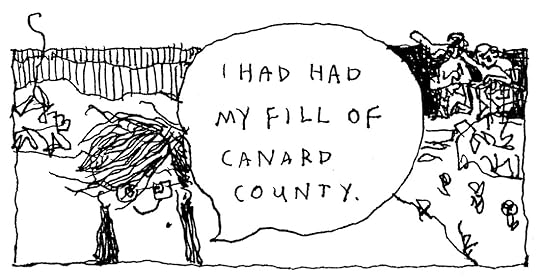
As for Gipe's illustrations, far be it from me to say whether they were purposefully minimalistic or whether Gipe just didn't do so great at art school. They're scraggly, underdetailed marks on paper. I loved them. Back to what I said about Shel Silverstein, similar to his books, (some of my favorites as a kid) the illustrations capture simplicity, or harsh reality, depending.
Trampoline is a deep, tough book to read, but one of those books where you'll finish, and know you're better for the experience.
I can't even imagine what Robert Gipe went through to get this book published. It was printed by Ohio University Press, and my sincerest thanks to them for doing so. I wasn't presented a free copy to review, nor did I ever see an unpolished manuscript. I'm grateful to them, but more grateful to my library for securing not one but five copies of it, (a lot for a small library to have of one book that isn't the Bible) and I'm most grateful to the head librarian, who, having known me since I was six years old, swore she'd club me over the head with this book if I didn't read it.
My local library is run by a bunch of 'treehuggers' (AKA: the best freaking librarians in the entire freaking world) who dared speak out against fracking. Fracking has done to parts of Oklahoma what strip mining has done to parts of Kentucky, my town included. The biggest earthquake to hit Oklahoma happened last September, the rumbling felt as far away as Kansas City, Kansas. Why? If you ask the state government, the will of God. If you ask, well, others, fracking and waste-water injection. Not that you'll be hearing much of that.
But, so I can end this review with everybody knowing I'm not all doom and gloom, I'd like to share one more quote. A quote I want everybody who might be warring with a family member or a friend in these trying times to think back on before they say something they might regret.
The faces of Denny and his daddy rose up before me. Those coal miners who had loved me through my tree-hugging ways, needed mountains and woods more than any of us. They loved it here, and they had to tear it up to stay. The full hard hardness of their lot came down on me on that winter night, and I knew maybe not them but other coal miners would be mad at me, would hate me, but after that night, I was never mad at them, not the ones who lived here with me, and not the ones taking their own sorrow and joy from what was left of these trees, these rocks, these rustling waters.
Trampoline: an Illustrated Novel by Robert Gipe is that rare chance to embrace a book that is like no other. It’s a strange gumbo of conflicting attributes. At times the narrative goes internal for the narrator and we are subjected to the dreamy disorientation she feels, yet the characters feel more real and fully developed than any book I’ve read in years, on the other hand characters are stylized and even caricatures, until they are not anymore and the reader understands their complexity. As I was reading it I was wondering is this a graphic novel? A young adult read? A mystery thriller? A Crime novel? The answer is not really to any of those genres but it does contain elements of each. Probably my favorite aspect of the book is the author’s unique use of language to convey state of mind, truisms and the light and the dark that lives within his very real characters. The setting is Appalachia and I’ve read a fair bit of books set there, but this felt like a more complete vision, maybe because it does not restrict itself to a genre. The book was highly recommended by David Joy, who’s Where All Light Tends to Go was also a top 5 read for me this year. There are a lot of rave reviews for Trampoline (4.61 on Goodreads). But my suggestion is to ignore the descriptions of the plot, give it a try and see if it speaks to you as it did me.
just ok... Important, because this voice isn't heard too often, but could have been better (maybe edited into a few short stories with these memorable characters).
I was skeptical about the illustrations before I started reading this, but ended up really liking them. There were perfectly timed, and offered a lot of comic relief to otherwise heavy material.
I a little confused about Dawn, everyone around her carry'd on like she had some special talents or passion for change, but her environmental activism seemed almost accidental.
Maybe I'm just out of touch with what it's like to be 15, but Dawn had almost zero social skills. About 2/3s through I wondered if this was supposed to be a story about overcoming mental illness/developmental delays.
This book tells a story of Appalachian life through the eyes of 15 year old Dawn Jewell. Dawn suddenly finds herself speaking up in support of her Grandmother, her Mamaw, in fighting to get strip mining on top of Blue Bear Mountain stopped. It's a controversial topic, given that strip mining provides jobs for people in a place where few jobs exists. But, even some of the miners secretly support the protest. But while an important issue, stopping strip mining is not the core of this book. Life in Appalachia is.
Dawn is a sophomore in high school. She's smart but she is also very angry. She is often suspended for fighting, often fights she starts. She misses here Daddy, who was killed working at a mine site when she was nine. She's loves her Momma but Momma has not been the same since Daddy died and is now an addict and a drunk. Momma and brother Albert live with Daddy's brother Hubert, who brews moonshine and sells it through a rather clever set up at his store. Hubert's a bit crazy but not as bad as his other brothers.
Dawn lives with Mamaw, who is the strong one of the family. She separated from her husband Houston years ago because of his wandering. Houston lives on the hillside behind Mamaw's house. Dawn sometimes escapes to Houston's.
Dawn falls in love with the 18 year old DJ on a Kingston radio station, who is a college dropout. Dawn meets him when she is staying with her Mamaw's sister June in Kingston. It is not love at first sight, as Willet sent her pictures of someone other than himself, but she gets over it.
Dawn's family's bad behavior gets her fired from her job at the Krispy Kreme. She wants money for a car. Her mother stole her first paycheck, so she basically worked for nothing.
Dawn is torn between leaving and staying. Her Aunt June has offered to let her live with her in Kingston. Her Mamaw wants her to get out of the family mess. Willet lives in Kingston. But Dawn is drawn back, again and again.
The characters are complex. The author shows you the struggle of life in Appalachia. The illustrations are a wonderful addition to the text. This is the moderator's pick for November for the GR Twenty-first century literature group. I doubt I would ever have encountered, let alone read it, but for that. I look forward to the discussion. It is a very good book.
From the over-mined mountains of Kentucky comes Dawn Jewell, a 15-yr old whose voice you'll not soon forget. This is one of those books that exceeds the limitations of a label like the YA one. A healthy dose of humor eases a world of pain and complexity as Dawn not only battles the mining industry with her grandma, but deals with a slew of personal and Appalachian issues ranging from grief to poverty and substance-abuse. Gipe weaves an incredibly touching tale that appears to be the personification of writing what you know given how close to his own roots this must be. While I still would have found the story just as strong without them, I felt the sporadic, quirky drawings helped bring Dawn to life as a character providing a kind of window into how she viewed herself.
There are the books you like, and the books you love, and then there are the ones you want to hold to your heart for a minute after you turn the last page. Trampoline is one of those—not just well written, which it is; and not just visually appealing, which the wonderfully deadpan black-and-white drawings make sure of; but there is something deeply lovable about it, an undertow of affection you couldn’t fight if you wanted to. Or I couldn’t, anyway. Coming-of-age stories are supposed to do that, aren’t they?—make you love their young heroes or heroines, no matter how difficult they might be. And most, I find, don’t.
But Gipe has done it with 15-year-old Dawn Jewell, growing up at the end of the '90s in a poor Kentucky mining town with a sprawling (in more ways than one) dysfunctional family, as well as loyal and not-so-loyal friends, drugs and moonshine, strip mining activism, car wrecks, Black Flag on the radio, and a sympathetic DJ. And Gipe deftly avoids every single cliché that could trip such a story up, which includes having a pitch-perfect ear for dialect and making it into something marvelous. There are arrests, fights, bad reputations—"When they showed up, it was like it started raining washing machines. Things got broke."—and fierce scraps of beauty pulled from anywhere Dawn can find them. Trampoline is a wonder. It’s not out until April, but you can catch a couple of chapters on the publisher’s website.
This is a great book (and I'm not saying this just because I know and revere Robert Gipe). I didn't know what to think because, at first, the idea of an illustrated novel made me think 'comic book' or 'graphic novel'. But, it's neither -- and Robert's illustrations add a lens into the mind of the main character that adds dimension to this difficult but inspiring story. I loved how the events and characters came together through the mind and heart of Dawn and, if I say anymore, I'm afraid of spoiling this for others. While this is fiction -- the topics covered so eloquently are definitely not.
I adore Dawn Jewell and the mountains she wars to protect against mining, but it is her perseverance in difficult and complicated love--romantic, familial, self--that earns five stars for me. A truly important reflection of the battle for environmental conservation against corporate greed as well as the much more complicated fact of our dependence on natural resources that have long been sourced unsustainably. This novel is a deeply mined story of context and culture, but it is also layered with a universal human story of how uneasy and conditional triumphs over changing adversities just might be said to be at the very foundation of creativity.
It's my privilege to say I am acquainted with Robert Gipe, and I admire the good work he's done in Cumberland at the community college and especially with the community theater he spearheaded. But I don't know him well enough to lie and say I like his book if I didn't. Trampoline is excellent. It is the Appalachian "Precious." As as a sixth-generation Appalachian, I can attest to the authenticity of our dialect as Robert portrays it. Readers who yearn for the haunting and evocative beauty of our language should read Trampoline, and throw Foolish J.D. Vance's book on the fire.
I am so moved by this novel. Gipe's illustrations added so much dimension to Dawn's world--more YA/adult novels with illos, please! The idiomatic dialogue lifted the characters off the page, and every time a character asked "Do what?" I heard it in my Grandpap's voice.
I'd like to end with the quote I kept paging back to reread and refeel:
"She pulled me toward her, and as I fell into her, I knew in my heart I was not dangerous, and that I did not want to be, either" (208).
Trampoline has forced me to come to terms with something.
When I think about Appalachia, I tend to think of it in a very pastoral, romantic way; sunlight glimmering through trees, june bugs buzzing in humid fields, families gathered for big feeds in tiny kitchens. However, as much as I think of these things... that is not the whole truth. Drugs. Addiction. Rampant unchecked violence due to too much rural land and too few urban police. These, too, are part of Appalachia, and they're often overlooked for bright, cheery nature scenes, and i'll admit that i've not been an exception to that fact.
Trampoline's story, following fifteen-year-old Dawn Jewell and her grandmother as they fight to protect Blue Bear Mountain from MTR mining, is a harsh one. The people around Dawn are both quirky and interesting, but at the same time dangerous. One character, upon his neighbor learning that he supports a petition against mountaintop removal mining, finds their dog dying a gruesome death after being fed meat laced with broken glass. Dawn herself winds up in many fights over what is, more or less, her grandmother's, not hers, fight against the mining companies.
It is in this world, a mix of rural depravity and picturesque quirkiness, that we follow Dawn. Speaking personally, I found Dawn to be a somewhat unlikable character for the largest portion of the novel. She never seems to speak to anyone, lets things stew inside her head, which leads to many bull-headed incidents. However, it's worth saying that i've never been a fifteen-year-old girl (no, not even that one time) and so there may be an aspect of her character i'm missing. In a world of characters reacting without thinking, I would have liked a bit more reaction from her and less thinking.
Ultimately, I came away from the novel feeling good about it. It has also helped me gain a fresh perspective on not only the best of what Appalachia can offer, but also the worst.
In a strange way, i'm reminded of Cormac McCarthy's Child of God. Within that novel, McCarthy demonstrates through Lester Ballard the most depraved actions seemingly possible by a human being, illustrating that even Lester is a "Child of God, much like yourself." Gipe uses the violent nature of several characters to create a contrast, and show that the people of Canard County are neither good, nor evil, but human. That said, it can be a rough read if you go into it expecting picturesque mountain vistas.
This morning I finished the illustrated novel "Trampoline" and I have one word for the book: Innovative! Brilliant! Important! Oh, wait...
Set in Appalachia (with addiction and stripmining themes), the descriptions and dialect in "Trampoline" are spot-on and wildly fresh. On every page I died a small happy death when I encountered phrases like: "Mom-cut bangs" and "...the trampoline squeaked like a girl talking about prom." Going forward, I'm going to squint my eyes and prick up my ears as I go through my days, so whenever I need to describe something, I'll choose words and phrases as well-suited and unusual as Gipe's.
The acerbic angst of 15-year old Misty Dawn Jewell (a 5'10," sometimes drinking, sometimes cussing smart girl with Sasquatch hands) keeps yet another story of hell-in-Appalachia from being preachy and predictable. Dawn Jewell reminds me of another Appalachian protagonist I adore: Ree Dolly in Daniel Woodrell's "Winter's Bone." I love them both for their fiery courage and determination.
Dawn's affection for the young dj Willett Bilson is endearing. And reciprocrated. Though both youths are flawed, as we all are, their seeming unconditional love for one another is admirable. All the characters in "Trampoline" are both flawed and beautiful. I love that Dawn's father from time to time visits her from the grave in order to give guidance.
If I were to complain of anything about "Trampoline," it would be that Gipe's illustrations only portray Dawn. I would have loved to see simple line drawings of the other characters as well. Also, I found the cast a bit hard to keep track of, due to its size. But since I plan to read the book again, I'll jot down the cast of characters for reference.
I love this important and innovative work. Already I've recommended it to a dozen people. You also should read it. Especially if you live in, or care deeply about, Appalachia and its people.
Trampoline, a novel written and illustrated by Robert Gipe, is wonderfully and wholly original. I don’t know how Gipe inhabited the mind and heart of a teenage girl, but he did it, and beautifully. Kentuckian Dawn Jewell, a budding environmentalist with a quick-draw temper, bounces through a life strewn with landmines. Her losses are real—a dead father, an addict mother—but Gipe handles those tragedies with humor and grace. Both Dawn and readers carry a blend of hope and despair for this region as a mountain is saved, but moonshine gives way to oxy. We all know what that means, but if anyone can charge into battle, it’s Dawn.
I loved everything about this book, the story, the characters, the setting, the illustrations, even at 13.99 for the ebook i couldnt complain. Great book for anyone wanting a very well written coming of age story. nothing over the top, just a story of an very common girl growing up in appalachia. alot to ponder on for this 15 yr old girl coming up in the times and struggles of her region. very good book, sometimes five stars isnt enough, and this is one of those times. Thanks Chris for recommending this book to me!!
Dawn made my heart hurt and soar from page to page. I loved and hated every character in the book at some point during the reading. I will hold this book in my mind, and will keep it on my bookshelf to share with people that I know will appreciate it too. The way I feel for Dawn is the way I feel about Eastern Kentucky, in all the glory and pain together.
I didn't love this book, but also felt the need to find out what happens to Dawn, the main character. I imagine she is an extreme representation of some teens. I personally don't know how common teens with drug abuse problems are also environmental avengers. Unfortunately, Dawn's alcohol abuse overshadows her hopes to do good in the world.
Love love loved this book. I hope more people in my orbit and beyond discover the primary character, Dawn Jewel. I want to give her as much love as possible.
I got to hear Mr. Gipe read from this book and was compelled to read more of the words he so fluently spoke of Appalachia. The portion he read created a misguided expectation within me of the book. I expected How Green Was My Valley combined with “The Sound of Music.” What I found as I read this thorny, near-irresistible book was closer to “The Waltons” meet “Winter’s Bone.” The author validated that his eloquence in using the Appalachian language extended beyond what he spoke, he articulates a culture that has been forced to change in ways that are counter to its history while remaining firmly grounded in that very history. Mr. Gipe has crafted a tale of heartache and hope, finely detailing the reality of family and community in Appalachia without hiding the pain created by joblessness, chemical dependency and poverty in the region. The mountains, the love of which are central to being “Appalachian,” bring beauty in their mere presence, offer promise in the coal they harbor within their veins and conflict when those who want to “protect” both of those resources collide. This is not an easy book to read as the writer precisely captures the turmoil spawned by such a confrontation within these pages. Some of these images may not be suitable for all readers. Fifteen-year-old Dawn Jewell began living with her maternal grandmother after her father was killed in a coal mining accident and her mother sought to ease the pain of her grief by using various substances. “Mamaw” is a staunch advocate of protecting the beauty of the mountains, in particular that of (fictional) Blue Bear Mountain, Kentucky’s highest peak. While at a public hearing where part of a petition to strip mine that pristine wilderness is to be addressed, Dawn speaks up – loudly, and with clear enunciation as to the heritage of some in opposition of her cause of saving Blue Bear. To this point, she had managed to live her life in her “outlaw” family and small high school without drawing attention to herself; now both sides were very aware of this bright, strong, assertive young woman’s being. For the next month, the reader is allowed to journey with her, Dawn is seeking to understand how she got to be in this present position in this unique time. This is a not an easy journey to witness. It is one fraught with violence, drug and alcohol use, abandonment, possibilities wasted due to self-sabotage but one ultimately ending at the right “place,” but not before traversing some dreadful ground. Late in the book, there is a moment of rebirth for Dawn and in that moment the mindset of Appalachia is revealed in ways marvelous and dangerous, healing and destructive, complete and still in process.
“Blue Bear wasn’t just about winning a fight. Everything I could see from Mamaw’s porch, . . . (were) all that kept me alive sure as if it was air I was breathing. . . . I needed them close always. I couldn’t let that get torn down.” (p. 225) “Those coal miners who had been so good to me, who had loved me through my tree-hugging ways, needed mountains and woods more than any of us. They loved it here, and they had to tear it up to stay. (Some of the coal miners) would hate me, but after that night, I never was mad at them, . . . , not the ones taking their own sorrow and joy from what was left of these trees, these rocks, these rustling waters.” (p.226)
Dawn is left with an awareness of connection to all who/that surround her. A connection that is not physical yet makes up all that exists. She understands the truth of the proverb, “There is so much good in the worst of us, so much bad in the best of us that the difference between all of us really does not make a difference.” All are doing the best they can, with the help of each other and a Presence that attends all.
This book really brought home for me the privileges I had growing up. Dawn Jewell and I both grew up in Appalachia during the same time frame, but our experiences were completely different. She lives in rural Kentucky, and does get to visit the relatively urban center of Kingsport where I grew up. Otherwise we were living in two different worlds. I can only guess at how accurately her experiences reflect those of similarly situated Appalachians, but the writing feels very authentic. Her story highlights the hardship of generational poverty and the heartbreaking consequences of pervasive drug use in Appalachia. What I see in this story are people who are trapped by their circumstances, who would otherwise be very high achieving based on inherent ability, especially Dawn herself. While I have not read Hillbilly Elegy, based on what others have said I believe this book provides a much clearer picture of the heart of Appalachia. While there are so many tragic circumstances, I found the book very enjoyable and couldn’t put it down. I look forward to reading the next in the series.
Today in Kim Kupperman's WVWC MFA residency seminar on using images to create/enhance narrative, she talked about the range of uses, from images that illustrate the text to those that "do something else," that is, images that associate with and energize the prose without correlating directly (the way the photos work in Sebald, for instance). The drawings in Gipe's TRAMPOLINE illustrate Dawn Jewell's story but also "do something else," or many things really: for me they depict the 15-year-old's rich interiority (and do so in keeping with her own style), they insert moments of levity or wryness right at the right time to pull the book back from being maudlin, they make you crack up and sometimes make your gut drop.
I really enjoyed the novel, and Dawn is very familiar -- she's a kid with a whole lot going on beneath the surface, but like most teenagers, she's also pretty concerned with the surface too. It matters. She's lovable and brave; she also steals stuff and hurts people and drinks too much. She's wounded by a family that's high most of the time in a community that's economically crashed up, but she also holds onto stubbornly strong strands of love throughout.
I love this bit:
32: "You walk on and on, thinking you're going deeper into the woods, deeper into the past, farther away from the bullshit of the world, and then you trip over the cable running from somebody's satellite dish, and then you see the trailer and hear the creak of the trampoline springs, and then it's oh well, welcome back."
Gipe's got a wonderful ear for dialog and a wonderful instinct for simile: 74: "Mamaw looked at me a long time, like I was a dead cow in the creek she couldn't figure out how to move." And a great sense of texture and details that unapologetically belong to Dawn's world: 87: "My nose filled with the smell of molding wood, my ears with the pinging of the cooling four-wheeler engines" and 210: "...Kingsport, flat-chested little factory town."
It's a good book to talk about; it's a book that provokes. There are times when the book looks out at you with some defensiveness and suspicion, like that which is often aimed toward folks who live outside of this specific Appalachian context (a gaze that I also feel in Scott McClanahan's work, which I admire, and in the work of other contemporary Appalachian writers, including myself, frankly), but that aspect only makes this novel even more important to the conversation about what is Appalachian literature, to whom does it speak, with whom does it reverberate.
While this book isn't perfect--and every once in a while, I got lost in the rapid action or forgot who one of the many characters was--it is beautiful in its imperfections. I don't even know why, but I wanted to cry through most of the last quarter of this book. It wasn't because I was sad or because the story was sad (though, I guess, it is). I think it was just because I felt like someone really got it, got how it is to be here, grow up here. And that's not to say my situation has ever been like Dawn's in regards to the drugs and abuse, but there is so much that Dawn knows and feels and comes to understand that feels like something I know and feel and understand. There was a part near the end when Dawn realizes that she can hate what mountaintop removal mining is doing to her place, but that she can't hate the miners, and she can't even hate them for wanting her family to stop fighting to stop the mining operations. She realizes that they have a closer and more complicated connection to the place than anybody, because they have to love the thing they kill, and kill the thing they love. Robert Gipe puts his fingers right on what we all know--whichever side of the treehuggers vs. coal company (and timber and natural gas) that you might be on--that there is no easy answer, and there is no answer without people getting hurt. Those who reduce it down are probably not people who ever lived here, or who can't just up and leave whenever they need to.
Anyway, this was not just a coal mining book--far from it. It is a book about place and family and a girl trying to figure out how to be. It's also incredibly voice driven and, if I were teaching a creative writing class, I would definitely include this as one of my required texts.
I hear rumor that there is a sequel coming. I can't wait to read it.