

What do you think?

Honey in the Horn
Honey in the Horn is a novel about life in the homesteading days of Oregon, 1906-1908. It is about the coming of age of an orphan boy named Clay Calvert, but it is also the about the trials of the pioneers who came to Oregon following the American Dream. Through the characters that Clay meets along the way, the author introduces the readers to the various occupations of the settlers of that era. (wikipedia)
400 pages, Paperback
First published January 1, 1935
About the author
H.L. Davis
19 books18 followersHarold Lenoir Davis (October 18, 1894–October 31, 1960), known as H. L. Davis, was an American novelist and poet. A native of Oregon, he won the Pulitzer Prize for his novel Honey in the Horn, the only Pulitzer given to a native Oregonian. Later living in California and Texas, he also wrote short stories for magazines such as The Saturday Evening Post.
Ratings & Reviews
Friends & Following
Create a free account to discover what your friends think of this book!
Community Reviews
Displaying 1 - 30 of 121 reviews

August 25, 2015
This is a novel about homesteaders in Oregon around 1900 that I had heard about for years, but it was out of print and the copies that were available were expensive. I finally found a used copy at a decent price and I was looking forward to reading it. It was disappointing. Despite winning the Pulitzer Prize in 1936, it is badly dated. Davis was first a poet and only later a novelist, and it shows. There are lengthy passages describing the landscape with long lists of fauna and flora that are beautiful to read but bring the narrative to a screeching halt.
Many times a character is introduced and is allotted several pages of description and then disappears and never shows up again. It is filled with tall tales and satiric vignettes that don't always hold together and that also slows things down.
Another complaint is that it is a picaresque tale in which the same people keep bumping into each other on both sides of the Cascades. That happened so often that if I didn't know better I would have thought that Oregon was smaller than Rhode Island.
Here is an example of one of the many sketches of bigger than life characters and clumsy attempts at humor. It concerns Gentle Annie, who operated a combination hotel, barroom, and restaurant at Dead Dog Station, and didn't allow any criticism of the rough grub that she provided for her patrons.
"...she was Gentle Annie, a forthright spirit of the district with a considerable name for disciplining exacting patrons. Once, when a traveling-man had requested a glass of milk, they related, she had opened the bosom of her dress and drawn him a brimming beaker of her own personal lacteal fluid, and then stood over him with a cleaver while he downed it, and they also told that during the balance of his stay he quenched his thirst with nothing but whisky because he didn't want to risk having her draw him a glass of water."
Davis is not very kind in his characterization of women or Indians, which is to be expected in a book written during that era, I suppose, but it sounds an anachronistic note to the modern ear.
Oh, did I mention that I could see the ending coming a mile away and that when it did happen it was so contrived as to be unbelievable?
I should add, however, that a lot of critics and readers, even modern readers, give it a very high rating that I don't quite understand. But I do know that my low rating is partially due to my high expectations of wanting to read the book for such a long time and the fact that it had received the Pulitzer.
I'm fairly certain that Mark Twain was one of Davis' influences, but he falls short of the master in terms of both humor and satire. Instead of reading this one, I would recommend Twain's Roughing It, similar, but much better.
Many times a character is introduced and is allotted several pages of description and then disappears and never shows up again. It is filled with tall tales and satiric vignettes that don't always hold together and that also slows things down.
Another complaint is that it is a picaresque tale in which the same people keep bumping into each other on both sides of the Cascades. That happened so often that if I didn't know better I would have thought that Oregon was smaller than Rhode Island.
Here is an example of one of the many sketches of bigger than life characters and clumsy attempts at humor. It concerns Gentle Annie, who operated a combination hotel, barroom, and restaurant at Dead Dog Station, and didn't allow any criticism of the rough grub that she provided for her patrons.
"...she was Gentle Annie, a forthright spirit of the district with a considerable name for disciplining exacting patrons. Once, when a traveling-man had requested a glass of milk, they related, she had opened the bosom of her dress and drawn him a brimming beaker of her own personal lacteal fluid, and then stood over him with a cleaver while he downed it, and they also told that during the balance of his stay he quenched his thirst with nothing but whisky because he didn't want to risk having her draw him a glass of water."
Davis is not very kind in his characterization of women or Indians, which is to be expected in a book written during that era, I suppose, but it sounds an anachronistic note to the modern ear.
Oh, did I mention that I could see the ending coming a mile away and that when it did happen it was so contrived as to be unbelievable?
I should add, however, that a lot of critics and readers, even modern readers, give it a very high rating that I don't quite understand. But I do know that my low rating is partially due to my high expectations of wanting to read the book for such a long time and the fact that it had received the Pulitzer.
I'm fairly certain that Mark Twain was one of Davis' influences, but he falls short of the master in terms of both humor and satire. Instead of reading this one, I would recommend Twain's Roughing It, similar, but much better.

November 18, 2012
Keeping with my goal to read each Pulitzer Prize winning novel written prior to 1940 (which isn't so monumental a task considering the first was awarded in 1917), I finished reading "Honey in the Horn" and I'm glad I did. Yes, it's archaic. Yes, for today's standards it wouldn't even find a publisher much less win a Pulitzer (if for any reason it lacks political correctness). But to approach a 70-plus year old novel without placing yourself in the author’s reference of time is unfair to yourself and the writer.
From the point of view of Davis and his contemporaries, HITH is a gorgeously written novel, dripping with profound beauty and sometimes ugliness, and loaded with fascinating characters. The novel itself is a historical (it takes place in 1902), chronicling the lives of Oregon settlers. HITH reads much like any western novel of its time and even brings to mind John Wayne-style Western films. You might even call it a tour de force. The main characters are in a constant state of motion, moving from settlement to settlement. Along the way, they run into intriguing people who have their own back stories (common writing technique for that period). Davis's richly detailed characters leap from the pages as if they were people I'd met myself.
Davis stated when he wrote HITH that he had no intention of making any social or political commentary, and indeed HITH avoids overt pontificating, which adds to the novels appeal. At times the novel drags, other times HITH is so entertaining I found myself unable to set the work down. Planting myself in 1936, I can see why the Pulitzer committee bestowed Davis with the prestigious award. Oregon history buffs will devour it. Western literature buffs might enjoy it. Overall, I read HITH quicker than anticipated and I’m glad I spent time in Davis’s imaginative world.
From the point of view of Davis and his contemporaries, HITH is a gorgeously written novel, dripping with profound beauty and sometimes ugliness, and loaded with fascinating characters. The novel itself is a historical (it takes place in 1902), chronicling the lives of Oregon settlers. HITH reads much like any western novel of its time and even brings to mind John Wayne-style Western films. You might even call it a tour de force. The main characters are in a constant state of motion, moving from settlement to settlement. Along the way, they run into intriguing people who have their own back stories (common writing technique for that period). Davis's richly detailed characters leap from the pages as if they were people I'd met myself.
Davis stated when he wrote HITH that he had no intention of making any social or political commentary, and indeed HITH avoids overt pontificating, which adds to the novels appeal. At times the novel drags, other times HITH is so entertaining I found myself unable to set the work down. Planting myself in 1936, I can see why the Pulitzer committee bestowed Davis with the prestigious award. Oregon history buffs will devour it. Western literature buffs might enjoy it. Overall, I read HITH quicker than anticipated and I’m glad I spent time in Davis’s imaginative world.

August 28, 2010
I used to have this long speech I'd give about 'literature' and how much more concerned with quality of content I am than the topic of the content. I used to say that I'd read a 1,000 page book written on the history of a couch, if the writing was done interestingly enough, because I am not typically very concerned with plots, suspense or other manipulative techniques that are typically used to make me forget / not notice that the writing is sub par.
It's been a long time since that speech and a long time since I've read something on a topic that bored me to tears, yet I remained completely absorbed. This book did manage to do that for me though.
Honey in the Horn takes place in the Pacific Northwest, when it was still half inhabited by indigenous people and almost everyone in the area was transient. There was a lot of farming business, killing of people business and jail-breaking business. None of these topics are ones that I'm ever particularly interested in, but H.L. Davis held my attention well.
I am typically anti-flowery descriptions in books. I am typically anti-two-pages-of-description-about-a-character-we're-only-going-to-read-one-line-of-dialogue-from-and-then-never-see-again. However, H.L. Davis could write a 1,000 page book about the history of a couch and I'd read it.
What I'm trying to tell you is that the man has his chops and I dug it.
It's been a long time since that speech and a long time since I've read something on a topic that bored me to tears, yet I remained completely absorbed. This book did manage to do that for me though.
Honey in the Horn takes place in the Pacific Northwest, when it was still half inhabited by indigenous people and almost everyone in the area was transient. There was a lot of farming business, killing of people business and jail-breaking business. None of these topics are ones that I'm ever particularly interested in, but H.L. Davis held my attention well.
I am typically anti-flowery descriptions in books. I am typically anti-two-pages-of-description-about-a-character-we're-only-going-to-read-one-line-of-dialogue-from-and-then-never-see-again. However, H.L. Davis could write a 1,000 page book about the history of a couch and I'd read it.
What I'm trying to tell you is that the man has his chops and I dug it.

November 16, 2023
There were many aspects of this novel that I enjoyed. It is set in the Pacific Northwest, Oregon territory, in the early 20th century; it is a time of pioneers and homesteaders, looking to create a life for themselves and their families. The writing was very descriptive of the geography, the flora, the fauna and the lives of the people. The story focuses on Clay Calvert, a young man who is highly motivated to succeed, smart and yet ignorant of the ways of the world, trying to prove himself. He meets Luce, a very dynamic and capable woman. Their future appears to be with one another except they can’t seem to escape their pasts.
There were also parts of this that I didn’t like. There were a multitude of colorful characters, many of whom after being described in detail exited stage never to return. A few did return, but only at the end when their appearance felt a bit contrived. There were other characters who had no name, some of whom played a significant role in the story. Then there were the Indians who had no name and were treated like generic placeholders. Some scenes felt like they were only there to serve as transitions to the next stage of the story. Finally, it was evident early on how the story would end; perhaps it was meant to be, but if so, why?
This novel is described by many as regional fiction. Given how richly it describes a locale I can perhaps understand that label, but its intention seems to be larger and more universal. It does, however, provide unique insight into a time and place.
There were also parts of this that I didn’t like. There were a multitude of colorful characters, many of whom after being described in detail exited stage never to return. A few did return, but only at the end when their appearance felt a bit contrived. There were other characters who had no name, some of whom played a significant role in the story. Then there were the Indians who had no name and were treated like generic placeholders. Some scenes felt like they were only there to serve as transitions to the next stage of the story. Finally, it was evident early on how the story would end; perhaps it was meant to be, but if so, why?
This novel is described by many as regional fiction. Given how richly it describes a locale I can perhaps understand that label, but its intention seems to be larger and more universal. It does, however, provide unique insight into a time and place.

November 24, 2008
What was missing in Davis's 1936 Pulitzer Prize-winning novel Honey in the Horn was the romantic stereotyping and moralizing that could be found in much of the regional literature of the time. Instead, this is essentially a coming-of-age novel with complex, finely wrought, often humorous characters who are just trying to make a life — though the going isn't easy. Davis's rendering of the rugged Oregon landscape is simply gorgeous. Reminiscent of Stegner's Big Rock Candy Mountain, but with much more humor, Honey in the Horn is a great gift.
Recommended by Liz, Powells.com
Recommended by Liz, Powells.com

November 1, 2025
Honey in the Horn by Harold L. Davis
12 out 10
Honey in the Horn is an astounding, phenomenal, spectacular, engaging, divine Magnus Opus.
Perfect, the ultimate chef d'oeuvre, winner of the Pulitzer Prize in 1936, after being published a year before...this date explains the sometimes politically incorrect views - for today's standards, evidently - expressed in the novel, especially when concerning Native Americans, albeit there is no blanket dismissal, but descriptions that are sometimes unfavorable and could be seen as discriminatory in the present...we need to see though that the book is not written now, but many decades ago.
It made this reader realize how important it is to engage with the work, for I have just attempted to finish The Swimming Pool Library by Alan Hollinghurst and I could not immerse in that work, while being so enthused by Honey in the Horn, it was so enticing, exhilarating that the author could write almost anything and it was greeted with awe...I am joking to some extent, but Harold Davis did write about aspects that do not generally interest me and if they were in some other book, it might have been discarded...it happened with the Pool Library, for not keen on gay sex in the cinema or elsewhere, I found that I must drop the read and I was so fortunate in finding Honey next.
Clay Calvert is the hero of the narrative and he embarks on an epic journey, the quest for the Holly Grail, a teenager who is only sixteen when he has to run away, but who becomes a grown up by the end, finding who he is in the process, started with the nearly impossible task of saving dozens of sheep bent on dying in a river, a stage when he was an insolent, stubborn, gritty, somewhat savage, proud, brave and resilient boy.
He is adopted by Preston Shiveley and works for him, up to the point where he is requested to come to the prison where Wade Shiveley is detained, because the authorities think that the suspect might confess to the murder of a man who had had about eight hundred dollars on him, a sum that people believe the killer has stolen and they want to get it for themselves.
Uncle Preston is a very peculiar character, who is so fond of his son Wade that he asks Clay to take a pistol to jail, give it to the prisoner, who would then try and use it to escape, only to be shot by his guards, because his own father has set up a trap and the gun would be of no use.
On the way to the town, the hero meets Luce, daughter of a horse trader, the one who seems to be the love of his life.
After passing the pistol and hiding from the law which would prosecute him if they catch him, Clay joins the horse trader and his outfit in their travels, for they live a nomadic, migratory life, camping where they are allowed, making a living from trading the horses when possible and when that is not an option, working in the fields, harvesting hops or other crops that require temporary, manual labor.
To begin with, Clay is ill fitted for this life, he soon gets in a quarrel with a domineering, obnoxious man, who was about to allow the travelers to use his land and wood from it, but the young, proud rebel disliked the humility involved in ingratiating this pompous, ridiculous figure, who kept his sons in slavery, making them work for no pay, even those who were already forty.
This is just the first of a series of conflicts, some of them with Luce, for the two appear to be in love with each other, but for a while they are unable to confess to the crimes they have each committed, Clay doesn't mention that he is wanted for his complicity in the escape of a wanted killer, for Wade has used the modified gun only to threaten and thus get out of jail.
Luce has her own dark secret and the two separate while harvesting hops and when the sheriff comes to the camp, the young hero escapes, thinking they are trying to arrest him, which they weren't, and thus he rides his mare towards the coast and he is reunited with his love a short way from the ocean.
The masterpiece is magnificent, with hilarious moments and wondrous quotes...'horning in on a man's time is stealing'...
Luce made manning seem bigger...
Local Indians hung the dead in the trees...hence they wee not sure if it is dew or remnants of somebody's grandmother...
The Casters, if they saw a man going for the doctor in a life and death case, they would stop him to tell him their stories...and they never end
It is a supreme joy to read a book like this.
12 out 10
Honey in the Horn is an astounding, phenomenal, spectacular, engaging, divine Magnus Opus.
Perfect, the ultimate chef d'oeuvre, winner of the Pulitzer Prize in 1936, after being published a year before...this date explains the sometimes politically incorrect views - for today's standards, evidently - expressed in the novel, especially when concerning Native Americans, albeit there is no blanket dismissal, but descriptions that are sometimes unfavorable and could be seen as discriminatory in the present...we need to see though that the book is not written now, but many decades ago.
It made this reader realize how important it is to engage with the work, for I have just attempted to finish The Swimming Pool Library by Alan Hollinghurst and I could not immerse in that work, while being so enthused by Honey in the Horn, it was so enticing, exhilarating that the author could write almost anything and it was greeted with awe...I am joking to some extent, but Harold Davis did write about aspects that do not generally interest me and if they were in some other book, it might have been discarded...it happened with the Pool Library, for not keen on gay sex in the cinema or elsewhere, I found that I must drop the read and I was so fortunate in finding Honey next.
Clay Calvert is the hero of the narrative and he embarks on an epic journey, the quest for the Holly Grail, a teenager who is only sixteen when he has to run away, but who becomes a grown up by the end, finding who he is in the process, started with the nearly impossible task of saving dozens of sheep bent on dying in a river, a stage when he was an insolent, stubborn, gritty, somewhat savage, proud, brave and resilient boy.
He is adopted by Preston Shiveley and works for him, up to the point where he is requested to come to the prison where Wade Shiveley is detained, because the authorities think that the suspect might confess to the murder of a man who had had about eight hundred dollars on him, a sum that people believe the killer has stolen and they want to get it for themselves.
Uncle Preston is a very peculiar character, who is so fond of his son Wade that he asks Clay to take a pistol to jail, give it to the prisoner, who would then try and use it to escape, only to be shot by his guards, because his own father has set up a trap and the gun would be of no use.
On the way to the town, the hero meets Luce, daughter of a horse trader, the one who seems to be the love of his life.
After passing the pistol and hiding from the law which would prosecute him if they catch him, Clay joins the horse trader and his outfit in their travels, for they live a nomadic, migratory life, camping where they are allowed, making a living from trading the horses when possible and when that is not an option, working in the fields, harvesting hops or other crops that require temporary, manual labor.
To begin with, Clay is ill fitted for this life, he soon gets in a quarrel with a domineering, obnoxious man, who was about to allow the travelers to use his land and wood from it, but the young, proud rebel disliked the humility involved in ingratiating this pompous, ridiculous figure, who kept his sons in slavery, making them work for no pay, even those who were already forty.
This is just the first of a series of conflicts, some of them with Luce, for the two appear to be in love with each other, but for a while they are unable to confess to the crimes they have each committed, Clay doesn't mention that he is wanted for his complicity in the escape of a wanted killer, for Wade has used the modified gun only to threaten and thus get out of jail.
Luce has her own dark secret and the two separate while harvesting hops and when the sheriff comes to the camp, the young hero escapes, thinking they are trying to arrest him, which they weren't, and thus he rides his mare towards the coast and he is reunited with his love a short way from the ocean.
The masterpiece is magnificent, with hilarious moments and wondrous quotes...'horning in on a man's time is stealing'...
Luce made manning seem bigger...
Local Indians hung the dead in the trees...hence they wee not sure if it is dew or remnants of somebody's grandmother...
The Casters, if they saw a man going for the doctor in a life and death case, they would stop him to tell him their stories...and they never end
It is a supreme joy to read a book like this.

July 4, 2021
I was rather bored with Honey in the Horn which deals with Oregon at the turn of the last century just as Now in November by Josephine Johnson, fellow Pulitzer winner the previous year. But, where Johnson describes homesteading in the eastern part of the state during a drought, Davis deals more with western Oregon a few years later. The protagonist Clay is rather one-dimensional and, at least I found, not remarkably likable. He has an on-again, off-again relationship with the daughter of a horse trade which I found unconvincing. There were passages of beautiful writing describing the mountains and coastline, but I was not enamored with the characters and found the plot to be rather inconsistent in terms of rhythm.
"He went back to making pelt-stretchers, and refused to take any money for his sardines and barley and crackers. It was hard to think how long he would go on sitting outside listening to the ocean he had never seen with his wife locked upstairs with the blinds down, hating the country about which neither of them had ever really learned anything, and how all the good their fidelity to one another had done was to keep both of them from doing what they wanted to. It seemed an unjust piece of punishment against two people who had never done anything except love and stay faithful and need each other. If that was all a couple got for practicing what was commonly looked upon as a virtue, a man was a lot better off going it alone." (p. 179)
This passage bothered me: "They were dark for Indians, their complexions running to brown rather than red. All were fat, and their faces had the same combination of stupidity and covetousness that one sees among the peasants of Normandy." (p. 188). First off, Clay would probably not even be able to find Normandy on a map (or France for that matter) much less know dumb (and inaccurate) stereotypes about Norman peasants. This seemed very anachronistic to me.
On the other hand, I felt this observation was relevant even now: "Different though all these people's histories were, there was one thing to be noticed about them. None of them told stories about things they had heard or read about other people having done. They considered nothing worth telling unless they had seen and performed in it themselves. It was true that they preferred telling about what they had done to getting out and preparing for what they intended to do. Winter, for instance, was the time to have rounded up their cattle, which were then pasturing the low brush close to the sea where they were easy to get at. But the men refused to disturb them until spring, when they had drifted back into the deep timber following the new grass. The fresh-foliaged brush made them hard to find, the good feed made them hard to catch, and the settlers had over a month of extra work rounding enough of them to pay for the wagons needed to move it." (p. 212) I think that for much of humanity, this lackadaisical attitude is still prevalent despite its obvious and predictable disadvantages.
This completes my reading of the first 20 years of Pulitzers. My best discoveries during this period were the writing of Willa Cather about pioneer life in One of Ours which I found wonderful, the humorous fictional depictions of the medical industry by Sinclair Lewis in Arrowsmith, and the fascinating descriptions of life on a farm in China in Pearl S Buck in The Good Earth My least favorite was clearly Scarlet Sister MaryScarlet Sister Mary. Looking at other books published these years, but not rewarded by the Pulitzer Committee, I found that I was less in agreement with them for these early years. Granted that there as less being published, so the choices were reduced, I think that they missed the mark, particularly with having missed out on awarding early works by Hemingway and Faulkner and ANY work by Fitzgerald was quite a shame.
In case you would like to see the resume of my reviews of the most recent 50 years of Pulitzers:(https://www.goodreads.com/author_blog...)
My votable list of Pulitzer winners which I have read (only have the 40s, 50s, and 60s to finish!):
"He went back to making pelt-stretchers, and refused to take any money for his sardines and barley and crackers. It was hard to think how long he would go on sitting outside listening to the ocean he had never seen with his wife locked upstairs with the blinds down, hating the country about which neither of them had ever really learned anything, and how all the good their fidelity to one another had done was to keep both of them from doing what they wanted to. It seemed an unjust piece of punishment against two people who had never done anything except love and stay faithful and need each other. If that was all a couple got for practicing what was commonly looked upon as a virtue, a man was a lot better off going it alone." (p. 179)
This passage bothered me: "They were dark for Indians, their complexions running to brown rather than red. All were fat, and their faces had the same combination of stupidity and covetousness that one sees among the peasants of Normandy." (p. 188). First off, Clay would probably not even be able to find Normandy on a map (or France for that matter) much less know dumb (and inaccurate) stereotypes about Norman peasants. This seemed very anachronistic to me.
On the other hand, I felt this observation was relevant even now: "Different though all these people's histories were, there was one thing to be noticed about them. None of them told stories about things they had heard or read about other people having done. They considered nothing worth telling unless they had seen and performed in it themselves. It was true that they preferred telling about what they had done to getting out and preparing for what they intended to do. Winter, for instance, was the time to have rounded up their cattle, which were then pasturing the low brush close to the sea where they were easy to get at. But the men refused to disturb them until spring, when they had drifted back into the deep timber following the new grass. The fresh-foliaged brush made them hard to find, the good feed made them hard to catch, and the settlers had over a month of extra work rounding enough of them to pay for the wagons needed to move it." (p. 212) I think that for much of humanity, this lackadaisical attitude is still prevalent despite its obvious and predictable disadvantages.
This completes my reading of the first 20 years of Pulitzers. My best discoveries during this period were the writing of Willa Cather about pioneer life in One of Ours which I found wonderful, the humorous fictional depictions of the medical industry by Sinclair Lewis in Arrowsmith, and the fascinating descriptions of life on a farm in China in Pearl S Buck in The Good Earth My least favorite was clearly Scarlet Sister MaryScarlet Sister Mary. Looking at other books published these years, but not rewarded by the Pulitzer Committee, I found that I was less in agreement with them for these early years. Granted that there as less being published, so the choices were reduced, I think that they missed the mark, particularly with having missed out on awarding early works by Hemingway and Faulkner and ANY work by Fitzgerald was quite a shame.
In case you would like to see the resume of my reviews of the most recent 50 years of Pulitzers:(https://www.goodreads.com/author_blog...)
My votable list of Pulitzer winners which I have read (only have the 40s, 50s, and 60s to finish!):

Read
August 28, 2023This was a quick DNF for me. I was curious to read about rural Oregon in the early twentieth century but there was way too much animal suffering and cruelty for me, something I find traumatizing to read about.

March 5, 2022
PULITZER PRIZE WINNER: 1936
===
2.5 rounded up
This was fine, but a bit boring and meandering. A lot of space is given to lush descriptions of the landscape, which painted quite the picture but quickly began to wear. Just about every character gets quite a long description of them as well, and while they're often interesting and insightful, it was just way too much page-space for characters we see once and then never again. The book definitely picks up in the second half, but the ~big~ reveal at the end was pretty obvious, and I just sort of felt like nothing much happened here, nor did I really feel like I knew any of the characters despite the little clever observations about the people Clay encountered throughout the novel. The treatment of women and Indigenous people was expected, and not as overpowering as other books I've read in this time period, though that's not exactly high praise. It was fine, but far longer than it needed to be.
===
2.5 rounded up
This was fine, but a bit boring and meandering. A lot of space is given to lush descriptions of the landscape, which painted quite the picture but quickly began to wear. Just about every character gets quite a long description of them as well, and while they're often interesting and insightful, it was just way too much page-space for characters we see once and then never again. The book definitely picks up in the second half, but the ~big~ reveal at the end was pretty obvious, and I just sort of felt like nothing much happened here, nor did I really feel like I knew any of the characters despite the little clever observations about the people Clay encountered throughout the novel. The treatment of women and Indigenous people was expected, and not as overpowering as other books I've read in this time period, though that's not exactly high praise. It was fine, but far longer than it needed to be.

December 29, 2011
I'll get this from the library tomorrow. I encountered Davis for the first time(as far as I remember) in the short story book I just finished. Never heard of him before that. We'll see... Started this morning with some reading before work and I'm a bit leary of the "wry folksiness" of the style. Typical 30's??? Lot's of rural Oregon 1900 colloqialisms as well. It'll probably flow better as I go along. The edition I'm reading came from the Southwest Harbor Library and is quite old. 1935 I think and hardbound of course. People have been checking it out regularly since then but with some major time gaps. The dates go back into the '30's. Slowly getting into the book after various interruptions. The opening kind of reminds me of "The Return of the Native" as the author describes the physical and then the cultural background of the story. Not so many words as Hardy though. As with TH the story is set in a remote nature-dominated place and the scenes of humans vs nature are beautiful and intense. Like Hardy, Davis was a poet and his prose is poetic: "The snow would cover them, more snow would fall and cover them deeper, and when spring came it would melt and the freshets would carry what was left of them away. Even the bones wouldn't last, because the little wood-mice would gnaw them down to the last nub." and some nice alliteration: "... the whole meadow moved with grass-stems shedding water and springing erect from the mat into which the rain had beaten and the frost fastened them. Water dripped from the hazel bushes and the wild-rose thickets speckled with scarlet rose-hips and from the clumps of wild crabapple along the fence.". Very nice. The more I read the more I think that Cormac McCarthy is a Davis fan. So far this story is reminding me of "All the Pretty Horses". I'm now at the mid-point of this slow-reading book. The "plot" has taken a back seat for now in favor of Davis' desire to illustrate for us the cultural and natural world of post-pioneer Oregon. Interesting. One does wonder about the characterization of the Indians and in particular the way of English-speaking of the kid with six-fingers. Me "thinkum" maybe not authentic... or maybe it is. I wasn't there and Davis was. At this point the story reminds me of another C. McCarthy book: "Suttree", as the kid has joined up with an itinerant family and fallen for the young daughter. Finished the book last night. An interesting book for sure and well written to boot. An unsentimental look at a still-unsettled time in Oregon. Some time right after the SF earthquake. At the end the pioneers/settlers/would-be exploiters are on the move again due to another starve-out. Plenty of violence both random and organized takes place. Murder, thieving, lynching, brawling and Indian massacres(of, not by) seem to be pretty common. "Civilization" hasn't taken hold yet but by the time the book was written(1930's) I imagine things had calmed down a lot. The fate of the uprooted white people is unsettled but the downward spiral of the Indians seems inexorable. Even though there seem to still be plenty of them around, they live on the shrinking fringe of the expanding white culture that has no use for them nor much understanding of or compassion for them. Davis maintains his vivid and careful descriptive style vis-a-vis the natural world right to the end.

January 19, 2017
H. L. Davis spins a tale that only a man who had lived through that period of time in Oregon, had picked hops, stacked hay, ridden the outlaw trail and listened to a whole lot of stories in bars could have written.
As a native Oregonian (that's actually a new paper, not the real name we call ourselves) with ancestors and relatives living across most of the state at one time or another in the past 150 years, I have heard some of these stories from the Willamette Valley about the bums and the hops picker gangs. I've seen the coastal range forests and tried hunting them in the deep snow where a man can step off a log and disappear because of the undergrowth, and my grandmother and father told a number of stories about the wild country east of Eugene, OR up in the lakes above Oak Ridge where the McBee's lived every summer in the early 1900's picking berries, catching fish and shooting an occasional deer for the pot.
Davis captures the real essence of the young Clay Calvert coming of age, realizing that he is growing up, becoming interested in women, wanting to move away from the authorities who have governed his life up to the moment. As you read the book you begin to understand how Davis' keen eye for the minutia of detail brought him the accolades and awards as a great writer.
A scene that comes to mind is at the beginning of the book during the flood with Clay Calvert attempting to save a flock of sheep that had decided to follow the leader into the swelling river and drown. Only a man who has seen the floods of the Oregon rivers, been run over by a big old ewe or two, tried to pick up a sodden sheep or been wet to the skin in the Oregon rain can be so eloquent in writing about it.
Another scene in the middle of the book when Clay is picking hops, has a blow-up with his girlfriend, and goes off to camp with an older single woman who plays guitar and is running from the law, captures the hand to mouth existence of many people at that time.
Finally, for those of you who have a spot in your heart for scenes from Lonesome Dove like the hanging of Jake Spoon. Davis' description of the hanging of Wade Shiveley from the hay stacking boom will strike your heart as to how hangings did occur in those days, sometimes not for what you just did, but because of other things associated with your life outside the law that just finally caught up with you.
It took me a while to get into the swing of the book, the paragraph long sentences, the language that is slow, deliberate and much like the true country folk still speak when they are at home or work, away from the rush of modern Californicated Oregon. You may not love the book, but you'll enjoy it and know you have read one of the best authors for writing about that period of time in Oregon history by the time you are done.
As a native Oregonian (that's actually a new paper, not the real name we call ourselves) with ancestors and relatives living across most of the state at one time or another in the past 150 years, I have heard some of these stories from the Willamette Valley about the bums and the hops picker gangs. I've seen the coastal range forests and tried hunting them in the deep snow where a man can step off a log and disappear because of the undergrowth, and my grandmother and father told a number of stories about the wild country east of Eugene, OR up in the lakes above Oak Ridge where the McBee's lived every summer in the early 1900's picking berries, catching fish and shooting an occasional deer for the pot.
Davis captures the real essence of the young Clay Calvert coming of age, realizing that he is growing up, becoming interested in women, wanting to move away from the authorities who have governed his life up to the moment. As you read the book you begin to understand how Davis' keen eye for the minutia of detail brought him the accolades and awards as a great writer.
A scene that comes to mind is at the beginning of the book during the flood with Clay Calvert attempting to save a flock of sheep that had decided to follow the leader into the swelling river and drown. Only a man who has seen the floods of the Oregon rivers, been run over by a big old ewe or two, tried to pick up a sodden sheep or been wet to the skin in the Oregon rain can be so eloquent in writing about it.
Another scene in the middle of the book when Clay is picking hops, has a blow-up with his girlfriend, and goes off to camp with an older single woman who plays guitar and is running from the law, captures the hand to mouth existence of many people at that time.
Finally, for those of you who have a spot in your heart for scenes from Lonesome Dove like the hanging of Jake Spoon. Davis' description of the hanging of Wade Shiveley from the hay stacking boom will strike your heart as to how hangings did occur in those days, sometimes not for what you just did, but because of other things associated with your life outside the law that just finally caught up with you.
It took me a while to get into the swing of the book, the paragraph long sentences, the language that is slow, deliberate and much like the true country folk still speak when they are at home or work, away from the rush of modern Californicated Oregon. You may not love the book, but you'll enjoy it and know you have read one of the best authors for writing about that period of time in Oregon history by the time you are done.

April 4, 2015
This book won the Pulitzer just 4 years before Grapes of Wrath (1936/1940). Which is really kind of amazing, as these books have a lot in common—they look at migrations of people and what led them there. Obviously Grapes of Wrath looks at a much larger migration in a different time and place and a much worse human-induced climatic catastrophe. But though this book is dated (esp when discussing the various Indian tribes—though Davis does go into detail about who is who, there are not just "Indians"), Davis does have some opinions about speculators (from town site sellers to work crew leaders), gossipy families, unsatisfiable settlers, etc etc.
While the focus of this book is Clay Calvert, an orphan who grew up on a farm that took in a fair number of orphans, the story is really about Oregon. It is about a semi-settled country and those trying to get rich on what is left. You meet orphans, Indians of various tribes and upbringings, settlers of varying competencies, an outlaw, a horse trader, itinerant workers, land speculators, and settlers who cannot quite be happy so keep moving looking for something better. Of course, this takes place 1904-1906—the best land has been taken and used for decades, and what is left is borderline.
I can see why this won the Pultizer when it did. It is about the generation that saw Oregon go from frontier to settled and American, though not everyone was quite ready for that. He actively mocks many of the sorts of settlers you learn about in history classes—land speculators that want to sell lots and get out before the town never gets built; gossipy families who can't quite manage to be successful as quick as they want, so the keep moving and never achieve that success; workgang "bosses" preying on immigrants adnd the not-so-bright.
Definitely an interesting read, the second half is stronger than the first.
While the focus of this book is Clay Calvert, an orphan who grew up on a farm that took in a fair number of orphans, the story is really about Oregon. It is about a semi-settled country and those trying to get rich on what is left. You meet orphans, Indians of various tribes and upbringings, settlers of varying competencies, an outlaw, a horse trader, itinerant workers, land speculators, and settlers who cannot quite be happy so keep moving looking for something better. Of course, this takes place 1904-1906—the best land has been taken and used for decades, and what is left is borderline.
I can see why this won the Pultizer when it did. It is about the generation that saw Oregon go from frontier to settled and American, though not everyone was quite ready for that. He actively mocks many of the sorts of settlers you learn about in history classes—land speculators that want to sell lots and get out before the town never gets built; gossipy families who can't quite manage to be successful as quick as they want, so the keep moving and never achieve that success; workgang "bosses" preying on immigrants adnd the not-so-bright.
Definitely an interesting read, the second half is stronger than the first.

May 27, 2011
I read this in advance of a recent trip to Oregon, as Davis was born to a settler family there and wrote a great deal about his home state. The period (1930s) and regional slang is challenging but only because we don't know it; a dictionary neatly addressed this problem. I am grateful to Davis, however, for preserving this exact language.
This is a coming-of-age tale, not sentimental, a sort of West Coast version of Huck Finn (though that's a stretch). It is full of entertaining and, by today's standards, surprising anecdotes: what, for example, will the main character do when a couple hundred head of sheep decide to drown themselves, in their herd mentality? Spanish moss kept cows alive when everything else was dead and frozen? Who knew? The book is also refreshing because, having written it in the 1930s rather than later, Davis does not romanticize either the people or way of life of long ago. We may choose to do that, and I found myself slipping into it a few times, mostly for how much responsibility we've taken from young people that we instead infantilize into adulthood, but that's our fault and not Davis's.
I highly recommend this. I've read nothing else like it.
This is a coming-of-age tale, not sentimental, a sort of West Coast version of Huck Finn (though that's a stretch). It is full of entertaining and, by today's standards, surprising anecdotes: what, for example, will the main character do when a couple hundred head of sheep decide to drown themselves, in their herd mentality? Spanish moss kept cows alive when everything else was dead and frozen? Who knew? The book is also refreshing because, having written it in the 1930s rather than later, Davis does not romanticize either the people or way of life of long ago. We may choose to do that, and I found myself slipping into it a few times, mostly for how much responsibility we've taken from young people that we instead infantilize into adulthood, but that's our fault and not Davis's.
I highly recommend this. I've read nothing else like it.

January 25, 2014
Finished yet another of our Pulitzer reads! This was a fascinating book - the adjectives colorful, complex, brilliant, rich, humorous - pop to mind as i try to find a way to describe it, but I find description of the book elusive. We stopped several times during our reading to comment on the vocabulary and phrases/expressions that that author used - some just plain tickled our fancy, others were many layered, more complex. This is one of those books that could/should be re-read for even deeper enjoyment.
March 16, 2022
Like many others, I read this book as part of my challenge to read every Pulitzer Prize winner on the fiction list. Two other novels on the list include The Travels of Jamie McPheeters and The Grapes of Wrath and are fictionalized accounts of early settlers in the American west. I absolutely adored each one of those so I thought I'd also enjoy Honey in the Horn. Nope. There's not much I can add here that other reviewers have stated. Long, loooong, passages detailing the landscape, horses, horses, and more horses, and random characters who appear for a hot minute then disappear. None of the main characters seem particularly likeable. The story really had the potential to be great and I did enjoy a handful of sections, but those were far and few between.

April 14, 2019
H.L. Davis won the Pulitzer Prize for Honey In the Horn in 1936. The story is about pioneers settling in Oregon in the early 1900's. I enjoy western novels , but this one was not one of my favorites. I liked Lonesome Dove much better, but I did enjoy the story. I give this book 3 stars.

September 16, 2014
From my perspective, this is just a mediocre book. Not bad, not great. I probably wouldn't have chosen this book for a Pulitzer, but I guess I can sort of see why it was chosen. In a sense, there is nothing more quintessentially "American" in the United States of America sense of the term than a western story. And this is exactly what the book is: a western. Cowboys, Indians, hunting, cattle, hangings, outlawry, frontier justice, etc. The fact that it takes place in the Northwest, in Oregon, makes it a tad more interesting to me because of my understanding of Westerns as stereotypically understood had more to do with the central plains and southwestern regions of the US. So this book was a needed tonic for me in terms of dispelling some elements of Western mythology from my imagination. And I guess the Pulitzer committee can't always just pick the non-westerns over the westerns, can they?
The story itself was nothing to speak of. It just basically followed the roaming travels of a rather loner young cowboy and his dealings and path-crossings with other similar characters of the time and region. To the extent that there was a kind of mystery about certain shootings and the resultant misappropriation of justice, I had that figured out about halfway through the book, though the actual revelation itself doesn't take place until the last 5 pages of the book, as part of a very uncharacteristic spasm of philosophical commentary about the ruggedness and meaningfulness of the roaming and semi-communal lifestyles and peoples of the region.
There were occasional moments of cleverness and atmosphere in the writing, but for the most part it was typical western fare. The book also lacked, in my opinion, any real character development. The only other Pultizer winning western novel I've yet read was McMurtry's "Lonesome Dove" and that was an infinitely better book in terms of rich character development. With "Honey in the Horn," even after 500+ pages, I still don't feel like I really know the characters at all, though I get the feeling that I am supposed to know them better. But it's just not there. I mean, really, I challenge anyone who has read the book to tell me what they really and truly know about Clay and Luz. What shaped their thinking and orientation? What formed their spirit? How did their work and shooting skills develop? What other events in their early lives shaped who they are? We really know nothing about them. And the same is true really for every other character in the novel.
Finally, the mass-market paperback edition I read was rife with horrific editorial mistakes and oversights. More misspellings than I can count, a number of times text lines were repeated, etc. It was a sloppily edited book; and the sloppiness of the editing can't help but transfer to a perception of a kind of sloppiness in the story itself.
I'm glad I read it as a matter of discipline and to see what kinds of Western literature appealed to the readers of the day as award-worthy literature; but, unless you REALLY like westerns, and/or have a personal fascination with a fictionalized history of frontier and settler life in Oregon and the Northwest in the late 19th/early 20th century, I'd not really recommend it.
The story itself was nothing to speak of. It just basically followed the roaming travels of a rather loner young cowboy and his dealings and path-crossings with other similar characters of the time and region. To the extent that there was a kind of mystery about certain shootings and the resultant misappropriation of justice, I had that figured out about halfway through the book, though the actual revelation itself doesn't take place until the last 5 pages of the book, as part of a very uncharacteristic spasm of philosophical commentary about the ruggedness and meaningfulness of the roaming and semi-communal lifestyles and peoples of the region.
There were occasional moments of cleverness and atmosphere in the writing, but for the most part it was typical western fare. The book also lacked, in my opinion, any real character development. The only other Pultizer winning western novel I've yet read was McMurtry's "Lonesome Dove" and that was an infinitely better book in terms of rich character development. With "Honey in the Horn," even after 500+ pages, I still don't feel like I really know the characters at all, though I get the feeling that I am supposed to know them better. But it's just not there. I mean, really, I challenge anyone who has read the book to tell me what they really and truly know about Clay and Luz. What shaped their thinking and orientation? What formed their spirit? How did their work and shooting skills develop? What other events in their early lives shaped who they are? We really know nothing about them. And the same is true really for every other character in the novel.
Finally, the mass-market paperback edition I read was rife with horrific editorial mistakes and oversights. More misspellings than I can count, a number of times text lines were repeated, etc. It was a sloppily edited book; and the sloppiness of the editing can't help but transfer to a perception of a kind of sloppiness in the story itself.
I'm glad I read it as a matter of discipline and to see what kinds of Western literature appealed to the readers of the day as award-worthy literature; but, unless you REALLY like westerns, and/or have a personal fascination with a fictionalized history of frontier and settler life in Oregon and the Northwest in the late 19th/early 20th century, I'd not really recommend it.

October 31, 2008
“There was a run-down old tollbridge station in the Shoestring Valley of Southern Oregon where Uncle Preston Shiveley had lived for fifty years, outlasting a wife, two sons, several plagues of grasshoppers, wheat-rust and caterpillars, and a couple or three invasions of land-hunting settlers and real-estate speculators, and everybody else except the scattering of old pioneers who cockleburred themselves onto the country the same time he did.”
THe setting is the early 1900s of Oregon. The plot concerns itself with a young man named Clay Calvert, who gets himself involved with springing Uncle Preston’s no-good son Wade from jail. Afraid to be caught for this transgression, Clay takes off with an Indian boy for a bit, until he meets a horse trader and his beautiful daughter, Luce. Winning Luce is no simple thing, and in the course of this relationship’s development the reader learns about cattle and horses, shipping on the Columbia River, harvesting wheat, horse racing, whore houses, and pioneer justice. The tone is breezy, and the descriptions of the land often beautiful. The only sour note for me was the consistently derogatory language the author uses to describe the Native Americans. It certainly wouldn’t be acceptable if it were written today.
THe setting is the early 1900s of Oregon. The plot concerns itself with a young man named Clay Calvert, who gets himself involved with springing Uncle Preston’s no-good son Wade from jail. Afraid to be caught for this transgression, Clay takes off with an Indian boy for a bit, until he meets a horse trader and his beautiful daughter, Luce. Winning Luce is no simple thing, and in the course of this relationship’s development the reader learns about cattle and horses, shipping on the Columbia River, harvesting wheat, horse racing, whore houses, and pioneer justice. The tone is breezy, and the descriptions of the land often beautiful. The only sour note for me was the consistently derogatory language the author uses to describe the Native Americans. It certainly wouldn’t be acceptable if it were written today.

March 19, 2014
This was last month's selection of the Pulitzer reading club I belong to.
I started it a bit late, but I am so glad I read this. The most amazing thing about the book is the voice of the narrator. Set in Oregon at the end of the 19th century, the book shares the traditions of authors like Mark Twain and Bret Harte. It is a vehicle for the author to develop a wide variety of characters from that place and era, and his descriptions and use of dialect lets these characters emerge clearly. At times, the book's plot seems to get lost in all the development of minor characters and in description of the setting that raise it to the status of a major character itself.
The plot centers on a young man, Clay Calvert, who without family to hold him back, goes where the winds of fate blow him. He resembles Huckelberry Finn in this and some other respects. One way they differ is that Clay lacks Huck's good heart, and that lets him follow the moral precepts of his times without must hesitation.
When the plot finally emerges, the reader realizes that the book has been driven by this all along, and the end moves very quickly.
I started it a bit late, but I am so glad I read this. The most amazing thing about the book is the voice of the narrator. Set in Oregon at the end of the 19th century, the book shares the traditions of authors like Mark Twain and Bret Harte. It is a vehicle for the author to develop a wide variety of characters from that place and era, and his descriptions and use of dialect lets these characters emerge clearly. At times, the book's plot seems to get lost in all the development of minor characters and in description of the setting that raise it to the status of a major character itself.
The plot centers on a young man, Clay Calvert, who without family to hold him back, goes where the winds of fate blow him. He resembles Huckelberry Finn in this and some other respects. One way they differ is that Clay lacks Huck's good heart, and that lets him follow the moral precepts of his times without must hesitation.
When the plot finally emerges, the reader realizes that the book has been driven by this all along, and the end moves very quickly.

May 14, 2008
This book offers an awesome look at Oregon at the end of the 1800's. I copied down several different quotes that were just philosophically awesome. There were terms in the book I'll never understand ("he dug the hole very jesusly") and explanations of occurrences I'd heard of, but with reasons I'd never heard (Davis claims the main reason immigrant workers (like the Chinese) were preferred for building the railroad because they often hired themselves out in teams with an american group-leader, and the leader knew the bosses didn't know who each worker was by name, so they would put extra names on the list and get paid for them. Actual caucasian, english speaking employees were much easier to check out and so the ruse didn't work as well with them).
Anyway, this book is a great store of info and insight; it definitely earned its Pulitzer.
Anyway, this book is a great store of info and insight; it definitely earned its Pulitzer.
February 16, 2016
A truly enjoyable and sometimes comic coming of age story set in Oregon, Davis home state. Clay Calvert, an orphan, is forced to flee his job as a ranch hand on a sheep farm and he falls in with some homesteaders seeking the perfect location. With them, he meets the lovely Luce who captures his heart. The story becomes their story, with all its quirky characters and its astonishing prose that details the native plants and describes the scenery so well. Davis' writing reminds me of Mark Twain's, for it has a sly humor much like his and is peopled with wily characters. It is the only Oregon book that has won a Pulitzer prize and richly deserved it.

January 5, 2010
This book won the 1937 Pulitzer Prize - Fiction. A serious read about Oregon life in the homestead era (early 20th century). Indelible character portraits coupled with a great love for Oergon's natural beauty, plus a quiet sympathy for the Native American people. Very much like reading Mark Twain. Highly recommended if you're into Oregon history.
December 1, 2015
A book that is first western, Oregon Trail epic, and then love story sounds like a winner. Honey in the Horn would be great if it didn't fall prey to the dreaded slow downs. The book was slow in several places, and it hurt the overall story. The characters were great though and the prose was surprisingly humorous.

October 29, 2022
On the one hand, I think this narrative about a young man finding himself (and a lot of trouble) in late nineteenth-century Oregon could be told in a much shorter novel, maybe even a short story. On the other hand, I found some of the author’s digressions into pioneer folklore and class politics (?!) more interesting than the main story. Altogether, it is an odd and surprising Pulitzer honoree.

January 15, 2010
This book was a Pulitzer Prize winner in the 1930's. I wonder if it would have been today. Davis' voice is intoxicating. His descriptions of people and places reminded me of Annie Proulx. The story follows a 16 year old boy on a journey into manhood in the 1900's in Oregon.

December 13, 2013
Raw account of rough life of Oregon homesteaders. Dense style loaded with wonderful and unsettling details.

November 10, 2019
This book was published eighty-four years ago and was awarded the Pulitzer Prize for fiction. I had never heard of it before. The author was from Oregon, and it takes place in Oregon at the beginning of the twentieth century, when there was a lot of unsettled land, a bigger Native American presence, and a significant amount of homesteading taking place. Once again (for the third time, recently) I've found myself reading a book for a scheduled discussion that I would not have selected for myself on my own, and that if not for that reason (the discussion) I probably would not have continued reading and finished. It wasn't completely lackluster, but still, overall reading it seemed more of a chore than an enjoyable experience. The style seemed somewhat stilted and not at all what we're used to in contemporary fiction. Still, it did grow on me as I kept reading ---I guess I began to feel more comfortable with it. In parts of the book the author is humorous and very satiric and sarcastic. Some of his depictions of various characters are savage, biting, brutal, and merciless. The descriptions of the natural surroundings are quite detailed. And the author imparts quite a few "food for thought" philosophical observations about life, the human condition, and human folly. Not that I've read them all, but this is probably the second most disappointing Pulitzer Prize winner I've ever read. I can't say I'd recommend it, nor would I pursue other works by the author.

December 14, 2024
3.5 stars. An interesting historical fiction coming of age novel set in rural Oregon in the early 1900s. Clay Calvert, a sixteen year old orphan, is a young man intent on traveling and adventure and working out what he wants in life. He wants to move away from authorities and becomes interested in women. There are many events throughout this book.
Clay initially works as a sheep rancher, getting caught up in a scheme to release his relative, Wade Shiveley, from prison. By slipping Wade a gun into the cell, Clay finds himself fleeing the area due to Wade bluffing his way out of jail! (Clay had expected Wade to be killed trying to escape!). He journeys through the state of Oregon, from the eastern wheat fields to the Columbia River. He encounters many characters on his travels including a native Tunne Indian boy and a girl named Luce with whom he falls in love.
The strength on the novel is the descriptions of the landscape.
Winner of the 1936 Pulitzer Prize for fiction.
Clay initially works as a sheep rancher, getting caught up in a scheme to release his relative, Wade Shiveley, from prison. By slipping Wade a gun into the cell, Clay finds himself fleeing the area due to Wade bluffing his way out of jail! (Clay had expected Wade to be killed trying to escape!). He journeys through the state of Oregon, from the eastern wheat fields to the Columbia River. He encounters many characters on his travels including a native Tunne Indian boy and a girl named Luce with whom he falls in love.
The strength on the novel is the descriptions of the landscape.
Winner of the 1936 Pulitzer Prize for fiction.

May 19, 2025
This is the sleepy flower patch on our way to Oz.
This is the Calypso's island in our Odyssey.
Hell is paved with good intentions but apparently not good books.
This is the Calypso's island in our Odyssey.
Hell is paved with good intentions but apparently not good books.

February 23, 2026
“Honey in the Horn” and the End of the American Wanderer: A Novel of Rumor, Labor Camps, and Learning How to Stay
By Demetris Papadimitropoulos | February 22nd, 2026
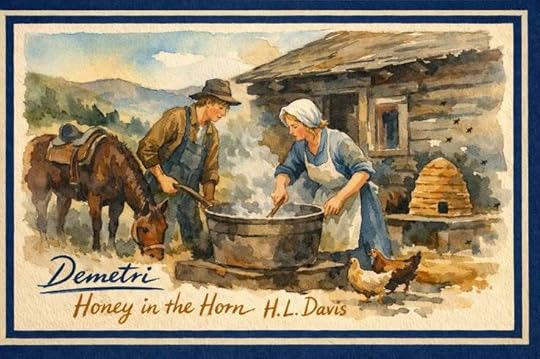
Watercolor Piece by Demetris Papadimitropoulos
“Honey in the Horn” arrives with the odd distinction of being both honored and half-forgotten – a Pulitzer-winning novel that can still feel, even now, like a side road in American fiction rather than a highway. Reading it as part of my project of working through all Pulitzer Prize winners in fiction and reviewing them for Goodreads, I found myself less in the presence of a monument than in the company of a stubborn, weathered intelligence: regional, unsentimental, observant, and quietly at war with the myths that American literature has so often loved to tell about itself.
This is a novel of Oregon, but more precisely it is a novel of after-Oregon – after the first rush, after the grand gestures, after the pioneer story has hardened into property lines, rumor networks, labor circuits, and old men who quote law as if it were Scripture. H. L. Davis is not interested in the frontier at the moment of conquest. He is interested in the residue. The cabins are abandoned. The stations are overbuilt. The camps are temporary. The boys coming of age inherit not a beginning but a leftover world. That choice alone gives “Honey in the Horn” a modernity that its date can obscure.
Its protagonist, Clay Calvert, is one of those boys born too late for the mythology that surrounds him. He is young, prickly, defensive, and not yet what the novel would call “set.” The book places him in the orbit of Uncle Preston Shiveley, one of the great stern figures in American regional fiction – a man of rootedness, law, endurance and a private intellectual life, the kind of settler mind that can be both rigorous and cramped. Preston represents a code. Not a fashionable code, not a cinematic one, but a granular, lived code: property matters, labor matters, staying matters, and institutions are useful only insofar as they ratify what people ought already to know.
Against Preston stands Wade Shiveley, a figure of impulse, speed and rupture – the frontier myth gone sour. Wade murders a man and steals money, and from that point forward the novel’s action is set in motion by a temptation that is less flashy than it sounds: the possibility that money could alter destiny quickly. The stolen sum functions as a moral accelerant. It is enough to matter, enough to distort loyalties, enough to tempt a young man into imagining a shortcut to adulthood. Davis, to his credit, never inflates this into a melodrama of greed. He keeps it local, practical, social. Money here is not abstract desire. It is feed, shelter, marriageability, leverage. It is the difference between drift and standing still.
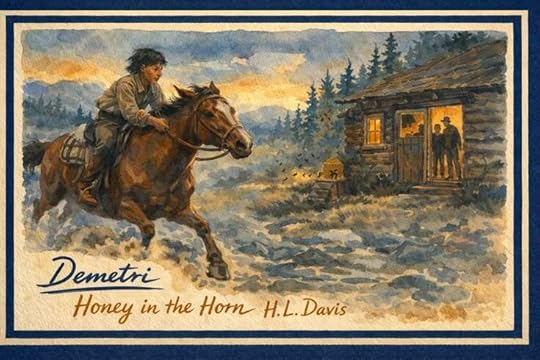
Watercolor Piece by Demetris Papadimitropoulos
Clay’s education, then, is not an education in ideas but in consequences. And “Honey in the Horn” is, among other things, a remarkable study of delayed consequences. Things do not explode on cue. They travel. They accumulate. Rumor outruns proof. Association becomes indictment. A choice made in one camp reappears miles later in another. This is one reason the novel can feel so contemporary without straining to be. We live, after all, in an era of reputational cascades, of social verdicts rendered before formal ones, of identities fixed in public by proximity and inference. Clay, long before the internet, discovers what it means to become a story in other people’s mouths.
That discovery is one of the book’s deepest subjects. If the frontier novel once promised self-invention, “Honey in the Horn” keeps asking a colder question: Who gets to author a life? Clay is forever trying to move ahead of the narrative forming around him – adopted boy, possible accomplice, drifter, no-account, labor hand, runaway. He cannot quite outrun the county’s memory, nor Preston’s moral gravity, nor Wade’s shadow. In that sense, Davis writes not a triumphant American self-making but a constrained one. Clay does not invent himself from nothing. He is shaped in collision – with land, with labor, with gossip, with older men, with women more practical than he is, with fatigue.
Fatigue, in fact, may be the novel’s most underrated engine. In many coming-of-age books, maturity comes as revelation. In this one, it comes as depletion. Clay’s pride burns hot early – his quickness to offense, his need to posture, his defensive toughness. But drift is exhausting. Seasonal work is exhausting. Being watched is exhausting. Being half-formed is exhausting. By the time the novel reaches its bee-country chapters, one of the most moving things Davis gives us is not a speech or a showdown but the simple fact of Clay sleeping, deeply and heavily, after too much fear and too much motion. It is a physical truth, and also a moral one. The boy’s volatility is burning off.
Those bee-country chapters are the book’s center of gravity, and the title’s key. “Honey in the Horn” is one of those American titles that can sound folkloric until the novel teaches you how literal and how hard-earned it is. Honey here is not sweetness as sentiment. It is stored labor. Preserved abundance. The result of small, repeated acts inside a structure. In the mountain cabins reclaimed by bees, Davis finds the novel’s governing metaphor without announcing it. The world of drift is motion without reserve. The world of bees is accumulation against winter.
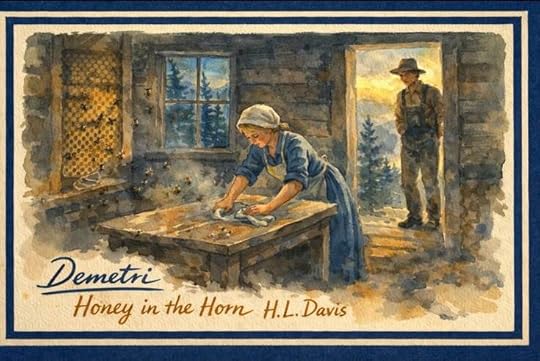
Watercolor Piece by Demetris Papadimitropoulos
Luce, Clay’s partner in this stretch of the book, understands this before he does. She is one of the novel’s strongest presences – not because Davis idealizes her, but because he grants her competence. While Clay is still metabolizing fear and reputation, Luce scrubs, sorts, boils, saves, organizes. She enters an abandoned cabin and begins converting it into a future. That is not decorative domesticity in this novel. It is civilization. Davis is too dry and too wry to turn Luce into a symbolic angel, but he is clear-eyed about the difference between talking a life and building one. In a book full of men performing versions of toughness, Luce simply works.
This is one of the pleasures of “Honey in the Horn” and also one of its provocations: the novel repeatedly shifts moral emphasis away from spectacle and toward maintenance. There are crimes, pursuits, arrests and escapes in the story, but the deepest weight often falls elsewhere – on a table being scrubbed clean, on a horse being handled, on fruit jars, on camp routines, on the practical intelligence required to make one more season possible. If “The Virginian” helped codify the glamour of frontier masculinity, Davis writes as if he has already seen what glamour leaves out. His world has more in common, spiritually, with the laboring drifters of “Of Mice and Men” or the social suspicion of “The Ox-Bow Incident” than with the heroic swagger of older Western templates.
That does not mean the novel is a social protest book in the Steinbeck mold. In fact, one of Davis’s most interesting choices is his refusal to sermonize. He reportedly disclaimed social criticism, and while the disclaimer is disingenuous on its face – this is plainly a novel with class texture – the spirit of it is true in one sense. Davis does not write to indict. He writes to observe systems at work. Hop fields become temporary economies. Owners manage labor and image simultaneously. Men cling to ideas of dignity while women and children carry visible burdens. Communities sort the trustworthy from the suspect with more speed than fairness. It is all there, but he lets the structure emerge through detail, not thesis.
That detail is the reason the novel remains valuable even when it frustrates. Davis is an exacting regional writer in the best way. He understands that landscape is not background but pressure. The valley, the roads, the hop camps, the mountain clearings – each setting modifies Clay’s possibilities. The land in this novel is never a postcard and never a god. It does not save him, and it does not punish him. It simply establishes terms. This makes “Honey in the Horn” feel less like romance and more like ecology. People move through systems they did not build, and character is revealed in how they adapt, endure or break inside them.
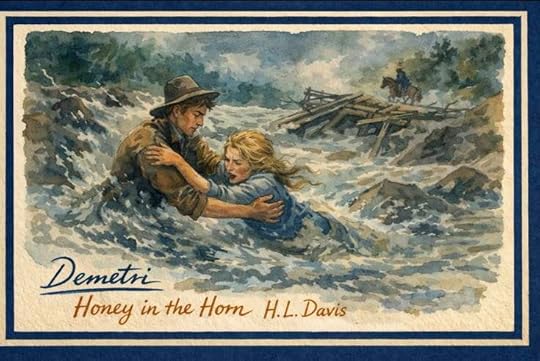
Watercolor Piece by Demetris Papadimitropoulos
If I have a reservation about the book – and I do – it lies in the very quality its defenders most admire: the picaresque looseness. “Honey in the Horn” is rich in episodes, textures and human weather, but it is not always elegant in momentum. There are stretches where the novel can seem to sidle rather than stride, where Davis’s interest in movement itself overtakes dramatic concentration. One can call this panoramic realism, and often it is. One can also feel, at times, that the book is testing the reader’s patience in order to make a philosophical point about patience. Some readers will find that bracing. Others will find it baggy. Both responses are fair.
The emotional temperature contributes to this divide. Davis writes cool. He is not after the lush ache of “My Ántonia,” nor the Biblical amplitude of “East of Eden,” nor the glittering fatalism of “The Great Gatsby.” His power comes from withholding. He rarely tells you when to feel. He is suspicious of climax, suspicious of heroics, suspicious even of confession. That tonal restraint is part of what makes the novel feel adult. It is also part of what can keep a reader at arm’s length. “Honey in the Horn” does not seduce. It accompanies.
Still, what it accompanies us through is more subtle than a standard coming-of-age plot. Clay’s arc is not from innocence to knowledge, exactly. It is from volatility to durability. He does not become grander. He becomes steadier. He loses things – quick anger, performative pride, the fantasy of pure motion, the belief that freedom means leaving. The novel’s deepest wisdom may be that growth is subtractive. American fiction so often celebrates expansion: new cities, new names, new fortunes, new selves. Davis writes the counterstory. Adulthood is contraction. You narrow your impulses. You narrow your options. You narrow your myth of yourself. And in that narrowing, if you are lucky, you gain shape.
For that reason, the ending is better than a louder one would have been. It does not arrive with fanfare. Clay is not redeemed by a speech, nor purified by punishment, nor transformed into Preston 2.0. He settles into a more ambiguous achievement – a capacity to stand where once he only flared. The novel does not pretend that reputation evaporates or that social memory forgets. It offers no magical reset. What it offers is harder and, in the long view, more convincing: the possibility that a person can become reliable before he becomes admired.
Reading the book now, I was struck by how many of its tensions feel current without needing to be updated. The precarious labor circuits of the hop fields echo our own gig economies, where movement is marketed as freedom and often experienced as instability. The social mechanics of rumor and accusation feel uncomfortably familiar in a time when identity can be fixed by online narrative before evidence catches up. Clay’s second-generation frustration – inheriting stories of opportunity while facing a narrowed horizon – belongs as much to contemporary adulthood as to post-frontier Oregon. Davis does not “predict” the present, exactly. He just writes clearly enough about systems that the parallels arrive on their own.
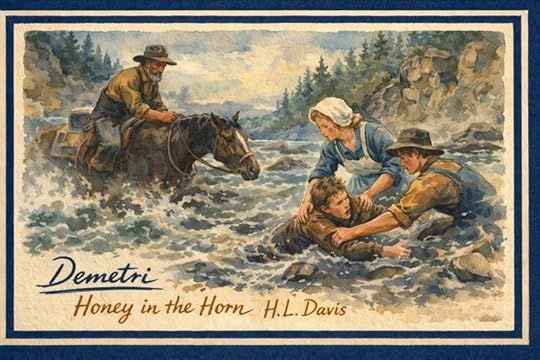
Watercolor Piece by Demetris Papadimitropoulos
As a Pulitzer winner, “Honey in the Horn” also makes an interesting case for what that prize can preserve and what it can obscure. It preserves a book’s existence. It does not guarantee its readability across generations, nor its canonical security. Davis’s novel has drifted a bit in our literary memory, perhaps because it refuses the very qualities that travel best in survey courses and recommendation culture: high symbolism, quotable aphorism, melodramatic set pieces, neat ideological packaging. It is a difficult novel to reduce. Its greatness, where it has it, lies in texture and pressure and temperament. It asks to be lived in more than summarized.
And yet it is not, for me, an unqualified triumph. There are books one admires and books one surrenders to, and “Honey in the Horn” remains somewhat in the former camp. I admire its anti-myth frontier vision, its dry intelligence, its labor realism, its sense of moral gravity. I admire the way it refuses to flatter Clay and refuses to flatter the reader. I admire the title’s metaphor, which gathers force slowly until it seems to explain not only the plot but the prose itself. But I also felt, across some stretches, the drag of its episodic architecture and the limits of its emotional reticence. It is a novel I respect more than I love – which, in this case, is not faint praise. Respect may be the proper mode for a book so committed to endurance.
If I were filing this in the spirit of a reviewer notice, I would call “Honey in the Horn” a significant American novel that outlived its moment by refusing to belong too comfortably to it. It stands in productive tension with “My Ántonia,” with “Of Mice and Men,” even with the anti-self-invention logic of “The Great Gatsby,” while remaining resolutely itself – Oregonian, skeptical, patient, dry-eyed. It is a book about what remains after the myth burns off. It is a book about how communities remember, how labor shapes character, how pride impersonates freedom, how sweetness must be stored because winter is real.
And it is, perhaps most of all, a book about staying – not the inherited staying of the first settler, but the earned staying of someone who has tested motion and found it wanting. In a culture that still glamorizes reinvention, that feels almost radical.
My rating: 69/100.
By Demetris Papadimitropoulos | February 22nd, 2026
Watercolor Piece by Demetris Papadimitropoulos
“Honey in the Horn” arrives with the odd distinction of being both honored and half-forgotten – a Pulitzer-winning novel that can still feel, even now, like a side road in American fiction rather than a highway. Reading it as part of my project of working through all Pulitzer Prize winners in fiction and reviewing them for Goodreads, I found myself less in the presence of a monument than in the company of a stubborn, weathered intelligence: regional, unsentimental, observant, and quietly at war with the myths that American literature has so often loved to tell about itself.
This is a novel of Oregon, but more precisely it is a novel of after-Oregon – after the first rush, after the grand gestures, after the pioneer story has hardened into property lines, rumor networks, labor circuits, and old men who quote law as if it were Scripture. H. L. Davis is not interested in the frontier at the moment of conquest. He is interested in the residue. The cabins are abandoned. The stations are overbuilt. The camps are temporary. The boys coming of age inherit not a beginning but a leftover world. That choice alone gives “Honey in the Horn” a modernity that its date can obscure.
Its protagonist, Clay Calvert, is one of those boys born too late for the mythology that surrounds him. He is young, prickly, defensive, and not yet what the novel would call “set.” The book places him in the orbit of Uncle Preston Shiveley, one of the great stern figures in American regional fiction – a man of rootedness, law, endurance and a private intellectual life, the kind of settler mind that can be both rigorous and cramped. Preston represents a code. Not a fashionable code, not a cinematic one, but a granular, lived code: property matters, labor matters, staying matters, and institutions are useful only insofar as they ratify what people ought already to know.
Against Preston stands Wade Shiveley, a figure of impulse, speed and rupture – the frontier myth gone sour. Wade murders a man and steals money, and from that point forward the novel’s action is set in motion by a temptation that is less flashy than it sounds: the possibility that money could alter destiny quickly. The stolen sum functions as a moral accelerant. It is enough to matter, enough to distort loyalties, enough to tempt a young man into imagining a shortcut to adulthood. Davis, to his credit, never inflates this into a melodrama of greed. He keeps it local, practical, social. Money here is not abstract desire. It is feed, shelter, marriageability, leverage. It is the difference between drift and standing still.
Watercolor Piece by Demetris Papadimitropoulos
Clay’s education, then, is not an education in ideas but in consequences. And “Honey in the Horn” is, among other things, a remarkable study of delayed consequences. Things do not explode on cue. They travel. They accumulate. Rumor outruns proof. Association becomes indictment. A choice made in one camp reappears miles later in another. This is one reason the novel can feel so contemporary without straining to be. We live, after all, in an era of reputational cascades, of social verdicts rendered before formal ones, of identities fixed in public by proximity and inference. Clay, long before the internet, discovers what it means to become a story in other people’s mouths.
That discovery is one of the book’s deepest subjects. If the frontier novel once promised self-invention, “Honey in the Horn” keeps asking a colder question: Who gets to author a life? Clay is forever trying to move ahead of the narrative forming around him – adopted boy, possible accomplice, drifter, no-account, labor hand, runaway. He cannot quite outrun the county’s memory, nor Preston’s moral gravity, nor Wade’s shadow. In that sense, Davis writes not a triumphant American self-making but a constrained one. Clay does not invent himself from nothing. He is shaped in collision – with land, with labor, with gossip, with older men, with women more practical than he is, with fatigue.
Fatigue, in fact, may be the novel’s most underrated engine. In many coming-of-age books, maturity comes as revelation. In this one, it comes as depletion. Clay’s pride burns hot early – his quickness to offense, his need to posture, his defensive toughness. But drift is exhausting. Seasonal work is exhausting. Being watched is exhausting. Being half-formed is exhausting. By the time the novel reaches its bee-country chapters, one of the most moving things Davis gives us is not a speech or a showdown but the simple fact of Clay sleeping, deeply and heavily, after too much fear and too much motion. It is a physical truth, and also a moral one. The boy’s volatility is burning off.
Those bee-country chapters are the book’s center of gravity, and the title’s key. “Honey in the Horn” is one of those American titles that can sound folkloric until the novel teaches you how literal and how hard-earned it is. Honey here is not sweetness as sentiment. It is stored labor. Preserved abundance. The result of small, repeated acts inside a structure. In the mountain cabins reclaimed by bees, Davis finds the novel’s governing metaphor without announcing it. The world of drift is motion without reserve. The world of bees is accumulation against winter.
Watercolor Piece by Demetris Papadimitropoulos
Luce, Clay’s partner in this stretch of the book, understands this before he does. She is one of the novel’s strongest presences – not because Davis idealizes her, but because he grants her competence. While Clay is still metabolizing fear and reputation, Luce scrubs, sorts, boils, saves, organizes. She enters an abandoned cabin and begins converting it into a future. That is not decorative domesticity in this novel. It is civilization. Davis is too dry and too wry to turn Luce into a symbolic angel, but he is clear-eyed about the difference between talking a life and building one. In a book full of men performing versions of toughness, Luce simply works.
This is one of the pleasures of “Honey in the Horn” and also one of its provocations: the novel repeatedly shifts moral emphasis away from spectacle and toward maintenance. There are crimes, pursuits, arrests and escapes in the story, but the deepest weight often falls elsewhere – on a table being scrubbed clean, on a horse being handled, on fruit jars, on camp routines, on the practical intelligence required to make one more season possible. If “The Virginian” helped codify the glamour of frontier masculinity, Davis writes as if he has already seen what glamour leaves out. His world has more in common, spiritually, with the laboring drifters of “Of Mice and Men” or the social suspicion of “The Ox-Bow Incident” than with the heroic swagger of older Western templates.
That does not mean the novel is a social protest book in the Steinbeck mold. In fact, one of Davis’s most interesting choices is his refusal to sermonize. He reportedly disclaimed social criticism, and while the disclaimer is disingenuous on its face – this is plainly a novel with class texture – the spirit of it is true in one sense. Davis does not write to indict. He writes to observe systems at work. Hop fields become temporary economies. Owners manage labor and image simultaneously. Men cling to ideas of dignity while women and children carry visible burdens. Communities sort the trustworthy from the suspect with more speed than fairness. It is all there, but he lets the structure emerge through detail, not thesis.
That detail is the reason the novel remains valuable even when it frustrates. Davis is an exacting regional writer in the best way. He understands that landscape is not background but pressure. The valley, the roads, the hop camps, the mountain clearings – each setting modifies Clay’s possibilities. The land in this novel is never a postcard and never a god. It does not save him, and it does not punish him. It simply establishes terms. This makes “Honey in the Horn” feel less like romance and more like ecology. People move through systems they did not build, and character is revealed in how they adapt, endure or break inside them.
Watercolor Piece by Demetris Papadimitropoulos
If I have a reservation about the book – and I do – it lies in the very quality its defenders most admire: the picaresque looseness. “Honey in the Horn” is rich in episodes, textures and human weather, but it is not always elegant in momentum. There are stretches where the novel can seem to sidle rather than stride, where Davis’s interest in movement itself overtakes dramatic concentration. One can call this panoramic realism, and often it is. One can also feel, at times, that the book is testing the reader’s patience in order to make a philosophical point about patience. Some readers will find that bracing. Others will find it baggy. Both responses are fair.
The emotional temperature contributes to this divide. Davis writes cool. He is not after the lush ache of “My Ántonia,” nor the Biblical amplitude of “East of Eden,” nor the glittering fatalism of “The Great Gatsby.” His power comes from withholding. He rarely tells you when to feel. He is suspicious of climax, suspicious of heroics, suspicious even of confession. That tonal restraint is part of what makes the novel feel adult. It is also part of what can keep a reader at arm’s length. “Honey in the Horn” does not seduce. It accompanies.
Still, what it accompanies us through is more subtle than a standard coming-of-age plot. Clay’s arc is not from innocence to knowledge, exactly. It is from volatility to durability. He does not become grander. He becomes steadier. He loses things – quick anger, performative pride, the fantasy of pure motion, the belief that freedom means leaving. The novel’s deepest wisdom may be that growth is subtractive. American fiction so often celebrates expansion: new cities, new names, new fortunes, new selves. Davis writes the counterstory. Adulthood is contraction. You narrow your impulses. You narrow your options. You narrow your myth of yourself. And in that narrowing, if you are lucky, you gain shape.
For that reason, the ending is better than a louder one would have been. It does not arrive with fanfare. Clay is not redeemed by a speech, nor purified by punishment, nor transformed into Preston 2.0. He settles into a more ambiguous achievement – a capacity to stand where once he only flared. The novel does not pretend that reputation evaporates or that social memory forgets. It offers no magical reset. What it offers is harder and, in the long view, more convincing: the possibility that a person can become reliable before he becomes admired.
Reading the book now, I was struck by how many of its tensions feel current without needing to be updated. The precarious labor circuits of the hop fields echo our own gig economies, where movement is marketed as freedom and often experienced as instability. The social mechanics of rumor and accusation feel uncomfortably familiar in a time when identity can be fixed by online narrative before evidence catches up. Clay’s second-generation frustration – inheriting stories of opportunity while facing a narrowed horizon – belongs as much to contemporary adulthood as to post-frontier Oregon. Davis does not “predict” the present, exactly. He just writes clearly enough about systems that the parallels arrive on their own.
Watercolor Piece by Demetris Papadimitropoulos
As a Pulitzer winner, “Honey in the Horn” also makes an interesting case for what that prize can preserve and what it can obscure. It preserves a book’s existence. It does not guarantee its readability across generations, nor its canonical security. Davis’s novel has drifted a bit in our literary memory, perhaps because it refuses the very qualities that travel best in survey courses and recommendation culture: high symbolism, quotable aphorism, melodramatic set pieces, neat ideological packaging. It is a difficult novel to reduce. Its greatness, where it has it, lies in texture and pressure and temperament. It asks to be lived in more than summarized.
And yet it is not, for me, an unqualified triumph. There are books one admires and books one surrenders to, and “Honey in the Horn” remains somewhat in the former camp. I admire its anti-myth frontier vision, its dry intelligence, its labor realism, its sense of moral gravity. I admire the way it refuses to flatter Clay and refuses to flatter the reader. I admire the title’s metaphor, which gathers force slowly until it seems to explain not only the plot but the prose itself. But I also felt, across some stretches, the drag of its episodic architecture and the limits of its emotional reticence. It is a novel I respect more than I love – which, in this case, is not faint praise. Respect may be the proper mode for a book so committed to endurance.
If I were filing this in the spirit of a reviewer notice, I would call “Honey in the Horn” a significant American novel that outlived its moment by refusing to belong too comfortably to it. It stands in productive tension with “My Ántonia,” with “Of Mice and Men,” even with the anti-self-invention logic of “The Great Gatsby,” while remaining resolutely itself – Oregonian, skeptical, patient, dry-eyed. It is a book about what remains after the myth burns off. It is a book about how communities remember, how labor shapes character, how pride impersonates freedom, how sweetness must be stored because winter is real.
And it is, perhaps most of all, a book about staying – not the inherited staying of the first settler, but the earned staying of someone who has tested motion and found it wanting. In a culture that still glamorizes reinvention, that feels almost radical.
My rating: 69/100.
Displaying 1 - 30 of 121 reviews