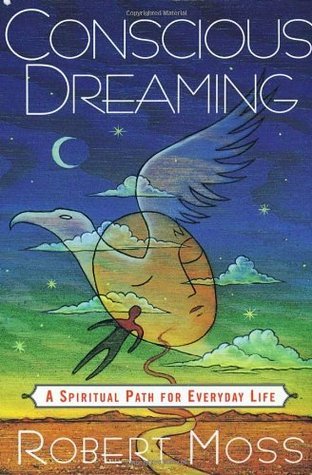
A leader of dream workshops and seminars details a unique, nine-step approach to understanding dreams, using contemporary dreamwork techniques developed from shamanic cultures around the world.
Conscious Dreaming shows you how to use your dreams to understand your past, shape your future, get in touch with your deepest desires, and be guided by your higher self. Author Robert Moss explains how to apply shamanic dreamwork techniques, most notably from Australian Aboriginal and Native American traditions, to the challenges of modern life and embark on dream journeys. Moss's methods are easy, effective, and entertaining, animated by his skillful retelling of his own dreams and those of his students—and the dreams' often dramatic insights and outcomes.
According to Moss, some shamans believe that nothing occurs in ordinary reality unless it has been dreamed first. In the dreamscape, we not only glimpse future events, we can also develop our ability to choose more carefully between possible futures. Conscious Dreaming's innovative system of dream-catching and transpersonal interpretation, of dream re-entry adn keeping a dream journal enables the reader to tap the deepest sources of creativity and intuition and make better choices in the critical passages of life.
Every once in a while, I'll go to a bookstore and buy a book with no clear reason why or even a notion of when I'll read it. This book was one of them. After a few weeks of it on my shelf, I started it. I think its subtly changed my life or, at least, my relationship to my dreams.
Moss offers a very sane view of dreams, backed up with years of personal experience, study, and work facilitating dream groups. He suggests that while dreams have a psychological component, they're also spiritual in nature. This isn't a new notion and in fact none of what he presents is novel. Rather, it reads more like a collection of chapters on common sense about dreaming than a presentation of a theory.
He simply points out that they're a very natural experience, albeit somewhat magical. He goes through their aspects and offers his experience on them, which is very interesting and informative. He offers techniques to engage with and explore dreams.
The best part of this book is that the techniques and experiences aren't limited to dreams in sleep. He offers methods to engage with the world, memories of dreams, and psychological phenomena during waking life. In fact, I finished reading this book with a strong appreciation for the dream-like nature of waking life.
Hmmm. After researching Robert Moss, my initial, unsettled, suspicious feelings regarding the validity and truthfulness of his writings, were heightened. Here is some of what I found about this author: There is no mention on Moss’s website that before he turned to dream work he was a protégé of notorious CIA and MI6 operative Brian Crozier. Along with the CIA and MI6, Moss left a high level and successful career as a master propagandist working for the Institute for the Study of Conflict (ISC) and Forum World Features, a London-based CIA-backed propaganda news service which operated from 1965 to 1974. Nor is there mention of his relationship to the Pinay Cercle, a secretive international policy group which continues to this day to bring together financiers, intelligence officers and politicians with links to fascist organizations and political factions from around the world. Apparently unknown to his New Age audience, Moss was once infamously well known to the intelligence world. His roman à clef novel The Spike with co-author Arnaud de Borchgrave aimed at undermining the credibility of Vietnam era war correspondents like Seymour Hersh by portraying them as agents of the KGB. And his work on an anti-Palestinian narrative with Crozier, helped to establish the blueprint for the endless war on (Islamic) terror kicked off after 9/11. This comment from Edward Herman and Gerry O’Sullivan’s 1989 The “Terrorism” Industry, makes it clear,
“Robert Moss has been a major figure in the organization of terrorism think tanks and in the dissemination of the right-wing version of the Western model of terrorism. In fact, as Fred Landis has pointed out, “For a price, Moss would go to Rhodesia, South Africa, Iran, and Nicaragua and tailor his standard KGB plot to local circumstances, thereby justifying repression of the political opposition and denial of human rights.”
Moss withdrew from the world of make-believe threat-conjuring in 1987 to write books and run workshops on the power of dreaming. But with his cutting edge expertise in seeding the collective unconscious with lies and fabrications for political and financial purposes, can it really be assumed that Robert Moss’s dream work is only about helping people to receive wisdom and gifts for your life?
This is absolutely one of the best books I've read ever.
The author suffered extremely poor health as a child and worked with his dreams from an early age, having many dream visitors/guides, including Philemon, whom he later discovered had been one of C.G. Jung's guides.
I lack words to express the richness of the book. The author shares freely with us his many exceptional dream experiences, including with guides and shamans.
We learn about conscious dreaming, which phrase the author prefers to the more common phrase "lucid dreaming". He feels that lucid dream enthusiasts have the aim of manipulating dreams to "serve the agendas of the waking ego". He is dissatisfied with people programming themselves to wake up inside the dream state. He thinks we should spontaneously become lucid by noticing ourselves doing things we are not generally capable of doing in our physical body. (But here I must stress that not everyone is as gifted as Robert Moss at spontaneously achieving lucidity, not to mention attracting all the other amazing experiences he easily manifests.)
He points out that dreams are "wiser than our everyday minds and come from an infinitely deeper source". He feels that "to try to control this source is the ultimate delusion".
He quotes a Seneca Indian healer: "The dream world is the real world."
It is vitally important to record our dreams as soon as possible, before they disappear from our memory. We should date our reports. give our dreams titles and note our feelings and immediate associations.
If we have a question we need answered, or a problem we need solved, we can take it to our dream source. We should formulate our question or request clearly, lay off alcohol, drugs and caffeine and refrain from overeating before going to bed, and agree to accept and work with the dreams given to us.
There is a chapter providing us with nine keys to our dreams. These are: 1) Pay attention to how you feel when waking from a dream. Your feelings and bodily sensations may be your best guide to the importance of a dream and its positive or negative implications. 2) Jot down your first associations with the dreams you record. 3) Dreams often contain accurate information about external reality, for instance, helpful information from the future. Ask "Could this dream mean exactly what it says?" 4) The meaning of a dream is inside the dream itself. We can learn to re-enter our dreams in a relaxed state and thus clarify messages about future events, resume contact with inner teachers, and resolve unfinished business. We generally forget 90% of our dreams, thus it is a valuable skill to re-enter them, e.g. by means of shamanic drumming, to search for information we may have missed. 5) learn to dialogue with dream characters. Ask them what they want to tell us. Everything in dreams is alive. (Moss remarks - "Shamans know the same is true of waking life".) 6) Follow your dream self, and you are likely to find that you have many selves. You my catch yourself changing your sex, age or race. You could even find yourself "body-hopping". 7) Explore dream symbols. 8) Ask what part of me different characters and elements in a dream represent. 9) We should always do something with important dreams. Record them, explore them and share them. We can write a dream motto, confirm our dream messages, find out how to help to bring a positive dream to pass or how to avoid negative future event.
Sharing dreams with a partner or with a group can be rewarding and provide a variety of insights that may illuminate many levels of the dream.
With regard to the etiquette of dream-sharing, remember: 1) You are the final authority on the meaning of your dream. 2) You should preface any comments you make about someone else's dream with the phrase "If it were my dream ...". 3)Do not ask other dreamers for personal details they have not volunteered and 4)Dreams shared within the circle should not be told to outsiders without the dreamer's permission.
A chapter about conscious dreaming also contains accounts of OBEs (out-of-body experiences). Moss has some amazing dreams/OBEs and communications with various beings. He has an "extended conversation" (telepathically) with what he terms "a life force", and enters a different galaxy. He develops personal maps of paths and landscapes inside the dreamworlds, places to which he can return.
Moss informs us that we can return again and again to dream locations that do not have a counterpart in ordinary reality. We can explore the possible conditions of life after physical death, and return to special places for specific guidance or healing.
Conscious dreaming facilitates shared dreaming - our ability to join a partner in our dreams. We can set up a "dream date" with a rendezvous familiar to both of us either in ordinary or non-ordinary reality.
There is an exciting chapter (though all the chapters are exciting) about shamanic dreaming. We learn about techniques for shifting consciousness, including shamanic drumming. We are taught how to enter the Lower World to make contact with an animal guardian and how to rise to the Upper World in search of a spiritual teacher.
The book includes chapters about 1) using "dream radar", including meeting your future self 2) dreams of the departed, including dialogues with the dead 3) dream guides and guardian angels (Gabriel is the Archangel of dreams) 4) dreams of healing including working with our dream doctor (we receive both warnings, diagnoses and presciptions in our dreams. 5) The creative power of dreams, including "creative incubation".
This excellent book is packed with accounts of exciting, amazing, illuminating dreams and dream experiences of both the author and those attending his dream courses. It contains numerous exercises, and much. much invaluable advice.
I found this to be the most valuable, gripping, informative book on dreams I've read. I can't see how any other dream book could excel this one. I highly recommend that you purchaze this wonderful book.
i couldn’t finish this. it seemed promising at first but it’s just too pompous. there are so many biographical stories from the very privileged author that i cannot relate to despite very similar childhood illness to mine. some of it is condescending in parts. he also thinks dinosaurs existed during the same time as our cavemen ancestors so i find it hard to believe the accuracy of his other statements about other cultures’ traditions and beliefs. he describes prophetic dreams as being much too clear and linear. many times i’ve had prophetic dreams that were so scrambled i could only honestly link them back once the event had come to pass. i never even realised they were prophetic at the time. meanwhile i worry that certain other dreams are prophetic which never come to pass. this book offered me no clear solutions on how to decipher which is which, apart from journaling, which i’ve already read in literally every other source about dream work. and there are just too many unbelievable and unrelatable stories about other people’s prophetic but linear dreams from what i could see when i skipped ahead (to see if the rest of the book was going to be pompous arrogant droning - it was); dreams that led to winning court settlements, etc. this book is nowhere near as deep as i thought it would be. for a book supposedly based on something so metaphysical i was surprised to find such materialism and literality.
Having recently had a series of "prophetic" dreams about a relationship, in which my subconscious, it seems, revealed to me what the situation really was like (as I had been actively fooling myself) and helped me to get closure, my interest in dream-work was kindled. So, despite being, mildly said, not fond of "spiritual path"-self help books, I picked this book up, as it had been recommended to me. . And here I must admit, that I have not read it in full but skipped several passages, as they would have just annoyed the crap out of me.
On the positive side, there is interesting information in this book about the perception of dreams in several cultures (although it is often superficial) and a few good advices, when it comes to dream-work. Therefore 2-stars.
Sadly, though, most of the book reads like a fantasy novel (as great parts are anecdotes that seem invented or tempered with) and worse yet, there are tons of new-age-y nonsense about "other worlds", "astral projection" and such poppycock.
Very little about technique and nothing really scientific, so not really helpful either.
At first I enjoyed reading this book but, same like the other one I've read, I get some difficulties finishing it. The first chapters are very basic... sharing information you will read in any (beginners) book about dreaming: keeping a dream journal, incubation and so on. The rest of the book is about shamanic dreaming. To me, the title is kinda misleading... conscious dreaming while half of the book is about daydreaming (drumming and re-entering the dream with visualization) and (same like the other book again) many many dream reports. To be honest I skipped some of those. Lucid dreaming is mentioned every now and then when a dreamer shares a dream ("This and that happened and I knew I was dreaming etc) but it's not about how to. I recommend this book for beginners who are open-minded to spirituality, shamanism and using dreams in waking life but not to the experienced dreamers who which to deepen their practice nor the ones who search a book about how to lucid dream. I've grew up with shamanism but still somehow this book is not my cup of tea.
Whether you think dreaming is all in your head or — at least occasionally — a connection to a wider reality than we typically perceive, Conscious Dreaming is compelling to read. Moss's view of dreams definitely favors viewing them as having the potential for oracular information and contacts with beings outside oneself, though he does also talk briefly in this book about dreams providing creative inspiration.
For me this book has been life changing. The overlap of the authors experiences and my own was extraordinary. The insights and exercises laid out in this book enabled me to take my work with the imaginal realm and my private dream source to a far greater level than I had anticipated possible from reading one single book.
It took me a long time to finish this one because of life. Sometimes it happens, your schedule changes, or something gets in the way of your routine and the time assigned to reading takes the toll. But, when the book is engaging I usually make it work. This is a tell right there of how little I enjoyed it. There are tons of examples of the cool things you can achieve with conscious dreaming but barely a couple of paragraphs on what it really is or how to achieve it. It wouldn't be such big a deal when there are so many books out there about lucid dreaming and dream incubation but here we get introduced to the concept of "waking dreams" and I would think an oxymoron like that deserves some explanation. There are way too many, all too convenient, dream recounts which is something boring by definition and there is an absolute abuse of the term "shamanic" which gets thrown in constantly like a wild card without proper definition.
Moss is the must-read author for anyone interested in dreams, including their interpretation, re-entry (yes it works just the way he said, I tried it), remembering more of them, using them for guidance in solving practical problems, etc. etc. Moss is a great writer, he's honest, direct, clear, sincere, he gives tons of examples of dreams and how they helped him and several of the people he worked with. He's been researching and teaching and refining and exploring dreams for decades, his dedication and integrity are immense and obvious. Anyone interested in dreams should check out all of his books on the subject.
This book is good, but I prefer some of Moss' other works more. It contains a lot of dream stories and examples. It is less of a practical step-by-step guidebook to lucid dreaming, in case you are looking for that. I feel it's more geared for someone who is a natural lucid dreamer, or someone who is not a beginner. You should already have some good methods for lucid induction. Others, not so advanced, can gain an understanding of what is possible with lucid dreaming, which may serve as motivation.
I wish this, and all of Moss' books, were in audiobook form. He is a master storyteller, and his dream stories and examples would really stand out in that format.
I would put this one at the top of the heap along with Stephen LaBerge's books. Although I haven't had the time to actually put to practice the techniques I have learned with this one, they seem easy enough. The key with any of this seems to be journaling. Write down your dreams before they dissipate like so much early morning fog once the sun breaks the tree line. It's amazing how much can be remembered with practice. And with that remembering comes a more rounded analysis of meaning. Now, if I could just stay asleep once I realize I am dreaming when I am dreaming.
Really interesting book on dreaming. The stories are amazing, I was somewhat blown away by what the author was able to accomplish for himself and others using dreams. He also provides a number of useful tools that as I've integrated into my dream life I'm finding more and more useful content. Highly recommend to anyone interested in the topic.
It is more woo-woo than I expected but completely fascinating. It appears to be his seminal work and much of his work since this book has built on the fundamentals of introduced in it. I'm still reading it and will be for years -- reading and rereading it. I don't like the linear nature of having to say I completed the book on a certain date in Goodreads because I'll never complete this one.
Raamat oli huvitav, haarav, humoorikas, väga hästi kirjutatud, nagu seiklusromaan- kohe oli aru saada, et autor on tegelikult ka kirjanik. Kirjeldatud unenäod tundusid õigupoolest sama suvalised kui minu omadki, ometi oskas autor neist välja lugeda sügavamaid tähendusi ja seoseid- see andis lootust, et kunagi ehk oskan seda isegi.
As someone who has been fascinated with the realm of dreams since childhood, I enjoyed this book. I had some powerful dream experiences occur while reading the book. And though I didn’t resonate with all of it, Conscious Dreaming gave me some new perspectives on dreams. Overall I’d recommend this to anyone interested in exploring their dreams further.
Molto molto interessante: l’ho trovato utilissimo perché, oltre a fornire una parte teorica, porta molti esempi e differenze culturali di interpretazione e significato dei sogni. Poi è importante l’impegno che il lettore deve applicare per comprendere come funzionano i propri sogni e cosa fare per scoprire di più su di sé.
I waffled about where to start with Robert Moss's work -- and this was a good place. It covers the gamut of dreamwork, including some recurring dream themes I myself have! I'm definitely going to be reading more of his work.
Grâce à ce livre, j'y suis même arrivé une fois. La sensation est telle que je ne peux qu'encourager les curieux à s'y plonger pour mieux se découvrir de l'intérieur! Frissons garantis.
This book was given to me as a birthday gift 21 years ago when I just turned 23 years old. If you are serious about doing some dream-time work, this book will serve you well. It's one of my favorites on this topic.
Regardless of your spiritual beliefs and whether you agree with everything in this book or not - one can’t argue that their is something about dreams that deserves more attention than we conventionally believe or have been taught to give them - this book is that tool which will begin to help you begin that journey - very insightful and interesting read for me to say the least …
👆🏼 P.S - If you found this review helpful - I’d like to invite you to discover more on our blog. Where the community share some of our most important insights to level up each others knowledge 💡- from experience in studying books like this, training programs, podcasts and much more - visit the blog link above to find out more.
P.P.S 😅 - You probably noticed from my profile that I’ve reviewed a LOT of books over the years now - if you love seeking knowledge like me I’d love to connect with you further as a like minded person (send me a friend invite! 😀) - Also if you are curious - here is my preferred and recommended resource for seeking timeless wisdom - Check it out via the website invite link below 👇🏼 (You’ll be able to claim some awesome books for free 📚)
This is one of the best books on dreaming that I've ever read.
I've always had some really crazy dreams, some of them seemed pretty big, and because of that, I have spent a lot of time learning about them. I studied Jung, Ann Faraday, and others in an effort to understand if... or what they might be saying.
Of course he uses a lot of fringe science, saying that we leave our bodies, or visit with "spirits," things like that. But I like it for a couple of reasons. He's consistent. He's not using the parts of the mythology that he likes, or changing the mythology so that it's what he wants it to be. His "spirit guides" aren't necessarily good, and they're not necessarily there to "help" us.
What makes this book worth the look is that it's a dreamer's take on dreaming. Inside the world of dreams so many crazy things happen, and it's worth entertaining those scenarios in our waking life just to play with them and see what they do.
Recently, my fascination with dreaming has become more intense. There are so many aspects I've wanted to explore. When someone says, "so you want to learn how to interpret dreams?" I become a bit agitated. That truly should be each of our individual goals to some extent. To me dreaming is at least a third of my life - I want to adventure there often, like I want to walk often & breathe always. I want to see, feel and hear stories - or visit with loved ones or long lost friends. I want to glimpse the future and bring it in to now. That interpretation part, yeah that's a reality. It happens. Dreaming is learning another language for me. It's another equation to solve. A mystery with a surprise twist. A literal life saver. I sometimes beg for a nightmare. This book brings it in, concisely. It's a springboard for further exploration & research (my favorite type of reading material!) There are many more of Robert Moss's books waiting patiently.
This was the first book that I read by Robert Moss. If you're at all into dreams this is a great book that brings together many ways of looking at and interpreting dreams. Moss teaches that the only person who can interpret your dreams is yourself. He gives good exercises and talks about dreams in a practical non woo-woo sort of way. He talks about dreams as a tool for our lives throughout his books. They are all insightful and I recommend them without question.
I read this book ten years ago and I had to read it again. It is not only an amazing reference, but also a good story of someone who had a strange childhood and a rich dream life. Moss is an excellent teacher- I got to take a workshop with him during grad school in SF. It was amazing, but the next best thing is reading this book. Just as good the second time. An excellent reference for those who want to have a stronger and more meaningful relationship to their dreams.
This book has supported my further exploration of the realm of dreaming, revealing it to be filled with potential teachers and guides. For numerous generations, this realm has served indigenous peoples across the Earth as a gateway to knowledge integral to their synergistic relationship with creation, both physically and in the form of spirit. I have only begun to tap this resource for my own better understanding of how to live in respectful and beautiful relationship with all life.