

What do you think?

Promise/Threat: Poems
Ratings & Reviews
Friends & Following
Create a free account to discover what your friends think of this book!
Community Reviews
Displaying 1 - 4 of 4 reviews

Review of advance copy received from Netgalley
A Mouth Full of Glass, a Sky Full of Moons: The Visceral Dream-Logic of Jonah Mixon-Webster’s “Promise/Threat”
By Demetris Papadimitropoulos | March 6th, 2026
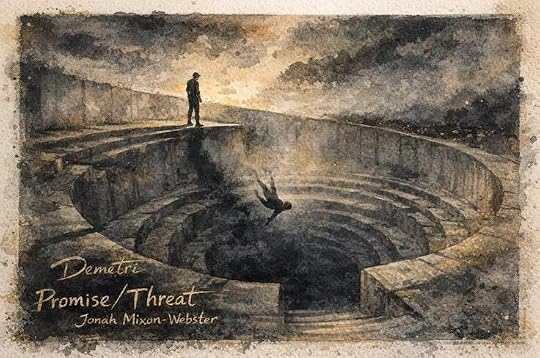
Watercolor Piece by Demetris Papadimitropoulos
Jonah Mixon-Webster’s second collection, “Promise/Threat”, begins where most books would rather not: in the mouth – not the mouth as metaphor (honeyed, singing, confessing), but the mouth as hazard, as snag, as evidence locker. Teeth break. Glass needles. Blood arrives like an uninvited proof. The body does not open onto insight so much as rupture. You don’t read the first pages so much as you’re pressed against them – cheek to cheek with a speaker who wakes already mid-undoing, who can’t quite separate dream logic from lived consequence, who understands that consciousness is sometimes just the aftertaste of what tried to kill you while you slept.
That opening is not simply a bid for intensity. It’s a thesis about how this book plans to operate. “Promise/Threat” is a collection obsessed with thresholds – sleep and waking, desire and recoil, confession and refusal, the self and the self watching itself from the corner of the room. Mixon-Webster writes as if the veil is not thin but actively fraying, as if the ordinary world is one more unstable set piece in a larger, more dangerous production. The poems are staged in the tenebrous realm between dreams and reality, yes, but also between private interiority and the public gaze. The effect is less confessional than it is surveilled. Even when the speaker is alone, he is not unobserved. Someone is always there: a mirror, a memory, a crowd, a voice that sounds like his but isn’t fully him.
The collection is arranged in three numbered sections – with an unnumbered prologue, “Elsewhere”, that functions like a trapdoor. “Elsewhere” announces the governing condition: the speaker leaves his body in “unconscious rituals,” becomes “a different person altogether,” wears “another face for the crowds,” then returns to waking life through the sensation of falling. The book’s most important question appears early, almost casually: “Are you always yourself / in your dreams?” You feel the line settle into the foundation. The rest of the book is one long, increasingly complicated attempt to answer it without lying.
Section I, which shares the book’s title, operates like ignition. The speaker reports “live” from the “ghetto of my mind,” a phrase that is both grimly comic and grimly accurate – the mind as neighborhood, economy, marketplace, policing zone. He buys and sells his brain for pennies. He walks through streetlamp shadows with “monkey paws,” as if the body has been forced into someone else’s caricature and then asked to clap politely. In one poem, he lists the “gentleman names” of spirits he drinks – Jim Beam, Johnnie Walker, Don Julio – and suddenly consumption becomes a catalogue of selves, each brand a mask, each mask a small surrender. In another, he stages the reader’s imagination as a crime scene. “The Negro Dreams of Fried Chicken” is not a poem that asks to be liked. It is a poem that dares you to notice what arrives in your head the moment it says what it says. The speaker fries chicken “two hundred and twenty feet in the air,” a surreal altitude that reads as either heaven or execution platform; he invites you to smell the grease, to feel the burn on his hands, then turns the sensory seduction into an indictment of projection. Who is imagining the “false negro voice” now? Who is consuming whom?
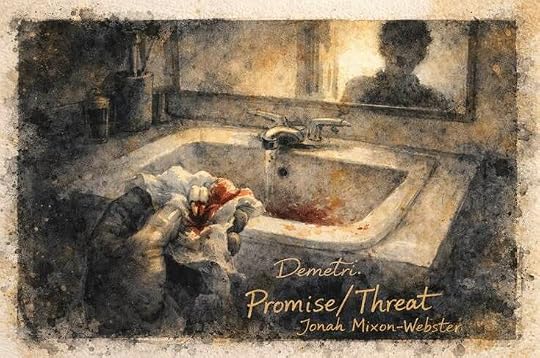
Watercolor Piece by Demetris Papadimitropoulos
This is where Mixon-Webster’s particular voice – the thing you can’t fake – begins to show itself: the way he can pivot from lyric to sermon to stand-up to nightmare without changing the temperature of the room. His lines can be supple and lucid, then suddenly refuse punctuation as if syntax itself has been chased into a corner. He likes the litany and the inventory, not as decorative devices but as nervous-system reports: lists as panic, lists as prayer, lists as a way of keeping the world from disappearing. “Lost and Found” is essentially one long, breathless interrogation – “Where’s my damn keys?” “Where’s my phone?” “Where’s God?” – a spiral that feels funny until it feels like you’re watching someone try to locate his own soul with the frantic logic of someone patting his pockets for a wallet.
Section I also establishes a second obsession: numbers. Lottery slips, dreambooks, license plates – the various ways a mind living under pressure tries to convert chaos into pattern. In “Dollar Straight / Dollar Box”, numbers become a form of folk metaphysics: 811, 580, 459, 1918. A mother says “play what you need.” A dreambook says “father” appears as a number, then neither the number nor the father comes. The poem holds the ache without melodrama. It understands that in certain American lives, superstition is not quaint; it’s a survival tactic. When institutions fail – when money is thin, when luck feels like policy, when the future has the texture of a rumor – the mind starts reading the world as omen.
If Section I is ignition, Section II – the long central sequence called “Territory” – is immersion. “Territory” is where the book makes its most ambitious formal gamble: it asks you to live inside the dream rather than merely visit it. Here the landscape becomes a mirror hall: rural and Southern and spectral, full of red clay rivers, cattails, honkytonks, burning bridges, “ghost faces / white as dove feathers.” This is not pastoral. This is the countryside as psychic pressure system, the American South as a kind of inherited nightmare – not because of any single event but because of what the land has been made to remember and what it has been trained to deny. Mixon-Webster doesn’t offer documentary detail; he offers atmosphere so thick it feels like weather you can’t shake from your clothes.
Midway through “Territory”, the book states its most chilling proposition: “language is the original trigger.” It’s a line that feels less like metaphor than diagnosis. In this “horror,” the speaker says, he is reincarnated “into the bullet which marks my passing,” and then comes the inversion that gives the line its force: the weapon is not merely held by someone else; the weapon is mouth, mind, mirror. A racial slur is shouted – “Get that n****r!” – and the speaker shoots “the first one I saw / in the mirror.” That action is both surreal and sickeningly precise. It captures the way external violence can install itself inside the self, the way a world’s language can become a person’s internal operating system. The poem implies that even when you survive the gun, you may not survive the grammar.

Watercolor Piece by Demetris Papadimitropoulos
This is also where the book’s sense of currentness becomes unavoidable, even without explicit headlines. “Promise/Threat” is steeped in the psychic climate of our moment: the anticipatory living, the rehearsed catastrophe, the feeling that danger is not a discrete incident but a background hum. In a country that has normalized active-shooter drills as childhood ritual, that watches body-cam footage like a genre, that scrolls past public grief until grief becomes just another form of content, Mixon-Webster’s dream loops read less like surrealism than like reportage from the nervous system. The speaker’s attempts to escape – every direction fenced, the car stalling, the city “made-up made-up” – resemble the lived experience of trying to outrun a structure that’s built into the ground.
“Territory” also stages America as simulation: a “white simulation in blackface,” a room where everyone is a frozen statue, a scene where the speaker lifts the lids behind people’s eyes and sees “the same child” in each. It is a strange, tender, frightening image: beneath performance and posture, a shared vulnerability; beneath the roles we’re trained to play, a child staring back. Yet the book refuses to turn that into cheap unity. Recognition does not equal safety. The fence remains.
By the time Section III arrives – “Back to Life / Back to Reality” – the reader is primed to expect either collapse or redemption, the two common endings our culture permits. Mixon-Webster offers neither. He offers something harder to sell but more convincing: integration. “The real poem is the life I’m writing,” the section begins, which sounds like a declaration until you realize it’s also a plea – a desire to believe that the life, the actual life, can still be authored. The poems here widen their gaze. Grief enters more explicitly – friends who have passed, conversations deferred, the dead speaking in sleep. The book’s language loosens, not into ease but into breath. There is a shift from claustrophobic recursion to a quieter, riskier form of exposure: tenderness.
“My Child, My Child” is one of the collection’s emotional hinges, a poem that refuses to be reduced to biographical decoding. Is the child literal, symbolic, an interior self, a lost version of the speaker? The poem does not clarify because it doesn’t need to. It is a poem about the agony of wanting to protect what cannot be protected, about loving in the aftermath, about learning parenthood through memory. In a culture that treats masculinity as either weapon or armor, the poem’s softness feels radical – not performative softness, but the kind that costs something. The speaker imagines giving birth “alone,” being “one and the same,” as if the only way to keep the beloved safe is to collapse the world’s divisions inside his own body. It is a beautiful impossibility, and the poem knows it.
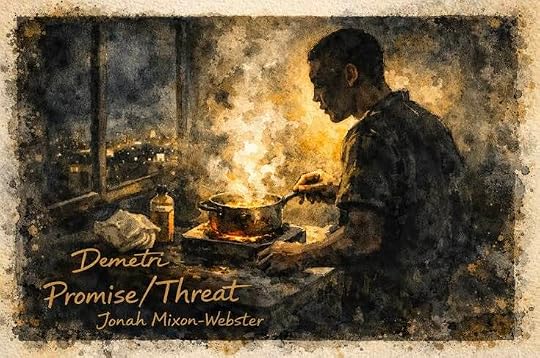
Watercolor Piece by Demetris Papadimitropoulos
The love poems in this final section are similarly unromantic in their honesty. Longing is rendered as compulsion, as hunger, as “cruelty.” There are repeated injunctions – “Please, under no circumstances, speak of love” – that read like the speaker trying to stop himself from naming what he needs. Naming has been dangerous in this book. Naming has gotten people killed. So the speaker approaches love the way you approach a live wire: reverent, terrified, unable to resist. Yet the poems insist, over and over, that tenderness is not a luxury. It is a survival technology.
One of the quiet achievements of Section III is how it changes the book’s relationship to evidence. Earlier, the body’s mess felt like catastrophe. Here, the speaker can catalogue remnants without disintegrating. In “An Attenuated List of Things I Find in My Bed Upon Waking”, he inventories half-faces, blood, “amorphous gunk,” bones, “Someone’s father,” “Someone.” The list is grotesque, yes – but it’s also composed. The speaker can look. He can name. He can hold the scene without fleeing. That is what recovery often looks like in real life – not cure, not epiphany, but the capacity to witness without collapse.
The book closes by turning outward again – moons, trees, water, wind – but it does not adopt a nature-as-salvation posture. Nature here is not sentimental backdrop. It is an argument about coexistence. Light wrestles dark. Water works with rock. Wind urges the world toward destiny. The ending insists on a cosmology where opposites don’t cancel each other out. That is the slash of the title, finally made literal. Promise and threat share a body. Light exists even in the dark, even in the day. The claim is not that darkness ends, but that it can be lived alongside.
If you’re searching for comps, they arrive less as direct echoes than as shared ambitions. The descent structure nods, inevitably, to “Inferno”. The reader-implicating scrutiny of language recalls “Citizen”. The dreamscapes and rehearsed deaths sit in conversation with the speculative afterlives of “Don’t Call Us Dead”. The masculine tenderness emerging from harm feels, at times, like a cousin to the formal and emotional intelligence of “The Tradition”. Yet Mixon-Webster’s book is not a collage of influences. It has its own weather. The humor is darker, the body more foregrounded, the dream logic more architectural than ornamental. The poems feel written by someone who understands, from the inside, how a mind survives: by splitting, by watching, by turning danger into pattern, by making a map out of what tries to remain unspeakable.

Watercolor Piece by Demetris Papadimitropoulos
That said, “Promise/Threat” is not flawless – and its imperfections are the kind that come attached to ambition rather than carelessness. There are stretches, especially in the densest dream sequences, where the reader may feel pummeled by recursion, where the pressure becomes the point and the point becomes exhausting. The book sometimes risks a kind of relentless intensity that can flatten nuance by sheer force. And a few provocations – especially those that deliberately weaponize stereotype – require a sophisticated readerly contract; without it, the work could be misread by those who want easy outrage or easy consumption. But these risks feel chosen. This is not a book interested in being universally digestible. It wants to enact the conditions it describes, to make the reader feel the cost of living inside language that can wound.
As a whole, “Promise/Threat” reads like a poet insisting that the interior life is a political site – not because it contains slogans, but because it contains the lived aftermath of a nation’s pressures: the constant watchfulness, the consumption-as-identity, the inherited fear, the desire for tenderness in a world that punishes it. In an era when reality itself feels increasingly like a hallucination – screens blanking, voices continuing, identities performed and replicated and surveilled – Mixon-Webster’s central idea that dreaming is not an escape but a revelation feels less literary than accurate. The book does not offer comfort. It offers recognition. It offers the sense that someone has been in the maze and has come back not to tell you how to get out, but to tell you what it costs to stay human inside it.
I would rate “Promise/Threat” 89/100 – a collection of fierce formal intelligence and visceral invention, one that sometimes presses too hard on its own pressure, but that ultimately achieves something rarer than catharsis: an earned steadiness, a language capable of holding contradiction without breaking, and a final insistence – quiet, stubborn, contemporary as breath – on staying alive.

Watercolor Piece by Demetris Papadimitropoulos
By Demetris Papadimitropoulos | March 6th, 2026
Watercolor Piece by Demetris Papadimitropoulos
Jonah Mixon-Webster’s second collection, “Promise/Threat”, begins where most books would rather not: in the mouth – not the mouth as metaphor (honeyed, singing, confessing), but the mouth as hazard, as snag, as evidence locker. Teeth break. Glass needles. Blood arrives like an uninvited proof. The body does not open onto insight so much as rupture. You don’t read the first pages so much as you’re pressed against them – cheek to cheek with a speaker who wakes already mid-undoing, who can’t quite separate dream logic from lived consequence, who understands that consciousness is sometimes just the aftertaste of what tried to kill you while you slept.
That opening is not simply a bid for intensity. It’s a thesis about how this book plans to operate. “Promise/Threat” is a collection obsessed with thresholds – sleep and waking, desire and recoil, confession and refusal, the self and the self watching itself from the corner of the room. Mixon-Webster writes as if the veil is not thin but actively fraying, as if the ordinary world is one more unstable set piece in a larger, more dangerous production. The poems are staged in the tenebrous realm between dreams and reality, yes, but also between private interiority and the public gaze. The effect is less confessional than it is surveilled. Even when the speaker is alone, he is not unobserved. Someone is always there: a mirror, a memory, a crowd, a voice that sounds like his but isn’t fully him.
The collection is arranged in three numbered sections – with an unnumbered prologue, “Elsewhere”, that functions like a trapdoor. “Elsewhere” announces the governing condition: the speaker leaves his body in “unconscious rituals,” becomes “a different person altogether,” wears “another face for the crowds,” then returns to waking life through the sensation of falling. The book’s most important question appears early, almost casually: “Are you always yourself / in your dreams?” You feel the line settle into the foundation. The rest of the book is one long, increasingly complicated attempt to answer it without lying.
Section I, which shares the book’s title, operates like ignition. The speaker reports “live” from the “ghetto of my mind,” a phrase that is both grimly comic and grimly accurate – the mind as neighborhood, economy, marketplace, policing zone. He buys and sells his brain for pennies. He walks through streetlamp shadows with “monkey paws,” as if the body has been forced into someone else’s caricature and then asked to clap politely. In one poem, he lists the “gentleman names” of spirits he drinks – Jim Beam, Johnnie Walker, Don Julio – and suddenly consumption becomes a catalogue of selves, each brand a mask, each mask a small surrender. In another, he stages the reader’s imagination as a crime scene. “The Negro Dreams of Fried Chicken” is not a poem that asks to be liked. It is a poem that dares you to notice what arrives in your head the moment it says what it says. The speaker fries chicken “two hundred and twenty feet in the air,” a surreal altitude that reads as either heaven or execution platform; he invites you to smell the grease, to feel the burn on his hands, then turns the sensory seduction into an indictment of projection. Who is imagining the “false negro voice” now? Who is consuming whom?
Watercolor Piece by Demetris Papadimitropoulos
This is where Mixon-Webster’s particular voice – the thing you can’t fake – begins to show itself: the way he can pivot from lyric to sermon to stand-up to nightmare without changing the temperature of the room. His lines can be supple and lucid, then suddenly refuse punctuation as if syntax itself has been chased into a corner. He likes the litany and the inventory, not as decorative devices but as nervous-system reports: lists as panic, lists as prayer, lists as a way of keeping the world from disappearing. “Lost and Found” is essentially one long, breathless interrogation – “Where’s my damn keys?” “Where’s my phone?” “Where’s God?” – a spiral that feels funny until it feels like you’re watching someone try to locate his own soul with the frantic logic of someone patting his pockets for a wallet.
Section I also establishes a second obsession: numbers. Lottery slips, dreambooks, license plates – the various ways a mind living under pressure tries to convert chaos into pattern. In “Dollar Straight / Dollar Box”, numbers become a form of folk metaphysics: 811, 580, 459, 1918. A mother says “play what you need.” A dreambook says “father” appears as a number, then neither the number nor the father comes. The poem holds the ache without melodrama. It understands that in certain American lives, superstition is not quaint; it’s a survival tactic. When institutions fail – when money is thin, when luck feels like policy, when the future has the texture of a rumor – the mind starts reading the world as omen.
If Section I is ignition, Section II – the long central sequence called “Territory” – is immersion. “Territory” is where the book makes its most ambitious formal gamble: it asks you to live inside the dream rather than merely visit it. Here the landscape becomes a mirror hall: rural and Southern and spectral, full of red clay rivers, cattails, honkytonks, burning bridges, “ghost faces / white as dove feathers.” This is not pastoral. This is the countryside as psychic pressure system, the American South as a kind of inherited nightmare – not because of any single event but because of what the land has been made to remember and what it has been trained to deny. Mixon-Webster doesn’t offer documentary detail; he offers atmosphere so thick it feels like weather you can’t shake from your clothes.
Midway through “Territory”, the book states its most chilling proposition: “language is the original trigger.” It’s a line that feels less like metaphor than diagnosis. In this “horror,” the speaker says, he is reincarnated “into the bullet which marks my passing,” and then comes the inversion that gives the line its force: the weapon is not merely held by someone else; the weapon is mouth, mind, mirror. A racial slur is shouted – “Get that n****r!” – and the speaker shoots “the first one I saw / in the mirror.” That action is both surreal and sickeningly precise. It captures the way external violence can install itself inside the self, the way a world’s language can become a person’s internal operating system. The poem implies that even when you survive the gun, you may not survive the grammar.
Watercolor Piece by Demetris Papadimitropoulos
This is also where the book’s sense of currentness becomes unavoidable, even without explicit headlines. “Promise/Threat” is steeped in the psychic climate of our moment: the anticipatory living, the rehearsed catastrophe, the feeling that danger is not a discrete incident but a background hum. In a country that has normalized active-shooter drills as childhood ritual, that watches body-cam footage like a genre, that scrolls past public grief until grief becomes just another form of content, Mixon-Webster’s dream loops read less like surrealism than like reportage from the nervous system. The speaker’s attempts to escape – every direction fenced, the car stalling, the city “made-up made-up” – resemble the lived experience of trying to outrun a structure that’s built into the ground.
“Territory” also stages America as simulation: a “white simulation in blackface,” a room where everyone is a frozen statue, a scene where the speaker lifts the lids behind people’s eyes and sees “the same child” in each. It is a strange, tender, frightening image: beneath performance and posture, a shared vulnerability; beneath the roles we’re trained to play, a child staring back. Yet the book refuses to turn that into cheap unity. Recognition does not equal safety. The fence remains.
By the time Section III arrives – “Back to Life / Back to Reality” – the reader is primed to expect either collapse or redemption, the two common endings our culture permits. Mixon-Webster offers neither. He offers something harder to sell but more convincing: integration. “The real poem is the life I’m writing,” the section begins, which sounds like a declaration until you realize it’s also a plea – a desire to believe that the life, the actual life, can still be authored. The poems here widen their gaze. Grief enters more explicitly – friends who have passed, conversations deferred, the dead speaking in sleep. The book’s language loosens, not into ease but into breath. There is a shift from claustrophobic recursion to a quieter, riskier form of exposure: tenderness.
“My Child, My Child” is one of the collection’s emotional hinges, a poem that refuses to be reduced to biographical decoding. Is the child literal, symbolic, an interior self, a lost version of the speaker? The poem does not clarify because it doesn’t need to. It is a poem about the agony of wanting to protect what cannot be protected, about loving in the aftermath, about learning parenthood through memory. In a culture that treats masculinity as either weapon or armor, the poem’s softness feels radical – not performative softness, but the kind that costs something. The speaker imagines giving birth “alone,” being “one and the same,” as if the only way to keep the beloved safe is to collapse the world’s divisions inside his own body. It is a beautiful impossibility, and the poem knows it.
Watercolor Piece by Demetris Papadimitropoulos
The love poems in this final section are similarly unromantic in their honesty. Longing is rendered as compulsion, as hunger, as “cruelty.” There are repeated injunctions – “Please, under no circumstances, speak of love” – that read like the speaker trying to stop himself from naming what he needs. Naming has been dangerous in this book. Naming has gotten people killed. So the speaker approaches love the way you approach a live wire: reverent, terrified, unable to resist. Yet the poems insist, over and over, that tenderness is not a luxury. It is a survival technology.
One of the quiet achievements of Section III is how it changes the book’s relationship to evidence. Earlier, the body’s mess felt like catastrophe. Here, the speaker can catalogue remnants without disintegrating. In “An Attenuated List of Things I Find in My Bed Upon Waking”, he inventories half-faces, blood, “amorphous gunk,” bones, “Someone’s father,” “Someone.” The list is grotesque, yes – but it’s also composed. The speaker can look. He can name. He can hold the scene without fleeing. That is what recovery often looks like in real life – not cure, not epiphany, but the capacity to witness without collapse.
The book closes by turning outward again – moons, trees, water, wind – but it does not adopt a nature-as-salvation posture. Nature here is not sentimental backdrop. It is an argument about coexistence. Light wrestles dark. Water works with rock. Wind urges the world toward destiny. The ending insists on a cosmology where opposites don’t cancel each other out. That is the slash of the title, finally made literal. Promise and threat share a body. Light exists even in the dark, even in the day. The claim is not that darkness ends, but that it can be lived alongside.
If you’re searching for comps, they arrive less as direct echoes than as shared ambitions. The descent structure nods, inevitably, to “Inferno”. The reader-implicating scrutiny of language recalls “Citizen”. The dreamscapes and rehearsed deaths sit in conversation with the speculative afterlives of “Don’t Call Us Dead”. The masculine tenderness emerging from harm feels, at times, like a cousin to the formal and emotional intelligence of “The Tradition”. Yet Mixon-Webster’s book is not a collage of influences. It has its own weather. The humor is darker, the body more foregrounded, the dream logic more architectural than ornamental. The poems feel written by someone who understands, from the inside, how a mind survives: by splitting, by watching, by turning danger into pattern, by making a map out of what tries to remain unspeakable.
Watercolor Piece by Demetris Papadimitropoulos
That said, “Promise/Threat” is not flawless – and its imperfections are the kind that come attached to ambition rather than carelessness. There are stretches, especially in the densest dream sequences, where the reader may feel pummeled by recursion, where the pressure becomes the point and the point becomes exhausting. The book sometimes risks a kind of relentless intensity that can flatten nuance by sheer force. And a few provocations – especially those that deliberately weaponize stereotype – require a sophisticated readerly contract; without it, the work could be misread by those who want easy outrage or easy consumption. But these risks feel chosen. This is not a book interested in being universally digestible. It wants to enact the conditions it describes, to make the reader feel the cost of living inside language that can wound.
As a whole, “Promise/Threat” reads like a poet insisting that the interior life is a political site – not because it contains slogans, but because it contains the lived aftermath of a nation’s pressures: the constant watchfulness, the consumption-as-identity, the inherited fear, the desire for tenderness in a world that punishes it. In an era when reality itself feels increasingly like a hallucination – screens blanking, voices continuing, identities performed and replicated and surveilled – Mixon-Webster’s central idea that dreaming is not an escape but a revelation feels less literary than accurate. The book does not offer comfort. It offers recognition. It offers the sense that someone has been in the maze and has come back not to tell you how to get out, but to tell you what it costs to stay human inside it.
I would rate “Promise/Threat” 89/100 – a collection of fierce formal intelligence and visceral invention, one that sometimes presses too hard on its own pressure, but that ultimately achieves something rarer than catharsis: an earned steadiness, a language capable of holding contradiction without breaking, and a final insistence – quiet, stubborn, contemporary as breath – on staying alive.
Watercolor Piece by Demetris Papadimitropoulos

May 8, 2026
4.5 stars. Beautifully read by the author.

Review of advance copy received from Netgalley
Promise/Threat
Poems
by Jonah Mixon-Webster
a collection of poems by a PEN America Award–winning poet that shows voice. The descriptions of love, ideas and dreams show thought and understanding of modern live. This is a good book for Black History month showing Voice. Although it should be upper middle school and high school because of some of the topics of the poems, including alcohol.
Poems
by Jonah Mixon-Webster
a collection of poems by a PEN America Award–winning poet that shows voice. The descriptions of love, ideas and dreams show thought and understanding of modern live. This is a good book for Black History month showing Voice. Although it should be upper middle school and high school because of some of the topics of the poems, including alcohol.

July 7, 2026
This was so good. The audiobook really brought this to life with the full production. My Child, My Child was the hardest poem to read and brought tears to my eyes. Loved this book and can’t wait to read my faves again.
Displaying 1 - 4 of 4 reviews