

What do you think?

The Broken Book
A remarkable story of one woman’s struggle to become the writer she has passionately planned to be her entire life—this fiercely beautiful novel conjures vivid and powerful emotions. Following the stunningly beautiful Katherine Elgin from a small coastal town in Australia to London and the islands of Greece—this intriguing and intricately structured tale unravels the truths of art and life. Katherine’s story will resonate powerfully with women—especially those who have faced the demands of motherhood, marriage, and the pursuit of an artistic passion.
310 pages, Paperback
First published January 1, 2005
About the author
Susan Johnson
15 books63 followersSusan Johnson was shortlisted for the 1991 Victorian Premier's Literary Award for her novel Flying Lessons, shortlisted for the 1994 National Book Council's Banjo Award for the novel A Big Life and shortlisted for the National Biography Award 2000 for her memoir A Better Woman. Her other books include Hungry Ghosts, Messages from Chaos, Women Love Sex (editor and contributor) and Life in Seven Mistakes. The Broken Book was shortlisted for the 2005 Nita B Kibble Award; the Best Fiction Book section of the Queensland Premier's Literary Award; the Westfield/Waverley Library Literary Award, and the Australian Literary Society Gold Medal Award for an Outstanding Australian Literary Work. Her last novel, My Hundred Lovers, was published in 2012 to critical acclaim.
Librarian Note: There is more than one author in the Goodreads database with this name. This author is entered with 2 spaces.
Librarian Note: There is more than one author in the Goodreads database with this name. This author is entered with 2 spaces.
Ratings & Reviews
Friends & Following
Create a free account to discover what your friends think of this book!
Community Reviews
Displaying 1 - 13 of 13 reviews

December 8, 2022
CRITIQUE:
A Stylish Book
This is one of those stylishly designed books that sits patiently on the shelf, waiting for you to eventually read it. (And no matter how long you might have procrastinated for, it proves to be eminently rewarding.)
It's not just the cover that is stylish, it's the layout of the entire novel. Some chapters are printed in roman font, others in italics. Chapter headings are in stylised handwriting, similar to the title of the book on the front cover.
The photo on the front cover shows a reclining woman reading a book, which she holds above her head.
She might be a woman proof-reading her own fiction, or a daughter reading something written by her mother.
An Interesting Structure
This is a work of fiction, which is inspired by the life of Charmian Clift, two of whose memoirs I have just read.
The language is both eloquent and sensitive, although I'm a little perplexed by its relationship with its ultimate source material. I can't tell to what extent it is based on Charmian's own writing (including her journals). In particular, there is one gossipy revelation, which I had previously questioned (and still do, pending a reading of her biography).
Charmian doesn't appear in the novel, at least under her own name.
Instead, the author, Susan Johnson, borrows the name of a character used by Clift and her husband, George Johnston, to embody Clift in their autobiographical fiction (namely, Cressida Morley).
Thus, there's a sense in which Susan Johnson has fleshed out Clift and Johnston's fictional character.
However, that's not the end of the story. Johnson has also created a narrator by the name of Katherine Anne Elgin, who writes about Cressida Morley in both her journals and a book within a book (an unfinished autobiographical novel by Katherine Elgin) called "The Broken Book".
The bulk of these chapters are set in the 1940's (when Katherine/Cressida is at primary school), the 1950's (when she is in her late teens and older, and travels to the Greek island of Hydra with her husband, David Murray [compared with David Meredith, the name of a character used by George Johnston in his trilogy of autobiographical fiction, which Kathy says is "packed with lost remembered life"), and the late 1960's (when they return to Sydney).
This content is gathered together in what is described as "Part One: Katherine".
It's followed by "Part Two: Anna", which purports to be narrated by Anna, the older and the more "difficult" of the two daughters of Katherine and David, the other being Lil.
I won't elaborate on this part, because it changed my perspective on the novel, at least once, if not twice, and to elaborate would be to risk spoilers.
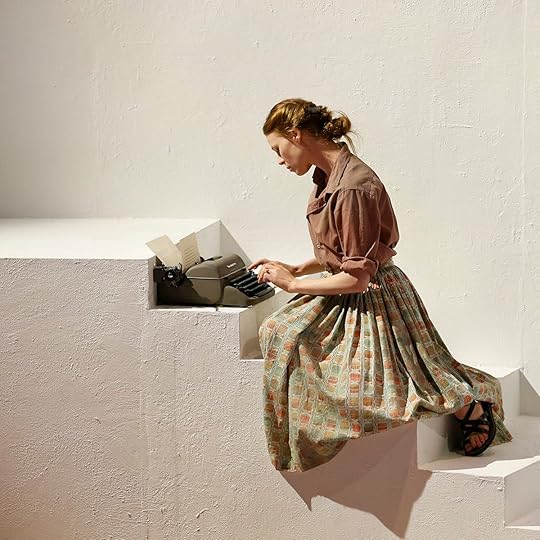
Anna McGahan as Charmian Clift in Sue Smith’s play "Hydra" [Jeff Busby/Queensland Theatre] Source
The Broken Book
It seems that "The Broken Book" (the book within the book) is a work of autobiographical fiction into which Katherine is trying to channel her creativity. In a way, it's her version of what David Murray is doing with his perspective on his social, family and marital life. It's her attempt to tell her own story, and not just be a pseudonymous character in her husband's fiction. She hopes to create her own fiction, instead of just supplying a character for her husband to develop in his fiction. She writes in her journal:
"The Broken Book" remains unfinished at the time of Katherine's death, which supplies its title.
There's a sense in which Katherine's novel is perceived as a failure - she's been unable to finish it ("I am too tired to invent myself any more. My heart has gone from the festival [of life]."), she's withheld most of her secrets from its telling, and she's written rather than being an attentive mother and wife ("My children have shown me to myself, at my best and at my very worst"). The "talent for happiness" she enjoyed in her youth and early adulthood has dissipated under the relentless, claustrophobic pressures of her life, many of which are self-imposed, though many more are inflicted on her by her jealous husband (who claims, "You have let yourself go"):
Anna has just finished reading her mother's journal and fiction, in an endeavour to better understand her mother after her death. She emerges with some more of the truth from her own perspective:
For a second time, the life of Charmian Clift (or her representation) prompted me to think of Virginia Woolf.
VERSE:
Weary Warriors
[In the Words of
Susan Johnson]
In the street
We walked
Side by side
Like two
Exhausted
Soldiers.
Too Close to Me
[In the Words of
Susan Johnson]
Take care,
Do not come too
Close to me,
The grey dust
of my failure
Will coat your clothes,
The stink of my ruin
Will curl in your
Blameless nostrils.
Pain
[In the Words of
Susan Johnson]
Pain is in the room,
Pain is stalking you,
Pain is who you are
And [who] you will ever be.
The Realm of the Unknown
(So Long, Charmian)
[Apologies to Leonard Cohen]
Well hello Marianne
From a Canadian.
It's time that we began
Love with no back-up plan,
Sans the Australian:
I've farewelled Charmian.
SOUNDTRACK:
A Stylish Book
This is one of those stylishly designed books that sits patiently on the shelf, waiting for you to eventually read it. (And no matter how long you might have procrastinated for, it proves to be eminently rewarding.)
It's not just the cover that is stylish, it's the layout of the entire novel. Some chapters are printed in roman font, others in italics. Chapter headings are in stylised handwriting, similar to the title of the book on the front cover.
The photo on the front cover shows a reclining woman reading a book, which she holds above her head.
She might be a woman proof-reading her own fiction, or a daughter reading something written by her mother.
An Interesting Structure
This is a work of fiction, which is inspired by the life of Charmian Clift, two of whose memoirs I have just read.
The language is both eloquent and sensitive, although I'm a little perplexed by its relationship with its ultimate source material. I can't tell to what extent it is based on Charmian's own writing (including her journals). In particular, there is one gossipy revelation, which I had previously questioned (and still do, pending a reading of her biography).
Charmian doesn't appear in the novel, at least under her own name.
Instead, the author, Susan Johnson, borrows the name of a character used by Clift and her husband, George Johnston, to embody Clift in their autobiographical fiction (namely, Cressida Morley).
Thus, there's a sense in which Susan Johnson has fleshed out Clift and Johnston's fictional character.
However, that's not the end of the story. Johnson has also created a narrator by the name of Katherine Anne Elgin, who writes about Cressida Morley in both her journals and a book within a book (an unfinished autobiographical novel by Katherine Elgin) called "The Broken Book".
The bulk of these chapters are set in the 1940's (when Katherine/Cressida is at primary school), the 1950's (when she is in her late teens and older, and travels to the Greek island of Hydra with her husband, David Murray [compared with David Meredith, the name of a character used by George Johnston in his trilogy of autobiographical fiction, which Kathy says is "packed with lost remembered life"), and the late 1960's (when they return to Sydney).
This content is gathered together in what is described as "Part One: Katherine".
It's followed by "Part Two: Anna", which purports to be narrated by Anna, the older and the more "difficult" of the two daughters of Katherine and David, the other being Lil.
I won't elaborate on this part, because it changed my perspective on the novel, at least once, if not twice, and to elaborate would be to risk spoilers.
Anna McGahan as Charmian Clift in Sue Smith’s play "Hydra" [Jeff Busby/Queensland Theatre] Source
The Broken Book
It seems that "The Broken Book" (the book within the book) is a work of autobiographical fiction into which Katherine is trying to channel her creativity. In a way, it's her version of what David Murray is doing with his perspective on his social, family and marital life. It's her attempt to tell her own story, and not just be a pseudonymous character in her husband's fiction. She hopes to create her own fiction, instead of just supplying a character for her husband to develop in his fiction. She writes in her journal:
"I am going to fill this book, and fill it and fill it with all the wonders I am about to see. I am going to write poems, stories, novels, the words of my children: I am going to write the story of my life...
"What a gift life is, what a strange and terrible responsibility it is to live...
"Let me be equal to it, let me feel its ecstasies and terrors.
"Let me give everything it is within my soul to give, plunge headlong into the fullest rush of life...Let life begin!"
"The Broken Book" remains unfinished at the time of Katherine's death, which supplies its title.
There's a sense in which Katherine's novel is perceived as a failure - she's been unable to finish it ("I am too tired to invent myself any more. My heart has gone from the festival [of life]."), she's withheld most of her secrets from its telling, and she's written rather than being an attentive mother and wife ("My children have shown me to myself, at my best and at my very worst"). The "talent for happiness" she enjoyed in her youth and early adulthood has dissipated under the relentless, claustrophobic pressures of her life, many of which are self-imposed, though many more are inflicted on her by her jealous husband (who claims, "You have let yourself go"):
"Should I have been more engaged in the public world instead of caught up in the vanity of believing I was making a testament to life through writing? Have I been generous enough to my husband, to my daughters, to my friends?
"...I tried to capture the experience of felt life in a net of meaning - some glimpse, some nuance that would reveal something at the heart of life, its mysterious core. But all my words have been stillborn things, too frail to support the great hopes I held for them...Everything has fallen short of my intentions..."
Anna has just finished reading her mother's journal and fiction, in an endeavour to better understand her mother after her death. She emerges with some more of the truth from her own perspective:
"I grew up surrounded by people turning their emotional lives into fiction...
"The mechanism by which she lived was broken."
For a second time, the life of Charmian Clift (or her representation) prompted me to think of Virginia Woolf.
VERSE:
Weary Warriors
[In the Words of
Susan Johnson]
In the street
We walked
Side by side
Like two
Exhausted
Soldiers.
Too Close to Me
[In the Words of
Susan Johnson]
Take care,
Do not come too
Close to me,
The grey dust
of my failure
Will coat your clothes,
The stink of my ruin
Will curl in your
Blameless nostrils.
Pain
[In the Words of
Susan Johnson]
Pain is in the room,
Pain is stalking you,
Pain is who you are
And [who] you will ever be.
The Realm of the Unknown
(So Long, Charmian)
[Apologies to Leonard Cohen]
Well hello Marianne
From a Canadian.
It's time that we began
Love with no back-up plan,
Sans the Australian:
I've farewelled Charmian.
SOUNDTRACK:

March 21, 2012
I stepped out of my comfort zone with this book - it's definitely not the sort of novel I would normally read. And I found it hard to know just how to rate it, I'm conflicted over enjoyment versus technical strength. So I thought a 3 was a fair compromise.
Katherine Elgin grew up in a small coastal town in NSW and from early on knew that she wanted to be a writer. But following her passion does not come easily - first there is World War Two to contend with and being part of the war effort and then comes the demands of marriage and children while living first in London and then in the Greek Islands. Married to a fellow writer, Katherine is always one step behind his success and struggles to maintain her own creative pursuits.
I found the structure of the book a bit hard to follow. While many authors slip between present and past fairly seamlessly, in the Broken Book it just seemed a bit disjointed at times. Also the point of view switches between Katherine herself and Cressida, the main character of her novel (who is based on Katherine herself). It also flips between the 1940s/50s and 1960s in no particular order.
I also found the storyline quite depressing, following Katherine's struggle to be the writer she wants to be and never really making it. While I could understand her frustration at her ambitions being swallowed by other demands, I also found her to be a victim and quite selfish. I guess I like a bit of joy and escapism in a story and there was just none in this one.
So what kept me reading then? Despite the points mentioned above, The Broken Book is beautifully written with very engaging prose. Even though I did not especially enjoy the storyline itself, I couldn't help but be swept up in the lovely flow of words. And although there is no real action to speak of, the pace is good and the short chapters keep things moving along. I found it relatively easy to read and had no problems finishing it.
Overall a different kind of novel, probably more suited to those who enjoy literature in it's purest form.
Katherine Elgin grew up in a small coastal town in NSW and from early on knew that she wanted to be a writer. But following her passion does not come easily - first there is World War Two to contend with and being part of the war effort and then comes the demands of marriage and children while living first in London and then in the Greek Islands. Married to a fellow writer, Katherine is always one step behind his success and struggles to maintain her own creative pursuits.
I found the structure of the book a bit hard to follow. While many authors slip between present and past fairly seamlessly, in the Broken Book it just seemed a bit disjointed at times. Also the point of view switches between Katherine herself and Cressida, the main character of her novel (who is based on Katherine herself). It also flips between the 1940s/50s and 1960s in no particular order.
I also found the storyline quite depressing, following Katherine's struggle to be the writer she wants to be and never really making it. While I could understand her frustration at her ambitions being swallowed by other demands, I also found her to be a victim and quite selfish. I guess I like a bit of joy and escapism in a story and there was just none in this one.
So what kept me reading then? Despite the points mentioned above, The Broken Book is beautifully written with very engaging prose. Even though I did not especially enjoy the storyline itself, I couldn't help but be swept up in the lovely flow of words. And although there is no real action to speak of, the pace is good and the short chapters keep things moving along. I found it relatively easy to read and had no problems finishing it.
Overall a different kind of novel, probably more suited to those who enjoy literature in it's purest form.

March 15, 2017
This is the second novel by this author that I have read and I must say I love her work. I loved this book, I could relate to the childhood experiences, although dated a few decades earlier than my own and I loved the protagonist's musings about the struggles women face in choosing to be creative when juggling so many other commitments. Self-indulgent, perhaps, but understandable for someone born to create and having had a brief spell at trying to establish a creative life for myself, I could relate to her challenges. However, I was disappointed by the second part of this book. I was ready to give it 5 stars and then, after reading this very small part of the novel, it felt like a balloon rapidly deflating. But I thorough enjoy the beauty of Johnson's prose and look forward to reading more of her novels.

January 24, 2017
I started reading this only to realise that I had read and really enjoyed it when it was first published. I was always interested in the character of Chairman Clift and found this fictionalised story of her life compelling - but not quite enough to have me re-read it when I have so many other TBR novels out from the library at present.

September 15, 2023
The last page completely broke me.

July 15, 2012
Review published in the Otago Daily Times, 19 February 2005
"Dirt of the grave fast upon her tongue"
The Broken Book
Susan Johnson
(Allen & Unwin, $35)
Reviewed by Philippa Jamieson
"Once I had the energy of a thousand girls at play," writes Katherine, the narrator of this novel. But now: "I am 45 years old and the dirt of the grave is fast upon my tongue."
Katherine is a writer who is depressed, drinks too much, and can barely churn out a weekly newspaper column, let alone finish the novel she set so much store in.
What went wrong? She started out all wide-eyed innocence and excitement, a beautiful young woman, with some early success in her writing career, and a burning desire to write the best novel she can. Then came her marriage to David, another writer and journalist, then the hard slog as they both tried to make a living out of writing while raising two children.
There's a novel within the novel: a story that runs parallel to Katherine's life like a thinly-disguised autobiography.
There are disturbing episodes in Katherine's novel that are not mentioned in her real life story, leaving the reader to wonder whether these things really did happen. If they did, perhaps they help explain why this shining star begins to fall.
The story leaps back and forth in time, over several decades in the mid-20th century, and between Sydney, London, a Greek island, and back to Sydney. Fortunately, Susan Johnson is a competent writer and manages to weave together the different threads of time, place and identity into a rich fabric.
The Broken Book shows how hard it is to make a life of writing, especially for women when they are expected to do the lion's share of child-rearing.
The reader can empathise with Katherine in the bitterness of her mid-life, as David eclipses her in his fame and fortune. He even borrows the name of the main character in Katherine's novel to use in his own novel – a metaphor for how he has pushed his career ahead at the expense of hers.
But Katherine has contributed to her fate too, with her own rather self-centred and depressive personality. The epilogue, seen through the eyes of one of her daughters, casts a fresh light on Katherine's life, and gives a more rounded view.
This is the fifth novel by Susan Johnson, an Australian now living in London. Her writing is polished and elegant, poetic and honest, and the story is bittersweet – one of the best novels I've read recently.
Philippa Jamieson is a Dunedin writer.
"Dirt of the grave fast upon her tongue"
The Broken Book
Susan Johnson
(Allen & Unwin, $35)
Reviewed by Philippa Jamieson
"Once I had the energy of a thousand girls at play," writes Katherine, the narrator of this novel. But now: "I am 45 years old and the dirt of the grave is fast upon my tongue."
Katherine is a writer who is depressed, drinks too much, and can barely churn out a weekly newspaper column, let alone finish the novel she set so much store in.
What went wrong? She started out all wide-eyed innocence and excitement, a beautiful young woman, with some early success in her writing career, and a burning desire to write the best novel she can. Then came her marriage to David, another writer and journalist, then the hard slog as they both tried to make a living out of writing while raising two children.
There's a novel within the novel: a story that runs parallel to Katherine's life like a thinly-disguised autobiography.
There are disturbing episodes in Katherine's novel that are not mentioned in her real life story, leaving the reader to wonder whether these things really did happen. If they did, perhaps they help explain why this shining star begins to fall.
The story leaps back and forth in time, over several decades in the mid-20th century, and between Sydney, London, a Greek island, and back to Sydney. Fortunately, Susan Johnson is a competent writer and manages to weave together the different threads of time, place and identity into a rich fabric.
The Broken Book shows how hard it is to make a life of writing, especially for women when they are expected to do the lion's share of child-rearing.
The reader can empathise with Katherine in the bitterness of her mid-life, as David eclipses her in his fame and fortune. He even borrows the name of the main character in Katherine's novel to use in his own novel – a metaphor for how he has pushed his career ahead at the expense of hers.
But Katherine has contributed to her fate too, with her own rather self-centred and depressive personality. The epilogue, seen through the eyes of one of her daughters, casts a fresh light on Katherine's life, and gives a more rounded view.
This is the fifth novel by Susan Johnson, an Australian now living in London. Her writing is polished and elegant, poetic and honest, and the story is bittersweet – one of the best novels I've read recently.
Philippa Jamieson is a Dunedin writer.

March 23, 2025
An interesting concept loosely based around the lives of Charmian Clift and George Johnston. Two separate narrative strains - Katherine Elgin's journal (the Clift character), the purported text of her autobiography, called "The Broken Book" calling herself (Cressida Morley) and chronological inconsistency make the work as a whole unnecessarily complicated. As one reviewer described it "this kind of extremely allusive and self-reflexive book" doesn't quite pull it off. The scenes where Elgin battles with the conflicts of trying to balance motherhood and writing, are the best in the book ... vivid and wholly authentic.
September 14, 2024
Really enjoyed the way this book was written; language used, descriptions that really immerse you into the story and take you back in time.
Although I do love a book that flips through different times and places, it is a bit disjointed here. Despite this, I couldn’t put it down.
Saw someone saying the book overall had a depressing tone, I’d have to agree but I think that makes it what it is. Honest, yet romanticised struggle.
A Broken Book. Of a Broken Life & Mind.
Although I do love a book that flips through different times and places, it is a bit disjointed here. Despite this, I couldn’t put it down.
Saw someone saying the book overall had a depressing tone, I’d have to agree but I think that makes it what it is. Honest, yet romanticised struggle.
A Broken Book. Of a Broken Life & Mind.
August 3, 2017
A poignant story told in two parts. The first part contains a novel within the novel while the plot flits back and forth in time. The second part is one daughter's reflections. I liked the quotes at the start of the story.
December 13, 2020
A remarkable book for structure. It jumps back and forth across decades, from journal to half written novel and more. Keeps the reader engaged all the time. My criticism is the unfair and inaccurate depiction of the life of Charmian Clift, on whom this novel is based.
November 21, 2023
I wish I’d known this book was based on Charmian Clift. I know her story and the life of all her fellow bohemian artists in Hydra. The similarities niggled at me which would not have been the case if I’d known she was actually the direct inspiration of the novel.

December 16, 2012
Katherine Elgin always wanted to be a writer, but faced many hurdles in pursuit of her dream. From a small coastal town in New South Wales, she first has to break free of the confines of her conservative upbring, then World War Two happens and the expectation to be part of the war effort. Next comes marraige and motherhood - which also conspire to keep the brakes on her writing career. Her marriage to a fellow writer is not a particularly happy or fulfilling one and her writing ambitions always take a back seat to his.
I found the format a little disjointed - switching between times and places - Australia, London, The Greek Islands - all in a bit of a random fashion. The story also vacillates between Katherine herself and Cressida the character in the novel she is writing (who, it turn is actually based on Katherine). I don't think this multi POV worked really well (for me, anyway). But it could just be that this is a different type of book than I normally read.
I will admit I didn't really like Katherine/Cressida. I did try to, but she just came across as a bit of a victim and I couldn't warm to her. Many women would understand how personal ambition can be swallowed by marriage and motherhood, but Katherine didn't seem to see the positives in her life as she struggled to become a writer.
The true strength of this book is in the writing. It really is beautiful - with a flow and rythm as smooth as silk. Although the storyline itself is sad and quite depressing at times, the writing style keeps you engaged and coming back for more.
I will admit this is not the kind of book I would normally read, but I am glad I branched out a little and tried a different genre. For those who like a more literary style of book, I am sure you would enjoy this one.
I found the format a little disjointed - switching between times and places - Australia, London, The Greek Islands - all in a bit of a random fashion. The story also vacillates between Katherine herself and Cressida the character in the novel she is writing (who, it turn is actually based on Katherine). I don't think this multi POV worked really well (for me, anyway). But it could just be that this is a different type of book than I normally read.
I will admit I didn't really like Katherine/Cressida. I did try to, but she just came across as a bit of a victim and I couldn't warm to her. Many women would understand how personal ambition can be swallowed by marriage and motherhood, but Katherine didn't seem to see the positives in her life as she struggled to become a writer.
The true strength of this book is in the writing. It really is beautiful - with a flow and rythm as smooth as silk. Although the storyline itself is sad and quite depressing at times, the writing style keeps you engaged and coming back for more.
I will admit this is not the kind of book I would normally read, but I am glad I branched out a little and tried a different genre. For those who like a more literary style of book, I am sure you would enjoy this one.

Displaying 1 - 13 of 13 reviews