

What do you think?

The Far End of Happy
Twelve tense hours, three women, and the suicide standoff that turns one family's little piece of heaven into a scene from hell Ronnie Farnham's husband is supposed to move out today. But when Jeff pulls into the driveway drunk, with a shotgun in the front seat, she realizes nothing about the day will go as planned.
The next few hours spiral down in a flash, unlike the slow disintegration of their marriage-and whatever part of that painful unraveling is Ronnie's fault, not much else matters now but these moments. Her family's lives depend on the choices she will make-but is what's best for her best for everyone?
Based on a real event from the author's life, The Far End of Happy is a chilling contemporary novel. Fans of Mary Kubica, Diane Chamberlin, and Rosalind Noonan will be on the edge of their seats during this story of one troubled man, the family that loves him, and the suicide standoff that will change them all forever.
Also From Kathryn
The Art of Falling-Penelope Sparrow, a 28-year-old dancer, has spent her entire life focusing on the perfection of her body. But when she wakes up in a Philadelphia hospital unable to move after a near-fatal accident, she can't remember the events leading up to her crushing 14-story fall.
What readers are saying about The Far End of Happy"This is one hell of a powerful book with a message. It's a work of fiction but by God it's near to truth."
"The story is tense and heartbreaking as it takes you through the twelve hours Ronnie has to endure as she waits for Jeff's fate to be decided."
"This is the kind of story that makes you appreciate what you have and see the world a little differently than you did before."
"The Far End of Happy is a tragic, yet hopeful story of human resilience."
"THE FAR END OF HAPPY is an extraordinarily compelling book, founded in an extraordinary comprehension of human nature, addiction, denial-and love, familial bonds, and character strength and integrity."
What reviewers are saying about The Far End of Happy"This novel is the very definition of a page-turner as it follows a twelve hour stand-off between a man threatening suicide and the police."-Huffington Post
"This title is based on the author's experience with a standoff involving her husband, which adds real, raw, emotion to the plot. Framing the novel within a 12-hour period keeps the pages turning"-Library Journal
..".a heartbreaking story packed with tension and brimming with humanity."-Lori Nelson Spielman, #1 international bestselling author of The Life List
"A compelling read, an unflinching exploration of one of life's most inexplicable horrors."-New York Journal of Books
"Kathryn Craft keeps the tension edge-of-your-seat suspenseful in The Far End of Happy..."- Kate Moretti, author of the New York Times bestselling Thought I Knew You, and Binds That Tie
"A complex and gripping story of broken hearts, lives, and marriages that will tear you apart from beginning to end."-Steena Holmes, New York Times and USA Today bestselling author of The Memory Child and Finding Emma
"An incredibly honest and courageous exploration of a marriage torn apart by neglect and threats of suicide."-Mary Kubica, author of The Good Girl
The next few hours spiral down in a flash, unlike the slow disintegration of their marriage-and whatever part of that painful unraveling is Ronnie's fault, not much else matters now but these moments. Her family's lives depend on the choices she will make-but is what's best for her best for everyone?
Based on a real event from the author's life, The Far End of Happy is a chilling contemporary novel. Fans of Mary Kubica, Diane Chamberlin, and Rosalind Noonan will be on the edge of their seats during this story of one troubled man, the family that loves him, and the suicide standoff that will change them all forever.
Also From Kathryn
The Art of Falling-Penelope Sparrow, a 28-year-old dancer, has spent her entire life focusing on the perfection of her body. But when she wakes up in a Philadelphia hospital unable to move after a near-fatal accident, she can't remember the events leading up to her crushing 14-story fall.
What readers are saying about The Far End of Happy"This is one hell of a powerful book with a message. It's a work of fiction but by God it's near to truth."
"The story is tense and heartbreaking as it takes you through the twelve hours Ronnie has to endure as she waits for Jeff's fate to be decided."
"This is the kind of story that makes you appreciate what you have and see the world a little differently than you did before."
"The Far End of Happy is a tragic, yet hopeful story of human resilience."
"THE FAR END OF HAPPY is an extraordinarily compelling book, founded in an extraordinary comprehension of human nature, addiction, denial-and love, familial bonds, and character strength and integrity."
What reviewers are saying about The Far End of Happy"This novel is the very definition of a page-turner as it follows a twelve hour stand-off between a man threatening suicide and the police."-Huffington Post
"This title is based on the author's experience with a standoff involving her husband, which adds real, raw, emotion to the plot. Framing the novel within a 12-hour period keeps the pages turning"-Library Journal
..".a heartbreaking story packed with tension and brimming with humanity."-Lori Nelson Spielman, #1 international bestselling author of The Life List
"A compelling read, an unflinching exploration of one of life's most inexplicable horrors."-New York Journal of Books
"Kathryn Craft keeps the tension edge-of-your-seat suspenseful in The Far End of Happy..."- Kate Moretti, author of the New York Times bestselling Thought I Knew You, and Binds That Tie
"A complex and gripping story of broken hearts, lives, and marriages that will tear you apart from beginning to end."-Steena Holmes, New York Times and USA Today bestselling author of The Memory Child and Finding Emma
"An incredibly honest and courageous exploration of a marriage torn apart by neglect and threats of suicide."-Mary Kubica, author of The Good Girl
432 pages, Kindle Edition
First published May 5, 2015
About the author
Kathryn Craft
5 books238 followersKathryn Craft is a novelist, developmental editor, and former dance critic whose work blends a deep love of storytelling with a lifetime of studying movement. She is the author of the writing craft book CRAFTING STORY MOVEMENT: Techniques to Engage Readers and Drive Your Novel Forward, as well as two novels, The Art of Falling and The Far End of Happy. Through her editing and workshops, it has been Kathryn's great joy to help thousands of writers master fiction pacing, create emotional storytelling, and develop character-driven novels that immerse readers from the very first scene. She lives in Pennsylvania, where she writes, teaches, and continues to explore the art and craft of story.
Ratings & Reviews
Friends & Following
Create a free account to discover what your friends think of this book!
Community Reviews
Displaying 1 - 30 of 283 reviews

January 3, 2015
Find all of my reviews at: http://52bookminimum.blogspot.com/
“You cannot force a man to drink something life-sustaining if he thirsts for something different. Can’t force him to stay afloat if he won’t swim.”
Confession time – I requested this book because it had a good title and a pretty cover. Yep, that’s how shallow I am sometimes. Worked out okay for me in this case too so I’ll probably continue choosing my books in this manner.
Now to get serious – on the morning Ronnie’s husband is supposed to be moving out of their old farmhouse he arrives with a shotgun rather than a moving truck. Locking himself in their barn, Jeff threatens to kill himself and anyone who comes near him. The next 12-hours is a standoff during which Ronnie, her mother, and her mother-in-law will all reflect on their lives and relationships.
The Far End of Happy is exactly what the title says. This is a bleak story . . . but I like bleak so I was actually looking forward to it. My problem with this one was two-fold (thus the 3 Star rating rather than 4). First, the official synopsis had me believing the book would focus on the actual standoff and be action-packed. Instead it was a depressing meander down memory lane. Second, at 432 pages this one was a bit long in the tooth. However, the writing was good with well-developed characters and complicated relationships, and it even came complete with a reader’s guide should yourwino group book club choose it as a selection. If you’re in the mood for something a little on the darker side when it comes to a family drama, this is a solid choice.
Look at that. No .gifs!
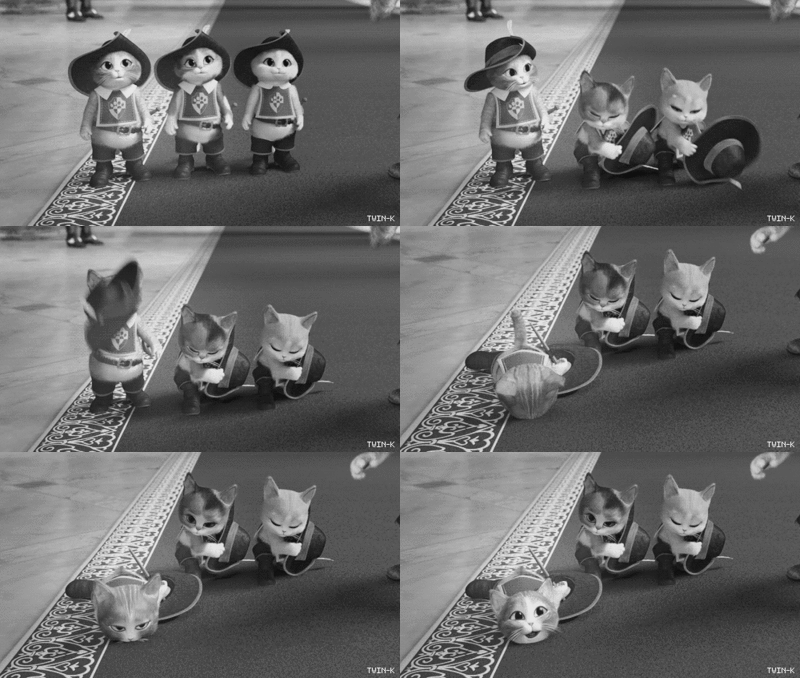
Ha! Suckers ; )
ARC provided by NetGalley in exchange for an honest review. Thank you, NetGalley!
“You cannot force a man to drink something life-sustaining if he thirsts for something different. Can’t force him to stay afloat if he won’t swim.”
Confession time – I requested this book because it had a good title and a pretty cover. Yep, that’s how shallow I am sometimes. Worked out okay for me in this case too so I’ll probably continue choosing my books in this manner.
Now to get serious – on the morning Ronnie’s husband is supposed to be moving out of their old farmhouse he arrives with a shotgun rather than a moving truck. Locking himself in their barn, Jeff threatens to kill himself and anyone who comes near him. The next 12-hours is a standoff during which Ronnie, her mother, and her mother-in-law will all reflect on their lives and relationships.
The Far End of Happy is exactly what the title says. This is a bleak story . . . but I like bleak so I was actually looking forward to it. My problem with this one was two-fold (thus the 3 Star rating rather than 4). First, the official synopsis had me believing the book would focus on the actual standoff and be action-packed. Instead it was a depressing meander down memory lane. Second, at 432 pages this one was a bit long in the tooth. However, the writing was good with well-developed characters and complicated relationships, and it even came complete with a reader’s guide should your
Look at that. No .gifs!
Ha! Suckers ; )
ARC provided by NetGalley in exchange for an honest review. Thank you, NetGalley!

March 27, 2015
4.9 rating
I had just purchased "The Art of Falling", Kathryn Craft's debut novel, a week prior before the discovery of "The Far End of Happy", on Netgalley.
Excited to read a new author whom I've heard great things about --I now have the pleasure to read her other book, "The Art of Falling", sitting right next to me!
The strengths about "The Far End of Happy" out *shine* any flaws. Other than I personally think the blurp tells readers more than they need to know, Kathryn Craft is a terrific writer who has an important story to tell! Despite knowing the outcome from the start, the author invites us into the storytelling -her home -the struggles and the complexity of choices made. While the characters are exploring deep root causes for a broken marriage -threats of a suicide -we are asking ourselves many questions along the way. How does a woman honor her marriage -with challenges such as her husband's alcoholism, or over spending, driving them deep into credit card debt? How do spouses find the strength to sign legal documents authorizing an action that will have significant impact on each others lives? (commit to a psych ward, or sign for a fetus-threatening surgery- or authorize the police to break windows with canisters of mace while your spouse is inside?
How does one separate their emotions from love, from their anger, and feeling like a demanding bitch?
With the busy lives of couples -with work - children - a dog -horses -a farm to run -mother-ins-laws -friends - it doesn't take much to slip into separate lives.
The author skillfully intertwines the backstory and alternating present-day narrative. The day that Ronnie's husband, Jeff, is suppose to move out --he shows up drunk with a shotgun in the front seat of his car. They have two little boys --
Ronnie needs to first find a way to keep her boys safe.
During a 12-hour period --Ronnie finds a way to protect her boys --but spends that time with her mother and her mother-in-law. ....Haunting in itself!
If I had to spend 12 hours in one small room with my mother and mother-in-law for 12 hours --I might just go join my husband --take my chances with the gun!
Thank you to the publisher -Netgalley --and my new discovery of a wonderful writer!
**Note: This book would make an excellent book-club pick. Much to talk about. Its a very serious topic.... painful/sensitive subject...(if I didn't find a few places for myself to laugh...I would have spent hours crying!
This author handles this story masterfully....(taking care of us--the readers- at the same time).
Personal true experience from our talented writer. She transforms TRUE to FICTION.
I had just purchased "The Art of Falling", Kathryn Craft's debut novel, a week prior before the discovery of "The Far End of Happy", on Netgalley.
Excited to read a new author whom I've heard great things about --I now have the pleasure to read her other book, "The Art of Falling", sitting right next to me!
The strengths about "The Far End of Happy" out *shine* any flaws. Other than I personally think the blurp tells readers more than they need to know, Kathryn Craft is a terrific writer who has an important story to tell! Despite knowing the outcome from the start, the author invites us into the storytelling -her home -the struggles and the complexity of choices made. While the characters are exploring deep root causes for a broken marriage -threats of a suicide -we are asking ourselves many questions along the way. How does a woman honor her marriage -with challenges such as her husband's alcoholism, or over spending, driving them deep into credit card debt? How do spouses find the strength to sign legal documents authorizing an action that will have significant impact on each others lives? (commit to a psych ward, or sign for a fetus-threatening surgery- or authorize the police to break windows with canisters of mace while your spouse is inside?
How does one separate their emotions from love, from their anger, and feeling like a demanding bitch?
With the busy lives of couples -with work - children - a dog -horses -a farm to run -mother-ins-laws -friends - it doesn't take much to slip into separate lives.
The author skillfully intertwines the backstory and alternating present-day narrative. The day that Ronnie's husband, Jeff, is suppose to move out --he shows up drunk with a shotgun in the front seat of his car. They have two little boys --
Ronnie needs to first find a way to keep her boys safe.
During a 12-hour period --Ronnie finds a way to protect her boys --but spends that time with her mother and her mother-in-law. ....Haunting in itself!
If I had to spend 12 hours in one small room with my mother and mother-in-law for 12 hours --I might just go join my husband --take my chances with the gun!
Thank you to the publisher -Netgalley --and my new discovery of a wonderful writer!
**Note: This book would make an excellent book-club pick. Much to talk about. Its a very serious topic.... painful/sensitive subject...(if I didn't find a few places for myself to laugh...I would have spent hours crying!
This author handles this story masterfully....(taking care of us--the readers- at the same time).
Personal true experience from our talented writer. She transforms TRUE to FICTION.

December 8, 2014
Wow, wow, wow! An emotionally charged novel that simply left me breathless. I couldn't get enough of Kathryn Craft's THE FAR END OF HAPPY - be sure to look for it when it arrives in 2015. Destined to be one of my favorites of the year!

March 15, 2015
So...I don't quite know where to start with this review: the brilliant, gorgeous writing, or the gut-punch of a story?
I read this knowing it was based on a real life experience, and it's one that hits close to home for me. The relationship between Ronnie and Jeff is heartbreaking and true and hard to witness at times. As the flashbacks take you through their history, you get the sinking feeling that it won't all work out in the end. But even when it doesn't, Kathryn manages to plant a seed of hope for the fractured family's future.
This is a sad, glorious book about facing loss and lack of control and inability to save someone else. Sometimes you just have to save yourself.
I read this knowing it was based on a real life experience, and it's one that hits close to home for me. The relationship between Ronnie and Jeff is heartbreaking and true and hard to witness at times. As the flashbacks take you through their history, you get the sinking feeling that it won't all work out in the end. But even when it doesn't, Kathryn manages to plant a seed of hope for the fractured family's future.
This is a sad, glorious book about facing loss and lack of control and inability to save someone else. Sometimes you just have to save yourself.

April 8, 2015
Thank you to the publisher and to Netgalley for an opportunity to read an advance copy of The Far End of Happy. 2 ½ stars. I feel like a cold hearted outlier on this book. I didn’t really enjoy reading it and I can’t quite figure out why. I am generally happy to read a good novel that makes me weep and that tugs hard at my emotions. But despite the subject matter and the fact that this was based on the author’s own experience 18 years ago, The Far End of Happy did not have that effect on me. The retelling of the standoff felt a bit mechanical and in an odd way I found it hard to relate to the characters’ emotions. Maybe it’s that something so dramatic is hard to recount in real time – emotions in the moment are not rational and can be all over the place. So only telling the story of the standoff between the police and Jeff -- Ronnie’s suicidal husband -- doesn’t allow for the perspective that time brings to these events. And not enough is made of Ronnie’s choice not to make false promises to try to save Jeff – I’m not being critical of the choice – it’s hard to imagine how one would react in the moment -- but this part of the story is huge and yet not given much attention. In the end, what may have made this book hard to read for me is that it is so personal and the author is so close to the subject that it didn't translate particularly well into a work of fiction. Or maybe it’s something near impossible to convey. Having said all that, kudos to Craft for taking the risk and for writing about such a harrowing part of her past. I suspect the process of writing is part of her attempt to come to terms with this. And maybe these are just my cold hearted views because many readers appear to have really liked and been moved by The Far End of Happy. And just to be clear, I'm not cold hearted about the subject matter and Craft's experience --it's the novel I'm struggling with.

April 12, 2015
I was a lucky early reader of this book which I thoroughly enjoyed. At once both engaging, heartbreaking and full of suspense, I highly recommend it.

January 6, 2015
A special thank you to Sourcebooks Landmark, NetGalley for an ARC in exchange for an honest review. "A lovely front cover depicting the perfection and calm of the exterior, versus the turmoil inside".
THE FAR END OF HAPPY, a complex, intense, and powerful novel told over a twelve hour span; three women, a trouble man (a son, a father, a husband), secrets, a past, mounds of debt, shame, insecurity, responsibility, guilt, baggage brought into a marriage, a family history, a suicide standoff, tragedy, two sons, despair, hope . . from private to public.
An author who courageously revisits a painful time, creating an emotional, sensitive yet captivating story with a highly charged subject, beautifully written --based on true events, seamlessly blending fact and fiction.
I cannot even image the emotional trauma, the guilt, the what ifs, and the persistent unanswered questions of a spouse, a family member, or a close friend of someone feeling they have nowhere to turn, utter desperation. I believe this story needed to be told, even as a work of fiction. It could provide a great help and support for families facing such despair, or early warning signs. No one likes the word “suicide” and we all tip toe around it; however, it is real.
In addition, many women live in fear each day, whether domestic violence, verbal abuse, or the neediness, or insecurity of the man or woman, making them feel guilty for wanting to divorce or wanting to leave an unhealthy environment. Many women stay in marriages for their children’s sake; however, in the end, they create a more unstable situation by remaining. Or as in the case of the book, a woman is made to feel guilty and pressured not to leave with the threat of suicide. Everyone in life has choices and we are the keeper of our own lives, and cannot control others out of fear or abandonment, due to their own illness.
With the crash of 2008, many families have been affected by the economy, while different people handle the same situation in a completely different way. Some are more fragile than others; however, many times they do not want help. A very controversial subject and highly commend the author for tackling and sharing this story.
As the author mentions, a tragedy is always unfolding somewhere, whether we know it or not—during the time it takes to read her interview at least one more person in the US, will die at his or her own hand. The story will be relatable to many women and families and hopefully provide hope to others starting over. Even though the novel may be painful for some to read, it can be uplifting and inspirational to others.
An ideal book for book clubs and discussions with many POVs. I enjoyed the honest discussion with the author and the reading group at the end, which will help readers gain new perspective about life. Now I am excited about reading her previous novel, The Art of Falling!
A word to the wise, always have a lengthy conversation with the first wife (or husband), of the man (woman) you are about to spend your life with. Keep an open mind – there may be much to learn which will save you pain down the road. Don’t we all wish we could step back and know what we know now? We would be so wise! Again, thanks to the author for this special book.
Judith D. Collins Must Read Books
On a person note, I have been involved with two suicides in my life, (not immediate family); both times each of these men found themselves in an unbearable situation, and as things began closing in, drove them to end their lives. But what if? It takes strength, courage, and faith for those left behind to move on and rebuild their lives.
THE FAR END OF HAPPY, a complex, intense, and powerful novel told over a twelve hour span; three women, a trouble man (a son, a father, a husband), secrets, a past, mounds of debt, shame, insecurity, responsibility, guilt, baggage brought into a marriage, a family history, a suicide standoff, tragedy, two sons, despair, hope . . from private to public.
An author who courageously revisits a painful time, creating an emotional, sensitive yet captivating story with a highly charged subject, beautifully written --based on true events, seamlessly blending fact and fiction.
"Interaction with death almost always invites us to reassess how we are spending our lives, why is suicide so troubling--the persistent, unanswered questions. The ongoing questions-- when did things begin to fall apart, how did I miss it, and in what ways is there compensation by each family member, or signs ignored? There are no clean lines in a story like this, only endless shades of gray, and a lot of questions about relationships and life that are well worth asking.” ---This is why Kathryn Craft writes THE FAR END OF HAPPY.
I cannot even image the emotional trauma, the guilt, the what ifs, and the persistent unanswered questions of a spouse, a family member, or a close friend of someone feeling they have nowhere to turn, utter desperation. I believe this story needed to be told, even as a work of fiction. It could provide a great help and support for families facing such despair, or early warning signs. No one likes the word “suicide” and we all tip toe around it; however, it is real.
In addition, many women live in fear each day, whether domestic violence, verbal abuse, or the neediness, or insecurity of the man or woman, making them feel guilty for wanting to divorce or wanting to leave an unhealthy environment. Many women stay in marriages for their children’s sake; however, in the end, they create a more unstable situation by remaining. Or as in the case of the book, a woman is made to feel guilty and pressured not to leave with the threat of suicide. Everyone in life has choices and we are the keeper of our own lives, and cannot control others out of fear or abandonment, due to their own illness.
With the crash of 2008, many families have been affected by the economy, while different people handle the same situation in a completely different way. Some are more fragile than others; however, many times they do not want help. A very controversial subject and highly commend the author for tackling and sharing this story.
As the author mentions, a tragedy is always unfolding somewhere, whether we know it or not—during the time it takes to read her interview at least one more person in the US, will die at his or her own hand. The story will be relatable to many women and families and hopefully provide hope to others starting over. Even though the novel may be painful for some to read, it can be uplifting and inspirational to others.
An ideal book for book clubs and discussions with many POVs. I enjoyed the honest discussion with the author and the reading group at the end, which will help readers gain new perspective about life. Now I am excited about reading her previous novel, The Art of Falling!
A word to the wise, always have a lengthy conversation with the first wife (or husband), of the man (woman) you are about to spend your life with. Keep an open mind – there may be much to learn which will save you pain down the road. Don’t we all wish we could step back and know what we know now? We would be so wise! Again, thanks to the author for this special book.
Judith D. Collins Must Read Books
On a person note, I have been involved with two suicides in my life, (not immediate family); both times each of these men found themselves in an unbearable situation, and as things began closing in, drove them to end their lives. But what if? It takes strength, courage, and faith for those left behind to move on and rebuild their lives.

March 4, 2015
This is an amazingly written book! Opening your life up to others by writing about a real life experience is bravery.

December 19, 2015
Sometimes a book just resonates and this one does. It's probably the saddest book I ever read.

April 23, 2015
A true story of 12 hours in a nontypical day in the life of this author. It's very candid, eye opening , and shows great strength by the author. A woman whose husband had to have a say in everything she did. He kept making up all these projects they could do together just to keep her in his sights. An alcoholic who knew that he got better than he deserved.
I know that these hostage situations happen all the time, but when you hear about them, you don't really stop to think, what when on during all those hours? Luckily, this family got away from the destructive father and did not have to spend those 12 hours in the same house with him.
It's still a really, really sad story no matter how it went down and one you will definitely shed tears over. It was definitely an eye opening experience between the mother in law and the daughter in law, as well as the mother and daughter. The grandmothers who had been friends since the couple were young also learned some things that the other was hiding.
This was a true story packed with human emotions from every different angle by all the people involved. Family, coworkers, neighbors and etc. I would highly recommend this book. Yes it's depressing at times, but it also contains some life lessons that a lot of adults could use.
Thank you Sourcebooks and Net Galley for providing me with this free e-galley in exchange for an honest review.
I know that these hostage situations happen all the time, but when you hear about them, you don't really stop to think, what when on during all those hours? Luckily, this family got away from the destructive father and did not have to spend those 12 hours in the same house with him.
It's still a really, really sad story no matter how it went down and one you will definitely shed tears over. It was definitely an eye opening experience between the mother in law and the daughter in law, as well as the mother and daughter. The grandmothers who had been friends since the couple were young also learned some things that the other was hiding.
This was a true story packed with human emotions from every different angle by all the people involved. Family, coworkers, neighbors and etc. I would highly recommend this book. Yes it's depressing at times, but it also contains some life lessons that a lot of adults could use.
Thank you Sourcebooks and Net Galley for providing me with this free e-galley in exchange for an honest review.

September 1, 2018
Only got to 30% but I’m not connecting to any of these characters so I’m throwing in the towel

March 3, 2015
It goes without saying that if you are sensitive to the topic of suicide this might not be the book for you. It's based on true events from the author's past so the emotions are very real and will definitely stir up strong emotions. It is a story that brings to the surface the painful choices that have to be made when dealing with someone we love who is battling mental illness, depression and alcoholism. This is not an easy story to read and it is very bleak but also sends a powerful message. The message I gained is that love is sometimes not enough to heal all wounds, especially when dealing with a person battling addictions. Watching someone you love slowly self destruct and feeling powerless to stop it is painful and sometimes you have to know when it's time to walk away and save yourself.
How do you decide between the well being of your husband or the safety of your children? That is the decision Ronnie had to face in this story and I can't imagine being in the same position. By leaving her husband she is risking him being pushed to brink of suicide. But, because of his delicate state of mind and his battle with depression and alcoholism she had to consider the well being of her boys. He was dangerous so she decided that leaving was her only option... and the result was a standoff between him and the police with the women on stand-by waiting and hoping and trying to figure out how Jeff got to this delicate state. There was this need to find blame... my fault, your fault, his fault... but blame is pointless and a waste of energy when addictions take hold of someone and won't let go.
If you're looking for an action filled stand off this is not the book for you... :) This is more about the emotional impact of the events taking place and there is a lot of "remembering" and "reminiscing" of the past. It was so sad seeing this family unit torn apart. They had built such a happy life together. Really is eye opening to contemplate how quickly that can change. But that is the power that addictions hold over you... they start out slow but eventually spread like an infection until things are out of control.
To the outside world Jeff was just a man gone crazy... but to Ronnie and the boys he was just a husband and father. Listening to them remember all the good moments they had together added a whole new level of sadness. It was heartbreaking...
I have several friends who have lost people they love to suicide... and, I read this with a heavy heart. Brought some painful emotions up to the surface. This is the kind of story that makes you appreciate what you have and see the world a little differently than you did before.
A very powerful story that is compelling yet heartbreaking but very beautifully written.
This would be an ideal choice for group reads and discussions. There is a helpful Q&A at the end of the book that the readers can use as a guide.
ARC was provided by the publisher

Follow us on
KT Book Reviews
Twitter
Facebook
Pinterest
How do you decide between the well being of your husband or the safety of your children? That is the decision Ronnie had to face in this story and I can't imagine being in the same position. By leaving her husband she is risking him being pushed to brink of suicide. But, because of his delicate state of mind and his battle with depression and alcoholism she had to consider the well being of her boys. He was dangerous so she decided that leaving was her only option... and the result was a standoff between him and the police with the women on stand-by waiting and hoping and trying to figure out how Jeff got to this delicate state. There was this need to find blame... my fault, your fault, his fault... but blame is pointless and a waste of energy when addictions take hold of someone and won't let go.
If you're looking for an action filled stand off this is not the book for you... :) This is more about the emotional impact of the events taking place and there is a lot of "remembering" and "reminiscing" of the past. It was so sad seeing this family unit torn apart. They had built such a happy life together. Really is eye opening to contemplate how quickly that can change. But that is the power that addictions hold over you... they start out slow but eventually spread like an infection until things are out of control.
To the outside world Jeff was just a man gone crazy... but to Ronnie and the boys he was just a husband and father. Listening to them remember all the good moments they had together added a whole new level of sadness. It was heartbreaking...
I have several friends who have lost people they love to suicide... and, I read this with a heavy heart. Brought some painful emotions up to the surface. This is the kind of story that makes you appreciate what you have and see the world a little differently than you did before.
A very powerful story that is compelling yet heartbreaking but very beautifully written.
This would be an ideal choice for group reads and discussions. There is a helpful Q&A at the end of the book that the readers can use as a guide.
ARC was provided by the publisher
Follow us on
KT Book Reviews

January 18, 2015
I was lucky enough to get an advanced copy of this book and blurb it!! Loved the writing, the story, the tension, the suspense and the emotional impact of this story.
Here is what I said:
Despite the known outcome, Kathryn Craft keeps the tension edge-of-your-seat suspenseful in The Far End of Happy, with deftly woven backstory and alternating present day hourly narrative. She creates a story that is unflinchingly honest and hard-hitting. A superb insider's look at the ripple effect of clinical depression and suicide.
Here is what I said:
Despite the known outcome, Kathryn Craft keeps the tension edge-of-your-seat suspenseful in The Far End of Happy, with deftly woven backstory and alternating present day hourly narrative. She creates a story that is unflinchingly honest and hard-hitting. A superb insider's look at the ripple effect of clinical depression and suicide.

July 24, 2015
Read this during my three-week absence off the internet, but marking it for today since I can't remember the read date. I couldn't put this book down and found myself watching to see the unfolding events in the characters' lives. Review coming, I'll probably settle on 3.5 stars, but depends on how my reflections on this one lend.

January 30, 2015
“I said it would be easier, not right. Sometimes we don’t get to do the easy thing. Sometimes life is tough.”
An understatement considering the topic of Craft’s newest novel, The Far End of Happy, about a suicide standoff that changes the landscape of a family forever. Based on the author’s first husband’s suicide, this novel is deftly crafted with tremendous character depth, details, and universal relationship truths that I connected with a great deal. The line I quoted above seems to reflect the over-arching story of courage and hope that can come out of difficult decisions and even tragedy. Sometimes life is beyond tough and we are often faced with decisions that mean making other people unhappy, but, as Craft says, easy and right are not always the same thing.
I love the way this novel is structured, volleying between points of view and time as we are carried on this marital journey with Ronnie. She pulls apart every moment, large and small, in effort to understand how she has arrived at this point—with her husband posing to kill himself—to try to make sense of how this could possibly happen. Meanwhile, her mother and mother-in-law are doing the same. As a writer and mother, I really appreciate this approach to the story because isn’t that what we do? We examine, process, and write in order to understand. And I’m right there with Ronnie as she cross-examines her own life to figure out where she might have gone wrong…or right.
The Far End of Happy is a tragic, yet hopeful story of human resilience. It’s a wonderful reminder that we can, with hard work, determination and love, overcome anything and rebuild our lives into what is good and right for ourselves.
An understatement considering the topic of Craft’s newest novel, The Far End of Happy, about a suicide standoff that changes the landscape of a family forever. Based on the author’s first husband’s suicide, this novel is deftly crafted with tremendous character depth, details, and universal relationship truths that I connected with a great deal. The line I quoted above seems to reflect the over-arching story of courage and hope that can come out of difficult decisions and even tragedy. Sometimes life is beyond tough and we are often faced with decisions that mean making other people unhappy, but, as Craft says, easy and right are not always the same thing.
I love the way this novel is structured, volleying between points of view and time as we are carried on this marital journey with Ronnie. She pulls apart every moment, large and small, in effort to understand how she has arrived at this point—with her husband posing to kill himself—to try to make sense of how this could possibly happen. Meanwhile, her mother and mother-in-law are doing the same. As a writer and mother, I really appreciate this approach to the story because isn’t that what we do? We examine, process, and write in order to understand. And I’m right there with Ronnie as she cross-examines her own life to figure out where she might have gone wrong…or right.
The Far End of Happy is a tragic, yet hopeful story of human resilience. It’s a wonderful reminder that we can, with hard work, determination and love, overcome anything and rebuild our lives into what is good and right for ourselves.

December 2, 2014
Review: THE FAR END OF HAPPY by Kathryn Craft
If the reader doesn't come away from this novel soul-wrenched, tear ducts dried out from crying, mind full of the characters--well, that reader must have read with eyes, ears, and heart closed. THE FAR END OF HAPPY is an extraordinarily compelling book, founded in an extraordinary comprehension of human nature, addiction, denial---and love, familial bonds, and character strength and integrity. It will be without a doubt a BEST of 2015. I can't praise it highly enough!
If the reader doesn't come away from this novel soul-wrenched, tear ducts dried out from crying, mind full of the characters--well, that reader must have read with eyes, ears, and heart closed. THE FAR END OF HAPPY is an extraordinarily compelling book, founded in an extraordinary comprehension of human nature, addiction, denial---and love, familial bonds, and character strength and integrity. It will be without a doubt a BEST of 2015. I can't praise it highly enough!

May 8, 2015
I'm still thinking about this book days after I finished it. Kathryn Craft's writing is achingly beautiful, and the story -- one based on events from the author's own life -- is powerful and haunting. The thing I loved most about it is the characters' stunning level of depth and complexity. This would make an excellent book club choice, as Craft doesn't shy away from shining a spotlight on tough questions and moral ambiguities. There's SO much to talk about here.

September 3, 2020
I just wished there would have been an epilogue telling us how Ronnie and the kids were years later - or maybe a book 2.

May 14, 2018
This was pretty repetitive and got really boring in the middle and even more so at the end. Not one of the characters was likable, and it just wrapped up at the end like, "hey, let's go get sandwiches!" Really? The writing was poor, dialogue was bloated, and the story too long.
October 15, 2015
It is going to be impossible for me to make it through this review without revealing to you that I know the author in real life, because that adds a whole layer of significance to my experience of reading this very intimate book. The Kathryn Craft I know is a warm, generous person who gives off that vibe of deep groundedness that belongs to those who've experienced true pain and come out on the other side of it. The Far End of Happy is a fictionalized account of the day that her husband committed suicide (exactly 18 years ago today), the act itself preceded by a police standoff on their family farm, following her asking for divorce. I read this whole book in two dimensions -- as the story of Ronnie and Jeff, yes, but also trying to pick out which feelings and insights belonged to the author, wanting to follow her growth into the realized person she is today.
The most notably excellent quality of this book is Craft's handling of Ronnie's feelings towards her husband Jeff, from infatuation at the beginning of their relationship to wary (but game) companionship through their financial troubles, to understanding that she could do no more for him towards the end of the standoff and up to his suicide. Anyone who has ever loved an addict or a very depressed person and healed from the complete (unhealthy) sacrifice of self that goes into wanting them to get better (more than they do) will see familiar feelings in Ronnie. Craft writes in very emotional language as a matter of style, and I believe that if readers who haven't had the experience of loving an addict read this book with openness, they may really understand the need for the former giver to build walls. I sometimes felt the truth of Ronnie's feelings deep in my bones.
I'll confess that when I read work by a friend, I don't expect to get swept away in the writing like I would if I didn't know the author. Knowing the author creates a permanent fourth wall, where I see the process and the whole rest of the person while reading just about as much as I see the work; meanwhile, other authors' work could have been written by brains in jars, for all I know. I own this as a personal flaw as a reader. The Far End of Happy, on the other hand, had me completely wrapped up in it at points. I found myself thinking about Ronnie and Jeff at my job, looking forward to getting home so I could keep reading. (This is funny when you consider that I already knew what was going to happen, and had heard or read parts of the story before in other forms.) I wanted for all of the intricacies of their relationship to be revealed and enjoyed settling in with the book at the end of the day. Craft's writing is very welcoming, homey, articulate, and gentle.
The one critical thought that I did have came after Jeff's suicide, as I felt the transition at the end from Ronnie and the rest of the family's feelings of shock and grief to hope was sudden. I'm not sure that a whole family would be already thinking in terms of hope for the future on the same day that their loved one committed suicide. It seemed more like an occasion for deep exhaustion and numbness and the early stages of grief. However, I do understand why Craft wanted to end on this note; she explains it in the supplemental material. Her ex-husband's name was Ron and she wanted someone with a variation of that name to be able to walk away from this experience, and with hope in their heart at that. I totally appreciate that sentiment and accepted that transition as part of this being a work of fiction, and a work on which the primary emphasis is healing.
(ETA: I forget that people respond to shock in different ways, and reasonable thinking about the future may be one of them.)
That The Far End of Happy was in fact written as a healing experience at whole is very clear. And the world could always use more reminders that love is complex and life will press on. I am so glad you shared this story, Kathryn! It's the one you were meant to write.
The most notably excellent quality of this book is Craft's handling of Ronnie's feelings towards her husband Jeff, from infatuation at the beginning of their relationship to wary (but game) companionship through their financial troubles, to understanding that she could do no more for him towards the end of the standoff and up to his suicide. Anyone who has ever loved an addict or a very depressed person and healed from the complete (unhealthy) sacrifice of self that goes into wanting them to get better (more than they do) will see familiar feelings in Ronnie. Craft writes in very emotional language as a matter of style, and I believe that if readers who haven't had the experience of loving an addict read this book with openness, they may really understand the need for the former giver to build walls. I sometimes felt the truth of Ronnie's feelings deep in my bones.
I'll confess that when I read work by a friend, I don't expect to get swept away in the writing like I would if I didn't know the author. Knowing the author creates a permanent fourth wall, where I see the process and the whole rest of the person while reading just about as much as I see the work; meanwhile, other authors' work could have been written by brains in jars, for all I know. I own this as a personal flaw as a reader. The Far End of Happy, on the other hand, had me completely wrapped up in it at points. I found myself thinking about Ronnie and Jeff at my job, looking forward to getting home so I could keep reading. (This is funny when you consider that I already knew what was going to happen, and had heard or read parts of the story before in other forms.) I wanted for all of the intricacies of their relationship to be revealed and enjoyed settling in with the book at the end of the day. Craft's writing is very welcoming, homey, articulate, and gentle.
The one critical thought that I did have came after Jeff's suicide, as I felt the transition at the end from Ronnie and the rest of the family's feelings of shock and grief to hope was sudden. I'm not sure that a whole family would be already thinking in terms of hope for the future on the same day that their loved one committed suicide. It seemed more like an occasion for deep exhaustion and numbness and the early stages of grief. However, I do understand why Craft wanted to end on this note; she explains it in the supplemental material. Her ex-husband's name was Ron and she wanted someone with a variation of that name to be able to walk away from this experience, and with hope in their heart at that. I totally appreciate that sentiment and accepted that transition as part of this being a work of fiction, and a work on which the primary emphasis is healing.
(ETA: I forget that people respond to shock in different ways, and reasonable thinking about the future may be one of them.)
That The Far End of Happy was in fact written as a healing experience at whole is very clear. And the world could always use more reminders that love is complex and life will press on. I am so glad you shared this story, Kathryn! It's the one you were meant to write.

May 7, 2015
Beautifully written and courageous story by Kathryn Craft
So many important issues are addressed in The Far End of Happy, and an equal number of lessons should be learned. I call Kathryn Craft courageous because she bares her soul, warts and all, in a fictionalized account of a horrific tragedy that befell her.
After mustering her courage to finally leave her deeply troubled, alcoholic husband, Ronnie and their two young sons watch in horror as an inebriated Jeff attempts to start the car. One boy calls 911 as Ronnie and her other son wrest the keys from him. Thus begins a story that left me breathless.
Two other women are central to the story: Beverly, Ronnie's mother, and Janet, Jeff's mother. The three women ultimately are confined to the local fire station, while Jeff is barricaded with a gun inside a farm market he and Ronnie built.
Janet to me is the most complex character. As the women try to make sense of Jeff's actions, whereby his past is dissected from three points of view, it becomes readily apparent that Jeff could do little wrong in his mother's eyes. Janet believes that Ronnie is responsible for all the marital discord because Jeff had told her so. She has also concealed parts of Jeff's past, which might have given Ronnie pause before marrying him.
Beverly has her own secret about Ronnie's father, that she has kept for years. Rather than telling Ronnie the truth, she has idealized her late husband.
Ronnie perhaps is guilty of loving Jeff so much that she overlooks his drinking and financial problems, hoping in vain to hold her family together. From my personal experience, I know how sly an alcoholic can be. She tries so valiantly to get him help, often a fool's errand with someone who refuses to own his illness.
Normally a fast reader, I took my time with this book. How Kathryn Craft wrote such a harrowing story in such exquisite prose is magical. The Far End of Happy is not a book for the faint of heart, but I highly recommend it to readers who want an unadulterated picture of mental illness, alcoholism and the innards of a collapsing marriage.
So many important issues are addressed in The Far End of Happy, and an equal number of lessons should be learned. I call Kathryn Craft courageous because she bares her soul, warts and all, in a fictionalized account of a horrific tragedy that befell her.
After mustering her courage to finally leave her deeply troubled, alcoholic husband, Ronnie and their two young sons watch in horror as an inebriated Jeff attempts to start the car. One boy calls 911 as Ronnie and her other son wrest the keys from him. Thus begins a story that left me breathless.
Two other women are central to the story: Beverly, Ronnie's mother, and Janet, Jeff's mother. The three women ultimately are confined to the local fire station, while Jeff is barricaded with a gun inside a farm market he and Ronnie built.
Janet to me is the most complex character. As the women try to make sense of Jeff's actions, whereby his past is dissected from three points of view, it becomes readily apparent that Jeff could do little wrong in his mother's eyes. Janet believes that Ronnie is responsible for all the marital discord because Jeff had told her so. She has also concealed parts of Jeff's past, which might have given Ronnie pause before marrying him.
Beverly has her own secret about Ronnie's father, that she has kept for years. Rather than telling Ronnie the truth, she has idealized her late husband.
Ronnie perhaps is guilty of loving Jeff so much that she overlooks his drinking and financial problems, hoping in vain to hold her family together. From my personal experience, I know how sly an alcoholic can be. She tries so valiantly to get him help, often a fool's errand with someone who refuses to own his illness.
Normally a fast reader, I took my time with this book. How Kathryn Craft wrote such a harrowing story in such exquisite prose is magical. The Far End of Happy is not a book for the faint of heart, but I highly recommend it to readers who want an unadulterated picture of mental illness, alcoholism and the innards of a collapsing marriage.

April 11, 2015
Although I'm already reading & listening to a couple other books right now, after meeting this author tonight at a Book Reading/Signing/Discussion event, I had to start reading this book tonight (debating between this book and her previous book "The Art of the Fall" which I also bought at the event). She's just a wonderful person and author. After sharing my struggle with suicidal thoughts, she came up and gave me a hug afterward and wrote a caring note in both my books.
What I've read so far is well-written, compelling and intimate, so much so I want to drink some coffee so I can try to stay awake to read a little more.
It was an open, honest, raw & emotional book that people show read, especially for those dealing with addictions, mental health issues, suicide, etc. or have friends or family similar situations.
What I've read so far is well-written, compelling and intimate, so much so I want to drink some coffee so I can try to stay awake to read a little more.
It was an open, honest, raw & emotional book that people show read, especially for those dealing with addictions, mental health issues, suicide, etc. or have friends or family similar situations.

December 8, 2014
Kathryn Craft is a brilliant storyteller.
The book starts by getting the reader attached to Ronnie, feeling that she is gearing up for a hard day and then raises the stakes to nearly breaking point. But then, through the 12 hour saga, and thanks to the three points of view we get to see, the tension ebbs and flows, good times and hard times blended together with pacing precision. And the voices of each character showed their strengths and weaknesses.
I was looking forward to this book. But even knowing that, I didn't expect to love it the way I did.
**Review on an ARC received from NetGalley***
The book starts by getting the reader attached to Ronnie, feeling that she is gearing up for a hard day and then raises the stakes to nearly breaking point. But then, through the 12 hour saga, and thanks to the three points of view we get to see, the tension ebbs and flows, good times and hard times blended together with pacing precision. And the voices of each character showed their strengths and weaknesses.
I was looking forward to this book. But even knowing that, I didn't expect to love it the way I did.
**Review on an ARC received from NetGalley***
April 29, 2015
Kathryn Craft has skilfully used fiction as a medium to explore deeper issues from several perspectives, creating a book that will resonate with a broader audience than a single viewpoint memoir would have done. Kathryn’s patience in waiting to write this story has paid off in producing a book that tackles a terrible topic without preaching, and delivering what hope there is to be found without compromising the tragedy.
I am an online friend and former colleague of Kathryn's and have followed her career and her writing for a number of years. I'm delighted that such a talented and insightful writer is starting to make waves in the genre of women's fiction.
ARC via NetGalley
I am an online friend and former colleague of Kathryn's and have followed her career and her writing for a number of years. I'm delighted that such a talented and insightful writer is starting to make waves in the genre of women's fiction.
ARC via NetGalley

March 18, 2016
This book starts out right away as being both exciting and sad, and it grips you all the way through. I really enjoyed this book about the challenges of dealing with someone who battles alcoholism and depression and, ultimately, suicide.

December 16, 2014
Bad. Really really bad. No structure. No plot. Undeveloped and unlikable characters. A lot of noise but no one said anything. Ugh.
ARC from publisher.
ARC from publisher.

July 29, 2015
I can see how people like this book. it's intense. good book about how 3 women deal and reflect during a standoff. I gave 3 star instead of 4 stars only cuz at times it was repetitive.

May 31, 2016
I did not like this book at all. I didn't like any of the characters. I didn't like what happened in the book. I didn't learn anything from it. It made me sad. I don't know why I even read it.
August 30, 2016
A heart wrenching story of love, family & loss.

October 26, 2015
What comes first, is it sex and attraction (of course) or depression, or alcoholism, or is something unseen and even more hidden – generational family secrets? A compulsion to repeat the past? Can anything be done? How do you help someone when they don’t want your help, or at least not the help you’re offering? These are questions nibbled at in Kathryn Craft’s fictional account of a real event in her life, written, I suspect, as she still tries to understand and cope with what happened. Briefly: The story is about a violent suicide, in front of family and TV cameras, of a man trying desperately to coerce his wife –who is divorcing him – not to.
There is so much going on here : 1) Writing style and point of view. 2) Real life statistical evidence and events. 3) Recovery. 4) Alcoholism. 5) Generational family drama. 6) Love and marriage. 7) Interpersonal communication. 8)The Media. 9) Modern policing. 10) The Power of Intention, or (not named) The Law of Attraction; and that’s not getting into any real psychological analysis. 11) Children of suicidal parents. 12) And finally, guns. 1) Personally, I can’t stand MFA style writing. Here’s an example; “ … ever-burbling spring that bathed Janet’s heart with its only source of joy.” (pg. 105) This water metaphor thing ran throughout the novel. It’s an attempt to show writing prowess. My notes were “please”; “barf”; etc. and then I gave up even making notes. But, I liked the way Craft constructed the story – one day, with flashbacks, and different characters recollections’. 2) The statistical evidence about suicides and alcoholism are accurate and woven into the story well, mostly through dialogue. The event happened to the author, in 2000. It’s impossible to know what , w/r/t the story, actually happened and what is “artistic license” for the benefit of the story, and what is 3) part of the author’s recovery process. There is a lot of “recovery speak” in the story. So, I don’t know if this reflects the mind of the character during the event, or a retelling, a re-remembering of events from ten years hence, and the concurrent and subsequent therapy. But, the decision to divorce, which was the actual trigger to the suicide, seems to be real. The next four themes 4,5,6, & 7) are so closely intertwined that it’s impossible to separate them. Some statements stood out: “ … believed in the power of women.” “tight-fisted management of husband’s paycheck.” “We are not having this conversation.” “What he wants is you.” “I don’t know what more I could have done. He’s a big boy.”
The best of the book/story was a description/detail/dialogue of an epic female fight between the wife (the protagonist/author) and her mother and her mother’s best friend, who happened to be the wife’s mother-in-law and mother of the husband suicider. Here Craft reveals the toxic formula for interpersonal and generational muck that seems at the root of much human suffering: despair, drama, hurt, trauma, and horror. Simply stated, a failure to be honest and disclose, or, a failure of intimacy. Who’s at fault? Or is it simply fate? Unavoidable? Part of the human condition?
10) Craft, it’s obvious, is using the writing of the novel as a sort of rationalization. ‘See, I did everything a reasonable, loving wife could be expected to do – and he still killed himself. I’m a good person. … No doubt. But Craft didn’t answer the questions – she just exonerated herself. The Media’s 8) role is, to be kind, questionable, as it is still today. Donald Trump may have it right, most of them are “scum.” Who would ever want to go into TV news? Is a question worth asking. The police’s 9) role is also questionable. Did they help or hurt the situation? But, they had to respond and follow protocol, they have no choice, once called to the/any scene. Left alone, without the 911 call, the situation might have wound up as a murder suicide; but, if they hadn’t forced the issue as night approached, maybe the man just falls asleep? Which brings up the issue of professional intervention. All “Ronnie”’s attempts to get help with/for her husband failed. Would nothing have saved this man’s life? Was it doomed from the start, or at least from early childhood? 11) What about the children of suicides? There’s not a lot devoted to this, but their role in the family is always relevant – how they are used by the parents. Which sounds harsh, but it’s true. Suicide tends to run in families. And finally, there is the question of guns 12) and mental health. There is much talk today about not allowing the mentally ill to possess firearms. But this story shows how that is really just not ever going to be possible. This man was a gun enthusiast, collected them, and then – What? After his admission into a psych ward, where he was deemed a suicide risk and alcoholic, do you get a legal order to take away the guns? How’s that going to work out? It’s not going to happen.
Maybe … she wanted so much to be a WRITER [you’ll have to read the novel] (10) she did contribute to all of this in some weird Law of Attraction way that we humans aren’t close to understanding. On page 251 she offers a glimpse: “She swallowed her anger, unsure who she was in this scenario: someone who deserved to defend her principles or a class-A bitch?” To which something stuck out to me. Ronnie, throughout her self-defense of her behavior, laments that she tried everything, but couldn’t get Jeff to talk, to open up. But when he wanted to talk, about her possible affair with Kevin, she slammed the door. “We’re not having this conversation.” (pg. 255) “Please … I want to talk.” Jeff almost begged. So …
I give Kathryn Craft a lot of credit for trying to put into words how ugly life can be, how unforgiving. The title is good, excellent.
Lastly, in some ways the story is so typical. Most all marriages begin with infatuation, desire, love, sex … then children and work … and then economics and money rear up, and weighs in and overwhelms all the romantic fantasy … and then the couple begins to find out who they really are – under real life pressures’. Usually the story doesn’t end so violently and horrific, it just goes on and on, and on. I don’t know who I could recommend this to … by the time it might be understandable, it’s too late.
How do you help someone who doesn’t want the help you are offering?
There is so much going on here : 1) Writing style and point of view. 2) Real life statistical evidence and events. 3) Recovery. 4) Alcoholism. 5) Generational family drama. 6) Love and marriage. 7) Interpersonal communication. 8)The Media. 9) Modern policing. 10) The Power of Intention, or (not named) The Law of Attraction; and that’s not getting into any real psychological analysis. 11) Children of suicidal parents. 12) And finally, guns. 1) Personally, I can’t stand MFA style writing. Here’s an example; “ … ever-burbling spring that bathed Janet’s heart with its only source of joy.” (pg. 105) This water metaphor thing ran throughout the novel. It’s an attempt to show writing prowess. My notes were “please”; “barf”; etc. and then I gave up even making notes. But, I liked the way Craft constructed the story – one day, with flashbacks, and different characters recollections’. 2) The statistical evidence about suicides and alcoholism are accurate and woven into the story well, mostly through dialogue. The event happened to the author, in 2000. It’s impossible to know what , w/r/t the story, actually happened and what is “artistic license” for the benefit of the story, and what is 3) part of the author’s recovery process. There is a lot of “recovery speak” in the story. So, I don’t know if this reflects the mind of the character during the event, or a retelling, a re-remembering of events from ten years hence, and the concurrent and subsequent therapy. But, the decision to divorce, which was the actual trigger to the suicide, seems to be real. The next four themes 4,5,6, & 7) are so closely intertwined that it’s impossible to separate them. Some statements stood out: “ … believed in the power of women.” “tight-fisted management of husband’s paycheck.” “We are not having this conversation.” “What he wants is you.” “I don’t know what more I could have done. He’s a big boy.”
The best of the book/story was a description/detail/dialogue of an epic female fight between the wife (the protagonist/author) and her mother and her mother’s best friend, who happened to be the wife’s mother-in-law and mother of the husband suicider. Here Craft reveals the toxic formula for interpersonal and generational muck that seems at the root of much human suffering: despair, drama, hurt, trauma, and horror. Simply stated, a failure to be honest and disclose, or, a failure of intimacy. Who’s at fault? Or is it simply fate? Unavoidable? Part of the human condition?
10) Craft, it’s obvious, is using the writing of the novel as a sort of rationalization. ‘See, I did everything a reasonable, loving wife could be expected to do – and he still killed himself. I’m a good person. … No doubt. But Craft didn’t answer the questions – she just exonerated herself. The Media’s 8) role is, to be kind, questionable, as it is still today. Donald Trump may have it right, most of them are “scum.” Who would ever want to go into TV news? Is a question worth asking. The police’s 9) role is also questionable. Did they help or hurt the situation? But, they had to respond and follow protocol, they have no choice, once called to the/any scene. Left alone, without the 911 call, the situation might have wound up as a murder suicide; but, if they hadn’t forced the issue as night approached, maybe the man just falls asleep? Which brings up the issue of professional intervention. All “Ronnie”’s attempts to get help with/for her husband failed. Would nothing have saved this man’s life? Was it doomed from the start, or at least from early childhood? 11) What about the children of suicides? There’s not a lot devoted to this, but their role in the family is always relevant – how they are used by the parents. Which sounds harsh, but it’s true. Suicide tends to run in families. And finally, there is the question of guns 12) and mental health. There is much talk today about not allowing the mentally ill to possess firearms. But this story shows how that is really just not ever going to be possible. This man was a gun enthusiast, collected them, and then – What? After his admission into a psych ward, where he was deemed a suicide risk and alcoholic, do you get a legal order to take away the guns? How’s that going to work out? It’s not going to happen.
Maybe … she wanted so much to be a WRITER [you’ll have to read the novel] (10) she did contribute to all of this in some weird Law of Attraction way that we humans aren’t close to understanding. On page 251 she offers a glimpse: “She swallowed her anger, unsure who she was in this scenario: someone who deserved to defend her principles or a class-A bitch?” To which something stuck out to me. Ronnie, throughout her self-defense of her behavior, laments that she tried everything, but couldn’t get Jeff to talk, to open up. But when he wanted to talk, about her possible affair with Kevin, she slammed the door. “We’re not having this conversation.” (pg. 255) “Please … I want to talk.” Jeff almost begged. So …
I give Kathryn Craft a lot of credit for trying to put into words how ugly life can be, how unforgiving. The title is good, excellent.
Lastly, in some ways the story is so typical. Most all marriages begin with infatuation, desire, love, sex … then children and work … and then economics and money rear up, and weighs in and overwhelms all the romantic fantasy … and then the couple begins to find out who they really are – under real life pressures’. Usually the story doesn’t end so violently and horrific, it just goes on and on, and on. I don’t know who I could recommend this to … by the time it might be understandable, it’s too late.
How do you help someone who doesn’t want the help you are offering?
Displaying 1 - 30 of 283 reviews