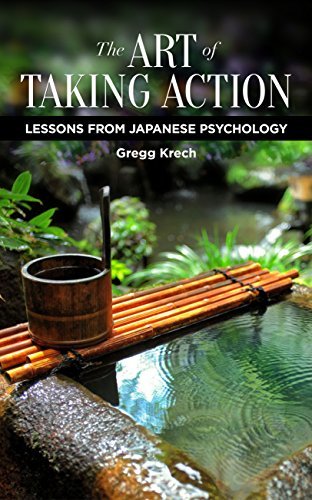
Drawing on Eastern philosophy, Zen, Tibetan Buddhism, Japanese Psychology, the Samurai, and Martial Arts, Gregg Krech offers an approach to ACTION that guides you to doing what is important for you to do in the time you have available. Most of us associate Eastern wisdom with meditation and contemplation. Krech offers a complimentary collection of wisdom on the Art of Taking Action that will help you take action even when you don’t feel like it. This isn’t just another “how to get things done” book. It’s about how you do what you do, and the impact that your action (and inaction) has on the world. Students of Zen, Yoga, Taoism, meditation, mindfulness and Japanese culture, will resonate with ideas and practical strategies such Overcome by Going Around, Non-attachment – Effort and Outcomes, The Rhythm of Activity, The Stress of Not Getting Things Done, Procrastination Disguised as Busyness, Working with the Conditions We Encounter, Impermanence and Legos, and more. Krech brings more than 25 years of experience teaching and studying Japanese psychology to create a unique collection wisdom on “Taking Action” that is both practical and profound. If you are ready for some “movement” in your life, this book is just what you need.
re-read October 2018. Still a favorite, and a 5-star read. So glad i own it on paper now.
***
I love this book and re-read it regularly. Now I'm debating getting a dead tree copy.
"Most procrastination is caused by a tendency to make a decision, in the present moment, based on what we feel like doing at that moment. And if we don’t feel like doing something NOW, then we’re not likely to feel like doing it later, because (are you following this?) later will just be another NOW. If you don’t feel like doing your taxes NOW, just accept that you’ll probably never feel like doing them. The fundamental change we need is a shift from a feeling-centered approach to decisions to a purpose-centered approach. The question isn’t “What do I feel like doing?” but, rather, “what needs to be done?” All the time management systems in the world won’t really help us very much until we’ve developed the capacity to make decisions based on purpose rather than feelings. And this is one of the reasons that Morita therapy is so valuable. It teaches us how to do that. We learn that we can coexist with our feelings and take them along for the ride. We don’t fight them. We don’t fix them. We don’t transform them. We coexist with them, while we move forward and take appropriate action . . . simply do the work because it’s what needs to be done, regardless of how we feel. We can call this maturity, or self-discipline, but it’s really about developing the skill to coexist with our feelings and take action anyway." (pp. 157-158).
A quick read but like a lot of simple things it would take a lifetime to master exactly what is being said.
The essential message is "Take action"
Action is greater than thought.
Action now is better than action later.
In many instances action is better than planning action. You cannot know all the difficulties you are going to face in a project before you start it, so start it and solve those difficulties.
The big shift in perception of a task was a fair way through the book when the author says his world was shifted when someone said instead of thinking "I've got to..." say "I get to..." and give thanks to all the people that have contributed to you being able to do that task and all the help they have given to make it easier for you.
The example was "I've got to pick the kids up from school" Change it to "I get to pick the kids up from school"
Think of the taxpayers that have made the building possible, the road network feasible. The people that planned and built those things. The people that built, designed, serviced the car you drive. The effort it took to get the petrol to the pump you are going to use. The teachers that trained to teach your children. The excitement your children are going to have recounting the days events. It will be a time to say hi to other parents, renew acquaintances.
The list just goes on and on for as long as you want it too and it will in any given situation. Suddenly the "got to" mindset is shifted from chore to a long list of gratitude which elevates the whole experience, keeping you in that moment rather than fretting you could be doing something more.
The other big takeaway was a story about someone listening to a lecture and a member of the audience says "That was inspiring". The lecturer says "What has it inspired you to do?"
So often we think that something is inspiring but forget to be inspired to actually do something.
This just scratches the surface of what this book has to teach and it is well worth taking the time to discover it for yourself.
Nì. Non so bene cosa pensare a proposito. Ci sono pagine molto belle, ma non sento di aver avuto chissà quale rivelazione. Forse dipende un po' dal mio scetticismo, non credo che questo libro mi lascerà qualcosa. In ogni caso è una lettura molto piacevole, e magari qualcuno potrà sentirsi davvero motivato a fine lettura.
So well written, this book caused me to look at my life and realize that my life is not a to do list. I am routinely overwhelmed and naturally an anxious person. By giving me a different set of tools, this book has given me hope to overcome my own paralysis and inaction from being overwhelmed. Amazing how just thinking a bit differently can make all the difference. Highly recommended.
The Art of Taking Action (2014) by Gregg Kech is a book that combines Zen and other related Eastern Philosophies and provides an approach for action. The first part of the book hangs together well but the essays after about the first half become fairly haphazard. Still, the book has some well thought through ideas and a different perspective on procrastination and other problems.
LIBRI DI CRESCITA PERSONALE. Li evito da sempre. Per lo più sono banali, vuoti e pure presuntuosi.
“Se bisogna compilare la dichiarazione dei redditi, diventa indispensabile pulire il frigorifero.”
Quest’anno però ne ho letti tre che mi sono piaciuti moltissimo. Sono sincera, per alcune pagine ho alzato gli occhi al cielo ma per altre ne ho trascritto le frasi e attaccate alla scrivania.
Niente spoiler perché tutti meritate di avere questa copertina sullo scaffale ma #lartedipassareallazione è pratico, ne ho apprezzato l’approccio e la visione d’insieme.
Sarà poco utile per chi già ha una meticolosa planning routine e per chi, al contrario, non ha intenzione di vivere con scalette organizzate.
Una buona lettura invece per coloro che si trovano al centro, un ottimo spunto per provare ad essere più presenti, capire le cause del procrastinare, distinguere le priorità urgenti da quelle importanti e prefissarsi di scrivere un minuto al giorno per completare il vostro libro.
Risulta sempre difficile leggere un occidentale che parla di "pensiero orientale" senza andare a sminuire alcuni concetti. L'autore vuole essere piuttosto concreto, ma questo vale solo per la parte iniziale e finale del libro. Si perde invece il filo del discorso nella parte centrale (circa 40 pagine) quando si iniziano a leggere gli interventi di persone care all'autore (moglie, collaboratori, amici) che esprimono esperienze piuttosto occidentali della questione. Il concetto finale è realmente contenuto nel titolo, e consiste nel vivere una vita "all'attacco", accettando gli errori (piuttosto che rimproverarsi) ed evitando quei pensieri, spesso scuse, che potrebbero portarci a vivere una vita da spettatori. Non è un libro profondo, tratta poche cose in poche pagine cercando di dare delle vie per raggiungere un fine comune, l'azione. La considererei una lettura da 3 stelle e mezzo, ma ne concedo 4 dato che potrebbe essere uno stimolo per approfondire il mondo orientale; magari partendo dai classici (Tao Te Ching; Chuang Tzu; I Ching) o da alcuni autori citati nel testo come Musashi Miyamoto o Thich Nhat Hanh.
A foreword to my reviews. The number of stars is heavily influenced by the effect a book had on me personally. This might not be the case in your situation.
Review of The art of taking action
The Art of taking Action is not an easy book for me to review. Based on my rating system it was worth four stars to me as I am already doing things differently. Thank you for that Gregg Kerch. On the other hand, it was not an easy book for me to read.
The first part of the book made me highlight many more snippets and produced the most profound realizations about the role of thinking in the context of action - without action at the end, thinking alone is not capable to produce results we want to see.
What didn't work for me were the 'guest writers' - other people contributing passages to the book. Their writing was different in style and I could not, on more than one occasion, fit it into the point the book was making. This detracted me from the experience.
What I missed most was clear reasoning based on facts with links to sources.
All in all, it did it job and therefore worth 4 stars to me.
In order to remind myself of the content of this practical guide, I would like to highlight ten points that are particularly essential to me.
Krech says about working through lists and forgetting about life: "Getting [the tasks of a conventional To Do list] done will allow you to maintain your life and continue to function, but for what purpose? There must be something else you need to do, beyond keeping your bathroom sanitary and your car clean, if you are to find fulfillment and meaning in your life."
The next passage summarizes Naikan, a method that points in the direction of significant activities. The process of Naikan reflection is relatively simple. It is based on three questions: (1) What have I received from ____? (2) What have I given to ______? (3) What troubles and difficulties have I caused ______? These questions provide a framework for reflecting on parents, friends, teachers, siblings, colleagues, children and partners. […] It’s hard to feel stressed out and grateful at the same time.
Krech emphasizes that a life that aims to avoid risks is a highly dangerous life: Reflection, risk and contribution—three pillars to a meaningful life. Perhaps we can better express it in an equation: Reflection + Risk = Contribution […] WARNING: Inaction and security may be hazardous to your purpose! […] When we don’t take risks we get stuck in a rut of safety. Over time, we become trapped inside our own life […] We grow resentful at ourselves for letting our grand passions languish.
Krech warns about lingering in doubt: Afraid to make the wrong choice, we can wait and hope for a decision to become obvious. We try to think through the issue in our minds. We analyze it and ruminate about it. But we can’t figure out life in our minds. Life is resolved through life itself. […] So when we are confronted by indecision, we need to take action despite our doubts or confusion. We need to move forward, even if we’re only taking small steps. […] The situation may change or reveal itself in a new way once we have moved to a new vantage point.
In many cases, the mistake is less important than what you do after you’ve made a mistake. [… O]nce a mistake is made, we must simply respond to the new reality.
Arugamama is a term used in the so-called Morita therapy: The state of arugamama is one in which we do not try to escape from our emotional experience. We are not seeking any kind of emotional or cognitive state other than the one we are in at the moment. Yet we continue to devote ourselves to what is important for us to do. We carry out the purposes of our lives, because they give life meaning.
The following quote reminds the reader that they are not the only ones to suffer if they postpone necessary tasks: Take procrastination, for example. Many of us prefer to tolerate the personal consequences and inconvenience that result from procrastination than to face the discomfort and disruption of changing our ways. […] Often we are not the only victim touched by our irresponsible choices and poor time management. Our day-to-day doings and misdoings impact on those we know and those we won’t ever know. [… W]hen we are trying to compress our work into what little time is left, our relationships with others can become strained and delicate
Krech also deals with the bondage into which we place ourselves when we grant absolute validity to our affinities. When I say, ‘I am going to do this because I like it; I am not going to do that because I don’t like it,’ what I am really saying is, ‘My hands are bound; I have no choice in life.’
In the following, a quote from Chogyam Trungpa is explained, which can be a guide to how to deal with loss: Hold the sadness and pain of samsara in your heart and at the same time the power and vision of the Great Eastern Sun. Then the warrior can make a proper cup of tea.”–Chogyam Trungpa […] The first thing we must do is be willing to hold our pain and sadness in our heart. [… T]o hold the sadness and pain in our heart is to be aware of the sadness and pain in our heart. We notice and acknowledge the feeling of disappointment, gloom, and frustration—and we hold it in our heart with warmth and tenderness. Think about how you usually respond to the feeling of sadness or depression. You want to get rid of it. You want to avoid it. You want to make it go away. […] The second element of Trungpa’s advice is to hold the power and vision of the Great Eastern Sun in our heart at the same time […] The Great Eastern Sun represents a combination of wisdom and discipline. It is about moving forward. It is about waking up to your life. The Great Eastern Sun shows us what to do and not do. It is cheerful, illuminating and carries the quality of nonaggression.
Finally, a warning about perfectionism: If you think about it, there is a relationship between perfectionism and grandiosity. If you think that what you do should be perfect, than you must have a very high opinion of yourself. On the other hand, if you assess your abilities realistically, you are likely to discover some humility and accept a more realistic perspective about what you are doing.
Come premesso dallo stesso autore, questo libro non ha la pretesa di essere illuminante o di cambiare radicalmente la vita. Attraverso esempi, storie di vita e analisi, cerca di indurre il lettore alla consapevolezza di quanto credenze e atteggiamenti ormai consolidati nella nostra quotidianità siano deleteri per la mente e per lo spirito, con inevitabili conseguenze anche sui rapporti tra persone. Scrittura scorrevole, approccio pratico e analisi semplici, ma accurate, rendono questo libro piacevole, interessante e un buon punto di inizio se si vuole migliorare la propria qualità di vita e magari 'passare all'azione'. Spesso ribalta quanto crediamo essere assolutamente vero, quelle cose che nessuno mette in dubbio. Una lettura brillante, piacevole e a tratti divertente che ho davvero apprezzato e che consiglio. Un libro che credo sarà utile anche riprendere periodicamente.
Although the book is short enough to finish in one or two days, it should be read over several weeks while practicing the advice given in the book. The first step to take is ask yourself these questions when interacting with others: 1) What have I received from _____, 2) What have I given to _____, and 3) What troubles and difficulties have I caused _____. These questions will help you to see how you fit in the overall picture. Rather than reacting or doing what is best only for yourself, you will start to choose actions that will bring balance to you and the relationships around you. Obviously, the next piece of critical advice is to take action. Do one small step... even if you don't feel like it. Moving forward, however small, is better than not moving at all.
Ci ho messo più di 2 anni per finire di leggere questo libro. Da una parte perché sono un'ottima procrastinatrice (motivo per cui ho l'comprato) e dall'altra perché ho scoperto che non mi piacciono i libri in cui ci sono concetti non collegati da una trama, nonostante possano essere molto interessanti. È il caso di questo libro, che non mi ha travolta come solo la trama di un romanzo avvincente sa fare; nonostante questo, mi ha fatta sentire capita e al tempo stesso mi ha schiaffeggiata con delle verità crude ma necessarie. Questo non vuol dire che non si percepisse il "calore" dell'autore nei confronti del lettore, anzi, lui stesso si trova a predicare dei consigli importanti perché sono dei problemi che lo coinvolgono personalmente. La cosa bella di questo libro è il fatto di essere diviso in piccoli paragrafi che non per forza devono essere letti in ordine. Vi consiglio di leggere uno/più paragrafi prima di fare quel qualcosa che tanto rimandate, nel mio caso studiare. Penso che lo terrò sulla mia scrivania e lo riaprirò ogni tanto, per rileggere le frasi più importanti per me, nel momento del bisogno.
Wow. So much wisdom here. Best taken in small bites because if you’re willing, this book could change your life. It begs to be read over and over, hopefully seeping in a little bit more each time. It’s one of those books that, while you’re reading, has you saying, « yea I KNOW that, but really needed reminding ». My dear friend Jimmy gifted this to me. Jimmy I have dog-eared probably 2/3 of the pages (is it cruel to tell a librarian that? I remember anti-dog-ear posters in my childhood library…) and will be reading this again and again, and again…
Is it a must-read? No. But I did get some useful bits from it. A rather funny aspect of the book is that it's main answer to the devil that is inaction is - just do it. That's what I got from it mainly. I thought it was interesting how much Kregg down played planning and thinking. Not ironic that you would hear that from a book on action. My question for Krech is, is there no place for planning? What if you don't have room to make a mistake? What if the cost of a mistake is very large? I suppose he was say, "then take action on the planning" or something to that effect. Let's see in my own life how much of an impact this has left. I know that I want it to.
An informative book which explores morita therapy and the benefits it can bring to your life if you apply the principles. It also discussed nikan a process of self reflection which will allow you to let go of a lot of the things that you are holding on to. There are also a lot of zen lessons contained in this book.
I enjoyed the book. It has some really good advice and lessons to help you get through life. It really made sense and was easy to follow. It can help in all areas and aspects of ones life. I highly recommend this book to anyone who feels they could use the info to better their lives. I won this book for free from the Goodreads Giveaway.
By Far the best book I have read on taking action. Though book is very small and can be finished fast, it require slow reading and constant mulling. Some of the points mentioned about taking action have already helped me get started on my projects.
I found The Art of Taking Action eminently worthwhile. Practical, realistic, and encouraging, it delivers on the promise of the title.
For full disclosure, I should add that I am an acquaintance of Gregg Krech and his kind and capable life-partner Linda. They both live what they teach. As a fellow teacher and and writer, I can appreciate the labor represented in putting together such a fine, well-organized and helpful work.
I attended a Naikan retreat at ToDo Institute at least a decade ago, and found it transformative. Mr. Krech's book (and his other books) enable any interested reader to benefit from these reminders about reality and how we can learn to function well. As I remind my own students (of "the peaceful warrior's way"), it may not seem especially spiritual or sexy to function well — but it's reasonable to assume that people who get things done enjoy a higher level of fulfillment than those who don't function as well.
Congratulations to the author, and best wishes to all readers of The Art of Taking Action.
8! É’ un manuale breve, molto semplice e molto pratico. Il concetto chiave del libro e’ quasi lapalissiano: diventiamo abili a passare all’azione solo passando all’azione. “Fallo e basta” e’ un monito che va incentivato, e’ provato che abbiamo un controllo maggiore sulle nostre azioni rispetto ai nostri pensieri. L’autore ci avvicina alla teoria Morita, un metodo responsabilizzante che ci offre delle alternative per affrontare le difficoltà. Ci parla del Kaizen: procedere a piccoli passi in un miglioramento continuo e del Naikan, una tecnica di auto riflessione. Un concetto semplice e potentissimo da ripetere come un mantra e’ : una decisione non cambia la realtà finché non passiamo all’azione! L’autore con molti esempi concreti ci accompagna all’inizio del cammino muovendo i primi passi con noi e donandovi una visione d’insieme.
Amazing! I needed to read this book and I think I will read it again. I wish I had read it a long time ago. Many good, digestible essays about common issues as well as motivations for taking action. There were a bunch of good quotes and stories... I put a ton of post it notes in this book. One thing he did say at the end was don't just be an audience member reading books and thinking about how awesome these articles, seminars, etc. are. That is the biggest thing and I'm hoping I can actually use the knowledge in this book to improve my own life and behavior. I'm definitely recommending this book to others.
I am a fast reader and do not usually take more than a week to read through an average length book. This book forced me to stop and reflect on each of its essays. It labeled so many of my flaws for me which I never realized were hurting me every day. There are so many books which give excellent advice on how to setup a productive system for getting things done. This books tells you how to work that nice system you have set up. It gives pointers on why you might be failing again and again and why it is perfectly fine to fail.
Sinceramente mi aspettavo di più. Alcune pagine sono d'ispirazione, mi sono piaciuti gli esempi pratici e le citazioni. Ma è una visione un po' semplicistica che mi ha dato quasi fastidio. Sarà perché ho esperienza con la depressione, ma leggere "ehi, se sei depresso basta che fai le cose per non esserlo più" so che può fare molto male se una persona non riesce perché ha una malattia. Mi stupisco che uno psicologo clinico possa non tenerne conto.
This was a refreshing alternative viewpoint to taking action from the otherwise typical push-your-way through Western way of doing things. This book is a collection of essays talking about the inner demons that we all confront, and how to stop resisting them to get into a state of flow to take action. I found some great points to reflect on and move forward in my life.
If you’re in a point of your life where you want to start something but something else holds you back, this is for you. We all know that the start is always the hardest one but oftentimes, we tend to drift away simply because we don’t know how to fight the uncomfortable and the unknown. This book literally saved me and helped continue my goals despite all the perceptive setbacks.
The book tells about one of the most effective Japanese principles of "Naikan" to get ride of everyday problems of procrastination. It helped me a lot to get me out of some of my similar problems. The principles and lessons are more about practice. I recommend it a must read for self-improvement seekers.
Questo libro ha un titolo accattivante che rapisce l'attenzione del lettore. Purtroppo nel mio caso le aspettative che mi ero creato non sono state raggiunte nemmeno lontanamente. Sono rimasto molto deluso dal fatto di non aver trovato nulla di nuovo. Mi è sembrata la fiera dell'ovvietà; sarà forse per libri simili letti in passato. In generale lo consiglierei soltanto a chi è alle prime armi.
Inizialmente pensavo fosse uno dei tanti libri di questo tipo, avanzando con le pagine, sono rimasta piacevolmente sorpresa. Questo libro non è buonista, è schietto, ti induce a riflettere , a guardarti dentro e ad ammettere i tuoi comportamenti tendenti alla procrastinazione causati dai più svariati motivi. Adotterò alcune delle pratiche qui consigliate ❤️.