Jump to ratings and reviews
Rate this book

As If

Not yet published
Expected 26 Feb 26
Rate this book
Two men meet in a flat in London. They are total strangers and yet they look remarkably alike. Lewis is grieving his dead wife; Korine is hiding from his very-much-alive one. Lewis never had children; Korine is an ambivalent parent at best. Lewis is an erstwhile actor, too depressed to attend the big audition that has just fallen into his lap. Korine has tried a dozen dead-end jobs but never pursued his acting dreams.

Two men living mirror image lives. Each seeking a second chance to get things right. Each wanting what the other has.

As If is an existential farce about the road not taken. Surreal and slyly poignant, suffused with ironic melancholia, it is a parable for the twenty-first century a character trapped in reality’s hall of mirrors, endlessly searching for something to live for.

240 pages, Kindle Edition

Expected publication February 26, 2026

222 people want to read

About the author

Isabel Waidner

13 books130 followers
Isabel Waidner is a writer and critical theorist.

Their books include We Are Made Of Diamond Stuff (2019), Gaudy Bauble (2017) and Liberating the Canon: An Anthology of Innovative Literature (ed., 2018), published by Dostoyevsky Wannabe.

Waidner's critical and creative texts have appeared in journals including AQNB, Cambridge Literary Review, The Happy Hypocrite, Tank Magazine and Tripwire.

They are the co-founder of the event series Queers Read This at the Institute of Contemporary Art (with Richard Porter), and an academic at University of Roehampton, London.

Ratings & Reviews

What do you think?
Rate this book

Friends & Following

Create a free account to discover what your friends think of this book!

Community Reviews

5 stars
4 (33%)
4 stars
2 (16%)
3 stars
5 (41%)
2 stars
1 (8%)
1 star
0 (0%)
Displaying 1 - 9 of 9 reviews
Profile Image for Paul Fulcher.
Author 2 books1,956 followers
December 3, 2025
Primarily, I based my performance on a combination of what I myself had seen of Korine (enough) and the fact I was navigating a set of conditions which, taken together, amounted to Korine's life and produced Korine-like responses. If acting was indeed living truthfully under imaginary circumstances, I had the advantage that on this occasion said circumstances were real.

Not that I didn't get it wrong. I frequently did Korine incorrectly. Like the time I neglected to mispronounce Cyril's teacher's Korean name which I gathered Korine did without fail.


My first encounter with Isabel Waidner's work was in September 2017 when their Gaudy Bauble was entered, and later shortlisted, for the 2018 Republic of Consciousness Prize, of which I was then a readers-panel judge.

The novel began with the memorable line: A formidable micro-horse sprang across a Formica tabletop. By the end of a first paragraph that included the motifs on a sweater becoming animate, and which concluded and this was just the beginning, I realised this was something very different to anything I'd read previously, Awkwardgarde fiction, potentially trailblazing as the authorial stand-in put it before the narrative baton was seized from them by a pegasus, and I must admit it took me several reads of that first page, and a read of the author's PhD thesis, before I really understood what they had achieved: Transliterary, a new genre of its own, "sharing agency (the capacity to influence the narrative) across assemblages of human and nonhuman, fictional and real, material and semiotic 'actors' ... to subvert normative versions of authorship, intentionality, causality, and process."

By the time of Waidner's 2nd novel We are Made of Diamond Stuff, I was, and remain, convinced that they were, in the words that opened my review, Britain's most exciting and important writer, an impression that was fully confirmed by Stirling Karat Gold, which won the one prize that, for me, compares to the Republic of Consciousness in its literary ambition, the Goldsmiths Prize.

And winning that Prize “as a writer lacking the structural privileges related to class, native status and cisgender” (as Waidner commented thanking the Prize organisers and judges), combined with a striking sobriquet of 'a modern-day Joe Orton' bestowed in a Goodreads review by a well-regarded blogger was the starting point for Waidner's fourth novel, Corey Fah Does Social Mobility, a brilliant exploration of one of the most neglected barriers to social mobility, cultural capital. That novel memorably included the character Sean St Orton, a version of Joe Orton in an alternative timeline where he escaped the real-life fate of the playwright as described in Prick Up Your Ears: The Biography of Joe Orton by John Lah.

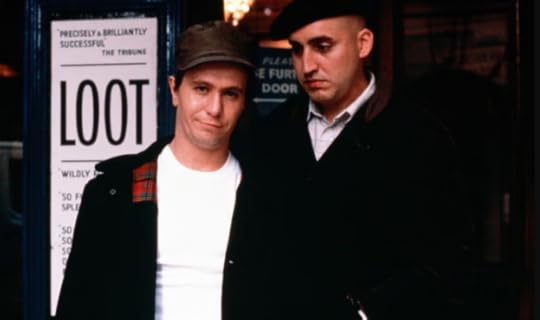
Lah's work was adapted by Alan Bennett into a screenplay for the 1987 film of the same name, directed by Stephen Frears, and starring the New Cross born working class actor, Gary Oldman.

And Oldman's upbringings and career are of crucial importance for each of the two main characters in 'As If', Waidner's latest novel, forthcoming in 2026, which again includes social mobility as one key theme. Aubrey Lewis and Lindsey Korine are both, like Oldman, from New Cross and they attended the West Greenwich School in Deptford around 20 years after the actor.

They were in the same year, although Aubrey doesn't seem to remember Korine, and Korine only vaguely remembers Aubrey. Korine remembers wanting to be an actor 'for about a minute aged ten or eleven' after seeing Oldman in Prick Up Your Ears, but took Oldman's example as very much an exception that proved the rule, while Lewis pursued a semi-successful acting career, following Oldman's example:

I come from a vastly different set of material circumstances compared to most actors I met in the industry over the decades. You’d think it doesn’t matter, but it does. It means that I come at it, acting, differently. I never even thought of it as something people did until I saw Gary Oldman play Joe Orton in Prick Up Your Ears one night on the BBC. I was ten or eleven. I was completely arrested. I’d heard that he, Oldman, went to the same secondary school in Deptford as I did, twenty years prior, which can’t have helped my subsequent overidentification with him.

However As If is primarily a distinguished admission to the literary list of dopplegangers, particularly those that represent to each other a different path not taken, from Doestevsky through Beckett to Jon Fosse's Septology and it's two Asles.

Each man has, or had, a wife named Laurie who had cancer, and both couples lived around the Barbican Estate. But Korine's wife is in remission, while Aubrey's Laurie died 18 months earlier. Korine has struggled economically, rather relying on his wife's career, in some form of gathering intelligence. Aubrey began his acting career, at the Barbican, as Vladimir in Waiting for Godot but ended in a long-running (seventeen seasons, three-hundred and eight four episodes) BBC TV series, about two sleuths, each hired to keep an eye on the other, Aubrey in a secondary role as the partner of one of the sleuths.

But Aubrey has become disillusioned with acting, in part after Laurie's death but also realising the TV show is a 'professional, defanged' version of what drew him to acting - 'playing a role, any role, like it mattered'. When is approached to play the lead role in a new series, As If, where the twin secondary roles become the lead, he declines

Meanwhile Korine has left his family, in a 'popping-out-to-the-shop-for-a-pint-of-milk' moment (in a brilliantly written scene involving a kitten), unable to cope with his wife's illness and recovery and the responsibility it transfers on to him, and hiding in the Barbican underpass, Beech Street, sees Aubrey pass by, and, on a whim follows him to his flat. Both men are essentially opting out of their responsibilities - while people 'stepped gingerly over them' (from Waidner's cleverly chosen epigraph from Beckett's Molloy), literally so in Korine's case in the underpass.

The plot has the two men, more by accident than design, and certainly not by connivance, swapping each lives, or, more accurately, swapping roles, an immediate second read strengthening how cleverly this, and the layers of doubling, have been constructed.

But for both Aubrey and Korine, far from playing a role, they need to discover themselves - as Korine notes from watching acting videos 'there is more to acting than just pretending to be someone else'. There's a brilliant passage where Korine's wife remarks sarcastically, as Aubrey starts to mirror Korine's unreliability - 'One thing's for certain, you're getting better at Korine', which he misinterprets as a comment on his acting skills:

On the surface of course, Laurie was affirming me in my role: you're getting better at Korine. But by openly referring to Korine as a third party, she was effectively undermining me in it. She had as good as announced to hypothetical theatregoers that someone, I, was acting while the play was in progress, disrupting the fictive reality.

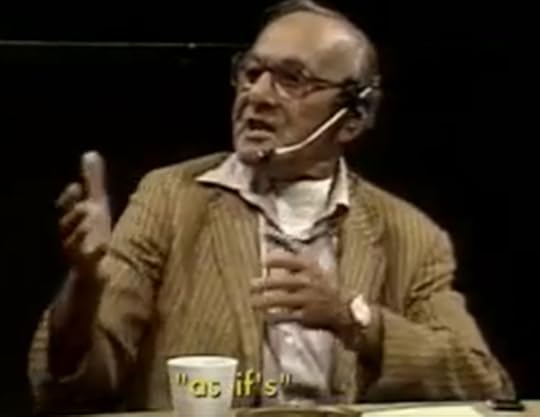
The novel's title comes - I think even if subliminally - from acting coach Sanford Miesner's (represented in the novel as 'Sandy M.') technique of 'as ifs', building on Stanislasky's concept of particularization: “A particularization, an as, if, is something else. It’s your personal example chosen from your experience or your imagination which emotionally clarifies the cold material of the text.”

And while my reading of the novel erred to a realistic explanation, Waidner (rather like Fosse) leaves open an alternative explanation, including in the novel’s emotionally moving closing scene.

The novel is both unmistakably Waidner - the crisp staccato sentences; the strong sense of place; the keen visual eye and particular interest in fashion (even if here it tending to the beige and unfashionable); the theme of social mobility; and the cultural and literary links (here extended to fascinating insight into the profession of acting) - but a further evolution of their literary style, with the pyrotechnics of Waidner's earlier work perhaps fading, but this allowing the novel to showcase their deeply intelligent writing and empathetic poignacy.

Another brilliant addition to an impressive ouevre.

Thanks to both the publisher via Netgalley but also the author directly for the advanced review copy.

Some visual images from the novel:

description
I saw Gary Oldman play Joe Orton in Prick Up Your Ears one night on the BBC

description
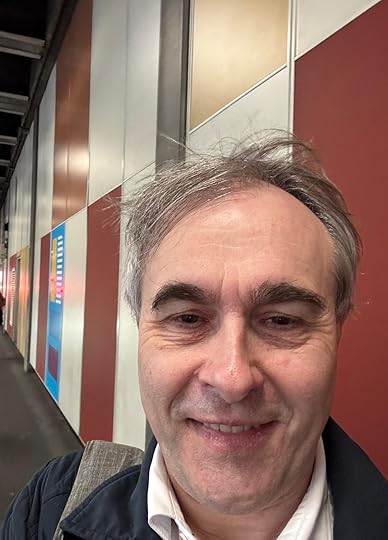
I was sitting in the Barbican underpass, Beech Street I think the official name is, I must’ve seen something. I was sitting on the pavement, leaning against one of the panels cladding the walls: a chipper palette of beige and its foils: light blue, maroon, white, bright yellow, I want to say sand.

description
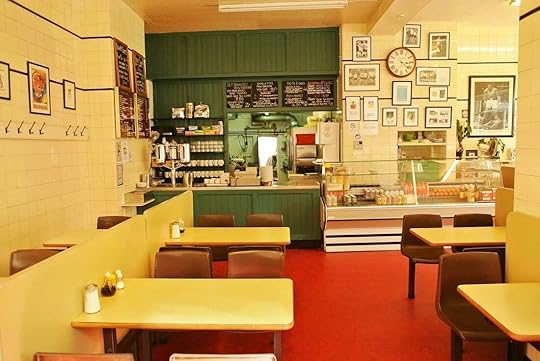
The Regency Cafe, Westminister, source of the UK cover photo and perhaps a model for Ludo's.
Twenty or so wooden tables, the typical condiments on each: salt and pepper shakers, sugar pourer, ketchup and brown sauce plastic squeeze bottles. Fake-leather-bound menus, not a tablecloth far and wide ... and framed celebrity photos all over the walls

description
One of the architectural idiosyncrasies of Basterfield House: sets of concrete steps provided direct access from the communal garden to the balconies of the upper-ground-floor maisonettes.

description
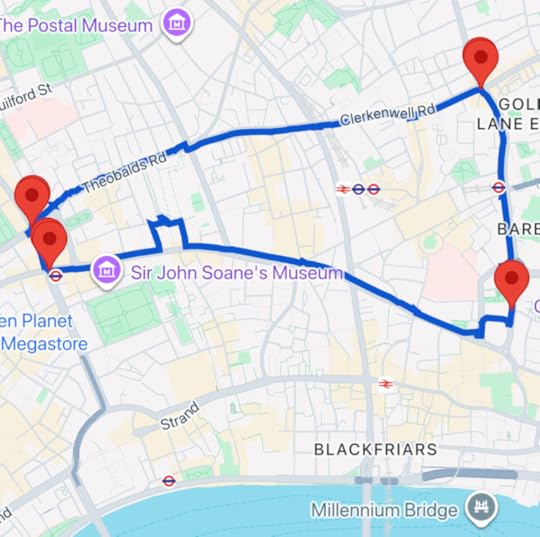
So I walked, circuting an area defined by my physical capabilities: northbound on Aldersgate Street, then left into Clerkenwell Road leading into Theobalds Road, then left into Southampton Row and left again into Holborn.

description
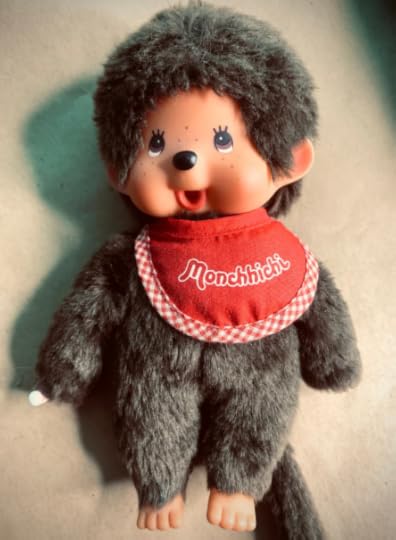
He pulled a children's toy, a little monkey with puffy cheeks, a Moncchichi, I believed, out of the plastic bag.

description
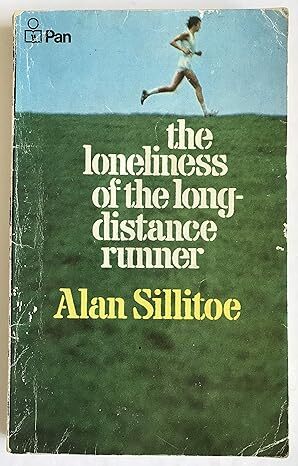
I walked straight into the lead of The Loneliness of the Long Distance Runner after that. The production, at the National, of all places, marked forty years since the publication of Sillitoe ’s novella.

description
Sandy M., one of the most influential and revered acting teachers in modern times, sits behind a desk.
Sanford Meisner, explaining to an acting student, reciting Humpty Dumpty, 'that's where your liking for "as if's" comes in.'
Profile Image for Kate O'Shea.
1,326 reviews192 followers
Review of advance copy received from Netgalley
December 25, 2025
3.5

Lewis is an out of work actor, once successful but now mourning the death of his wife, he is stalled in life. Lindsay has walked out on his wife and child, avoiding life . The two meet in a subway where Lindsay follows Lewis home and moves in.

From this point on the two men's lives swap and change with the roles alternating in a strange story where neither man seems to know what he wants, where he should be or even who he truly is.

As If is a strange tale but surprisingly compulsive reading as you try to work out whether the story is fiction and if either man is real or a figment of the other's imagination.

I did get a bit bewildered at one point but I still couldn't stop reading. Recommended if you enjoy ethereal, existential tales that question most things about reality.

Thankyou to Netgalley and Farrar, Strauss and Giroux for the advance review copy.
Profile Image for endrju.
443 reviews54 followers
Read
December 28, 2025
If I wanted to be cheeky, I’d say this is Gender Trouble without gender. Read in relation to Waidner’s earlier work, which reveled in freewheeling queerness, this marks a 180-degree turn: there’s not a queer in sight. But - and this is why Butler still matters, I think - As If remains firmly on queer ground in how it explodes cherished social roles (fatherhood, nuclear family, the singular person), revealing them as purely performative: no substance, no essence, only repetitions and mirrorings with no origin or ground to speak of. I’m very excited to see what Waidner brings next. Their work has become essential queer reading.
Profile Image for Gumble's Yard - Golden Reviewer.
2,189 reviews1,797 followers
December 4, 2025
I thought about Laurie, my wife, the fact that I'd known her, and Korine's wife. I thought about Kirstie. I thought about acting, too, and I didn't mean the professionalised, defanged version Id become overfamiliar with. I didn't mean playing Korine either, which, I finally realised, represented this exact sort of acting at best: the Schmidt of this year. I meant acting: playing Simon in an imaginary production of Lord of the Flies. Playing Vladimir in Godot. Playing Colin in The Loneliness of the Long Distance Runner and, even more so, failing at it. And by playing Simon, Vladimir, Colin I didn't mean playing the lead in a major production. I meant playing a role, any role, like it mattered. An image came to me of the child actor I once was, who entertained the sports shop's clientele against their wishes. Who got bullied at school for simply rehearsing. Who wasn't encouraged by anyone, but who insisted on himself with an urgency I'd not known since. This risk-to-life-and-limb sort of actor: who could he be at forty-six, naivety lost, seasoned. The point was, I didn't know. I'd never dared to find out.

 
I first came across Isabel Waidner in 2017 – a playfully experimental German-British author, cultural theorist and University teacher - who disassembles fictional conventions as a way of disassembling racial, nationality, sexuality and class conventions in British society - when I was one of the judging panel for the 2018 Republic of Consciousness Prize – for which we shortlisted the author for their debut novel “Gaudy Bauble”, a novel which was an integral part of their PhD Thesis.   Their second novel “We Are Made of Diamond Stuff” was shortlisted for both the Republic of Consciousness and Goldsmith Prizes, before their third “Sterling Karat Gold” (which made it three RoC shortlists and her first Orwell Prize shortlisting) won the Goldsmith Prize in 2021.  That prize (with its normally distinctive trophy being awarded in a virtual ceremony) was then the jumping off spot for their fourth novel (and first with a major publisher) the Joe Orton meets Bambi mash-up “Corey Fah Does Social Mobility” (shortlisted for the Arthur C Clarke Memorial Award).
 
And now this their fifth novel – due to be published in February 2026.
 
The novel has (at least on the face of it) two alternating first party narrators; although each at times openly muses if the other really exists and the reader or is a projected alter ego – and the reader is invited to share and enjoy this ambiguity.
 
Aubrey Lewis – a long time successful actor in a long running rather surreal detective show which “revolved around the premise of one slueth A. Smyth, who was hired to keep watch on another sleuth B. Smith who was in turn hired to keep watch on A Smythe” (Lewis playing Smythe’s frustrated partner C Schmidt) has fallen on hard times – his wife Laurie dead from cancer, his career ended as the show was cancelled.  Now though he has been asked to appear at an audition for a potential spin-off for which he would be the star (one based on a novel “As If”) – something he is reluctant to do – instead walking out of his flat.
 
Lindsay Korine – a very old distant school acquaintance (from a school which as an aside links via Gary Oldman with Corey Fah) turns up in his flat just ahead of the audition.  Korine is homeless having walked out on his wife (also Laurie and who has just recovered from cancer) and child – and decides to take Lewis’s place at the rehearsal and to stay in his vacated flat.
 
Meanwhile Lewis moves in with Korine’s wife and child.
 
And both deal with the fear of discovery (while also realising many around them already know of their role playing) while suspecting the other of a staging some form of plot to ruin their own shot at a second chance
 
For me the novel represents an interesting and evolution and maturing of their writing approach (the author in a dedication to me called it “enter[ing their] middle style”)
 
Perhaps less experimental - although still way more unusual than even most literary fiction, this has similarities to “Audition” but with a more absurdist stance and the latter was the most experimental book on this year’s Booker.
 
But very much stronger on empathy and the human condition - one moment in particular when a throw away remark about a cat causes an irretrievable breach in a marriage that has seemingly survived its strongest test almost took my breath away in admiration. Update: I have subsequently found this novel was the first written and the genesis of the novel.
 
Isabel Waidner is an author that deserves even wider recognition than they have already achieved – I would love to see them on the Booker longlist – and I really think this might be the book that achieves that – one which asks what it means in the 21st Century not just to act to believe that you truly have something to live for. 
 
Highly recommended.
 
My thanks to the author for a review copy and to Hamish Hamilton, Penguin UK for an ARC via NetGalley
Profile Image for Siobhan.
Author 3 books119 followers
Review of advance copy received from Netgalley
December 28, 2025
As If is the new novel by Isabel Waidner, a story of two men with strangely mirrored lives who want each other's opportunities. Lewis was an actor, but since the death of his wife he's too depressed to go to auditions. Korine has a wife and child, but feels unfulfilled. Both look strangely similar and went to the same school. A chance meeting leads them to talk in Lewis' flat, and from there, their mirror lives turn upside down.

Waidner is one of my favourite current novelists so I was very excited for this book. As If definitely represents a new direction in their writing, though it retains many distinctive elements (in style and existential nature, but also the Prick Up Your Ears references and interest in class and opportunity). It is direct and reflective, without as many surreal turns as their previous novel (and my favourite) Corey Fah Does Social Mobility, but instead plays the dark comedy straight, making the book feel even more like a midcentury British play (fittingly, of course, for the theme of acting and the kinds of plays/playwrights referenced in the book).

As If is a strangely timeless novel that would make an accessible entry point into Waidner's work, but it is also a deeply existential story exploring failures and chances. I like how the story feels so straightforward, but also anything but—a clash between the real and the absurd that creates a hum of humour under everything even as both men fail to get anywhere in their new opportunities. I went into the book expecting another book following Waidner's previous novels, but I got something else, and I'm starting to appreciate that maybe that's what I needed, even if it wasn't what I expected. Whilst reading, I thought it was good but not mindblowing, but now I'm finished, I find that I want to recommend it to everyone.
Profile Image for Roman Clodia.
2,900 reviews4,657 followers
November 7, 2025
It's perhaps unfortunate timing but this feels like a belated version of Katie Kitamura's Audition, but with - for this reader - less enticing writing and more mundane characters.

Where Kitamura leaves open spaces that magnify the enigmas in her narrative, Waidner fills them in so there's no room for the reader's imaginative collaboration. Instead, we're told how the main characters feel about their swapped roles, how acting leaves them feeling more themselves - we're even left at the end with the narrator thinking about an audition.

I'll be interested to see how other readers find this, especially if they haven't read Audition or if it's no longer playing in their heads as it was for me.

2.5 stars rounded up as this might have been affected by its juxtaposition in my head with a prior text.
Profile Image for Ben Dutton.
Author 2 books50 followers
Review of advance copy received from Netgalley
December 15, 2025
As If, the latest novel from Isabel Waidner, is as startlingly original and challenging as any of their other works, though this one feels much more accepting of newcomers than their last novel. This is a story of doubles - nothing new in fiction in that - but the way in which Waidner uses this motif to explore class, identity, queerness, and life itself is brilliant.

Aubrey Lewis is a successful actor, about to head to an audition when Lindsay Korine, an old classmate, walks into his life. Korine has just walked out on his wife and child, and takes Lewis's place at the audition. Lewis, meanwhile, moves in with Korine's wife. This is just the beginning of the mirroring, the doubling up, of a tale that becomes more engaging and entertaining as it progresses and which, by novels end, leaves you certain that Waidner is a great novelist.

I can highly recommend this novel - as I can any of Waidner's other works - and I expect it to be on many best of lists at the end of 2026.

Thank you to Netgalley and the publishers for the ARC.
Profile Image for Elisha Robinson.
45 reviews
December 3, 2025
As If is due for publication in February 2026.

This is my first time reading a book from Isabel Waidner and whilst I did enjoy it, I didn’t enjoy it quite as much as I was expecting. However, as I always try to do, I would like to focus on the positives more so than the negative - and there were still plenty of positives!

The book pulls you in from the very first line and truly captivates you. I loved how this one started off. The story is unique but also complex at times to the point where it feels a bit all over and it’s a struggle to keep up. This may be a result of me feeling that the characters were lacking in comparison to the message the novel was aiming to get across.

I did strongly enjoy the first half of the book as well as how the chapters are laid out. The chapter sizes helped the book to keep flowing.

Thank you to Penguin UK & Hamish Hamilton for kindly sending me an early eview copy of this book.

3⭐️
Profile Image for Amanda Grace.
163 reviews3 followers
December 8, 2025
Sterling Karat Gold blew my narrative world open, so to have the chance to snag an ARC for As If felt like winning my own little literary scratchcard! Waidner's talent of refracting is interposed in a much more (ostensibly) linear way in their 2026 release — think 'the prince and the pauper dropped acid from their council flat' vibes.

Maybe this is what placed this below SKG in my totally subjective affective ranking: it felt consumable in a way I hoped it wouldn't be. What I did adore, as a performer, were the obviously loving references to acting: the popular craft, yes, but also the ways in which we are all putting on our own little show every moment of every day. The universality of it.

TLDR: trippy but knowable.
Displaying 1 - 9 of 9 reviews

Can't find what you're looking for?

Get help and learn more about the design.