A visually stunning tour of Earth from the astronaut whose photographs - taken from the International Space Station - made us fall in love with our planet all over again . . .
In You Are Here, bestselling author and celebrated astronaut Chris Hadfield creates a virtual orbit of Earth, giving us the really big picture: this is our home, from space. The millions of us who followed Hadfield's news-making Twitter feed from the ISS thought we knew what we were looking at when we first saw his photos. But we may have caught the beauty and missed the full meaning. Now, through photographs - many of which have never been shared - Hadfield unveils a fresh and insightful look at our planet. He sees astonishing detail and importance in these images, not just because he's spent months in space but because his in-depth knowledge of geology, geography and meteorology allows him to reveal the photos' mysteries.
Featuring Hadfield's favourite images, You Are Here is divided by continent and represents one (idealized) orbit of the ISS. This planetary photo tour - surprising, playful, thought-provoking and visually delightful - provides a breathtakingly beautiful perspective on the wonders of the world. You Are Here opens a singular window on our planet, using remarkable photographs to illuminate the history and consequences of human settlement, the magnificence of newly uncovered landscapes, and the power of the natural forces shaping our world and the future of our species.
Chris Hadfield is one of the most seasoned and accomplished astronauts in the world. The top graduate of the U.S. Air Force Test Pilot School in 1988 and U.S. Navy test pilot of the year in 1991, Hadfield was selected by the Canadian Space Agency to be an astronaut in 1992. He was CAPCOM for 25 Shuttle launches and served as Director of NASA Operations in Star City, Russia from 2001-2003, Chief of Robotics at the Johnson Space Center in Houston from 2003-2006, and Chief of International Space Station Operations from 2006-2008. Hadfield most recently served as Commander of the International Space Station where, while conducting a record-setting number of scientific experiments and overseeing an emergency spacewalk, he gained worldwide acclaim for his breathtaking photographs and educational videos about life in space. His music video, a zero-gravity version of David Bowie's "Space Oddity," received over 10 million views in its first three days online.
This book was a wonderful Christmas gift from my partner last year. I guess me raving on about how wonderful An Astronaut's Guide to Life on Earth for weeks on end sent her a subtle hint. And while I have been flipping through this wonderful book for a few months now, I have finally managed to sit down and read the text and walk through it from beginning to end.
For those who do not know who Commander Chris Hadfield I feel a mixture of pity and resignation that you are a lost cause. You're probably not reading this review anyway. For the rest of us here is a picture to swoon over.
Sorry couldn't resist.
Anyway, in An Astronaut's Guide to Life on Earth Chris talks a bit about taking photographs of the Earth while on the ISS. This book is a collection of some of his best photos arranged by continent. There are cool little geography stories that go along with some of them and others are just pure eye candy.
So of my favourites are Mount Etna, the Gulf of Aqaba, bushfires on the Nullarbor Plains, San Francisco Bay, the Panama Canal, and I think my favourite might be the photo of plane contrails over British Columbia. Here Chris communicated with the pilots of the Snowbirds, Canada's military acrobatic team to fly in unison to make a single contrail visible in space. It is amazing to think that he saw this form in real time also.
One thing to keep in mind while reading this book is that it is not a copy of those glossy "Earth From Space" coffee table books. Those images are taken from satellite using very sophisticated equipment and probably have more work done on the image than a glossy magazine cover image. This is an amateur with an amateur camera in a brilliant location. He just took theses images in the few minutes he had between working on the ISS. So while these images cannot compete with those glossies with respect to the visual aesthetic factor, the value of theses images is in how they were taken, who they were taken by and also how they were collated and talked about. And that makes this book stand much taller than any glossy inhuman satellite photo book.
🍁🇨🇦—I’m finding it quite difficult to write a review about a book like this. All I can say is, if you have any interest in seeing our planet from a different perspective (where you have NO reference points to hint at where up and down are, or where east and west are) check it out for yourself. Chris took THOUSANDS of photos from the International Space Station. In some, you’ll swear you see things that (obviously) aren’t there—like a whale about to swallow a mouthful of krill, or an elephant, or a bird pecking at seeds. They’re remarkable! He did have a fair bit of help with this over the years. Photography was a small part of his standard, multi-year astronaut training. During his 21-year career with the Canadian Space Agency and NASA, general optics and Earth observation were taught as standard skills, and he certainly put that training to good use!
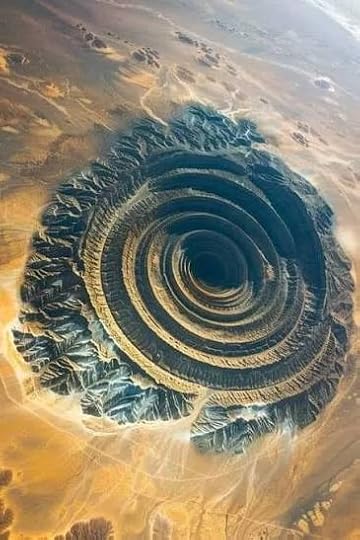
His favourite images to capture were those of the Sahara Desert, due to the colourful rock formations, and shifting sands. He was fascinated by abstract patterns, changing seasons, and landmarks that took on unexpected organic shapes, like the "Eye of the Sahara"—a giant, deeply eroded dome in Mauritania that he and other astronauts use as a primary visual landmark:
It’s a beautiful book to study when you’ve got time on your hands. I admit that, at some points, I found it a bit difficult to follow, but I put that down to the fact I read this as an eBook so the formatting wasn’t nearly as clear or precise as it would have been on a physical copy. And let me just say, this would make an absolutely gorgeous “coffee table book” for the photog or scientist in your life. Recommended!
Yes! The book is beautiful, a sturdy hard cover published by Little, Brown, and Company, printed on high quality card stock in a large easy on the eyes font, and staging more than 140 full sized & glorious color photos! Only a sampling of the 45,000 photographs Hadfield took during his 2,597 turns around the "blue marble", revealing that the marble beautifully bears out every color of the rainbow, not just the prevailingly presented blue.
In the Introduction he spends a few pages relating to his audience with humility, modesty, and an attractive "every man" quality how this book came to be, out of wonder and awe, while Commander in residence on the International Space Station. "Like many people, I want to understand our world better. Seeing it from a different angle really helps, and no perspective is more radically different than the one you get when you leave the planet althogether and look back - whether literally, as I did, or through photographs."
The photos are just breathtaking! Literally😮💨! I can't look at most of them without gasping for air! The height from which they are taken is just astounding 🌍 but at the same time are nausea 🤢 and vertigo inducing😵💫.
Hadfield's whimsical sense of humor shines through in his annotations as he compares some of these low earth orbit shots to body parts, punctuation marks, animals, arachnids, mythical creatures, and common household items.
Chris Hadfield, "one of the world's most seasoned and accomplished astronauts" reports in the Acknowledgements, "This book is the combined work of many talented and motivated people, My hope is that you find it beautiful and rewarding, and that it shows you something fresh and exciting about the planrt we share."
Mission accomplished, Commander Hadfield! Thank you so very much 💛🧚♀️🙋🏼👍! Highly recommend.
Many thanks to gr friend, Jodi, for puting this on my radar 🙌.
You Are Here is a gorgeous book, a collection of photographs taken by Chris Hadfield during his time on the ISS. He shows us Earth in all its variety: the densely inhabited cities lighting up the night, the marks we've left on the landscape, and then also the stretches of empty desert, the glorious geologic features of mountains and volcanoes, the places where meteorites have impacted. It's much better than looking at the photos on a computer, as he says in the introduction: it seems so much sharper and clearer, the colours truer.
There's not much by way of editorial content here -- some explanations of what you're looking at, short inset paragraphs with Hadfield's comments, but mostly the photographs speak for themselves.
Chris Hadfield took 45,000 photographs during 2,597 orbits of planet earth traveling at 17,500 miles per hour for five months in 2012-2013 on the International Space Station. This 200 page photo tour of our planet includes photos of Africa, Europe, Asia, Oceania, North America, and South America.
"A very human glance into a rarefied world....The vacuum of space is unforgiving and brutal. Life on Earth isn't easy, either. Hadfield has genuinely and refreshingly increased our understanding of how to thrive in both places." Wall Street Journal
"Hadfield reawakened the awe humanity felt about space exploration half a century ago." Foreign Policy
Hadfield has been fortunate enough to live on the International Space Station. While he was there he became fascinated with his planet and our planet below. Using his own camera, he began to take pictures of the things he saw from space. They are the beautiful parts, the bizarre landscapes, and the some of more wonderful natural and man made places. He first shared photos these on Twitter, and built a huge following of fans.
In this book he brings us his favourite pictures and places that he took as he went over the earth every 92 minutes. In print these pictures are spectacular, there are images of deserts, lakes, city lights and rivers. He has captured the urban landscape, the patchwork of fields and the roof of the world in the Himalayas. There are parts of the earth that look unreal too, parts that look like eyes, and ears; almost as if the world is looking out into space too. There is also images of mans effect on the earth, the runoff from fields out onto the ocean floor, scars from mining and contrails from planes.
It is a coffee table look that is out of this world. Ideal for those that want to see our planet in a totally different light. Not much text though, but that isn’t the point of the book. 3.5 stars
I always love coffee table books such as this one written by Chris Hadfield. It's the perfect book to flip through whenever I want to see stunning images taken from space. And, of course, I'm very happy to have a signed copy.
Simply stunning. Hadfield has the eye of an impressionist and the heart of a poet - as well as a pretty sly sense of humor, (see final photo). Absolutely recommended for absolutely everybody!
Aside from being a former astronaut, (and fighter pilot, test pilot, engineer and musician), Hadfield has also written a memoir An Astronaut's Guide to Life on Earth, and recently published his second Tom Clancy-esque techno-thriller, The Defector. So all I can say is, cut it out, dude - you're making the rest of us look really bad! _________________________________
(The second photo above shows a bunch of "oxbow lakes," which I'd never heard of before but which are apparently formed when extreme oxbow rivers try to straighten out their courses and so snip off some of the more extreme loops...or something like that. But just bizarre and REALLY cool!
This is a beautifully curated book of photos taken from the International Space Station. It offers a perspective of Earth that’s hard to wrap your head around unless you’ve actually been up there.
The structure of the book is simple — and I mean that in a good way. Hadfield takes us on a single 92-minute orbit of Earth, which is how long it takes the space station to make a full circle around the planet. The book flows from place to place as the ISS would, beginning over the Pacific and zipping across continents, deserts, oceans, and cities, before returning to the starting point. That’s it. No chapters. No long essays. Just one amazing photo after another, captioned with short observations.
Visually, it’s stunning. This is where the book shines. You’ve got these crisp, high-definition shots of glaciers that look like cracked glass, rivers winding like veins across the land, massive deserts with brushstroke-like patterns, and cities glowing like gold leaf under darkness. Hadfield’s perspective from orbit strips away political borders and human squabbles and just shows the raw, overwhelming beauty of the planet. And every once in a while, you get an image that makes you do a double-take — like a cluster of circular farm fields in the middle of nowhere or a thunderstorm frozen mid-flash.
But here’s the thing: as breathtaking as it is, this book is much more visual than intellectual. It’s not the kind of book you read cover to cover in a traditional sense. There’s very little text — just brief captions, a few personal notes, and a short introduction. Don’t expect detailed explanations of climate patterns or geographic histories. Hadfield keeps the writing light, often poetic, and pretty sparse. Sometimes I wished he’d said more — you know, give us a bit more context or science behind what we’re seeing. Why does the Sahara ripple like that? What causes those weird patterns in the ice? He hints at answers but rarely goes deep.
Now, I understand that wasn’t really the point of this book. It’s more about the feeling of awe and appreciation, not about teaching a geography lesson. But part of me still wanted just a bit more meat. Something to sink my teeth into. Instead, the captions often lean into the “isn’t this beautiful?” or “look at that curve of the river!” vibe. It works well for casual browsing, but if you’re looking for deeper insight, you might find it a little underwhelming.
On the plus side, Hadfield’s tone throughout is warm and humble. He never sounds like he’s showing off, even though he probably could. Instead, he’s genuinely curious and fascinated by what he’s seeing, and that attitude is contagious. It makes you want to pause and appreciate Earth in the same way he does — not just for its beauty, but for its fragility and uniqueness.
One thing that did stick with me is how familiar and alien everything looks from above. Cities become little starbursts of light. Coastlines curve like puzzle pieces. You start to see how everything is connected — rivers that flow into oceans, weather patterns that cross continents, deserts that span countries. And from that distance, there’s this quiet message in the book: Look at this planet. It’s the only one we’ve got. Hadfield doesn’t hit you over the head with environmental messaging, but the images themselves kind of do the job.
So, would I recommend this book? Yes — but with a caveat. If you’re someone who enjoys coffee-table books, travel photography, or just needs a break from doomscrolling to stare at something genuinely beautiful, You Are Here is a solid pick. It’s the kind of book you flip through slowly, maybe with a cup of tea in hand, marveling at the weird patterns of Earth from above. Just don’t expect a deep dive into science or spaceflight.
In the end, what I appreciated most was the perspective shift. It reminded me how huge and detailed the world is — and how easy it is to forget that when you’re stuck in your routines down here on the ground. Chris Hadfield may have written other books that are more technical or philosophical, but this one is just about looking — and that’s enough sometimes.
What a cool idea! Not only are there great photos of places around the world that I didn't even know existed - hello learning ;) - but also there are fun ways of describing them. I like when learning is fun and also the photographs are gorgeous. The Earth is spectacular and this book has reinforced that notion for me.
Mesmerizing. Gorgeous photos taken by Hatfield while he was on the International Space Station. Chosen with an eye for color and pattern and with a touch of whimsy.
I've made a new shelf called "coffeetable books" -- though I'm unlikely to read very many of those from cover-to-cover, and this one doesn't entirely count as a coffeetable book anyway, because Chris Hadfield explicitly wanted it designed to be small enough & light enough for you to carry it around and read it comfortably, rather than an inaccessible tome that just sits on the table untouched. And that worked out great! It's exactly the right size to read happily without straining your poor hands too much.
And "You Are Here" is a delightful little read, feat. gorgeous and unusual photography of Earth from space, along with little informational tidbits about the geographical feature/location. Sometimes I literally pressed my nose to the page, trying to get a closer view of some of the dazzling, baffling photographs.
I want to learn more about Hadfield & his adventures in space so I'm definitely going to read his other book, but this one is still good: a lens turned on us and our planet, seen from outside it. It's a heartwarming little reminder of what a lovely, beautiful, varied planet we actually live on.
Also bonus points for him being one of the most charming, charismatic, inspiring men ever. My heart did little flip-flops when I shook his hand and got this signed, I stg.
Breathtaking images organized by continent. This is entirely reminiscent of Col. Hadfield's posts on Social Media during Expeditions 34 and 35 aboard the ISS. Clearly the captions accompanying the photos are Col. Hadfield's voice.
My only complaint...the size. Whilst the size makes this book accessible to more people (by keeping costs down), which I am sure was the motivation behind the size, these stunning photos also deserve to be formatted in a manner that does them justice. My fingers are still crossed (over 2 years since I first saw the Colonel's first images from space) for a great big thick coffee table book with ginormous photos!!! (yes, I said ginormous)
I will refrain from what will sure to be a deluge of environmental awareness comments ( which are also incredibly valid) and stick to being awed by the beauty unveiled in these pages.
This is a treasury of photos to be enjoyed over and over again.
Amazing, perspective altering photos of the Earth from the International Space Station, as taken by Commander Chris Hadfield during his nearly 3000 orbits of the planet. Apparently he took nearly 45,000 photos turning his time aboard the ISS - I can't imagine how much work it was to sort them and identify the locations...
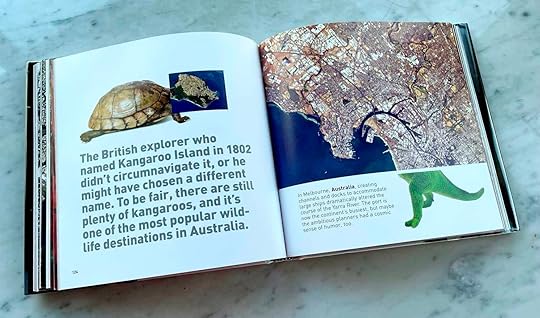
The book "You are here" has a striking collection of photographs of Earth’s surface, captured by Chris Hadfield from aboard the International Space Station. In spirit, it reminded me of Infinite Wonder by Scott Kelly, though here the images are thoughtfully organized by continent - though, without representation from the Arctic or Antarctic. Alongside the photographs, Hadfield provides text that not only contextualizes each shot but also explains the natural phenomena - whether a cloud formation or a terrestrial pattern - that shaped the view. The inclusion of a map pinpointing each photograph’s location at the end is a particularly thoughtful touch, helping to orient the viewer in both geography and scale.
As a photographer, I couldn’t help noticing that a few images were slightly out of focus, and some were marred by overlaid text in contrasting colors that distracted from the visual impact. Still, the book succeeds in offering a sense of wonder at the planet’s beauty, as seen from a vantage point few of us will ever experience.
You are Here by Chris Hadfield (4 stars) is a collection of Canadian astronaut Hadfield's favourite images from his time spent on the International Space Station.
During his 2597 orbits of Planet Earth, Astronaut Chris Hadfield took 45000 photographs. Hadfield is able to show us aeriel views that depict the beauty of Earth. Most of the images within the pages have never been shared through Hadfield's popular Twitter feed, giving the reader a new look at our planet. Hadfield is able the share his love of geology and geography as he reveals the mysteries behind some of Earth's wonders. I really enjoyed his charisma and wit throughout the book.
You Are Here is divided into sections based on continent yet, the whole book flows like one orbit of the ISS around Earth. Some photos depict intricate detail that one can only see from up above. I wish that with some of the photos, there was more editorial content accompanying instead of a one-line tidbit. You are Here is a playful and visually stunning planetary tour of Earth that really shows us how a picture can really be worth a thousand words.
You Are Here is a gorgeous, coffee table book about our wonderful planet. I look forward to reading Hadfield's An Astronaut's Guide to Life on Earth later this month!
I'll be honest, I don't usually read the text in these art- or photography-based books but with this one I was really interested in what Commander Hadfield had to say.
Hadfield does make some good observations about the images but I found that I would have liked more text than there was. For each photograph there was only a small snippet explaining what it was and I would have liked more detail. Having said that, the photographs were unique and gave a unique view of the world. This is definitely more a coffee table book than an in-depth study of the images but I still really enjoyed it and will be revisiting the images from time to time.
I love the way author presented his works. So grateful to have such works. Every images taught me recollect my thoughts and experience different things; How feeble we actually are; How drastically we're changing the geography of our beautiful home; And in some places, how blessed we're to get such views to look at our Pale Blue dot. Gave me a lot of historical information as well like 28000 year old civilisations in Australia. Not too much technical though and that's why I feel like everyone can enjoy the work and admire our only home, we've got so far. "You're here, we all are, for life. Let's get to know the place a little better."
Another book I found up in a cabin and it did not disappoint! I felt so small flipping through its pages, in awe of Earth and its many landmarks seen from space. This held photographs of our landscapes, which are etched with footprints of our culture and history, taken miles and miles away! It’s inspiring to think: these were the views seen by astronauts as they stared out of the ISS.
I kept this out of the library as long as I could and might just buy a copy. It's a gorgeous book and a great, different perspective of our planet. Chris Hadfield's descriptions and interludes are entertaining and informative.
A quick read with some gorgeous photography. I actually followed the author while posting to social media during his time in space and he's right, in one of his comments in the book, the photos do look even more spectacular printed out than the did on the computer screen.
Honestly such nice pictures of the planet but I really loved that each picture had an explanation. Super interesting to see earth from a different perspective.
Când sunt în avion, îmi place să stau la geam și nu mă plictisesc niciodată de spectacolul de dedesubt: orașele luminate noaptea, parcelele cu lanuri colorate, formele orașelor, munții, cu 2-3 km mai aproape decât restul decorului, zborul ocazional peste vreun vulcan, soarele reflectat în parbrizul vreunei mașini cât un purice pe vreun drum, singura dovadă că jos există un furnicar de viață. Motiv pentru care mi-a plăcut teribil albumul foto al colonelului Chris Hadfield, “You Are Here: Around the world in 92 minutes“, cu imagini ale Pământului, așa cum se vede de pe Stația Spațială Internațională (ISS), al cărei comandant a fost pe durata expediției 34/35, dec. 2012 – mai 2013.
Fotografiile, alături de scurtele filme educative pe care le publica aproape zilnic, au fost elementul care a stâns atâta admirație și i-a adus atâta popularitate astronautului canadian. Deși știm că deasupra noastră dă ture de câteva ori pe zi (16, mai precis) un laborator spațial (luminiță insignifiantă pe cerul nopții), nu concretizăm neapărat și faptul că acolo sunt 4-5 oameni care se uită în jos la noi (când au timp, că nu se duc să caște gura pe geam) și văd planeta în toată splendoarea ei de natură moartă și vie în același timp.
Albumul începe cu un cuvânt înainte din partea colonelului Chris Hadfield (despre autobiografia căruia, Ghidul unui astronaut despre viața pe pământ, v-am vorbit recent), care ne amintește de primul ocol al Pământului, început de Magellan în 1519 și terminat trei ani mai târziu, după moartea sa (o lecție de geografie și istorie, care ne învață și cât de fain e să fii pionier, explorator, deschizător de drumuri, dar și ce sfârșit trist poți avea când încerci să convertești la creștinism o căpetenie filipineză numită Lapu-Lapu). 500 de ani mai târziu, ISS dă ocol Pământului în 92 de minute, făcând 16 ture pe zi. Deși NASA nu alocă timp pozatului, un management eficient al agendei de lucru permite astronauților să își facă timp pentru această distracție fascinantă, așa că după cele 2597 de orbite executate în 5 luni de misiune, colonelul s-a întors acasă cu 45.000 de fotografii din spațiu. (continuarea cronicii: http://www.bookaholic.ro/te-afli-aici...)
I loved the photos of known and unknown locations shown from the unique perspective of space. Also really enjoyed Hadfield's whimsical side with his inclusion of pareidolia, the ability to see shapes in clouds and landforms. The book provides great insight into the impact of natural phenomena and the consequences of human settlement.There are striking photos of Australia that have resulted in me buying several copies to leave as gifts to old and new friends we encounter on an upcoming trip to down-under. I am also keeping a few in reserve to give as gifts for 'significant' birthdays. Just turning 60, I found this book provided me lots of opportunities for introspection on my place is this magnificent world.