

What do you think?

The Puma Blues #1-2
The Puma Blues: The Complete Saga in One Volume
"Intelligent and urgent mythology for the end of the millennium." — Neil Gaiman
"Now that it's done, The Puma Blues can take its rightful place alongside the period's other great monuments, such as Alan Moore's From Hell and Neil Gaiman's Sandman . Without it, any well-stocked comics library should be considered incomplete." — A.V. Club
"Absolutely outstanding art by Zulli. The visuals are eye-popping." — Publishers Weekly
Out of print for nearly 25 years and one of Rolling Stone 's Top 50 Non-Super Hero graphic novels of all time, The Puma Blues is a series of interrelated stories that visualize life at the turn of the 21st century as a world of mutated animals, in which a lone government agent investigates the truth behind environmental degradation. Written by Stephen Murphy, the most prolific Teenage Mutant Ninja Turtles author of all time, and illustrated by Michael Zulli, artist on many of the most popular Sandman comics , The Puma Blues unveils "a near-future world kissed by terrorist assaults…and the threat of ecological ruin. Zulli's wildlife art is utterly breathtaking." — The Comics Journal. "If you want to see a book with truly amazing art that challenges the constructs of illustrated fiction, look no further." — Cleveland.com. Suggested for mature readers.
Exclusive Bonus
• New forty-page ending by original creators
• Hard-to-find The Puma Blues mini-comic
• New Introduction by Dave Sim, legendary creator of Cerebus
• New Afterword by Stephen R. Bissette, acclaimed artist on Swamp Thing
• Four-page The Puma Blues story by Alan Moore ( Watchmen, V for Vendetta )
"Now that it's done, The Puma Blues can take its rightful place alongside the period's other great monuments, such as Alan Moore's From Hell and Neil Gaiman's Sandman . Without it, any well-stocked comics library should be considered incomplete." — A.V. Club
"Absolutely outstanding art by Zulli. The visuals are eye-popping." — Publishers Weekly
Out of print for nearly 25 years and one of Rolling Stone 's Top 50 Non-Super Hero graphic novels of all time, The Puma Blues is a series of interrelated stories that visualize life at the turn of the 21st century as a world of mutated animals, in which a lone government agent investigates the truth behind environmental degradation. Written by Stephen Murphy, the most prolific Teenage Mutant Ninja Turtles author of all time, and illustrated by Michael Zulli, artist on many of the most popular Sandman comics , The Puma Blues unveils "a near-future world kissed by terrorist assaults…and the threat of ecological ruin. Zulli's wildlife art is utterly breathtaking." — The Comics Journal. "If you want to see a book with truly amazing art that challenges the constructs of illustrated fiction, look no further." — Cleveland.com. Suggested for mature readers.
Exclusive Bonus
• New forty-page ending by original creators
• Hard-to-find The Puma Blues mini-comic
• New Introduction by Dave Sim, legendary creator of Cerebus
• New Afterword by Stephen R. Bissette, acclaimed artist on Swamp Thing
• Four-page The Puma Blues story by Alan Moore ( Watchmen, V for Vendetta )
576 pages, Hardcover
First published September 16, 2015
About the author
Stephen Murphy
133 books8 followersStephen Murphy is an American comic book writer and editor known for his work on the Teenage Mutant Ninja Turtles series. With Michael Zulli, he was co-creator of the critically acclaimed 1980s independent comic The Puma Blues.
Pseudonyms: Dean Clarrain, J.D. Vollman.
Pseudonyms: Dean Clarrain, J.D. Vollman.
Ratings & Reviews
Friends & Following
Create a free account to discover what your friends think of this book!
Community Reviews
Displaying 1 - 30 of 43 reviews
November 27, 2025
Stick THAT in your Comic Art Metaphysic pipe and smoke it!
Dave Sim – creator of Cerebus, independent publisher, first sponsor of this series
You don’t need to be an environmentalist in order to appreciate the intelligent, poetic writing of Stephen Murphy or the ‘utterly breathtaking’ artwork of Michael Zulli, but it does help. Puma Blues is probably one of the best adult comics that you never heard of. At least I didn’t, until it came up in my Goodreads feed with a posting from a friend.
The project’s small run and publishing woes, coupled with its experimental narrative and adult oriented material, the lack of superheroes or of scantily clad heroines ensured its relative obscurity. It’s overt political engagement and its lengthy introspective existential musings added to the perception of a difficult read.
I can’t say I enjoyed every single panel of this 559 page black & white album or that I wasn’t occasionally baffled by the mix of urban terrorism, natural tranquillity, aliens, dream sequences, soul searching and nuclear experiments commentary. I am sure a second reading would elevate the book to a five star rating, because there is enough food for thought in here for a dozen more books on the subject.
It’s not easy to do a synopsis. I am not sure it is even helpful in explaining my interest in both the words and the artwork. But a little context is probably welcome: the first issues of Puma Blues appeared in 1985. The events described take place in a futuristic 1997 and onward, in the aftermath of a terrorist nuclear blast in Bronx that predates 9/11 concerns. Accelerated climate change and loss of biodiversity are mirrored in sanity and responsibility questions about humanity.
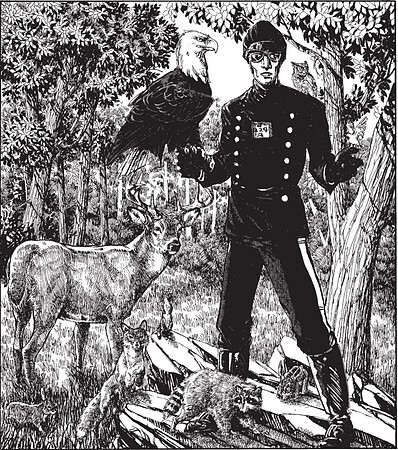
The two central figures of the book are a man and an animal. Gavia Immer, a soldier detached to the Quabbin Reservoir in Massachusetts, is tasked to monitor the closed ecosystem and to identify aberrant wildlife, which he then teleports with a special rifle into secret government laboratories.
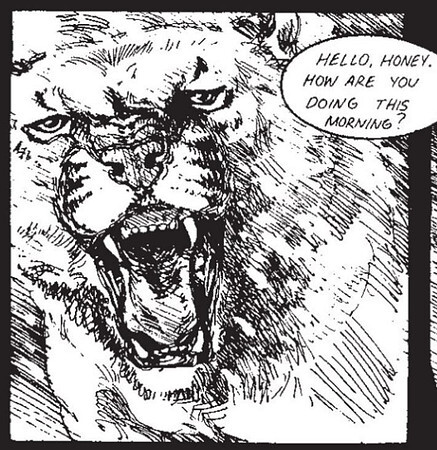
The lake shores are patrolled by a puma, a species that was considered extinct in the territory. Immer and the mountain lion never cross paths – an alienation between man and nature that is the backbone of the whole project.
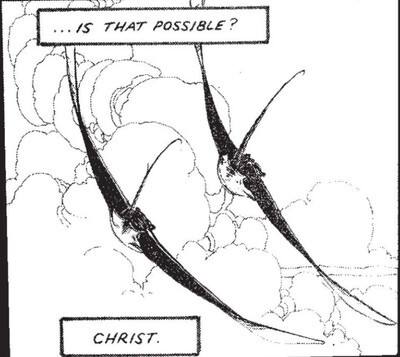
There’s a lot more to the story, but I don’t want to get into details, including about its emblematic flying manta rays. My own angst about what we are doing to the planet and about the corruption of public discourse by politics and business concerns would drive me to write many angry words in this review, like these:
We All Knew! The suffering of our planet is on our shoulders. Major environmental issues were raised as far back as the 1970s when I was a teen. We did nothing! Just as we do nothing today, when the stakes are much clearer, and much more urgent.
Murphy and Zulli do a much better job that I ever could. I hope their work is kept in print and rediscovered by a new generation of readers. The poems scattered between images are also worth saving.
Sense of loss
Sense of gain
Sense of balance
Sense of pain
Trail of words
Trail of tears.
This reservoir of longing.
Concert for an aching violin.
Dave Sim – creator of Cerebus, independent publisher, first sponsor of this series
You don’t need to be an environmentalist in order to appreciate the intelligent, poetic writing of Stephen Murphy or the ‘utterly breathtaking’ artwork of Michael Zulli, but it does help. Puma Blues is probably one of the best adult comics that you never heard of. At least I didn’t, until it came up in my Goodreads feed with a posting from a friend.
The project’s small run and publishing woes, coupled with its experimental narrative and adult oriented material, the lack of superheroes or of scantily clad heroines ensured its relative obscurity. It’s overt political engagement and its lengthy introspective existential musings added to the perception of a difficult read.
I can’t say I enjoyed every single panel of this 559 page black & white album or that I wasn’t occasionally baffled by the mix of urban terrorism, natural tranquillity, aliens, dream sequences, soul searching and nuclear experiments commentary. I am sure a second reading would elevate the book to a five star rating, because there is enough food for thought in here for a dozen more books on the subject.
It’s not easy to do a synopsis. I am not sure it is even helpful in explaining my interest in both the words and the artwork. But a little context is probably welcome: the first issues of Puma Blues appeared in 1985. The events described take place in a futuristic 1997 and onward, in the aftermath of a terrorist nuclear blast in Bronx that predates 9/11 concerns. Accelerated climate change and loss of biodiversity are mirrored in sanity and responsibility questions about humanity.
The two central figures of the book are a man and an animal. Gavia Immer, a soldier detached to the Quabbin Reservoir in Massachusetts, is tasked to monitor the closed ecosystem and to identify aberrant wildlife, which he then teleports with a special rifle into secret government laboratories.
The lake shores are patrolled by a puma, a species that was considered extinct in the territory. Immer and the mountain lion never cross paths – an alienation between man and nature that is the backbone of the whole project.
There’s a lot more to the story, but I don’t want to get into details, including about its emblematic flying manta rays. My own angst about what we are doing to the planet and about the corruption of public discourse by politics and business concerns would drive me to write many angry words in this review, like these:
We All Knew! The suffering of our planet is on our shoulders. Major environmental issues were raised as far back as the 1970s when I was a teen. We did nothing! Just as we do nothing today, when the stakes are much clearer, and much more urgent.
Murphy and Zulli do a much better job that I ever could. I hope their work is kept in print and rediscovered by a new generation of readers. The poems scattered between images are also worth saving.
Sense of loss
Sense of gain
Sense of balance
Sense of pain
Trail of words
Trail of tears.
This reservoir of longing.
Concert for an aching violin.

October 8, 2024
کمیک پوما بلوز روی چند ساله که توی لیستهای مختلف یا مقالهها میبینم و معمولا ازش به عنوان یکی از بهترین کمیکهای غیر سوپرهیرویی یاد میشه. حتی کسایی مثل آلن مور و نیل گیمن هم بارها به تاثیر این کمیک روی خودشون اشاره کردن و این باعث میشه تصور کنم حداقل غیرمستقیم روی خیلی چیزهای دیگه هم تاثیر داشته. این هفته فرصت کردم بخونمش و میتونم بگم راضی بودم. کمیک جالبیه که اتفاقاتش توی سال ۲۰۰۰ میگذره، بعد از اینکه نیویورک توی یک حملهی تروریستی/اتمی کامل نابود شده. حالا شخصیت اصلی داستان توی (احتمالا)یک منطقهی حفاظت شده زندگی میکنه و شغلش اینه که به حیوونهایی که به خاطر تغییرات طبیعت جهش یافته شدن شلیک کنه و اونها رو به یک محیط دیگه بفرسته.
بیشتر این کمیک یک استیتمنته برای اینکه ما به عنوان انسان چه بلایی سر طبیعت اوردیم و اصلا خودمون و نژادمون اونقدر مهمی نیستیم، پس حق نداریم اینقدر وحشیانه رفتار کنیم به نسبت همه چیز. داستانش هم خیلی جاها به سمت رئالیسم جادویی میره، مرز بین واقعیت و تخیل اونقدر مشخص نیست. همین باعث میشد خوندنش خیلی سخت بشه، من بخشهای زیادی از داستان یا مفهوم پشتش رو نمیفهمیدم. به نظرم یک بخش از این غیرقابل فهم بودنش برمیگرده به اینکه حدود چهل سال پیش منتشر شده و اون موقع هنوز یکسری از روشهای روایت و طراحی توی کمیک به تکامل نرسیده بودن. شاید اگه الان سعی میکردن بنویسنش این اتفاق نمیافتاد.
در کل خیلی تجربهی خوندن خوبی بود. پوما بلوز شبیه یک تیکه از پازله که اگه نباشه بقیهی بخشها ممکنه درست به نظر نیان. طراحیهاش تاثیرگذار بودن و از بیشتر هم نسلهاش یک سر و گردن بالاتره.
بیشتر این کمیک یک استیتمنته برای اینکه ما به عنوان انسان چه بلایی سر طبیعت اوردیم و اصلا خودمون و نژادمون اونقدر مهمی نیستیم، پس حق نداریم اینقدر وحشیانه رفتار کنیم به نسبت همه چیز. داستانش هم خیلی جاها به سمت رئالیسم جادویی میره، مرز بین واقعیت و تخیل اونقدر مشخص نیست. همین باعث میشد خوندنش خیلی سخت بشه، من بخشهای زیادی از داستان یا مفهوم پشتش رو نمیفهمیدم. به نظرم یک بخش از این غیرقابل فهم بودنش برمیگرده به اینکه حدود چهل سال پیش منتشر شده و اون موقع هنوز یکسری از روشهای روایت و طراحی توی کمیک به تکامل نرسیده بودن. شاید اگه الان سعی میکردن بنویسنش این اتفاق نمیافتاد.
در کل خیلی تجربهی خوندن خوبی بود. پوما بلوز شبیه یک تیکه از پازله که اگه نباشه بقیهی بخشها ممکنه درست به نظر نیان. طراحیهاش تاثیرگذار بودن و از بیشتر هم نسلهاش یک سر و گردن بالاتره.
December 19, 2015
Very satisfying to read the new, completed edition of this gorgeously illustrated, out-of-left-field comic series that haunted and perplexed me as a teenager. Environmental catastrophe, metaphysical speculations, nuclear terrorism, mutated flying manta rays. Ah, youth.

March 17, 2016
Wasn't sure what to expect, and I'm still not 100% sure what I think, but I know I enjoyed the hell out of this hefty saga. A bit of a 1980s time machine but (sadly) the themes of environmental and social breakdown are just as relevant now as they were then. The art is amazing (especially the flying manta rays!) and the delicate play between the shifting and turning narrative and the art gives the book the tension that it needs to keep moving the reader along. A post-disaster future / past / present with dead fathers resurrected on VHS and "extinct" pumas waiting humanity out. So much to think about here, meatpies... Thanks for suggesting this one, Joe!

November 21, 2015
Sitting in my comic book collection under four feet of dust is an autographed copy of "Watch That Man," the first volume of Puma Blues. Elsewhere in the house are a handful of other, loose issues. Until "Finder" came out, it was, by miles, the best comic book I ever read, and I would eagerly shove copies before the noses of everyone within spit distance: "YOU MUST READ THIS REVELATORY TEXT."
I arrived at it the way most of its readers did - hopscotching through various indie comix in the rummage bins of the local retailer, from Spider-Man to TMNT to Cerebus to Usagi Yojimbo to the point where it was as if the entire medium was saying, "Okay, now that I have your attention, let's show you what we can really do." So, of course, having heard that the story had been completed and compiled thirty years after the fact, I jumped up and down on the counter of my local retailer and started making eager sounds of the sort only heard from jungle animals on the move.
These are strange times to read "The Puma Blues." When howling politicians are calling for entire ethnic classes to be rounded up, when the last of the glaciers are turning into salty slush puppies, in the midst of a surveillance state more concerned with selling you stuff than oppressing you, "The Puma Blues" is both a quaint throwback to 1986 eco-narrative and more timely than ever.
It's impossible to read it without putting your brain where it was the first time you saw it, and then meditating on the weight of the subsequent twenty-mumble years. I read it and I'm eighteen again, and then I look in the mirror and jump. Now I need to find someone within spit distance and shove it under their noses.
I did ignore most of the tiresome introduction by Dave Sim, who's grown somewhat ossified in his dotage, and which amounts mostly to a massive unsupported "No, you." What I did read of it was so lonely and desperate that I just couldn't finish, a rictus grin of "EVERYTHING'S PERFECTLY NORMAL! I'M FINE! I'M COMPLETELY HAPPY!" masking some illusion of inner peace. Poor bastard doesn't even realize that the arc of the book gives him a role; he's the Contrarian, the AGW denier who has nothing more than a game "No, it isn't" when confronted with the mountain of evidence that yes, it is.
I arrived at it the way most of its readers did - hopscotching through various indie comix in the rummage bins of the local retailer, from Spider-Man to TMNT to Cerebus to Usagi Yojimbo to the point where it was as if the entire medium was saying, "Okay, now that I have your attention, let's show you what we can really do." So, of course, having heard that the story had been completed and compiled thirty years after the fact, I jumped up and down on the counter of my local retailer and started making eager sounds of the sort only heard from jungle animals on the move.
These are strange times to read "The Puma Blues." When howling politicians are calling for entire ethnic classes to be rounded up, when the last of the glaciers are turning into salty slush puppies, in the midst of a surveillance state more concerned with selling you stuff than oppressing you, "The Puma Blues" is both a quaint throwback to 1986 eco-narrative and more timely than ever.
It's impossible to read it without putting your brain where it was the first time you saw it, and then meditating on the weight of the subsequent twenty-mumble years. I read it and I'm eighteen again, and then I look in the mirror and jump. Now I need to find someone within spit distance and shove it under their noses.
I did ignore most of the tiresome introduction by Dave Sim, who's grown somewhat ossified in his dotage, and which amounts mostly to a massive unsupported "No, you." What I did read of it was so lonely and desperate that I just couldn't finish, a rictus grin of "EVERYTHING'S PERFECTLY NORMAL! I'M FINE! I'M COMPLETELY HAPPY!" masking some illusion of inner peace. Poor bastard doesn't even realize that the arc of the book gives him a role; he's the Contrarian, the AGW denier who has nothing more than a game "No, it isn't" when confronted with the mountain of evidence that yes, it is.
March 25, 2016
I stumbled on this bound collection looking for graphic novels not centered around superheroes. Luckily someone else more in the know recommended The Puma Blues. It is one of those works that shows how often neglected the potential for comics to show a vast range of thematic and stylistic elements. The Puma Blues is, in other words, a comic that can only exist as a comic. Any attempt to translate it into another medium would diminish its power. I couldn't recommend it more.

May 11, 2016
This book is a combination of a morality play and a future ecological mythography. Even though the specific details in this imagining are not always correct (and how could they be given the nature of chaotic systems), the over-arching theme of environmental degradation is happening before our eyes, and it's depiction here is heartbreaking. Zulli's nature artwork is gorgeous, particularly the depiction of the various animals, although I find his humans to be kind of grotesque. That might be deliberate on his part, contrasting the damage humans have done to the biosphere, with its natural beauty.
There are aspects of his narrative that are troubling. He depicts one of the four horse of the apocalypse wearing a cap with the letters 'GMO', which unfortunately feeds into an all too common anti-science attitude of people concerned with environmental issues, food, and nutrition, and this is one area where I strongly differ with the average left-wing position. Given this was written 20 to 30 years ago, I suppose Zulli can be forgiven, but ideologically and simplistically classifying a technology as essentially evil is short sighted and can actually work against our ability to adapt to the changing climate.
Dave Sim proves himself an asshole, as if we needed another reminder, with his self-righteous and tiresome attacks against climate science. He seems to believe that because his is a successful author, that therefore his ignorant opinion, and unoriginal denial of the reality of climate change is better than the scientific body of work that has been put together by actual scientists who actually study climate, a body of work that has been building for at least the last 50 years.
There are aspects of his narrative that are troubling. He depicts one of the four horse of the apocalypse wearing a cap with the letters 'GMO', which unfortunately feeds into an all too common anti-science attitude of people concerned with environmental issues, food, and nutrition, and this is one area where I strongly differ with the average left-wing position. Given this was written 20 to 30 years ago, I suppose Zulli can be forgiven, but ideologically and simplistically classifying a technology as essentially evil is short sighted and can actually work against our ability to adapt to the changing climate.
Dave Sim proves himself an asshole, as if we needed another reminder, with his self-righteous and tiresome attacks against climate science. He seems to believe that because his is a successful author, that therefore his ignorant opinion, and unoriginal denial of the reality of climate change is better than the scientific body of work that has been put together by actual scientists who actually study climate, a body of work that has been building for at least the last 50 years.

July 7, 2015
The main thing you need to know about this book is that I am mentioned in the acknowledgments. BECAUSE I AM AWESOME.

April 28, 2016
an indescribably beautifull book. Rob Bateman has got nothing on Mike Zulli when it comes to animals and nature. fluid and full of life, meticulously detailed and simply transcendent.
the story itself, which can't be divorced from the visuals is insightful and introspective, ambitious and experimental. it is at times transcendent and poetic but the narrative and purpose sometimes get choked by its own metaphoric acid rain and environmental doom.
wonderful layers of ideas, and concepts as relates to the planetary environment, animal extinction, evolution, man's hubris and destructive nature.
some segments very much induced in me the kind of existential terror, righteous anger and paranoia the main character suffers thru.
an excellent book, not perfect but it aims so high and that deserves praise.
that they did this book for the love of the art form and for the need to communicate is all too rare,
but it is exactly what all artists should strive for and make part of their practice.
an essential book for comic/graphic literature, sequential art.....whatever.... get it. it's amazing. the world is dying.
read this.
the story itself, which can't be divorced from the visuals is insightful and introspective, ambitious and experimental. it is at times transcendent and poetic but the narrative and purpose sometimes get choked by its own metaphoric acid rain and environmental doom.
wonderful layers of ideas, and concepts as relates to the planetary environment, animal extinction, evolution, man's hubris and destructive nature.
some segments very much induced in me the kind of existential terror, righteous anger and paranoia the main character suffers thru.
an excellent book, not perfect but it aims so high and that deserves praise.
that they did this book for the love of the art form and for the need to communicate is all too rare,
but it is exactly what all artists should strive for and make part of their practice.
an essential book for comic/graphic literature, sequential art.....whatever.... get it. it's amazing. the world is dying.
read this.

November 21, 2016
The Puma Blues is one of those comics that I always meant to read, but never got around to. I remember positive buzz back when it first started coming out, and the fact that it's one of very few non-Cerebus titles published by Dave Sim's Aardvark-Vanaheim deserves some recognition. In the end, though, it's not quite my cup of tea.
It's a difficult series to sum up. It's set in the future, or at least what was then the future back when it was published. It's set in 1997, but was written back in 1985, so obviously there are details that Murphy and Zulli got wrong. The story focuses on Gavia Immer, who works for the government, minding a reservoir/nature preserve, monitoring wildlife, capturing specimens (via a sort of raygun affair that teleports them to a collection point), and sifting through memories of his father. As Murphy himself (quoted in Stephen Bissette's Afterword) puts it, "Gavia spends all of his time at the Quabbin [Reservoir], drinking beer ... angst ridden and riddled with anxiety ... isolated in a cabin. There's a puma shadowing him but he never sees it. He has a box of videotapes made by his father, in which his father sort of explains the state and secret history of the world. Gav spends all of his time watching them and drinking beer." There are these flying manta ray things at the Reservoir that the public apparently isn't supposed to know about. There's a strong environmental message throughout the whole series. There isn't really a strong plot. Things happen, sure, but the main appeal of the series is the mood and exploration of Immer's state of mind. There's an entire issue with no dialogue, just nature sounds.
The early issues are a bit on the clumsy side. You can see both Murphy and Zulli improving as the series progresses. I found myself occasionally getting bored by overwritten captions and oblique storytelling. Ultimately, it's very much a product of its time, and, while I enjoyed reading it, I don't think I'll be in a hurry to do so again. The creators have created a new ending for the series, and the book is rounded out by a Puma Blues minicomic, and a story written by Alan Moore that originally appeared in issue 20 of the series. There's also an introduction by Dave Sim, and an afterword by Stephen Bissette, both of which are worth reading. As comics history, this is an impressive book. As reading material ... it depends on you. I liked it, but didn't love it. Worth reading, but your mileage may vary.
It's a difficult series to sum up. It's set in the future, or at least what was then the future back when it was published. It's set in 1997, but was written back in 1985, so obviously there are details that Murphy and Zulli got wrong. The story focuses on Gavia Immer, who works for the government, minding a reservoir/nature preserve, monitoring wildlife, capturing specimens (via a sort of raygun affair that teleports them to a collection point), and sifting through memories of his father. As Murphy himself (quoted in Stephen Bissette's Afterword) puts it, "Gavia spends all of his time at the Quabbin [Reservoir], drinking beer ... angst ridden and riddled with anxiety ... isolated in a cabin. There's a puma shadowing him but he never sees it. He has a box of videotapes made by his father, in which his father sort of explains the state and secret history of the world. Gav spends all of his time watching them and drinking beer." There are these flying manta ray things at the Reservoir that the public apparently isn't supposed to know about. There's a strong environmental message throughout the whole series. There isn't really a strong plot. Things happen, sure, but the main appeal of the series is the mood and exploration of Immer's state of mind. There's an entire issue with no dialogue, just nature sounds.
The early issues are a bit on the clumsy side. You can see both Murphy and Zulli improving as the series progresses. I found myself occasionally getting bored by overwritten captions and oblique storytelling. Ultimately, it's very much a product of its time, and, while I enjoyed reading it, I don't think I'll be in a hurry to do so again. The creators have created a new ending for the series, and the book is rounded out by a Puma Blues minicomic, and a story written by Alan Moore that originally appeared in issue 20 of the series. There's also an introduction by Dave Sim, and an afterword by Stephen Bissette, both of which are worth reading. As comics history, this is an impressive book. As reading material ... it depends on you. I liked it, but didn't love it. Worth reading, but your mileage may vary.

May 15, 2018
I really wanted to like this book. Dover assembled a very handsome package, and even in this very early incarnation, Zulli's such a terrific artist. Alas, the story is impenetrably rambling and unfocused. The wildlife interludes are far more interesting and compelling than anything seen in the characters.
Maybe it gets better after 150 pages, if you can stick it out.
Maybe it gets better after 150 pages, if you can stick it out.

November 9, 2019
This is one of those artsy independent comics that I think are just over my head. The Michael Zulli artwork is awesome, really light years ahead of most independent black and white comic art of the 80s. The story, while ambitious, lost me. There's a heavy theme of environmentalism and there is also a major plot thread involving the main characters relationship with his father, but there's also a ton of existentialism.
The story is set in a bleak future where a nuclear explosion destroys the Bronx, and the fallout wreaks havoc on the world's ecosystem. A colony of flying manta rays which live outside of the ocean becomes a secret that most be kept at any cost, I assume because it shows just how badly nature has been screwed up.
When the series first started, the storyline was fairly linear and there was great world building and I saw a ton of potential. Then things slowly started falling apart as the story became more experimental.
This book is fairly polarizing because some feel it's truly a work of genius to be recorded in the annals of high literature, while others (such as myself) find it a little too existential and experimental. But when you analyze that, that's true of several novels that are considered high marks of literature (Kafka, Burroughs, etc.)
So overall, I did try, and I loved the artwork so I don't see this as a waste of time. If you enjoy your stories with wild imagery and poetic descriptions and aren't overly concerned with linear storytelling this is for you. If you're a big fan of Michael Zulli and don't mind reading just for the art, this would be for you as well. If you like more traditional graphic novels, however, this one isn't for you.
In conclusion I can't help but feel like I'm missing something with this one and it's probably better than I think, but I just couldn't get into it.
The story is set in a bleak future where a nuclear explosion destroys the Bronx, and the fallout wreaks havoc on the world's ecosystem. A colony of flying manta rays which live outside of the ocean becomes a secret that most be kept at any cost, I assume because it shows just how badly nature has been screwed up.
When the series first started, the storyline was fairly linear and there was great world building and I saw a ton of potential. Then things slowly started falling apart as the story became more experimental.
This book is fairly polarizing because some feel it's truly a work of genius to be recorded in the annals of high literature, while others (such as myself) find it a little too existential and experimental. But when you analyze that, that's true of several novels that are considered high marks of literature (Kafka, Burroughs, etc.)
So overall, I did try, and I loved the artwork so I don't see this as a waste of time. If you enjoy your stories with wild imagery and poetic descriptions and aren't overly concerned with linear storytelling this is for you. If you're a big fan of Michael Zulli and don't mind reading just for the art, this would be for you as well. If you like more traditional graphic novels, however, this one isn't for you.
In conclusion I can't help but feel like I'm missing something with this one and it's probably better than I think, but I just couldn't get into it.

March 7, 2020
I’d heard such good things about this, loved the artwork and thought it would be a meaty and insightful novel. Unfortunately I found it quite slow, wandering and quite honestly a bit pretentious as a narrative. The plot arc could have been done in 1/5 the size without any less detail... shame as I really did want to like it!

January 13, 2023
A testament to the fact that just because something is elaborate does not mean it is good.
The text is largely incoherent. Stream of consciousness does not fit fell into the comic book format. All the characters seem to be a vague middle age no matter how old they are supposed to be, the women of color feel exoticized and objectified, the main character is deeply unlikeable (in a hard-to-read way, not the compelling way). None of it made any sense! Until near the end, that is. The brief glimpse of actually compelling writing toward the end of the volume reinforced my disappointment tenfold. You mean the writing could have been decent this whole time??
This is not to say that the message is not important. Talking about apocalypse might be the only way to scare some people into caring. But the nihilistic tone, insufferable lead character, and incomprehensible story itself obscures and frustrates the message at every possible turn. This tome is not the proper vehicle for the message it carries. It feels like trying to transport a chicken egg by rolling it downhill in a hamster ball.
Maybe the Puma Blues is really for the people it is for, but it really isn't for me. If anyone has better recommendations for eco-fiction, I will gladly take them.
The text is largely incoherent. Stream of consciousness does not fit fell into the comic book format. All the characters seem to be a vague middle age no matter how old they are supposed to be, the women of color feel exoticized and objectified, the main character is deeply unlikeable (in a hard-to-read way, not the compelling way). None of it made any sense! Until near the end, that is. The brief glimpse of actually compelling writing toward the end of the volume reinforced my disappointment tenfold. You mean the writing could have been decent this whole time??
This is not to say that the message is not important. Talking about apocalypse might be the only way to scare some people into caring. But the nihilistic tone, insufferable lead character, and incomprehensible story itself obscures and frustrates the message at every possible turn. This tome is not the proper vehicle for the message it carries. It feels like trying to transport a chicken egg by rolling it downhill in a hamster ball.
Maybe the Puma Blues is really for the people it is for, but it really isn't for me. If anyone has better recommendations for eco-fiction, I will gladly take them.

August 25, 2018
Originally read this work as it was published in the 80's, each issue after the first deeply anticipated. The work resonated with my younger moody self. The world is ending for life as we know it by our own doing. I've known even as a child, schooled by early television environmentalists such as Jacques Cousteau and that weepy Italian Indian, Iron Eyes Cody. "Puma Blues" acknowledged the ugly fact of this, projected it into a future, and made gorgeous art of it.
The only publication I ever sent a complimentary letter to, back when doing so required paper and postage. They published it. I was quite touched. Later, when a character with my first name appeared in the story, I liked to think it was as an acknowledgement of my devotion. Probably just hubris on my part.
The collected edition is wonderful. All I remember is there. The newer material is great as well, though it doesn't feel an organic extension of the prior story. The attempt to blend the real happenings of our future with the events of the fictional future envisioned in the 1980's just jarred me a bit.
Read this if you haven't. It's had a hold of me ever since I first encountered it.
The only publication I ever sent a complimentary letter to, back when doing so required paper and postage. They published it. I was quite touched. Later, when a character with my first name appeared in the story, I liked to think it was as an acknowledgement of my devotion. Probably just hubris on my part.
The collected edition is wonderful. All I remember is there. The newer material is great as well, though it doesn't feel an organic extension of the prior story. The attempt to blend the real happenings of our future with the events of the fictional future envisioned in the 1980's just jarred me a bit.
Read this if you haven't. It's had a hold of me ever since I first encountered it.

February 16, 2026
that was certainly... something

April 13, 2023
5 stars for the art, 1 for the plot. The nature and animal drawings are phenomenal, the plot is incoherent and rambling. I’m sure this is Art, but maybe I’m just too tired of bleak things to appreciate it.

July 27, 2018
I had a hard time getting into this but enjoyed it once I did get into it.
July 4, 2024
An heartfelt, gorgeous and insightful work, but also a frustrating one.
One of the main aspects to keep in mind when reading this book is that The Puma Blues was a comic series first, specifically an independent comic series that faced several publishing hazards and was ultimately left unfinished. That is, up until the conclusion created for this very volume.
And unfortunately, the fact that the original run of the series was held back and cut short is quite apparent in the complete book format. If you're expecting a consistent narrative all the way through, you're bound for disappointment.
At first it does seem like there is an overarching narrative and set of characters for us to follow along, but eventually the focus shifts entirely to the single main character's stream of consciousness, ramblings and misadventures. This portion works great as a standalone comic but it is almost completely detached from the first half of The Puma Blues, to the point you could change the name of the main character and it would seem like a different series altogether, only done by the same creative team.
The new 40 page conclusion is even more detached. It follows from the events of the latter portion of the series, with the stream-of-consciousness of the protagonist still serving as narration, but writer Stephen Murphy makes no attempt to continue from where he left off. There is an immediate timeskip and an acknowledgement of how the real world progressed in comparison to the hypothetical future established in the 80's by the early issues. The art, although still done by the remarkable Michael Zulli and great in its own way, is also noticeably different from Zulli's 80's and 90's style. That's completely fine, Zulli had no obligation to keep to a style he used 20 years earlier, but it adds to the detachment of the conclusion from the rest of the work.
Overall, the setting, style and tone change so much that I find it hard to believe Murphy and Zulli would have done anything similar to this if they managed to conclude the series in the original timeframe. As such, Puma Blues works as an expression of the creators' evolving mindset and growth throughout the years, but it doesn't work as a narrative.
With that out of the way, the beauty in this book is undeniable.
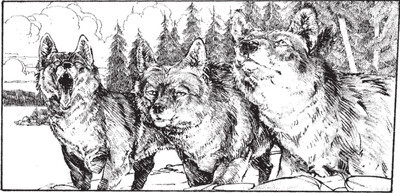
Perhaps the best way to describe it is as "comic poetry". There are entire wordless sequences of wildlife roaming about and doing their thing (including a puma, obviously) and they are executed to perfection by Michael Zulli. His depiction of natural wildlife is nothing short of amazing. The human scenes are also amazingly drawn. Zulli employs a photo-realistic and extremely detailed style, and he never faulters.
There are many black-and-white comics, including highly-celebrated ones, where the artwork becomes confusing with hard-to-distinguish faces and even entire panels where you have to make an effort to grasp what is meant to be happening. This never happens in the Puma Blues. Everything is as immediately understandable as it could be, including scenes as nuanced as a man (or robot) imitating the movements of a crane or an implied bathroom sex scene where only the legs are shown. Not that Zulli has any problem drawing fully explicit sex, as that also happens.
The writing is overall pretty great, although not without flaws. Murphy has a way with words and a trademark style of extremely pensive and self-reflective dialogue/narration, which he employs here to great use. The obvious focus of The Puma Blues is ecology and environmentalism, but Murphy seems just as interested in talking about religion, synchronicity and the philosophical implications of Ufology. In fact, the pondering on the UFO phenomenon is one of the book's most distinguishing features.
The portrayal of religion is refreshingly open-minded but also deeply-rooted in the American zeitgeist of the 80's. In particular, a major plot-point involving an extremist Christian sect and nuclear weapons is such low-hanging fruit that it might as well be touching the ground.
I understand that many people of Stephen Murphy's generation held a grudge against the more hypocritical aspects of organized religion, but the depiction of narrow-minded Christians as unhinged terrorists trying to cause global upheaval is a trope that has been done to death and stopped being provocative a long time ago.
The real meat of the writing end up being the long existential rants about the mysteries of life and how the perception of them affects the protagonist's mind. I can't tell whether Stephen Murphy is exposing his own doubts and fears or reshaping his own opinions to create an entirely original character but he does a terrific job either way.
The protagonist is extremely believable as a man who is simultaneously trying to find his own place in a dying world, grieve the death of his father and come to terms with all the ontological questions, fears and doubts that his father's homemade conspiracy theory videos are planting on his mind. These videos and the protagonists attempts at rationalizing them form the highest points in the books, besides the aforementioned wildlife sequences.
The Puma Blues is a book that certainly deserves to be recommended and is nothing short of an achievement. The artwork by itself would be worth "the price of admission" and the writing that ties it together is sometimes informative, sometimes thought-provoking, never boring. But be prepared to face an incohesive narrative and some moments of indulgence.
A textbook example of a flawed masterpiece.
One of the main aspects to keep in mind when reading this book is that The Puma Blues was a comic series first, specifically an independent comic series that faced several publishing hazards and was ultimately left unfinished. That is, up until the conclusion created for this very volume.
And unfortunately, the fact that the original run of the series was held back and cut short is quite apparent in the complete book format. If you're expecting a consistent narrative all the way through, you're bound for disappointment.
At first it does seem like there is an overarching narrative and set of characters for us to follow along, but eventually the focus shifts entirely to the single main character's stream of consciousness, ramblings and misadventures. This portion works great as a standalone comic but it is almost completely detached from the first half of The Puma Blues, to the point you could change the name of the main character and it would seem like a different series altogether, only done by the same creative team.
The new 40 page conclusion is even more detached. It follows from the events of the latter portion of the series, with the stream-of-consciousness of the protagonist still serving as narration, but writer Stephen Murphy makes no attempt to continue from where he left off. There is an immediate timeskip and an acknowledgement of how the real world progressed in comparison to the hypothetical future established in the 80's by the early issues. The art, although still done by the remarkable Michael Zulli and great in its own way, is also noticeably different from Zulli's 80's and 90's style. That's completely fine, Zulli had no obligation to keep to a style he used 20 years earlier, but it adds to the detachment of the conclusion from the rest of the work.
Overall, the setting, style and tone change so much that I find it hard to believe Murphy and Zulli would have done anything similar to this if they managed to conclude the series in the original timeframe. As such, Puma Blues works as an expression of the creators' evolving mindset and growth throughout the years, but it doesn't work as a narrative.
With that out of the way, the beauty in this book is undeniable.
Perhaps the best way to describe it is as "comic poetry". There are entire wordless sequences of wildlife roaming about and doing their thing (including a puma, obviously) and they are executed to perfection by Michael Zulli. His depiction of natural wildlife is nothing short of amazing. The human scenes are also amazingly drawn. Zulli employs a photo-realistic and extremely detailed style, and he never faulters.
There are many black-and-white comics, including highly-celebrated ones, where the artwork becomes confusing with hard-to-distinguish faces and even entire panels where you have to make an effort to grasp what is meant to be happening. This never happens in the Puma Blues. Everything is as immediately understandable as it could be, including scenes as nuanced as a man (or robot) imitating the movements of a crane or an implied bathroom sex scene where only the legs are shown. Not that Zulli has any problem drawing fully explicit sex, as that also happens.
The writing is overall pretty great, although not without flaws. Murphy has a way with words and a trademark style of extremely pensive and self-reflective dialogue/narration, which he employs here to great use. The obvious focus of The Puma Blues is ecology and environmentalism, but Murphy seems just as interested in talking about religion, synchronicity and the philosophical implications of Ufology. In fact, the pondering on the UFO phenomenon is one of the book's most distinguishing features.
The portrayal of religion is refreshingly open-minded but also deeply-rooted in the American zeitgeist of the 80's. In particular, a major plot-point involving an extremist Christian sect and nuclear weapons is such low-hanging fruit that it might as well be touching the ground.
I understand that many people of Stephen Murphy's generation held a grudge against the more hypocritical aspects of organized religion, but the depiction of narrow-minded Christians as unhinged terrorists trying to cause global upheaval is a trope that has been done to death and stopped being provocative a long time ago.
The real meat of the writing end up being the long existential rants about the mysteries of life and how the perception of them affects the protagonist's mind. I can't tell whether Stephen Murphy is exposing his own doubts and fears or reshaping his own opinions to create an entirely original character but he does a terrific job either way.
The protagonist is extremely believable as a man who is simultaneously trying to find his own place in a dying world, grieve the death of his father and come to terms with all the ontological questions, fears and doubts that his father's homemade conspiracy theory videos are planting on his mind. These videos and the protagonists attempts at rationalizing them form the highest points in the books, besides the aforementioned wildlife sequences.
The Puma Blues is a book that certainly deserves to be recommended and is nothing short of an achievement. The artwork by itself would be worth "the price of admission" and the writing that ties it together is sometimes informative, sometimes thought-provoking, never boring. But be prepared to face an incohesive narrative and some moments of indulgence.
A textbook example of a flawed masterpiece.

March 6, 2019
So I want to put a personal belief of mine out there before we get started. When a fellow inhabitant of this planet goes apocalyptic and says "THE WORLD IS GOING TO END" I can't help but scoff. Humanity will not last forever, but this planet will survive us. When it's done with us society may end, but Gaia will survive.
Now that that is out of the way...
I first became aware of Puma Blues in late 80s or early 90s after reading issues of the original Teenage Mutant Ninja Turtles done by Rick Veitch and Michael Zulli in respective issues. I have lauded Veitch's work in my reviews of Alan Moore's run on Swamp Thing, but at the time, being unaware of Zulli's work, I was blown away by Zulli's take on TMNT--for the first time in my exposure to the Turtles they looked like actual turtles! And there, in the back, a one page ad for The Puma Blues.
I can guarantee you that when I saw that ad, things like the environment, the AIDS virus and splitting the atom did not resonate with me like they did with me now, finally getting a chance to read the entire work. While sometimes the point of the series is not abundantly clear, we get an idea of the existential crises that kept Stephen Murphy up when he conceived of the series. And ironically, to be clear, a work in a visual medium like comics doesn't necessarily have to be clear to have an impact on its reader--the plot and point of one of the greatest films of all time, 2001: A Space Odyssey is murky at best and it the fuzziness that makes it great. When Murphy worries about the travails of the world through his protagonist Gavia Immer, you are left with the feeling that environmental collapse, AIDS and nuclear annihilation are interconnected and in some ways prescient--science has borne out that climate change is real and potentially deadly.
Of course, because Murphy doesn't just want to come out and say it, there is a giant possibility that the medium, in the wrong hands, will muddle the message. This is where Michael Zulli's art comes in. Zulli, one of the foremost comic artists of "nature" scenes is well suited here. Nature is its own character in The Puma Blues (in the way the desert is a "character" in Lawrence of Arabia--like what all of Lawrence does is in response to the desert, Immer reacts to Nature trying to re-assert itself.) It is because of Nature that I think The Puma Blues resonates with me, even if I don't always know what's going on--like I said, I firmly believe that the world won't end, it will just be done with humans leaving the fossils of our folly behind for the pumas and flying mantas and their ilk.
The Puma Blues is likely a work that reveals more to its readers on repeated readings. Unfortunately it is a dense work and there's so much read and so little time (I know am invoking images of a bespectacled Burgess Meridith on The Twilight Zone here) and if we are looking over the precipice waiting for the planet to give humanity the boot, I don't know if I'll have time to get back to this one.
Now that that is out of the way...
I first became aware of Puma Blues in late 80s or early 90s after reading issues of the original Teenage Mutant Ninja Turtles done by Rick Veitch and Michael Zulli in respective issues. I have lauded Veitch's work in my reviews of Alan Moore's run on Swamp Thing, but at the time, being unaware of Zulli's work, I was blown away by Zulli's take on TMNT--for the first time in my exposure to the Turtles they looked like actual turtles! And there, in the back, a one page ad for The Puma Blues.
I can guarantee you that when I saw that ad, things like the environment, the AIDS virus and splitting the atom did not resonate with me like they did with me now, finally getting a chance to read the entire work. While sometimes the point of the series is not abundantly clear, we get an idea of the existential crises that kept Stephen Murphy up when he conceived of the series. And ironically, to be clear, a work in a visual medium like comics doesn't necessarily have to be clear to have an impact on its reader--the plot and point of one of the greatest films of all time, 2001: A Space Odyssey is murky at best and it the fuzziness that makes it great. When Murphy worries about the travails of the world through his protagonist Gavia Immer, you are left with the feeling that environmental collapse, AIDS and nuclear annihilation are interconnected and in some ways prescient--science has borne out that climate change is real and potentially deadly.
Of course, because Murphy doesn't just want to come out and say it, there is a giant possibility that the medium, in the wrong hands, will muddle the message. This is where Michael Zulli's art comes in. Zulli, one of the foremost comic artists of "nature" scenes is well suited here. Nature is its own character in The Puma Blues (in the way the desert is a "character" in Lawrence of Arabia--like what all of Lawrence does is in response to the desert, Immer reacts to Nature trying to re-assert itself.) It is because of Nature that I think The Puma Blues resonates with me, even if I don't always know what's going on--like I said, I firmly believe that the world won't end, it will just be done with humans leaving the fossils of our folly behind for the pumas and flying mantas and their ilk.
The Puma Blues is likely a work that reveals more to its readers on repeated readings. Unfortunately it is a dense work and there's so much read and so little time (I know am invoking images of a bespectacled Burgess Meridith on The Twilight Zone here) and if we are looking over the precipice waiting for the planet to give humanity the boot, I don't know if I'll have time to get back to this one.

May 17, 2021
Growing up reading comics in the 80's, I was slightly too young to appreciate this at the time. I remember it as a book that was always mentioned in the same company as your Cerebuses and your Vs for Vendetta, the sort of book that The Comics Journal always had a raging hard-on for.
Revisiting it now (and reading it for the first time in 2021), I don't know if I'd mention it in that company. I can’t say that it’s aged particularly well, especially the writing. It’s kind of all over the place, prescient in the abstract but whiffing on the particulars.
But I LOVE what a big damn swing it is. It's the work of two passionate young creators who are doing a book exactly the way they want to do it, and no one else could do it except them. It was effectively self-published, so there was zero editorial interference, for better or for worse. It's very "indie 80's" — new-agey and artsy and very activist, in ways that some folks will find endearing and others kind of obnoxious. But it's an important book and deserves its spot in the canon — if for no other reason than Michael Zulli is one of the greatest comics artists to ever grace the page, and holy god is it amazing to watch Michael Zulli become MICHAEL ZULLI right before your eyes.
Steve Bissette's afterword tells the story behind the story of The Puma Blues, and it's at least as interesting as the work itself. And the creators made a very good decision to have the first thing in the book be an introduction written by Dave Sim, The Puma Blues first publisher, because nothing that follows is more batshit insane than that.
Revisiting it now (and reading it for the first time in 2021), I don't know if I'd mention it in that company. I can’t say that it’s aged particularly well, especially the writing. It’s kind of all over the place, prescient in the abstract but whiffing on the particulars.
But I LOVE what a big damn swing it is. It's the work of two passionate young creators who are doing a book exactly the way they want to do it, and no one else could do it except them. It was effectively self-published, so there was zero editorial interference, for better or for worse. It's very "indie 80's" — new-agey and artsy and very activist, in ways that some folks will find endearing and others kind of obnoxious. But it's an important book and deserves its spot in the canon — if for no other reason than Michael Zulli is one of the greatest comics artists to ever grace the page, and holy god is it amazing to watch Michael Zulli become MICHAEL ZULLI right before your eyes.
Steve Bissette's afterword tells the story behind the story of The Puma Blues, and it's at least as interesting as the work itself. And the creators made a very good decision to have the first thing in the book be an introduction written by Dave Sim, The Puma Blues first publisher, because nothing that follows is more batshit insane than that.

May 31, 2026
This is one of the greatest comics ever. The story is set around the millennium and follows Gavia Immer, a governmental fauna agent, as he goes through an existential dilemma while watching videos his father left for him after his death.
This premise doesn't even come close to what is contained in these pages. The art by Michael Zulli is some of the best in comics. The details of the wildlife and nature scenes are absolutely incredible. One of the themes explored in this book is apathy in the face of ecological and environmental devastation. Gavia Immer is stationed by the U.S. military in a cabin in the woods. He displaces mutated animals and dealing with a colony of flying manta rays.
This book is all over the place in terms of its narrative. There's an entire section without dialogue or humans and we follow a puma during nighttime as he stalks the area. During the second half of the narrative, it takes the form of illustrated prose poetry as we follow Gavin's dreams and reality becomes more surreal. There are references to UFO culture, Buddhism, the Trinity atomic testing site, the Four Horseman of the Apocalypse and so much more.
This is a comic you have to read to believe. When I was reading, I wondered where all this was going. By the end, I still don't know but I loved it for its experimentation, detailed art style that changed throughout the narrative, and the story, even though I didn't fully understand it. One of the greatest comics that should be next to Watchmen, V for Vendetta, The Sandman, Preacher, Saga, and many more.
This premise doesn't even come close to what is contained in these pages. The art by Michael Zulli is some of the best in comics. The details of the wildlife and nature scenes are absolutely incredible. One of the themes explored in this book is apathy in the face of ecological and environmental devastation. Gavia Immer is stationed by the U.S. military in a cabin in the woods. He displaces mutated animals and dealing with a colony of flying manta rays.
This book is all over the place in terms of its narrative. There's an entire section without dialogue or humans and we follow a puma during nighttime as he stalks the area. During the second half of the narrative, it takes the form of illustrated prose poetry as we follow Gavin's dreams and reality becomes more surreal. There are references to UFO culture, Buddhism, the Trinity atomic testing site, the Four Horseman of the Apocalypse and so much more.
This is a comic you have to read to believe. When I was reading, I wondered where all this was going. By the end, I still don't know but I loved it for its experimentation, detailed art style that changed throughout the narrative, and the story, even though I didn't fully understand it. One of the greatest comics that should be next to Watchmen, V for Vendetta, The Sandman, Preacher, Saga, and many more.

April 26, 2020
"La tierra esta la notre"
Publicada entre 1986 y 1989, THE PUMA BLUES consiguió un rápido estatus de culto en la historieta independiente al recibir el nuevo siglo desde una perspectiva apocalíptica. Escrita por Stephen Murphy e ilustrada por Michael Zulli, describe un futuro próximo donde el noreste de los Estados Unidos sigue recuperándose de una explosión nuclear y un agente gubernamental es asignado a monitorear animales mutados y cambios en la vida salvaje.
Los conflictos internos, el puma que merodea su cabaña (metáfora de una naturalea desconfiada) y la aparición de unas mantarrayas voladoras cuya existencia quiere mantenerse en secreto trazan una historia que va desestructurando su narrativa principal a un dramatico giro en la segunda parte de la saga, cuando el protagonista abandona el servicio iniciando un viaje a través del país y el estilo gira a la prosa ilustrada, con un fuerte mensaje sobre la responsabilidad ambiental.
Controversias con Diamond Comics Distributors afectaron los tirajes de la serie, logrando sin embargo captar la atención de autores como Alan Moore (que más tarde escribe un breve episodio) o Neil Gaiman, quienes alabaron su propuesta adulta y ecologista. Con apenas dos ediciones recopilatorias de sus 24 números, The Puma Blues es una lectura reflexiva y adulta a temas urgentes, siendo elegida por Rolling Stone como una las 50 mejores novelas gráficas no superheroicas de todos los tiempos.
Publicada entre 1986 y 1989, THE PUMA BLUES consiguió un rápido estatus de culto en la historieta independiente al recibir el nuevo siglo desde una perspectiva apocalíptica. Escrita por Stephen Murphy e ilustrada por Michael Zulli, describe un futuro próximo donde el noreste de los Estados Unidos sigue recuperándose de una explosión nuclear y un agente gubernamental es asignado a monitorear animales mutados y cambios en la vida salvaje.
Los conflictos internos, el puma que merodea su cabaña (metáfora de una naturalea desconfiada) y la aparición de unas mantarrayas voladoras cuya existencia quiere mantenerse en secreto trazan una historia que va desestructurando su narrativa principal a un dramatico giro en la segunda parte de la saga, cuando el protagonista abandona el servicio iniciando un viaje a través del país y el estilo gira a la prosa ilustrada, con un fuerte mensaje sobre la responsabilidad ambiental.
Controversias con Diamond Comics Distributors afectaron los tirajes de la serie, logrando sin embargo captar la atención de autores como Alan Moore (que más tarde escribe un breve episodio) o Neil Gaiman, quienes alabaron su propuesta adulta y ecologista. Con apenas dos ediciones recopilatorias de sus 24 números, The Puma Blues es una lectura reflexiva y adulta a temas urgentes, siendo elegida por Rolling Stone como una las 50 mejores novelas gráficas no superheroicas de todos los tiempos.

October 7, 2018
This is very much an artists passion project. It's noncommercial--slowly paced, meditative and reflective. It's the kind of book that will get accolades by Alan Moore, Dave Sim and honest Neil Gaiman.
This is End of the World via economic disaster--which is actually much more relevant know then before we knew about Climate Change/Global Warming. It's a disciplined work about outsides/rebels and those inside the system wanting to make change. As such, it's a bit pretentiousness and it reminds me of Cerebus. You know that this is a well-executed vision, you may just not me glued to your seat the entire time.
Dave Sim's Introduction is one of the better introductions I've read in a long while. It's crazy, yet extremely sincere. Just like this comic.
This is End of the World via economic disaster--which is actually much more relevant know then before we knew about Climate Change/Global Warming. It's a disciplined work about outsides/rebels and those inside the system wanting to make change. As such, it's a bit pretentiousness and it reminds me of Cerebus. You know that this is a well-executed vision, you may just not me glued to your seat the entire time.
Dave Sim's Introduction is one of the better introductions I've read in a long while. It's crazy, yet extremely sincere. Just like this comic.

November 2, 2023
4.5 stars, I really liked all of this. Some of the pacing and transitions were rough but Michael Zulli's gorgeous artwork and Stephen Murphy's very touching words always made up for it. The general "story" became more of a background noise for the environmentalist/counter culture poetry and art. It still felt none the less engaging and i could see some elements in the writing improving on rereads.
This is a series that was made at various periods throughout several decades. Despite the "future" that most of it is set in has come and gone the messages and emotions are still very relevant.
There's such an inherent beauty in nature and a sinister violence in humankind's treatment of it. It's really impressive how this book captures the thought that destroying the natural world is a direct form of self destruction.
This is a series that was made at various periods throughout several decades. Despite the "future" that most of it is set in has come and gone the messages and emotions are still very relevant.
There's such an inherent beauty in nature and a sinister violence in humankind's treatment of it. It's really impressive how this book captures the thought that destroying the natural world is a direct form of self destruction.

February 23, 2020
An independent comic published in the 80s. I used to pick it up as best I could, but it was difficult. Finally they have collected it into one volume with an additional 40 page ending to the story, plus a bonus story by Alan Moore and Stephen Bissette. This comic was well ahead of its time, dealing with environmental issues in an esoteric manner, completely different from any other comic of its day. Beautifully illustrated and incredibly imaginative. This is not your standard narrative but it is certainly worth your time.

September 14, 2017
The art and paneling are really well done (in an 80s comics... style, I guess, for most of it). The story meanders into stream of consciousness philosophy/political musings/rants, and tries to retcon itself in the last addition, which doesn't feel right. Glad I read it for a lot of reasons, the main one being FLYING MANTAS

July 26, 2024
Eko-korku,komplo teorileri,dünyanın sonu,mutant hayvanlar,uzaylılar ve daha nicesi.Puma Blues okuduğum en ilginç (iyi anlamda) çizgi romanlardan biri oldu.Merhum Michael Zulli geçtiğimiz haftalarda aramızdan ayrıldı zaten bir çok işine sahipken artık Puma Blues'a dalma zamanı gelmişti.İyi ki edinmişim zamanında beklentimin çok üzerinde bir grafik romandı hem çizim hem de yazım mânâsında.

August 26, 2017
1. Read this.
2. I pulled something in my back, lying on my stomach and moving this huge volume from my nigghstand to my bed.
3. The 4-page Alan Moore contribution is now in my top 10 Moore stories ever.
4. Take your time.
2. I pulled something in my back, lying on my stomach and moving this huge volume from my nigghstand to my bed.
3. The 4-page Alan Moore contribution is now in my top 10 Moore stories ever.
4. Take your time.
July 29, 2023
第一视角的日记和梦境交错,时间跨度有四十年,讲的是核爆炸(Bronx 被核平—.—)之后的一个末日世界。主角曾受雇于政府,在野外测试环境受核污染的影响,发现了一种神秘的会飞的鳐鱼。这是政府阴谋,基因改造,还是受核污染的生物?前半段故事带有这种悬疑的情节线。到了篇末,主角回顾自己参加一个在新墨西哥州美军核爆试验地的观光团,更加明确的点出核灾难和环境危机的主题。最后结尾则是衰老隐居的主角在末日死去。整本书有各种宗教末日隐喻,很迷幻,特别是插播在若干处的主角父亲自制的录影带,各种符号主义,还有外星人等等。
Displaying 1 - 30 of 43 reviews