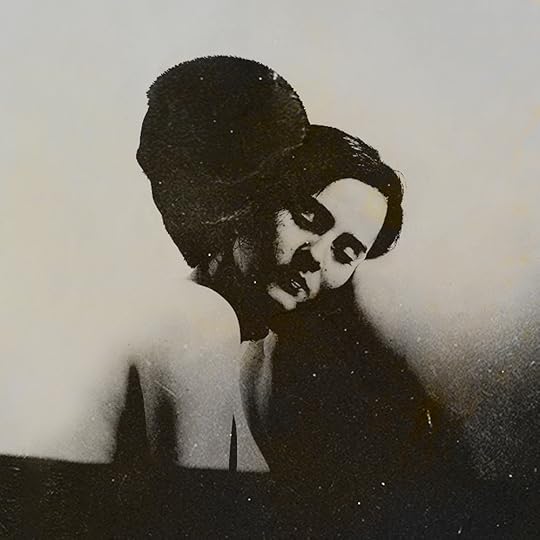
Ada Sibelius. What a Remarkably Drawn 14-Year-Old Protagonist!
This is a coming-of-age novel unlike any I can readily recall. Yesterday morning, after finishing it, I was ready to say 3.6, thinking then it may have been 50 pages too long. The novel did not affect me with a strong emotional reaction such as utter sadness upon finishing a few novels.
This novel impacted me in ways that are much more subtle and rather more profound
. Please bear with me in my too-lengthy explanation of this bold statement.
This morning, I say 4.6. My primary barometers on a novel's quality are whether it will follow me, has it evoked contemplation of some pressing issue in my world, whether I've been transported into another world in the reading, whether I've connected with at least one character in some way, positively or negatively, and Borges' test of aesthetic emotions mentioned below. On all counts, I'd say definitely yes. Moreover, if I was pushed to say the 50 pages I would have cut, I'd be hard-pressed to point to any parts I now believe were unnecessary to the final resolution and what I got from reading the novel.
This has been described by some as a mystery, but the mystery part is not that difficult. While that mystery certainly was the motor that drove the book from beginning to end, I didn't see it as a huge revelation in the bigger picture, particularly not in today's world. If you seek a book of mystery, you'll likely be disappointed and find this book too slow. On the other hand, if you are a "hedonistic reader" as Borges described himself, one who reads "books for the aesthetic emotions they offer me, and ignor[ing] the commentaries and criticism," then I think this book is for you, especially for female geeks, and I use that term in a positive way to describe girls who grew up with a technical or scientific precocity and/or weren't in the uppity social crowd in grade school.
Much has been made of the novel earlier this summer, The Girls, and how it was that many women connected with the 14-year-old female protagonist being thrown into an odd environment. The protagonist, Ada Sibelius, here is 14 for most of the novel and is thrown not into a fire of curiosity as was Evie in The Girls, but into several fires of which she played no part in starting. I connected much more with her, found her nuances much deeper, as well as having considerably more empathy for her fears, the betrayals she's suffered, and her utter lack of trust now in anyone in the world along with her significant losses. While it's true I'm male, the author Liz Moore has most definitely been a 14-year-old girl. While I had to look up the name Evie as "The Girls" protagonist, I won't forget Ada's name.
Ada grew up with her single dad, David Sibelius, a socially awkward computer scientist, being "home schooled" (before home schooling had been approved in MA) at his computer lab on the campus of a fictional MIT (here called Boston Institute of Techn.). She was born to a surrogate mother and raised by David. We learn much of their connection and life together and of Ada's work on a computer program that processes the English language, called ELIXIR. But dad's mind starts to go to the point he ultimately has to be taken to a home for Alzheimer's patients. Before he's lost all of his mental faculties, he gives Ada what should be the key to decode a text document explaining his past. Yet she cannot figure out how to decode it for many years.
Before long, she learns that his name was not David Sibelius. That disclosure is a big part of the book, because it sets Ada adrift at a time when she's already having a tough time adapting to the unknowns of a Catholic school after being home schooled all her life, and now this: a betrayal that shakes the foundation of her identity. Who was her father if not the David Sibelius estranged from a monied NYC family who graduated from Cal Tech and was hired to run the lab at BIT? So, Ada's having to attempt to discover David's secret world.
Another unseen world is David's brain slowly deteriorating from Alzheimer's, with his inability to recall the language of which he was so aware in building ELIXIR, and he then starts to have a Midwestern U.S. twang in his accent, starts referring to Ada as Susan, says his name is Harold Kannady and can only remember things if put a certain way, like his favorite Christmas song which Ada sings to him, when he's no longer aware of who Ada is.
The book is told mostly 3d person from Ada's POV, from early 1980s Boston fast forward to 2009 San Francisco and back to the 1940s and 50s to discover facts about David, ending in 2016 Boston and going beyond in the last chapter, the Epilogue, which is told from a completely unique POV.
I'll leave out discussion here of computer science and virtual reality, except to say that Liz Moore does a great job of breaking it down in terms that made sense.
In addition to the theme of rapidly changing technology, the book fully explores what it means to be a parent and to give your child a surname; the trust we blindly give our parents as children until we are betrayed in some way, big or small; the cycle of life, escape, love of family, what is your family (does it include a good family friend who raises you from 14 to 18?), puppy love v. amorous love, and fear of betrayal.
The thing I took away from it most was identifying with as fully developed a character as I can recall in recent memory, Ada Sibelius, a 14-year-old girl who was thrown into a tailspin by a double-whammy: the loss of her father and of life as she knew it to his Alzheimer's; and, the loss of her trust in him and her identity as a person at possibly the most precarious time in a person's life (puberty), and thrust into a social world in which she is painfully awkward and in which she has no one to trust, as she now lives with Liston, a close work friend and neighbor of David's, and her 3 sons, one of whom is 17 and is her crush. Seeing her grow into a fully-realized woman as she works her way through to resolutions in her complex life was most satisfying.
I recommend this novel highly for your enjoyment of such a remarkable young female character, and I give it an extra oomph if you were ostracized as a geek/nerd in high school. I do include the provisos that you should not expect a typical mystery/thriller/suspense novel, and you do not mind a slow burn in development of a character as a price for a more satisfying payoff.