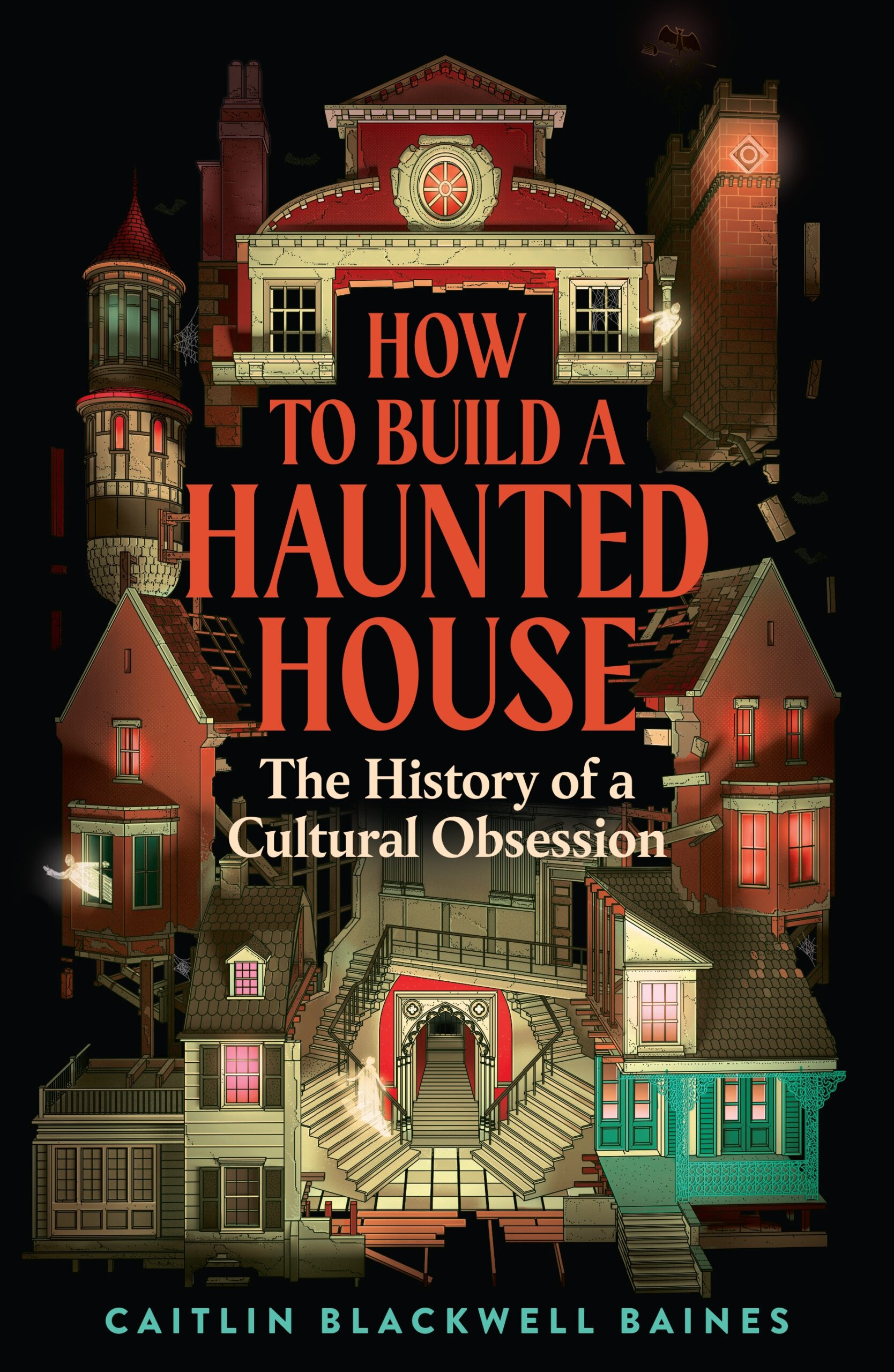
A grand tour of The Haunted House through art, architecture, ghost stories and more
What makes a house haunted? Why do some buildings conjure up a reputation for being particularly creepy, while others leave us unmoved? Barring the possibility of a looming afterlife, what are the particular features, contexts and histories that lend a building the dreaded identity of haunted house?
How to Build a Haunted House tours some of the world's most famously spine-chilling structures in search of answers. From Medieval Scotland to Enlightenment-era London; Victorian suburbs to pre-Civil War Louisiana, Blackwell-Baines, an expert in Gothic art and architecture, will explore that specific set of ingredients that captures our imaginations and contributes to our collective understanding of the eternally eerie. After all, whether a staunch sceptic or paranormal enthusiast, we all know a haunted house when we see one.
I absolutely adored this book. Using fascinating case studies, it compellingly explores the historic and cultural development of the haunted house as a focus of human obsession - never, however, omitting the possibility of the paranormal… Any fan of horror, whether that be books, films or tourism, would enjoy this book and its deep dive into the human building blocks of hauntings. It is meticulously researched and really captures that sense of uncanny.
A great book if you like me are interested in ghost stories as a concept and phenomenon but not necessarily believe in ghosts. This book approaches famous haunted houses from a historical, sociological and architectural point of view. Well written and researched and never chooses the sensational approach.
Lots of interesting stories if you are a macabre little nerd like me! Some of the chapters were a little boring but that was definitely a me thing and not a researching and writing done by the author thing. I did love seeing how the haunted house trope started and how it changed through the years, everything is family trauma!
I had an interesting and entertaining time reading this book about how the cultural phenomenon of the haunted house evolved in Anglo-American countries and how it spread throughout most of the world, so that nowadays basically everyone would know what a haunted house looks like.
"Catholic doctrine does not teach purgatory as a place, but rather a state of being, a stage in the process of life, death and eternal salvation. So, out of the raw material of ancient religious dogma, writers of Gothic fiction (and the general public) came to conceive of ghosts as trapped souls with unfinished business. Where once those souls with unfinished business might have been thought to be tied to an abstract metaphysical space, they were now firmly connected to a literal one. A specific one: the domestic home." (p. 45)
While some of the architectural traits of the Gothic style are usually what we imagine for such a building to look like today, the author also emphasised that basically any building could become to be perceived as haunted, even if it was a suburban home or if there was no particularly gruesome story attached to a building. In some ways architecture and history seem to have reinforced each other at times in some cases: because a building looked creepy, ghost stories slowly developed; but if a building looked more ordinary but had a bloody past, the architecture didn't stop ghost stories from developing either.
"It was this childhood trip to Hampton Court that inspired my lifelong interest in social history; in the stories of the past and the people who shaped it. In the end, perhaps it doesn't matter if the palace really is haunted by the ghosts of Tudor queens. Even if it's not literally haunted, it is certainly imbued with that 'mystic' aura Ernest Law spoke of - the haunting atmosphere that will forever remind us of the 'illustrious historical characters' who once wandered its halls." (p. 151)
I found it fascinating how the author traced the evolving narrative of these ghost stories, be it the ghost of Chloe at a plantation house in the American South, various family ghosts at old castle and palaces or ghost stories involving Native Americans. As society and culture changed their perspective on slavery and the heinous acts that happened on plantations, so did the various ghost stories. I also appreciated the author discussing if these ghost stories can be more than tasteless cash grabs and may enhance our empathy and understanding of the past.
"Where the Bulls' encounters with the paranormal had occurred in the rectory grounds - ethereal forms appearing to them at a hazy distance outside their home - the ghosts seem to have moved in with the Smiths. The 'traditional ghosts' - spectral figures with romantic backstories that were the stuff of legend and folklore - were no more. The unthreateningly remote spirits were replaced by a haunting that was present, personal and invasive. This haunted house was evolving, and its new inhabitants took the form of the insidiously modern poltergeist." (p. 111)
"It had long been considered an asset for an aristocratic household to have a resident family ghost. After all, having a ghost meant having a history. And now more than ever, having a ghost was invaluable to once great families desperately clinging to their ancestral homes. So, the Brown Lady of Raynham Hall ceased to be scary and instead became a comforting reminder of happier times. Not that it was all that happy for poor old Dorothy, of course, but her epoch did represent the Townshend family's heyday." (p. 194)
"As with the legacy of slavery in the American South, the collective guilt over the events of Westward expansion would eventually go on to inspire ghostly legends, but it would take some time for Native Americans to break free of negative stereotypes to become the more sympathetic - and tragic - figures we know today. Even now, though, Americans' guilt seems to be fixated on the seizure of indigenous land rather than their barbaric treatment of the actual people. This has had a unique effect on the modern Native American-themed ghost story." (p. 258)
"There are some subtle commonalities between the Winchester Mystery House mythology and the Indian burial ground trope, as well as a shared timeline in terms of their development as a kind of mea culpa for past injustices perpetrated against indigenous peoples. In both, the Native American is simultaneously ever-present, yet conspicuously absent. A long, dark shadow cast by a faceless, nameless form. And perhaps this is to be expected, since the history of relations between Native American and white settlers is a history of erasure." (p. 261)
An interesting throughline was how much women were involved in these ghost stories, not only because the most famous ghosts are all female, but also because it was usually a female proprietor of a 'haunted' location to see its potential - either spiritually or from a business perspective. I loved reading the author's reflections on how this could have come about.
"As we saw with Chillingham Castle, an ancient fortress that was likewise used and occupied by countless men, it also became populated by the ghosts of women and children. The haunted house (or castle or palace) of our modern understanding is inevitably tied up with notions of the 'domestic' and of 'family' - ideal or otherwise - which is traditionally defined by the presence of women. On top of this, there has long been a tendency to hold up famous women of the past - particularly those who died tragically - as amorphous symbols of time and place; their ghosts symbolising the social and political dynamics of their period in history." (p. 149)
"It is surely no coincidence that haunted house narratives, particularly those of nineteenth-century American Gothic fiction, are largely populated by single women. If the haunted house represents the inverse of the ideal family home, then it makes sense that the canonical central character for the haunted house story should be the opposite of the ideal woman. Childless and unmarried governesses, boarding-house matrons, adult daughters and widows feature heavily in works by Henry James, Nathaniel Hawthorne, Edith Wharton and Mary E. Wilkins Freeman, among others." (p. 250)
I appreciated the author's approach to these stories: there was humour and a healthy dose of scepticism in her retelling of ghost stories and reflection on what makes us think of specific buildings as haunted, but she never ridiculed those who believed they experienced supernatural phenomena.
"Why is it that all abandoned houses are popularly assumed to harbour ghosts? Partly, it comes down to that 'melancholy' look that columnist Lucy Hardy spoke of. A home bearing signs of years of neglect results in a tangible image of decay, evidencing the decline of the house itself - and of the people who once lived there. (…) As people accustomed to living in homes with our nuclear family, we simply can't stand the idea that a structure that was designed as a dwelling lacks the one thing that makes a house a home. We must, therefore, populate these empty houses with the inhabitants that we believe should rightly be there." (p. 210)
Caitlin Blackwell Baines’ How to Build a Haunted House is a refreshing and much-needed take on a subject that is often shrouded in cliché. Too often, haunted house lore gets reduced to the same recycled ghost stories—sometimes even with the wrong names, dates, or events attached. This book cuts through that fog. Instead of retelling campfire tales, Baines traces the history of these houses, exploring how and why they became labeled as “haunted” in the first place.
What makes this book stand out is its focus on the real history of the locations. Baines dives into the cultural, social, and psychological factors that shape our fascination with haunted houses, rather than simply repeating sensational claims. It’s a study of belief, atmosphere, and storytelling as much as it is about the buildings themselves. Reading it feels like peeling back layers—what’s fact, what’s folklore, and what’s a projection of our own need for mystery.
As someone who is often frustrated when TV shows or articles get the history of these places wrong in service of a good ghost story, I found this approach both honest and refreshing. It doesn’t spoil the fun—it deepens it. Haunted houses aren’t just eerie because someone insists a ghost lingers there; they’re haunted because of the complex dynamics of history, culture, and imagination that surround them.
This is a truly original and thought-provoking book, offering an intelligent yet accessible lens on a subject that too often gets trivialized. If you’re interested in haunted houses, folklore, or cultural history, this is absolutely worth the read.
This is a really well researched and written look at why we perceive some structures to be haunted, mostly focussed on the west but with some interesting looks further abroad. I felt that I got the full story at each stage of the book based on it fun structure which focussed on a different house per chapter. The structure of telling the popular story and then the facts allowed a spooky vibe to combine well with the more academic side although I’m always going to say I want something a bit more spooky. Also interesting to discuss was the impact of architecture as well as history however this could have been supported better with pictures instead of just the artistic renditions of the houses at the start of each chapter as all the detail became hard to visualise. I also felt that some information was repeated in a way that didn’t effectively reinforce the narrative but instead become boring at times. This said, I was engaged for the large majority of this book and would recommend it to anyone with an interest in historic houses or spookiness.
This is an interesting look at what makes a house feel 'haunted.' Mainly, it concentrates on famous (or infamous) houses in the UK or US. So, we have Horace Walpole, author of possibly the first Gothic novel, 'The Castle of Otranto,' and his home, Strawberry Hill House. There are castles of course - Chillingham in Northumbria, Hampton Court and country houses, such as Raynham Hall. In the US there is the Myrtles Plantation, Amityville and Winchester. Other houses are less grand, such as Borley Rectory and, in the final chapter, the author looks further afield.
Much of this book uses locations to explore history and culture. There are digressions into Harry Price, famous spectres, poltergeists, American heiresses and seances, among other things. Some houses have a lot of history, others have particular issues and many have similar stories. I found this an enjoyable, social history of houses known as haunted and why such labels existed.
This is a perfect non-fiction for this time of year! A book dedicated to places that are known for being haunted. The author has done an incredible amount of historic research for this and it’s very interesting.
We learn about a number of different places, ranging from houses and mansions to castles, some in the UK and some abroad. There is also a lot of information about the residents that played a vital role and where the supposed hauntings may have their origin. It’s just a really intriguing read even though it sometimes feels like reading an academic text.
This book also tries to explore the question of what makes a house more prone to being haunted, despite the obvious suggestion of apparitions and ghostly goings ons. What is it about a house, castle, place that makes us shiver and feel something otherworldly is at play?
Definitely recommend if you’re interesting in this!
In which one big 'haunted' house per chapter has its stories of hauntings unpacked. Includes lots of historical details. Very interesting overall although I found some parts a bit dry (but that's me and history) Loved the delightful illustrations of each house complete with ghosts.