

What do you think?

How to Get What You Want: Mastering the Art and Science of Persuasion
Life is about getting what you want. When you’re negotiating a salary, buying a house, or talking politics with your uncle at Thanksgiving dinner, you’re always after the best outcome.
Learn from an expert how to get what you want in every situation—no matter who you’re talking to.
Your ability to get what you want depends upon your ability to persuade. Unfortunately, the way most people approach persuasion has the opposite we double down on our own perspective and cite tons of facts to make our point—or even try to strong-arm people into giving in. None of this is persuasive. In reality, it pushes people away from us, making it hard or even impossible to get what we want.
Persuasion expert Josh Bandoch has spent over a decade uncovering the secrets of persuasion. He’s mined psychology, neuroscience, economics, public policy, and history for cutting-edge techniques that actually work—and he’s used them in speeches written for senior government officials, national leaders, business executives, and dozens of his own talks to audiences around the world.
How to Get What You Want combines Bandoch’s groundbreaking research with practical experience persuading at the highest levels to give you a fresh, surprisingly simple approach that will get you what you want and need when it matters
Adopting the persuader's mindset Learning proven techniques for making the most persuasive emotional and logical appeals Unlocking the secret formula for memorable and motivating stories Tapping into the power of tone, body language, and other subconscious signals
How to Get What You Want teaches you how to navigate any political, professional, or personal situation more effectively to get optimal results each and every day.
Learn from an expert how to get what you want in every situation—no matter who you’re talking to.
Your ability to get what you want depends upon your ability to persuade. Unfortunately, the way most people approach persuasion has the opposite we double down on our own perspective and cite tons of facts to make our point—or even try to strong-arm people into giving in. None of this is persuasive. In reality, it pushes people away from us, making it hard or even impossible to get what we want.
Persuasion expert Josh Bandoch has spent over a decade uncovering the secrets of persuasion. He’s mined psychology, neuroscience, economics, public policy, and history for cutting-edge techniques that actually work—and he’s used them in speeches written for senior government officials, national leaders, business executives, and dozens of his own talks to audiences around the world.
How to Get What You Want combines Bandoch’s groundbreaking research with practical experience persuading at the highest levels to give you a fresh, surprisingly simple approach that will get you what you want and need when it matters
Adopting the persuader's mindset Learning proven techniques for making the most persuasive emotional and logical appeals Unlocking the secret formula for memorable and motivating stories Tapping into the power of tone, body language, and other subconscious signals
How to Get What You Want teaches you how to navigate any political, professional, or personal situation more effectively to get optimal results each and every day.
288 pages, Kindle Edition
Published April 21, 2026
About the author
Joshua Bandoch
3 books5 followersPersuasion expert Joshua Bandoch has spent over a decade uncovering the secrets of persuasion. He’s mined psychology, neuroscience, economics, public policy, and history for cutting-edge techniques that work. He’s put them to use in hundreds of speeches written for senior government officials delivered to just about any audience. Bandoch uses and refines these persuasion techniques on a daily basis as a think tank leader, where he crafts and communicates policies on issues like poverty, social mobility, education, and the economy to politically diverse audiences, including elected officials, local and national media, and grassroots activists.
Ratings & Reviews
Friends & Following
Create a free account to discover what your friends think of this book!
Community Reviews
Displaying 1 - 27 of 27 reviews
March 17, 2026
Got an early copy of this book for an interview, and it was a great read! Josh takes a unique approach to persuasion, one that provides valuable insights to people in different fields. There’s something for everyone here!
The book is both written very well, but also approachable, a hard needle to thread in these types of books. Highly recommend to all who want to “get what they want”!
The book is both written very well, but also approachable, a hard needle to thread in these types of books. Highly recommend to all who want to “get what they want”!

May 3, 2026
Joshua Bandoch’s “How to Get What You Want” is a fascinating and insightful guide on persuasion. It’s brimming with information and examples that highlight what works and what doesn’t. The book offers so many practical ideas, and honestly, adopting most of them will make you a much more likable person. His critique of the “logic tsunami” was spot on. I particularly appreciated the discussion on the importance of truly understanding the other person’s perspective and appealing to their values—a true “meet them where they are” approach. Each chapter concludes with a summary of the key takeaways, which I found very helpful. I thoroughly enjoyed this book and am eager to put what I’ve learned into practice.
Special thanks to the author, BenBella Books, and NetGalley for the gifted copy.
Special thanks to the author, BenBella Books, and NetGalley for the gifted copy.

April 22, 2026
The Wanting Self Learns to Wait
In “How to Get What You Want,” Joshua Bandoch turns persuasion into a discipline of listening, delay, and the small silence before the ask.
By Demetris Papadimitropoulos | April 21st, 2026
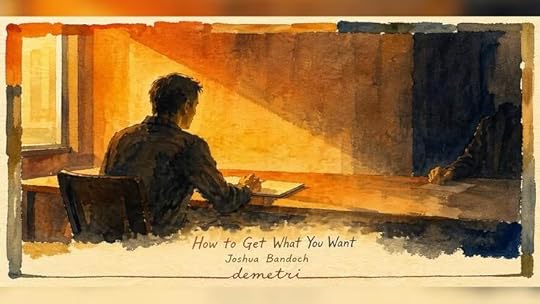
The want arrives first; persuasion begins only when it learns to wait, listen, and leave room for another person to answer.
The title tells on itself.
“How to Get What You Want” sounds, at first, like it belongs on the overbright shelf of self-improvement, professional polish, and immaculate urgency, somewhere between the book that promises a transformed life by Tuesday and the one that teaches you how to command every room while never quite learning to read one.
Joshua Bandoch’s book is more disciplined than its sales pitch first admits, though the pitch is not false. It names the wanting before the book spends nearly three hundred pages trying to discipline it.
Bandoch’s first necessary correction is that persuasion is not conquest. Not a logic volley. Not the art of making another person feel like a loser with better punctuation. Persuasion, in his formulation, is “shared action” – movement toward an agreement, decision, or action people can inhabit rather than merely endure. The phrase steadies nearly every later tactic. It moves persuasion away from the miniature theater of winning and toward something slower, more relational, and harder to counterfeit. The person across from you is not a target, obstacle, convert, or future success story in which you look clever. They are the room in which the enterprise must happen. If they do not feel heard, understood, respected, or at least not cornered, your brilliant argument is just a very handsome brick wall.
He starts with two assumptions that ruin most attempts at persuasion: that persuasion is about winning, and that logic is the master key. Bandoch is especially good at exposing the childishness tucked inside adult disagreement and professional speech. The person who wants to “win” a disagreement with a spouse still has to wake up next to the loser. The manager who asks, “What do we need to tell them?” has already centered the wrong party. The professional who floods a room with facts may be persuading only himself, which is a tidy but lonely achievement.
Bandoch builds the guide in three linked turns: mindset, mind, technique. First, put the audience first and animate action with vision. Then come feelings, positivity, moral appeal, and story. Finally, the toolkit: negotiation, nonverbal presence, and clarity. The design keeps the path visible; it does not stop to admire the broom. It also hands you a takeaway sheet so you can pretend you were always the sort of person who listens calmly and asks excellent questions instead of mentally drafting your rebuttal while nodding like a dashboard saint with a neck spring.
The premise first earns its keep in “Put Them First.” Bandoch tells the story of meeting Mohammed, a TEDx organizer, while hoping for an invitation to speak. The obvious approach would have been to pitch himself. Instead, he listens. He asks about Mohammed’s efforts to bring a TEDx event to his university and lets the other person’s world become interesting before asking it to become useful. Mohammed eventually asks about Bandoch’s work and offers the invitation. The scene glows with the soft instructional lighting of a teaching anecdote, but the lesson is sharper than the setup: the surest way to move toward what you want may be to delay your own arrival.
Delay, in this book, is not hesitation. It is discipline. Again and again, Bandoch tells the reader to wait. Listen before talking. Ask before advising. Identify barriers before pushing. Invite “no” before chasing “yes.” Use silence before explaining. Revise before presenting. Clarify before ornamenting. “How to Get What You Want” is advertised as a guide to getting what one wants, but its best chapters are really about postponing the ego’s first move. That is less glittering than the title’s appetite for victory, and more durable in practice. Wanting, here, must be trained before it can become persuasive.
Bandoch’s listening taxonomy – passive, active, proactive – is plain enough to try that afternoon, not so plain that it evaporates. Passive listening means shutting up, which in many rooms would qualify as a minor miracle. Active listening means noticing what requires further exploration. Proactive listening means steering toward possible shared action without shoving the other person into a conclusion they have not reached. The chapter also offers one of the book’s best corrections: “them-first” is not “them-only.” If the other person never shows reciprocal interest, the relationship may not be ground sturdy enough for persuasion. Without that caveat, the book would risk turning empathy into strategic self-erasure. With it, Bandoch acknowledges that persuasion is relational, not devotional.
The vision chapter is sturdy but less alive. Bandoch distinguishes vision from mission, invokes the North Star, warns against being rudderless, and argues that aspiration must remain tethered to reality. A vision should animate action, not float above it looking inspirational and unemployed. The contrast between visionary and “delusion-ary” has blunt usefulness. Still, this stretch moves through leadership furniture already rented for the afternoon: North Stars, big pictures, strategy, operations, tactics. The book is better closer to the table – when someone is hesitating, fuming, asking for a raise, dodging an uncomfortable truth, or pretending that “yes” means yes.
The negotiation chapter is where the guide finds its sharpest rhythm. Bandoch openly borrows from “Never Split the Difference” by Chris Voss with Tahl Raz, along with other negotiation literature, but he integrates those tools into his larger argument about mutual action. “No” becomes less a slammed door than a blueprint: boundary, fear, condition, path. It defines what does not work, discloses what may be protected, and clarifies what would have to change for cooperation to become possible. This is Bandoch in his best register – testable, psychologically plausible, and aligned with the book’s deeper claim.
He is equally sharp on barriers. Instead of asking, “How do I get this person to do what I want?,” he asks, “What is stopping this person from doing it already?” That question has the clean force of a diagnosis that changes the treatment. It turns persuasion from pressure into investigation. In a work example, he identifies a burdensome fact-checking process as the obstacle preventing his team from producing more research; rather than simply demanding greater output, he removes the barrier. When he interviews prospective hires, he asks what would stop them from accepting an offer. The question sounds almost too simple, which is often how good questions disguise themselves.
The “accusations audit” material is one of the book’s most tactically exact moves. Bandoch advises naming the negative things the other person may already be thinking: you worry our brand is toxic, you think we are too political, you suspect this partnership will hurt you. The point is not to agree with every concern, but to show that you see it. He compares this to letting air out of a balloon, and the image earns its place because the technique depends less on eloquence than on nerve. Most people would rather talk around the uncomfortable thing and then act wounded when it remains uncomfortable. Bandoch’s advice is to put the monster on the table and see whether it is, in fact, a monster or merely a large, badly lit coat.
Here the book sits nearest to “How to Win Friends and Influence People” by Dale Carnegie, though Bandoch is more tactical and contemporary in his research vocabulary. Like Carnegie, he understands that people want to feel important, seen, and not humiliated. Unlike Carnegie, he is working in a world of hybrid meetings, customer-service scripts, policy coalitions, social-media reflexes, and professional self-advocacy. His scenes have the texture of offices, interviews, strained meetings, and asks made under fluorescent lights. They also fall into a pattern: Bandoch uses the tool, the other person opens up, and he gets the job, raise, invitation, discount, funding, partnership, or desired answer. The examples teach, but they also behave themselves a little too well. Reality, that impolite editor, is often less compliant.
“Go Beyond Words” is where usefulness and danger share a desk. Bandoch is right that persuasion does not happen through language alone. Tone can poison the right sentence. Body language can make confidence visible or contempt unbearable. First impressions matter. Likability matters. Image matters. PowerPoint can become a municipal hazard if left unsupervised.
This is also where the ethical unease becomes harder to ignore. Bandoch insists on authenticity, but the chapter leans hard into perception management. For purposes of persuasion, he argues, how people perceive you may matter more than who you believe yourself to be, because perception is their reality. That is true enough to be workable and unsettling enough to deserve scrutiny. One reader will hear humane audience awareness. Another will hear the soft hum of image engineering. Bandoch usually keeps his footing, but he lets us feel the ridge underfoot.
The body-language material especially needs proportion. Bandoch includes caveats, and he is sensible about treating signals as clues rather than verdicts. Still, advice about steepling, throat tension, eyebrow movement, ventral fronting, pacifying behaviors, smiles, and contempt can invite amateur surveillance. A tight throat might mean evasion or stress. It might also mean anxiety, fatigue, neurodivergence, illness, cultural difference, or a sad desk sandwich. The book is at its best when observation remains observation, not a warrant for prosecuting every blink across the conference table.
The finest final test is the “granny test”: would your grandmother understand what you are saying? Bandoch uses it to attack obscurity, jargon, pretentiousness, and the comforting academic fog in which weak arguments often hope to pass as depth. His contrast between Martin Heidegger’s deliberate difficulty and the need for clarity is a little staged, but the rebuke holds. If the audience cannot understand you, that is not their failure to ascend. It is your failure to build stairs.
This clarity chapter belongs near “Made to Stick” by Chip Heath and Dan Heath, though Bandoch is less interested in why ideas become memorable than in whether they can lead to mutual action. He is good on thesis, simplicity, precision, revision, and the “curse of knowledge.” He rightly distinguishes simple from simplistic. That distinction matters because practical books often worship plainness until difficulty gets flattened into a slogan. Bandoch knows better, at least in principle. Poverty, policy, work, marriage, leadership, and moral disagreement are not solved by making sentences shorter. They are made worse when no one can understand what anyone means.
Bandoch mostly passes his own test. His sentences usually know where the door is. They are brisk, plainspoken, example-heavy, and built for use. He likes short questions, quick reversals, and little comic taps: “Nope,” “Well,” “Not exactly.” The rhythm can feel like a workshop run by someone who has had enough coffee to care about your future. The diction braids coaching language, research summary, and conversational aside. At its best, the style gives abstract habits a body: logic becomes ammunition, manipulation becomes pyromania, morality has flavors, clarity has Granny, silence has a void people rush to fill.
The prose is clear by design, though it does not always trust itself to stop. “Persuasion genius” appears often enough to begin sounding like a laminated certificate one might receive after a hotel ballroom seminar with surprisingly good muffins. “Shared action,” “them-first,” “ONE Thing,” “barriers,” and “clarity” recur because the book is teaching, but not every repetition deepens the idea. Sometimes it simply reminds the reader where the labeled exits are.
Its real achievement is that it makes persuasion usable without pretending it is free of leverage. Loss framing, silence, accusations audits, tone control, image management, “no”-oriented questions: these can be used ethically, and Bandoch repeatedly says they should be. They can also be used otherwise. The book knows this and warns against manipulation, comparing it to playing with fire. But the most interesting thing about the book is not that it resolves the pressure between influence and ethics. It is that the pressure remains visible.
So the title keeps returning. “How to Get What You Want” could have been a cruder book. It could have been a manual for winning. Instead, its better chapters argue that the wanting self must become more disciplined, more curious, more patient, and more intelligible before it has any right to ask another person to move. That does not make the book pure. It makes it more honest. Self-interest is still here, wearing polished shoes and holding a notebook. But Bandoch keeps asking it to listen before it speaks.
The clear limitation is that Bandoch rearranges a well-stocked shelf of influence literature more often than he builds a new room. Much of his wisdom has recognizable ancestors: “How to Win Friends and Influence People” by Dale Carnegie, “Never Split the Difference” by Chris Voss with Tahl Raz, “Difficult Conversations” by Douglas Stone, Bruce Patton, and Sheila Heen, “Influence” by Robert B. Cialdini, “Made to Stick” by Chip Heath and Dan Heath. His contribution is not to invent the field anew. It is to arrange useful persuasion thinking into a coherent, readable operating manual. That is careful shelving, not new architecture.
The book will divide readers less by ideology than by their tolerance for being coached. Readers who like applied nonfiction that gives them phrases to try tomorrow will find much to use. Managers, fundraisers, job candidates, policy people, parents, consultants, and anyone who has watched a meeting die slowly under the weight of everyone’s favorite facts may appreciate its directness. Readers allergic to self-improvement confidence may flinch at the branding, the tidy anecdotes, and the repeated implication that the right technique can unlock almost any room. Readers wary of persuasion itself may remain unconvinced that influence can be so neatly separated from leverage.
Still, the book belongs to a moment crowded with speech and starved for hearing. Its relevance does not need to be dragged under a spotlight. Political polarization, workplace strain, expert jargon, screen distraction, and managerial exhaustion all sit behind its examples. Bandoch is not predicting a new communication crisis so much as diagnosing an old one under current lighting: we want other people to understand us, but we often make ourselves difficult to understand, trust, or follow.
My final rating is 82/100, which translates to a Goodreads-compatible 4/5 stars: a strong, well-organized persuasion guide with a serious ethical frame, limited by familiar influences, self-confirming examples, and the occasional category sheen.
The best thing about “How to Get What You Want” is that it quietly mistrusts the title’s first impulse. It knows wanting is easy. The harder work is learning how not to let wanting fill the whole room. Bandoch’s most persuasive lesson is not that every “no” can be turned into “yes,” or that every person can be moved if you ask the right question in the right tone while wearing the sanctioned blazer. It is that the question worth asking may come only after you have stopped performing certainty long enough to hear what the other person is protecting. Persuasion begins there: not with the raised voice, not with the perfect fact, not with the victorious closing line, but with the small, difficult silence before you decide whether to speak or finally listen.
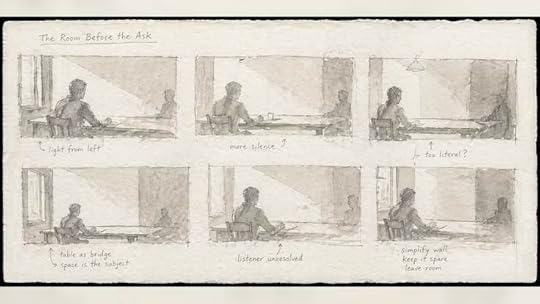
Finding the room before finding the argument – small studies of distance, silence, table, figure, and the empty space where persuasion will either fail or begin.
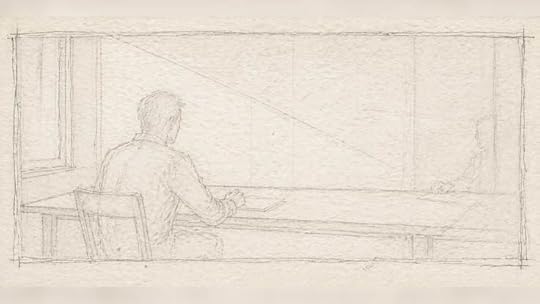
The first shape of the pause – a spare pencil map of posture, table, light, and the listener who must remain partly unresolved.
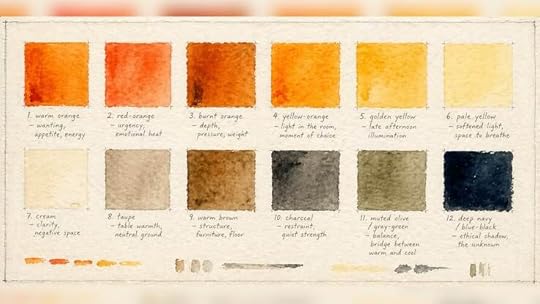
The cover palette translated into feeling – orange for appetite, charcoal for restraint, cream for clarity, and muted green-gray for the space between impulse and action.

The argument has not arrived yet; the light has – the first broad wash begins turning structure into atmosphere and empty space into tension.

The body waits before the sentence does – a study of shoulders, hands, and seated weight as the visible discipline of not speaking too soon.
All watercolor illustrations by Demetris Papadimitropoulos.
In “How to Get What You Want,” Joshua Bandoch turns persuasion into a discipline of listening, delay, and the small silence before the ask.
By Demetris Papadimitropoulos | April 21st, 2026
The want arrives first; persuasion begins only when it learns to wait, listen, and leave room for another person to answer.
The title tells on itself.
“How to Get What You Want” sounds, at first, like it belongs on the overbright shelf of self-improvement, professional polish, and immaculate urgency, somewhere between the book that promises a transformed life by Tuesday and the one that teaches you how to command every room while never quite learning to read one.
Joshua Bandoch’s book is more disciplined than its sales pitch first admits, though the pitch is not false. It names the wanting before the book spends nearly three hundred pages trying to discipline it.
Bandoch’s first necessary correction is that persuasion is not conquest. Not a logic volley. Not the art of making another person feel like a loser with better punctuation. Persuasion, in his formulation, is “shared action” – movement toward an agreement, decision, or action people can inhabit rather than merely endure. The phrase steadies nearly every later tactic. It moves persuasion away from the miniature theater of winning and toward something slower, more relational, and harder to counterfeit. The person across from you is not a target, obstacle, convert, or future success story in which you look clever. They are the room in which the enterprise must happen. If they do not feel heard, understood, respected, or at least not cornered, your brilliant argument is just a very handsome brick wall.
He starts with two assumptions that ruin most attempts at persuasion: that persuasion is about winning, and that logic is the master key. Bandoch is especially good at exposing the childishness tucked inside adult disagreement and professional speech. The person who wants to “win” a disagreement with a spouse still has to wake up next to the loser. The manager who asks, “What do we need to tell them?” has already centered the wrong party. The professional who floods a room with facts may be persuading only himself, which is a tidy but lonely achievement.
Bandoch builds the guide in three linked turns: mindset, mind, technique. First, put the audience first and animate action with vision. Then come feelings, positivity, moral appeal, and story. Finally, the toolkit: negotiation, nonverbal presence, and clarity. The design keeps the path visible; it does not stop to admire the broom. It also hands you a takeaway sheet so you can pretend you were always the sort of person who listens calmly and asks excellent questions instead of mentally drafting your rebuttal while nodding like a dashboard saint with a neck spring.
The premise first earns its keep in “Put Them First.” Bandoch tells the story of meeting Mohammed, a TEDx organizer, while hoping for an invitation to speak. The obvious approach would have been to pitch himself. Instead, he listens. He asks about Mohammed’s efforts to bring a TEDx event to his university and lets the other person’s world become interesting before asking it to become useful. Mohammed eventually asks about Bandoch’s work and offers the invitation. The scene glows with the soft instructional lighting of a teaching anecdote, but the lesson is sharper than the setup: the surest way to move toward what you want may be to delay your own arrival.
Delay, in this book, is not hesitation. It is discipline. Again and again, Bandoch tells the reader to wait. Listen before talking. Ask before advising. Identify barriers before pushing. Invite “no” before chasing “yes.” Use silence before explaining. Revise before presenting. Clarify before ornamenting. “How to Get What You Want” is advertised as a guide to getting what one wants, but its best chapters are really about postponing the ego’s first move. That is less glittering than the title’s appetite for victory, and more durable in practice. Wanting, here, must be trained before it can become persuasive.
Bandoch’s listening taxonomy – passive, active, proactive – is plain enough to try that afternoon, not so plain that it evaporates. Passive listening means shutting up, which in many rooms would qualify as a minor miracle. Active listening means noticing what requires further exploration. Proactive listening means steering toward possible shared action without shoving the other person into a conclusion they have not reached. The chapter also offers one of the book’s best corrections: “them-first” is not “them-only.” If the other person never shows reciprocal interest, the relationship may not be ground sturdy enough for persuasion. Without that caveat, the book would risk turning empathy into strategic self-erasure. With it, Bandoch acknowledges that persuasion is relational, not devotional.
The vision chapter is sturdy but less alive. Bandoch distinguishes vision from mission, invokes the North Star, warns against being rudderless, and argues that aspiration must remain tethered to reality. A vision should animate action, not float above it looking inspirational and unemployed. The contrast between visionary and “delusion-ary” has blunt usefulness. Still, this stretch moves through leadership furniture already rented for the afternoon: North Stars, big pictures, strategy, operations, tactics. The book is better closer to the table – when someone is hesitating, fuming, asking for a raise, dodging an uncomfortable truth, or pretending that “yes” means yes.
The negotiation chapter is where the guide finds its sharpest rhythm. Bandoch openly borrows from “Never Split the Difference” by Chris Voss with Tahl Raz, along with other negotiation literature, but he integrates those tools into his larger argument about mutual action. “No” becomes less a slammed door than a blueprint: boundary, fear, condition, path. It defines what does not work, discloses what may be protected, and clarifies what would have to change for cooperation to become possible. This is Bandoch in his best register – testable, psychologically plausible, and aligned with the book’s deeper claim.
He is equally sharp on barriers. Instead of asking, “How do I get this person to do what I want?,” he asks, “What is stopping this person from doing it already?” That question has the clean force of a diagnosis that changes the treatment. It turns persuasion from pressure into investigation. In a work example, he identifies a burdensome fact-checking process as the obstacle preventing his team from producing more research; rather than simply demanding greater output, he removes the barrier. When he interviews prospective hires, he asks what would stop them from accepting an offer. The question sounds almost too simple, which is often how good questions disguise themselves.
The “accusations audit” material is one of the book’s most tactically exact moves. Bandoch advises naming the negative things the other person may already be thinking: you worry our brand is toxic, you think we are too political, you suspect this partnership will hurt you. The point is not to agree with every concern, but to show that you see it. He compares this to letting air out of a balloon, and the image earns its place because the technique depends less on eloquence than on nerve. Most people would rather talk around the uncomfortable thing and then act wounded when it remains uncomfortable. Bandoch’s advice is to put the monster on the table and see whether it is, in fact, a monster or merely a large, badly lit coat.
Here the book sits nearest to “How to Win Friends and Influence People” by Dale Carnegie, though Bandoch is more tactical and contemporary in his research vocabulary. Like Carnegie, he understands that people want to feel important, seen, and not humiliated. Unlike Carnegie, he is working in a world of hybrid meetings, customer-service scripts, policy coalitions, social-media reflexes, and professional self-advocacy. His scenes have the texture of offices, interviews, strained meetings, and asks made under fluorescent lights. They also fall into a pattern: Bandoch uses the tool, the other person opens up, and he gets the job, raise, invitation, discount, funding, partnership, or desired answer. The examples teach, but they also behave themselves a little too well. Reality, that impolite editor, is often less compliant.
“Go Beyond Words” is where usefulness and danger share a desk. Bandoch is right that persuasion does not happen through language alone. Tone can poison the right sentence. Body language can make confidence visible or contempt unbearable. First impressions matter. Likability matters. Image matters. PowerPoint can become a municipal hazard if left unsupervised.
This is also where the ethical unease becomes harder to ignore. Bandoch insists on authenticity, but the chapter leans hard into perception management. For purposes of persuasion, he argues, how people perceive you may matter more than who you believe yourself to be, because perception is their reality. That is true enough to be workable and unsettling enough to deserve scrutiny. One reader will hear humane audience awareness. Another will hear the soft hum of image engineering. Bandoch usually keeps his footing, but he lets us feel the ridge underfoot.
The body-language material especially needs proportion. Bandoch includes caveats, and he is sensible about treating signals as clues rather than verdicts. Still, advice about steepling, throat tension, eyebrow movement, ventral fronting, pacifying behaviors, smiles, and contempt can invite amateur surveillance. A tight throat might mean evasion or stress. It might also mean anxiety, fatigue, neurodivergence, illness, cultural difference, or a sad desk sandwich. The book is at its best when observation remains observation, not a warrant for prosecuting every blink across the conference table.
The finest final test is the “granny test”: would your grandmother understand what you are saying? Bandoch uses it to attack obscurity, jargon, pretentiousness, and the comforting academic fog in which weak arguments often hope to pass as depth. His contrast between Martin Heidegger’s deliberate difficulty and the need for clarity is a little staged, but the rebuke holds. If the audience cannot understand you, that is not their failure to ascend. It is your failure to build stairs.
This clarity chapter belongs near “Made to Stick” by Chip Heath and Dan Heath, though Bandoch is less interested in why ideas become memorable than in whether they can lead to mutual action. He is good on thesis, simplicity, precision, revision, and the “curse of knowledge.” He rightly distinguishes simple from simplistic. That distinction matters because practical books often worship plainness until difficulty gets flattened into a slogan. Bandoch knows better, at least in principle. Poverty, policy, work, marriage, leadership, and moral disagreement are not solved by making sentences shorter. They are made worse when no one can understand what anyone means.
Bandoch mostly passes his own test. His sentences usually know where the door is. They are brisk, plainspoken, example-heavy, and built for use. He likes short questions, quick reversals, and little comic taps: “Nope,” “Well,” “Not exactly.” The rhythm can feel like a workshop run by someone who has had enough coffee to care about your future. The diction braids coaching language, research summary, and conversational aside. At its best, the style gives abstract habits a body: logic becomes ammunition, manipulation becomes pyromania, morality has flavors, clarity has Granny, silence has a void people rush to fill.
The prose is clear by design, though it does not always trust itself to stop. “Persuasion genius” appears often enough to begin sounding like a laminated certificate one might receive after a hotel ballroom seminar with surprisingly good muffins. “Shared action,” “them-first,” “ONE Thing,” “barriers,” and “clarity” recur because the book is teaching, but not every repetition deepens the idea. Sometimes it simply reminds the reader where the labeled exits are.
Its real achievement is that it makes persuasion usable without pretending it is free of leverage. Loss framing, silence, accusations audits, tone control, image management, “no”-oriented questions: these can be used ethically, and Bandoch repeatedly says they should be. They can also be used otherwise. The book knows this and warns against manipulation, comparing it to playing with fire. But the most interesting thing about the book is not that it resolves the pressure between influence and ethics. It is that the pressure remains visible.
So the title keeps returning. “How to Get What You Want” could have been a cruder book. It could have been a manual for winning. Instead, its better chapters argue that the wanting self must become more disciplined, more curious, more patient, and more intelligible before it has any right to ask another person to move. That does not make the book pure. It makes it more honest. Self-interest is still here, wearing polished shoes and holding a notebook. But Bandoch keeps asking it to listen before it speaks.
The clear limitation is that Bandoch rearranges a well-stocked shelf of influence literature more often than he builds a new room. Much of his wisdom has recognizable ancestors: “How to Win Friends and Influence People” by Dale Carnegie, “Never Split the Difference” by Chris Voss with Tahl Raz, “Difficult Conversations” by Douglas Stone, Bruce Patton, and Sheila Heen, “Influence” by Robert B. Cialdini, “Made to Stick” by Chip Heath and Dan Heath. His contribution is not to invent the field anew. It is to arrange useful persuasion thinking into a coherent, readable operating manual. That is careful shelving, not new architecture.
The book will divide readers less by ideology than by their tolerance for being coached. Readers who like applied nonfiction that gives them phrases to try tomorrow will find much to use. Managers, fundraisers, job candidates, policy people, parents, consultants, and anyone who has watched a meeting die slowly under the weight of everyone’s favorite facts may appreciate its directness. Readers allergic to self-improvement confidence may flinch at the branding, the tidy anecdotes, and the repeated implication that the right technique can unlock almost any room. Readers wary of persuasion itself may remain unconvinced that influence can be so neatly separated from leverage.
Still, the book belongs to a moment crowded with speech and starved for hearing. Its relevance does not need to be dragged under a spotlight. Political polarization, workplace strain, expert jargon, screen distraction, and managerial exhaustion all sit behind its examples. Bandoch is not predicting a new communication crisis so much as diagnosing an old one under current lighting: we want other people to understand us, but we often make ourselves difficult to understand, trust, or follow.
My final rating is 82/100, which translates to a Goodreads-compatible 4/5 stars: a strong, well-organized persuasion guide with a serious ethical frame, limited by familiar influences, self-confirming examples, and the occasional category sheen.
The best thing about “How to Get What You Want” is that it quietly mistrusts the title’s first impulse. It knows wanting is easy. The harder work is learning how not to let wanting fill the whole room. Bandoch’s most persuasive lesson is not that every “no” can be turned into “yes,” or that every person can be moved if you ask the right question in the right tone while wearing the sanctioned blazer. It is that the question worth asking may come only after you have stopped performing certainty long enough to hear what the other person is protecting. Persuasion begins there: not with the raised voice, not with the perfect fact, not with the victorious closing line, but with the small, difficult silence before you decide whether to speak or finally listen.
Finding the room before finding the argument – small studies of distance, silence, table, figure, and the empty space where persuasion will either fail or begin.
The first shape of the pause – a spare pencil map of posture, table, light, and the listener who must remain partly unresolved.
The cover palette translated into feeling – orange for appetite, charcoal for restraint, cream for clarity, and muted green-gray for the space between impulse and action.
The argument has not arrived yet; the light has – the first broad wash begins turning structure into atmosphere and empty space into tension.
The body waits before the sentence does – a study of shoulders, hands, and seated weight as the visible discipline of not speaking too soon.
All watercolor illustrations by Demetris Papadimitropoulos.
April 25, 2026
I work in sales and I bought this book to try to get a few tips. I just finished it and it greatly exceeded my modest-to-high expectations. The title promises a lot, and it delivers. I used a few of the techniques with clients yesterday and they actually worked! I highly recommend this book to anyone in sales. I know it's going to help me bring in a lot more revenue.
Want to Read
April 16, 2026How to Get What You Want by Joshua Bandoch is a concise and practical exploration of persuasion, blending behavioral insights with real world application. The book breaks down the art and science of influence into accessible principles that are easy to understand and apply. A useful read for anyone interested in communication, negotiation, and human behavior.
May 20, 2026
How to Get What You Want: Mastering the Art and Science of Persuasion
by Joshua Bandoch
Thank you to BenBella Books for the gifted copy.
How to Get What You Want is a practical and readable guide to persuasion that is less about winning arguments and more about understanding the person on the other side of the conversation. Joshua Bandoch’s main point is simple but useful: if you want to persuade someone, you have to stop centering yourself first.
The strongest parts of the book focus on listening, identifying barriers, asking better questions, and creating what Bandoch calls shared action. That framing keeps the book from feeling like a manipulation manual. It treats persuasion as something relational, not just a way to get your way through better phrasing.
That said, much of the material will feel familiar if you have read other communication or negotiation books. The ideas are solid, but not exactly groundbreaking. The book is strongest as an organized, accessible operating manual rather than a completely new approach to persuasion. I also would have liked more real world examples and a more current discussion of how AI is changing communication and persuasion.
Still, the writing is clear, the advice is usable, and the ethical frame matters. The reminder to listen first, understand what someone is protecting, and avoid turning every disagreement into a contest is worth taking seriously.
A strong, practical guide for anyone who wants to communicate more effectively without turning persuasion into pressure.
4 stars.
by Joshua Bandoch
Thank you to BenBella Books for the gifted copy.
How to Get What You Want is a practical and readable guide to persuasion that is less about winning arguments and more about understanding the person on the other side of the conversation. Joshua Bandoch’s main point is simple but useful: if you want to persuade someone, you have to stop centering yourself first.
The strongest parts of the book focus on listening, identifying barriers, asking better questions, and creating what Bandoch calls shared action. That framing keeps the book from feeling like a manipulation manual. It treats persuasion as something relational, not just a way to get your way through better phrasing.
That said, much of the material will feel familiar if you have read other communication or negotiation books. The ideas are solid, but not exactly groundbreaking. The book is strongest as an organized, accessible operating manual rather than a completely new approach to persuasion. I also would have liked more real world examples and a more current discussion of how AI is changing communication and persuasion.
Still, the writing is clear, the advice is usable, and the ethical frame matters. The reminder to listen first, understand what someone is protecting, and avoid turning every disagreement into a contest is worth taking seriously.
A strong, practical guide for anyone who wants to communicate more effectively without turning persuasion into pressure.
4 stars.

Review of advance copy received from NetGalley
➡️ "How To Get What You Want".......
was not what I wanted. 😭😭😭
🔷 NO NEW CONCEPTS. While the author’s emphasis on "empathy-based persuasion"—prioritizing the motivations and fears of others—was commendable, it was not a "groundbreaking" concept.
Despite the publisher blurb’s promises of revolutionary research, the core strategies felt very familiar.
🔷 MORE REAL LIFE EXAMPLES????
I would have preferred fewer theories and more real-life examples.
🔷 AI ????
There was no mention of AI in this book. For a book released in 2026, overlooking how AI can be leveraged to refine persuasion techniques and communication strategies felt incomplete and dated.
🔷 NO DOWNLOADABLE PDF FOR KEY TAKEAWAYS.
When listening to "How to" audiobooks, it's always helpful to have a downloadable PDF for takeaways.
I listened to the audiobook, expertly narrated by BJ Harrison.
I always love to get what I want and was elated when I was approved by NetGalley and the publisher for an ARC in exchange for an honest review.

May 30, 2026
I have always been interested in persuasion—understanding how influence works and what I can do to communicate my ideas more effectively, especially in a professional setting.
That curiosity led me to this book. Persuasion is a topic that has been covered extensively, and it often feels like there is little new left to say. However, with subjects like these, the value often lies not in new ideas but in how they are presented. The language, pacing, structure, and examples can make familiar concepts much easier to understand and apply.
Joshua does a great job of this. The book is well-written, engaging, and practical. While many of the concepts were not entirely new to me, the author helped me understand them more clearly and appreciate the psychology behind them. I also particularly liked the summary points at the end, which reinforced the key lessons and made the book feel actionable.
I received a free copy of the book from NetGalley. This doesn't impact my opinion in any way.
That curiosity led me to this book. Persuasion is a topic that has been covered extensively, and it often feels like there is little new left to say. However, with subjects like these, the value often lies not in new ideas but in how they are presented. The language, pacing, structure, and examples can make familiar concepts much easier to understand and apply.
Joshua does a great job of this. The book is well-written, engaging, and practical. While many of the concepts were not entirely new to me, the author helped me understand them more clearly and appreciate the psychology behind them. I also particularly liked the summary points at the end, which reinforced the key lessons and made the book feel actionable.
I received a free copy of the book from NetGalley. This doesn't impact my opinion in any way.
June 1, 2026
I don't always learn something from a book that really opens my mind to meaningful new knowledge and application. This one taught me about research in a relatable way, confirmed some conclusions and helped me expand my understanding. That's invaluable. .
If you are discouraged or upset about how your communications go right by people, over their heads or falls short, this book might be one you'll like.
I study communications, interactions, trust and professional relationships and I can say, I learned social science, in layman's language, that I didn't know. Yes, I knew about the powerful force that feelings have on rapport, trust and persuasion. Not everyone does. And mastering it is difficult, even if you do know.
I wasn't aware, however, about moral tastes. It was explained well and in an interesting way. This chapter might surprise you too.
You'll learn about "palatable" approaches that stand a much higher chance at being well received and increase the odds of persuasiveness.
If you are discouraged or upset about how your communications go right by people, over their heads or falls short, this book might be one you'll like.
I study communications, interactions, trust and professional relationships and I can say, I learned social science, in layman's language, that I didn't know. Yes, I knew about the powerful force that feelings have on rapport, trust and persuasion. Not everyone does. And mastering it is difficult, even if you do know.
I wasn't aware, however, about moral tastes. It was explained well and in an interesting way. This chapter might surprise you too.
You'll learn about "palatable" approaches that stand a much higher chance at being well received and increase the odds of persuasiveness.
April 22, 2026
This is an excellent book and a must-read for anyone interested in persuasive communication. It's grounded in the best neuroscience and psychology research available today. Yet I've learned a ton of actionable tools and techniques that are highly applicable both at work and at home. I am truly impressed by how comprehensive it is! The persuader's "them-first" mindset is gold, and I'm excited to test it out, because that's counterintuitive to how I've been approaching persuasion. I especially enjoyed reading Part 2, which dives into how our brains actually work, which is we feel first, reason later, and offers an innovation take on the moral foundations theory. Just finished the chapter on clarity, "Ace the Granny Test", and boy do I wish more people aimed for clarity in their communication! The prose is highly engaging and accessible. And it's often humorous, which makes it a highly enjoyable read and a great book to bring along when you travel.
September 29, 2026
At a time when too many people spend their time angrily shouting at each other, along comes a book suggesting that we can actually talk to each other. I really cannot recommend it highly enough.
Of course this is hardly the first book to teach persuasive communication techniques, though the author does an exceptionally good job of tapping into the latest research on psychology, neuroscience, and communication techniques, but Bandoch also focuses on the goal of persuasion, not winning abstract arguments, but to motivate "shared action.” It is a results oriented tool, not a weapon. And, yes, most of this book is designed around those who, like the author, (and me) use persuasion for a living, but he also demonstrates how the same tools can be used effectively in everyday life. All of this written with humor, and humility, as well as eloquence. As a result, even if you think you have seen this before, you will still learn a great deal from this book.
Of course this is hardly the first book to teach persuasive communication techniques, though the author does an exceptionally good job of tapping into the latest research on psychology, neuroscience, and communication techniques, but Bandoch also focuses on the goal of persuasion, not winning abstract arguments, but to motivate "shared action.” It is a results oriented tool, not a weapon. And, yes, most of this book is designed around those who, like the author, (and me) use persuasion for a living, but he also demonstrates how the same tools can be used effectively in everyday life. All of this written with humor, and humility, as well as eloquence. As a result, even if you think you have seen this before, you will still learn a great deal from this book.
Review of advance copy received from Author
I have begun reading this advanced copy and find the introduction outstanding--and an amazing example of the book's purpose and intent to ANY individual or group audience. I am into the chapters, and the quality and language continues at the same level. Heavy use of real stories as examples of the points he is making--and referral to subsequent (or past) chapters where the point is more fully explicated. I look forward to continuing reading and expect to find the same quality through out. For those very interested in source or further material on the points beyond the book, they appear at the end via footnotes in the text. I predict this will be a "classic" publication on the topic(s) in the years to come for many years.
April 21, 2026
I read How to Get What You Want early, and it’s excellent. Josh Bandoch does something very difficult very well: he synthesizes a large body of research on persuasion in a way that is both accessible and genuinely practical. As a research psychologist myself, and as someone who has both run and evaluated trainings on this and related topics, I found this book to be a rare blend of theory and application.
Although the book engages a great deal of theory, it never feels dense or overly academic. It is clearly written for people who want to use what they learn, whether in teaching, leadership, practice, or everyday life.
At a time when so many people talk past each other, this book feels especially timely and useful.
Definitely recommend.
Although the book engages a great deal of theory, it never feels dense or overly academic. It is clearly written for people who want to use what they learn, whether in teaching, leadership, practice, or everyday life.
At a time when so many people talk past each other, this book feels especially timely and useful.
Definitely recommend.
Review of advance copy received from Author
As a leadership coach and professor, I read a lot of books on leadership, influence, and persuasion. Bandoch's book does what it boldly claims: it comprehensively covers the important aspects of the art and science of persuasion.
Many other books cover some aspects. This one ties them together, with anecdotes and stories, personal and from history, that illuminate, as well as myths and things to avoid.
I wish I had this book years ago.
Many other books cover some aspects. This one ties them together, with anecdotes and stories, personal and from history, that illuminate, as well as myths and things to avoid.
I wish I had this book years ago.
May 18, 2026
Mr. Bandoch’s book offers a different perspective of persuasion, pushing against the facts and logic framing that dominates most of the debates in the public square. It is an excellent read that makes you critically evaluate how you have gone about persuasion in the past. Readers will walk away having gained a deeper understanding of the functions of the human brain and how to appeal to our biological tendencies, and thus more effective in getting what they want.
July 16, 2026
There are a couple of things here that I found a little irritating; constantly referring to others as counterparts, for starters, it's correct, but just feels odd, especially on repeat. And the term "persuasion genius" felt more like a marketers afterthought than something a trained psychologist would write. That said, the book is an excellent read on communciation and persusion and deserves its place alongside the growing body of literature on the topic.

September 21, 2026
Josh does an excellent job of synthesizing the latest in cognitive theory with the best of good old fashioned common sense into a useful guide for getting ahead in life. As a fellow colleague, I'm especially proud of the work he has done to make us all more happy and effective in our daily lives. Interview about the book from the Free the Economy podcast here: https://www.youtube.com/watch?v=tItba....
Review of advance copy received from Author
We feel before we rationalise.
This is a wonderful book for making sense of why communication is a million things below the surface as much as it is the words you use.
Great frameworks for understanding that navigation and beautifully written with personal stories and studies that drive the message.
This is a wonderful book for making sense of why communication is a million things below the surface as much as it is the words you use.
Great frameworks for understanding that navigation and beautifully written with personal stories and studies that drive the message.
Review of advance copy received from Netgalley
4.25*
This book walks you through the steps to become persuasive. It touches on all kinds of topics regarding becoming an open and well spoken advocate for the things that you feel strongly about. It is set together in a logical and very engaging way. Thank you to @netgalley for my ALC. I enjoyed it and found it full of good advice and tactics.
This book walks you through the steps to become persuasive. It touches on all kinds of topics regarding becoming an open and well spoken advocate for the things that you feel strongly about. It is set together in a logical and very engaging way. Thank you to @netgalley for my ALC. I enjoyed it and found it full of good advice and tactics.

May 5, 2026
A fantastic, well-researched book that can help anyone to understand human psychology and communication better so they are more likely to get what they want, in a way that isn't manipulating others. One of my favorite insights is to reframe from what you need to tell people to what they need to hear...with tips to help you implement this in your own work and communication.
August 2, 2026
This book makes the art of persuasion easy to understand and apply. The relatable examples and practical techniques are useful for both professional and everyday conversations. It is clear, engaging, and insightful without feeling overly complicated. A worthwhile read for anyone who wants to communicate more confidently and effectively.

May 6, 2026
If you want to be a person of influence, one who leads a productive and effective life and enjoys a network of loyal friends, this is the book for you. You'll learn how to persuade in ways that preserve your character and dignity.
Review of advance copy received from Publisher
Hey, he persuaded me. A good self help book will give you a to-do list. I finished with a series of practices and techniques to work on.

Review of advance copy received from Publisher
I have selected this book as Stevo's Business Book of the Week for the week of 4/19, as it stands heads above other recently published books on this topic.
April 28, 2026
Josh does such a nice job linking his experiences in persuasion and working with politicians with neuroscience and psychology-backed reasoning to his claims.
Review of advance copy received from NetGalley
Know what you are getting. This is a book on negotiation and persuasion through understanding and mutual benefit. It is not a strict negotiation book. (For that I would actually sign up for Harvard Law School's Program on Negotiation. They have multiple free papers and offer coursework and certification.) It is similar to the books Influence and Pre-suasion both by Robert Cialdini but with a much more mellow tone.
In other words, yes this is a book on negotiation for normal people who want to improve relationships, succeed in business/work, and to truly connect with people and get people to see them and their point. It is not as much for super high stakes negotiation such as hostage and suicide situations although there is a lot of overlap.
There is a good delineation of chapters with specific points that do have some overlap. There is a good progression with well thought out reasoning.
It is VERY approachable with simple application in normal everyday situations up to more complex situations including business deals, improving family relations and connection in politics.
I got the audiobook and the narration was very good without being too slow and had a clear almost Hollywood accent.
In other words, yes this is a book on negotiation for normal people who want to improve relationships, succeed in business/work, and to truly connect with people and get people to see them and their point. It is not as much for super high stakes negotiation such as hostage and suicide situations although there is a lot of overlap.
There is a good delineation of chapters with specific points that do have some overlap. There is a good progression with well thought out reasoning.
It is VERY approachable with simple application in normal everyday situations up to more complex situations including business deals, improving family relations and connection in politics.
I got the audiobook and the narration was very good without being too slow and had a clear almost Hollywood accent.
April 25, 2026
I enjoyed reading this book. It’s very comprehensive. Many “How To” books never quite outline the concepts and processes but this one did. It’s very comprehensive and extremely well written. So many tangible take aways to practice. Highly recommend.
Displaying 1 - 27 of 27 reviews