Jump to ratings and reviews
Rate this book

A Table For Fortune

A Table for Fortune 1

Rate this book
In A Table for Fortune , National Book Award-winner William T. Vollmann depicts from the balcony-level of history the last half-century of American politics, war, and life. At once a family drama, bildungsroman, and national epic, this 3,000+ page, four-part novel may be our most ambitious writer's most ambitious novel.   

891 pages, Hardcover

Published March 3, 2026

Loading...
Loading...

About the author

William T. Vollmann

108 books1,630 followers
William Tanner Vollmann is an American author, journalist, and essayist known for his ambitious and often unconventional literary works. Born on July 28, 1959, in Los Angeles, California, Vollmann has earned a reputation as one of the most prolific and daring writers of his generation.

Vollmann's early life was marked by tragedy; his sister drowned when he was a child, an event that profoundly impacted him and influenced his writing. He attended Deep Springs College, a small, isolated liberal arts college in California, before transferring to Cornell University, where he studied comparative literature. After college, Vollmann spent some time in Afghanistan as a freelance journalist, an experience that would later inform some of his works.

His first novel, You Bright and Risen Angels (1987), is a sprawling, experimental work that blends fantasy, history, and social commentary. This novel set the tone for much of his later work, characterized by its complexity, depth, and a willingness to tackle difficult and controversial subjects.

Vollmann's most acclaimed work is The Rainbow Stories (1989), a collection of interlinked short stories that explore the darker sides of human nature. His nonfiction is equally notable, particularly Rising Up and Rising Down (2003), a seven-volume treatise on violence, which was a finalist for the National Book Critics Circle Award.

Over the years, Vollmann has continued to write prolifically, producing novels, short stories, essays, and journalistic pieces. His work often delves into themes of violence, poverty, and the struggles of marginalized people. He has received several awards, including the National Book Award for Fiction in 2005 for Europe Central, a novel about the moral dilemmas faced by individuals during World War II.

Vollmann is known for his immersive research methods, often placing himself in dangerous situations to better understand his subjects. Despite his literary success, he remains somewhat of an outsider in the literary world, frequently shunning public appearances and maintaining a low profile.

In addition to his writing, Vollmann is also an accomplished photographer, and his photographs often accompany his written work. Painting is also an art where's working on, celebrating expositions in the United States, showing his paintings. His diverse interests and unflinching approach to his subjects have made him a unique voice in contemporary American literature.

Ratings & Reviews

What do you think?
Rate this book

Friends & Following

Create a free account to discover what your friends think of this book!

Community Reviews

5 stars
2 (50%)
4 stars
1 (25%)
3 stars
1 (25%)
2 stars
0 (0%)
1 star
0 (0%)
Displaying 1 - 2 of 2 reviews
Profile Image for Nick Black.
Author 2 books929 followers
October 27, 2026
come at me, brah. i really wanted to like this. i was going around to all manner of people when the (beautiful) box set finally arrived, preordered months prior at $140. i'd read the rainbow stories, which i thought were pretty good. beyond that, just a bit of his journalism and alexander sorondo's fantastic article in the metropolitan review. i feel i never heard him mentioned before 2010 or so, but i'm sure he was (amazon shows that i ordered the rainbow stories in 2017). vollmann seems right up my alley, the kind of Modern Maximalist Masculine fact-heavy, frenetic work of formidable size that rejects all the Updiky (and to a lesser extent Cheevery and maybe even Rothy) shit DFW famously excoriated in The Observer 1997-10-13 (i can only find excerpts online; it's collected in Consider the Lobster). though he apparently has money sufficient to hire his own researcher(!), he doesn't live in some tasteful New England brick townhome, but a semi-subterranean mexican restaurant conversion lifted from Fallout where the indigent scream, try to kick through his windows, and are likely (we're not told, but suspect) sometimes blown to hell. this was going to be a kickass good time.

there are three books we, or at least i, must consider when assessing a table for fortune:
* War and Peace: vollmann invites comparison to it in the foreward ("if you didn't like war and peace, with its lengthy essays at the end, you will not like this book"). i can say "if you didn't enjoy looking at mario lopez as a.c. slater in saved by the bell you won't like looking at me", with the clear implication, almost an outright claim, that i think i look like said hispanic heartthrob. if i don't look at all like him, it's unearned and confusing and kinda silly.
* The Underworld Trilogy by james ellroy. all the real people mixed in, the fonts for inserted documents, the focus on CIA etc makes this a pretty obvious context
* Harlot's Ghost, one of the last works of Norman Mailer. at something like 1300 pages, i was pretty sure this would be the longest novel i would ever read taking place in the CIA. i remember essentially zero details, but definitely thoroughly enjoyed it.

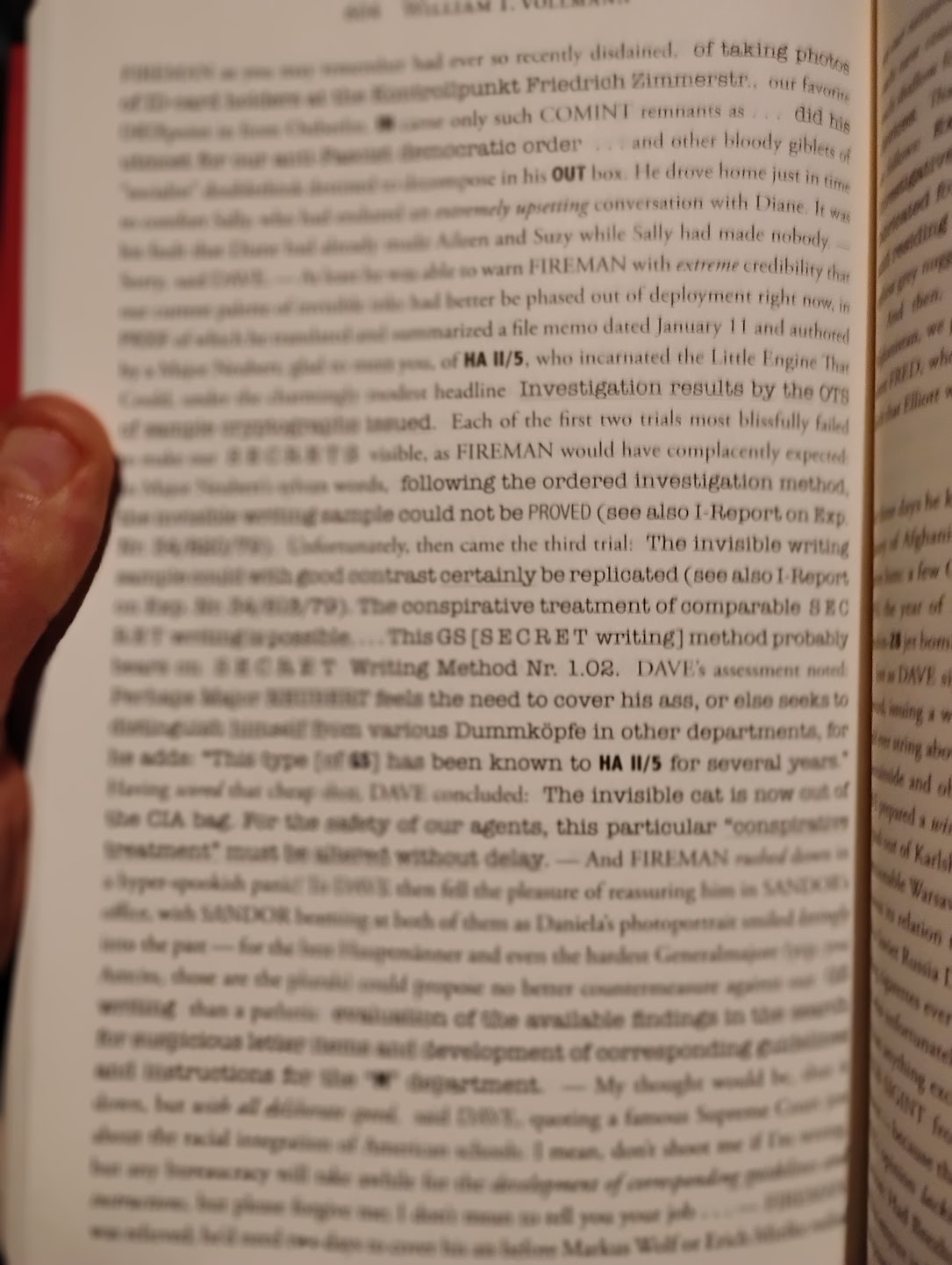
first, let's talk about the fonts. the fucking fonts. here's a sample page:


apparently requiring particular fonts was the blood eagle that broke Viking's back, leading Vollmann to publish with Arcade (an imprint of Skyhorse). personally, that sounds like a cop-out. i imagine he showed up with 2,000 pages looking like this and his editor there ("hopefully still a friend", again from the foreward) looked for a way to send the manuscript to a place from which it might not return. this cutesy shit doesn't really hurt the book, but it certainly doesn't add anything, either. monospaced for document inserts, presumably typed? go for it. REWIND being printed in caps, in letter boxes, with slashes through each letter (the only word receiving this treatment)? that does nothing for me save remind me of House of Leaves, which managed to be pretty good only despite its annoying typography. you went full House of Leaves, vollmann, and you should never go full House of Leaves. what's really objectionable is the horrible, straight up abominable kerning and horizontal spacing, which tends to be worst around these font changes. seriously, it's distracting. look at that page above. look at the em dash before "And FIREMAN", and the em dash seven lines below it. what the fuck is going on here? shit looks like it was laid out in microsoft word. maybe it was. i'm strictly a LaTeX man, and wouldn't know. $200 ought buy me professional layout, not madcap changes of font face.

we've covered roughly 1969 through 1981 in this first volume, and the "main character" has yet to be born. lots of talk of trying to conceive. so very much talk about trying to conceive. DAVE's wife is loathsome pretty much from the time she's introduced. come to think of it, all the women in this book are either loathsome pests or delightful, amusing, forgiving hotties DAVE could have were he ever less than such an upstanding fucking guy. he suffers the twin indignations of his wife refusing to blow him and getting chubby -- "if she didn't stop the snacking and drinking, disgusting" with a brave face. poor DAVE! as Cheese said, "So I'm like, I don't be understandin' how these hoes be actin and shit. So I tell the bitch like either ya suck dick, or ya don't suck dick. Know what I'm sayin?" i'm not sure how that applies, but it's a great line, one DAVE with high medium certainty could learn from. this first volume is basically Stoner if stoner worked at the CIA and john edward williams worked in media of more than 200 pages at a time.

admittedly i'm better read up on the cold war than most people i'll meet, but not much was learned here. i was expecting a really deep dive into angola, but got nothing i didn't already know from the wikipedia page. fun fact: there was a massacre at a place called Jamba, where UNITA was headquartered, and if you reference this in your local Jamba Juice franchise no one will know what the fuck you're talking about. you won't hear about Jamba in A Table for Fortune, though; that's straight from my feed to your eyeballs. if you've read one of the numerous competent histories of the CIA (which if you're only going to read one book about the CIA, skip the general histories and instead make sure you read Blind Man's Bluff), you know most of what vollmann covers, at least in this first volume. i suspect that having read The 9/11 Comission Report, i'll know a good bit of what's coming. we'll see.

the photographs neither seem striking nor informative. they basically seem like what your aunt would post to facebook were she summering in tikrit. a few are so blurry/dark (and uncaptioned!) that i don't really know what they are. again, no value added.

i don't mean to sound so negative. it's not a bad book (volume, anyway). i breezed through it, and enjoyed it. but three more volumes are a lot to wager based on this, and fifteen years seem like they ought have produced something better (especially with that paid researcher!), and i feel a bit embarrassed going around smugly telling people this was going to be the literary event of the decade. i'll likely finish the quartet, but i'm noticeably less excited now.

on a positive note, calling indira gandhi a "leftwing harpy" made me laugh out loud. i'm going to call everyone i meet today a leftwing harpy. "mr black i believe you have a package." "thank you you leftwing harpy!" etc.


---
(at page 210) man the kerning in this book absolutely sucks. i'm not sure i would have noticed it before writing my own, but i can't ignore it now. if you're going to switch fonts and faces around this much, you need to get a good handle on your layout engine! one can tell this book was not written with LaTeX. other than that, pretty good so far, though not as great as i'd hoped. we'll see how it develops. there are a great many characters.

(at page 288) ok if you're gonna say "[Bush] would correct this mistake in a special passage of the PATRIOT Act", you've gotta supply the citation (wtf is a "special passage"?). we can assume Vollmann refers to Section 215, which so far as I understand was left out of the 2015 Freedom Act (jfc), a fact which i feel bears mentioning. never thought i'd find myself defending the PATRIOT act but here we are. i mean, technically i'm not, but this is the first thing i've found that felt actively intellectually dishonest. i wanted to really like this book, and expected to, but i'm getting a bit worried. it's fun thus far for sure, but these ~300 pages hardly justify ~2500. we continue on.

(at page 385) gerald bull seems like an incredibly cool guy

(page 478) raised used where razed was intended, argh

(page 603) "leftwing harpy indira gandhi" made me laugh out loud :D
Displaying 1 - 2 of 2 reviews