

What do you think?

Nature Poems to See By: A Comic Artist Interprets More Great Poetry
This stunning anthology of favorite poems about our relationship with the natural world, visually interpreted by acclaimed comic artist Julian Peters, breathes new life into some of the greatest poems of all time.
These are poems that can change the way we see the environment, and encountering them in graphic form promises to change the way we read the poems. In an age of increasingly visual communication, this format helps unlock the world of poetry and literature for a new generation of reluctant readers and visual learners.
Following the seasons of the year and of life, Nature Poems to See By will also help young readers see themselves differently. A valuable teaching aid appropriate for middle school, high school, and college use, the collection includes favorites from the canon already taught in countless English classes.
This sequel to the artist’s award-winning anthology Poems to See By includes adaptations of poems by Langston Hughes, William Shakespeare, Sylvia Plath, Emily Dickinson, Gerard Manley Hopkins, William Wordsworth, Mary Karr, Robert Frost, Edward Thomas, William Blake, Dylan Thomas, Robert Burns, Rhina P. Espaillat, Joy Harjo, Alfred L. Tennyson, Matsuo Basho, Gwendolyn Brooks, Stevie Smith, Li Po, Carl Sandburg, e. e. cummings, Elizabeth Bishop, and Philip Larkin.
These are poems that can change the way we see the environment, and encountering them in graphic form promises to change the way we read the poems. In an age of increasingly visual communication, this format helps unlock the world of poetry and literature for a new generation of reluctant readers and visual learners.
Following the seasons of the year and of life, Nature Poems to See By will also help young readers see themselves differently. A valuable teaching aid appropriate for middle school, high school, and college use, the collection includes favorites from the canon already taught in countless English classes.
This sequel to the artist’s award-winning anthology Poems to See By includes adaptations of poems by Langston Hughes, William Shakespeare, Sylvia Plath, Emily Dickinson, Gerard Manley Hopkins, William Wordsworth, Mary Karr, Robert Frost, Edward Thomas, William Blake, Dylan Thomas, Robert Burns, Rhina P. Espaillat, Joy Harjo, Alfred L. Tennyson, Matsuo Basho, Gwendolyn Brooks, Stevie Smith, Li Po, Carl Sandburg, e. e. cummings, Elizabeth Bishop, and Philip Larkin.
152 pages, Hardcover
Published March 24, 2026
Ratings & Reviews
Friends & Following
Create a free account to discover what your friends think of this book!
Community Reviews
Displaying 1 - 30 of 81 reviews
December 6, 2025
5★
"The best laid schemes o' mice and men gang aft agley,
An' lea'e us nought but grief an' pain,
For promis'd joy!" Robert Burns
How often have I heard this quoted, misquoted, or at least referred to? It's such handy shorthand to say "Ah… the best laid plans…" when commiserating over an unexpected loss. This is from "To a Mouse, on Turning Her Up in Her Nest With the Plough, November, 1785".
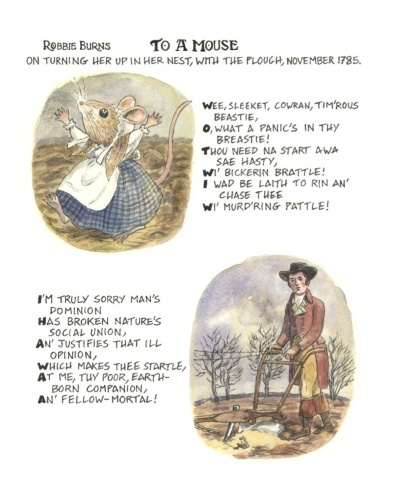
The artist has illustrated each of the eight stanzas with charming, old-fashioned drawings of the apologetic farmer and the rightly miffed Mrs Mouse, in an apron and bonnet. But he consoles himself by saying the mouse is lucky compared to him, because she knows only about the present and not the past or future.
"Still thou art blest, compar'd wi' me
The present only toucheth thee:
But, Och! I backward cast my e'e.
On prospects drear!
An' forward, tho' I canna see,
I guess an' fear!"
The illustrations tell the story, so that even children will get the gist of it, and older kids might figure out some of the words. It's perfect for a group or class discussion. The mouse is a fully-clothed lady, spinning by her little fire when a plough blade begins to poke through her wall.
The book is divided into the four season, with six poems for each, all very different with different styles of illustration. Poets are American, English, Scottish, Welsh, Chinese, and Japanese. Espaillat is Dominican-American.
"To a Mouse" is part of "AUTUMN".
The seasons begin with "SUMMER", and I've chosen the poem "Truth" by Gwendolyn Brooks, the first African-American to win the Pulitzer Prize. Although the poem was written around 1949, and may refer to general fear of the unknown, and 'be careful what you wish for', the artist has chosen to use powerful cartoon art to show how we regard climate change.
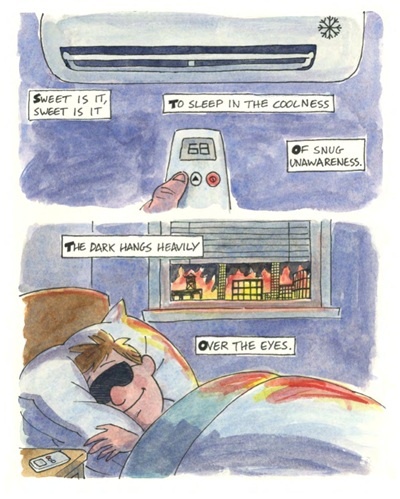
"Sweet is it, sweet is it
To sleep in the coolness
Of snug unawareness.
The dark hangs heavily
Over the eyes" by Gwendolyn Brooks
Then "AUTUMN" (above) and "WINTER", from which I chose a couple of classics.
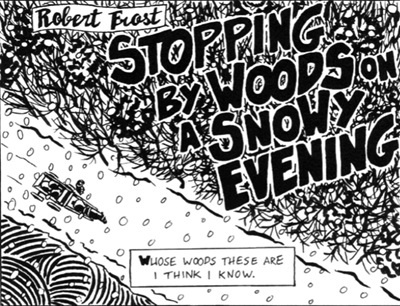
"The woods are lovely, dark and deep,
But I have promises to keep,
And miles to go before I sleep,
And miles to go before I sleep."Robert Frost
Moving from snow to fog. This is a handy one for those who would like to be able to quote but have trouble memorising.
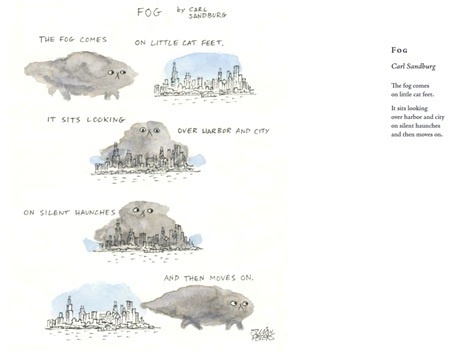
" The fog comes
on little cat feet.
It sits looking
over harbor and city
on silent haunches
and then moves on." by Carl Sandburg
Next a couple from "SPRING"
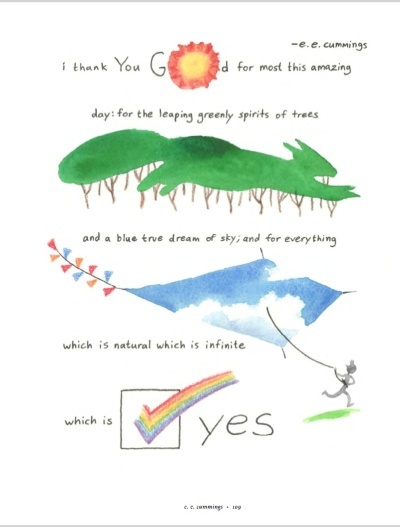
"i thank You God for most this amazing
day:for the leaping greenly spirits of trees
and a blue true dream of sky;and for everything
which is natural which is infinite which is yes" by e.e. cummings
I was delighted by the bright, cheery cartoon illustrations of the mood evoked by William Wordsworth's "I Wandered Lonely as a Cloud." These were not the whimsical images I was expecting for Wordsworth, but they may be closer to how excited he was by what he was imagining.
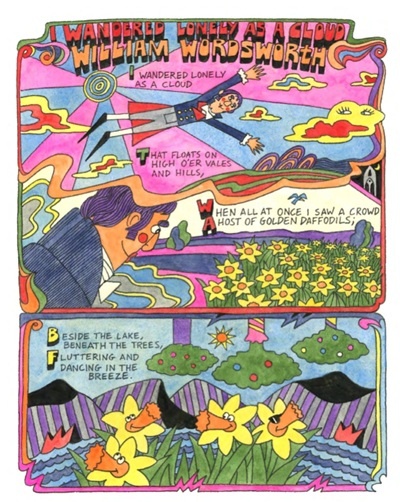
"When all at once I saw a crowd
A host of golden daffodils."
I love books like these, where both your eyes and mind can wander, enjoying the words, the illustrator's interpretation, and then your own interpretation. These may not all be to everyone's taste (what is?), but they are each unique.
Most authors are American or English, with one Scottish, one Welsh, one Chinese, and three Japanese who each wrote a haiku about the moon.
There is a good bibliography at the end, but I wanted more, of course. I found myself googling and looking for biographical material, dates of the poems, and the context in which they may have been written.
Knowing nothing about Gwendolyn Brooks, for example, I thought "Truth" seemed to be about Climate Change. But later, I went down a few rabbit holes and found it was written before 1949, so I was wrong – it was obviously a broader message. However, like all good poetry, its universal nature makes it just as relevant today.
This would be an excellent book club choice, and it's an obvious teaching prompt or tool for classrooms of various ages. It's a companion to the author's previous book, Poems to See by: A Comic Artist Interprets Great Poetry.
Thanks to NetGalley and Plough Publishing for making this available to me for review. Even on a laptop screen, the print is small, and being italicised, it's even harder to read. But the pages are certainly big enough to appreciate the artwork, and the poems are easy to find online. It's available for NetGalley readers until publication.
I think the real book, to be published in March 2026, will be terrific.
"The best laid schemes o' mice and men gang aft agley,
An' lea'e us nought but grief an' pain,
For promis'd joy!" Robert Burns
How often have I heard this quoted, misquoted, or at least referred to? It's such handy shorthand to say "Ah… the best laid plans…" when commiserating over an unexpected loss. This is from "To a Mouse, on Turning Her Up in Her Nest With the Plough, November, 1785".
The artist has illustrated each of the eight stanzas with charming, old-fashioned drawings of the apologetic farmer and the rightly miffed Mrs Mouse, in an apron and bonnet. But he consoles himself by saying the mouse is lucky compared to him, because she knows only about the present and not the past or future.
"Still thou art blest, compar'd wi' me
The present only toucheth thee:
But, Och! I backward cast my e'e.
On prospects drear!
An' forward, tho' I canna see,
I guess an' fear!"
The illustrations tell the story, so that even children will get the gist of it, and older kids might figure out some of the words. It's perfect for a group or class discussion. The mouse is a fully-clothed lady, spinning by her little fire when a plough blade begins to poke through her wall.
The book is divided into the four season, with six poems for each, all very different with different styles of illustration. Poets are American, English, Scottish, Welsh, Chinese, and Japanese. Espaillat is Dominican-American.
"To a Mouse" is part of "AUTUMN".
The seasons begin with "SUMMER", and I've chosen the poem "Truth" by Gwendolyn Brooks, the first African-American to win the Pulitzer Prize. Although the poem was written around 1949, and may refer to general fear of the unknown, and 'be careful what you wish for', the artist has chosen to use powerful cartoon art to show how we regard climate change.
"Sweet is it, sweet is it
To sleep in the coolness
Of snug unawareness.
The dark hangs heavily
Over the eyes" by Gwendolyn Brooks
Then "AUTUMN" (above) and "WINTER", from which I chose a couple of classics.
"The woods are lovely, dark and deep,
But I have promises to keep,
And miles to go before I sleep,
And miles to go before I sleep."Robert Frost
Moving from snow to fog. This is a handy one for those who would like to be able to quote but have trouble memorising.
" The fog comes
on little cat feet.
It sits looking
over harbor and city
on silent haunches
and then moves on." by Carl Sandburg
Next a couple from "SPRING"
"i thank You God for most this amazing
day:for the leaping greenly spirits of trees
and a blue true dream of sky;and for everything
which is natural which is infinite which is yes" by e.e. cummings
I was delighted by the bright, cheery cartoon illustrations of the mood evoked by William Wordsworth's "I Wandered Lonely as a Cloud." These were not the whimsical images I was expecting for Wordsworth, but they may be closer to how excited he was by what he was imagining.
"When all at once I saw a crowd
A host of golden daffodils."
I love books like these, where both your eyes and mind can wander, enjoying the words, the illustrator's interpretation, and then your own interpretation. These may not all be to everyone's taste (what is?), but they are each unique.
Most authors are American or English, with one Scottish, one Welsh, one Chinese, and three Japanese who each wrote a haiku about the moon.
There is a good bibliography at the end, but I wanted more, of course. I found myself googling and looking for biographical material, dates of the poems, and the context in which they may have been written.
Knowing nothing about Gwendolyn Brooks, for example, I thought "Truth" seemed to be about Climate Change. But later, I went down a few rabbit holes and found it was written before 1949, so I was wrong – it was obviously a broader message. However, like all good poetry, its universal nature makes it just as relevant today.
This would be an excellent book club choice, and it's an obvious teaching prompt or tool for classrooms of various ages. It's a companion to the author's previous book, Poems to See by: A Comic Artist Interprets Great Poetry.
Thanks to NetGalley and Plough Publishing for making this available to me for review. Even on a laptop screen, the print is small, and being italicised, it's even harder to read. But the pages are certainly big enough to appreciate the artwork, and the poems are easy to find online. It's available for NetGalley readers until publication.
I think the real book, to be published in March 2026, will be terrific.

June 18, 2026
This was a big gamble on my part. I am not a huge fan of poetry, so was hopeful that a book that melded different art styles to different poems might work for me.
It did and it didn't. If the artwork didn't make sense to me pair with a particular poem, it was a miss. But when it was on, it was ON. The one that really hit me was Stevie Smith's "Not Waving, but Drowning". The haiku, Robert Frost's "Stopping by the Woods on a Snowy Evening", Shakespeare, "Shall I Compare Thee to a Summer's Day" and Tennyson's "The Eagle" also worked very well for me.
So, while this book didn't make me a die-hard fan of poetry, it did enhance my enjoyment of it, so 3.5 stars, rounded up, as I plan on adding the finished version to my personal library. I also recommend it to other poetry-cautious readers, as well as poetry fans who would like to see something a little bit different in how the poetry they know can be displayed.
4, I'm not a believer but I am now poetry-curious, stars.
My thanks to NetGalley and Plough Publishing House for an eARC of this book to read and review.
It did and it didn't. If the artwork didn't make sense to me pair with a particular poem, it was a miss. But when it was on, it was ON. The one that really hit me was Stevie Smith's "Not Waving, but Drowning". The haiku, Robert Frost's "Stopping by the Woods on a Snowy Evening", Shakespeare, "Shall I Compare Thee to a Summer's Day" and Tennyson's "The Eagle" also worked very well for me.
So, while this book didn't make me a die-hard fan of poetry, it did enhance my enjoyment of it, so 3.5 stars, rounded up, as I plan on adding the finished version to my personal library. I also recommend it to other poetry-cautious readers, as well as poetry fans who would like to see something a little bit different in how the poetry they know can be displayed.
4, I'm not a believer but I am now poetry-curious, stars.
My thanks to NetGalley and Plough Publishing House for an eARC of this book to read and review.
This entire review has been hidden because of spoilers.

April 7, 2026
It's taken five years, but Julian Peters has finally published a follow-up to his excellent book Poems to See by: A Comic Artist Interprets Great Poetry, wherein he created visual interpretations of well-known poems. This second volume continues in that same vein with a focus on nature-themed poems from a diverse set of writers, such as Joy Harjo, Li Po, and Dylan Thomas.
As with the first book, Peters adopts his graphic style to each poem, so that the visual look of each one is unique and specific to that text. For Wordsworth's "I Wandered Lonely as a Cloud" he uses a cartoony, psychedelic approach reminiscent of George Dunning's film of the The Beatles' Yellow Submarine, while the presentation of Sylvia Plath's "Mushrooms" utilizes photographic collage with small painted overlays in simple shapes. The range of Peters' visual talent is impressive, and his genuine love for each selected poem is evident.
As with the first book, Peters adopts his graphic style to each poem, so that the visual look of each one is unique and specific to that text. For Wordsworth's "I Wandered Lonely as a Cloud" he uses a cartoony, psychedelic approach reminiscent of George Dunning's film of the The Beatles' Yellow Submarine, while the presentation of Sylvia Plath's "Mushrooms" utilizes photographic collage with small painted overlays in simple shapes. The range of Peters' visual talent is impressive, and his genuine love for each selected poem is evident.

April 19, 2026
Such a unique way of highlighting poetry. I enjoyed the drawings so much!
Thank you to Ingram Books for sending me this beautiful edition!
Thank you to Ingram Books for sending me this beautiful edition!

March 24, 2026
"Nature Poems to See By" is a visually stunning anthology that breathes new life into classic poems through thoughtful and often playful illustrations.
What stood out most to me was how the artwork deepened my experience of certain poems—especially those that are quiet, reflective, and layered beneath their simplicity. Pieces like “Truth” by Gwendolyn Brooks, “Not Waving but Drowning” by Stevie Smith, “Fog” by Carl Sandburg, “The Eagle” by Alfred Lord Tennyson, and “Stopping by Woods on a Snowy Evening” by Robert Frost became especially vivid through their visual interpretations. The illustrations didn’t just decorate the poems—they revealed them.
I also encountered poets I had never heard of, e.g., Gwendolyn Brooks. Her poem seems so timeless! It could apply to any topic in any era. It fits the 1960s in which it was written as much as our climate change discussions nowadays.
While not every poem resonated with me on the same emotional level, even those I felt less connected to were made more accessible and engaging through the artwork. The format invites readers to slow down, observe, and experience poetry in a more embodied way.
Overall, this collection is a beautiful bridge between visual art and poetry. It’s especially rewarding for readers who appreciate subtle, contemplative poems that unfold gently but leave a lasting impression.
What stood out most to me was how the artwork deepened my experience of certain poems—especially those that are quiet, reflective, and layered beneath their simplicity. Pieces like “Truth” by Gwendolyn Brooks, “Not Waving but Drowning” by Stevie Smith, “Fog” by Carl Sandburg, “The Eagle” by Alfred Lord Tennyson, and “Stopping by Woods on a Snowy Evening” by Robert Frost became especially vivid through their visual interpretations. The illustrations didn’t just decorate the poems—they revealed them.
I also encountered poets I had never heard of, e.g., Gwendolyn Brooks. Her poem seems so timeless! It could apply to any topic in any era. It fits the 1960s in which it was written as much as our climate change discussions nowadays.
While not every poem resonated with me on the same emotional level, even those I felt less connected to were made more accessible and engaging through the artwork. The format invites readers to slow down, observe, and experience poetry in a more embodied way.
Overall, this collection is a beautiful bridge between visual art and poetry. It’s especially rewarding for readers who appreciate subtle, contemplative poems that unfold gently but leave a lasting impression.

Read
May 29, 2026I got this book expecting a collection of nature poems and some wonderful art to go with them. Though the majority of the poems reference nature for some calling it a nature poem is a stretch. The poems are divided by seasons but another issue is that most of the poems make no reference to any season. Since most of the poems could belong to any season I think it's a dumb way to divide them.
My other problem is the art for each poem that covers a variety of different styles so each one has a unique look. It could have worked but some of the art didn't fit the poem and seemed to have very little to do with the words. Out of all of the illustrations I only found one or two that I could say I really liked.
I was planning on reading the author's other book of poetry but the disappointment of this book changed my mind.
My other problem is the art for each poem that covers a variety of different styles so each one has a unique look. It could have worked but some of the art didn't fit the poem and seemed to have very little to do with the words. Out of all of the illustrations I only found one or two that I could say I really liked.
I was planning on reading the author's other book of poetry but the disappointment of this book changed my mind.

March 4, 2026
Thank you netgalley for an ARC in exchange for a review!
I absolutely adore all forms of poetry, so I was really excited to pick this up.
It was great to experience all of the colorful and detailed illustrations, in many different, varying styles.
I believe that books like this are very important, especially for introducing poetry to people who might not read poetry already, it’s a great introduction to this golden aspect of literature. I think it brings people together. I hope more people get a hold of it.
I absolutely adore all forms of poetry, so I was really excited to pick this up.
It was great to experience all of the colorful and detailed illustrations, in many different, varying styles.
I believe that books like this are very important, especially for introducing poetry to people who might not read poetry already, it’s a great introduction to this golden aspect of literature. I think it brings people together. I hope more people get a hold of it.
This entire review has been hidden because of spoilers.

June 27, 2026
Beautiful artwork and lovely poems!!

Review of advance copy received from Netgalley
From Dew to Fog, From Utopia to Smudge: “Nature Poems to See By” Maps the Natural World as Our Most Human Mirror
By Demetris Papadimitropoulos | February 25th, 2026
Julian Peters opens “Nature Poems to See By” with a small act of corrective humility. In the preface, he admits that a line he once wrote – that a beautiful poem is “pretty much the most beautiful creation I can imagine” – needed revision. Poems are human splendors, yes, but nature is “in a whole other league,” so abundant and omnipresent that we cease to notice it. One function of art, he argues, is to return our attention to what familiarity has dulled, to help us see the world “afresh, as if with new eyes.” This sequel to “Poems to See By” takes that credo seriously, not only by gathering canonical poems about the natural world, but by treating each one as a practical exercise in perception: a visual translation into comics, followed by the poem in its original form, so the reader can toggle between the seen and the said, and measure the difference.
That structure is more than a pedagogical courtesy. It is the book’s quiet thesis about reading itself. We like to pretend that poetry arrives directly into the mind, unmediated. But Peters insists – implicitly, page after page – that reading is always already an act of imagining, a private cinema in which line breaks become cuts, metaphors become lighting cues, and a single image can rewrite the emotional weather of an entire stanza. By placing his comics first, then returning us to the unillustrated poem, he reverses the usual hierarchy. The illustration is not decoration; it is an argument. And the poem, reencountered afterward, becomes newly audible, as if the page itself has changed pressure.
The anthology is organized by seasons: Summer, Autumn, Winter, Spring. That’s an elegant conceit that could have remained merely decorative, a way of moving the reader through a year’s worth of mood. But Peters’ selection – six poems per season – builds a genuine arc from innocence toward consequence, from attention toward ethics, from wonder toward a more chastened, hard-won kind of affirmation. The book’s pleasures are real and immediate: clean layouts with generous white space, shifts in style and media that keep the eye awake, and a curator’s ear for poems that can still startle even after long familiarity. Yet the deeper pleasure is how the seasonal structure becomes a narrative of consciousness. Summer begins with dawn and longing; Autumn introduces labor, violence, and community pressure; Winter pares the world down to moon, fog, mountain, and misread signals; Spring returns with gratitude that remembers it has been endangered.
Consider the way the book opens, with Langston Hughes’ “Daybreak in Alabama.” Hughes imagines himself becoming “a colored composer,” writing “the purtiest songs” about daybreak in Alabama, rising “like a swamp mist” and falling “like soft dew.” The poem is a sensorial inventory – pine needles, red clay after rain – but also a social vision. Hughes populates his dawn with “big brown arms,” “poppy colored faces,” and “field daisy eyes / of black and white black white black people,” then moves toward a tactile, almost sacramental image: “white hands / and black hands and brown and yellow hands and red clay earth hands” touching everybody “with kind fingers,” “natural as dew.” Nature isn’t a backdrop; it’s a moral model: if the morning can be common, so can the world.
Peters’ comics adaptation of Hughes reads as an act of faith in the communicative power of the image – a faith that feels newly resonant in an era when public language is continually weaponized, and when attention itself is treated like an extractable resource. Without naming contemporary platforms, the book’s preface already gestures toward the threat: “insidious new technologies” that undermine the human creative impulse. That line lands now with a double edge. On one side lies the everyday experience of automated language, synthetic imagery, and the subtle deadening that can come from outsourcing imagination. On the other lies the more urgent ecological fear: “our natural environment is being poisoned, dismembered, and depleted at a tremendous pace.” Peters quotes William Blake: “To the eyes of a man of imagination, nature is imagination itself.” If nature and imagination are linked, he suggests, we are in danger of losing both.
The choice to include Blake’s “And Did Those Feet in Ancient Time” – the anthem often called “Jerusalem” – is a canny way of threading this anxiety into the canon. The poem’s pastoral opening (“England’s mountains green”) turns quickly to indictment: “dark Satanic Mills.” Blake’s speaker calls for weapons not to destroy, but to build: “Bring me my Bow of burning gold,” “Bring me my Chariot of fire.” The true battlefield is mental: “I will not cease from Mental Fight.” In Peters’ hands, the poem becomes less a nationalist hymn than a study in conflicted landscape – the green and pleasant land shadowed by industry’s grim architecture. It is hard not to read “dark Satanic mills” as an endlessly updating image, flexible enough to encompass smokestacks, server farms, and the invisible mills of extraction and attention that hum behind our screens.
Summer’s other selections complicate brightness with memory and unease. Edward Thomas’ “Adlestrop” records an “unwonted” stop of an express train on a late June afternoon. Nothing “happens,” and that is precisely the point. “No one left and no one came / On the bare platform.” What remains is the name itself, and then the surrounding vegetation – willows, willow-herb, meadowsweet – and finally the blackbird’s song expanding outward, “mistier, / farther and farther.” It’s a poem of stillness, an argument that the most negligible interruption can become a lifelong possession. In a culture trained to scroll past what doesn’t immediately declare itself, “Adlestrop” feels like a corrective: attention as an ethic, not a hobby.
Gwendolyn Brooks’ “Truth” turns that ethic darker. “And if the sun comes / How shall we greet him?” Brooks imagines sunlight as something we might dread after a “lengthy… session with shade.” Truth arrives not as a gentle illumination but as “fierce hammering / hard on the door.” Better, perhaps, to flee into “the dear thick shelter / of the familiar / propitious haze.” Brooks’ poem reads like a parable for our present information climate – the comfort of curated haze, the dread of exposure, the sweetness of “snug unawareness.” Peters’ book never becomes a polemic, but it doesn’t need to. Brooks has already written the emotional mechanics of denial.
Dylan Thomas’ “Fern Hill” closes the Summer suite with one of the most intoxicating hymns to childhood ever written – green and gold, barns and hayfields, owls bearing the farm away. Yet even here, Time is the presiding presence, granting joy “in the mercy of his means.” The poem’s final turn is devastating: “Time held me green and dying / Though I sang in my chains like the sea.” That line – green and dying – could serve as a refrain for the whole anthology, a reminder that nature’s radiance is inseparable from time’s taking.
Autumn is where the book begins to press its moral thumb harder against the page. Sylvia Plath’s “Mushrooms” is a stealth uprising. “Overnight, very whitely, discreetly,” the mushrooms take hold, “very quietly,” pushing through loam and even “the paving.” They are “earless and eyeless,” “perfectly voiceless,” and yet their “soft fists insist.” They multiply. They “shall by morning / inherit the earth.” “Our foot’s in the door.” Plath’s genius here is to make meekness tactical. The poem’s collective voice – so many of us – reads as both feminist parable and broader political fable: change as quiet pressure, not spectacle. In the current era of labor organizing, mutual aid, and grassroots movements that accrue force before they become visible, Plath’s mushrooms feel less like metaphor than like method.
Emily Dickinson’s storm poem, “There Came a Wind Like a Bugle,” follows with omen and electricity. The wind “quivered through the grass,” and a “green chill upon the heat” passes “ominous.” The “doom’s electric moccasin” arrives; trees pant as a “strange / mob.” Rivers run where houses ran. And yet Dickinson ends with a kind of fierce calm: “How much can come / and much can go, / and yet abide the world!” It’s a line that could be read today as an attempt to hold steadiness amid increasingly regular upheaval. The poem doesn’t deny catastrophe; it simply refuses to grant catastrophe the final claim on meaning.
Robert Burns’ “To a Mouse” brings the scale down to the field and the plough. Burns overturns a mouse’s nest, then apologizes for “Man’s dominion” breaking “Nature’s social union.” The poem is a masterpiece of ethical imagination: the recognition that harm can be accidental and still require confession. It also delivers that grimly famous line: “The best laid schemes o’ mice an’ men / gang aft agley.” Plans fail. Homes are destroyed. Winter comes. The mouse, Burns admits, may be better off than the human, because the mouse is touched only by the present, while the human is haunted by backward grief and forward fear. In an era of precarity – climate, economy, health – the poem’s uneasy humility feels newly legible.
Rhina P. Espaillat’s “Butchering” is one of the collection’s quiet shocks. It sketches a grandmother “toughened by the farm,” “hardened by infants’ burials,” able to swing a knife and axe “as if her woman’s arm / wielded a man’s hard will.” She tends the sick, washes the dead. But she falters when describing the cows sensing their calves are marked for slaughter. “Their wordless / eloquence / impossible to still with anything – sweet clover, or her unremitting / care.” The poem doesn’t sentimentalize; it reveals the limit of toughness, the bruise inside competence. In a culture that has recently begun to speak more openly about inherited trauma, about how survival habits persist long after their original necessity, Espaillat’s grandmother is an emblem of care shaped by loss.
Joy Harjo’s “This Land Is a Poem” turns from inherited hardness to humility before the earth. The land is “ochre and burnt sand,” a poem she could never write unless “paper were the sacrament of sky” and ink were “the broken line of / wild horses staggering the horizon.” Even then she asks: “does anything written ever matter to / the earth, / wind, / and sky?” It’s a question that hangs over every artistic response to ecological crisis: What is the moral weight of art when the world is burning? Peters doesn’t answer; he stages the question in the very act of making, refusing both despair and self-congratulation.
Mary Karr’s “The Voice of God” offers a bracing tonal shift: God speaking from “the bowels of the subway,” insisting that ninety percent of what’s wrong with you could be cured with a hot bath. No five-year plan. No long-term solution. Just small, fond, local instructions. “Put down that gun, you need a sandwich.” In the midst of American public life – where violence and spectacle often crowd out basic care – Karr’s poem is an anti-theology of common sense. It suggests that transcendence may arrive not as cosmic revelation but as the obvious thing we refuse to do. Peters’ decision to include a poem that begins underground, in a subway, also widens the anthology’s definition of “nature.” Nature is not only forest and field; it’s the animal fact of bodies that need warmth, food, rest.
Winter strips the world to essentials, and the comics medium shines here, because comics excel at the eloquence of minimal gesture. The three haiku about the moon – Basho, Shiki, Choshu – arrive as tiny instruments for calibrating attention. Clouds “give rest to the moon-beholders.” A monkey contemplates how to catch hold of the moon. The moon in water breaks and breaks again, “still it is there.” These poems are lessons in non-ownership, in the persistence of the real beneath shattered reflection. In a time when images are endlessly reproducible, endlessly manipulable, the haiku insist on something older: the moon is not content. It is presence.
Tennyson’s “The Eagle” is power distilled: he clasps the crag, ring’d with azure, watching from mountain walls, then falling “like a thunderbolt.” Frost’s “Stopping by Woods on a Snowy Evening” is temptation and duty in perfect balance: the woods lovely, dark, deep; the traveler drawn toward stillness; the horse ringing its harness bells as if to ask whether the stop is a mistake; the closing insistence of “miles to go before I sleep.” Stevie Smith’s “Not Waving but Drowning” is the season’s social tragedy: a distress signal misread as play, a life spent “much too far out.” Li Po’s “Alone Looking at the Mountain” offers the counterpoint, solitude as companionship: birds and clouds depart, and the speaker sits with the peak, neither growing tired of the other. Sandburg’s “Fog” ends the winter suite with a small, perfect animal metaphor: fog comes on “little cat feet,” sits looking over harbor and city, then moves on. It’s a poem about transience, but also about quiet authority – how the world can change shape without noise.
Spring returns not as naive brightness, but as a deliberate reopening. E. E. Cummings’ “i thank You God for most this amazing” is one of the great poems of gratitude in English, and it reads here like resurrection without doctrine. “i who have died am alive again today,” he writes, and the day becomes the sun’s birthday, the birth day of life and love and wings. The poem ends with perception itself awakening: “now the ears of my ears awake and / now the eyes of my eyes are opened.” In the context of Peters’ preface, that opening is almost a manifesto. The book wants to reopen our senses against numbness.
Elizabeth Bishop’s “Sandpiper” is the spring poem that refuses serenity. The bird runs in “controlled panic,” obsessed with the spaces between grains, a “student of Blake.” The world becomes mist, then minute and vast and clear. The tide is higher or lower; he cannot tell. His beak is focused; he is looking for something, something, something. Bishop captures the mind’s compulsive hunger for detail, the way attention can become both survival strategy and trap. It is hard not to hear the modern mind in that bird – scanning, searching, preoccupied – even while the ocean roars beside it, taken for granted.
Christina Rossetti’s “A Birthday” returns pleasure with ornament: heart like a singing bird, an apple-tree bent with fruit, a rainbow shell in a halcyon sea. “Because my love is come to me,” she demands a dais of silk and down, purple dyes, doves, pomegranates, peacocks with a hundred eyes. The poem is an ecstatic insistence that joy deserves craft, that beauty should be built. Philip Larkin’s “The Trees” complicates spring with grief: trees coming into leaf “like something almost being said,” greenness as grief, because their rebirth makes us think of our aging. Yet Larkin refuses to surrender: “Begin afresh, afresh, afresh.” Wordsworth’s daffodils offer the classic bargain of memory: the flowers return later, unbidden, to the inward eye, and the heart dances again. Hopkins’ “God’s Grandeur” closes the anthology with its double vision: the world charged with God’s grandeur, flaming out like shook foil, and yet all is seared with trade, bleared, smeared with toil. Still: “nature is never spent.” There lives “the dearest freshness deep down things.” Morning springs because the Holy Ghost broods with bright wings. In the era Peters names in his preface – a time of smudge, of depletion, of threatened imagination – Hopkins offers a theology of replenishment without denial.
If “Nature Poems to See By” sometimes falls short of perfection, it does so because its strength is also its risk. Peters embraces a wide variety of visual approaches, honoring the diversity of the source material. The result is a gallery of styles, a restless showcase of modes. That variety is exhilarating, and it suits a collection spanning Hughes to Basho, Plath to Harjo. Yet it can also produce a mild sense of channel-switching. Some readers may crave a more unified aesthetic world – a single visual atmosphere that binds the book as one continuous artifact rather than a curated portfolio. Peters’ commitment is principled, and in many cases it’s precisely what keeps the book awake. But the cost of variety is occasional discontinuity.
Still, what the book accomplishes is rare: it makes classic poems feel not merely accessible but newly unstable, as if their meanings could shift under the pressure of a different medium. It belongs, in that sense, to the lineage of ambitious adaptation anthologies like “The Graphic Canon,” while remaining more intimate and more disciplined in its focus. It also sits comfortably beside poetry-comics projects such as “Embodied: An Intersectional Comics Poetry Anthology,” though Peters’ method is less collaborative and more curatorial – a single sensibility moving through many voices. And it stands in direct conversation with its predecessor, “Poems to See By,” expanding the first book’s premise into a seasonal ecology of attention.
Perhaps the deepest compliment to “Nature Poems to See By” is that it makes you want to test your own seeing. You finish a poem and find yourself looking at the nearest tree, the nearest patch of sky, the nearest weathered sidewalk crack, as if it might contain a line you haven’t learned to read yet. That is Peters’ hope: that the poems he has illustrated can help us open our eyes in time. Not to escape the world, but to return to it – to notice the dew, the red clay after rain, the fog’s cat feet, the daffodils stored behind the eyelids, the charged foil of morning. In a culture increasingly tempted by substitution – synthetic image, automated voice, mediated attention – this book insists on the old-fashioned, radical act of looking.
Rating: 89/100
By Demetris Papadimitropoulos | February 25th, 2026
Julian Peters opens “Nature Poems to See By” with a small act of corrective humility. In the preface, he admits that a line he once wrote – that a beautiful poem is “pretty much the most beautiful creation I can imagine” – needed revision. Poems are human splendors, yes, but nature is “in a whole other league,” so abundant and omnipresent that we cease to notice it. One function of art, he argues, is to return our attention to what familiarity has dulled, to help us see the world “afresh, as if with new eyes.” This sequel to “Poems to See By” takes that credo seriously, not only by gathering canonical poems about the natural world, but by treating each one as a practical exercise in perception: a visual translation into comics, followed by the poem in its original form, so the reader can toggle between the seen and the said, and measure the difference.
That structure is more than a pedagogical courtesy. It is the book’s quiet thesis about reading itself. We like to pretend that poetry arrives directly into the mind, unmediated. But Peters insists – implicitly, page after page – that reading is always already an act of imagining, a private cinema in which line breaks become cuts, metaphors become lighting cues, and a single image can rewrite the emotional weather of an entire stanza. By placing his comics first, then returning us to the unillustrated poem, he reverses the usual hierarchy. The illustration is not decoration; it is an argument. And the poem, reencountered afterward, becomes newly audible, as if the page itself has changed pressure.
The anthology is organized by seasons: Summer, Autumn, Winter, Spring. That’s an elegant conceit that could have remained merely decorative, a way of moving the reader through a year’s worth of mood. But Peters’ selection – six poems per season – builds a genuine arc from innocence toward consequence, from attention toward ethics, from wonder toward a more chastened, hard-won kind of affirmation. The book’s pleasures are real and immediate: clean layouts with generous white space, shifts in style and media that keep the eye awake, and a curator’s ear for poems that can still startle even after long familiarity. Yet the deeper pleasure is how the seasonal structure becomes a narrative of consciousness. Summer begins with dawn and longing; Autumn introduces labor, violence, and community pressure; Winter pares the world down to moon, fog, mountain, and misread signals; Spring returns with gratitude that remembers it has been endangered.
Consider the way the book opens, with Langston Hughes’ “Daybreak in Alabama.” Hughes imagines himself becoming “a colored composer,” writing “the purtiest songs” about daybreak in Alabama, rising “like a swamp mist” and falling “like soft dew.” The poem is a sensorial inventory – pine needles, red clay after rain – but also a social vision. Hughes populates his dawn with “big brown arms,” “poppy colored faces,” and “field daisy eyes / of black and white black white black people,” then moves toward a tactile, almost sacramental image: “white hands / and black hands and brown and yellow hands and red clay earth hands” touching everybody “with kind fingers,” “natural as dew.” Nature isn’t a backdrop; it’s a moral model: if the morning can be common, so can the world.
Peters’ comics adaptation of Hughes reads as an act of faith in the communicative power of the image – a faith that feels newly resonant in an era when public language is continually weaponized, and when attention itself is treated like an extractable resource. Without naming contemporary platforms, the book’s preface already gestures toward the threat: “insidious new technologies” that undermine the human creative impulse. That line lands now with a double edge. On one side lies the everyday experience of automated language, synthetic imagery, and the subtle deadening that can come from outsourcing imagination. On the other lies the more urgent ecological fear: “our natural environment is being poisoned, dismembered, and depleted at a tremendous pace.” Peters quotes William Blake: “To the eyes of a man of imagination, nature is imagination itself.” If nature and imagination are linked, he suggests, we are in danger of losing both.
The choice to include Blake’s “And Did Those Feet in Ancient Time” – the anthem often called “Jerusalem” – is a canny way of threading this anxiety into the canon. The poem’s pastoral opening (“England’s mountains green”) turns quickly to indictment: “dark Satanic Mills.” Blake’s speaker calls for weapons not to destroy, but to build: “Bring me my Bow of burning gold,” “Bring me my Chariot of fire.” The true battlefield is mental: “I will not cease from Mental Fight.” In Peters’ hands, the poem becomes less a nationalist hymn than a study in conflicted landscape – the green and pleasant land shadowed by industry’s grim architecture. It is hard not to read “dark Satanic mills” as an endlessly updating image, flexible enough to encompass smokestacks, server farms, and the invisible mills of extraction and attention that hum behind our screens.
Summer’s other selections complicate brightness with memory and unease. Edward Thomas’ “Adlestrop” records an “unwonted” stop of an express train on a late June afternoon. Nothing “happens,” and that is precisely the point. “No one left and no one came / On the bare platform.” What remains is the name itself, and then the surrounding vegetation – willows, willow-herb, meadowsweet – and finally the blackbird’s song expanding outward, “mistier, / farther and farther.” It’s a poem of stillness, an argument that the most negligible interruption can become a lifelong possession. In a culture trained to scroll past what doesn’t immediately declare itself, “Adlestrop” feels like a corrective: attention as an ethic, not a hobby.
Gwendolyn Brooks’ “Truth” turns that ethic darker. “And if the sun comes / How shall we greet him?” Brooks imagines sunlight as something we might dread after a “lengthy… session with shade.” Truth arrives not as a gentle illumination but as “fierce hammering / hard on the door.” Better, perhaps, to flee into “the dear thick shelter / of the familiar / propitious haze.” Brooks’ poem reads like a parable for our present information climate – the comfort of curated haze, the dread of exposure, the sweetness of “snug unawareness.” Peters’ book never becomes a polemic, but it doesn’t need to. Brooks has already written the emotional mechanics of denial.
Dylan Thomas’ “Fern Hill” closes the Summer suite with one of the most intoxicating hymns to childhood ever written – green and gold, barns and hayfields, owls bearing the farm away. Yet even here, Time is the presiding presence, granting joy “in the mercy of his means.” The poem’s final turn is devastating: “Time held me green and dying / Though I sang in my chains like the sea.” That line – green and dying – could serve as a refrain for the whole anthology, a reminder that nature’s radiance is inseparable from time’s taking.
Autumn is where the book begins to press its moral thumb harder against the page. Sylvia Plath’s “Mushrooms” is a stealth uprising. “Overnight, very whitely, discreetly,” the mushrooms take hold, “very quietly,” pushing through loam and even “the paving.” They are “earless and eyeless,” “perfectly voiceless,” and yet their “soft fists insist.” They multiply. They “shall by morning / inherit the earth.” “Our foot’s in the door.” Plath’s genius here is to make meekness tactical. The poem’s collective voice – so many of us – reads as both feminist parable and broader political fable: change as quiet pressure, not spectacle. In the current era of labor organizing, mutual aid, and grassroots movements that accrue force before they become visible, Plath’s mushrooms feel less like metaphor than like method.
Emily Dickinson’s storm poem, “There Came a Wind Like a Bugle,” follows with omen and electricity. The wind “quivered through the grass,” and a “green chill upon the heat” passes “ominous.” The “doom’s electric moccasin” arrives; trees pant as a “strange / mob.” Rivers run where houses ran. And yet Dickinson ends with a kind of fierce calm: “How much can come / and much can go, / and yet abide the world!” It’s a line that could be read today as an attempt to hold steadiness amid increasingly regular upheaval. The poem doesn’t deny catastrophe; it simply refuses to grant catastrophe the final claim on meaning.
Robert Burns’ “To a Mouse” brings the scale down to the field and the plough. Burns overturns a mouse’s nest, then apologizes for “Man’s dominion” breaking “Nature’s social union.” The poem is a masterpiece of ethical imagination: the recognition that harm can be accidental and still require confession. It also delivers that grimly famous line: “The best laid schemes o’ mice an’ men / gang aft agley.” Plans fail. Homes are destroyed. Winter comes. The mouse, Burns admits, may be better off than the human, because the mouse is touched only by the present, while the human is haunted by backward grief and forward fear. In an era of precarity – climate, economy, health – the poem’s uneasy humility feels newly legible.
Rhina P. Espaillat’s “Butchering” is one of the collection’s quiet shocks. It sketches a grandmother “toughened by the farm,” “hardened by infants’ burials,” able to swing a knife and axe “as if her woman’s arm / wielded a man’s hard will.” She tends the sick, washes the dead. But she falters when describing the cows sensing their calves are marked for slaughter. “Their wordless / eloquence / impossible to still with anything – sweet clover, or her unremitting / care.” The poem doesn’t sentimentalize; it reveals the limit of toughness, the bruise inside competence. In a culture that has recently begun to speak more openly about inherited trauma, about how survival habits persist long after their original necessity, Espaillat’s grandmother is an emblem of care shaped by loss.
Joy Harjo’s “This Land Is a Poem” turns from inherited hardness to humility before the earth. The land is “ochre and burnt sand,” a poem she could never write unless “paper were the sacrament of sky” and ink were “the broken line of / wild horses staggering the horizon.” Even then she asks: “does anything written ever matter to / the earth, / wind, / and sky?” It’s a question that hangs over every artistic response to ecological crisis: What is the moral weight of art when the world is burning? Peters doesn’t answer; he stages the question in the very act of making, refusing both despair and self-congratulation.
Mary Karr’s “The Voice of God” offers a bracing tonal shift: God speaking from “the bowels of the subway,” insisting that ninety percent of what’s wrong with you could be cured with a hot bath. No five-year plan. No long-term solution. Just small, fond, local instructions. “Put down that gun, you need a sandwich.” In the midst of American public life – where violence and spectacle often crowd out basic care – Karr’s poem is an anti-theology of common sense. It suggests that transcendence may arrive not as cosmic revelation but as the obvious thing we refuse to do. Peters’ decision to include a poem that begins underground, in a subway, also widens the anthology’s definition of “nature.” Nature is not only forest and field; it’s the animal fact of bodies that need warmth, food, rest.
Winter strips the world to essentials, and the comics medium shines here, because comics excel at the eloquence of minimal gesture. The three haiku about the moon – Basho, Shiki, Choshu – arrive as tiny instruments for calibrating attention. Clouds “give rest to the moon-beholders.” A monkey contemplates how to catch hold of the moon. The moon in water breaks and breaks again, “still it is there.” These poems are lessons in non-ownership, in the persistence of the real beneath shattered reflection. In a time when images are endlessly reproducible, endlessly manipulable, the haiku insist on something older: the moon is not content. It is presence.
Tennyson’s “The Eagle” is power distilled: he clasps the crag, ring’d with azure, watching from mountain walls, then falling “like a thunderbolt.” Frost’s “Stopping by Woods on a Snowy Evening” is temptation and duty in perfect balance: the woods lovely, dark, deep; the traveler drawn toward stillness; the horse ringing its harness bells as if to ask whether the stop is a mistake; the closing insistence of “miles to go before I sleep.” Stevie Smith’s “Not Waving but Drowning” is the season’s social tragedy: a distress signal misread as play, a life spent “much too far out.” Li Po’s “Alone Looking at the Mountain” offers the counterpoint, solitude as companionship: birds and clouds depart, and the speaker sits with the peak, neither growing tired of the other. Sandburg’s “Fog” ends the winter suite with a small, perfect animal metaphor: fog comes on “little cat feet,” sits looking over harbor and city, then moves on. It’s a poem about transience, but also about quiet authority – how the world can change shape without noise.
Spring returns not as naive brightness, but as a deliberate reopening. E. E. Cummings’ “i thank You God for most this amazing” is one of the great poems of gratitude in English, and it reads here like resurrection without doctrine. “i who have died am alive again today,” he writes, and the day becomes the sun’s birthday, the birth day of life and love and wings. The poem ends with perception itself awakening: “now the ears of my ears awake and / now the eyes of my eyes are opened.” In the context of Peters’ preface, that opening is almost a manifesto. The book wants to reopen our senses against numbness.
Elizabeth Bishop’s “Sandpiper” is the spring poem that refuses serenity. The bird runs in “controlled panic,” obsessed with the spaces between grains, a “student of Blake.” The world becomes mist, then minute and vast and clear. The tide is higher or lower; he cannot tell. His beak is focused; he is looking for something, something, something. Bishop captures the mind’s compulsive hunger for detail, the way attention can become both survival strategy and trap. It is hard not to hear the modern mind in that bird – scanning, searching, preoccupied – even while the ocean roars beside it, taken for granted.
Christina Rossetti’s “A Birthday” returns pleasure with ornament: heart like a singing bird, an apple-tree bent with fruit, a rainbow shell in a halcyon sea. “Because my love is come to me,” she demands a dais of silk and down, purple dyes, doves, pomegranates, peacocks with a hundred eyes. The poem is an ecstatic insistence that joy deserves craft, that beauty should be built. Philip Larkin’s “The Trees” complicates spring with grief: trees coming into leaf “like something almost being said,” greenness as grief, because their rebirth makes us think of our aging. Yet Larkin refuses to surrender: “Begin afresh, afresh, afresh.” Wordsworth’s daffodils offer the classic bargain of memory: the flowers return later, unbidden, to the inward eye, and the heart dances again. Hopkins’ “God’s Grandeur” closes the anthology with its double vision: the world charged with God’s grandeur, flaming out like shook foil, and yet all is seared with trade, bleared, smeared with toil. Still: “nature is never spent.” There lives “the dearest freshness deep down things.” Morning springs because the Holy Ghost broods with bright wings. In the era Peters names in his preface – a time of smudge, of depletion, of threatened imagination – Hopkins offers a theology of replenishment without denial.
If “Nature Poems to See By” sometimes falls short of perfection, it does so because its strength is also its risk. Peters embraces a wide variety of visual approaches, honoring the diversity of the source material. The result is a gallery of styles, a restless showcase of modes. That variety is exhilarating, and it suits a collection spanning Hughes to Basho, Plath to Harjo. Yet it can also produce a mild sense of channel-switching. Some readers may crave a more unified aesthetic world – a single visual atmosphere that binds the book as one continuous artifact rather than a curated portfolio. Peters’ commitment is principled, and in many cases it’s precisely what keeps the book awake. But the cost of variety is occasional discontinuity.
Still, what the book accomplishes is rare: it makes classic poems feel not merely accessible but newly unstable, as if their meanings could shift under the pressure of a different medium. It belongs, in that sense, to the lineage of ambitious adaptation anthologies like “The Graphic Canon,” while remaining more intimate and more disciplined in its focus. It also sits comfortably beside poetry-comics projects such as “Embodied: An Intersectional Comics Poetry Anthology,” though Peters’ method is less collaborative and more curatorial – a single sensibility moving through many voices. And it stands in direct conversation with its predecessor, “Poems to See By,” expanding the first book’s premise into a seasonal ecology of attention.
Perhaps the deepest compliment to “Nature Poems to See By” is that it makes you want to test your own seeing. You finish a poem and find yourself looking at the nearest tree, the nearest patch of sky, the nearest weathered sidewalk crack, as if it might contain a line you haven’t learned to read yet. That is Peters’ hope: that the poems he has illustrated can help us open our eyes in time. Not to escape the world, but to return to it – to notice the dew, the red clay after rain, the fog’s cat feet, the daffodils stored behind the eyelids, the charged foil of morning. In a culture increasingly tempted by substitution – synthetic image, automated voice, mediated attention – this book insists on the old-fashioned, radical act of looking.
Rating: 89/100

January 15, 2026
I was so excited when I came across this collection of illustrated poems. As a poetry lover I think the beautiful illustrations by Julian Peters really added to my reading experience and the interpretations of the poems. Every page was a delight!
My personal favorites where 'Fog' by Carl Sandburg with the little cat-cloud and 'There came a wind like a bugle' by Emily Dickinson.
I also think this kind of collection will be especially helpful for people with less experience in reading poetry who might be a little intimidated to give it a try. The illustrations lightens up the text and help spark the readers imagination.
Thank you to NetGalley and the publisher for letting me read an advanced copy.
My personal favorites where 'Fog' by Carl Sandburg with the little cat-cloud and 'There came a wind like a bugle' by Emily Dickinson.
I also think this kind of collection will be especially helpful for people with less experience in reading poetry who might be a little intimidated to give it a try. The illustrations lightens up the text and help spark the readers imagination.
Thank you to NetGalley and the publisher for letting me read an advanced copy.

February 7, 2026
What an utterly stunning collection of poems (some I knew, some I didn’t) and beautifully illustrated in so many different ways. I haven’t read the first poetry selection so I wasn’t quite sure what to expect from this one. I really appreciated having the poem printed in full after each illustration. A joy for any season of the year. With thanks to NetGalley for this advance copy.

March 29, 2026
This book is different and interesting! I liked the graphic anthology of poems, which fall into categories of nature and the four seasons—spring, summer, winter, and fall.
The book has many types of poems and artwork, showing so many things about our world. Some poems reminded me of ones I read when I was school-aged and a reading necessity for class, but now I enjoy them more for their meaning, beauty, and (in this case) the pictures that go with them.
Thank you to the publisher, for my complimentary copy. Opinions are my own.
The book has many types of poems and artwork, showing so many things about our world. Some poems reminded me of ones I read when I was school-aged and a reading necessity for class, but now I enjoy them more for their meaning, beauty, and (in this case) the pictures that go with them.
Thank you to the publisher, for my complimentary copy. Opinions are my own.
April 1, 2026
A beautiful book of nature poetry divided into four seasons.It was wonderful to read these poems and the illustrations were delightful a really special read.Thanks #ploughshares for my copy.

January 23, 2026
Simply gorgeous! I randomly received this as a digital ARC and was pleasantly surprised. Julian Peters is an incredibly talented artist, and his poetry selection was separated by season. Each poem includes a graphic novel-style spread as well as the poem in its original form. My wheels are turning— expect an arts integration project from this one!
Thank you to Plough Publishing for my advanced copy— publishes March 24, 2026.
Thank you to Plough Publishing for my advanced copy— publishes March 24, 2026.
May 22, 2026
Fantastic imagery in a comic book style to amazing poetry including some of my favorites. The Langston Hughes and Stevie Smith visuals are brilliant and worthy of the poetry; no small accomplishment.
April 9, 2026
Julian Peter’s books - volume 1 &2 -are a poetry readers best friend. Not because he try’s to educate readers with pedantic adaptations. The poems are presented without context or the author’s notes. Rather his illustrations provide fresh takes and another dimension to these beloved classics of the poetry cannon. This isn’t poetry for dummies. Instead it’s a sincere homage by a lover of 2 different forms to marry them & bring new life to timeless works of art that he clearly cherishes. Bravo!
December 5, 2025
Thank you Plough Publishing and NetGalley for the advanced electronic review copy of this book. This volume includes a great variety of poems visually represented in an interesting way. It is a wonderful way to introduce poetry to reluctant readers. The book follows seasons of the year and is appropriate for middle school through college students. I enjoyed seeing the visual choices the author made and which aspects of which poems he chose to visually highlight. Overall, a great volume.

March 29, 2026
Summary: An anthology of great nature poems, organized by seasons and graphically interpreted.
Graphic works have rendered original stories in striking fashion for a new generation. And they have brought to life old stories in fresh ways. But can this work in the world of poetry, with its rich, dense, and often metaphorical use of language? This work, by comic artist Julian Peters, answered this question for me with a resounding yes. This is his second foray into this territory, having published Poems to See By in 2020.
As is obvious from these titles, Peters believes poetry is a means by which we see the world. He also believes poetry is a means by which we see ourselves and even greater realities than those we see with only our eyes. And he employs graphic art to aid us in the seeing.
This anthology collects twenty-four poems, including many familiar ones around the theme of nature. It opens with Langston Hughes poem, “Daybreak in Alabama, evoking both the red clay landscape of Alabama, and “the dream” of races reconciled. It closes with Gerard Manley Hopkins “God’s Grandeur,” concluding with a striking image of the final lines:
Because the Holy Ghost over the bent
World broods with warm breast and with ah! bright wings.
There are six poems for each of the seasons of the year.
“Summer” includes an imaginative rendering of the rich imagery in William Blake’s “And Did Those Feet in Ancient Time” and an apocalyptic rendering of Gwendolyn Brook’s haunting “Truth.”
“Autumn” opens in a portrayal of Sylvia Plath’s proliferating “Mushrooms” and includes Emily Dickinson’s “There Came a Wind Like a Bugle” which eerily evoked reminders of a recent windstorm. Peters vividly renders “The Voice of God” which eludes all human pretensions to come in the small and the ordinary.
“Winter” includes a striking black and white rendering of Robert Frost’s “Stopping by Woods on a Snowy Evening.” Then he follows by a monochrome rendering of Stevie Smith’s “Not Waving but Drowning,” with the concluding lines “I was much too far out all my life/And not waving but drowning.”
Finally, we come to “Spring,” opening with e. e. cummings “I Thank You God for Most This Amazing.” Also, this collection includes an op art portrayal of William Wordsworth’s “I Wandered Lonely as a Cloud.” I felt like I was back in the Sixties!
But some might object to the substitution of the artist’s imagination for one’s own engagement with the text. To address this, the text of each poem follows its graphic rendering. However, I personally found the graphic images encouraged me to pause and ponder the phrasing of each poem that a textual reading alone might gloss over. I found myself wondering why the artist chose particular ways of rendering. This both illuminated and highlighted the ways I was “seeing” the poem.
In conclusion, Julian Peters has created a wonderful doorway into poetry for those new to this world. Likewise, his renderings help us “see” old favorites in a new way. This was a delight to the eye and the eyes of my heart.
_______________________
Disclosure of Material Connection: I received a complimentary copy of this book from the publisher for review.
Graphic works have rendered original stories in striking fashion for a new generation. And they have brought to life old stories in fresh ways. But can this work in the world of poetry, with its rich, dense, and often metaphorical use of language? This work, by comic artist Julian Peters, answered this question for me with a resounding yes. This is his second foray into this territory, having published Poems to See By in 2020.
As is obvious from these titles, Peters believes poetry is a means by which we see the world. He also believes poetry is a means by which we see ourselves and even greater realities than those we see with only our eyes. And he employs graphic art to aid us in the seeing.
This anthology collects twenty-four poems, including many familiar ones around the theme of nature. It opens with Langston Hughes poem, “Daybreak in Alabama, evoking both the red clay landscape of Alabama, and “the dream” of races reconciled. It closes with Gerard Manley Hopkins “God’s Grandeur,” concluding with a striking image of the final lines:
Because the Holy Ghost over the bent
World broods with warm breast and with ah! bright wings.
There are six poems for each of the seasons of the year.
“Summer” includes an imaginative rendering of the rich imagery in William Blake’s “And Did Those Feet in Ancient Time” and an apocalyptic rendering of Gwendolyn Brook’s haunting “Truth.”
“Autumn” opens in a portrayal of Sylvia Plath’s proliferating “Mushrooms” and includes Emily Dickinson’s “There Came a Wind Like a Bugle” which eerily evoked reminders of a recent windstorm. Peters vividly renders “The Voice of God” which eludes all human pretensions to come in the small and the ordinary.
“Winter” includes a striking black and white rendering of Robert Frost’s “Stopping by Woods on a Snowy Evening.” Then he follows by a monochrome rendering of Stevie Smith’s “Not Waving but Drowning,” with the concluding lines “I was much too far out all my life/And not waving but drowning.”
Finally, we come to “Spring,” opening with e. e. cummings “I Thank You God for Most This Amazing.” Also, this collection includes an op art portrayal of William Wordsworth’s “I Wandered Lonely as a Cloud.” I felt like I was back in the Sixties!
But some might object to the substitution of the artist’s imagination for one’s own engagement with the text. To address this, the text of each poem follows its graphic rendering. However, I personally found the graphic images encouraged me to pause and ponder the phrasing of each poem that a textual reading alone might gloss over. I found myself wondering why the artist chose particular ways of rendering. This both illuminated and highlighted the ways I was “seeing” the poem.
In conclusion, Julian Peters has created a wonderful doorway into poetry for those new to this world. Likewise, his renderings help us “see” old favorites in a new way. This was a delight to the eye and the eyes of my heart.
_______________________
Disclosure of Material Connection: I received a complimentary copy of this book from the publisher for review.
Review of advance copy received from Netgalley
I'm more of a visual person, so when I came across this book I thought : what a great way to read and discover more poetry.
Nature Poems to See By, A Comic Artist Interprets More Great Poetry, is a collection of poems about nature, from William Shakespeare to Emily Dickinson, and more, like Matsuo Bashō, Masaoka Shiki, Ueda Chōshū, illustrated through the lens of Julian Peters.
I think it's a great opportunity for people who struggle to read text, or don't pick up poetry. For students, school. For people who are curious about interpretations, and adaptations, who like visual arts. There are some interesting takes.
The book is fractionned into four parts : Summer, Autumn, Winter and Spring.
I was not moved by all the poems and the illustrations inspired by them. I was misled by an excerpt I saw before starting the book. In the end, the style didn't match what I had glimpsed. This led to slight disappointment. The excerpt, illustrated in a style that appealed to me, didn't represent the style of the entire work; the predominant style. But I still found some good ones, and discovered nice poetry and drawings.
"Watching, rather, the spaces of sand between them, where (no detail too small) the Atlantic drains rapidly backwards and downwards. As he runs, he stares at the dragging grains.
The world is a mist. And then the world is minute and vast and clear. The tide is higher or lower. He couldn't tell you which."
I preferred the more abstract ones. And the more interpretative ones. Simple and intricate at the same time. There's poetry in illustration too.
This Land Is A Poem, Joy Harjo.
"This land is a poem of ochre and burnt sand I could never write, unless paper were the sacrament of sky, and ink the broken line of wild horses staggering the horizon several miles away. Even then, does anything written every matter to the earth, wind, and sky?"
Some of my favorites were : Like This Land Is A Poem, by Joy Harjo. There came a wing like a bugle, by Emily Dickinson. Fern Hill, by Dylan Thomas. Fog, by Carl Sandburg. Sandpiper, by Elizabeth Bishop. The tree haïkus about the moon, by Matsuo Bashō, Masaoka Shiki, Ueda Chōshū, that I will share right at the end of this review.
Sometimes I liked the illustration more, sometimes the poem, something both.
You know what ? Some of my favorites poems + illustrations reminded me of childrens illustrated books of fiction and non-fiction. It's a genre that I absolutely adore.
"The woods are lovely, dark and deep, But I have promises to keep, And miles to go before I sleep, And miles to go before I sleep."
Having the poems in both forms is a smart thing. We can then read the poem in images, embedded in and mixed within the illustrations. And then, reread it in simple text, as it was originally written and created.
***
THREE HAÏKUS ABOUT THE MOON :
Matsuo Bashō
From time to time The clouds give rest to the moon-beholders.
Masaoka Shiki
The long night; The monkey thinks how to catch hold of the moon.
Ueda Chōshū
The moon in the water; broken and broken again, still it is there.
Nature Poems to See By, A Comic Artist Interprets More Great Poetry, is a collection of poems about nature, from William Shakespeare to Emily Dickinson, and more, like Matsuo Bashō, Masaoka Shiki, Ueda Chōshū, illustrated through the lens of Julian Peters.
I think it's a great opportunity for people who struggle to read text, or don't pick up poetry. For students, school. For people who are curious about interpretations, and adaptations, who like visual arts. There are some interesting takes.
The book is fractionned into four parts : Summer, Autumn, Winter and Spring.
I was not moved by all the poems and the illustrations inspired by them. I was misled by an excerpt I saw before starting the book. In the end, the style didn't match what I had glimpsed. This led to slight disappointment. The excerpt, illustrated in a style that appealed to me, didn't represent the style of the entire work; the predominant style. But I still found some good ones, and discovered nice poetry and drawings.
"Watching, rather, the spaces of sand between them, where (no detail too small) the Atlantic drains rapidly backwards and downwards. As he runs, he stares at the dragging grains.
The world is a mist. And then the world is minute and vast and clear. The tide is higher or lower. He couldn't tell you which."
I preferred the more abstract ones. And the more interpretative ones. Simple and intricate at the same time. There's poetry in illustration too.
This Land Is A Poem, Joy Harjo.
"This land is a poem of ochre and burnt sand I could never write, unless paper were the sacrament of sky, and ink the broken line of wild horses staggering the horizon several miles away. Even then, does anything written every matter to the earth, wind, and sky?"
Some of my favorites were : Like This Land Is A Poem, by Joy Harjo. There came a wing like a bugle, by Emily Dickinson. Fern Hill, by Dylan Thomas. Fog, by Carl Sandburg. Sandpiper, by Elizabeth Bishop. The tree haïkus about the moon, by Matsuo Bashō, Masaoka Shiki, Ueda Chōshū, that I will share right at the end of this review.
Sometimes I liked the illustration more, sometimes the poem, something both.
You know what ? Some of my favorites poems + illustrations reminded me of childrens illustrated books of fiction and non-fiction. It's a genre that I absolutely adore.
"The woods are lovely, dark and deep, But I have promises to keep, And miles to go before I sleep, And miles to go before I sleep."
Having the poems in both forms is a smart thing. We can then read the poem in images, embedded in and mixed within the illustrations. And then, reread it in simple text, as it was originally written and created.
***
THREE HAÏKUS ABOUT THE MOON :
Matsuo Bashō
From time to time The clouds give rest to the moon-beholders.
Masaoka Shiki
The long night; The monkey thinks how to catch hold of the moon.
Ueda Chōshū
The moon in the water; broken and broken again, still it is there.

April 16, 2026
🎨🌿💕 What a fun concept! The author used comic style visual art to showcase a selection of well-known poems by famous poets. This book was divided into four sections representing the four seasons. I love nature themed writings, as they have a sense of universality in the way they mix poignant human experiences and emotions to bring forth key themes.
"This land is a poem of ochre and burnt sand I could never write,
unless paper were the sacrament of sky, and ink the broken line of
wild horses staggering the horizon several miles away. Even then,
does anything written ever matter to the earth, wind, and sky?"
- Joy Harjo (This Land is a Poem)
🎨 The artist's creative interpretation of the poems added depth and a playful spirit, bringing out the stories beautifully through the artwork. There was a great variety in the styles of illustrations, and in the way the mood of the poetry was conceptualized along with the characters.
🎨 Collectively, I preferred the selection of poems in the winter and spring sections. I loved seeing some translated Asian poems included.
"The moon in the water;
broken and broken again,
still it is there."
-Ueda Choshu (Haiku) / translated from Japanese
"Flocks of birds have flown high and away;
A solitary drift of cloud, too, has gone, wandering on.
And I sit alone with Ching-ting Peak, towering beyond.
We never grow tired of each other, the mountain and I."
- Li Po (Alone Looking at the Mountain) / translated from Chinese
🎨 I felt the summer and autumn collection of poems could have been better overall. Some of the poems and themes were not to my taste, either due to the western/religious specificity of the topic or the style of poetry itself. But the visual art accompanying each was always interesting and helped to connect better with the writings through the artistic expression.
🎨 I was familiar with some poets in this collection, and got a chance to read poems I hadn't read before from them. I saw quite a few poems listed in the first illustrated book by Julian Peters that I recognized - I look forward to picking it up and seeing his visual interpretations of those!
Thank you to NetGalley and the publisher for the e-arc of this book. All opinion expressed here are my own.
"The woods are lovely, dark and deep,
But I have promises to keep,
And miles to go before I sleep,
And miles to go before I sleep."
- Robert Frost (Stopping By Woods on a Snowy Evening)
"For oft, when on my couch I lie
In vacant or in pensive mood,
They flash upon that inward eye
Which is the bliss of solitude;
And then my heart with pleasure fills,
And dances with the daffodils."
-William Wordsworth (I Wandered Lonely as a Cloud)
"This land is a poem of ochre and burnt sand I could never write,
unless paper were the sacrament of sky, and ink the broken line of
wild horses staggering the horizon several miles away. Even then,
does anything written ever matter to the earth, wind, and sky?"
- Joy Harjo (This Land is a Poem)
🎨 The artist's creative interpretation of the poems added depth and a playful spirit, bringing out the stories beautifully through the artwork. There was a great variety in the styles of illustrations, and in the way the mood of the poetry was conceptualized along with the characters.
🎨 Collectively, I preferred the selection of poems in the winter and spring sections. I loved seeing some translated Asian poems included.
"The moon in the water;
broken and broken again,
still it is there."
-Ueda Choshu (Haiku) / translated from Japanese
"Flocks of birds have flown high and away;
A solitary drift of cloud, too, has gone, wandering on.
And I sit alone with Ching-ting Peak, towering beyond.
We never grow tired of each other, the mountain and I."
- Li Po (Alone Looking at the Mountain) / translated from Chinese
🎨 I felt the summer and autumn collection of poems could have been better overall. Some of the poems and themes were not to my taste, either due to the western/religious specificity of the topic or the style of poetry itself. But the visual art accompanying each was always interesting and helped to connect better with the writings through the artistic expression.
🎨 I was familiar with some poets in this collection, and got a chance to read poems I hadn't read before from them. I saw quite a few poems listed in the first illustrated book by Julian Peters that I recognized - I look forward to picking it up and seeing his visual interpretations of those!
Thank you to NetGalley and the publisher for the e-arc of this book. All opinion expressed here are my own.
"The woods are lovely, dark and deep,
But I have promises to keep,
And miles to go before I sleep,
And miles to go before I sleep."
- Robert Frost (Stopping By Woods on a Snowy Evening)
"For oft, when on my couch I lie
In vacant or in pensive mood,
They flash upon that inward eye
Which is the bliss of solitude;
And then my heart with pleasure fills,
And dances with the daffodils."
-William Wordsworth (I Wandered Lonely as a Cloud)

Review of advance copy received from Publisher
This stunning hardcover graphic novel shares selected nature poems, alongside comic style illustrations of the text. Sometimes, the illustrations depict what a poem directly describes. Other times, they offer the artist's interpretation of metaphorical concepts. Artist Julian Peters chose a variety of nature poems from different eras. The selections are primarily from Western authors, both men and women, along with some works by Chinese poets.
The poems vary in style and theme, and the illustration styles vary widely. Some are bright and colorful, others are monochrome and moody, and one reproduces photographs that appear to be from 1950s ads. The lines of each poem appear in hand-lettering throughout the comic panels, and at the end, a blank white page reproduces the original text in standard formatting. I enjoyed reading each poem both ways, and I encountered some familiar favorites and poems that were completely new to me.
Because this book involves in eclectic range of poetry and art styles, people will find some parts appealing and others less so, but everyone should find something to enjoy. The illustrations make the poems more accessible for modern readers who struggle to understand poetry, and the comic panels also help readers slow down. Instead of quickly reading through and glazing over the words of a printed poem, readers will encounter each line with spaces and drawings in between. This slower pace will help people better absorb the content, in addition to them benefiting from interpretive visual aids.
Nature Poems to See By is a unique coffee table book and conversation starter. This is a good entryway for people who feel intimidated by poetry, whether they are studying it in school or pursuing poetry on their own time. I recommend this for teens and adults, and am now interested in reading the author's first poetry comics collection as well.
I received a free copy from the publisher, and am voluntarily leaving an honest review.
The poems vary in style and theme, and the illustration styles vary widely. Some are bright and colorful, others are monochrome and moody, and one reproduces photographs that appear to be from 1950s ads. The lines of each poem appear in hand-lettering throughout the comic panels, and at the end, a blank white page reproduces the original text in standard formatting. I enjoyed reading each poem both ways, and I encountered some familiar favorites and poems that were completely new to me.
Because this book involves in eclectic range of poetry and art styles, people will find some parts appealing and others less so, but everyone should find something to enjoy. The illustrations make the poems more accessible for modern readers who struggle to understand poetry, and the comic panels also help readers slow down. Instead of quickly reading through and glazing over the words of a printed poem, readers will encounter each line with spaces and drawings in between. This slower pace will help people better absorb the content, in addition to them benefiting from interpretive visual aids.
Nature Poems to See By is a unique coffee table book and conversation starter. This is a good entryway for people who feel intimidated by poetry, whether they are studying it in school or pursuing poetry on their own time. I recommend this for teens and adults, and am now interested in reading the author's first poetry comics collection as well.
I received a free copy from the publisher, and am voluntarily leaving an honest review.
April 13, 2026
A second book of graphic novel-styled interpretations of poems, this time with a nature emphasis. I say emphasis, as the first piece here is about race, "Not Waving But Drowning" (which I swear blind was in my sampler last time, but must have been kept back all these years for this) is about madness, and Sonnet 18 ("Shall I Compare Thee to a Summer's Day…") is of course about love, and merely uses nature references to that end. But that's to ignore the fact that here the visuals can be definitive enough to make these verses look like they're about nature – the juxtaposition used with Gwendolyn Brooks' "truth" makes it clearly about reactions to eco-catastrophe.
Once more this is an appealing book with probably something much less than a general audience to appeal to. The art book fan gets a portrayal of how these canonical verses – and the others here – can be represented multiple visual ways; the poetry fan ditto. It's an educational source book, giving hints to potential approaches and styles. I think this time round there may be less variation in the design work than the first such book (https://www.goodreads.com/review/show...), although having said that we have a very Beatrix Potter-adjacent style for one, and the next seems to include a collage of sandpapers. Wordsworth's "Daffodils" have never looked so trippy.
So once more as a must-buy it probably falls flat, but it certainly is something well worth browsing, proving to be of high appeal for at least one quick read-through. And I can't deny the craft here by giving less than four stars.
Once more this is an appealing book with probably something much less than a general audience to appeal to. The art book fan gets a portrayal of how these canonical verses – and the others here – can be represented multiple visual ways; the poetry fan ditto. It's an educational source book, giving hints to potential approaches and styles. I think this time round there may be less variation in the design work than the first such book (https://www.goodreads.com/review/show...), although having said that we have a very Beatrix Potter-adjacent style for one, and the next seems to include a collage of sandpapers. Wordsworth's "Daffodils" have never looked so trippy.
So once more as a must-buy it probably falls flat, but it certainly is something well worth browsing, proving to be of high appeal for at least one quick read-through. And I can't deny the craft here by giving less than four stars.
Review of advance copy received from Netgalley
⭐ Poetry | Nature | Illustrated Collection
Thank you to Plough Publishing for this ARC in exchange for my honest review!
Nature Poems to See By is a great curated collection that brings classical nature poetry to life through visual storytelling. The book is organized by the four seasons. What makes this collection especially unique is that the author is an illustrator and comic book artist who adapts each poem into a short comic before presenting the original poem in its traditional text form.
Seeing the visual interpretation first adds an imaginative layer before encountering the poem on its own. The artwork varies widely in style, which keeps the experience fresh and engaging. Some poems are illustrated with soft watercolor paintings, others with colored pencil, and some through mixed-media cutouts combined with photographs. This variety complements the diverse voices and eras of the poets themselves.
Two standout moments for me were the haiku by Matsuo Bashō about the moon and a couple being reflective, it's paired well visually as the poem states...
From time to time
The clouds give rest
to the moon-beholders.
I also enjoyed The Eagle by Alfred Lord Tennyson, which felt striking in imagery and verse.
Overall, Nature Poems to See By is a lovely blend of poetry and visual art. It’s an inviting way to experience classic poems, whether you’re new to poetry or already familiar with these works.
Thank you to Plough Publishing for this ARC in exchange for my honest review!
Nature Poems to See By is a great curated collection that brings classical nature poetry to life through visual storytelling. The book is organized by the four seasons. What makes this collection especially unique is that the author is an illustrator and comic book artist who adapts each poem into a short comic before presenting the original poem in its traditional text form.
Seeing the visual interpretation first adds an imaginative layer before encountering the poem on its own. The artwork varies widely in style, which keeps the experience fresh and engaging. Some poems are illustrated with soft watercolor paintings, others with colored pencil, and some through mixed-media cutouts combined with photographs. This variety complements the diverse voices and eras of the poets themselves.
Two standout moments for me were the haiku by Matsuo Bashō about the moon and a couple being reflective, it's paired well visually as the poem states...
From time to time
The clouds give rest
to the moon-beholders.
I also enjoyed The Eagle by Alfred Lord Tennyson, which felt striking in imagery and verse.
Overall, Nature Poems to See By is a lovely blend of poetry and visual art. It’s an inviting way to experience classic poems, whether you’re new to poetry or already familiar with these works.

Review of advance copy received from Netgalley
This book is a collection of some 20 poems, each illustrated. Most of the poems are familiar to readers who've taken courses in English literature.
Can I praise this book highly enough? Firstly, great choice in poems. While I wasn't familiar with all of them, I recognized a fair few and have studied some of them. In many ways, poetry is a conversation between the poet and the reader, with poets sharing an experience and readers trying to feel what it was like to be there. This book, with its wide variety of art styles and interpretations, adds a vastness to the experience of reading these poems. From photographic charcoal to whimsical 70s style, the art helps set the mood of each poem and interpret some of the trickier words. It gives readers permission to feel and interpret things fantastically instead of literally. Overall, I even though I haven't fallen in love with every poem in this book, I can now say I have a great appreciation for each one and the brilliant way the poet and the artist helped me experience it. I'll definitely be recommending this book to anyone who wants to show poetry as fresh and interesting.
Thank you to NetGalley and the publisher for this ARC. All opinions are my own.
Can I praise this book highly enough? Firstly, great choice in poems. While I wasn't familiar with all of them, I recognized a fair few and have studied some of them. In many ways, poetry is a conversation between the poet and the reader, with poets sharing an experience and readers trying to feel what it was like to be there. This book, with its wide variety of art styles and interpretations, adds a vastness to the experience of reading these poems. From photographic charcoal to whimsical 70s style, the art helps set the mood of each poem and interpret some of the trickier words. It gives readers permission to feel and interpret things fantastically instead of literally. Overall, I even though I haven't fallen in love with every poem in this book, I can now say I have a great appreciation for each one and the brilliant way the poet and the artist helped me experience it. I'll definitely be recommending this book to anyone who wants to show poetry as fresh and interesting.
Thank you to NetGalley and the publisher for this ARC. All opinions are my own.

March 26, 2026
This is an illustrated poetry anthology that features nature as a central theme, organized by the four seasons. I loved Julian Peters' artwork, he included distinct art styles that accompanied each poem. I found the art styles of 'Mushrooms' by Sylvia Plath and 'There came a wind like a bugle' by Emily Dickinson very interesting.
Readers of all ages can enjoy this book, just as I did. Poetry beginners like myself, as well as more advanced readers, can benefit from this broad selection of great poems. Since I am quite new to poetry, many of these authors were new to me, so thanks to this book I now have a variety of authors to explore further.
Some of my favorite illustrated interpretations were 'Butchering' by Rhina P. Espaillat, 'The Voice of God' by Mary Karr, 'The Trees' by Philip Larkin, and 'I Wandered Lonely as a Cloud' by William Wordsworth. However, my absolute favorite was the comic of the poem 'Fern Hill' by Dylan Thomas, the artwork is amazing, this one I enjoyed it the most.
One thing to note is that I would have preferred to read the poems before the comic interpretations to see how my own visual imagination compared to the artist’s.
Thank you Plough Publishing and NetGalley for the advanced electronic review copy of this book!
Readers of all ages can enjoy this book, just as I did. Poetry beginners like myself, as well as more advanced readers, can benefit from this broad selection of great poems. Since I am quite new to poetry, many of these authors were new to me, so thanks to this book I now have a variety of authors to explore further.
Some of my favorite illustrated interpretations were 'Butchering' by Rhina P. Espaillat, 'The Voice of God' by Mary Karr, 'The Trees' by Philip Larkin, and 'I Wandered Lonely as a Cloud' by William Wordsworth. However, my absolute favorite was the comic of the poem 'Fern Hill' by Dylan Thomas, the artwork is amazing, this one I enjoyed it the most.
One thing to note is that I would have preferred to read the poems before the comic interpretations to see how my own visual imagination compared to the artist’s.
Thank you Plough Publishing and NetGalley for the advanced electronic review copy of this book!

Review of advance copy received from Netgalley
This is a wonderful collection of comic interpretations of classic nature poems.
Broken into the four seasons, this book features a handful of poems in each section, using a variety of illustration techniques that complement the style of each poem. After each comic, the original poem is also included in its standard verse.
I really enjoyed this collection. The art was phenomenal and brought abstract and difficult concepts to life visually. The different styles worked beautifully together, even when they were unique, it was clear they were all by the same artist. Collecting poems from such a wide group of poets in this way is a thoughtful and engaging adaptation. I think it would be great for middle-grade readers and up, as some of the concepts might be a bit heavy for younger children.
I was really impressed with this collection and now I need to check out the first installment Poems to See By to read more of these adaptations.
Art 5/5
My Enjoyment: 5/5
*** I received an ARC and am voluntarily leaving my honest review.
Broken into the four seasons, this book features a handful of poems in each section, using a variety of illustration techniques that complement the style of each poem. After each comic, the original poem is also included in its standard verse.
I really enjoyed this collection. The art was phenomenal and brought abstract and difficult concepts to life visually. The different styles worked beautifully together, even when they were unique, it was clear they were all by the same artist. Collecting poems from such a wide group of poets in this way is a thoughtful and engaging adaptation. I think it would be great for middle-grade readers and up, as some of the concepts might be a bit heavy for younger children.
I was really impressed with this collection and now I need to check out the first installment Poems to See By to read more of these adaptations.
Art 5/5
My Enjoyment: 5/5
*** I received an ARC and am voluntarily leaving my honest review.

Review of advance copy received from Netgalley
What a beautiful book! Nature Poems to See By shows the power of words and images - both alone and together. This book is divided into four sections, each highlighting a different season. There is a wide mix of poems conveying a different aspect and feeling of a particular season - there are some familiar names and lines as well as new-to-me poets and poems. The art styles also change from poem to poem which adds another layer of appreciating the many ways poetry and art can be interpreted and enjoyed. Naturally some of the poems and artwork were more compelling and hard-hitting to me than others, but isn't that also the beauty of poetry and visual art? I appreciate that the art often showed me a different way to interpret a line in a poem or the ideas/feelings the poet might have been trying to capture. Overall this was a great way to enjoy a variety of poems and art in style and content.
Huge thanks to Plough Publishing and NetGalley for this beautiful e-arc and for introducing me to the work of Julian Peters! I imagine Nature Poems to See By will be even better in hardcopy!
Huge thanks to Plough Publishing and NetGalley for this beautiful e-arc and for introducing me to the work of Julian Peters! I imagine Nature Poems to See By will be even better in hardcopy!

Review of advance copy received from Netgalley
I am not a lover of poetry, but I keep trying to love more of it than I currently do, so I thought this book would be helpful in accomplishing this [I read the first book of illustrated poems by this author and loved it and in all fairness, would recommend it before this one]. I was mostly right.
Divided into the 4 seasons [winter and spring were my favorites in this book], each season features poems [I only knew one poem in this collection this time around] that have been illustrated by the author; some are colorful, some are black & white. Some are stark, some very busy, many are whimsical, but all become very thought-provoking when shown through the lens of illustrations.
While I didn't love all of the poems featured here, I did love the illustrations and how they brought the poetry to life and I DID find several new favorites, and so I will take that as a win!
I was invited to read/review this by the publisher [Plough Publishing/Plough Publishing House] and I thank them, Julian Peters, and NetGalley for providing this ARC in exchange for an honest review.
Divided into the 4 seasons [winter and spring were my favorites in this book], each season features poems [I only knew one poem in this collection this time around] that have been illustrated by the author; some are colorful, some are black & white. Some are stark, some very busy, many are whimsical, but all become very thought-provoking when shown through the lens of illustrations.
While I didn't love all of the poems featured here, I did love the illustrations and how they brought the poetry to life and I DID find several new favorites, and so I will take that as a win!
I was invited to read/review this by the publisher [Plough Publishing/Plough Publishing House] and I thank them, Julian Peters, and NetGalley for providing this ARC in exchange for an honest review.
Review of advance copy received from Netgalley
I read Poems to See By today and then moved on to Nature Poems to See By, which feels like such a treat. The preface about poems being the most beautiful creation of humankind and nature being a separate, gargantuan beauty resonates with me from the start. There is nothing better than finding yourself in awe of a vibrant sunset, the sound of waves crashing on the shore, or the sweet faces of your cats as they dream. I loved that this book was separated by seasons, which also felt so fitting since it is the spring equinox today. The variation in the art styles to suit the specific poems is just as brilliant as in the first collection and, once again, I enjoyed seeing the poems as written after the visual representation. Just as I was delighted to find Caged Bird amongst many other poems in the first collection, I loved seeing old favorites (I am looking at you, Sonnet 18, Stopping by Woods on a Snowy Evening, and I Wandered Lonely as a Cloud) and being introduced to poems that were new to me in this way. Thank you to NetGalley for the ARC!

Review of advance copy received from Netgalley
🍃
A Gentle Gateway Into Poetry
If you’ve ever wanted something to encourage you to read poetry, this is the book for you.
If you’re a visual person who wants to see every word come to life, this is also the book for you.
🍂 Seasons and Structure
I loved that the poems and illustrations are divided into seasons. It gives the book a natural rhythm.
Each poem has its own colour scheme and visual identity, as well as an array of illustrative techniques Julian Peters uses, making the experience feel more intentional and immersive.
🖌️ Art That Interprets
I really appreciated the illustrative interpretations Julian Peters presents. Rather than sticking to word-for-word visuals, he steps further back and deeper.
He invites us into the meaning behind the poems, into the feeling the poets were reaching for, not just the literal imagery.
Thank you, Netgalley and Plough Publishing, for the ARC.
If you’ve ever wanted something to encourage you to read poetry, this is the book for you.
If you’re a visual person who wants to see every word come to life, this is also the book for you.
🍂 Seasons and Structure
I loved that the poems and illustrations are divided into seasons. It gives the book a natural rhythm.
Each poem has its own colour scheme and visual identity, as well as an array of illustrative techniques Julian Peters uses, making the experience feel more intentional and immersive.
🖌️ Art That Interprets
I really appreciated the illustrative interpretations Julian Peters presents. Rather than sticking to word-for-word visuals, he steps further back and deeper.
He invites us into the meaning behind the poems, into the feeling the poets were reaching for, not just the literal imagery.
Thank you, Netgalley and Plough Publishing, for the ARC.
Displaying 1 - 30 of 81 reviews