

What do you think?

Dekonstructing the Kardashians: A New Media Manifesto
From the creator of the highly popular Kardashian Kolloquium comes a new media manifesto for the TikTok age, blending theory and cultural analysis to explain the meteoric rise of the Kardashians and explore what their fame can teach us about the way media functions today
Since 2007, Kim Kardashian and the extended Kardashian family have been mesmerizing—and scandalizing—America. Whether we’ve liked it or not, we’ve been inundated with stories of their social lives, scandals, and reality show shenanigans and have witnessed the subsequent ascent of their multibillion-dollar fashion, beauty, and media empire. But the question Why are the Kardashians so famous in the first place? And what does this tell us about the new media that have delivered them to us?
In Dekonstructing the Kardashians, MJ Corey, creator of the viral social media presence Kardashian Kolloquium, brings us not only the definitive chronicle of the family that’s captivated a nation, but, perhaps more important, the story of how media has transformed in the internet age and how it continues to transform us as individuals and as a culture at large. Part media theory, part cultural analysis, Dekonstructing the Kardashians interweaves history from the past fifty years of Western media—from the Old Hollywood studio system, to the advent of the twenty-four-hour news cycle, to tabloid culture and beyond—with analysis of the cultural influence Kim Kardashian wields over us all and the influences that have shaped her in kind. In so doing, Corey offers proof that the Kardashians are, in fact, the First Family of our image-saturated and deeply divided nation, while also demonstrating how they hold the keys to understanding the disjointed, self-referential reality of our current era.
Since 2007, Kim Kardashian and the extended Kardashian family have been mesmerizing—and scandalizing—America. Whether we’ve liked it or not, we’ve been inundated with stories of their social lives, scandals, and reality show shenanigans and have witnessed the subsequent ascent of their multibillion-dollar fashion, beauty, and media empire. But the question Why are the Kardashians so famous in the first place? And what does this tell us about the new media that have delivered them to us?
In Dekonstructing the Kardashians, MJ Corey, creator of the viral social media presence Kardashian Kolloquium, brings us not only the definitive chronicle of the family that’s captivated a nation, but, perhaps more important, the story of how media has transformed in the internet age and how it continues to transform us as individuals and as a culture at large. Part media theory, part cultural analysis, Dekonstructing the Kardashians interweaves history from the past fifty years of Western media—from the Old Hollywood studio system, to the advent of the twenty-four-hour news cycle, to tabloid culture and beyond—with analysis of the cultural influence Kim Kardashian wields over us all and the influences that have shaped her in kind. In so doing, Corey offers proof that the Kardashians are, in fact, the First Family of our image-saturated and deeply divided nation, while also demonstrating how they hold the keys to understanding the disjointed, self-referential reality of our current era.
453 pages, Kindle Edition
Published May 5, 2026
Ratings & Reviews
Friends & Following
Create a free account to discover what your friends think of this book!
Community Reviews
Displaying 1 - 30 of 80 reviews

May 16, 2026
Yikes. M. J. Corey subtitles this work “a new media manifesto”, but a manifesto has a point of view. This book is actually a new media collection (kollection); a compilation of ‘compare and contrast’ statements about multiple topics inside one theme. Somewhat of a book report on 100+ works by other authors. Ideas that Corey then matches to incidents and features within the lives of the Kardashian family. Unfortunately, for every interesting comparison, there's more that are flimsy and could be made of hundreds of other celebrities.
At one point the events of the French Revolution are compared to the Astroworld tragedy, with historical figures like Marie Antoinette, Jean-Paul Marat, Maximilien Robespierre compared to Kardashians and Kardashian-adjacents alike. It's such a paper-thin idea Corey herself notes that unlike the bloody end faced by both aristocrats and Jacobins, Travis Scott just went back on tour (which ended up netting $200+ million).
It's obvious that @kardashian_kolloquium's content works very well in the short-form format of Instagram. What happened here? Why does this much-anticipated book feel so scattered?
Corey doesn’t seem to have an argument or even a question to explore ... But she does have references. And they come in the form of direct quotes. Corey quotes from other works so frequently, and with unnecessarily lengthy passages, that it's off-putting. It's clear that Corey is capable of explaining an author's concept in her own words and showing how it's applicable to her argument (on Instagram). I didn't see that talent in this book.
A single paragraph about the O.J. Simpson trial has three separate direct quotes from Frantz Fanon, Ann duCille, and George Lipsitz. Corey uses multiple quotes from Baudrillard to explain Disneyland as a modern exemplary simulacrum. We read three full paragraphs in a row quoted from Ways of Seeing. How is it possible that Corey couldn’t explain these ideas herself? The book is padded out with other people's words beyond reasonable tolerance.
Dekonstructing the Kardashians seems deliberately structured to overwhelm with storytelling over clarity. I was frequently frustrated trying to follow the point Corey started making 20 pages ago, as she jumps from topic to topic and timeline to timeline. We hear thoughts on whether or not Armenians are white, the history of production woes at Disney, lessons on Marshall McLuhan, the development of Kim's Hollywood mobile app, and JFK is in there too.
If you don’t remember how events happened in the Kardashian family, you will often feel lost. Corey assumes her audience knows quite a bit about the Kardashians. The first half of the book jumps right in without even a cursory explanation of who Kim Kardashian is, the members of her family, or her rise to fame. Corey tells us about Kim’s husband and her robbery in Paris without context for folks not familiar with these people or events. Even the first reference to Kim's sex tape is undated and you could guess the video was produced at any point after celebrityhood. The second half of the book uses Kim's personal timeline as chapter titles but still moves back and forth between events across decades.
You must be fairly Kardashian-fluent to understand what's being explained to you. It was wild to read so much about Boudrillard, with reference to theorists like Ferdinand de Saussure, without an explanation of the signifier that became signified. Not everyone was there for the DASH Doll days. Maybe the point of all these comparisons is the position statement that the Kardashian family is worthy of study. Does this point need to be made? They're billionaires and absolutely should be under the microscope.
Corey mentions in passing a unique idea: Kardashians overwhelm their followers with so much marketing content (more than other celebrity competitors like Fenty) so that there’s a chance that one message sticks and mistakes are forgotten. This idea really could be the topic of its own book, and it would focus on a topic that's under-explored - the marketing success of the Kardashian dynasty. I was surprised that the Kardasian family's marketing talent (a serious skill that people study in school, win awards for, and are paid to deploy) was a side note in the book.
When it does come to discussing marketing, Corey points out the Kardashian family is famous for cyclical references. They don’t invent, they reframe and sell. Corey claims the Kardashians remind us of everything we already know, and signify nothing we don’t already know. In a way, exactly how this book communicates (kommunicates) to readers.
At one point the events of the French Revolution are compared to the Astroworld tragedy, with historical figures like Marie Antoinette, Jean-Paul Marat, Maximilien Robespierre compared to Kardashians and Kardashian-adjacents alike. It's such a paper-thin idea Corey herself notes that unlike the bloody end faced by both aristocrats and Jacobins, Travis Scott just went back on tour (which ended up netting $200+ million).
It's obvious that @kardashian_kolloquium's content works very well in the short-form format of Instagram. What happened here? Why does this much-anticipated book feel so scattered?
Corey doesn’t seem to have an argument or even a question to explore ... But she does have references. And they come in the form of direct quotes. Corey quotes from other works so frequently, and with unnecessarily lengthy passages, that it's off-putting. It's clear that Corey is capable of explaining an author's concept in her own words and showing how it's applicable to her argument (on Instagram). I didn't see that talent in this book.
A single paragraph about the O.J. Simpson trial has three separate direct quotes from Frantz Fanon, Ann duCille, and George Lipsitz. Corey uses multiple quotes from Baudrillard to explain Disneyland as a modern exemplary simulacrum. We read three full paragraphs in a row quoted from Ways of Seeing. How is it possible that Corey couldn’t explain these ideas herself? The book is padded out with other people's words beyond reasonable tolerance.
Dekonstructing the Kardashians seems deliberately structured to overwhelm with storytelling over clarity. I was frequently frustrated trying to follow the point Corey started making 20 pages ago, as she jumps from topic to topic and timeline to timeline. We hear thoughts on whether or not Armenians are white, the history of production woes at Disney, lessons on Marshall McLuhan, the development of Kim's Hollywood mobile app, and JFK is in there too.
If you don’t remember how events happened in the Kardashian family, you will often feel lost. Corey assumes her audience knows quite a bit about the Kardashians. The first half of the book jumps right in without even a cursory explanation of who Kim Kardashian is, the members of her family, or her rise to fame. Corey tells us about Kim’s husband and her robbery in Paris without context for folks not familiar with these people or events. Even the first reference to Kim's sex tape is undated and you could guess the video was produced at any point after celebrityhood. The second half of the book uses Kim's personal timeline as chapter titles but still moves back and forth between events across decades.
You must be fairly Kardashian-fluent to understand what's being explained to you. It was wild to read so much about Boudrillard, with reference to theorists like Ferdinand de Saussure, without an explanation of the signifier that became signified. Not everyone was there for the DASH Doll days. Maybe the point of all these comparisons is the position statement that the Kardashian family is worthy of study. Does this point need to be made? They're billionaires and absolutely should be under the microscope.
Corey mentions in passing a unique idea: Kardashians overwhelm their followers with so much marketing content (more than other celebrity competitors like Fenty) so that there’s a chance that one message sticks and mistakes are forgotten. This idea really could be the topic of its own book, and it would focus on a topic that's under-explored - the marketing success of the Kardashian dynasty. I was surprised that the Kardasian family's marketing talent (a serious skill that people study in school, win awards for, and are paid to deploy) was a side note in the book.
When it does come to discussing marketing, Corey points out the Kardashian family is famous for cyclical references. They don’t invent, they reframe and sell. Corey claims the Kardashians remind us of everything we already know, and signify nothing we don’t already know. In a way, exactly how this book communicates (kommunicates) to readers.

May 26, 2026
How did this book make it to print and who is it possibly for? I hoped for cultural critique and instead found this book to be a disorganized mishmash of anecdotes about the Kardashian family. For someone who claims to be "Dekonstructing," Corey fails to mention that race is a construct (or gender). Instead, she overemphasizes and reifies racial categorization in an uncomfortable way during her discussion of the family's Armenian heritage. She also fails to perform any analysis on the texts that she references, instead quoting them for lengthy paragraphs or even pages at a time. I'm almost inclined to count how many of Corey's words are her own, as opposed to summarized, paraphrased, or repeated from somewhere else. I'd be surprised if this book contained more than one-third original content. Her use of the cited material is rarely transformative and often teeters on the edge of the definition of plagiarism. She may have skimmed a few postmodern writers' works, but clearly had little more than a surface level grasp on the content. Moreover, the fact that Corey writes from a postmodern lens in 2026 without acknowledging the recent rise of metamodernism makes her work feel oblivious and dated. I'm annoyed I wasted my time trying to parse any kind of coherent theory from this book because there is none. Thank you NetGalley & Pantheon for the ARC.

Read
December 25, 2025ARC for review. To be published May 5, 2026.
DNF
This sounded interesting and I tried but it was more like a boring media studies textbook where the same four scholars are quoted over and over again. There were a few interesting tidbits but they were immersed in too much blah.
DNF
This sounded interesting and I tried but it was more like a boring media studies textbook where the same four scholars are quoted over and over again. There were a few interesting tidbits but they were immersed in too much blah.

June 18, 2026
I love smart books on silly topics, so this was right up my alley. I’m not a Kardashian expert (I know about as much about the family as any standard media-consuming normie!) but you don’t need to be to get a lot out of this book. The author’s analysis is so smart and she managed to make a topic I wasn’t previously super interested in completely fascinating. It’s going to sound wild, given the topic, but reading this book will leave you feeling smarter than before.

April 2, 2026
read advanced copy from pantheon:
lowkey wtf did I just read…
part of my grad-school /reality tv loving brain found this interesting but the main part felt this was an ambitious, sprawling piece that did not come together cohesively.
as much as I love rereading bits from derrida, lacan, foucault, haraway, deleuze, etc. their theories and ideas were haphazardly placed within the context of the kardashians in a way that felt forced.
and as much as I love a media analysis of the bimbo summit, balenciaga, and beauty standards, the conclusions felt abrupt and not comprehensive (granted, is that even possible with this subject?)
I feel each chapter of this book could’ve been more effective as its own book..
truly unsure how I shall review this…
lowkey wtf did I just read…
part of my grad-school /reality tv loving brain found this interesting but the main part felt this was an ambitious, sprawling piece that did not come together cohesively.
as much as I love rereading bits from derrida, lacan, foucault, haraway, deleuze, etc. their theories and ideas were haphazardly placed within the context of the kardashians in a way that felt forced.
and as much as I love a media analysis of the bimbo summit, balenciaga, and beauty standards, the conclusions felt abrupt and not comprehensive (granted, is that even possible with this subject?)
I feel each chapter of this book could’ve been more effective as its own book..
truly unsure how I shall review this…

August 12, 2026
Ugh I was hoping this was going to be so much better - it had so much promise and her promo interview with the good noticings hosts was sooo good! Alas. Interesting points but they lost themselves in their stretching out, better as short quips.

May 21, 2026
I won't argue about whether or not the Kardashians are culturally significant; clearly they are, even to people like me, who have tried to avoid their media empire -- like Andy Sachs, I'm sure I'm still ending up with their blue sweaters in various ways. But what Corey fails to make a case for here is whether they're actually interesting. I still say...nah?

May 10, 2026
The Surface Gives Up Its Alibi
MJ Corey’s “Dekonstructing the Kardashians” turns fame, family, spectacle, and synthetic afterlife into a theory of how the self survives as image.
By Demetris Papadimitropoulos | May 5th, 2026
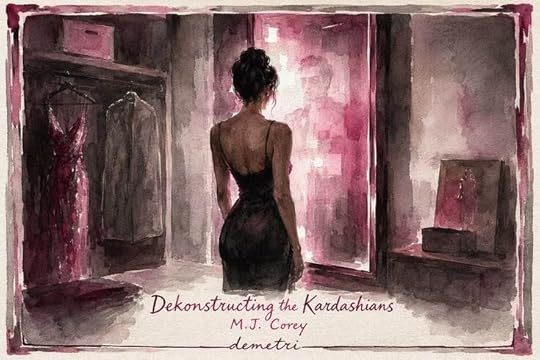
“The Archive Mirror” – a solitary figure stands between reflection, storage, and artificial light, distilling “Dekonstructing the Kardashians” into an image of glamour preserved, grief illuminated, and the self made almost too visible to disappear.
The final Kardashian wish in MJ Corey’s “Dekonstructing the Kardashians: A New Media Manifesto” is not fame. Fame, by the end of this sharp, crowded, lacquered book, looks almost quaint: the launch vehicle, the warm-up act, the step-and-repeat before the ritual underneath.
The colder wish is persistence. The photograph outlives the face. The wound becomes product logic. The family album becomes catalog, proof, property; the catalog becomes platform; the platform begins to resemble an afterlife with camera coverage.
Its mascot is a dead father returned as a hologram. Robert Kardashian Sr. appears as pixels, voice work, choreography, and permission, praising his daughter from inside a birthday spectacle. The scene is tender and appalling, a séance with production values. Of course the Kardashian patriarch comes back as content. Of course grief gets a lighting cue. Of course the blessing is mediated.
That is a large claim to hang on a household famous for making largeness rentable, and Corey knows it. Some readers will arrive already rolling their eyes, not only at Kim, Kris, Kourtney, Khloé, Kendall, Kylie, Kanye, Paris, Marilyn, Jackie, Barbie, and the rest of the flashbulb seating chart, but at the proposal that such names can bear this interpretive freight. “Dekonstructing the Kardashians” does not try to make the family noble before making it readable as an apparatus. Corey’s better move is to keep the tackiness on the evidence table. The vulgarity is not a stain on the evidence; it is the evidence. The dress, the selfie, the contour, the catchphrase, the tabloid humiliation, the luxury tantrum, the apology cycle, the relaunch – these are not distractions from the argument. They are where the argument clocks in.
Corey, creator of Kardashian Kolloquium, is not writing an access biography, a fan brief, or a gossip recap with a bibliography pinned to it like a borrowed brooch. She reads the Kardashians as an attention economy given a surname, and that economy is most revealing when we stop pretending we are not helping it run. We have not merely watched this enterprise; we have financed it with attention. Hatred, defense, envy, mockery, imitation, clicks, memes, backlash, and bored late-night scrolling all enter the ledger. If celebrity is a mirror, the Kardashians are a mirror with ring lighting, affiliate links, and a suspiciously good algorithm.
The structure is not just shelving. Part I builds the genealogy: Marilyn Monroe, Princess Jasmine, the Kennedys, OJ Simpson, the Spice Girls, and Paris Hilton become older ways of manufacturing public attention – aura, fantasy, dynastic polish, racial spectacle, group branding, tabloid punishment, fame as industrial process. Part II applies that kit to the family’s rise, moving from “ARRIVAL (2007–2013)” through “EVERYWOMAN (2013–2020)” to “THE DONDA ERA (2020–2024).” Then the feed takes over the metronome. First Corey traces the conditions that made the Kardashians possible; then she shows the Kardashians becoming one of those conditions.
Ideas drive the book, but objects keep taking over the argument: dresses, apps, braids, closets, bodies, feeds. Corey’s preferred unit of analysis is the picture that starts behaving like an event – Kim wearing Marilyn Monroe’s dress to the Met Gala, Kim returning again and again to Princess Jasmine, Paris Hilton as heiress prototype and discarded ladder, the Playboy shoot as maternal management theater, the selfie book “Selfish,” Kimoji, “Bo Derek braids,” SKIMS, the private-island birthday during the pandemic, “Barbie,” Robert Kardashian Sr. as a rendered ghost. Corey’s gift is not simply that she knows her Jean Baudrillard, Marshall McLuhan, John Berger, Roland Barthes, Walter Benjamin, Jacques Derrida, and Donna Haraway. It is that she understands why Kim in a dress can be a theoretical pressure point without ceasing to be Kim in a dress.
The chapter on Marilyn gives the book one of its strongest early emblems. Kim’s 2022 Met Gala appearance in Monroe’s “Happy Birthday Mr. President” dress becomes a question of aura, reproduction, bodily discipline, archival ethics, nostalgia, crash-diet spectacle, and outrage arriving with a seating chart. Corey does not settle for the simple scolding question: should Kim have worn the dress? The discomfort remains, as it should. But Corey is more interested in why the event worked so efficiently as culture: why the dress had to be the dress, why a replica would not have done, why everyone instantly knew how to argue about it, why the outrage became part of the performance. Marilyn belonged to one regime of looking; Kim belongs to another. The charge came from forcing one body, one garment, and two eras of spectatorship into the same fragile seam.
That is where Corey is best. Her sentences quicken when an object starts generating pressure. They are layered and associative, often mimicking the scroll without surrendering to it. A passage may move from theorist to scandal to tweet to magazine cover to joke to counterexample, then turn into gender, race, or money with another celebrity arriving in the wrong lesson and the right costume. The diction is fluent in theory and tabloid. Corey can write about semiotics without embalming the sentence; she can write about SKIMS without lowering the analytic ceiling to shapewear height. Her style has the energy of someone opening too many tabs because, maddeningly, the tabs do connect.
The danger is not incoherence; it is associative velocity that sometimes stops testing its own links. “Dekonstructing the Kardashians” is so good at making connections that, at times, it seems too charmed by its own speed. Another borrowed icon, another monetized wound, another campaign, another theorist, another proof that the family is everywhere: the abundance can begin to resemble the saturation Corey is diagnosing. This is not a structural failure. A minimalist book about the Kardashians would be like a silent disco about Wagner. Still, the best cultural criticism does not only demonstrate that everything touches everything else. It tells us which touches leave bruises. Corey usually knows. Occasionally, she lets a glittering adjacency keep its hand on the reader’s shoulder for a few beats too long.
Even so, the book’s most valuable trick is considerable: it turns disposable culture into usable evidence without rinsing off the glitter. Corey does not rescue reality television, tabloid spectacle, plastic-surgery discourse, influencer capitalism, or celebrity merch from their manufactured tackiness. She shows how tackiness became one of contemporary life’s most expensive materials. In that sense, the book belongs somewhere in the loose lineage of “Mythologies” by Roland Barthes and “The Image” by Daniel J. Boorstin, though Corey’s book is faster, gaudier, more platform-saturated, and much more willing to let the mess talk back. Barthes anatomized soap powders, wrestling, toys, striptease, steak, and bourgeois myth; Boorstin gave us the pseudo-event. Corey gives us a household that turns living into pseudo-event: confession, conflict, maternity, sexuality, race, religion, law, grief, and commerce under the same lighting scheme.
The Kardashians are useful to her because they are not pure. They are agents and symptoms, architects and products, women with unusual leverage and beneficiaries of arrangements that have harmed other women, especially women whose beauty, language, hair, bodies, and labor have been borrowed, repackaged, and monetized. Corey is at her sharpest when she refuses to let symbolic remixing excuse aesthetic extraction. Her sections on cultural appropriation matter because they keep the book from turning into a defense brief with citations. Kim’s “Bo Derek braids,” the family’s long romance with Black aesthetics, Kendall’s tequila imagery, and the easy conversion of other people’s cultural codes into Kardashian style are not merely examples of postmodern recombination. They are examples of power deciding that everything can be worn.
That double vision keeps the book honest. A weaker version would indict the Kardashians so completely that it would have nothing left to explain, or defend them so gamely that judgment would become contour. Corey’s more interesting instinct is to show how condemnation itself becomes fuel. Spectator revulsion is not outside Kardashian fame. It is one of its energy sources. Outrage produces fresh visibility; critique becomes engagement; attempted distance extends the field in which the family matters. The Kardashians are not famous despite the hatred. They have become expert at turning revulsion into distribution.
Corey is especially good on the family as cast list, product line, and weather system. The Kardashians are often discussed as individual brands, but the book understands the group as a structure: sisterhood as product category, motherhood as governance, conflict as renewable fuel, reconciliation as finale, difference as market segmentation. The Spice Girls sections help here, not because the comparison is exact, but because both phenomena depend on legible types.
Which one are you? The glamorous one, the sporty one, the maternal one, the messy one, the rich one, the relatable one, the rebellious one who still appears in the group shot? The question is childish, and therefore powerful. Personality becomes packaging; packaging becomes identification; identification becomes sales.
The architecture teaches the reader how to watch. The first part shows how photographs, costumes, scandals, and public women inherit older forms. The second shows what happens when inheritance becomes a live feed. Marilyn had studio manufacture, magazine circulation, physical aura, and the inaccessible body. Paris had paparazzi, inherited wealth, tabloid cruelty, catchphrase performance, and reality-TV vacancy as style. Kim had all of that, plus the internet’s ability to turn the self into a searchable, shareable, editable object. By the time the book reaches TikTok, SKIMS, pandemic luxury, conspiracy discourse, and “Barbie,” the pace has tightened into platform weather. The sections shorten, thicken, pivot, churn. The book does not merely describe acceleration. It makes the reader sit inside a polished version of it.
Eventually, the abundance starts charging interest. Some later sections feel like exquisitely labeled drawers in a closet that has more handbags than walls. The case is never lost, but the reader can feel it managing overflow. The book could have trusted a few of its strongest readings to do more work. A tighter version might have left more silence around its darker implications: children born into surveillance, beauty as compulsive self-editing, grief as rendered artifact, ordinary people invited to imitate luxury while being excluded from its protections. Corey knows these stakes are present. At times, one wishes she would stay with them longer before the next brilliant object clacks down the runway.
Still, it would be unfair to fault a book about Kardashian culture simply for being seduced by abundance. Seduction is part of the archive. The question is whether Corey’s abundance clarifies more than it clutters. Mostly, it does. Her readings do not reduce the Kardashians to a single sin or a single genius. They are not only vain, strategic, lucky, exploitative, exploited, American, digital, female, rich. They are a set of contradictions that learned to make contradiction photogenic.
The book does not need to import relevance as a last-minute brand partner; anyone with a camera roll is already implicated. We live in the aftermath of the Kardashian lesson whether or not we keep up with them. A trip is not fully a trip until it has produced images. A face is not merely a face if it can be filtered, injected, tutorialized, compared, and sold back to the viewer. A complaint is not merely a complaint if it improves the numbers. This is why the Kardashians are not aliens in Corey’s book. They are the showroom. The rest of us are browsing the cheaper floor samples.
Corey’s sentences keep that relevance from curdling into sermon. She is too amused by the machinery to scold, and too alert to the damage to swoon. Her wit has a nimble social intelligence: she lets a Kardashian absurdity remain funny while still extracting the bruise beneath it. The writing is not as austere as “Ways of Seeing” by John Berger, though Berger’s concern with images, desire, glamor, and ownership shadows the project. Corey is more maximalist, more caffeinated, more crowded. Her form is less clean window than mirrored elevator: the doors close, the lights flatter, and suddenly you can see yourself from too many angles.
The final turn lifts the book above clever topicality. In the late archive sections, Corey moves from fame as circulation to fame as preservation. Kim’s closet, the family’s stored objects, birthday recreations, auctioned relics, and possible future Kardashian collections press the book toward a colder question: who gets saved, who gets displayed, who gets to control the story of the body after the body is gone? Then comes Robert Kardashian Sr. as hologram, Kanye’s birthday gift to Kim: the dead father reconstructed to speak, praise, sanction, and return. It is the book’s strangest receipt. The patriarch reappears not as memory alone, but as product, blessing, data, family myth, and technological séance.
That scene changes the meaning of everything before it. The costumes, selfies, brands, wedding specials, legal ambitions, beauty templates, family feuds, and public apologies begin to look like rehearsals for a larger scheme: persistence by reproduction. To be copied is to continue. To be stored is to resist erasure. To be turned into data is to hover, uncannily, between presence and product. The Kardashians, in Corey’s final accounting, are not merely selling the dream of looking better, living richer, working harder, or being envied. They are selling the dream that a self can be made so visible it cannot disappear.
I would place “Dekonstructing the Kardashians” at 87/100, which translates under my rubric to 4/5 Goodreads-compatible stars. It is too crowded to be immaculate: it overstocks its closet, repeats some of its best proofs, and occasionally treats the family as such a useful key that the key seems cut before the lock has been examined. But it is alive to contradiction, not merely alert to references – exacting, funny, strange, overfull, and finally more ghosted by its own archive than its premise first suggests. Corey has written a book that understands the Kardashians not as the end of culture, nor as its secret summit, but as one of the places where the surface gives up its alibi. The surface gleams. The surface lies. The surface remembers. And somewhere inside the glow, a father made of light, script, and permission keeps telling his daughter she has done beautifully.
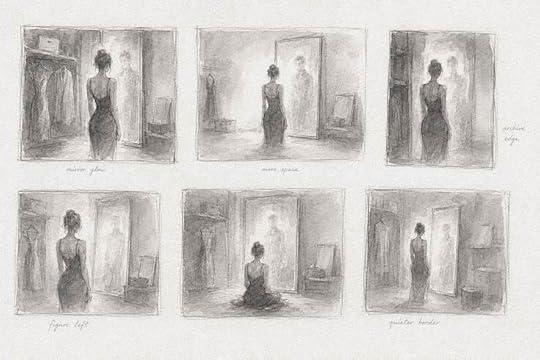
Early thumbnail studies for “The Archive Mirror,” searching for the quiet balance between figure, mirror, closet-archive, negative space, and the faint pressure of a presence made of light.
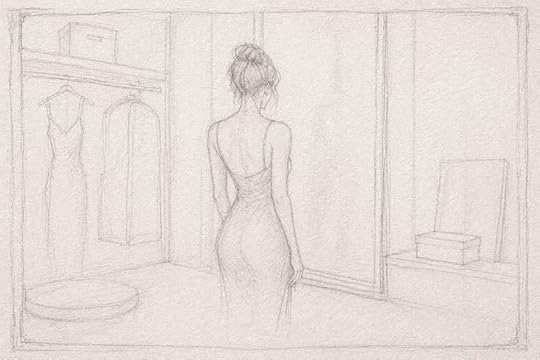
The first pencil structure fixes the room’s emotional geometry – one body, one reflective plane, a few archival cues, and enough empty space for the silence to gather.
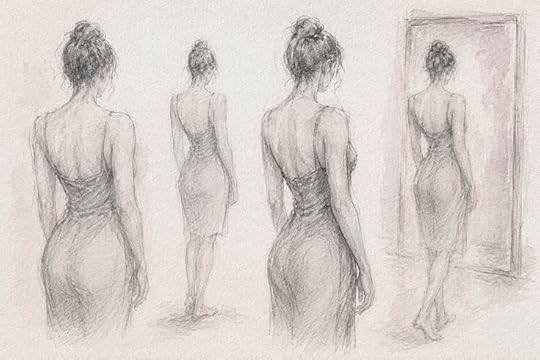
An anatomical study of the solitary figure, refining posture, shoulder line, stance, and bodily weight so the final image feels human rather than merely fashionable.

A restricted palette study drawn from the cover world of “Dekonstructing the Kardashians” – near-black, greys, blush, mauve, fuchsia, berry, and plum tested for atmosphere and restraint.
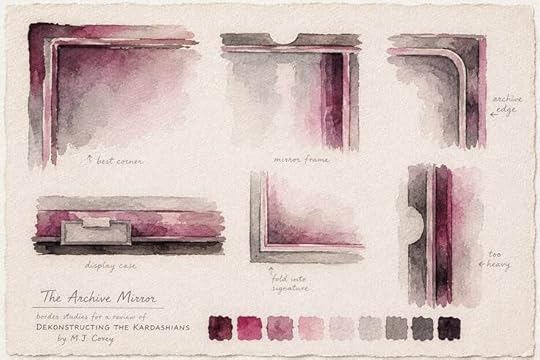
A border study exploring the image as framed object, mirror, closet trim, display case, and archive edge – containment as part of the meaning, not decoration.

The first wash begins to soften the drawing into atmosphere, introducing pale stone, muted mauve, and pink-white glow before the room has fully become haunted.
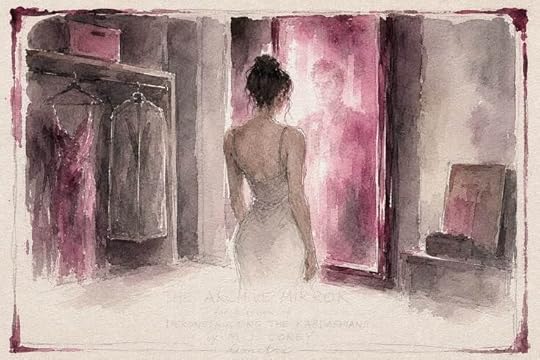
The mirror light, figure, garment, and faint afterimage begin to cohere, showing the moment when the composition shifts from interior scene to mediated memory.
All watercolor illustrations by Demetris Papadimitropoulos.
MJ Corey’s “Dekonstructing the Kardashians” turns fame, family, spectacle, and synthetic afterlife into a theory of how the self survives as image.
By Demetris Papadimitropoulos | May 5th, 2026
“The Archive Mirror” – a solitary figure stands between reflection, storage, and artificial light, distilling “Dekonstructing the Kardashians” into an image of glamour preserved, grief illuminated, and the self made almost too visible to disappear.
The final Kardashian wish in MJ Corey’s “Dekonstructing the Kardashians: A New Media Manifesto” is not fame. Fame, by the end of this sharp, crowded, lacquered book, looks almost quaint: the launch vehicle, the warm-up act, the step-and-repeat before the ritual underneath.
The colder wish is persistence. The photograph outlives the face. The wound becomes product logic. The family album becomes catalog, proof, property; the catalog becomes platform; the platform begins to resemble an afterlife with camera coverage.
Its mascot is a dead father returned as a hologram. Robert Kardashian Sr. appears as pixels, voice work, choreography, and permission, praising his daughter from inside a birthday spectacle. The scene is tender and appalling, a séance with production values. Of course the Kardashian patriarch comes back as content. Of course grief gets a lighting cue. Of course the blessing is mediated.
That is a large claim to hang on a household famous for making largeness rentable, and Corey knows it. Some readers will arrive already rolling their eyes, not only at Kim, Kris, Kourtney, Khloé, Kendall, Kylie, Kanye, Paris, Marilyn, Jackie, Barbie, and the rest of the flashbulb seating chart, but at the proposal that such names can bear this interpretive freight. “Dekonstructing the Kardashians” does not try to make the family noble before making it readable as an apparatus. Corey’s better move is to keep the tackiness on the evidence table. The vulgarity is not a stain on the evidence; it is the evidence. The dress, the selfie, the contour, the catchphrase, the tabloid humiliation, the luxury tantrum, the apology cycle, the relaunch – these are not distractions from the argument. They are where the argument clocks in.
Corey, creator of Kardashian Kolloquium, is not writing an access biography, a fan brief, or a gossip recap with a bibliography pinned to it like a borrowed brooch. She reads the Kardashians as an attention economy given a surname, and that economy is most revealing when we stop pretending we are not helping it run. We have not merely watched this enterprise; we have financed it with attention. Hatred, defense, envy, mockery, imitation, clicks, memes, backlash, and bored late-night scrolling all enter the ledger. If celebrity is a mirror, the Kardashians are a mirror with ring lighting, affiliate links, and a suspiciously good algorithm.
The structure is not just shelving. Part I builds the genealogy: Marilyn Monroe, Princess Jasmine, the Kennedys, OJ Simpson, the Spice Girls, and Paris Hilton become older ways of manufacturing public attention – aura, fantasy, dynastic polish, racial spectacle, group branding, tabloid punishment, fame as industrial process. Part II applies that kit to the family’s rise, moving from “ARRIVAL (2007–2013)” through “EVERYWOMAN (2013–2020)” to “THE DONDA ERA (2020–2024).” Then the feed takes over the metronome. First Corey traces the conditions that made the Kardashians possible; then she shows the Kardashians becoming one of those conditions.
Ideas drive the book, but objects keep taking over the argument: dresses, apps, braids, closets, bodies, feeds. Corey’s preferred unit of analysis is the picture that starts behaving like an event – Kim wearing Marilyn Monroe’s dress to the Met Gala, Kim returning again and again to Princess Jasmine, Paris Hilton as heiress prototype and discarded ladder, the Playboy shoot as maternal management theater, the selfie book “Selfish,” Kimoji, “Bo Derek braids,” SKIMS, the private-island birthday during the pandemic, “Barbie,” Robert Kardashian Sr. as a rendered ghost. Corey’s gift is not simply that she knows her Jean Baudrillard, Marshall McLuhan, John Berger, Roland Barthes, Walter Benjamin, Jacques Derrida, and Donna Haraway. It is that she understands why Kim in a dress can be a theoretical pressure point without ceasing to be Kim in a dress.
The chapter on Marilyn gives the book one of its strongest early emblems. Kim’s 2022 Met Gala appearance in Monroe’s “Happy Birthday Mr. President” dress becomes a question of aura, reproduction, bodily discipline, archival ethics, nostalgia, crash-diet spectacle, and outrage arriving with a seating chart. Corey does not settle for the simple scolding question: should Kim have worn the dress? The discomfort remains, as it should. But Corey is more interested in why the event worked so efficiently as culture: why the dress had to be the dress, why a replica would not have done, why everyone instantly knew how to argue about it, why the outrage became part of the performance. Marilyn belonged to one regime of looking; Kim belongs to another. The charge came from forcing one body, one garment, and two eras of spectatorship into the same fragile seam.
That is where Corey is best. Her sentences quicken when an object starts generating pressure. They are layered and associative, often mimicking the scroll without surrendering to it. A passage may move from theorist to scandal to tweet to magazine cover to joke to counterexample, then turn into gender, race, or money with another celebrity arriving in the wrong lesson and the right costume. The diction is fluent in theory and tabloid. Corey can write about semiotics without embalming the sentence; she can write about SKIMS without lowering the analytic ceiling to shapewear height. Her style has the energy of someone opening too many tabs because, maddeningly, the tabs do connect.
The danger is not incoherence; it is associative velocity that sometimes stops testing its own links. “Dekonstructing the Kardashians” is so good at making connections that, at times, it seems too charmed by its own speed. Another borrowed icon, another monetized wound, another campaign, another theorist, another proof that the family is everywhere: the abundance can begin to resemble the saturation Corey is diagnosing. This is not a structural failure. A minimalist book about the Kardashians would be like a silent disco about Wagner. Still, the best cultural criticism does not only demonstrate that everything touches everything else. It tells us which touches leave bruises. Corey usually knows. Occasionally, she lets a glittering adjacency keep its hand on the reader’s shoulder for a few beats too long.
Even so, the book’s most valuable trick is considerable: it turns disposable culture into usable evidence without rinsing off the glitter. Corey does not rescue reality television, tabloid spectacle, plastic-surgery discourse, influencer capitalism, or celebrity merch from their manufactured tackiness. She shows how tackiness became one of contemporary life’s most expensive materials. In that sense, the book belongs somewhere in the loose lineage of “Mythologies” by Roland Barthes and “The Image” by Daniel J. Boorstin, though Corey’s book is faster, gaudier, more platform-saturated, and much more willing to let the mess talk back. Barthes anatomized soap powders, wrestling, toys, striptease, steak, and bourgeois myth; Boorstin gave us the pseudo-event. Corey gives us a household that turns living into pseudo-event: confession, conflict, maternity, sexuality, race, religion, law, grief, and commerce under the same lighting scheme.
The Kardashians are useful to her because they are not pure. They are agents and symptoms, architects and products, women with unusual leverage and beneficiaries of arrangements that have harmed other women, especially women whose beauty, language, hair, bodies, and labor have been borrowed, repackaged, and monetized. Corey is at her sharpest when she refuses to let symbolic remixing excuse aesthetic extraction. Her sections on cultural appropriation matter because they keep the book from turning into a defense brief with citations. Kim’s “Bo Derek braids,” the family’s long romance with Black aesthetics, Kendall’s tequila imagery, and the easy conversion of other people’s cultural codes into Kardashian style are not merely examples of postmodern recombination. They are examples of power deciding that everything can be worn.
That double vision keeps the book honest. A weaker version would indict the Kardashians so completely that it would have nothing left to explain, or defend them so gamely that judgment would become contour. Corey’s more interesting instinct is to show how condemnation itself becomes fuel. Spectator revulsion is not outside Kardashian fame. It is one of its energy sources. Outrage produces fresh visibility; critique becomes engagement; attempted distance extends the field in which the family matters. The Kardashians are not famous despite the hatred. They have become expert at turning revulsion into distribution.
Corey is especially good on the family as cast list, product line, and weather system. The Kardashians are often discussed as individual brands, but the book understands the group as a structure: sisterhood as product category, motherhood as governance, conflict as renewable fuel, reconciliation as finale, difference as market segmentation. The Spice Girls sections help here, not because the comparison is exact, but because both phenomena depend on legible types.
Which one are you? The glamorous one, the sporty one, the maternal one, the messy one, the rich one, the relatable one, the rebellious one who still appears in the group shot? The question is childish, and therefore powerful. Personality becomes packaging; packaging becomes identification; identification becomes sales.
The architecture teaches the reader how to watch. The first part shows how photographs, costumes, scandals, and public women inherit older forms. The second shows what happens when inheritance becomes a live feed. Marilyn had studio manufacture, magazine circulation, physical aura, and the inaccessible body. Paris had paparazzi, inherited wealth, tabloid cruelty, catchphrase performance, and reality-TV vacancy as style. Kim had all of that, plus the internet’s ability to turn the self into a searchable, shareable, editable object. By the time the book reaches TikTok, SKIMS, pandemic luxury, conspiracy discourse, and “Barbie,” the pace has tightened into platform weather. The sections shorten, thicken, pivot, churn. The book does not merely describe acceleration. It makes the reader sit inside a polished version of it.
Eventually, the abundance starts charging interest. Some later sections feel like exquisitely labeled drawers in a closet that has more handbags than walls. The case is never lost, but the reader can feel it managing overflow. The book could have trusted a few of its strongest readings to do more work. A tighter version might have left more silence around its darker implications: children born into surveillance, beauty as compulsive self-editing, grief as rendered artifact, ordinary people invited to imitate luxury while being excluded from its protections. Corey knows these stakes are present. At times, one wishes she would stay with them longer before the next brilliant object clacks down the runway.
Still, it would be unfair to fault a book about Kardashian culture simply for being seduced by abundance. Seduction is part of the archive. The question is whether Corey’s abundance clarifies more than it clutters. Mostly, it does. Her readings do not reduce the Kardashians to a single sin or a single genius. They are not only vain, strategic, lucky, exploitative, exploited, American, digital, female, rich. They are a set of contradictions that learned to make contradiction photogenic.
The book does not need to import relevance as a last-minute brand partner; anyone with a camera roll is already implicated. We live in the aftermath of the Kardashian lesson whether or not we keep up with them. A trip is not fully a trip until it has produced images. A face is not merely a face if it can be filtered, injected, tutorialized, compared, and sold back to the viewer. A complaint is not merely a complaint if it improves the numbers. This is why the Kardashians are not aliens in Corey’s book. They are the showroom. The rest of us are browsing the cheaper floor samples.
Corey’s sentences keep that relevance from curdling into sermon. She is too amused by the machinery to scold, and too alert to the damage to swoon. Her wit has a nimble social intelligence: she lets a Kardashian absurdity remain funny while still extracting the bruise beneath it. The writing is not as austere as “Ways of Seeing” by John Berger, though Berger’s concern with images, desire, glamor, and ownership shadows the project. Corey is more maximalist, more caffeinated, more crowded. Her form is less clean window than mirrored elevator: the doors close, the lights flatter, and suddenly you can see yourself from too many angles.
The final turn lifts the book above clever topicality. In the late archive sections, Corey moves from fame as circulation to fame as preservation. Kim’s closet, the family’s stored objects, birthday recreations, auctioned relics, and possible future Kardashian collections press the book toward a colder question: who gets saved, who gets displayed, who gets to control the story of the body after the body is gone? Then comes Robert Kardashian Sr. as hologram, Kanye’s birthday gift to Kim: the dead father reconstructed to speak, praise, sanction, and return. It is the book’s strangest receipt. The patriarch reappears not as memory alone, but as product, blessing, data, family myth, and technological séance.
That scene changes the meaning of everything before it. The costumes, selfies, brands, wedding specials, legal ambitions, beauty templates, family feuds, and public apologies begin to look like rehearsals for a larger scheme: persistence by reproduction. To be copied is to continue. To be stored is to resist erasure. To be turned into data is to hover, uncannily, between presence and product. The Kardashians, in Corey’s final accounting, are not merely selling the dream of looking better, living richer, working harder, or being envied. They are selling the dream that a self can be made so visible it cannot disappear.
I would place “Dekonstructing the Kardashians” at 87/100, which translates under my rubric to 4/5 Goodreads-compatible stars. It is too crowded to be immaculate: it overstocks its closet, repeats some of its best proofs, and occasionally treats the family as such a useful key that the key seems cut before the lock has been examined. But it is alive to contradiction, not merely alert to references – exacting, funny, strange, overfull, and finally more ghosted by its own archive than its premise first suggests. Corey has written a book that understands the Kardashians not as the end of culture, nor as its secret summit, but as one of the places where the surface gives up its alibi. The surface gleams. The surface lies. The surface remembers. And somewhere inside the glow, a father made of light, script, and permission keeps telling his daughter she has done beautifully.
Early thumbnail studies for “The Archive Mirror,” searching for the quiet balance between figure, mirror, closet-archive, negative space, and the faint pressure of a presence made of light.
The first pencil structure fixes the room’s emotional geometry – one body, one reflective plane, a few archival cues, and enough empty space for the silence to gather.
An anatomical study of the solitary figure, refining posture, shoulder line, stance, and bodily weight so the final image feels human rather than merely fashionable.
A restricted palette study drawn from the cover world of “Dekonstructing the Kardashians” – near-black, greys, blush, mauve, fuchsia, berry, and plum tested for atmosphere and restraint.
A border study exploring the image as framed object, mirror, closet trim, display case, and archive edge – containment as part of the meaning, not decoration.
The first wash begins to soften the drawing into atmosphere, introducing pale stone, muted mauve, and pink-white glow before the room has fully become haunted.
The mirror light, figure, garment, and faint afterimage begin to cohere, showing the moment when the composition shifts from interior scene to mediated memory.
All watercolor illustrations by Demetris Papadimitropoulos.

July 10, 2026
Overly ambitious in its scope, while failing to address a centralized thesis.

September 8, 2026
I enjoyed this a lot, and found it really compulsive to read (and I highlighted loads to read into more), but overall I felt that it could have been... more? As someone else has said in their review, it reads a little bit like a literature review (although it was a literature review that I enjoyed!).

Want to Read
February 17, 2026watched a video essay by the author and it was so good it sent me down a rabbit-hole that lead me to their book! looking forward to reading this one.
June 9, 2026
First part was great second part left something to be desired

July 24, 2026
There are very few families in modern culture who occupy as much collective mental real estate as the Kardashians. Whether you actively follow them or avoid them at all costs, they seem impossible to escape. That's perhaps the strangest realization I had while reading Dekonstructing the Kardashians: A New Media Manifesto by M.J. Corey. I've never watched a single episode of Keeping Up with the Kardashians, nor have I intentionally sought out news about Kim, Kylie, or the rest of the family. Yet somehow, I already knew most of the major events of their lives. That alone speaks volumes about the phenomenon Corey is attempting to dissect.
This isn't a celebrity biography or a gossip-filled retrospective. Instead, Corey approaches the Kardashians as a cultural text, examining them through the framework of media studies, branding, celebrity, capitalism, feminism, and digital culture. It's an academic exploration rather than an exposé, and one that often challenges readers to reconsider why this family continues to dominate public conversation more than fifteen years after their rise to fame.
I have to admit that the book itself feels strange—but not because of the writing. The writing is intelligent, accessible, and surprisingly engaging considering the subject matter. The strangeness comes from the Kardashians themselves. They're simultaneously overexposed and unknowable, deeply familiar yet entirely manufactured. Reading an entire book devoted to unpacking their significance forces you to confront just how unusual their existence is within popular culture.
The central argument of Dekonstructing the Kardashians is that the Kardashian empire isn't simply about celebrity; it's about media evolution. Corey positions the family as architects of a new model of fame, one built on constant visibility, personal branding, and the collapse of traditional distinctions between public and private life. Rather than dismissing them as "famous for being famous," the book argues that they've fundamentally reshaped how celebrity functions in the digital age.
One of the book's strongest aspects is its discussion of branding. The Kardashians aren't presented merely as individuals but as an interconnected corporate ecosystem. Every appearance, controversy, relationship, product launch, and social media post contributes to an ever-expanding commercial identity. Fame itself becomes a product, and authenticity becomes something carefully curated rather than naturally expressed. Corey explores how this business model has influenced not only influencers but modern marketing as a whole.
The analysis focuses predominantly on Kim Kardashian and Kylie Jenner, who receive considerably more attention than the other members of the family. This makes sense from a cultural perspective, as both women arguably represent the brand's greatest commercial successes. Kim becomes the blueprint for the modern influencer-businesswoman hybrid, while Kylie exemplifies the younger generation of digital entrepreneurship, where social media influence translates directly into billion-dollar business ventures.
Although I would have appreciated a more balanced discussion involving Kourtney, Khloé, Kendall, Kris, and even Caitlyn Jenner's complicated relationship to the family's public narrative, the emphasis on Kim and Kylie never feels arbitrary. Corey clearly views them as the most significant case studies through which to examine the evolution of celebrity culture.
What surprised me most was how effectively the book frames the Kardashians through the lens of pop culture studies. Before reading this, I'd never really considered them as worthy subjects of academic analysis. They're so often dismissed as shallow or frivolous that it's easy to overlook what they actually represent. Corey argues that popular culture deserves serious examination precisely because it reflects society's values, anxieties, aspirations, and contradictions.
Viewed this way, the Kardashians become less interesting as individuals and more interesting as symbols. They embody consumerism, beauty standards, race, gender performance, entrepreneurship, social media, and the commodification of identity. Whether you admire them or despise them almost becomes secondary to the fact that they successfully dominate cultural discourse.
The book also charts the extraordinary love-hate relationship the public has with both Kim, Kylie, and the Kardashian brand itself. Few public figures inspire such intense emotional reactions. Millions admire their business acumen, resilience, and ability to continually reinvent themselves. Others criticize nearly every aspect of their influence—from unrealistic beauty standards and excessive wealth to accusations of cultural appropriation and performative authenticity.
Corey doesn't attempt to resolve these contradictions. Instead, the book argues that they're essential to the Kardashian machine. The criticism fuels the brand just as effectively as admiration does. Every controversy generates headlines, engagement, discourse, and ultimately greater visibility. In today's media ecosystem, outrage is often as valuable as praise.
I found this one of the book's most compelling observations. It explains why the Kardashians remain culturally relevant despite years of predictions that their fame would eventually fade. The brand thrives because people simply cannot stop talking about it. Love them or hate them, participation in the conversation reinforces their cultural dominance.
Another recurring topic is the relationship between social media and identity. Corey explores how the Kardashians helped normalize the idea of living publicly online, where personal milestones, family relationships, and even vulnerability become content. Looking back, it's remarkable how much of influencer culture now feels like an extension of strategies the Kardashians either pioneered or perfected.
Despite its strengths, there are moments where the book feels somewhat repetitive, particularly when revisiting similar ideas about branding and digital performance. Certain arguments are reinforced multiple times from slightly different theoretical perspectives, which occasionally slows the pace. Readers unfamiliar with media theory may also find some sections denser than others, though Corey generally succeeds in balancing academic language with accessible explanations.
Even so, I found the insights consistently worthwhile. The book encouraged me to think about celebrity culture in ways I never had before. Rather than asking why the Kardashians are famous, Corey asks why society continues to reward this particular model of fame—and what that says about us.
By the end, I wasn't any more interested in watching Keeping Up with the Kardashians. If anything, I remain fascinated by the bizarre contradiction that I've absorbed years of Kardashian history through cultural osmosis without ever intentionally consuming their content. That, perhaps, is the family's greatest achievement and the strongest evidence supporting Corey's thesis. The Kardashians have become so deeply woven into the fabric of modern media that participation is almost unavoidable.
Dekonstructing the Kardashians isn't a book about liking or disliking celebrities. It's about understanding the systems that create them, sustain them, and transform them into global brands. Even readers who have little personal interest in the Kardashians—as I did—may find themselves unexpectedly captivated by what the family reveals about contemporary culture.
Strange? Absolutely. But that's fitting, because the Kardashians themselves remain one of the strangest—and undeniably most influential—pop culture phenomena of the twenty-first century. M.J. Corey successfully demonstrates that beneath the tabloid headlines lies a surprisingly rich case study of media, identity, capitalism, and our collective fascination with fame.
This isn't a celebrity biography or a gossip-filled retrospective. Instead, Corey approaches the Kardashians as a cultural text, examining them through the framework of media studies, branding, celebrity, capitalism, feminism, and digital culture. It's an academic exploration rather than an exposé, and one that often challenges readers to reconsider why this family continues to dominate public conversation more than fifteen years after their rise to fame.
I have to admit that the book itself feels strange—but not because of the writing. The writing is intelligent, accessible, and surprisingly engaging considering the subject matter. The strangeness comes from the Kardashians themselves. They're simultaneously overexposed and unknowable, deeply familiar yet entirely manufactured. Reading an entire book devoted to unpacking their significance forces you to confront just how unusual their existence is within popular culture.
The central argument of Dekonstructing the Kardashians is that the Kardashian empire isn't simply about celebrity; it's about media evolution. Corey positions the family as architects of a new model of fame, one built on constant visibility, personal branding, and the collapse of traditional distinctions between public and private life. Rather than dismissing them as "famous for being famous," the book argues that they've fundamentally reshaped how celebrity functions in the digital age.
One of the book's strongest aspects is its discussion of branding. The Kardashians aren't presented merely as individuals but as an interconnected corporate ecosystem. Every appearance, controversy, relationship, product launch, and social media post contributes to an ever-expanding commercial identity. Fame itself becomes a product, and authenticity becomes something carefully curated rather than naturally expressed. Corey explores how this business model has influenced not only influencers but modern marketing as a whole.
The analysis focuses predominantly on Kim Kardashian and Kylie Jenner, who receive considerably more attention than the other members of the family. This makes sense from a cultural perspective, as both women arguably represent the brand's greatest commercial successes. Kim becomes the blueprint for the modern influencer-businesswoman hybrid, while Kylie exemplifies the younger generation of digital entrepreneurship, where social media influence translates directly into billion-dollar business ventures.
Although I would have appreciated a more balanced discussion involving Kourtney, Khloé, Kendall, Kris, and even Caitlyn Jenner's complicated relationship to the family's public narrative, the emphasis on Kim and Kylie never feels arbitrary. Corey clearly views them as the most significant case studies through which to examine the evolution of celebrity culture.
What surprised me most was how effectively the book frames the Kardashians through the lens of pop culture studies. Before reading this, I'd never really considered them as worthy subjects of academic analysis. They're so often dismissed as shallow or frivolous that it's easy to overlook what they actually represent. Corey argues that popular culture deserves serious examination precisely because it reflects society's values, anxieties, aspirations, and contradictions.
Viewed this way, the Kardashians become less interesting as individuals and more interesting as symbols. They embody consumerism, beauty standards, race, gender performance, entrepreneurship, social media, and the commodification of identity. Whether you admire them or despise them almost becomes secondary to the fact that they successfully dominate cultural discourse.
The book also charts the extraordinary love-hate relationship the public has with both Kim, Kylie, and the Kardashian brand itself. Few public figures inspire such intense emotional reactions. Millions admire their business acumen, resilience, and ability to continually reinvent themselves. Others criticize nearly every aspect of their influence—from unrealistic beauty standards and excessive wealth to accusations of cultural appropriation and performative authenticity.
Corey doesn't attempt to resolve these contradictions. Instead, the book argues that they're essential to the Kardashian machine. The criticism fuels the brand just as effectively as admiration does. Every controversy generates headlines, engagement, discourse, and ultimately greater visibility. In today's media ecosystem, outrage is often as valuable as praise.
I found this one of the book's most compelling observations. It explains why the Kardashians remain culturally relevant despite years of predictions that their fame would eventually fade. The brand thrives because people simply cannot stop talking about it. Love them or hate them, participation in the conversation reinforces their cultural dominance.
Another recurring topic is the relationship between social media and identity. Corey explores how the Kardashians helped normalize the idea of living publicly online, where personal milestones, family relationships, and even vulnerability become content. Looking back, it's remarkable how much of influencer culture now feels like an extension of strategies the Kardashians either pioneered or perfected.
Despite its strengths, there are moments where the book feels somewhat repetitive, particularly when revisiting similar ideas about branding and digital performance. Certain arguments are reinforced multiple times from slightly different theoretical perspectives, which occasionally slows the pace. Readers unfamiliar with media theory may also find some sections denser than others, though Corey generally succeeds in balancing academic language with accessible explanations.
Even so, I found the insights consistently worthwhile. The book encouraged me to think about celebrity culture in ways I never had before. Rather than asking why the Kardashians are famous, Corey asks why society continues to reward this particular model of fame—and what that says about us.
By the end, I wasn't any more interested in watching Keeping Up with the Kardashians. If anything, I remain fascinated by the bizarre contradiction that I've absorbed years of Kardashian history through cultural osmosis without ever intentionally consuming their content. That, perhaps, is the family's greatest achievement and the strongest evidence supporting Corey's thesis. The Kardashians have become so deeply woven into the fabric of modern media that participation is almost unavoidable.
Dekonstructing the Kardashians isn't a book about liking or disliking celebrities. It's about understanding the systems that create them, sustain them, and transform them into global brands. Even readers who have little personal interest in the Kardashians—as I did—may find themselves unexpectedly captivated by what the family reveals about contemporary culture.
Strange? Absolutely. But that's fitting, because the Kardashians themselves remain one of the strangest—and undeniably most influential—pop culture phenomena of the twenty-first century. M.J. Corey successfully demonstrates that beneath the tabloid headlines lies a surprisingly rich case study of media, identity, capitalism, and our collective fascination with fame.

July 15, 2026
I really wanted to LOVE this book, but it was too dense and repetitive without landing a thesis. Not to say I didn’t enjoy nerding out over some of the media theory references in the book, but you can’t drop in paragraphs of McLuhan without coming to a consensus.
I loved how it ended on the Robert Sr. of it all.
I loved how it ended on the Robert Sr. of it all.

June 19, 2026
This book attempts to orient the reader to the Kardashians’ place in historical context (next to Disney and Jackie O?), but really struggled to present a cohesive thesis. Got a lot of information, but not a lot of why.

July 8, 2026
Absolutely feminist banger on self commodification, conspicuous consumption and influencer culture. It is certainly interesting to see the Kardashians impact analyzed by a psychological and philosophical lens. The book never got boring to me even though it is very info heavy.

August 9, 2026
Any book that quotes Edward Said and Frantz Fanon while talking about Kim Kardashian has my attention

July 8, 2026
2026 #22
June 22, 2026
required reading for any pop culture nerd.
this book succinctly and entertainingly explains the backbone of the media and celebrity ecosystem for the last 30 or so years.
this book succinctly and entertainingly explains the backbone of the media and celebrity ecosystem for the last 30 or so years.

June 15, 2026
After only reading theory that was written before 1990 for my grad program for two years, it was really refreshing to read cultural theory that actually felt contemporary and relevant. That being said, this probably could have been about 100 pages less. Dont get me wrong, I really enjoyed the cultural comparisons & deep dives but it just got to a point with the tangential discourse that it really lost focus and I honestly got bored. Whateverrrr tho, MJ Corey is mad smart and I'm really happy to have my personalized signed copy out here <3

June 8, 2026
as much as i love the marilyn monroe jean baudrillard mickey mouse jacques lacan paris hilton friederich nietzsche princess jasmine walter benjamin jackie o and jfk marie antoinette john berger oj simpson donald trump the brady bunch michel foucault the spice girls cleopatra edward said guy debord vibe……the death of the thesis statement is alive and well
July 3, 2026
Really wanted to enjoy this. However it is all over the place and deconstructed in itself. So much political angst..it becomes unreadable and very choppy.
August 10, 2026
Audio. Definitely not a fan of Kardashian or any other Influencer. I picked this up just to better understand the whole mystic of Kardashian and how Influencers manage to captivate so many. Sadly, this was not the book. I gave up after 40% and jumped to the end hoping that the summary/conclusion will finally provide some deep insights. Alas, no. I was initially very impressed with the scholarly opening but quickly realized that Corey was just quoting other psychologists, philosophers and cultural specialists without it seeming to provide any original insights of her own. I was expecting a deep dive into how Kardashian has managed to bamboozle so many people with zero talent and yet had millions enthralled with her and her family's rather dull life. And the numerous digressions about Jacklyn Kennedy, Princess Di, OJ, Spice Girls, etc was not the point of the book. What Cory personally provided was just a lot of pseudo cultural mumbo-jumbo. Just not sure what the heck her thesis and point really was at the end.

August 23, 2026
Stuart Hall's encoding/decoding model might be the secret to consuming pop culture correctly. I am a huge fan of the TikTok and Instagram Kardashian Kolloquium, so of course I was eventually going to pick this book up.
Corey breaks down how the Kardashians use new media to construct, deconstruct, and maintain their own mythology. As someone who prays for a seat at the masterclass of Kris Jenner marketing, I cannot recommend this book enough. If you're fascinated by new media, celebrities' relationship to fame, the construction of public personas, or what celebrity looks like in the digital age, you have to read this. Corey is largely self-taught in the philosophical and sociological concepts she uses to understand the Kardashians, and she applies them to everything from product launches and Instagram posts to media interviews and the construction of celebrity itself. Every choice becomes something to interrogate.
And this is what makes the book so good: it isn't simply Kardashian fan service. Corey takes the criticisms people have lobbed at the Kardashians seriously and analyzes what their success actually tells us about American culture. If we have an American icon of the digital age, Corey argues, it has to be the Kardashians. That's not necessarily an endorsement. It's an observation about what they have become: enduring cultural artifacts who have been exceptionally good at constructing their own iconography.
The first half of the book examines the various "blueprints" the Kardashians have borrowed from figures like Marilyn Monroe, Princess Jasmine, and the Kennedy family. The second becomes more of a history of Kim Kardashian's transformation from Paris Hilton's assistant into the billionaire megawatt celebrity she is today. But Corey continually connects that history to the larger machinery of pop culture: the Spice Girls, Sex and the City, the rise of women identifying themselves through recognizable archetypes, and eventually the way those identities became marketing tools.
The Kardashians become a lens through which to understand ourselves.
Celebrity culture has gone from untouchable stars whose lives were almost completely opaque, to tabloids and paparazzi controlling the narrative, to the current era in which celebrities can increasingly construct and distribute their own images. The Kardashians didn't invent that transition, but they understood it exceptionally well. Their television show, Instagram accounts, TikToks, businesses, and various digital platforms have allowed them to participate in the construction of their own mythology in a way earlier generations of celebrities simply couldn't.
And this is where Stuart Hall's encoding/decoding model became one of my favorite parts of the book. Hall argues that every piece of media is encoded with an ideology or belief system by its creator, while the audience has to decode that message. You can accept the dominant interpretation, reject it entirely, or negotiate with it: acknowledge what the creator wants you to see while bringing your own social context and experience to the interpretation. The negotiation piece especially clicked for me because it is essentially how I already consume reality television.
Take Tamra Judge from The Real Housewives of Orange County. The show encodes her as a villain: she stirs the pot, exposes secrets, starts fights, and generally creates excellent television. You can accept that framing and decide she's awful. Or you can reject it completely and say she's simply doing her job. Or you can negotiate. You can acknowledge that the producers want you to see a villain while also asking who Tamra was when she entered the show, what circumstances she was living in, what she gained from becoming financially independent, and what the reality television environment permits her to express that ordinary social life doesn't.
Maybe she really is messy. Maybe she really does enjoy stirring the pot. Maybe she also has a side of herself that wants to be messy, angry, selfish, dramatic, and occasionally terrible, but doesn't have the freedom to express that side in her everyday relationships without consequences. Reality television gives her a socially sanctioned arena in which to do exactly that. So she's not just the villain, and she's not simply a dispassionate employee manufacturing drama. She's both, and she's more than either interpretation.
That is what I found so fascinating about Hall's model. It finally articulated something I think I've been doing instinctively for years when consuming reality television and pop culture. People tend to occupy these three positions: accepting the narrative, rejecting it, or negotiating with it. And once you start looking at media that way, it's difficult to stop. The story of the Kardashians is, in many ways, the story of modern media: reality television, celebrity culture, social media, parasocial relationships, personal branding, and eventually the commodification of identity itself.
I had to stop reading this book every ten minutes to look something up, flag a reference, annotate something, or find the article or paper being discussed. I love a writer who makes you want to read more than the book you're currently holding. Corey clearly reads, and she makes you want to read too.This is not simply a book about the Kardashians. It's a book about why the Kardashians matter.
Brilliant, genuinely fascinating, and easily one of the most intellectually satisfying books I've read about contemporary pop culture.
Corey breaks down how the Kardashians use new media to construct, deconstruct, and maintain their own mythology. As someone who prays for a seat at the masterclass of Kris Jenner marketing, I cannot recommend this book enough. If you're fascinated by new media, celebrities' relationship to fame, the construction of public personas, or what celebrity looks like in the digital age, you have to read this. Corey is largely self-taught in the philosophical and sociological concepts she uses to understand the Kardashians, and she applies them to everything from product launches and Instagram posts to media interviews and the construction of celebrity itself. Every choice becomes something to interrogate.
And this is what makes the book so good: it isn't simply Kardashian fan service. Corey takes the criticisms people have lobbed at the Kardashians seriously and analyzes what their success actually tells us about American culture. If we have an American icon of the digital age, Corey argues, it has to be the Kardashians. That's not necessarily an endorsement. It's an observation about what they have become: enduring cultural artifacts who have been exceptionally good at constructing their own iconography.
The first half of the book examines the various "blueprints" the Kardashians have borrowed from figures like Marilyn Monroe, Princess Jasmine, and the Kennedy family. The second becomes more of a history of Kim Kardashian's transformation from Paris Hilton's assistant into the billionaire megawatt celebrity she is today. But Corey continually connects that history to the larger machinery of pop culture: the Spice Girls, Sex and the City, the rise of women identifying themselves through recognizable archetypes, and eventually the way those identities became marketing tools.
The Kardashians become a lens through which to understand ourselves.
Celebrity culture has gone from untouchable stars whose lives were almost completely opaque, to tabloids and paparazzi controlling the narrative, to the current era in which celebrities can increasingly construct and distribute their own images. The Kardashians didn't invent that transition, but they understood it exceptionally well. Their television show, Instagram accounts, TikToks, businesses, and various digital platforms have allowed them to participate in the construction of their own mythology in a way earlier generations of celebrities simply couldn't.
And this is where Stuart Hall's encoding/decoding model became one of my favorite parts of the book. Hall argues that every piece of media is encoded with an ideology or belief system by its creator, while the audience has to decode that message. You can accept the dominant interpretation, reject it entirely, or negotiate with it: acknowledge what the creator wants you to see while bringing your own social context and experience to the interpretation. The negotiation piece especially clicked for me because it is essentially how I already consume reality television.
Take Tamra Judge from The Real Housewives of Orange County. The show encodes her as a villain: she stirs the pot, exposes secrets, starts fights, and generally creates excellent television. You can accept that framing and decide she's awful. Or you can reject it completely and say she's simply doing her job. Or you can negotiate. You can acknowledge that the producers want you to see a villain while also asking who Tamra was when she entered the show, what circumstances she was living in, what she gained from becoming financially independent, and what the reality television environment permits her to express that ordinary social life doesn't.
Maybe she really is messy. Maybe she really does enjoy stirring the pot. Maybe she also has a side of herself that wants to be messy, angry, selfish, dramatic, and occasionally terrible, but doesn't have the freedom to express that side in her everyday relationships without consequences. Reality television gives her a socially sanctioned arena in which to do exactly that. So she's not just the villain, and she's not simply a dispassionate employee manufacturing drama. She's both, and she's more than either interpretation.
That is what I found so fascinating about Hall's model. It finally articulated something I think I've been doing instinctively for years when consuming reality television and pop culture. People tend to occupy these three positions: accepting the narrative, rejecting it, or negotiating with it. And once you start looking at media that way, it's difficult to stop. The story of the Kardashians is, in many ways, the story of modern media: reality television, celebrity culture, social media, parasocial relationships, personal branding, and eventually the commodification of identity itself.
I had to stop reading this book every ten minutes to look something up, flag a reference, annotate something, or find the article or paper being discussed. I love a writer who makes you want to read more than the book you're currently holding. Corey clearly reads, and she makes you want to read too.This is not simply a book about the Kardashians. It's a book about why the Kardashians matter.
Brilliant, genuinely fascinating, and easily one of the most intellectually satisfying books I've read about contemporary pop culture.

June 7, 2026
I’m trying to picture who this book was written for. Maybe me? — someone who has studied many of the postmodern social theorists/cultural critics referenced throughout and also watched the Kardashians’ reality tv shows for years. But it’s so academically dry and so over-reliant on quoting other thought leaders’ ideas that any college professor would return the draft with a note like “promising, but needs a more coherent and novel point of view of your own.”

August 3, 2026
Enjoyed the author’s analysis and incorporation of foundational sociological authors and texts for interpreting the Kardashian family unit and enterprise. Say what you will about the Kardashians (which there is a lot to say), but they’ve managed to stay relevant in media for 20 years (and counting) by gamifying attentions spans, adapting to new media mediums, and capitalizing on those methods and turning it into consistent profit and stronger influence.
I think the author was spot on with the different archetypes the various KarJenners have been inspired by, leaned on, and referenced throughout the years ie Jackie O, Marilyn Monroe, Barbie, etc. The ordering of subjects in a roughly chronological order given the technology of time (first with reality show/paper tabloids, traditional media of the oughts, shifting into nascent social media, and the current landscape molded by the COVID era with increasingly short form, mind hacking TikTok algorithms).
Other readers seemed to be bothered by the jumping timelines of various anecdotal moments. I thought the connection was clear when the author would recall specific moments from their tv shows/social media/gossip rag articles to highlight a point she would be making. The Kardashians are a large family of differing personalities who produce their lives on television and social media to elicit as much controversy/attention in the media as possible. Of course they will be a little all over the place across two decades of performance/personal lives. Expecting clear cut progressions from each individual as if they are a self-contained specimen, instruction manual for a robot, or perfectly organized academic literature is not a reasonable expectation to have of any person, especially when you consider them within their social group and interactions across the years.
The author is clearly familiar with the media the KarJenners have produced in addition to the press coverage of their latest scandal and what the various denfenders and detractors have said on social media (the most applicable audience given the KarJenners methods). The authors application classic sociological analysis onto a brand/enterprise that is inherently working those perspectives to their advantage can help the average reader become more aware of how effective these methods can be for navigating an increasingly fragmented media landscape and think more deeply about how narratives are constructed, presented, consumed, and replicated in our society. While the novel did drag a bit towards the end, I think that’s more so reflective of how the KarJenners are still hanging onto staying relevant when their repeated “fights” over the same topics and gimmicks have been getting stale for a while.
While the focus was how the Kardashians manipulated the media, there were many moments touching on the misogyny, sexism, and racism rampant within reports and tv anchors own reporting. I would’ve liked to see a bit more media deconstruction, but that is covered in many other places. This book kept its focus tight, which benefited my rewarding time especially towards the end.
I think the author was spot on with the different archetypes the various KarJenners have been inspired by, leaned on, and referenced throughout the years ie Jackie O, Marilyn Monroe, Barbie, etc. The ordering of subjects in a roughly chronological order given the technology of time (first with reality show/paper tabloids, traditional media of the oughts, shifting into nascent social media, and the current landscape molded by the COVID era with increasingly short form, mind hacking TikTok algorithms).
Other readers seemed to be bothered by the jumping timelines of various anecdotal moments. I thought the connection was clear when the author would recall specific moments from their tv shows/social media/gossip rag articles to highlight a point she would be making. The Kardashians are a large family of differing personalities who produce their lives on television and social media to elicit as much controversy/attention in the media as possible. Of course they will be a little all over the place across two decades of performance/personal lives. Expecting clear cut progressions from each individual as if they are a self-contained specimen, instruction manual for a robot, or perfectly organized academic literature is not a reasonable expectation to have of any person, especially when you consider them within their social group and interactions across the years.
The author is clearly familiar with the media the KarJenners have produced in addition to the press coverage of their latest scandal and what the various denfenders and detractors have said on social media (the most applicable audience given the KarJenners methods). The authors application classic sociological analysis onto a brand/enterprise that is inherently working those perspectives to their advantage can help the average reader become more aware of how effective these methods can be for navigating an increasingly fragmented media landscape and think more deeply about how narratives are constructed, presented, consumed, and replicated in our society. While the novel did drag a bit towards the end, I think that’s more so reflective of how the KarJenners are still hanging onto staying relevant when their repeated “fights” over the same topics and gimmicks have been getting stale for a while.
While the focus was how the Kardashians manipulated the media, there were many moments touching on the misogyny, sexism, and racism rampant within reports and tv anchors own reporting. I would’ve liked to see a bit more media deconstruction, but that is covered in many other places. This book kept its focus tight, which benefited my rewarding time especially towards the end.

Review of advance copy received from Netgalley
"A woman must continually watch herself. She is almost continually accompanied by her own image of herself."
This book is an interesting blend of cultural analysis and media theory that takes a look at one of the most famous families in the world. It not only asks the question of "why are the Kardashians famous?", but also "what events and people have impacted our culture to make us interested in the Kardashians?" It opens up the conversation into something broader, and touches on subjects that have to do with our overall relationship with pop culture, media, and celebrity. Some people are going to see some of the connections the author makes as a stretch (there's one chapter that makes connections between Disney, the Gulf War, and the way Kim presents her ethnicity that is particularly interesting), which is inevitable in a book that utilizes any sort of analysis/theory. As technical as it gets at times, it still manages to be a fairly accessible read, and I think it would still be enjoyable to the average person who is interested in the Kardashians or pop culture in general.
As someone who has always been fascinated with pop culture and celebrity - and who has a Mass Media degree - I love this kind of deep dive. There's clearly so much that can be discussed when you're talking about the Kardashians, both as a whole and when looking at each individual. Even if you aren't fans of theirs, you have to acknowledge how impressive it is that they've managed to sustain their level of fame for this many years, and be so in tune to what's going to keep them relevant as culture shifts and changes. I think they're all going in such interesting directions in their lives as they grow their families and pursue different careers (Kim getting her law degree being the most notable), and I really wonder how they'll change how they present themselves and imbed themselves in the culture.
Thanks to NetGalley and the publisher for an eARC in exchange for an honest review!
This book is an interesting blend of cultural analysis and media theory that takes a look at one of the most famous families in the world. It not only asks the question of "why are the Kardashians famous?", but also "what events and people have impacted our culture to make us interested in the Kardashians?" It opens up the conversation into something broader, and touches on subjects that have to do with our overall relationship with pop culture, media, and celebrity. Some people are going to see some of the connections the author makes as a stretch (there's one chapter that makes connections between Disney, the Gulf War, and the way Kim presents her ethnicity that is particularly interesting), which is inevitable in a book that utilizes any sort of analysis/theory. As technical as it gets at times, it still manages to be a fairly accessible read, and I think it would still be enjoyable to the average person who is interested in the Kardashians or pop culture in general.
As someone who has always been fascinated with pop culture and celebrity - and who has a Mass Media degree - I love this kind of deep dive. There's clearly so much that can be discussed when you're talking about the Kardashians, both as a whole and when looking at each individual. Even if you aren't fans of theirs, you have to acknowledge how impressive it is that they've managed to sustain their level of fame for this many years, and be so in tune to what's going to keep them relevant as culture shifts and changes. I think they're all going in such interesting directions in their lives as they grow their families and pursue different careers (Kim getting her law degree being the most notable), and I really wonder how they'll change how they present themselves and imbed themselves in the culture.
Thanks to NetGalley and the publisher for an eARC in exchange for an honest review!

Review of advance copy received from Publisher
MJ Corey, the author, has a blog about the Kardashians and their influence. This book, while not what I was expecting, was very well researched and authoritative. I think this could be used as a textbook for a university Media Studies class, as it was not really *about* the Kardashians so much as it was about *how we consume* the Kardashians. The book is structured by the characters that Kimberly has "cosplayed" as, which is a substantial list, and how our culture views them- her racial ambiguity as Cleopatra, sometimes as a powerful family as Jackie O- and this is more about Jackie O and Cleopatra as fashion icons, not about themselves. Kim isn't necessarily comparing herself to Princess Jasmine, she is using these characters as Spice Girls as much as Marie Antoinette- with wigs and costumes and all the camp. While the narrative talks about all 6 of the Kar-Jenner kids, this is 95% Kimberly and for good reason.
I am more of a fiction/memoir reader but since I can't bear to look away from the Kardashians, I requested this book and I am grateful to have been gifted it as a Pantheon Partner. It definitely challenged me with a more research academic heavy nature, but I was still very much hooked and intrigued. Particularly behind the actual structure of the book. It isn't a tell all, it is about how a matriarchy didn't reject the patriarchy but they did monetize it. It is undeniable and intriguing as a business and media proposition.
Thank you again to Pantheon for the ARC. Book to be published May 5, 2026
I am more of a fiction/memoir reader but since I can't bear to look away from the Kardashians, I requested this book and I am grateful to have been gifted it as a Pantheon Partner. It definitely challenged me with a more research academic heavy nature, but I was still very much hooked and intrigued. Particularly behind the actual structure of the book. It isn't a tell all, it is about how a matriarchy didn't reject the patriarchy but they did monetize it. It is undeniable and intriguing as a business and media proposition.
Thank you again to Pantheon for the ARC. Book to be published May 5, 2026

May 20, 2026
“Why does anybody care about the Kardashians anyway?” you ask, annoyed that you can’t escape them but still relishing in their latest scandal. “Maybe their significance to the hegemony is worth thinking about,” this books responds.
Anyway, it’s interesting to apply theory to the Kardashians. I think the repeated comparisons to Marie Antoinette—something the family has done to themselves than once— is provocative, particularly because this author discusses the class revolution brought against the former queen but only indirectly points toward the notion of something similar happening in our time. Why wouldn’t the Kardashians be exactly the kind of people done away with in an era of increasing wealth stratification?
The way this book is organized can be repetitive, though I think the author builds on previous ideas each time she revisits them. There are also moments where she inserts her own experiences with online discourse and “cancellation” that I don’t think are necessarily useful—especially when she does admit that every inch of public outrage ever given to the Kardashians has only benefited the family by putting money in their pockets and reinforcing their place and power in society.
Overall, it’s good! People should be engaging with popular culture on this level regularly.
Anyway, it’s interesting to apply theory to the Kardashians. I think the repeated comparisons to Marie Antoinette—something the family has done to themselves than once— is provocative, particularly because this author discusses the class revolution brought against the former queen but only indirectly points toward the notion of something similar happening in our time. Why wouldn’t the Kardashians be exactly the kind of people done away with in an era of increasing wealth stratification?
The way this book is organized can be repetitive, though I think the author builds on previous ideas each time she revisits them. There are also moments where she inserts her own experiences with online discourse and “cancellation” that I don’t think are necessarily useful—especially when she does admit that every inch of public outrage ever given to the Kardashians has only benefited the family by putting money in their pockets and reinforcing their place and power in society.
Overall, it’s good! People should be engaging with popular culture on this level regularly.

July 8, 2026
I think this is a deserving topic, regardless of what you think of the Kardashians. I came to this book without having watched KUWTK or following any of the family on Instagram, and yet I was still keeping up with them. How could I not? They are our culture. In many ways I have the same awareness of them as a fish to water, by which I mean not much and yet it's all around me. This books gives their influence more shape.
While Corey makes an impressive attempt to introduce readers to renown media theorists (Baudrillard, McLuhan, Debord, among many many others) and translate their theories into more digestible material through something as accessible as pop culture, I found the book loud with voices other than the author's. It's the nature of the work, bringing in so much theory alongside news headlines, Instagram comments, TV show dialogue, etc etc, but it crowded the text and made the writing read as distracted even if it all related to each other. Still, I recommend for those interested in either media theory or the Kardashians. It's a good introduction to both even if writing style wasn't totally to my liking.
While Corey makes an impressive attempt to introduce readers to renown media theorists (Baudrillard, McLuhan, Debord, among many many others) and translate their theories into more digestible material through something as accessible as pop culture, I found the book loud with voices other than the author's. It's the nature of the work, bringing in so much theory alongside news headlines, Instagram comments, TV show dialogue, etc etc, but it crowded the text and made the writing read as distracted even if it all related to each other. Still, I recommend for those interested in either media theory or the Kardashians. It's a good introduction to both even if writing style wasn't totally to my liking.
Displaying 1 - 30 of 80 reviews