Walker Evans's magnificent black-and-white photographic portraits of the Depression are complemented by a poetic celebration of the lives of ordinary people struggling to survive under extreme conditions.
Walker Evans (November 3, 1903 – April 10, 1975) was an American photographer best known for his work for the Farm Security Administration (FSA) documenting the effects of the Great Depression. Much of Evans's work from the FSA period uses the large-format, 8x10-inch camera. He said that his goal as a photographer was to make pictures that are "literate, authoritative, transcendent".
Many of his works are in the permanent collections of museums and have been the subject of retrospectives at such institutions as The Metropolitan Museum of Art or George Eastman House.
In 2000, Evans was inducted into the St. Louis Walk of Fame
I have absolutely no idea how to rate this because I feel very conflicted. I like the poetry and the pictures, and I like the idea of telling a story based on a picture with almost no context. But when I first showed this book to a friend, years ago, she said she felt there was something dishonest about this type of work, and that's stuck in my brain. It feels uncomfortable for the author to make up stories about these Depression-era strangers that likely died before she was even born. There's stories of forbidden lust, of tragedy that she has no right to, that are projected onto these random folks that often seem to just be going about their business. Who are you to write a poem about the very real death of a child you don't know? Why do you look at this man sitting in a shop and invent a story about people thinking he doesn't deserve the job? I admire the creativity of this project, of creating a whole story from one photograph, but its questions like these that make it impossible for me to decide if I love or hate this book. I'm giving it 3 stars for now as a middle ground but I may change that.
This is a great book that can be used for the poetry or the picture or both to aid student learning. I would mainly use the pictures to help facilitate word choice and how that connects to author's voice. I would have students look at a picture up on the board. Using Melanie Shoffner's activity from class on 5/2, I would have the students first think of four or five words that first come to their minds when looking at the picture. After that, I would have then write down four or five words to describe their feelings towards the picture. (the pictures are from the great depression) After that, students will write down one question that they want to know about the picture. They will be partnered up and share the four or five things they have come up with as well as write a sentence for the first two task using three of their words. The pairs must agree on all three words. We will then regroup and talk about some of the sentences the pairs came up with. We will then talk about how tone and mood set the stage for author's voice in the novel. It is one tool we use to help convey our voices in the novel. Student will then get a copy of the poem that goes along with the picture and a description about The Great Depression. They will then try to answer their questions with their partners. They will have access to a computer if they need to do additional research. Each pair will chose one question/ answer to share with the class.
My inspiration and light for all of my poetry. This style is so beautiful, unique, and rarely found. 'Something Permanent' uses the pictures a man took during the Great Depression and Cynthia Rylant adds her own poems to them. Sort of a collection of a lot of mini narratives. And, you actually start to believe after a while that these stories were true. The amazing style she utilizes with simple words and "show but not tell" with her sensory language is truly spell-binding. Every poem is beautiful and unique, capturing a new part of your heart.
This review is more a side study to a collection of essays by Takuma Nakahira than anything independently focused on the work of Walker Evans and Cynthia Rylant (the latter of which is uncredited on Goodreads for this? Hmm). I also read this on a whim over my lunch break at half priced books, so it wasn’t the most focused reading anyways. For those reasons, I don’t feel the need to rate this explicitly.
The specific essay of Nakahira’s I’m referencing here is titled “Things Crouched in Silence: On Walker Evans.” At least from the translation I’m working with (which I believe is the only English translation available as of now?), Nakahira’s use of the word “Things” here is of immediate note, as he is exceedingly preoccupied with the notion of “things” and their relation to the self, and of the world that is resultant of the conflicting gazes between the two. Nakahira’s central point in this essay on Walker is that Walker’s photographs elude reduction to some nameable quality or subject, and, in their impenetrable silence, instill in the viewer anxiety at is most base meaning. The counter example given by Nakahira is Dorothea Lange’s famous depression-era portrait of the worried woman with wrinkled forehead and children about her, which Nakahira argues “speaks only of that which is implied by the word ‘poverty’” and, due to that, “the image becomes ‘nameable;’ then, we are relieved.”
In my coincidental opportunity to survey Evans’ work in this brief collection just hours after reading Nakahira’s essay, I found that Nakahira’s interpretation of Evans’ work did in fact ring true for me (to the degree that his interpretation influenced mine; that is almost certain!). Evans’ understated approach to people and environments in an unquestionably miserable place in time is haunting. He makes no attempt to guide the viewer to narrative, he doesn’t lean on any stylistic or compositional distortions to supplement his subjects, and his subjects themselves are often vague - but always physical things that confront the viewer with their bareness. All of this, I found, does produce a certain anxiety when confronting the reality of these images.
To pivot to Cynthia Rylant’s accompanying poetry here: I liked it. It is imaginative as it is rooted in this same reality Evans’ work depicts, and it often provoked a visceral sadness in me comparable to that visceral anxiety delivered by the photographs. If I had one critique of her work here, it’s that on the whole these poems were fairly formulaic and literal to the photographs each poem was coupled to - her best work here (in my opinion, this was the short bird feeder poem) breaks free of a developed narrative of hers. But, at least in my quick reading of this, Rylant was at the unfortunate disadvantage of me having just finished Nakahira’s essay where he writes “The silence of Evans’ photography unexpectedly compels us to fill it with language. But even if one had tens of thousands of words, this would probably not be enough. Words pass straight through Evans’ things, end up somewhere, and disappear.” And, to this assertion, I agree. At the very least, as a photographer looking at this collection with the primary intention of viewing Evans’ work, Rylant’s poems were at best unnecessary and at worst a distraction. I did find the only one to actually improve an image was the aforementioned bird feeder poem (which was truly a feat on its own), although many would still work very well as stand alone poems, separate from their photographic inspirations.
Overall: very glad to have had the opportunity to read through this as a supplemental detour to Nakahira’s essays, and I came away with this wanting to both see more of Evans’ work and read more of Rylant’s - although preferably as separate experiences.
Rick Wormeli praised this book on Twitter, and I already was familiar with some of Cynthia Rylant's work, so I immediately purchased this collection of Great Depression photography paired with Rylant's poetry. The combination is haunting and lovely, but the book's flawed design takes readers out of the immersive experience with random placement of poems on the page--even in far corners. The photographs and poems are not placed consistently on left and right pages, but could swap randomly with each page turn. The effect is disorienting, which is a shame because the photographs are powerful and the poems usually incisive.
Walker Evans Depression-era photographs are paired with poems by Cynthia Rylant. Rylant's simplicity captures the essence of the time period, giving you genuine glimpses into the struggles of the era. Published in 1994, this work provides an opportunity for students to understand the power of an imagined story behind an image. Also, a possibility to show students examples of how pictures and authorial voice can complement one another.
An amazing merging of forms: Cynthia Rylant's poems hover above the photos like the sounds a bell makes after being rung. (This is what I have been trying to do with my Slide Poems.) I love how hers open up the images so seemingly naturally.
Can't wait to share these with the 9th graders. But I also know that what Rylant makes look easy is not at all.
I’ve loved many of Cynthia Rylant’s childrens books, but this is a whole different facet of her writing skill. She has selected compelling and haunting photographs from the Great Depression and written brief free verse poems that imagine the stories or feelings that might go with them. A quick but thought provoking read.
Thank you, Katie Wood Ray for the mentor text suggestion! I love Walker Evans' photography, and these poems are accessible and great models for students. Writing about photographs has always been a cherished writing prompt.
When I picked up this book to read at my local library I was interested in the photographs. While the photographs inspired Cynthia Rylant's poetry, her poems distracted me from the photographs. And while I liked some of them, others felt invasive and wrong.
I loved this book. Long before I had my son, I found this book in the poetry section of a very good children's book store. I'd always found Walker Evans's Depression-era photos haunting and I felt the poems made the photos even more personal. It reminded me in a way of Chris Van Allsburg's book "The Mysteries of Harris Burdick," in which a series of black-and-white drawings each has a single caption to use as a launchpad to write your own stories. Except here, a poet has written poems that tell the stories. I didn't know who Cynthia Rylant was at the time and I've only just made the connection that this is the same person who writes the books my son loves so well, such as the Poppleton series, Gooseberry Park, and the Mr. Putter and Tabby books. She's a remarkably versatile writer. These poems aren't really for kids. Maybe teenagers. Some deal with complex issues, such as the death of children, making love, poverty. Here is an example on a picture of a grave mound that has a saucer on top and a simple board for a headstone:
Grave
It was customary to decorate a child's grave with something pretty from the house and a china plate was as pretty as they had, though it gave them not one bit of solace, and they worried late in the evening some dog or somebody had come along and tipped it over, making their boy's grave look a foolish thing and it wasn't. It wasn't.
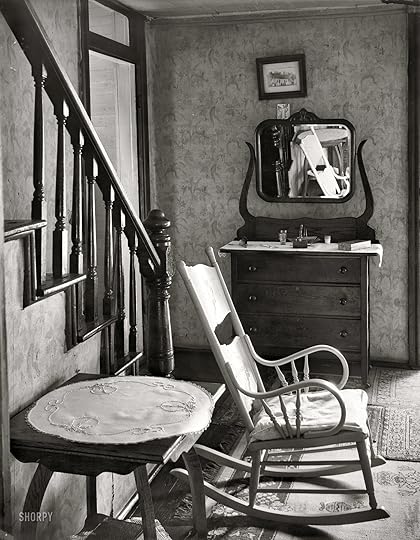
And here's another, for a photo of a rocker at the bottom of a staircase:
Rocker
She wanted to be sure to hear the other babies if they cried, so she nursed them, one at a time, at the bottom of the stairs then carried them, one at a time, softly up, their small hearts beating.
Walker Evans and Cynthia Rylant form a simply magical rapport in Something Permanent. Cynthia Rylant’s connection to the photographs is quite eerie given that the book came to fruition after the passing of Walker Evans. It’s as if she has studied the photographs for hours, interviewed Evans, painstakingly plucked the hidden words from the pictures, and shaped them into poems. The poems and photographs surrounded me, and as an outsider separated by experience, time and distance, it became possible for me to walk within the worlds created by Evans and Rylant. It was a struggle to come back, but I had to so I could tell you to come with me next time.
Evans’ photography is stark but dense. It isn’t tidy, and sometimes the disregard is a sharp punch—the tongue of a worn out shoe, a crude grave, signs shredded with weather’s indifference. Oh, but Evans knew his lines; he was an instrument of light, and his photographs tell you this. His rocking chair isn’t just an object. It still contains the person who sat there, not the humanness of the person but the presence, the light. The light could even be me or you leaving the room or the century, but only as our physical selves.
Cynthia Rylant’s poetry reflects Evans’ photography, yes, but it also tells us a story, a thread that reaches spectacularly for the truth. Her words, like Evans’ photography, are simple but saturated and sprinkled with grit—a barbershop masquerading as heaven, the tight clutch of grief that materializes in a pair of shoes and later, a hat. While Rylant did not experience the depression, her poems say otherwise. Clearly, Walker Evans’ light is still reaching. It is reaching through Cynthia Rylant.
Cynthia Rylant uses photographs taken by Walker Evans in the 1930s as a basis for writing poetry. Published in 1994, this work provides me with a mainstay for helping older elementary students understand the power of the imagined story behind an image, and gives them the courage to try it for themselves.
Rylant's work is a miracle of simplicity as well as depth and reflects the humility of what it takes to live through unusually demanding times. This book deserves a place in any student library.
I love photographs, and those of the depression era included in this book are particularly evocative. In this book, Cynthia Rylant has written poems to go along with the photos. Some I really liked; others not so much. I wondered how she saw what she wrote about in the photo I saw. But I see potential for that, as well, in helping students write from photos. Some poems in this book may not be appropriate for all students, but the ones that are provide lovely poetic language and an example of how students could do their own writing from photos or pictures.
Photographs by Walker Evans, Poetry by Cynthia Ryland The photographs of Walker Evans tell stories, stories of ordinary people living in America in the the extraordinary time of the Great Depression. Poet Cynthia Rylant has studied the photos of Evans, and added her insightful poetry. Together, they tell a poignant and touching story of a difficult time in America. A short book, but well worth checking out of a library.
This collection is an honest and forthright attempt to capture the words - the stories - of a series of past photos. It, in a way, both enhances the photos with its apt prose, while simultaneously taking away some of their unspoken mystique. It's a pleasant collection that, while a bit light, is a nice read.
Walker Evan's photographs are the appeal of this book.
I'm not, however, a fan of the format of pairing art and poetry. The poet's interpretation is an overlay that, in my opinion, obfuscates more than it embellishes.
A collection of small-town tragedy, heartache and humanity, set to photos taken during the Great Depression.
"[A]nd then, dead tired but still in love, they would turn toward each other and, nestled in the warm breathing of their other babies, ease their weary minds with the sex they knew would likely make them poorer and richer all the same time."
This was my Book Club's selection from last month (my turn to choose). It was our first poetry/photography venture and was a huge hit! The poet is chiefly "Young Adult" writer and we "not so young adults" loved it .
I'm accustomed to Cynthia Rylant's childrens books, so her poetry here was a fascinating departure to me. Loved the choice of Depression era photographs by Walker Evans, and Rylant's companion poems were quite interesting. Hard to pick a favorite here.
Beautiful photography with some great poetry which fits the pictures very well. The 1930's black and white photography is poetry in its own right while the poetry sometimes takes you deeper into the picture you see and sometimes lets you see the picture from a new angle.
I feel like this book really captures America during the Great Depression - the combination of great photography and interesting poetry are really appealing, they make the reader really think...