Jump to ratings and reviews
Rate this book

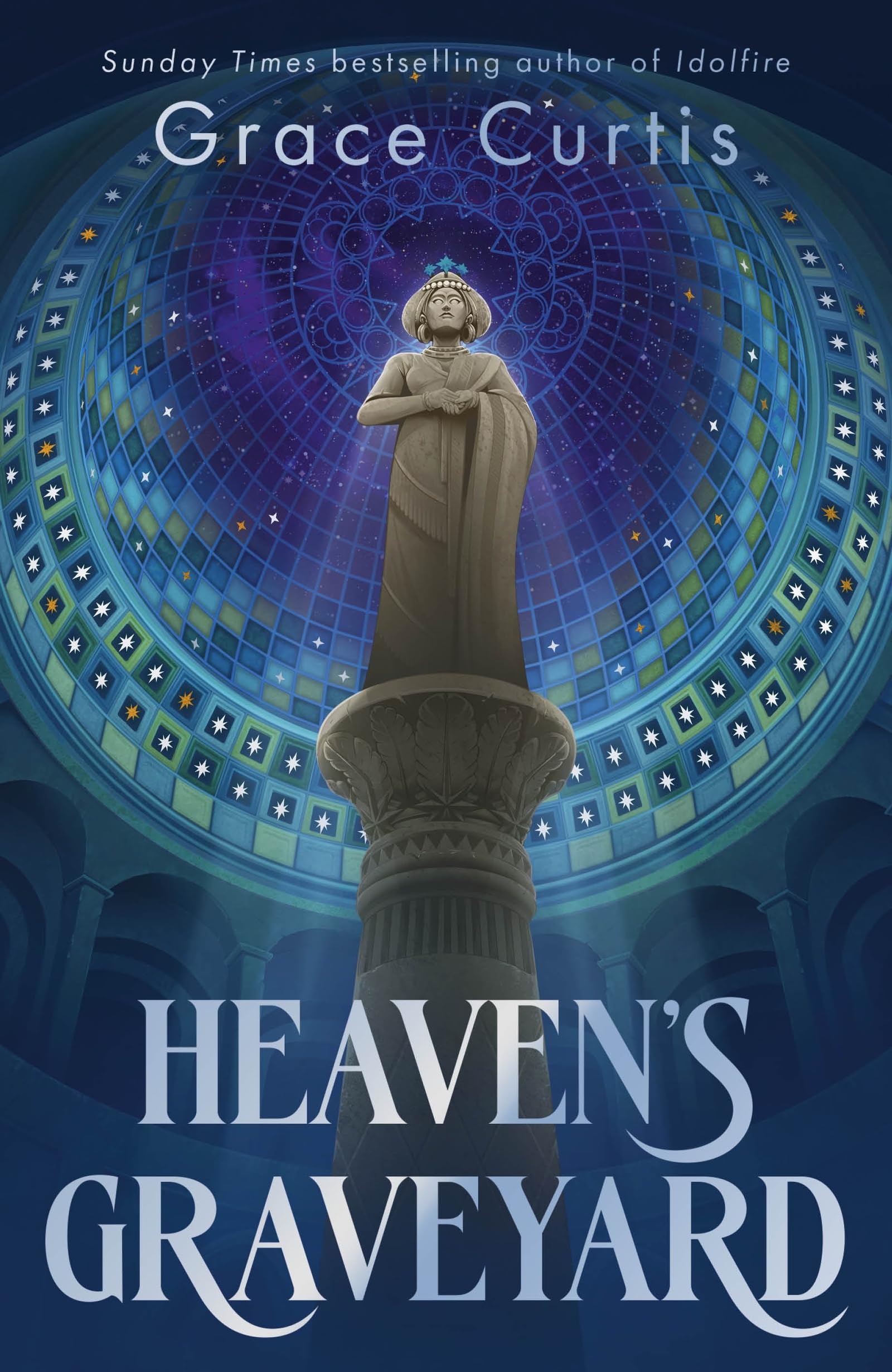
Heaven's Graveyard

Rate this book
From the Sunday Times-bestselling author of Floating Hotel and Idolfire comes a science fantasy tale of history and myth, magic and mystery, perfect for fans of Shelley Parker-Chan and A. K. Larkwood

Be careful what you pray for . . .

Cod became an archaeologist to chase the ghost of her hero, Aleya Ana-Ulai. History may have written Aleya off as a myth, but Cod is determined to prove she existed, even if it means sifting through relics for the rest of her life.

Then a message arrives summoning her home. Cod's former teacher has found something monumental: the ruins of an enchanted city, slumbering beneath the soil.

This could be the breakthrough they've always dreamed of. But with war brewing, rival powers circling, and ancient magics stirring underfoot, their discovery soon becomes far more trouble than it's worth. Even Cod starts to wonder if some things are better left buried . . .

Heaven's Graveyard is a sinister lesbian history mystery bringing old magic into a dangerous new century.

362 pages, Kindle Edition

First published June 16, 2026

Loading...
Loading...

About the author

Grace Curtis

5 books343 followers
Author of FRONTIER, FLOATING HOTEL and IDOLFIRE. Up next: HEAVEN'S GRAVEYARD.

Ratings & Reviews

What do you think?
Rate this book

Friends & Following

Create a free account to discover what your friends think of this book!

Community Reviews

5 stars
36 (24%)
4 stars
68 (46%)
3 stars
34 (23%)
2 stars
6 (4%)
1 star
3 (2%)
Displaying 1 - 30 of 108 reviews
Profile Image for Aila Krisse.
242 reviews11 followers
June 4, 2026
This was nice. Made me cry. Great disaster lesbian rep.
I wouldn’t exactly call this dark academia, because it is kinda dark, but it’s actually the academia’s fault. But it is a fantasy where academia plays a major role. And I really liked that aspect of it actually, it wasn’t too elaborate or detailed but also not too shallow. It managed to perfectly convey how much of a nerd Coda is and also made me completely understand why she’s such a nerd about this, cause if I lived in that world I’d also be nerd about it.

I just generally quite liked Cod, even though I kept tripping up over her name a bit. Cause it’s a weird nickname. The other characters, especially Thal and Sparrow, were also great. I really liked how much their relationships towards Cod changed over the course of the story, yet it still always felt organic.

Also, the tagline on netgalley calls this a romantasy, but that really doesn’t feel accurate, cause romance does kind of play a significant role in the book but in a very different way than what you usually find in romantasy. I can’t say too much without it being a spoiler, but do not go into this expecting it to be romance-centred, or even romance-focused.

The one thing I didn’t quite love was that the archaeology mystery ended up being kind of a letdown. The climax of the story is related to it, but I wish it’d played a broader role. The book is titled Heaven’s Graveyard, but then the actual ‘heaven’s graveyard’ ended up being on page for very little time. I felt similarly about Idolfire, which is set in the same world, but 2000 years before Heaven’s Graveyard (you don’t need to have read the former to understand or enjoy the latter though btw). It also had a big not-yet-archaeological mystery at its core, but the actual mystery ended up being a bit underwhelming.

Still a good book though. 4.25 / 5 stars I guess.

Tropes and such:
- archaeology and a protagonist who’s real nerdy about it
- disaster lesbians (like actually genuinely disastruous)
- themes of child neglect and just mental illness in general
- found family
- betrayal
----
Thank you to Hodderscape for the ARC
Profile Image for Kat.
799 reviews39 followers
December 5, 2025
I received a free copy from DAW via Netgalley in exchange for a fair review. Release date June 16th, 2026.

I liked both of Curtis' previous novels, and I thought the premise of her academia-based latest sounded intriguing. In Heaven's Graveyard, detached academic Coda is summoned back to her hometown with news of a massive archeological find--only to find that the beloved professor who sent the message has been murdered. Chasing stories of her beloved and probably mythical Aleya, Coda is about to be dragged into a plot that is far more than she bargained for.

With its obsessive academic fixated on stories of a dead woman while oblivious to her country's slow slide into war, Heaven's Graveyard sets up obvious comparisons with one of my standout reads of 2025, The Everlasting. Like Owen Mallory, Coda is spectacularly oblivious, paying so little attention to politics that she tries to leave the country without even realizing that her world is on the brink of effectively World War I. Unlike The Everlasting, Coda's indifference to modern events does not become a major thematic element--it just adds a layer of complication in the form of an unreliable narrator who doesn't pay attention to an important chunk of plot. Even if Coda doesn't bother to follow modern events, modern events are about to be deeply interested in her...

It was an interesting decision for Cutis to set a sequel to Idolfire thousands of years later, moving from the mythic past to a world of trains and movies. I liked the emphasis on history fading into legend. Compared to Idolfire, I liked the setting of Heaven's Graveyard better, with its recognizably modern empire teetering on the brink of sectarian violence. It's a fun world, and the book would have been far less compelling set in the usual medieval-generic rather than in the loud clatter of cities and trams and university politics.

Outside of the expansiveness of the world, the story itself was relatively small and compact. The cast is effectively just Coda, her tumultuous ex, her dead professor Marr, and the stiffly religious Thal, who gets dragged into the whole mess. The plot is vaguely murder mystery shaped in that Coda answers an urgent summons only to find a dead friend instead of the promised academic triumph. However, Coda does very little in the way of actual investigating . She's quickly dragged into the archaological find (and the resulting political implications) that Marr was murdered over, and doesn't really get into any Sherlock Holmes type business.

A slow sapphic novel about the perils of archaeology and difficult ex-lovers. Readable enough, but not quite up to the flash and bang of The Everlasting. Great concept though, and much stronger than the comparatively aimless Floating Hotel. I'm interested to see what Curtis writes next.


Profile Image for Jamedi.
928 reviews156 followers
July 12, 2026
Review originally on JamReads

Heaven's Graveyard is a science-fantasy novel written by Grace Curtis, published by DAW Books. A standalone set in the same world as Idolfire (I think it's enjoyable without reading Idolfire, but I think there's a bit of extra juice if you've already done) with a murder mystery plot that also focuses on the love around historical research and archeology, a neurodivergent (probably) main character, and that knows how to play with the scope to create an engaging and always interesting plot.

The world is on the brink of another war between the powers that rule it, but archeologist Cod couldn't care less about the latest news. She's happy in obscurity, cataloging relics in Asha and searching for clues that prove the existence of the mythical Aleya Ana-Ulai, a lifelong obsession. When her old mentor summons her to her old home, Palgaro, with what might be the discovery of a lifetime, the ruins of Nivela, she can't hide the discovery; but once she arrives there, she will find herself in a complicated situation, as her old mentor has just died, and Nivela's ruins discovery might hide something that threatens to tip the balance of the world.

I absolutely loved how Curtis decided to portray Cod, how we get a main character that is so neurodivergent coded, how it reflects in certain moments of her past and how she has made of certain of those passions the job of her life; but there's space for much nuance inside this character, and partly I think it's captured by how the romance with Sparrow charms her. The whole Sparrow's arc is brilliant, but I cannot talk much about it if I want to keep it as spoiler-free as possible.
The rest of the cast is a bit overshadowed by the sheer force of those two characters, but they still fit perfectly into the roles we need them to play in the plot.

Returning to this world 2000 years after the events of Idolfire was certainly an experience, watching how the characters from the previous book became a legend and how the progress has changed the shape of the society; it felt quite coherent, almost natural the contrast between both books.
The pacing was in a nice spot, despite feeling too slow at the start, as we are introduced to Cod and before she reaches Palgaro, but once the mystery is unleashed, we don't stop until the end.

I really enjoyed Heaven's Graveyard, being this a great science-fantasy murder mystery story that conquests your heart through the characterization; it can be enjoyed as a standalone, but I would recommend reading Idolfire before it. Another remarkable novel by Grace Curtis!
Profile Image for Samhain.
577 reviews42 followers
July 6, 2026
Just inject Grace Curtis' prose directly into my veins, please!

I think she's published enough books now that I can safely say she's one of my all-time favourite authors and a part of me will always be excited knowing she's out there, planning a next book, no matter how long it takes before I can get my hands on it. Watching her grow as a storyteller is amazing. I'm glad I get to live at the same time as her so I can experience this adventure in real time.

PS: since it's what people actually read review for, I'll add that the book itself succeeded in its hard mission of being a worthy (sort of) follow-up to Idolfire! The latest hasn't lost its crown as my favourite Curtis book but Heaven's Graveyard is a pretty solid successor. I loved every minute of it.
Profile Image for Nancy Weiler.
169 reviews5 followers
June 7, 2026
This reminded me so much of a film I used to watch as a child - one where an archeologist finds an artefact and dedicates their whole life to finding this missing city from years back but no one believes them. This was such an interesting story, with a dark academia twist on the plot.

Coda FMC read as a child this one book about fairytales believing in a woman with magic was real. She dedicates her life to finding the truth and when she goes to college, the history professor turns out to be the author of said book. Part of this story is set in a school, which would relate to it being dark academia however it’s not the whole basis of the plot. It’s like a home point they return to.

I loved how Coda was such a nerd and the dedication to her beliefs in finding the truth. She comes off very blunt and socially awkward but then her character development throughout the story was so lovely to see. There are dark themes in this book, ones I didn’t actually see coming at all. Which was such a great surprise.

I did find towards the end I became a little lost, and was unclear what was happening. But, the whole premise was so interesting with unique features which I loved - especially with the mother.

The sapphic fantasy did hold tension and obviously there’s a rift between the characters, I wouldn’t say I was obsessed with the connection but I did enjoy it and gave me totally psychotic vibes with one character which I loved!

Thank you to HodderScape for the early review copy.
2,743 reviews57 followers
January 3, 2026
If nothing else, I respect the fact that Curtis decided this stand alone could also techncially tie in to her previous novel by setting it in the same setting, just a millenium or so down the line, which is an absolutely ballsy choice. We get a fantasy world on the verge of war, and an archaeologist professor who is trying to find her missing professor, who is slowly drawn into an Indiana Jones esque conspiracy involving possible weapons of the gods, nation building mythos, and nations manuevering to try and come out on top. We also have a reveal of an arch nemesis whose epistolary forms a good part of the back of the novel, and gives us some A++ yearning letters. Also the imposition of the second person POV for the god adjacent POV is a really nice touch. Hell of a flex of a novel, and highly recommended when it comes out next summer.
Profile Image for Alex.
116 reviews
May 22, 2026
Heaven’s Graveyard
5/5⭐️
I got this book as an ARC from NetGalley, so thanks a lot to the publisher and NetGalley! This was everything I wanted it to be and so much more!

First up, here’s a few Content Warnings:
Animal death/murder (Graphic)
Violence (Graphic)
Injuries (Moderate)
Religion/Religious Violence (Moderate)
Murder (Minor)
Death (Minor)
War (Minor)

Quick note: I found a few editing mistakes throughout the book, with sentences cutting off or words missing, but since I read this as an ARC that is to be expected.

MINOR SPOILERS! Now, let’s get into it.
First of all, I LOVE the characters. Coda feels real and honestly relatable in many aspects. She is flawed, sometimes ignorant and awkward and just so memorable. Her flaws impacted the book in all the perfect ways and I love how she grows throughout the book. I also liked Sparrow and Thal for very different reasons, which I can’t really get into without spoilers 😅 I love Marr. I yearn for a Mentor/Father figure like him. Hated Hani.

The relationships in this book were so interesting. Sparrow and Coda have such a complex and unique relationship. It made me want to hit and hug them at the same time 😭 Thal and Coda clash a lot with their different ideals and beliefs, which made their dynamic so much more interesting. I definitely enjoyed the queerness of it all ☺️
Marr being a Mentor and Father figure made me so sad and I wished we had gotten more of him with Coda 😭 The relationship between Coda and her mother was also so complicated and well written. The discussions on a mother’s love hit me harder than expected. The exploration on what it’s like to have a child you didn’t want and how it can destroy your life and make you bitter towards your own child. I loved it and yearned for a redemption (Thanks for the Epilogue).

The worldbuilding was honestly a little confusing at first because we are just thrown into the world, but once I got the hang of it, I was obsessed. I wish I had a map to look back on every once in a while, but maybe the final version of this book has it. The world is really complex, with many different places and people, who had their own beliefs and opinions. The world felt so alive and that was really exciting to me. The atmosphere felt heroic and vibrant, but also dangerous, which matched the world so well.

On that note, politics and religion being on opposite sides of a War felt very realistic and scary. I loved how thought-provoking it was, with neither side being fully good nor fully evil (but both being definitely more bad than good). I loved and hated how it mirrored big parts of our world and it made me think a lot. Both the Alliance and the Church are after power and using their own ways to try and get it, but in the end, their aren’t that different.
Also the magic system being connected to worship was genius. It felt like a perfect symbol for weaponized religion/beliefs/worship, because it literally made objects of worship into weapons.

The plot twists were so good and I was genuinely flabbergasted. This book is not afraid of changing course and it took me by surprise (in the best way). Some parts of the plot felt kind of convenient and info dumpy, but that didn’t really bother me.
Both the plot and the characters also made me think about justice and what’s right or wrong. With many of these characters doing things that make you wonder what justice means to them and what they think is right/wrong. Like, how can you think that’s okay?
The pacing is was really fast (at least to me) and felt slightly unbalanced sometimes. Specifically the journey that happens later in the book, feels a little too fast/short to me. It didn’t take me out of the story, but I did notice it.
The writing style was captivating and a little chaotic (just how I like it).
The murder mystery aspect was very simple, but enjoyable.

I’m definitely going to pick up Idolfire as soon as possible 😭
Profile Image for Annemieke / A Dance with Books.
1,006 reviews
June 29, 2026
Thank you to DAW and Netgalley for the review copy in exchange for an honest review. This does not change my opinion in anyway.

tw/cw Killing Animal | Violence | Blood | Murder | Death

The idea of Heaven's Graveyard, an archeologist finding out that a story is true, sounded really interesting. Unfortunately I wasn't quite as taken by this book as I had hoped.

We meet Cod as she is working at a museum when she receives a letter from her old mentor. He has discovered something and he wants her help. When she returns home however her old mentor is murdered and a world of secrets open up for her.

As said, the idea of Heaven's Graveyard I found very appealing. I love it when characters are archeologists and when the history is of importantance. However Cod as a character fell flat on me. She wasn't nessecarily flatly written but I could not really connect with her in anyway. Not on an emotional level anyway. I think that meant that a lot later on the book didn't really hit as the author wanted it to. I also feel that her past relationship with Sparrow wasn't written very well. There was too much glossed over for me to believe their supposed love. I also called the betrayal twist pretty early on. It was a bit too obvious.

It is not a bad book but it just didn't do anything for me.
Profile Image for Laurenreadsx_.
753 reviews81 followers
June 10, 2026
I received it a few days ago and I instantly had to pick it up because ‘lesbian fantasy mystery’ had me straight away.

I absolutely loved this book, it had me interested from the very start. I haven’t read Idolfire but I will certainly be picking it up now after the little links in this book to it. This felt like such a different book from what I normally read and I enjoyed every second. I loved the little twists and how things played out.

I loved Cod and seeing her growth throughout the book, I loved the relationship she built and grew with and the direction the relationships went were very interesting 🥰

I highly recommend adding this one to your tbr if you love a fantasy read with a lot of mystery attached to it 🙌🏽
Profile Image for Céline Badaroux.
Author 34 books13 followers
Did Not Finish
June 17, 2026
We follow an obsessive scholar in search of a legendary city. I was into it until she sacrificed a rabbit. You have the blood, the fur... It was the moment I closed the book (35% mark). That's a DNF for me, no thank you.
Profile Image for Demetri Papadimitropoulos.
729 reviews98 followers
Review of advance copy received from NetGalley
April 15, 2026
What the Archive Wants, and What the Dead Refuse to Give
In Grace Curtis’s “Heaven’s Graveyard,” relics, labels, and buried histories turn a myth-soaked mystery into a severe, elegant meditation on possession, reverence, and the dangerous manners of discovery.
By Demetris Papadimitropoulos | April 14th, 2026


Beneath a jeweled dome, the archivist stands before the relic she longs to touch, held in the charged stillness where scholarship, reverence, and possession are not yet fully separable.

Every archive rests on a small imperial conceit: the belief that the past, once properly labeled, will finally behave. Grace Curtis’s “Heaven’s Graveyard” begins inside that conceit and spends the rest of its pages tapping it smartly across the knuckles. It offers all the old bait – a dead mentor, an urgent wire, a disputed heroine, a hidden power, an archivist poised to confuse devotion with method. At first it buttons itself into relic-hunt drag. It turns out to be harder-edged than that: a novel in which reverence, desecration, and vanity often differ only by the wording on the label.

That is where the book stops smiling. Curtis has written about archives, relics, scholarship, borders, gods, and the kind of old love that never learns table manners. Beneath the catalog cards and shrine ash lies the question that keeps worrying the novel: who gets to handle the dead and call it scholarship? A brooch held in a gloved hand. A museum caption that turns a private hunch into public fact. A notebook eased from a locked drawer. A tomb opened because the living cannot endure not knowing. “Heaven’s Graveyard” understands that inquiry is not only a way of honoring the past. It is also a way of laying claim to it.

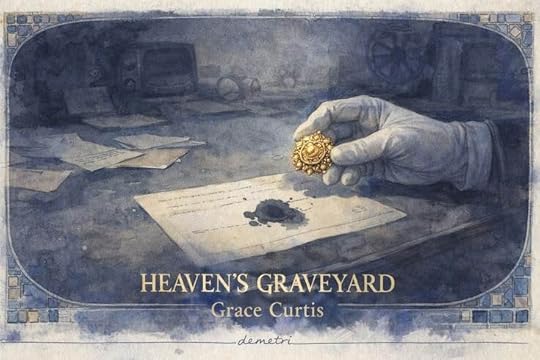
Cod, the archivist at the center of the book, works at the Asha Civic Museum in a role that is modest on the job description and proprietary in effect. She catalogs fragments, translates objects into public meaning, and moves through the world with the shut, slightly avian air of someone who prefers the dead because they rarely interrupt. Curtis pins her to the page as though she were a rare, irritable bird – carefully, unsentimentally, and with evident respect for the beak. Cod is watchful, difficult, dryly funny by accident, and better at noticing the edge of a clasp than the edge in another person’s voice. She has spent years fixating on Aleya Ana-Ulai, the legendary heroine of “The Eternal City,” whom sensible people shelve under myth. When Cod finds a brooch that seems to support Aleya’s existence, she does not merely feel curiosity. She feels that quick, private flare that comes when possession borrows the language of care. More telling still, she decides almost at once that the brooch is, in spirit, already hers. Her preferred verb is not “steal” but “borrow,” which tells on her beautifully.


A relic hovers above an unfinished label, poised at the exact threshold where study becomes claim and the language of care begins to sound suspiciously like possession.

Then comes the wire from her mentor, Denali Marr, summoning her home because of a “historic discovery.” By the time she reaches Tessi, Marr is dead, his papers are compromised, his institution evasive, and whatever he found bends the whole plot into its orbit. Up to this point, the story still affects the manners of clue-work. Curtis can do clue-work perfectly well: missing notes, suspicious timing, shifty administrators, old lovers, sanctified menace, bad borders, and the small social bloodshed that erupts whenever someone as armored as Cod has to deal with the living. But the mystery is never the deepest thing here. Cod, not Marr’s corpse, is the real evidence.

His death catches her, but grief comes to her after stopping for paperwork. Her first instinct is inventory: who found him, when, in what position, after what meal, with what trace left behind. Some people cry. Some rage. Cod begins, mentally, to take statements. Curtis is exact about this species of rerouted sorrow. Detection, for Cod, is tidier than grief and far less humiliating. That emotional logic is one of the book’s quiet strengths. It understands that there are people for whom mourning arrives disguised as work, as procedure, as the sorting of details that can be handled because the feeling itself cannot.


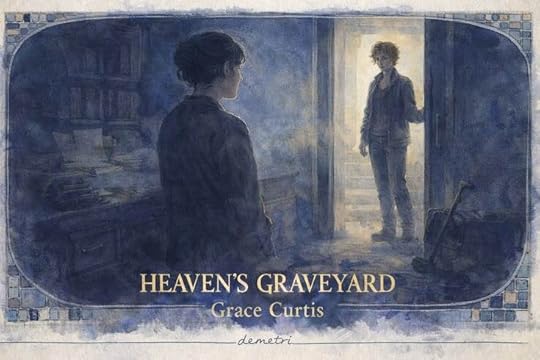
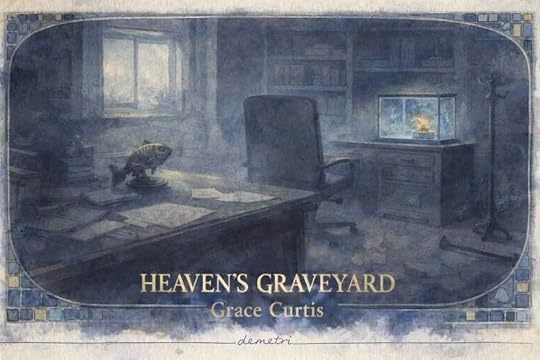
An emptied office, a cold blue tank, a chair still facing the desk: absence here has already begun the slow transformation from life into record.

Marr’s discovery sends Cod through blocked archives, bad borders, and back into the few human attachments she has not successfully mislabeled. Marr himself gave her intellectual shape. Her mother gave her a more private damage. Sparrow – old love, old wound, old nuisance – gives the novel much of its unruly life. Sparrow matters because she cannot be cased, captioned, or footnoted. She remains inconveniently alive. That resistance is not garnish. It keeps the whole book from floating into thesis. Cod can adore Aleya because Aleya is distant, silent, and easy to embroider. The living answer back, often at inopportune moments and with dreadful timing, which is one of the many reasons they are less manageable.


At the threshold stands the problem of the living: unarchivable, backlit, emotionally inconvenient, and impossible to arrange into the stillness the dead so generously permit.

Curtis is too intelligent to leave that contrast lying around as mere character texture. Cod’s fixation on Aleya is not simply scholarly. It is filial, devotional, and just romantic enough to make everyone involved look a little foolish. Aleya is the dead in their most flattering form: far enough away to seem perfect, mute enough to accept whatever the living pin on her. She can lend a lonely life grandeur without ever objecting to the terms. The book knows exactly how dangerous that arrangement is. To love the dead is to enjoy a creaturely asymmetry. They cannot revise your story about them. They cannot tell you to put that relic down.

That is why the novel’s most important revelation lands not as triumph but as correction. When Cod finally reaches Aleya’s hidden resting place and realizes that concealment was chosen – that Aleya withdrew herself and the dangerous power bound to her from history’s grasp on purpose – “Heaven’s Graveyard” modulates, suddenly and beautifully, into something less forgiving. Yes, the myth is real. Yes, the scholar was right. And none of that grants access. Proof, as Curtis says flatly, does not confer permission.


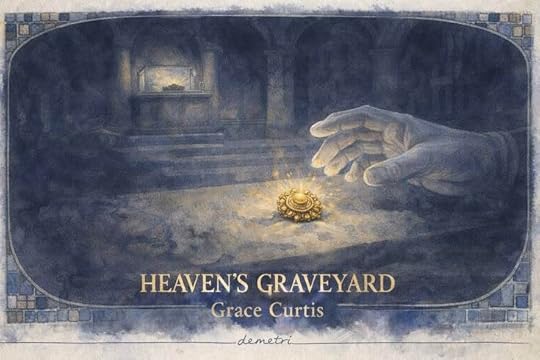
In the dim blue chamber of revelation, the hand hovers and does not close, as discovery sheds its triumph and becomes an ethics of refusal.

That is where ingenuity gives way to judgment. “Heaven’s Graveyard” takes a plot built from the old satisfactions of buried knowledge and turns it against the fantasy that revelation is inherently virtuous. It never loses its appetite for trace, proof, fragment, relic. Nor should it. This is not an anti-knowledge novel, which would be easy and pious. It is an anti-entitlement novel. Curtis understands, from the inside, why institutions and individuals alike love to promote appetite into procedure without losing composure. Museums, universities, churches, scholars, collectors – everyone here has a way of converting desire into policy and calling it stewardship. Because something can be recovered, cataloged, and exhibited, it begins to seem as though it ought to be. Curtis is particularly sharp on how quickly preservation can turn proprietary, how easily care can put on a white glove and become possession.

That argument would be respectable enough on its own. What makes the book good is that Curtis dramatizes it rather than filing a neat essay under the plot. Her prose helps make the point bite. She writes as Cod thinks: precise, tactile, a little ceremonious about surfaces. The sentences keep their cuffs buttoned and their instruments in order. They are sensuous without going soft, measured without going prim. Most arrive in balanced lengths, then tighten or flare when awe, shame, or annoyance breaches Cod’s reserve. The world is built not from ornamental mist but from handled things: clasps, bangles, labels, tram rails, fish statues, dust, old paper, stone gone cold under the hand. This tactile precision does more than furnish the scene. It teaches the reader to trust the artifact, to feel the pull of the handled object, to mistake matter for innocence. Later the novel rebukes that trust. The style is not polish laid over the argument. It is part of the machine that makes the argument cut.

Curtis is good, too, at tonal calibration. “Heaven’s Graveyard” carries melancholy, dread, intellectual excitement, and metaphysical wonder without sloshing them into one undifferentiated broth. The wit is especially well managed. Cod’s dryness, Marr’s eccentricity, Sparrow’s disruptive vitality, and the novel’s steady awareness that institutions are often ridiculous even when dangerous keep the book from drifting into solemn vapor. Curtis has the sense to know that a story about gods, death, archives, and historical trespass still needs people to say the wrong thing at the right moment. Even in its loftier reaches, the novel remembers that the sacred and the absurd are frequent roommates.

The structure is not decoration. It is excavation by other means. Prologue, acts, short titled chapters, memory fragments, letters, travel, institutional procedure, revelation held back just long enough – all of it suits a novel about reconstruction. Each chapter feels like another shard lifted from the dirt and brushed clean. The segmented design also gives Curtis a useful rhythm of advance and pause. Inquiry leads to recollection; recollection alters inquiry. The form keeps reminding us that history is seldom encountered whole. It comes in pieces, and the pieces arrive already handled by others.

A lesser version of this story would have treated its final disclosure as treasure-chest payoff: the heroine was real, the gods were real, the hidden world was there all along, cue scholarly vindication. Curtis gives us all that and then lets the applause begin before quietly spoiling it. Revelation is not the reward. Revelation becomes trespass in ceremonial dress. That reversal deepens the entire book. It changes what the opening scenes were doing, changes what the relics mean, changes the ethical temperature of every label and note and scholarly inference that came before. It is not simply a good ending. It is a re-annotation of the novel’s first principles.

There is a cost attached to this severity. Cod’s cool reserve gives the book much of its authority, but it also tightens the emotional reach. Curtis is right not to soften her. Cod should be difficult. Her mind is the method. Even so, there are stretches – especially in the first half – when the page is already bleeding while the reader is still being handed the gloves. Marr’s death, parts of the Sparrow material, even some of Cod’s private history arrive through observation and inference first, feeling second. The delay is purposeful. It is also, at times, limiting.

The novel returns, now and then, to the same sore place. Because obsession governs it, Curtis keeps circling Aleya, proof, and the friction between myth and evidence. Mostly that deepens the pressure. A few times it simply presses the bruise again. The repetition is understandable – obsession is repetitive, that is half the trouble – but there are moments when one wishes the book would trust the force of what it has already established and move on with a little less ceremonial reapproach.

Some readers will call that exacting. Others will call it chilly. Both will have a case. Anyone wanting a brisk fantasy of sacred objects and secret histories will find a slower, more barbed, more self-interrogating thing. Readers who like speculative fiction with archives, gods, awkwardness, and moral pressure will fare better. The standard comparisons illuminate a corner, then give up, which is usually a good sign. “Possession” by A. S. Byatt shares the archival seduction. “Piranesi” by Susanna Clarke shares some of the estranged wonder. Curtis is flintier than either, and much less interested in consoling anyone for the labor of reading.

Its relevance does not need hauling in. It is already in the room. At a moment when museums are being pressed on what exactly they own, when archives are being reread for omission as much as inclusion, and when “preservation” increasingly sounds like the word people use just before someone else asks for their property back, “Heaven’s Graveyard” feels cool-eyed and diagnostic. It is not chasing a mood. It is examining an old reflex: the habit of mistaking visibility for virtue. Because something can be shown, it starts to seem as though it should be shown. Curtis is too fair to make that reflex monstrous. She knows its seductions because her heroine feels them in her fingertips.

The late ascent – Tahlia’s appearance, her unnervingly calm account of knowledge as a weapon one grips by the blade – could have gone pious or vaporous. It does neither. Curtis earns the elevated register by keeping the story tethered to embarrassment, objects, bad timing, and love’s habit of reaching where it has not been invited. Even at its loftiest, “Heaven’s Graveyard” remembers that people are acquisitive creatures. They want to keep what moves them. They want to name what outlives them. They want the relic, the answer, the proof, the blessing, and, given the choice, a decent display case. The gods may arrive. The museum dust keeps its seat.

For me, “Heaven’s Graveyard” lands at 89/100 – 4 out of 5 stars: a strong, exacting, unusually intelligent speculative novel whose coolness is both part of its authority and part of its limit. I admired it at once, felt it by gathering degrees, and respected it more each time I turned it over. Its excellence is chiefly artistic and intellectual, though the feeling is real once Curtis stops letting Cod hide behind procedure.

The best thing the novel knows is that the past is fragile not only because it can vanish, but because it can be found by people who mistake access for permission. Curtis begins with the old fantasy that buried truth is waiting for the right scholar to bring it into view. She ends somewhere wiser and sadder. What remains is not the bright click of a solved mystery, but the sight of a cataloguer’s hand hovering over the relic at last and, against every trained instinct – to classify, to keep, to publish – choosing not to close into a fist.


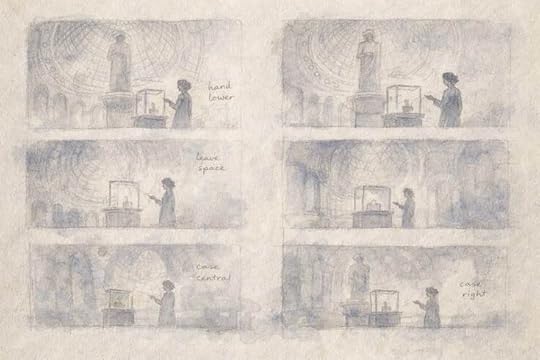
Early compositional studies testing how dome, figure, relic, and negative space might hold the book’s central tension between sacred scale and the private impulse to claim what should perhaps remain untouched.


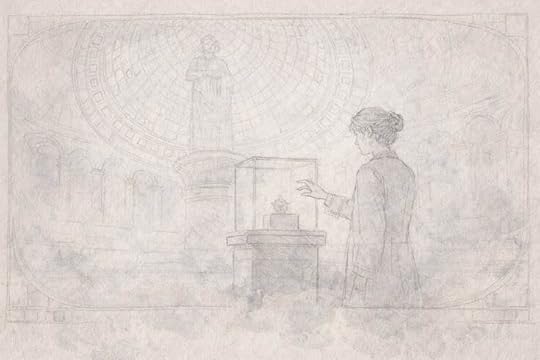
The faint underdrawing establishes the painting’s hidden architecture – figure, case, dome, and hovering hand – before atmosphere and color soften the scene into something more haunted and morally suspended.


With the first cool washes in place, the image begins to move from structure into mood, as the museum turns luminous, the dome turns watchful, and restraint begins to take on emotional weight.


This palette study gathers the cover-derived blues, golds, slates, and muted greens that shape the final image’s solemn radiance, keeping the painting tied to the book’s world of relics, shadows, and withheld revelation.

All watercolor illustrations by Demetris Papadimitropoulos.
Profile Image for Marlene.
3,556 reviews250 followers
Review of advance copy received from Edelweiss+
June 13, 2026
This is the world created by Idolfire AND the world created by its lack. It’s also the story of one scholar’s obsession with history and one rogue assassin’s obsession with her. And, it’s a story about the havoc that obsession can create, both with its absorption and with the damage that its single-mindedness scatters like rain.

Let’s unpack that a bit, shall we?

Heaven’s Graveyard takes place in the same setting as the author’s earlier book, Idolfire. But this is not a sequel. Instead, this is that same world, centuries later. So far distant that the broken scraps of a dead empire that was the world of Idolfire, a world where magic is still a force in the world and at a time when wishes still had power in all the worst, cursed ways – has now become a gaslamp world at about the level of technology as our late 19th century. Jules Verne and H.G. Wells would have felt right at home.

Their technology rules. Maybe not our kind of tech, but tech all the same. And, like many a tech-based world, magic is considered a myth. A story for children. But literal magic isn’t the only thing that’s disappeared. So have the larger-than-life heroes of legend.

And that’s where Coda Canalluny (who very much insists on being called just “Cod” for reasons that become clear in the story), Doctor of Archaeology, curator at the Asha Civic Museum, comes into the picture.

Or rather, it’s where she came in as a child, when she discovered Professor D. Marr-Ahava’s book, Ashan Myths for Children and fell in love with the legendary Aleya Ana-Ulai. The hero of a tale so old that it had passed into myth. A story about standing up and defying a queen, undertaking a dangerous world-spanning quest, falling in love and having to give up that love for the good of the kingdom she came to rule.

A story about bringing back the magic that was stolen from her people by breaking into the lost ruins of a formerly world-spanning empire, and bringing her people’s most powerful artifact back home where it belonged.

People in Cod’s world, in Cod’s own profession, are sure that Aleya’s entire story is a myth. Because there is no magic in their world. (OTOH, we know it’s all TRUE, because it’s the story in the book Idolfire. Cod’s world is the world that was made out of Aleya and Kirby’s sacrifices for both of their widely-separated peoples.)

Cod is obsessed with proving that Aleya really existed, and that all the stories about her quest to the fabled capital of Nivela are historic truth and not merely mythological hyperbole. She’s spent her career trying to prove her hypothesis – just as her mentor has done.

So when she receives a ‘wire’ from that mentor, claiming a momentous discovery, Cod rushes back home, the last place she ever planned to return to, only to find that her beloved teacher was murdered mere hours before her arrival.

She’s certain his death has to do with his discovery and their shared quest. She just doesn’t know who or how or why. And she is so desperate to discover the truth of everything that she can’t see the threat standing right by her side until its far too late.

Escape Rating A-: Heaven’s Graveyard is linked to the previous book, Idolfire, in multiple ways – but I think it stands alone all the same. The stories are told in the same way, that the current quest is a result of an incident in the mythological past that no one in the stories present believes to have been true. Idolfire looked back at Nivela in its prime and Heaven’s Graveyard casts its eyes back at the quest to find the ruins of Nivela that no one believed existed then – and believe even less now.

Idolfire was not a story of Nivela itself, we didn’t need to know whether the legends that Aleya and Kirby followed were true or not. We just got caught up in them following that thread. Likewise here, we need to know what is believed in Cod’s today about what happened in the past. We don’t need the details of that past to follow along on this quest.

To be fair, there are moments that have a lot more resonance if you do know Aleya’s and Kirby’s story from Idolfire. But you don’t HAVE to know to get into Heaven’s Graveyard. Cod’s quest to find her mentor’s murderer and the truth of his potential discovery is more than enough story for one book.

As much as Heaven’s Graveyard is about Cod’s search for the historical Aleya and for the contemporary murderer, underneath that it’s a story about obsession, and that story starts with Aleya’s mother, a scientific genius who was obsessed with making space travel feasible. Vivette Canalluny’s career was cut short by poverty and single-motherhood. The birth of Coda was the literal ending, or coda, to all her dreams. Cod grew up in the shadow of her mother’s intellectual obsessions, her neglect, and her eventual madness.

So Cod mostly raised herself, knowing that she was a constant disappointment to a mother who resented her every breath. In her turn, Cod retreated into her own intellectual obsession with Aleya, and neglected the people around her in favor of her own obsession. Never realizing that her lover was obsessed with her and was willing to do anything to have her. Or get her back and use Cod’s obsessions as a way of punishing her while feeding, in turn, her own obsessions for money and power.

Because while Cod is looking for vindication of her theories, her frenemy Sparrow is following right behind her, looking for the power that Aleya brought home to her kingdom. Because power is a weapon that Sparrow can use and sell without a care in the world about the price the world will pay for the war she’s intending to arm on both sides.

I think the above represent the largest threads in this story, but they’re not the only ones. It’s a murder mystery wrapped in an epic quest filled with questions about how history gets remembered and what qualities turn a life into a legend and who gets to decide the legacy of that legend.

I don’t think ‘fun’ is the right word for this story, because it gets kind of deep and goes to some sad places. But it is absolutely compelling in all of its searching and questing for all the truths that Cod has hidden from herself and the truths that have been hidden from her along the way. The sapphic romance in Idolfire was a tragic one because Aleya and Kirby knew from the beginning that they could only be together in death. And they were. The sapphic romance in Heaven’s Graveyard isn’t so much tragic as it is utterly misguided and completely one-sided – at least until Cod finally opens her eyes to the world that’s been around her – and her own obsession – all along.

Originally published at Reading Reality
Profile Image for Alana.
228 reviews5 followers
January 12, 2026
I want more! What an excellent stand alone fantasy full of mystery and magic. The world building is great, I’d even argue that there could be even more. I do appreciate the pacing of this story overall, as some fantasy can become too muddled with details. The first half of the story is more of a slow build up with discoveries. The latter half, Act 2, ramps up and we see a satisfying flow of events. I enjoyed Cod as a character, but I wish we got even more relationship building with Thal and Sparrow.

Heaven’s Graveyard was a well written, fast paced fantasy with interesting lore.

Thank you NetGalley and the publisher for this copy to review in return for my honest opinion.
Profile Image for Elle.
397 reviews19 followers
Review of advance copy received from NetGalley
May 26, 2026
Knowledge is a dagger with a blade for a handle.

Most people fall out of love with their first crush over time. Coda is different: her first love is a mythical queen from a children's book of stories, and Coda grows up determined to prove that Aleya was real. She becomes an archeologist, moves to Aleya's home country of Asha, enjoys a prominent job at a prestigious museum... yet is no closer to finding proof than she was as a child. Until her former university professor, also obsessed with the myth, sends her a summons. He's found something that could change everything. Unfortunately Coda arrives home to find him murdered. What did he find, and who had him killed for it? Coda won't rest until she knows.

Heaven's Graveyard is a murder mystery starring a lesbian-disaster version of Indiana Jones. Well, a slightly more academic, slightly less whip-wielding Indy. It's also a fascinating look at relationships with the people around us. Who supports us and why or why not? Why do we close ourselves off from others, and how do we fix that if we indeed even want to? How do you go about untangling very complicated relationships you thought were ancient history? But it's also literally about ancient history, too. How we treat knowledge and relics and discoveries. How history can lie to us, and why it might do so.

Is all information good or worth learning? Is it ever right to destroy it or hide it away?

Heaven's Graveyard isn't going to give you all the answers, but it will tease you with the questions and some scenarios while dragging you along on a high-tension rollercoaster ride.

The characters are amazing. Complex, deep, and often far too realistic in their flaws. Coda is such a disaster, but a sympathetic one and I loved being in her head. Abandoned and down-trodden, often ridiculed for her theories and goals, with exactly one person in her corner and a possibly-fantasy figure she clings to for security and stability. Marr was entirely believable as an academic, but also a likeable character who half-adopted Coda and shared the same academic dream. So much we learn of Marr is from the people he's left behind: Coda, his ex-wife, his current top student / replacement for Coda. Said semi-replacement, Thal, is a foreign exchange student from a religious neighbour who war keeps threatening to break out with. She's an outsider like Coda though for different reasons, but I'm so happy that the author never slipped into religious cliches with Thal. She's not a zealot or a preacher or any of those easy-to-reach-for tropes that a religious semi-antagonist semi-suspect might fall into in another type of novel. Sparrow, Coda's ex-girlfriend, is a hot mess who still somehow manages to keep things together better than Coda. She's the spunky sidekick with gadgets, the support, maybe even the crutch that Coda falls back on as the world goes insane around her. The author walks this wonderfully thin line where it's hard to tell if Coda is perhaps slightly using Sparrow on account of Sparrow still having feelings for Coda, or if Sparrow is the one who keeps inserting herself in hopes it'll cause a relapse of feelings. Their relationship and how it develops had me on tenterhooks the entire time.

I love the world of this novel. It's a bit grimy and a lot steampunky. We travel through barren near-desert areas, harsh coastlines and seas, and pleasant green woodlands that have been sectioned off into a protected wildlife area. We travel by clunky trams, large boats, and mechanical 'runners', which are the lovechild of Gauntlet Runners (from 2024's hit rpg Metaphor Refantazio) and Star Wars' AT-ST Scout Walker -- imagine a steampunk cabin raised and moved by mechanical 'legs', so your car "runs" you to the next town. It felt very fresh, especially as a world that supposedly built itself over a history of magic and gods.

The plot itself is well crafted. The tension is always high from one subplot or another, the relationships are always growing or straining in interesting ways, and throughout it all Coda's own personal history, not just ancient history, also weaves in and out of her story and development. Things she thought were behind her, either from outrunning or abandoning, are actually not that far gone. It was captivating to see how the past threads built up the fuller picture of Coda while also making her fray at the edges. Just as knowledge cuts both ways, the past both hurts and heals, builds and destroys.

The only issue I can remember having with this novel is the nicknames. Coda (with a long OH sound) constantly refers to herself as Cod. Should I be pronouncing that like the fish? And if so, why? Or is it meant to be pronounced 'Code' despite looking like a completely different word? Sparrow also has her name shortened a few times, though not nearly as regularly as Coda, and I have the same problem. Saying half of the word 'sparrow' just doesn't roll off the tongue, and one again looks more like a completely different word with different pronunciation, spar (long AH). The one time I wanted a pronunciation guide just so I could be sure how I was meant to be reading/hearing the main character's name.

I don't recall how this novel came to my attention in the first place, but I came in with no or low expectations and was blown away. Biggest surprise read of 2026 so far. Apparently there is a prequel novel to this one set in the same world at a different point in time? Onto the TBR it goes!

Love makes us unwise. Nevertheless, it will be the last thing left. Love will be there at the end of everything.


Rating: 4.5 stars -- Honestly kind of torn whether this needs an extra half star to hit a full 5. I can't think of anything it could have improved on (apart from the nickname guide).

Edit: Screw it, upgraded to 5. It deserves it.
Profile Image for Siobhan.
306 reviews9 followers
Review of advance copy received from NetGalley
May 18, 2026
Thank you to NetGalley and Hodderscape for this E-ARC in exchange for an honest review.

3.75⭐️

Much like with Idolfire, this review is going to be a tricky one to write because, whilst I enjoyed this book and it had some excellent moments, it never quite lived up to its full potential for me.

I'll start with what I did like about this book though because, despite my incoming criticisms, I did really enjoy reading this! For one, I thought the character work here was strong, and Cod was a really interesting character to perceive this story through: socially awkward, at times unintentionally blunt or ignorant, and so utterly devoted to her academia. As an autistic academic myself, I found her character to be quite relatable. The wider character work was really strong too, with distinct characters across the board. Thal was an especially intriguing character that I wish we'd gotten to see much more of (especially since her and Cod's relationship didn't get nearly enough time to develop, and her and Cod had far more chemistry than Cod and Sparrow in my opinion), Marr was incredibly vibrant despite only appearing in a handful of flashback scenes, haunting the narrative; and Sparrow was certainly... intriguing, but I won't say much more on her. I also thought the setting was an interesting choice, combining fantasy and mystery and academic against a modern cityscape or a red-brick university, all darkened by an incoming war. The political theming was quite strong, examining the threat of looming war, and the darkness that comes with arms selling, and what destruction power can bring when taken by the wrong hands. The big reveal of the book was certainly one I never saw coming, and as someone who has read Idolfire, I really loved picking up on all the hints about Aleya and Kirby (who is unnamed in this book, but certainly relevant) and their epic journey!

Overall though, this is a book that just couldn't quite nail the execution. The first half of the book (mainly focused on a murder mystery style plot) reads incredibly slow and boring at times, and then the second half is much more gripping, fast-paced and threatening, but isn't grounded enough with strong worldbuilding. It's established early on in this book that we're teetering on the brink of war, and yet we never seem to be given any explanations as to why this war is even a possibility, or why the conflict between these countries exist, which also meant it was very hard to keep track of which country was which, which religion was which, and why they were in such opposition.

There are also some issues when it comes to character development and motivation, especially with Sparrow. I can't say too much as it would spoil some major things massively. but she just isn't written strongly enough for the role she fulfils, and as such comes off at times like a caricature. We're given very small hints of a potential backstory, but again never any explanation/justification as to why she ends up in the position we does, which makes her character feel somewhat shallow. We get more backstory and explanation about Cod's mother, and she's barely important to the story, only appearing outside of flashbacks in the Epilogue. The plot itself often felt underdeveloped too, and especially the ending, which was so rushed and seemed to tie everything up a bit too neatly.

I think one of this book's biggest issues is that it doesn't fully know what it wants to be. To my understanding, this book is supposed to be an indirect sequel to Idolfire, whilst also working as a standalone, and in my opinion it doesn't really fit into either category, instead sitting in an uncertain grey area. If you've read Idolfire, then this book loses a lot of its suspense, as you already know the truth about Aleya and her story, but I think if you need to have read Idolfire to understand the magic system and history in this book, because the worldbuilding in Heaven's Graveyard just isn't strong enough standing alone. I do think the commentary on history and the ways that archaeology can be invasive is interesting and a driving force for this book, but with this execution it just doesn't really work. In all honesty I'm not sure if this story was quite right for this fictional world (I still insist that Idolfire should have been a duology, and doesn't work as a standalone), and I don't think the book fully knows its own purpose either.

Overall this was a flawed read, but still fun! I would recommend this for those who have already read Idolfire, as it does add some interesting new concepts to the story and the world, but I do think the execution was quite a let down for me unfortunately.
Profile Image for becks.
25 reviews1 follower
Review of advance copy received from Netgalley
January 15, 2026
Thank you to DAW Books and NetGalley for providing a free digital ARC in exchange for a fair review.

This was a delightful and very intriguing read, and my first outing with Grace Curtis' books. I was immediately interested in the premise of the book, especially from the description calling it a "sinister lesbian history mystery bringing old magic into a dangerous new century" in what might be a description made to appeal directly to me.

I will note that I have not read Idolfire, so my thoughts are focused solely on Heaven's Graveyard. Despite this being a far future sequel of sorts, I don't think you need to read one to understand the other. That being said, I did find myself wondering what it would be like to read this book with knowledge of Idolfire. With 2,000 years between Idolfire and Heaven's Graveyard, I imagine there are some interesting call backs and bonuses for a reader who has read both books given the focus on history, mythology and archaeology.

Heaven's Graveyard is a rather unique mix of murder mystery thriller and archaeological adventure blended into one. The story follows Coda, or "Cod", our protagonist. An academic fixated on the mythological tales of Aleya Ana-Ulai, Coda is drawn back to her hometown by her old professor, mentor and friend, Marr, with the promise of a grand discovery relating to their shared interest in Aleya. However, her homecoming takes a sad turn when she arrives only to find Marr was found dead in his office that very morning. From here the story shifts as Coda quickly realises there is something off about her mentor's death and she chooses to take up the research he left behind, only to slowly realise she may be in over her head. I found the plot to be strong and interesting. The first 10% was a little slow, but once Coda reaches Tessi it picks up and maintains a steady pace.

Mysteries thread through the heart of the story itself, from the obvious mystery of what happened to Coda's professor, to the slower burn mysteries of Aleya herself and why Coda left her hometown, breaking off relationships and friendships in the process. But there are plenty of other topics as well: warfare and religion, and how the two drive humanity makes up a large chunk of the story as well, with an underlying mystery for the reader regarding what is happening in the world, with whispers and rumours of war on the horizon. Curtis did a great job of making the wider world feel present even when the story was so focused on a few individuals.

Obsession and how it can drive and ruin someone crops up during the book as well. Coda's obsessive desire to know everything about Aleya Ana-Ulai and prove she was real is the driving force of the book, and was shared to a lesser extent by her professor Marr. There are a couple of other characters that have their own defining obsessions as well, but I will leave that for future readers to discover.

The cast were very strong. Coda is a very unique woman who reads as neurodivergent, but with a certain awareness of her behaviours and how much she struggles to "correctly" interact with people. It's subtle, but she does undergo a reasonable amount of growth without fundamentally changing who she is. Sparrow is a delightful contrast to Coda, being friendly, fun and personable where Coda isn't, while having many secrets of her own, and Thal's no nonsense attitude and blunt criticism of Coda's behaviour provides a lovely counterbalance in the story. My only complaint is that I wish we'd seen a bit more of Thal, but I still feel we were given plenty of reasons why she couldn't have been more involved.

Overall, I had a very enjoyable time with this book and am interested in picking up Curtis' other works in the future. If the 'sinister lesbian history mystery' tagline intrigues you, or if you love fantasy realism, and a story that balances tension, mystery and some good old sapphic yearning well, then keep your eyes out for the book when it releases in June 2026!
Profile Image for laku.
10 reviews12 followers
Review of advance copy received from Netgalley
March 12, 2026
The premise of this book is amazing: an introverted archaeologist obsessed with proving a female hero from ages past actually existed is forced to return to her home country when her favourite professor and dear friend is assassinated. I have not read its prequel-of-sorts, Idolfire, which follows said female hero through her adventures, but as I understand it’s an epic fantasy road trip journey of self-discovery with a larger cast. This is not the case for Heaven’s Graveyard.
Rather, this is a character-driven novel about struggling with guilt and grief, and how to push past the self-loathing they engender to live a fulfilling life—and of course, save the world in the process.

At the beginning, it reminded me a lot of The Everlasting by Alix E. Harrow, what with the childhood obsession with a female figure out of myth, the complicated relationship with her mother, and the indifference to war and current events. Unlike everyone else, I did not particularly enjoy that book, so I was glad that the plot here went into a completely different direction.
Despite the grittiness implied in a murder mystery set in a world on the brink of war, the atmosphere was almost cozy for a big chunk of the book. It’s hard to feel a sense of impending doom when the cities are described so vibrantly, with trams whistling past and colorful bell towers. That made the switch of tone midway through hit all the hardest.

For a book with stakes so high, the cast was surprisingly small. Most secondary characters disappeared with barely a mention after they fulfilled their role, leaving just four characters with significant arcs, though all of them revolved around Coda.
She was a good protagonist to follow—not special in any way, and with a confidently negative opinion of herself that sometimes hit too close for comfort, who nonetheless never shied away from tackling head-on the problems she caused. Much more compelling than her, however, was the villain: ruthless but also silly, obsessed with Coda but not to the point of putting her well-being above their own interests, and vaguely unhinged. Just a lot of fun.

I quite liked Curtis’s writing style. It was simple but engaging, with beautiful descriptions of the modernish cities and some cracking metaphors and similes that conveyed Coda’s feelings better than a whole paragraph of exposition ever could.
There were also some interesting reflections about history—as befitting a book with an archaeologist as a protagonist—explored through two competing views on the role of historians. One sees them as scholars dedicated first and foremost to improving the present by understanding the past; the other as advocates for the dignity of the dead. The concept comes into play from the beginning regarding things like opening tombs, moving human remains, and damaging relics to better understand them, but it is also reflected in Coda’s character development as she slowly shifts her worldview from one interpretation to the other (and in the switch of sidekick).

A note on the reading order. The author mentioned writing them as two interconnected books that can be read in any order, but I would suggest reading Idolfire before Heaven’s Graveyard, if only to have a firmer understanding of the magic. I found it the most fascinating aspect of this novel, and I was slightly disappointed that the focus wasn’t on how it worked. We are told a few details, but not much beyond that—because, I’m assuming, Idolfire already explored the topic in great detail. In addition, certain plot threads I was extremely interested in ended up going nowhere, which makes me think they were easter eggs rather than foreshadowing for some big reveal as I expected. I will be definitely pick it up soon to get more of this world!

Many thanks to Hodderscape and Netgalley UK for providing me with a review copy of this book. All the opinions stated here are my own.
Profile Image for Tessa.
72 reviews4 followers
Review of advance copy received from NetGalley
June 11, 2026
Thank you to Hodderscape, Grace Curtis and NetGalley for sending me an eARC of Heaven's Graveyard.

Heaven's Graveyard follows scholar and archaeologist Cod who has spent her life researching the long-dead mythical figure Aleya Ana-Unai. She's determined to prove that Aleya did exist two thousand years ago, and her search leads her to lost relics and a life of museum curation. One day, a message from her old mentor calls her home to witness a historic discovery, and Cod jumps at the chance to go. However, when she arrives in her home city, she finds herself entangled in a conspiracy of war and power that leads her to question everything she once believed to be true.

2.75 stars.

I picked up Heaven's Graveyard not knowing that it's a successor to Idolfire; not a sequel as such but set in the same world two thousand years later. I haven't read Idolfire just yet, but this makes me want to go back and read it as I was more interested in the magic and gods of this world than the more modern setting that this book is set in, so I think I'll enjoy Idolfire way more. You don't need to have read Idolfire to have read this, and in fact I think I preferred it this way as I didn't know Aleya's story and was in as much of an investigative mood as Cod was when trying to learn about her.

I'm sadly a bit disappointed with the execution of this book. I was really intruiged by the archaeological and historical aspects of the world, and trying to piece together Aleya's story with Cod, however the main plot, the murder mystery element and the characters just let me down a bit. I really didn't feel connected to Cod as a character at all; she's quite disconnected from everyone around her and also in a way to the reader, at least from my experience. Her naiviety and disregard for a lot of things outside of her job really annoyed me sometimes; she'd have put things together way faster if she were clued in on the politics and the war brewing in the world, but she didn't know anything about that due to not reading newspapers or engaging with people. I can totally see how someone can get so entranced in the things they find interesting that the rest of the world is shut out, however Cod was so disconnected that she felt really uninformed at times which I didn't like.

Also the animal cruelty in this felt a little out of place. I was hoping that Cod would have a change of heart, especially as the animal had a name, but no, the cruelty still happened. I can see why it was done, but I found myself wanting to DNF at that point as I just lost any connection I felt to Cod after she did that. Definitely be aware of the animal cruelty/death TW going into this if that's something that upsets you.

The overall pacing of the book also felt a bit off; some parts were super rushed and others felt like they dragged on. I did enjoy the parts of the story where it switched to second person POV; I've been reading a few books with that switch in recently and always really enjoy the way it's used to change the narrative, and it was done well in this. However the main plot didn't really engage me, and the way the murder mystery was resolved felt a bit anti-climactic and was brushed past in favour of getting back to the main plot, so it didn't feel satisfying to uncover the murderer at all.

Overall, Heaven's Graveyard had a great premise and themes but the execution didn't live up to what I wanted it to be. However this does make me want to read Idolfire way more now as I think I'll enjoy the more magical historical setting that will be in that book. It'll be fun to see how Aleya's story unfolds from her own perspective instead of hearing about it like a myth.
Profile Image for Red.
239 reviews15 followers
Review of advance copy received from Netgalley
March 16, 2026
Heaven’s Graveyard was a fun, light-hearted book and was a nice break between heavier/more complex reads. We follow Coda (or Cod), an archaeologist with an obsession about the legendary hero Aleya Ana-Ulai and a desire to prove she was a real figure. Receiving a letter about a monumental discovery from her childhood mentor, she returns to her hometown but finds him dead in an apparently unfortunate accident. But Cod suspects that not all is as it seems. What discovery could be worth killing for?

Heaven’s Graveyard is set in the same world and ties into the events of one of Grace Curtis’ previous books, Idolfire, but I hadn’t read that before reading this one. It’s definitely not necessary to, but there were a lot of easter eggs and moments where it felt like the author was bringing attention to things and winking at the audience that I just didn’t get or appreciate so I think it would probably improve the experience to read Idolfire in the same way that it would improve the experience of reading Mistborn Era 2 if you read Era 1 first, though it’s definitely not needed to understand and appreciate the story. Speaking of the story, it was a lot of fun! I really liked the main character, Cod. Many of her flaws and struggles were really relatable like her struggles to connect with people and I also really liked how determined and decisive she was despite her fears and inexperience of the wider world. The supporting characters also all really worked, they all felt like they had hidden layers and messy motivations.
The murder mystery plot didn’t actually take up a huge amount of page time, but I didn’t mind that because the other mystery plots surrounding the archaeological discoveries and Cod’s mother were also pretty engaging. The plot twists really got me in this one, I felt so blindsided even though in hindsight it should’ve been obvious!

The magic was a really interesting concept, though I felt like I was missing a bit of context and I didn’t quite understand how it worked, which may be because it was fleshed out more in Idolfire. It was still really fun and I loved how chaotic it was but it could have hit a bit harder if I’d understood it more. The worldbuilding also fell into a bit of confusion for me, because it’s the kind of thing I see often in books nowadays where it’s clearly set in a time period that’s meant to reflect the past but the time period is really hard to parse because the older technologies are surrounded by very modern language/turns of phrase. But I did really like the exploration of the effects of new technologies appearing and the effects of a world becoming more and more connected and globalised as these technologies appear, triggering conflict.

The pacing was a bit off quite slow to begin with and then everything was wrapped up really quickly at the end leaving me a bit unsatisfied. It felt like everything was just ultimately a bit too easy to fix and I would have liked more exploration of the wider consequences of the characters’ actions.

Overall, Heaven’s Graveyard was a really fun read. The writing style was clever and engaging, I loved the characters and the plot was full of mystery and twists even if I was a little dissatisfied with the resolution. Definitely pick this up if you’re looking for a light, quick, sapphic read with some fun twists and an interesting political backdrop.
Profile Image for Yaz.
77 reviews5 followers
Review of advance copy received from NetGalley
May 14, 2026
Thanks to the publisher Hodder & Stoughton for this eARC of Heaven's Graveyard received via NetGalley in exchange for my honest review!

I was over the moon that I got the eARC for this! I absolutely love Grace Curtis and not just because she's from my home town of Newcastle! (Do I fantasise about bumping into her in Waterstones whenever I visit back home? Maaaaaaaybe)(Remember when there used to be TWO Waterstones really close to each other?!)

Anyway! This book is set some 2000 years after Idolfire, and all the events and characters from Idolfire are loooooong forgotten / lost to time and/or become a myth. Aleya is mostly believed to just be a kid's story now and not a real person from history.

Except Cod absolutely and truly believes in her bones that Aleya was a real person. She read about Aleya as a child and she grows up to be an archeologist who wants to prove that Aleya and the city of Nivela were real. The only other person who believes the same as her is this old professor called Marr whom she befriended as a (lonely, neglected) child.

Shortly after making a big discovery, Marr is killed. It's down to Cod to a) prove that her friend was in fact murdered and find out by whom; b) find out WHY; c) find out what this big discovery of Marr's was and what does it have to do with Aleya.

This book starts out relatively slow, right until the murder and things begin to escalate bit by bit.
It starts out as a murder-mystery, and then....around half way through becomes something a little darker.

I found it a little frustrating how Cod REFUSED to read any news and so she had absolutely no fucking clue about the war that was brewing, like I just wanted to shake her!

But hey, I missed ALL the clues leading up to the twist in the book and looking back they were actually kinda...obvious in retrospect. Like....fuck, when you tallied them all up it all made so much sense, I can't believe I missed it. I strongly empathised with Cod's inability to read people, because I realised that if I were in her place, I would have missed the clues in real life too.

Really enjoyed this so much! I loved Cod, I loved Sparrow who's like the opposite to Cod, I loved Thal and her blunt honesty and no-nonsense attitude.

This isn't a sequel to Idolfire. It might actually be fun to read this first and then read Idolfire to build on the historical aspect of it.
I do wish I'd read this straight after Idolfire though because I had to go back to it to remind myself of the characters and what happened - there are some call backs to it in Heaven's Graveyard. I love that we get a small, little finale to Aleya and Kirby's story.

I should say too, that this book is also partly about obsession, and we get to see that from two different POVs, which I really enjoyed.

I've seen some people say it's interesting that Curtis has set the book 2000ish years after Idolfire. But this is why I love Grace Curtis's books. She's such an engaging writer who isn't afraid to try different things, and the way her books build up the story / tension bit by bit - I mean, I love slow-burn romance and Curtis to me does slow-burn story tension. Does that makes sense?

Anyway, I definitely recommend for when it comes out in June 2026!
Profile Image for Jessica.
822 reviews35 followers
Review of advance copy received from Netgalley
June 2, 2026
"That's the real problem, Cod. By the time we met you'd already fallen in love with a myth."


Having studied anthropology myself, a book about an archaeologist working in museum studies is sure to grab my attention. Make it science fantasy, and I'm even more intrigued. The "sinister lesbian history mystery" part at that point is just bonus material!

Dr. Coda Canalully left the relative backwaters of Tessi for the vibrant city of Asha amid some unfortunate circumstances, never planning to look back. But when her mentor, history professor Denali Marr, sends her a telegram requesting she come see him about a "historic discovery", her interest is piqued. The two of them have long shared a dream of proving that mythic heroine Aleya Ana-Ulai was a real person. But the day Cod arrives back her old university stomping grounds, it's discovered that Marr has died under suspicious circumstances. What exactly had he discovered, and could there be those who don't want it shared with the world?

She needed a thousand data points to shield herself from the one fact that mattered: Marr was dead. He'd died that morning. Seven years away from home and she'd missed him by a single day.


This book reminded me very much of the video game Heaven's Vault in vibes. (Also, the main character in the game is named Aliya!) The game is "an archaeological sci-fi adventure that oozes a contemplative, mysterious, and grand vibe, combining ancient history with cosmic exploration". This book leans more fantasy with a sprinkling of steampunk, and its adventures are rooted in one imagined world rather than across many (although there is mention of the possibility of visiting other planets some day). The discoveries in the game reveal a concept of repeating, fallen civilizations, and there is a hint of this cyclical nature in this book. It seems it actually references the events of another novel by this same author, Idolfire, which I have not read--otherwise I suspect these hints may have been more like pleasing little easter eggs in the story.

To be an archaeologist was to be a perpetual beggar-detective, sifting through miserly scraps preserved by the whim of time. And the scraps grew smaller the further back in time you looked. The vault of years between Cod and Aleya was as impassable as the space between life and death...
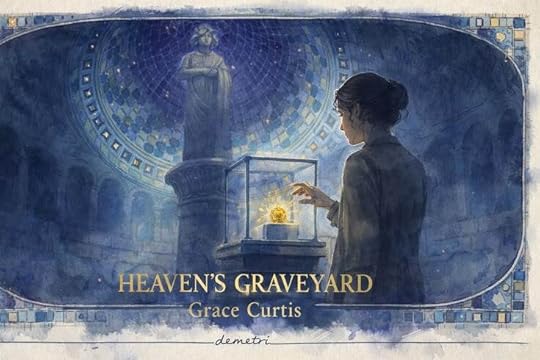
Anyway, the content and vibes of both book and game work well for me, and I enjoyed my time spent within these pages. Academics interested in connecting to the past suddenly faced with danger on top of the inherent mystery in their labors, the details of the legends out of time (the gods, effigy magic, etc), the worldbuilding insofar as the rivalry between the Alliance and Procumbent Church, the swashbuckling ex whose heart Cod broke years before, and the evolving relationship with an adversary--all made for a satisfying adventure. I will be keeping this author on my radar!

Content warning: there is one brutal scene of the killing of an animal, but if you feel like you might want to even just skim over that one part, there is nothing else like it again.

Thanks you to DAW and NetGalley for the eARC in exchange for my unbiased review.
Profile Image for Tina.
1,056 reviews37 followers
Review of advance copy received from NetGalley
June 11, 2026
I received this book from NetGalley in exchange for a fair review.

While intriguing and fun, it didn’t resonate with me as much as Idolfire (but it's still a great read).

You don’t really need to have read Idolfire to enjoy and understand this one, but it does give a bit of insider information, and a reveal near the end is a bit more impactful knowing the end of that book (in fact, I’d argue it’s a mini spoiler for Idolfire, so read that one first before this one).

I adored Idolfire, so it’s possible I was going into this one with extremely high expectations. I wasn’t let down, as the story is fun, fast-paced, and has interesting characters, but I suppose it just wasn’t Idolfire.

Anyway, what Heaven’s Graveyard has is a sort of National Treasure with lesbians vibe, but with a hint of supernatural or magic. I guess in that sense it’s sort of like Tomb Raider or Indian Jones, if the main character wasn’t a fighter but a historian who is bad with people. Cod is an interesting person because she’s so wrapped up in her own head she fails to recognize when she’s not being great to the people in her life. She also has real Mommy issues, which serve to broaden her characterization. There was one scene, though, that was quite distressing that I think was supposed to show the depths of her obsession but instead came off as unfeeling. I think Coda’s obsessive nature could have actually been shown more previous to this.

The two other major characters in the book - Sparrow and Thal - are both completely different in personality from Coda and each other, yet work well as personality foils for her. The dynamics of both pairs of woman was interesting, though seeing them as a trio would have been fun.

I really enjoyed the mystery, though I wish we’d seen a bit more excavating.

One thing that did fall a bit flat for me was the worldbuilding. While Idolfire felt fleshed out because the women are travelling from place to place (and, granted, this one had a bit of that too), there is next to no politics in this. And while not every book needs that, I sort of needed it to make the impending war aspect a bit stronger.

The pacing was a little off-center. The first two-thirds is a mystery and the last is a sort of chase, but the latter needed a bit more time to really make the reveal a payoff. It felt a little bit rushed.

The book also isn’t a romance at all. There’s a subplot that is tied to the plot itself, but there’s no yearning or slow burn or anything like that at all. This isn’t a failing of the book but a strength - I just wanted to bring that up if people are thinking this is a romantasy for some reason.

Overall, if you enjoyed Idolfire, you’ll love this. If you loved Idolfire, this might not be as compelling, but it’s still a great read, and I enjoyed it. And if you haven't read Idolfire, this is a fun fantasy mystery under an academic umbrella.
Profile Image for Robert Goodman.
637 reviews20 followers
Review of advance copy received from NetGalley
June 14, 2026
In 2025 Grace Curtis released her first fantasy novel Idolfire. Idolfire was set in a fantasy world and followed two very different characters travelling to a legendary city. The ‘Idolfire’ of the title was a power that drew on religious belief to channel magic. Curtis’ latest book Heaven’s Graveyard is a sequel of sorts. It is set in the same world as Idolfire but two thousand years after the events of that book, a time when those events and characters that are associated with them have faded into legend. Because of this the two books could actually be read in any order.
Coda became an archaeologist because of her obsession with legendary figure Aleya Ana-Ulai, one of the protagonists of Idolfire but who, now, most believe is just a children’s tale. That obsession took Coda to the capital city of Ash where she digs around in the catacombs and works in the museum. When Heaven’s Graveyard opens Cod has finally found an object that she believes might point to the existence of the real Aleya. But before she can do anything about that she receives an intriguing summons from her old mentor who claims he has made a world-changing discovery. Only she returns to find that he has died in mysterious circumstances.
Curtis then follows Coda as she tries to discover what her mentor had discovered (and was possibly killed for). She reconnects with her old flame Sparrow, a relationship that ended messily. Sparrow wants to rekindle their relationship and Coda is sort of interested but more interested, as she always was, with solving archaeological mysteries (and possibly also the mystery of her mentor’s death). Coda is also still dealing with her past, and the reason why she ran to Ash. Meanwhile, around them, the world is on the brink of another war.
Heaven’s Graveyard takes the religion-based fantasy world of Idolfire and projects it into a scientific, steampunk-inspired future with sail-powered boats and walking vehicles. Curtis is interested in exploring what happens when these two realities converge and does it through the modern-day character of Coda and her obsession with the past. At the centre is Coda’s relationships – both her fraught, broken one and a more fragile one with someone who may be friend of enemy. As with Idolfire (and Curtis’s earlier works) these relationships have a key role in driving the action.
Heaven’s Graveyard is another great work of fantasy from Curtis who is getting better with every book. By drawing on Idolfire she is able to create a rich and complex world but one in which readers do not require detailed knowledge of the earlier work. And she ensures her big reveals and action pieces are humanised by centring the plot around a small group of flawed but relatable characters and their relationships.
Profile Image for Dotti.
518 reviews3 followers
May 22, 2026
3.5 stars

Grace Curtis’s Heaven’s Graveyard is a fantastical mystery novel following Cod, an archivist at a museum, as she tries to solve the mystery of her mentor’s murder. Cod receives a telegram from her mentor one day, telling her to come urgently, and on the day she arrives, she finds that he has died. Cod is convinced that the death is connected to his discovery and, with the help of friends and strangers, seeks to find out what he had found. The story winds around Cod’s love of a historical myth and her own complicated past.

The description for this book is a “sinister lesbian history mystery”, which is a wild tagline to start with, but ultimately pretty accurate. The story is complicated and mysterious and rooted in the past and the present of a fantasy world very similar to our own. There’s a looming threat of war hanging over the book, geopolitics that are glossed over (in an appropriate way for the genre).

The pacing of this book is interesting; the mystery wraps up at about the end of the second act, and the third act becomes a chase sequence. The story doesn’t follow traditional fantasy or mystery pacing, which makes the story feel less familiar. The story moves well, though I did find it hard to engage with in the very beginning. The dialogue was also difficult to follow at times, which made conversations hard to navigate.

I think the hardest thing about this book is that Cod is ultimately not a likable character. She’s not someone I particularly root for, and I found myself wishing she would get to a therapist to process through things. Her lack of empathy, her distain for human connection, and her clinical disassociation from others made it hard to be in her perspective. However, her growth throughout the third act especially makes her more engaging, and it made the last part of the book much more enjoyable to read.

There is no explicit content in this book, and the romance plotline is a subplot at best. Because this is not a romance, don’t expect a traditional happily ever after. There are scenes that are violent, both towards humans and non-humans, including a graphic scene of animal death, as well as racism and religious violence.

Ultimately, I think this book was interesting, especially if you forgive the slow start. I personally prefer things that are a little more positive, so I don’t think this book was for me, but I can see how this would be an enjoyable book for people who the tagline “sinister lesbian history mystery” strikes true. To truly enjoy this book, I think you have to be okay being in the brain of an unlikable character.

Thank you to the publisher for this advanced reader copy!
20 reviews
Review of advance copy received from NetGalley
June 1, 2026
Heaven’s Graveyard is a fun, engaging science fantasy mystery, strongly reminiscent of adventure films like The Mummy, National Treasure and Indiana Jones, or The Adventures of Tintin.

Heaven’s Graveyard is set in the same world as Grace Curtis’ previous release, Idolfire, although 2,000 years have passed between the two. We find ourselves in a world reminiscent of early-to-mid 20th century Europe, with the world on the brink of war. The main character, Cod, doesn’t particularly care about this – she has her head in the sand, focusing on her work with the museum and trying to prove the existence of her childhood obsession, mythical hero Aleya Ana-Ulai. This name will be familiar to those who have read Idolfire, as the events of that book have passed into legend over the 2,000 intervening years. The controversy about accepting Aleya’s existence surrounds the necessary joint acceptance of magic, which is generally accepted to not exist.
The action starts with a mysterious letter from Cod’s former mentor, hinting of an exciting new discovery. When Cod arrives at her former home city, she finds her erstwhile teacher and friend dead in mysterious circumstances. Compounding this mystery is the reappearance of Cod’s ex-girlfriend and an impending religious war.

An important thing to state about Heaven’s Graveyard is that it does stand alone well – it is not necessary to have read Idolfire in advance (I didn’t), but I imagine there will be easter eggs for those who have. Treating your own story like a myth and mystery to be uncovered is a really interesting idea, and reading Heaven’s Graveyard has made me more likely to seek out Idolfire and see how they treat the stories differently.

The plot of Heaven’s Graveyard is a lot of fun once it gets going, especially in the second half – there are many scenes that feel highly cinematic and tense. The mystery is also very compelling even if you haven’t read Idolfire, and the twist at the approximate mid point of the novel is well-earned. That said, there are also some weak points to the novel. The characters weren’t entirely convincing – Cod is not the most compelling or likeable main character, and the main side characters shift personality very abruptly. In addition, the two most climactic scenes are over too quickly, and the finale is a particular let down. It relies on the main character having a hidden plan which gets pulled off perfectly, and there are no complications or twists.

I recommend this book if you want a fun, diverting read that you can forget about after, but it’s not one that will bear up under extended scrutiny
Profile Image for Emily.
1,243 reviews13 followers
Review of advance copy received from NetGalley
June 14, 2026
Thank you to NetGalley and DAW for providing a copy of this novel!

This was a great read! I especially loved the narration style. The novel is written in 3rd-person limited perspective with Cod as the narrator. Cod is heavily implied to be on the autism spectrum. I have read many books with autistic-coded narrators, and I consider this to be one of the best iterations. We are often lacking in information during certain scenes because Cod, herself, doesn't care or notice. I feel like in a lot of books with autistic narrators, the author tries to "have their cake and eat it too." The writing style might be a bit more stilted, but there are still in-depth descriptions of what is going on. That was not the case in this book. There was one scene toward the beginning of the book where Cod is essentially interrogating another character. And it isn't until a different character intervenes that Cod realizes that the first character is on the brink of tears. This is something she never would have noticed and only became aware of because another character told her to stop. Instances like this pop up all throughout the book. I appreciated how the author was willing to give up a bit of detail in order to keep the perspective truer to the main character.
I was also really invested in the story. I personally found the first half more engaging than the second, but I still really liked the whole thing. The first half almost has more of a dark academia feel, in that it focuses on Cod's desire to solve the mystery of Aleya, no matter the cost. While the second half is more focused on... well, I don't really know how to describe it without spoiling anything. So, I'm just going to say "wacky journey," I guess? The second half wasn't bad by any means and worked really well to show Cod's journey and character arc, but I just really love a story of a character willing to sacrifice anything for knowledge.
One thing I can say that might polarize some readers, is that some of the overarching plot isn't really resolved in a satisfying way. Namely, the "war plot." We never really get a lot of details on the different sides of the war or anything. It also pretty much all happens off page and in the background. While I can see how this could be frustrating, I didn't mind this, because it leaned well into the narrative style. Cod has no knowledge of the war and honestly doesn't really care about it. She is really only interested in Aleya. Therefore, the focus of the story is more on her personal journey with Aleya and her loved ones than the brewing war.
This was a great read and I plan to check out more of Curtis's works!
Profile Image for Tanya.
1,475 reviews27 followers
Review of advance copy received from NetGalley
June 15, 2026
"No one can decide if it was a mass hallucination or a -- a mir --" Her lips convulsed. "Some kind of divine event... But I know what this is. It's fuckery." [loc. 3613]

Heaven's Graveyard is a fantasy novel, set in the same world as, though long after the events in, Curtis' earlier Idolfire (which I have not read), and featuring archaeology, sapphic romance, a protagonist who mostly lives in her head, and a murder mystery.

Cod -- short for Coda -- is an archivist, working in blissful solitude in Asha's Civic Museum. One day, she receives a message saying 'historic discovery, come home urgently'. It's signed by her friend Denali Marr. Since she first encountered his Ashan Myths for Children, Cod has been captivated by the story of Aleya Ana-Ulai, and she and Marr both believe that the legendary heroine really existed. Surely it's worth taking leave of absence and heading back to Palgaro, where she grew up in poverty with an emotionally-distant mother.

Except, of course, it's never that simple. Cod encounters her ex, Sparrow, who is apparently now a travelling saleswoman; she learns more about Marr's great discovery, and makes discoveries of her own -- not least that there is, after all, some truth in the old stories.

I didn't initially warm to Cod, but as her own history was revealed, and as she began to connect to people (and indeed to the world in which she lives, which is on the brink of war; which has 'rattlers' and 'rails' instead of cars and buses; which is plagued by religious schism) I became more engrossed in her story. That said, I found the book's climax frustratingly rushed, and the epilogue -- though it provides closure to one element of the story, and opens up new possibilities -- doesn't give much idea of just how much the world has changed. Though perhaps that's Cod (who is autistic-coded) simply not paying much attention to it...


From the author's afterword: "I'd like to ask [you] to keep this book's surprises to yourself, at least for a little while. Together we can horribly betray many more people to come."

Read because: I recently read and enjoyed Floating Hotel (which is more SFnal). Thanks to the publisher and Netgalley for the advance review copy, in exchange for this full honest review. UK Publication Date is 18th June 2026.

Profile Image for Joy Sanwo.
12 reviews
Review of advance copy received from Netgalley
January 6, 2026
Thank you to NetGalley and the publisher for an arc in exchange for an honest review!

This was my first Grace Curtis book, but I was immediately intrigued at the “sinister lesbian history mystery” description. I ended up really enjoying my time with it! Heaven’s Graveyard is an ambitious hybrid of a murder mystery and a National Treasure-esque archeological discovery adventure, set against a backdrop of a nation on the brink of war, but at the end of the day it’s a story about a workaholic academic just finding her way in life.

I really clicked with Grace Curtis’s writing - her characters are delightful and so fun to follow. I really liked Cod, our main character. She’s socially awkward and single-minded, but as we go on we find out so much about her backstory that makes it really easy to empathize with her. The supporting characters are equally as fun - I loved getting scenes with Marr and Sparrow, their more extroverted, charismatic personalities were a great contrast to Cod. I do wish we got more from Thal in the first half, given how much she grew on me by the end.

The world building was also well done, especially in her descriptions of the bustling city of Ash and Cod’s hometown of Tessi. You really get the sense very early on that this nation Cod lives in is quite polarizing in its views of progress, religion, etc. For a story that only focuses on a couple characters and is very zoomed-in in its narration, I think Curtis does a good job of insinuating larger-scale repercussions.

For the most part the plot was quite quick, but I think it did fumble a little bit in the middle. I found myself in a bit of disbelief that some development in the plot would happen so easily. That’s just me nitpicking, though. I would also be remiss if I didn’t mention the scene with animal violence that happens about halfway into the book - it’s brief but pretty graphic and feels a bit out of place in terms of tone.

Now that I’m reading through other reviews, apparently Heaven’s Graveyard is set in the same universe as Curtis’s other book Idolfire, just 2,000 years later. I imagine reading that one first would give you a better idea on the lore and magic system but I definitely think that this stands on its own just fine. I’m definitely intrigued to pick up Idolfire though!
Profile Image for Here_Lies_the_Bookdragon.
139 reviews2 followers
Review of advance copy received from Netgalley
June 15, 2026
Grace Curtis has yet to write a book I don't love - this was one of my most anticipated releases for the year, and it did not disappoint.

Coda is a historian/archaeologist who is specialised in (read: obsessed with) the myth of Aleya. She's convinced Aleya was real, and very much hopes to prove it. So when the father figure/mentor/old teacher, Marr, with whom she shares her fascination sends a message asking her to come help him with a big discovery, that's what she does. Coda drops everything and hops on a boat home. What she finds when she gets there may not exactly be what she was expecting though...

First things first, Coda is my kind of oblivious nerd. She knows more than anyone about ancient times, but hasn't looked up from her work for long enough to have picked up on the threat of war looming over everyone's head. She's an incredibly well written character: relatable but very flawed, and with complicated relationships to those she loves deeply. While most of the side characters barely appear on the page, the prominent ones are equally great, and they feel believable (if not always realistic) and individual. I adored the relationships and how they developed over the course of the novel - without spoilering: families and first loves can be complicated...

And my very favourite thing about this book? The concept. If you've ever wondered what future archaeologists would have to say about you - that's what this book is. It's not exactly a sequel, but the Aleya that Coda is so interested in, is the main character from Idolfire. We're in the same world, just a few thousand years later. I absolutely adored this premise, and this was both a worthy follow up to Idolfire and a very different book. While it works perfectly fine as a standalone, I would strongly recommend starting with Idolfire, because a) it's really good, and b) it will make this book a lot easier to follow.

Anyway, this book has everything. Dramatic sapphic love, looming war, murder, betrayal and cool archaeological finds. And in true Curtis fashion, the ending is bittersweet. You should probably read it 🤷‍♀️

Many thanks to Hodder & Stoughton for sharing an ARC with me via Netgalley - I had a great time with it! My opinions on it are as always my own.
Displaying 1 - 30 of 108 reviews