Want to hear anecdotal evidence about millionaires from the 1980s quitting their high paying jobs and tapping into their extensive networks to “go all in” on their dream jobs, written by a literal venture capitalist millionaire whose net worth is estimated in the high hundred millions? Can you say out of touch?
The author has no working understanding of the current job market and difficulty of Millennials and Gen Z to carve out their place in a workforce where pay and employment prospects are shrinking each year (in 2026 the purchasing power of the minimum wage is at its lowest point in 68 years in the United States and the housing crisis has left nearly 75% of households unable to afford property while many spend every last dime they have on rent).
Glad it worked out for you, Bill, but for the rest of us it’s not going so well. Reader, you would be better off searching up guides on resume writing and figuring out a reasonable career path than reading this out of touch Boomer selling you on quitting your day job to chase your dreams while offering no practical advice on how to do so.
Like the title of this book, a hit song by Tom Petty released way back 1989, Bill’s perspective comes about 40 years too late. Do yourself a favor and put that $26 you’d pay for a hardcover towards a resume writer or career advisor who is actually qualified to speak about the job market.
2 Stars because the ghost writer did an excellent job on the prose (and my condolences for having to listen to Bill ramble about “the good old days when hard work mattered” for hours on end).
Ultimately, this book is classic, old-school American advice: Do what you love. And that advice may still work if you are brilliant at what you do. But the vast majority of people cannot be “above average” at their work by definition. Labor market competition has increased significantly in the last few decades as well—making good work more competitive to come by.
There will be a crowd of people who follow this book’s advice to great success—mostly (although, not exclusively) the well-connected, well-educated, well-resourced crowd.
There will also be another crowd of people from humbler backgrounds who will follow this book’s advice without success. More likely to be met by that forever-tough question of “what do you do when you’ve worked hard for years, and things still don’t work out?” Sure, there will be outliers who succeed. But, without significant resources to fall back on, there is also a high chance that this book is delivering the wrong message to this second group.
Bill Gurley is an American venture capitalist, formerly at the Silicon Valley-based Benchmark VC firm, where he was involved with early investment deals for such tech companies as Uber and Zillow. Prior to his VC days, he was earned an MBA and worked as a design engineer at Compaq
His 2026 book Runnin' Down a Dream is his retrospective career advice manifesto, concluding with his own career story but beginning by highlighting his general career principles and others' unexpected career stories. I've read a fair number of career manifesto books, and I do generally resonate with Gurley's advice, but then again, I'm a fellow INTJ so much of his advice is geared toward those of us who inherently have the INTJ/ENTJ-like mindset of lifelong learning, insatiable curiosity, cross-disciplinary idea pollination, etc. Gurley's advice includes relocating to a geographic nexus of one's chosen industry, chasing target companies so aggressively that you accept any position there for a foot in the door (with a similar philosophy toward networking and finding mentors), and investing a lot of one's own time, money, etc. to keep upskilling and learning the background of the industry/company and getting a lay of the land. This is all great advice though may not be feasible for most people's circumstances. Personally, I've moved across the country four times to pursue my education and later career, and while I have more geographic flexibility than most, I can't pretend that uprooting myself repeatedly has been easy, universally fulfilling, or without any geographic constraints. Fundamentally, I don't think most people aspire to have the kind of career Gurley or the folks he profiled here have had -- I think most people aim to have a stable career that is as financially rewarding as possible and allows them the flexibility to attend to other important areas of their life. As someone who's more on Gurley's path, one obstacle that he doesn't really consider is what it's like to succeed in difficult careers when you're not a white male, as well as the negative marks that having ambition and attempting to bring new ideas and perspectives may have depending on one's work environment and peer group. Someone with drive and forward momentum can often get driven out of workplaces when colleagues are not similarly inclined.
This book may be the one I recommend to anyone who wants to talk careers, jobs, etc. Need Bill Gurley to sponsor me tho b/c the paperback is $25.99.👀
It includes engaging retellings of stories of people who not only found success, but also meaning in careers. I especially like how he tells the stories with a pseudonym or cloaks their real identity & then concludes each chapter or section: • “This musician was Bob Dylan, the most famous singer dude ever [my words].” • “Robert was Bobby Knight, the winningest coach in basketball history.”
I also appreciated that it wasn’t a memoir, an explicit choice the author made, and he spares readers of his success stories until the Epilogue. Bill wasn’t trying to sell us on what worked for him, instead offering timeless principles & practices to succeed & find meaning.
Refreshing take on timeless advice with practical tips and stories
A great career book with practical advice that doesn’t come across as preachy. The first few chapters were especially enlightening. I would certainly recommend to those starting or thinking to start a new career.
Pretty underwhelming. Perhaps I have too high an expectation.
It wasn't bad but for all the inspiring stories / example, the writing - verbose, did itself a disservice.
Compared to other entrepreneurship books, such as 'Build' by Tony Fadell or 'The Hard Thing about Building the Hard Thing' from Horowitz, 'Runin Down a Dream'just lacks the authenticity and passion I was seeking.
With the formers, one can feel the blood, sweat and tears, as well as hard earned wisdom punching through the pages.
I guess that's the difference between being an entrepreneur vs. working with entrepreneurs as a VC. Even as the top 'entrepreneurs whisperer' at the most successful VC firm in the valley.
Definitely my most anticipated release of the year and I will be very happy if this is the best book I read this year. Bill Gurley is such a gift and this book came as a gift at a perfect time for me in my career. I shall keep this one close to me on the shelf.
inspiring! i love hearing about successful people's life stories and the conveyor belt analogy at the beginning is incredibly apt. thanks for the rec keerthi <3 if i don't have a big girl job offer by the end of next school year ima give my dream a go...
A Venture Capitalist Writes the Anti-Safe Career Manual: What “Runnin’ Down a Dream” Gets Uncomfortably Right About Ambition, Apprenticeship, and the Price of Playing Small By Demetris Papadimitropoulos | February 17th, 2026
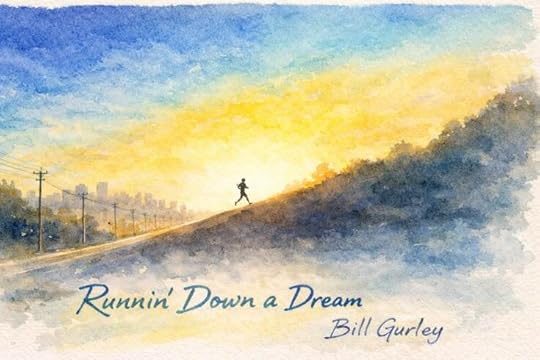
Watercolor Piece by Demetris Papadimitropoulos
“Runnin’ Down a Dream” arrives wearing two outfits at once: the clean, crisp blazer of a venture capitalist who has spent decades thinking in odds, incentives, and compounding advantage, and the broken-in denim of a storyteller who knows that the only ideas that travel are the ones that come with scenes, voices, and the faint smell of real rooms. Bill Gurley, writing with Michael J. Mooney’s magazine-bred momentum, has made a book that is both a permission slip and a set of field notes: a casebook of people who did not merely “follow their passion,” but treated desire as an operating system – one that must be debugged, stress-tested, and repeatedly updated in public.
The book’s premise is simple enough to fit on a conference badge: most people carry career regret; most advice is designed to prevent embarrassment; many dreams die less from lack of talent than from a quiet failure of nerve. What Gurley adds, almost stubbornly, is an insistence that dreaming is not a mood. It is a method. The heroes of “Runnin’ Down a Dream” do not wait for clarity to descend like sunlight. They manufacture it – through voracious learning, shameless outreach, iterative experiments, and a willingness to start at the bottom, inside the building, near the fluorescent hum of the work itself.
That emphasis on process is not incidental. Gurley is a man who has spent a career asking what causes outcomes – and what causes people to misread them. He is allergic to the tidy myth that greatness is either predestined or purely accidental. He likes edges: small asymmetries in information, training, network, timing, and stamina that look trivial until they compound into something that feels like fate. In his world, “luck” is real, but it is rarely alone in the room.
The book’s signature move is to borrow the narrative pleasure of biography while refusing biography’s oldest seduction: the idea that a life is a clean arc. Instead, Gurley treats careers as systems. Every profile becomes a little laboratory. Danny Meyer, Jen Atkin, Tony Fadell, Jay Sweet, Sal Khan, MrBeast – they are not presented as saints or unicorns, but as people who kept showing up to the same obsession until the obsession developed muscles. The emphasis is not on the glow of achievement, but on the gritty prehistory: the mail rooms, the assistant jobs, the self-funded flights, the embarrassing cold emails, the long days that look irrational from the outside because they are being evaluated with the wrong metric.
One of Gurley’s greatest strengths is that he writes ambition in the language of investment, not fantasy. He is drawn to the people who can look at a future that currently has “zero” odds and still decide to push it to ten percent. He has affection for the kind of audacity that is not mere bravado but an accounting decision: If I fail, will the attempt still be worth the cost? Is the pain a fee I’m willing to pay for the right to play?
It is in the Sam Hinkie chapter – the most explicitly probabilistic in spirit – that the book’s worldview becomes almost crystalline. Hinkie’s path from Oklahoma numbers kid to Bain analyst to the analytics-forward front offices of the Rockets and, eventually, the Philadelphia 76ers, is framed not as a parable about sports but as an anatomy of conviction under hostility. The story is not just that Hinkie embraced “The Process,” but that he understood what most institutions cannot tolerate: time horizons. “Runnin’ Down a Dream” keeps returning, like a refrain, to the notion that “the longest view in the room always wins.” It is a seductive line, and Gurley knows it – but he also seems genuinely moved by the tragedy embedded in it. Having the longest view can make you right. It can also make you lonely. It can also get you fired.
Here the book almost brushes against literature: the idea that a person can be punished for being early, for insisting on outcomes that will only be legible after they are gone. Hinkie’s tenure in Philadelphia – “complicated,” Gurley calls it, politely – becomes a lesson in the mismatch between rational planning and emotional ecosystems. To “trust the process” is not merely to accept delayed gratification. It is to accept public misunderstanding as part of the job. It is to live inside a narrative that will be rewritten by people who did not do the work but will later enjoy the harvest. There is something bitterly modern in that, recognizable far beyond basketball, in a decade when the labor of building often gets separated from the glory of “growth.”
Gurley’s own sections, especially the later personal narrative, add a second engine to the book: the pleasure of watching a mind explain itself. Gurley is at his most compelling when he is being specific – not about being “motivated,” but about learning how to learn. He tells stories the way an investor thinks: the detail is not decoration; it is the lever. A Palm Pilot with a preloaded list of conference attendees becomes an early thesis about distribution. A weekend locked in a walk-up apartment writing an industry report becomes a thesis about manufacturing opportunity through preparation. His repeated insistence on external learning – reading beyond your organization, your sector, your tribe – makes the book feel in dialogue with “Range,” with “Mindset,” with the great modern shelf of curiosity-as-discipline. But Gurley’s version is less therapeutic and more tactical. He does not ask, “What do you feel?” so much as, “Where is your edge coming from? And can you widen it?”
At times, this “edge” lens produces the book’s cleanest wisdom. Gurley’s people win because they keep putting themselves where information lives. They chase mentors. They chase peers. They chase rooms. One of the book’s quiet philosophies is that careers are not ladders but maps of access. If you want to do a thing, you must get close enough to smell it. You must learn the language and the culture and the unspoken rules. You must be in the building, not merely admiring the building from the outside.
This is why the book’s repeated fascination with “starting at the bottom” feels more than nostalgic. In an era of frictionless online identity – when it is possible to look like an expert long before you have earned any scars – Gurley is oddly old-fashioned about apprenticeship. He loves the idea of the mail room even as he acknowledges, almost wryly, that the literal mail room has vanished. The romance here is not about drudgery for its own sake. It is about proximity: the bottom rung as the place where you get to watch, to absorb, to become fluent in how value is actually created.
Still, a book this upbeat about “permission” inevitably wanders into the question it can’t fully answer: permission from whom? Gurley is not naïve. He is careful, in the conclusion, to stress that passion must be deep and that the work will hurt. He includes the naysayers, the parents who fear the rent, the advisers who want safety. He offers, with genuine warmth, the Gregg Lehrman idea that people who are willing to work hard in the industry they love tend to find a job – not necessarily riches, but a life with fewer regrets.
And yet: reading “Runnin’ Down a Dream” in 2026, it is hard not to feel the gravitational pull of the world outside its pages. The book is written against a background of widening inequality, student debt that behaves like weather, and a labor market increasingly reshaped by automation and algorithmic hiring. The internet has made certain forms of ambition easier (learning is cheap; distribution is cheap; building a public body of work is easier than ever) and other forms crueler (entry-level pathways evaporate; gigs replace jobs; “always on” becomes the cost of visibility). Gurley nods at this modernity – he cannot help it; he is a creature of tech’s ecosystem – but the book’s structure, built on success stories, sometimes glides past the jagged reality that not everyone can afford the “unpaid intern” chapter of their life. Not everyone can take the roadshow. Not everyone has a spouse who can drive them to the office while they sleep on an inflatable mattress and work from dawn to midnight.
This is not a moral indictment so much as a measurement. A reader may find themselves admiring the book’s ethos while also wanting a harder confrontation with the system that makes “dreaming” feel like a privilege product. Gurley believes, sincerely, that hard work plus methodical process plus curiosity can bend probability. He is not wrong. But there are places where probability is not just a math problem. It is a policy problem. It is a healthcare problem. It is a discrimination problem. The book’s optimism is partly what makes it enjoyable – the feeling that life can still be chosen – yet optimism can also become a kind of lighting trick, brightening the stage while leaving the backstage underexposed.
The book is at its best when it refuses lighting tricks. It is strongest in its insistence that failure is not the opposite of success but the raw material of it. Gurley’s affection for “failing gracefully,” his willingness to describe careers as experiments, feels unusually compatible with the moment. Many readers are coming to books like this not because they are dreamy, but because they are tired: tired of work that feels like slow erosion, tired of corporate loyalty narratives that have collapsed into quarterly language, tired of watching entire industries redraw themselves overnight. In that sense, “Runnin’ Down a Dream” belongs in a shelf that includes “The Power of Regret” and “Designing Your Life,” but with a more kinetic, street-level American confidence: don’t just reflect – prototype.
Mooney’s influence is felt in how quickly the book gets to the good parts. The profiles are shaped like stories, not lectures. You can feel the writerly pleasure in the small choices: the burritos across from Stanford, the Southwest Airlines roadshow, the conference lobby where the future is sitting on a folding table for sale. Gurley’s voice, too, is distinctive: the blend of coach and investor, the man who can’t help turning a life into a set of variables – but who also, surprisingly often, lets tenderness leak through. He loves mentors. He loves the assistant who can solve anything. He loves the colleague who shares a model. He loves the idea that you can build a career not only by competing but by joining a community of high-metabolism learners and then giving back to it.
That “give back” principle is the book’s moral spine. For all its talk of edge, it is not ultimately a book about domination. It is a book about contribution – contribution to a craft, to a field, to a network of peers. It is also, implicitly, a book about the pleasures of being fully awake inside your own work. Gurley keeps returning to the sensation of enthusiasm: the urge to read just one more thing, to stay late not because you fear punishment but because you can’t stop thinking. He quotes Tom Petty on paying the rent. He borrows from James Clear’s “optimize for enthusiasm.” He argues, in essence, that the only sustainable hustle is the kind that feels like appetite.
There is a risk in that message, too. In a culture that already fetishizes productivity, “enthusiasm” can sound like a demand to be endlessly on fire. But Gurley’s best passages do not read like a burnout manifesto. They read like a defense of aliveness – a plea to refuse the modern flattening where work is only survival and “meaning” is postponed until retirement, as if the self can be stored in a warehouse until later.
So how should we read “Runnin’ Down a Dream”? Not as gospel. Not as a universal plan. But as a beautifully engineered set of stories that can be used as tools. The book is most helpful when it turns the vague ache of “I want something else” into action: write the report; send the letters; take the class; build the portfolio; get in the building; find the peers who sharpen you; let failure teach you; keep the long view; and, when you have anything to offer, offer it.
If the book sometimes underplays the unevenness of the playing field, it compensates with a rare generosity of spirit. It does not sneer at ordinary jobs. It does not glamorize risk for its own sake. It insists, again and again, on the simplest radical idea: life is use-it-or-lose-it, and regret is not a verdict but a signal.
There are more elegant books about meaning and work, and more rigorous books about structural labor economics, and more skeptical books about the mythology of hustle. But few are as readable, as humane, or as insistently practical as this one. “Runnin’ Down a Dream” is the kind of career book that understands the secret of all persuasive nonfiction: people don’t change because they are told to. They change because they can suddenly picture themselves inside a different story.
And that, finally, is what Gurley and Mooney offer – not a blueprint, but a repertoire of possible selves, narrated with enough momentum to make you stand up from the couch, look at your own life as if it were a set of probabilities, and ask the dangerous, invigorating question: What would it look like to push the odds?
Book gets a four because Bill Gurley has good taste in people. The stories he selects happen to be some of my favorite “doers”. I also appreciate the humanizing of greatness in an era that doesn’t embrace that as much.
What a sensational book for “young” people of any age to read and live. Nothing contributed more to my success than working hard and chasing passions. It has never been articulated better than Bill does in this book. His interview on CNBC about the book is super too.
Gurley does a nice job of showing some outstanding individuals and their late career paths. A good reminder that many people don’t discover their passion until their 30s or 40s. It’s hard to know how everything we’ve done comes together, but just keeping working towards your goal and eventually it snaps into place.
Super boring way to profile those biographies. The best part was when he talked about his own journey. The publishers were right. This book should have been about him.
Thank you to Crown Publishing for the gifted copy of Runnin' Down a Dream: How to Thrive in a Career You Actually Love by Bill Gurley.
This is one of those books that I found myself both agreeing with and pushing back against at the same time. There’s some genuinely useful advice here about curiosity, learning, relationships, and finding work that feels meaningful. But there were also moments where I couldn't stop thinking, "Okay, but this advice is going to look very different depending on where you're starting from."
⭐️⭐️⭐️
The strongest part of the book is its focus on pursuing genuine interests rather than blindly following a traditional career path. I appreciated the emphasis on learning, building strong peer networks, and staying curious. Those lessons felt practical and broadly applicable.
The examples and stories are also engaging, especially if you enjoy reading about successful people and the paths they took to get where they are.
Where I struggled was with the perspective behind some of the advice. A lot of the stories come from highly successful, well-connected individuals, and while their experiences are interesting, they don't always feel universally relatable. At times, the book seemed to underestimate how much circumstances, resources, timing, and opportunity can influence career outcomes.
What I Loved • The focus on curiosity and continuous learning • Encouragement to pursue meaningful work • Interesting stories from successful professionals • Practical advice about networking and peer groups • An optimistic and motivating tone
What Didn’t Work for Me • Some advice felt overly dependent on privilege or access • Repeated ideas could make parts feel repetitive • The perspective occasionally felt disconnected from the realities many people face • I wanted more discussion of what happens when hard work alone isn't enough
Overall, this is an easy-to-read and motivating career book with some valuable insights, but I think it works best when read as one perspective rather than a universal roadmap. There’s useful advice here, but your mileage may vary depending on your circumstances and opportunities.
not an unhelpful thing to read--would've been more useful to me a few years ago.
I quite liked the Bob Dylan, Danny Meyer and Newport Folk Festival chapters, others felt like Gurley giving his friends love. The sports anecdotes are surface level, even though he knows ball he writes for an audience that doesn't which makes sports seem really dumb. I'd be interested in the contrast he sees between the leadership you need to do things with tightly bounded rules and win conditions like get 5 guys to win a basketball game vs be a successful founder.
The problem with this book is that this is the guy who got travis kalanick fired over the weekend his mother died, and all the advice is"be a nice good person thank everyone give out good vibes work hard and things will work out". It was probably the right thing for Uber and Benchmark's investors to fire Travis but that was a hard decision which isn't just like being nice to everyone! Grappling more with the less mass-market-paperback bits of what Gurley has seen in himself and others that make them successful would have been more compelling.
I need to try to write an hour a day.
"find fascinating, fascination is way better than passion"-seinfeld. If you're fascinated, you'll want to be curious about it.
'live as if you were to die tomorrow, learn as if you had forever to learn'-gandhi I wanna learn about that
This book is engaging and readable but also flawed in that it's another example of an already-rich person saying, "follow your passion." That's the kind of advice that causes too many men to spend too many years playing minor league baseball.
Scott Galloway's advice is better, which is that chasing a "dream job" in a highly competitive or low-paying field easily leads to financial instability or insolvency; instead: follow your talent, pursue mastery, and allow passion to develop after you become excellent at what you do.
Another issue is that Bill seems to not recognize that many don't have a "dream" job or career at all but just want to become financially independent, retire early (FIRE). Pursuing FIRE can be a passion, and various jobs can serve that end.
Finally, although he doesn't really get into his worldview, Bill's recommended books on "how the world works" [according to Bill, of course] include authors such as Dawkins, Harari, and Pinker, so he seems to reveal himself as a hardcore atheist. A problem with this is that any human, temporal "passions" or "dreams" are rendered meaningless if this bleak worldview is true, if people have nothing to look forward to in the end but an eternal tomb.
On the Capital Group book recommendation reading list.... here was the write up for this book...
Few decisions shape a life more than choosing a career. Portfolio manager Chris Buchbinder, a father of four teens who will soon be choosing their initial career paths, had this in mind when he selected Runnin’ Down a Dream: How to Thrive in a Career You Actually Love by Bill Gurley.
Gurley, a noted Silicon Valley venture capitalist, explores what it means to build a meaningful and satisfying career rather than focusing on compensation, status or other definitions of success. Beginning with his own career transformation, Gurley shares the professional journeys of entrepreneurs, sports executives, restaurateurs and other high achievers. He identifies commonalities from the most satisfied professionals, including finding work that aligns with your interests, talents and sense of purpose.
“This book provides a thoughtful framework for thinking about careers,” says Buchbinder, principal investment officer for CGDV — Capital Group Dividend Value ETF and CGVV — Capital Group U.S. Large Value ETF. “As someone worried about how my sons will navigate a world transformed by artificial intelligence, I found the book especially timely.”
I tore through Runnin’ Down a Dream in two days and didn’t expect it to stay with me the way it has. What stood out most was the through line of curiosity. So many of the people Gurley profiles were changed by a single book they picked up at the right moment or a conversation with a mentor who shifted their trajectory. None of them followed a straight path, and none of them did it alone. There’s a consistent message about being relentlessly curious, reaching out to people in your field, asking questions even when it feels uncomfortable, and not being too proud to start at the lowest rung just to get in the room. The stories of Bobby Knight, MrBeast, Mike Leach, and Danny Meyer make it clear that ambition is not about optics, it’s about leaning into what genuinely pulls at you and having the courage to follow it. Just as important is the idea that you build your tribe by giving back and sharing what you learn along the way. More than anything, this book made me reflect on whether I’m really chasing what excites me or just riding momentum. For anyone who feels like they left a little dream on the table, this could be the book that shows up at exactly the right time.
I could see a lot of folks engaging with the content and landing at a 2-3 and saying it is quite obvious, very surface level, and not particularly insightful. But, often times, the best advice is the simplest and the older I get I find there is no secret formula to success. It's more realistically the output of a great process, attitude, and consistency of showing up - which this book drives home with its key principles. I like the alternating chapters between someone's life story then Bill's commentary/analysis. He looks at a variety of industries and types of people and the different methods of how they broke into their industries. It's a nice reminder to take control of your career and be intentional with how you curate a network within it. Bill is one of the greatest investors of this generation and seeing his admiration for how so many others broke into their craft was a very enjoyable & easy read!
I was originally expecting this book to follow Bill Gurley’s life and give the usual examples of why you should chase your passion. I was pleasantly surprised by the actual structure: he tells a story about someone else chasing their dream, then spends about ten pages breaking down the specific lessons we should take from that person’s journey.
The book was very inspirational and it’s full of additional recommendations to check out. For me, the biggest piece of advice was the idea that you need a genuine fascination with a subject and the grit to become the most knowledgeable person in that field. Success eventually follows once people realize the value of what you can provide. It’s the combination of fascination and grit that lets you keep up that high level of energy over a long period of time while you're putting all your effort into expanding your knowledge.
Overall was a good read and definitely good for anyone (presumably) in their career. Obviously is much more impactful if you are starting a career (i.e Me!). I especially liked the mini lessons of being curious, trying to follow and study mentors, giving back, and even getting on X, as the best people in tech and finance are always posting their thoughts.
My favorite part is his take on following your fascination vs passion. Every time he was able to show examples of what fascination looked like, I found myself relating to it heavily and it affirmed even more that what I am/ want to do as of now seems like the right path.
Bill's own story and book list at the end was also nice.
The only thing I thought was negative was that some of the stories and examples were a little to long. I think the book definitely could have been shorter.
Bill Gurley has written a book that feels less like career advice and more like a well-curated collection of stories about people who bet on themselves and won. The profiles are the heart of it, and they’re what linger. The Bob Knight chapter stands out not for the familiar intensity-and-championships narrative, but for something quieter: how Knight absorbed everything he could from the coaches above him, treating every rung of the ladder as a classroom. The Danny Meyer story carries a similar lesson about curiosity and craft applied patiently over time.
Runnin’ Down a Dream is an energizing read, the kind that makes you put it down and take stock of whether you’re really pursuing what pulls at you.
I finished this just after turning 35, and the number of stories about people finding their vocational stride in their 30s, 40s, and beyond gave me a real opportunity to reflect. What are the outcomes I want to drive in this next season, both vocationally and non-vocationally?
The throughline on the importance of like-minded peers really stood out to me. Having a strong network of people who can sharpen one another and find ways to win together. It’s making me question whether I have a well-enough-established network of peers aligned to what I believe God has called me to do.
Overall I found the book really enjoyable. Strong emphasis on stories, and the examples he used did well to illuminate the points he was making.