

What do you think?

The Whisper
When a little girl received a curious book filled only with pictures, a whisper urges her to create the words she cannot see. As the pages turn, her imagination takes flight and she discovers that the greatest storyteller of all might come from within.
A celebration of reading and the power of the imagination, Pamela Zagarenski's debut as an author reminds us that we each bring something different to the same book.
A celebration of reading and the power of the imagination, Pamela Zagarenski's debut as an author reminds us that we each bring something different to the same book.
34 pages, Hardcover
First published October 6, 2015
About the author
Pamela Zagarenski
36 books71 followersCaldecott Honor Medalist Pamela Zagarenski is a brilliant painter of many worlds. As well as illustrating picture books, she creates sculptures and large paintings, which can be viewed at an art gallery in Mystic, Connecticut. She divides her time between Stonington, Connecticut, and her house on Prince Edward Island.
Ratings & Reviews
Friends & Following
Create a free account to discover what your friends think of this book!
Community Reviews
Displaying 1 - 30 of 414 reviews

November 22, 2015

along with This Is Sadie, this is another gorgeously-illustrated picture book about the power of storytelling and the imagination that has several pictures of foxen.

here, a little girl borrows a magical book of stories from her teacher, but on her way home all the words escape, leaving only the pictures behind.

Where were the words? Where were the stories?
It's just not a book of stories, without any words, she thought.
but then she hears a whisper on the wind:
"Dear little girl, don't be disappointed.
You can imagine the words.
You can imagine the stories.
Start with a few simple words and imagine from there.
Remember: beginnings, middles, and ends of
stories can always be changed and imagined differently.
There are never any rules, rights, or wrongs in imagining -
imagining just is."
and so she begins…

and it's like If on a Winter's Night a Traveler jr edition; on each of the following pages we get fragments of stories that sometimes cut off midsentence, stories with titles such as The Magical Cloak or Tiger's Prayer that the little girl imagines as accompaniments to the lush full two-page spreads of artwork which are completely unconnected, although each illustration contains a fox and a rabbit.

again, i do tend to uprate picture books in a way that i don't with "regular books," and if we're being honest, as a story, this is kind of unsatisfying. the illustrations are phenomenal; there are so many details and layers and different styles of artwork on each page that you could spend a lot of time just appreciating them as art and you don't really need a story to frame them. i mean, what's that kid even complaining about?

and the message of "using your imagination to create your own stories" is obviously valuable (although i feel like kids pretty much already naturally gravitate towards that, don't they?) but apart from that, the story qua story is a little frustrating because although there are recurring animals, the story fragments are unrelated and kind of a tease for kids accustomed to a more linear narrative.
but ohhh that artwork. you could get lost in it.

i don't know how this book would play with kids or if this is just one of those picture books that's really more for us grown folks. but in any case, it's a gorgeous object, and i absolutely loved the revised aesop fable at the end.

 come to my blog!
January 16, 2021
Apparently I'm in the minority. I didn't love the book, and I didn't love the art. The art had a fantastical folklore feel that I'm sure a lot of people love, but it just didn't strike a chord with me. As far as the story goes, I think the premise was good, but it was executed badly. It felt like this was trying to be three books at once. There was the main story, followed by a book inside the book without words, and to top it off, an incomplete story about the wordless book, made up by a girl using her imagination. Storybookception much? I think a young kid, with little to no attention span, would probably enjoy reading this to themselves. However as an adult reading it to a child, I didn't enjoy it. Honestly when I read these books to my autistic son, if he likes the book, he puts it back on the shelf so I don't return it to the library just yet. This one he did not take from me, and had no qualms with me putting it in the backpack with the rest of the books to get turned in. To me that says it all.

October 12, 2024
Pamela Zagarenski is both the author and the illustrator of “The Whisper.” The illustrations are really breathtaking. The colors are so vivid. And Zagarenski has an obvious fantastic imagination. But there were a few issues with the picture book.
Zagarenski is a poetic writer, but in my opinion this picture book is too wordy and needs to be edited for brevity. And while the story is interesting, adding in the fox towards the end of the story was unnecessary; there was just too much going on, which detracted from the story.
This is a beautifully illustrated children’s book and while the illustrations were beautiful and the main story line was really interesting, the book is word heavy and the plot needs a lot of work.
Zagarenski is a poetic writer, but in my opinion this picture book is too wordy and needs to be edited for brevity. And while the story is interesting, adding in the fox towards the end of the story was unnecessary; there was just too much going on, which detracted from the story.
This is a beautifully illustrated children’s book and while the illustrations were beautiful and the main story line was really interesting, the book is word heavy and the plot needs a lot of work.
January 10, 2016
An incandescent picture book, and my pick for the Caldecott.
I really don't know what else to say about it. It's gorgeous. It's charming. I was instantly in love with it.
My sister gave it to me along with a lip gloss shaped like a little fox, which made it EVEN BETTER.
For the reader, the dreamer, the artist in all of us.
I really don't know what else to say about it. It's gorgeous. It's charming. I was instantly in love with it.
My sister gave it to me along with a lip gloss shaped like a little fox, which made it EVEN BETTER.
For the reader, the dreamer, the artist in all of us.

April 24, 2017
This is beyond beautiful. It's imaginative and colorful. A favorite of mine.

September 29, 2017
Enchanting. Entrancing. Eye captivating. I have grown to love the artwork done by Pamela Zagarenski. This book was both written and illustrated by Zagarenski. The idea of the story is that a little girl borrows a magical book. On her way home, to read the book, somehow, all the words spill from the pages. When she opens the book, it is a wordless picture book. She is sad at first, but then she hears a whisper that tells her to not be disappointed. The whisper goes on and tells the little girl that she can imagine the words and stories and that a story can always be changed; there aren't any rules to being imaginative. The little girl then begins to look at the wordless pictures in her book and begins to make up stories on her own.
I absolutely love the idea of this book, and the illustrations are gorgeous. I felt like the book would have been stronger, though, if their were less words and if some of the pages were actually left wordless, so the child/ reader could imagine the stories themselves. (It is sort of written like a how-to-book, for "reading" a wordless picture book. )
Art: 5 stars
Text: 3.5
I absolutely love the idea of this book, and the illustrations are gorgeous. I felt like the book would have been stronger, though, if their were less words and if some of the pages were actually left wordless, so the child/ reader could imagine the stories themselves. (It is sort of written like a how-to-book, for "reading" a wordless picture book. )
Art: 5 stars
Text: 3.5

July 18, 2017
Pamela Zagarenski's detailed mixed media illustrations are magical, as always:


The story, however, is not particularly interesting and kind of overwritten: everything is spelled out and there is way too much redundancy between the words and the illustrations (and too many words in general).
The story, however, is not particularly interesting and kind of overwritten: everything is spelled out and there is way too much redundancy between the words and the illustrations (and too many words in general).

January 14, 2017
The paintings in the book were magical and multi-layered. After a brief storyline that the book had no words, only pictures, each page was captioned with a series of brief introductions that went nowhere to indicate that the child was making up the stories herself. If this was an indication that the reader should do the same, why ruin the effect with a weak intro to every painting.
Pictures - 5 stars
Story - 2 stars
Pictures - 5 stars
Story - 2 stars

December 9, 2015
I very much liked the illustrations, but the story was both unsatisfying and heavy-handed.

December 4, 2015
I read this because of Karen's exuberant review. The art IS indeed gorgeous from this two-time-winner of Caldecott Honors. It's a picture book with words and illustrations ABOUT illustration, a kind of teaching book for how to read silent or wordless books that just have illustrations. But this isn't wordless, it's not just silent. And it's pretty delightful, on the whole, but as I see it it's more a how-to book about the imagination, and maybe more for adults than kids, because it teaches in an adult way.
The little girl gets a book and goes outside to read it, but the letters from all the words in the book trail behind her. That particular illustration you can see now in Karen's fine review, and it is stunning. But why do the words leave the book? Dunno, and this could be a problem for the story, but anyway, initially she is sad about this. Then she gets adult advice that I am not sure a kid needs, having read several silent picture books with kids:
"Dear little girl, don't be disappointed.
You can imagine the words.
You can imagine the stories.
Start with a few simple words and imagine from there.
Remember: beginnings, middles, and ends of
stories can always be changed and imagined differently.
There are never any rules, rights, or wrongs in imagining -
imagining just is."
I find this a tad didactic, though I appreciate the sentiment. So then with every (always gorgeous) illustration in the book the girl is reading, she begins a story about it. I like each of the illustrations. And I even like these stories. I suppose by example they can urge readers to imagine their own stories, perhaps. But I'll tell you what I would have preferred: I wish those pages were just silent so WE or little kids reading it could tell our own stories of those pages. Or at least SOME of these illustrated pages!
I liked the Aesop Fable rewrite that happens in the end when Fox tells the girl he found all the words to her book and will exchange them for help in getting him/her some grapes. This is the Fox who, in the Fable, couldn't reach the grapes so decides they must have been sour, anyway. . . which is the origin of the term/concept "sour grapes"! This is cool and surprising and again helps us make the point that stories can be rewritten.
So why four stars? Ironically, for a book that purports to teach about the powers of the imagination in viewing art and illustration, this one has far too many words! It does too much work for us in interpreting what is going on! Read it and see (I say this as a former journal editor) if you couldn't cut the word count in half! I say use as few words as possible for such a concept as encouraging children to read illustrations FOR THEMSELVES and tell their own stories!
Still, I liked it a lot, I really did.
The little girl gets a book and goes outside to read it, but the letters from all the words in the book trail behind her. That particular illustration you can see now in Karen's fine review, and it is stunning. But why do the words leave the book? Dunno, and this could be a problem for the story, but anyway, initially she is sad about this. Then she gets adult advice that I am not sure a kid needs, having read several silent picture books with kids:
"Dear little girl, don't be disappointed.
You can imagine the words.
You can imagine the stories.
Start with a few simple words and imagine from there.
Remember: beginnings, middles, and ends of
stories can always be changed and imagined differently.
There are never any rules, rights, or wrongs in imagining -
imagining just is."
I find this a tad didactic, though I appreciate the sentiment. So then with every (always gorgeous) illustration in the book the girl is reading, she begins a story about it. I like each of the illustrations. And I even like these stories. I suppose by example they can urge readers to imagine their own stories, perhaps. But I'll tell you what I would have preferred: I wish those pages were just silent so WE or little kids reading it could tell our own stories of those pages. Or at least SOME of these illustrated pages!
I liked the Aesop Fable rewrite that happens in the end when Fox tells the girl he found all the words to her book and will exchange them for help in getting him/her some grapes. This is the Fox who, in the Fable, couldn't reach the grapes so decides they must have been sour, anyway. . . which is the origin of the term/concept "sour grapes"! This is cool and surprising and again helps us make the point that stories can be rewritten.
So why four stars? Ironically, for a book that purports to teach about the powers of the imagination in viewing art and illustration, this one has far too many words! It does too much work for us in interpreting what is going on! Read it and see (I say this as a former journal editor) if you couldn't cut the word count in half! I say use as few words as possible for such a concept as encouraging children to read illustrations FOR THEMSELVES and tell their own stories!
Still, I liked it a lot, I really did.

childrens-books
September 7, 2021
February 29, 2020
What beautiful artwork.

January 12, 2016
This book to me is about the power of imagination. What do you do when you find yourself in front of a beautiful painting or picture? You can't help but wonder about the story behind it. One little girl decided to do more than that and actually use her words to tell the story behind each picture in this book.
Although I love a lot of things about the book (including the gorgeous illustrations) I can't shake the feeling that something is missing. But maybe I am the one missing the point instead? I will most likely revisit this book again.
Although I love a lot of things about the book (including the gorgeous illustrations) I can't shake the feeling that something is missing. But maybe I am the one missing the point instead? I will most likely revisit this book again.

October 1, 2015
I love books that celebrate imagination & being imaginative and this gorgeously illustrated book does just that. Children will be absorbed by the fairy tale-like art work, so many dainty & interesting details. I don't use the phrase "must-have" often, but this is a "must-have" for every child's collection. (Well, and my own collection too!)

August 27, 2015
A lovely fable about the magic of storytelling and the power of imagination with fanciful, resplendent illustrations.

October 19, 2015
Beautiful illustrations and I love how the story talks about storytelling and wordless books.

April 5, 2020
When her teacher gives her a special collection of stories, the young girl in The Whisper is ecstatic, rushing home in order to enjoy them at her leisure. But although the book is beautifully illustrated, she is distressed to discover that it contains no words. "It's just not a book of stories, without any words, she thought." But then a whisper of encouragement comes her way, instructing her to supply her own words... and so begins a storytelling project in which the beautiful paintings inspire the girl to create her own tales...
A gorgeous book, both visually and textually, The Whisper is a tribute to the beauty and strength of words, the power of storytelling, and the capacity of art to stir the imagination. This is a rich book, one which rewards rereading, as there are so many details of both art and story that might be lost at first, but which add to the reader/peruser's pleasure. I loved the fox character - no surprise there, given my personal and research interest in all things vulpine - and came away wondering whether it was the fox who was the source of the whisper which encourages the girl. Certainly, it is she (the fox) who is looking in the window when the girl hears the whisper. However that may be, the fox runs like a thread throughout the tale, appearing on almost every page, and offering a revised retelling of the classic Aesopian fable of The Fox and the Grapes as the conclusion of the story here. Of course, there are many such threads, and the beauty of Pamela Zagarenski's book is that it is for the reader to choose the thread that speaks most to them, and follow it through the book. Recommended to anyone who appreciates beautiful picture-book art, or who is looking for more thoughtful picture-book stories.
A gorgeous book, both visually and textually, The Whisper is a tribute to the beauty and strength of words, the power of storytelling, and the capacity of art to stir the imagination. This is a rich book, one which rewards rereading, as there are so many details of both art and story that might be lost at first, but which add to the reader/peruser's pleasure. I loved the fox character - no surprise there, given my personal and research interest in all things vulpine - and came away wondering whether it was the fox who was the source of the whisper which encourages the girl. Certainly, it is she (the fox) who is looking in the window when the girl hears the whisper. However that may be, the fox runs like a thread throughout the tale, appearing on almost every page, and offering a revised retelling of the classic Aesopian fable of The Fox and the Grapes as the conclusion of the story here. Of course, there are many such threads, and the beauty of Pamela Zagarenski's book is that it is for the reader to choose the thread that speaks most to them, and follow it through the book. Recommended to anyone who appreciates beautiful picture-book art, or who is looking for more thoughtful picture-book stories.

February 5, 2021
This is yet another stellar book with images that pull you in to the beauty on each page.
In this story, in school, a little girl spies a lovely book high up on a shelf. When asked what is in the book, the teacher tells her it is magical. As she walks home, the words in the book fly in the air and land in the net of a fox.
As the girl opens the book at home, she and finds a quiet place to read. And, as she opens page after page there are beautiful images with each page more beautiful than the last. But, there are NO words.
As the girl continued to enjoy the images, she heard the wind outside her bedroom. The wind blows, and carefully as she listens there is a small sounding whisper. And, it is the whisper that tells her the beauty of words can be found inside her and her imaginings will take her to magical places.
As she listens to the whisper, she is able to listen to the story she makes to match the pictures.
The blue bear surrounded by bees visits on the first day of spring, then the whispering voice and she again notes a rabbit and a fox on each page as page, one, then another can be filled with the words of her own story, of adventure and the hundred mile journey begins with the fox, an elephant and a lovely lion.
And so, with one word followed by another and another, an entire magical story is imagined. As the morning arrives, and as she walks to school, a fox hands her a bag of words that the fox collected at the beginning of the story.
The photos, the story, all of it is sheer magic. But, most importantly, this is a beautiful book of the power of imaging and the use of words.
In this story, in school, a little girl spies a lovely book high up on a shelf. When asked what is in the book, the teacher tells her it is magical. As she walks home, the words in the book fly in the air and land in the net of a fox.
As the girl opens the book at home, she and finds a quiet place to read. And, as she opens page after page there are beautiful images with each page more beautiful than the last. But, there are NO words.
As the girl continued to enjoy the images, she heard the wind outside her bedroom. The wind blows, and carefully as she listens there is a small sounding whisper. And, it is the whisper that tells her the beauty of words can be found inside her and her imaginings will take her to magical places.
As she listens to the whisper, she is able to listen to the story she makes to match the pictures.
The blue bear surrounded by bees visits on the first day of spring, then the whispering voice and she again notes a rabbit and a fox on each page as page, one, then another can be filled with the words of her own story, of adventure and the hundred mile journey begins with the fox, an elephant and a lovely lion.
And so, with one word followed by another and another, an entire magical story is imagined. As the morning arrives, and as she walks to school, a fox hands her a bag of words that the fox collected at the beginning of the story.
The photos, the story, all of it is sheer magic. But, most importantly, this is a beautiful book of the power of imaging and the use of words.

August 1, 2021
Ilustrasinya kece, ceritanya unik.
Tentang seorang gadis cilik yang meminjam buku ajaib dari gurunya. Namun dalam perjalanan pulang, tanpa ia ketahui, kata-kata di dalam buku menghilang. Hanya tertinggal gambar-gambar. Si gadis cilik berusaha memahami gambar-gambar indah tanpa kata tersebut (wordless), tapi di akhir buku dia bingung dan sedih, ke mana kata-kata yang mestinya ada di dalam sebuah buku?
Si gadis pun berusaha merangkai kata demi kata dan mengimajinasikan cerita dari gambar-gambar yang ada. Apakah cerita yang dirangkai memuaskan si gadis cilik?
Buku yang lumayan menarik dengan pesan tentang kekuatan berimajinasi.
Tentang seorang gadis cilik yang meminjam buku ajaib dari gurunya. Namun dalam perjalanan pulang, tanpa ia ketahui, kata-kata di dalam buku menghilang. Hanya tertinggal gambar-gambar. Si gadis cilik berusaha memahami gambar-gambar indah tanpa kata tersebut (wordless), tapi di akhir buku dia bingung dan sedih, ke mana kata-kata yang mestinya ada di dalam sebuah buku?
Si gadis pun berusaha merangkai kata demi kata dan mengimajinasikan cerita dari gambar-gambar yang ada. Apakah cerita yang dirangkai memuaskan si gadis cilik?
Buku yang lumayan menarik dengan pesan tentang kekuatan berimajinasi.

April 7, 2018
This is a beautifully charming book full of wonderfully imaginative illustrations. There is an overarching story (in a bookended kind of way) about a little girl who borrows a book, loses the words, and then hears a whisper encouraging her to make up her own story. The middle of the book has illustrations that are intended more as story starters with an opening line or two. You can either just kind of read the book through or choose an illustration and make up a story.

January 16, 2016
The Whisper, written and illustrated by Pamela Zagarenski, has been highly praised by many readers as a wonderful book that encourages imagination, full of amazing illustrations. While I agree that the illustrations are very artistic and highly imaginative, I found the story - as well as the story within the story - to be very convoluted and unenjoyable.
The story is about "a little girl who loved stories" with words and pictures that "took her to new and secret places that existed in a world all her own". The little girl borrows a "magical book of stories" from her teacher, but while carrying the book home, all the words and letters escape from the book. She's left with pages full of pictures and, despite loving stories, can't really enjoy the book because as she sees it, the book didn't have any stories since there weren't any words. It would appear that the book's "magic" amounts to a set of loosely adhered words. That, it seems, is its only trick. Having given the book a brief scan, and with a noticeable pout, the little girl decides to employ her imagination and provide her own story to each picture. (Again, no magic is being employed, so why the book is described as "magical" is confusing.) Now we come to the stories within the story. This is the part where readers are encouraged to employ their own imaginations to complement the illustrations. However, with each of these illustrations, the little girl's conjured narrative provides the initial sentences of a story, pre-imagined by Ms. Zagarenski. Any faith that young readers will come up with a story well-suited to her complex, but lovely illustrations seems to be out the window. After several pages of grand(iose) illustrations provided for a faux magical-mystery-tour, we rejoin the earlier narrative, and it's time for the little girl to get to school and return the book to her teacher, who offers only a small amount of encouragement about the stories the little girl imagined. (Maybe because she overslept and is late for class.) Oh, there's a fox, who not only appears in every wordless illustration in the story-in-a-story, but is apparently in the "real" world too, and hands the little girl a bagful of words that he caught as they escaped from the book the day before. The fox speaks (so apparently the "real" world is a rather imaginative place already, despite the little girl's inability to employ her own imagination from the start), and asks the girl if she would give him a boost up to a bunch a grapes in exchange for his good deed of collecting and returning the wayward words. That, in a large nutshell, is what happens in this book - except for an odd addendum on the end-papers that gives us the author's weirdly edited one paragraph version of Aesop's The Fox and the Grapes.
The book is an oddity. It indeed has lovely pictures from the two-time Caldecott Honoree, but it fails miserably with the story and with the intention of exercising a child's imagination. Perhaps Ms. Zagarenski does best with the pictures and not so much with the words (this was her first attempt as author and illustrator combined). The greatest amount of imagination needed with this book is on the part of adults who will need to figure out how to surmount this book's hurdles.
The story is about "a little girl who loved stories" with words and pictures that "took her to new and secret places that existed in a world all her own". The little girl borrows a "magical book of stories" from her teacher, but while carrying the book home, all the words and letters escape from the book. She's left with pages full of pictures and, despite loving stories, can't really enjoy the book because as she sees it, the book didn't have any stories since there weren't any words. It would appear that the book's "magic" amounts to a set of loosely adhered words. That, it seems, is its only trick. Having given the book a brief scan, and with a noticeable pout, the little girl decides to employ her imagination and provide her own story to each picture. (Again, no magic is being employed, so why the book is described as "magical" is confusing.) Now we come to the stories within the story. This is the part where readers are encouraged to employ their own imaginations to complement the illustrations. However, with each of these illustrations, the little girl's conjured narrative provides the initial sentences of a story, pre-imagined by Ms. Zagarenski. Any faith that young readers will come up with a story well-suited to her complex, but lovely illustrations seems to be out the window. After several pages of grand(iose) illustrations provided for a faux magical-mystery-tour, we rejoin the earlier narrative, and it's time for the little girl to get to school and return the book to her teacher, who offers only a small amount of encouragement about the stories the little girl imagined. (Maybe because she overslept and is late for class.) Oh, there's a fox, who not only appears in every wordless illustration in the story-in-a-story, but is apparently in the "real" world too, and hands the little girl a bagful of words that he caught as they escaped from the book the day before. The fox speaks (so apparently the "real" world is a rather imaginative place already, despite the little girl's inability to employ her own imagination from the start), and asks the girl if she would give him a boost up to a bunch a grapes in exchange for his good deed of collecting and returning the wayward words. That, in a large nutshell, is what happens in this book - except for an odd addendum on the end-papers that gives us the author's weirdly edited one paragraph version of Aesop's The Fox and the Grapes.
The book is an oddity. It indeed has lovely pictures from the two-time Caldecott Honoree, but it fails miserably with the story and with the intention of exercising a child's imagination. Perhaps Ms. Zagarenski does best with the pictures and not so much with the words (this was her first attempt as author and illustrator combined). The greatest amount of imagination needed with this book is on the part of adults who will need to figure out how to surmount this book's hurdles.

December 29, 2015
Gorgeous illustrations and a story the champions the imagination, creativity and leaves the reader exhilarated. A little girl borrows a story book from her teacher. On the walk home all the words fall out and when she opens the book all she finds are the illustrations. She hears a whisper: "make up your own stories based on the pictures" it says - so she does. I adored this book and think Pamela Zagarenski is a genius. Bravo.

October 15, 2015
At first I didn't love this because I thought the story was a little obtuse. But I ended up liking it after my son and I started using the pictures and story prompts to start imagining our own stories. It really connected the practice of entering into the story with the book's message along those lines.

December 21, 2015
This book was so totally for me. I'm so totally a dunce when it comes to wordless books and the protagonist of this book explores that concept. Just gorgeous in the illustrations, the font and the little touches throughout. The cadence and the plot are a bit tricky for a read BUT could imagine this one as a precursor to David Macaulay's lovely books.

February 25, 2016
What a beautiful book! I received it from my mother-in-law as a baby shower gift and finally had some time to read it in more detail today. The Whisper is an excellent book to spark creativity in young readers as several of the pages are just the beginning of stories that children can finish. SO perfect for me and the little reader/writer I'm raising!

November 13, 2015
Wow, the illustrations to this book were just magical, beautiful, stunning! The girl and her story she thought up were wonderful, I would have loved to hear more of her stories. :D
I would recommend this one.
I would recommend this one.

September 18, 2020
| Read on Reader Fox |

Where were the words? Where were the stories?
Pamela Zagarenski's The Whisper is a book I picked up for the fox. The story itself really doesn't have much to do with the creature, though to my excitement he is featured throughout pretty much the entire book. Ultimately, this is a story about using your imagination and building your own fantastical tales. In general, that is definitely a message that I can get behind. Therefore, I actually quite enjoyed reading this book.
A Book Without Words
As a reader, I love words. They're incredibly important to me. That said, some stories can be told without them. The little girl in this story has yet to learn this truth. Thus, when her teacher notices that the little girl loves to read, she offers to let her borrow a very special book. On her journey home, however, the words escape from the book only to be caught in a net by the fox behind her. When the girl gets home, she finds herself hold a book flowing with pictures and no words. Suddenly, it falls to her to fill in the pieces.
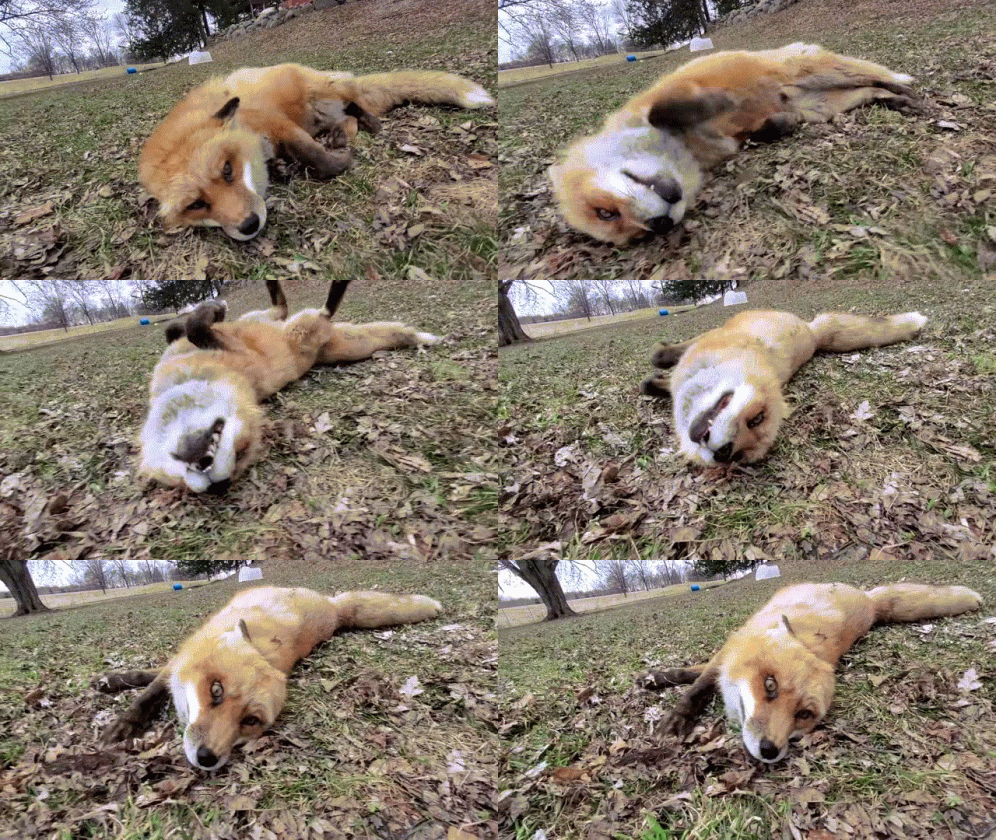
For a book that promotes storytelling with imagery rather than language, The Whisper is surprisingly bad at telling its story in the same way. Much of it is spelled out for the reader and there are a ton of words. I don't necessarily hate this, but I do think it is counterproductive to the message as a whole. And honestly, Zagarenski's idea would have been much more poignant if she'd given her book's readers the opportunity to put it into practice. This especially should have happened during the portions in which the little girl was telling her own stories based on the images.
Loved the Artwork!
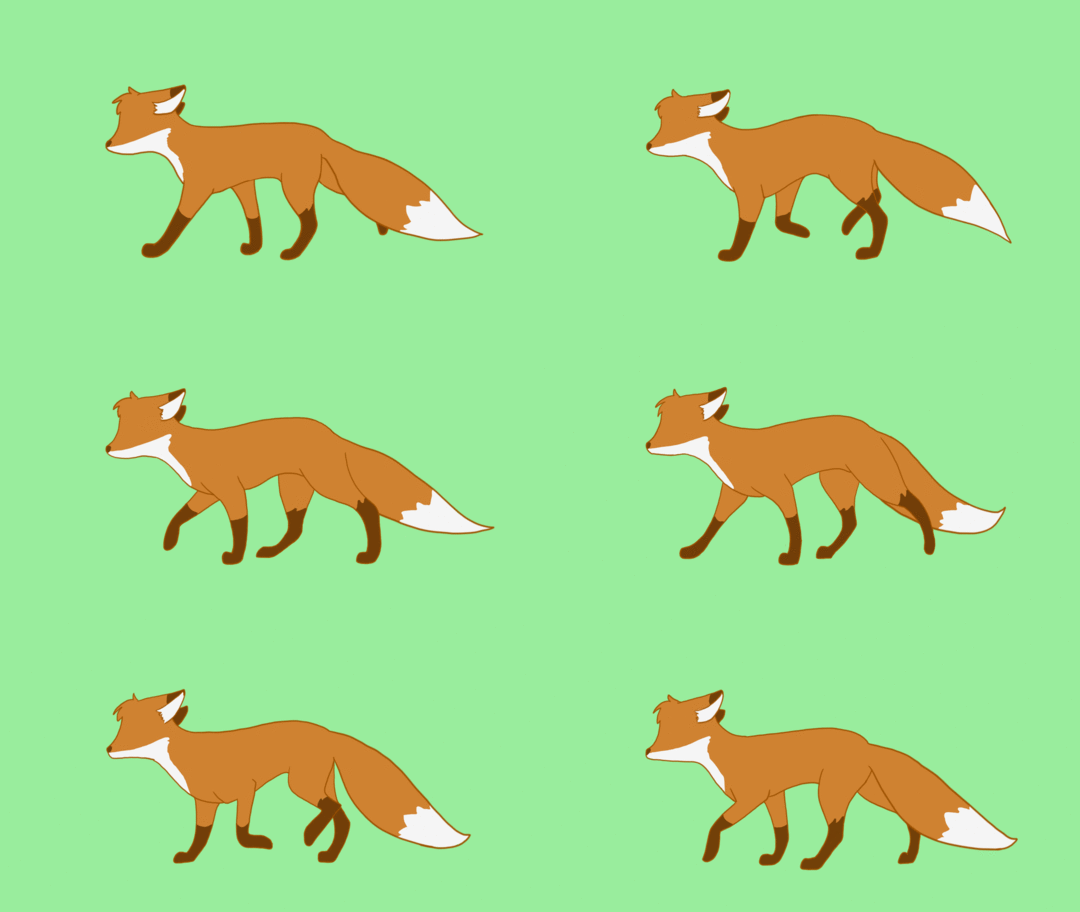
I have to give this book some serious props for how beautiful the art was. Not only that, but all the fox references made my heart so happy. Listen, the fact that the main character also had a hoodie that basically amounts to the equivalent of having fox ears was such a wonderful touch. And, as this is a story about appreciating how pictures tell stories, you need great artwork.
And maybe I'm a little biased. The fox presence on literally every single page made it impossible for me to not love it.
In the end...
So, I loved this book. I loved the story and I loved the reference to words and pictures. But, I do have to admit that it is the kind of book I don't really have an inclination to pick up again. Maybe one day, years in the future, when I have a child of my own it's one that I will share with them. But I didn't have any immense attachment to it. And honestly, if the fox motif hadn't been such a strong one, I probably would have rated it a little lower.
| Instagram | Twitter | Reader Fox Blog | Bloglovin’ | Facebook |
Where were the words? Where were the stories?
Pamela Zagarenski's The Whisper is a book I picked up for the fox. The story itself really doesn't have much to do with the creature, though to my excitement he is featured throughout pretty much the entire book. Ultimately, this is a story about using your imagination and building your own fantastical tales. In general, that is definitely a message that I can get behind. Therefore, I actually quite enjoyed reading this book.
A Book Without Words
As a reader, I love words. They're incredibly important to me. That said, some stories can be told without them. The little girl in this story has yet to learn this truth. Thus, when her teacher notices that the little girl loves to read, she offers to let her borrow a very special book. On her journey home, however, the words escape from the book only to be caught in a net by the fox behind her. When the girl gets home, she finds herself hold a book flowing with pictures and no words. Suddenly, it falls to her to fill in the pieces.
For a book that promotes storytelling with imagery rather than language, The Whisper is surprisingly bad at telling its story in the same way. Much of it is spelled out for the reader and there are a ton of words. I don't necessarily hate this, but I do think it is counterproductive to the message as a whole. And honestly, Zagarenski's idea would have been much more poignant if she'd given her book's readers the opportunity to put it into practice. This especially should have happened during the portions in which the little girl was telling her own stories based on the images.
Loved the Artwork!
I have to give this book some serious props for how beautiful the art was. Not only that, but all the fox references made my heart so happy. Listen, the fact that the main character also had a hoodie that basically amounts to the equivalent of having fox ears was such a wonderful touch. And, as this is a story about appreciating how pictures tell stories, you need great artwork.
And maybe I'm a little biased. The fox presence on literally every single page made it impossible for me to not love it.
In the end...
So, I loved this book. I loved the story and I loved the reference to words and pictures. But, I do have to admit that it is the kind of book I don't really have an inclination to pick up again. Maybe one day, years in the future, when I have a child of my own it's one that I will share with them. But I didn't have any immense attachment to it. And honestly, if the fox motif hadn't been such a strong one, I probably would have rated it a little lower.
| Instagram | Twitter | Reader Fox Blog | Bloglovin’ | Facebook |

August 14, 2024
One day, a little girl sees a beautiful book in her teacher's office and asks to take it home. But she soon realizes that there are no words, only pictures, and she's disappointed. But a whisper reaches her, reminding her that stories are remarkably flexible things, so she begins to dream.
There are many stories within this story, most of them unfinished, which is to say, left up to the imagination. I fell in love with the illustrations and couldn't help reading this book three times again, making up new stories as I went along. I hope you'll give this book a try and that you'll take part in the story-making too.
There are many stories within this story, most of them unfinished, which is to say, left up to the imagination. I fell in love with the illustrations and couldn't help reading this book three times again, making up new stories as I went along. I hope you'll give this book a try and that you'll take part in the story-making too.

April 15, 2018
Great story to teach kids about storytelling
I loved the illustrations and the flow of the book. I borrowed it from my library and would love to own it.
The story is about a little girl who asks her teacher if she could borrow her book. Once she gets home, she learns the book is more of a picture book with no words. The little girl used her imagination to come up with what the pictures mean. The pages don't finish so you can use your imagination to do it. I think the book is clever and promotes a child's imagination.
I loved the illustrations and the flow of the book. I borrowed it from my library and would love to own it.
The story is about a little girl who asks her teacher if she could borrow her book. Once she gets home, she learns the book is more of a picture book with no words. The little girl used her imagination to come up with what the pictures mean. The pages don't finish so you can use your imagination to do it. I think the book is clever and promotes a child's imagination.
August 4, 2017
I thought this book beautiful and good, imaginative, except for the parts that obviously mentioned Satan with the name Pan. The guy who has horns. That didn't please me, or some of the other underlying themes in the book hidden in between the lines. Or all the checkers (masonic, splitting of the mind).
Otherwise, I enjoyed it as a story. These reasons are why I docked two stars.
I don't believe satanic stuff should be hidden throughout kids' books.
Otherwise, I enjoyed it as a story. These reasons are why I docked two stars.
I don't believe satanic stuff should be hidden throughout kids' books.
Displaying 1 - 30 of 414 reviews