What do you think?
Rate this book


441 pages, Hardcover
First published September 3, 2015


 BOTW
BOTW http://www.bbc.co.uk/programmes/b067w2dv
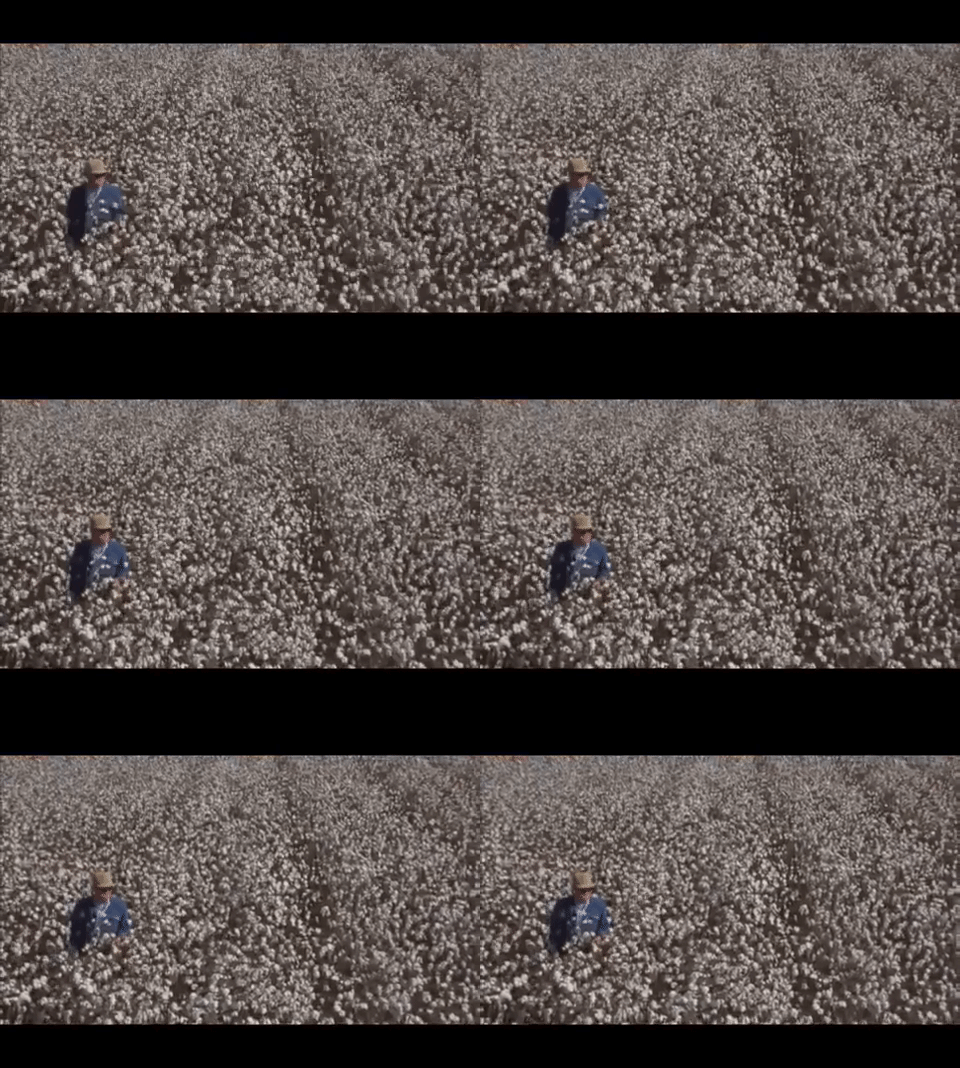
 1/5: . He's in Tusacaloona, in a car park, thinking about going to church. In a vehicle beside him sits Lucille, all black silk and lacey sleeves - "You lost, baby?" Her welcoming words are typical of the South.2/5: In Greensboro he meets the impressive Rev. Eugene Lyles, aged 79, who has his own church, his own barber shop and runs the local diner on Main Street. So, time for a haircut, then some lunch...3/5: The author stays at the 'Blue Shadows Bed and Breakfast' in Greensboro, and through its owner, Janet May, meets Randall Curb. And through Curb he will then encounter the legendary Mary Ward Brown, short story writer, aged 96.4/5: 4. At Aiken's steeplechase event he meets well-healed locals, mainly horse people and cotton baron descendents. Then he visits a hovel, once inhabited by Melvin Johnson, who has stories to tell..5/5: He takes to the backroads of Georgia and Alabama, which smell of sun-heated tar. The fields are full of cotton and the big rivers beckon..
“You starved us,” the woman said. “You made us eat rats.” This sort of response—sometimes heartfelt, sometimes a bitter joke, sometimes spoken with defiant nostalgia—is so commonly uttered in the South, always by whites, to a Northern visitor, that I learned not to say, “That was a hundred and fifty years ago,” but instead listened with sympathy, because conquered people feel helpless, and the proof of this is the monotony of their complaint. Their nagging on this point, ancient to me but fresh as today in their minds, gives the North—of which I was the embodiment that morning—a fiendish magnitude.
Reflecting on the Crimson Tide, I ceased to think of it as football at all, except in a superficial way; it seemed much more like another Southern reaction to a feeling of defeat, with some of the half-buried emotion I’d noticed at gun shows. In a state that is so hard-pressed, with one of the highest poverty rates in the nation, with its history of racial conflict, and with so little to boast about yet wishing to matter, it is natural that a winning team—a national champion—would attract people in need of meaning and self-esteem in their lives, and would become the basis of a classic in-group, The Tide was robust proof of social identity theory.
That was when I began to understand the mood of the gun show. It was not about guns. Not about ammo, not about knives. It was not about shooting lead into perceived enemies. The mood was apparent in the way these men walked and spoke: they felt beleaguered, weakened, their backs to the wall. How old was this feeling? It was as old as the South, perhaps, for all they talked about was the Civil War, and they were oppressed by that and everything that had happened since, a persistent memory of defeat.
As a white man I hear the word differently, as a strange ritualized artifact that has become a taboo. Declaring the word taboo is one of the ways—one of the very few ways—a black person can control a white, penalizing him for using a word that he, a black, in a subtler declaration, is licensed to speak freely. In this context, the use of the word by a white belittles (if not degrades) a black person by reclaiming the word, violating the taboo, infuriating and taking power from the black.