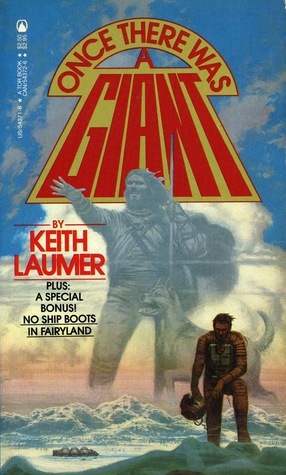
Once There Was A Giant(1968) It's not often that a fellow gets paid well to do what he'd like to do for free, and Baird Ulrik does only that. A licensed assassin who only contracts to kill dope runners, con men, and other scum, Baird Ulrik is an assassin with scruples. But one day he's framed for a crime he didn't commit and his only way out is to assassinate a man who has been a hero to him. No Ship Boots in Fairyland (1984)
Followed by commentary by Sandra Miesel, "The Long and Short of It" (1984)
John Keith Laumer was an American science fiction author. Prior to becoming a full-time writer, he was an officer in the U.S. Air Force and a U.S. diplomat. His brother March Laumer was also a writer, known for his adult reinterpretations of the Land of Oz (also mentioned in Keith's The Other Side of Time).
Keith Laumer (aka J.K Laumer, J. Keith Laumer) is best known for his Bolo stories and his satirical Retief series. The former chronicles the evolution of juggernaut-sized tanks that eventually become self-aware through the constant improvement resulting from centuries of intermittent warfare against various alien races. The latter deals with the adventures of a cynical spacefaring diplomat who constantly has to overcome the red-tape-infused failures of people with names like Ambassador Grossblunder. The Retief stories were greatly influenced by Laumer's earlier career in the United States Foreign Service. In an interview with Paul Walker of Luna Monthly, Laumer states "I had no shortage of iniquitous memories of the Foreign Service."
Four of his shorter works received Hugo or Nebula Award nominations (one of them, "In the Queue", received nominations for both) and his novel A Plague of Demons was nominated for the Nebula Award for Best Novel in 1966.
During the peak years of 1959–1971, Laumer was a prolific science fiction writer, with his novels tending to follow one of two patterns: fast-paced, straight adventures in time and space, with an emphasis on lone-wolf, latent superman protagonists, self-sacrifice and transcendence or, broad comedies, sometimes of the over-the-top variety.
In 1971, Laumer suffered a stroke while working on the novel The Ultimax Man. As a result, he was unable to write for a few years. As he explained in an interview with Charles Platt published in The Dream Makers (1987), he refused to accept the doctors' diagnosis. He came up with an alternative explanation and developed an alternative (and very painful) treatment program. Although he was unable to write in the early 1970s, he had a number of books which were in the pipeline at the time of the stroke published during that time.
In the mid-1970s, Laumer partially recovered from the stroke and resumed writing. However, the quality of his work suffered and his career declined (Piers Anthony, How Precious Was That While, 2002). In later years Laumer also reused scenarios and characters from his earlier works to create "new" books, which some critics felt was to their detriment:
Alas, Retief to the Rescue doesn't seem so much like a new Retief novel, but a kind of Cuisnart mélange of past books.
-- Somtow Sucharitkul (Washington Post, Mar 27, 1983. p. BW11)
His Bolo creations were popular enough that other authors have written standalone science-fiction novels about them.
Laumer was also a model airplane enthusiast, and published two dozen designs between 1956 and 1962 in the U.S. magazines Air Trails, Model Airplane News and Flying Models, as well as the British magazine Aero Modeler. He published one book on the subject, How to Design and Build Flying Models in 1960. His later designs were mostly gas-powered free flight planes, and had a whimsical charm with names to match, like the "Twin Lizzie" and the "Lulla-Bi". His designs are still being revisited, reinvented and built today.
The 1984 version has only two stories: Once There Was a Giant and a "bonus" No Ship Boots in Fairyland.
Once There Was a Giant (4-stars) is a Jack the Giant Killer story, but the rolls are reversed. "Jack" (Baird Ulrik, an assassin) is the bad guy and the "giant" (Johnny Thunder) is the good guy.
The story bogs down a bit in the middle, but it's far from boring. Laumer uses the time to develop the characters. By the time things come to a head, I knew the characters quite well and was rooting for Johnny Thunder. Baird wasn't all bad, but he's still the bad guy. It's worth at least one "read" if you can find a copy.
No Ship Boots in Fairyland (3-strs) is a Gulliver in Lilliput story with a time warped twist (I'll let you figure it out for yourself). The Gulliver character, Vallent, isn't all that bright (like a lot of Laumer's "heroes"). I know what was happening before he had his nose shoved in it. Aliens have taken over the Solar System, including Earth, pretending to be benign. When Vallent gets into trouble with them, he has to get out of town. He encounters an old man who knows him and tries to fill him in on what's happening, but as is usual with Laumer, Vallent won't listen (too busy objecting) and the old man dies before he can get the info into Vallent's thick skull. He leaves behind a foot-high sidekick who attaches himself to Vallent and they're off to save the world.
I guess I'm getting bored with Laumer's clay-footed heroes because I couldn't get totally involved in the story. The ending isn't predictable which is a nice surprise, but we kinda know how it's going to happen before we get there (I can't say more without spoiling it). If you're a die-hard Laumer fan, it's worth one reading, but (at least for me) not a second.
Keith Laumer, author of this collection called Once There Was A Giant, is something of a giant in my eyes as an author. Whether military adventure in his famous Bolo series of “Machinery, the Bolos were, but never mere.” (p. 211), hilarious diplomatic parody (I didn’t realize he had a real background in the diplomatic realm until I read the closing essay in this collection—p. 213) in the Retief anthologies, twisted tales of farcical looping time travel in The Shape Changer series, or more typical fare such as in the Worlds of Imperium or The Ultimax Man.
In the opening novella, Once There Was A Giant (with copyright to Mercury Press, probably originally published in The Magazine of Fantasy and Science-Fiction), one is not sure whether the protagonist is antihero or, as the adventure progresses, villain. Laumer doesn’t choose an unrealistic, sentimental ending, but the story is full of conflicting emotions. Commissioned (in this case, also known as “blackmailed”) into an assassination mission directed at a larger-than-life alien who, ostensibly, stands in the way of progress (symbolically being able to subdivide an under-developed planet). In a story predating the film Enemy Mine, there are some aspects of the story that would resonate with the Dennis Quaid vehicle which came later. Obligations slide back and forth between would-be assassin and targeted victim. The story doesn’t develop quite as I expected it to unfold. Frankly, I like Laumer’s actual resolution rather than my expected ending.
While Once There Was A Giant may have more literary value, No Ship Boots in Fairyland is the most fun with its twist on alien invasion, fantasy-esque Lilliputians, and space-time anomalies. It features Laumer’s typical play with names, the protagonist is Vallant (who is reluctantly valiant), a professor has the surname of Wormwell (C. S. Lewis’ reference to junior demon Wormwood?) who are introduced on the first page of this novella (p. 93), but my biggest chuckle was regarding Princess Touch-Me-Not (p. 151). Speaking of allusions, there is a scene of feasting which takes place prior to the start of a deadly quest and leads to a biblical reference from one of Jesus’ parables. After Vallant calls out to “Eat, drink, and be merry…,” his companion, Jimper (of Lilliputian comparison) responds: “’If you can,’ Jimper said, mournful again, ‘knowing what tomorrow will bring.’” (p. 161)
The combination of fascinating human adventure in the first novella, sheer entertainment in the second novella, and intriguing observations in the concluding essay make Once There Was A Giant a significantly more valuable addition to any science-fiction fan’s collection than I would have anticipated upon seeing the cover. I may rank the collection higher than many readers, but it belongs above the “I liked it” stage in my collection.
Ok the title story is maybe a 3-star read, but then No Ship Boots in Fairyland is as cringy as it sounds, with a race of foot-tall fantasy creatures who in my mind look like Robin Hood in the Disney cartoon version, and whose only named characters are Jimper, King Tweeple the Eater of One Hundred Tarts, and Princess Touch-me-not, so one of those "1 stars only because there aren't 0 stars" items.
The only piece of any real interest is Sandra Miesel's 20-page essay, The Long and the Short Of It, which as far as I know is the only "academic" study of Laumer as an author, discussing recurrent themes in his work, his background, influence of Raymond Chandler - a nice little think piece that actually makes me take him a tad more seriously.
I should probably add that I've only read "peripheral" Laumer - 4-5 of his standalone novels and his execrable "The Avengers" TV-show tie-ins - and none of his more famous Bolo or Retief books. I may yet give Bolo a try - his series about sentient battle tanks - but I plan to stay far away from the "satirical" Retief stories which, by their description alone and my existing experience with Laumer's "humorous" writing, sound like they'd be pretty awful by today's standards.
Laumer’s main characters are always hard case scenario white men. The main character in this story was one of his coldest hearted bastards yet.
This story shook me up. It provoked my feelings in a way I usually don’t get from Laumer. Another planet, another interesting being and another good sci-fi tale with a twist that left me disgustedly satisfied.
Laumer is a master story teller and this is one of his best.