

What do you think?

True Color: The Strange and Spectacular Quest to Define Color—from Azure to Zinc Pink
A kaleidoscopic journey through the secret history of hues—and the story of the obsessive genius behind the definitions of colors we use today, from the beloved author of Word by Word
begonia (n.): 3 -s : a deep pink that is bluer, lighter, and stronger than average coral (see coral 3b), bluer than fiesta, and bluer and stronger than sweet william — called also gaiety
What could "bluer than fiesta" possibly mean? While editing dictionaries for Merriam-Webster, Kory Stamper found herself drawn again and again to the whimsical color definitions in Webster’s Third New International Dictionary—especially when compared to the dry and impersonal entries that filled the rest of the volume. Stamper couldn’t help but Who was the voice behind these peculiar definitions?
Meet I. H. Godlove, an erratic but brilliant up-and-coming scientist who was one of the experts Merriam-Webster hired in 1930 to help revise the dictionary to reflect a rapidly modernizing world. His fascinating life mirrors the wild and winding journey that color science, color psychology, and color production took through the twentieth century. Stamper tracks these industries as they move into the atomic age and intertwine in strange and surprising ways, spanning two world wars and involving chemical explosions, an unexpected suicide, dramatic office politics, and an extraordinary love story.
Filled with captivating facts about color words and colors themselves—did you know that the word “puke” used to refer to a fashionable shade of reddish-brown before it was associated with vomit?—and fueled by Stamper’s inexhaustible curiosity, True Color will transform the way you see the world, from black-and-white to Technicolor.
*Includes a downloadable PDF of images from the book
begonia (n.): 3 -s : a deep pink that is bluer, lighter, and stronger than average coral (see coral 3b), bluer than fiesta, and bluer and stronger than sweet william — called also gaiety
What could "bluer than fiesta" possibly mean? While editing dictionaries for Merriam-Webster, Kory Stamper found herself drawn again and again to the whimsical color definitions in Webster’s Third New International Dictionary—especially when compared to the dry and impersonal entries that filled the rest of the volume. Stamper couldn’t help but Who was the voice behind these peculiar definitions?
Meet I. H. Godlove, an erratic but brilliant up-and-coming scientist who was one of the experts Merriam-Webster hired in 1930 to help revise the dictionary to reflect a rapidly modernizing world. His fascinating life mirrors the wild and winding journey that color science, color psychology, and color production took through the twentieth century. Stamper tracks these industries as they move into the atomic age and intertwine in strange and surprising ways, spanning two world wars and involving chemical explosions, an unexpected suicide, dramatic office politics, and an extraordinary love story.
Filled with captivating facts about color words and colors themselves—did you know that the word “puke” used to refer to a fashionable shade of reddish-brown before it was associated with vomit?—and fueled by Stamper’s inexhaustible curiosity, True Color will transform the way you see the world, from black-and-white to Technicolor.
*Includes a downloadable PDF of images from the book
320 pages, Hardcover
First published March 31, 2026
About the author
Kory Stamper
2 books430 followersKory Stamper is a lexicographer (that is, a writer and editor of dictionaries) at Merriam-Webster (the dictionary). She has written and appeared in the "Ask the Editor" video series at Merriam-Webster, and has traveled around the world giving talks and lectures on language and lexicography. Her writing has appeared in a number of publications, including The Washington Post, The Guardian and The New York Times. A medievalist by training, she knows a number of languages, most of them dead. She drinks more coffee and owns more dictionaries than is good for anyone.
Ratings & Reviews
Friends & Following
Create a free account to discover what your friends think of this book!
Community Reviews
Displaying 1 - 30 of 159 reviews

Did Not Finish
July 18, 2025A bit heavy on the philosophy of observation and the science of perception, and a bit light on fun color facts, so I'm setting this aside for now.
Perhaps it's the subtitle that led me astray, but I thought this would be an amusing book about various colors and the challenges found in defining them, along with some fun facts about them. Instead, it's a biography about a scientist named I. H. Godlove, whom Merriam-Webster hired to help revise the dictionary. Interesting facts about color can be found here, but 100 pages in, they are few and far between.
Perhaps it's the subtitle that led me astray, but I thought this would be an amusing book about various colors and the challenges found in defining them, along with some fun facts about them. Instead, it's a biography about a scientist named I. H. Godlove, whom Merriam-Webster hired to help revise the dictionary. Interesting facts about color can be found here, but 100 pages in, they are few and far between.

February 8, 2026
Although I am neither a color scientist nor a lexicographer, I have run dye facilities for theatrical costume shops for decades, and color control is exceedingly important to costume designers. Many prefer to talk about the colors they want used rather than provide color swatches, despite the nebulous interpretation of speech with respect to color. Many consider the emotion evoked by a color to be of primary import in the context of theatrical production.
I have worked with creatives who use emotional language rather than color samples to communicate their intentions with respect to how fabrics and costume pieces should be dyed; for example, “this pink needs to be a little more sad,” or “jazz up this orange with more jubilance.”
So a book about the struggle of lexicographers putting together a new edition of a dictionary at a time when the field of color science was beginning to be broadly studied and codified, is directly in my wheelhouse.
I don’t want to nerd out too hard in this book review, so I’ll just mention a few of the interesting (to me, at least) topics covered—synthetic dyestuffs in wartime, color standardization for commercial foodstuffs, urine colorwheels as diagnostic tools (really). The book then dives deep into the pedantic minutiae of hardcore word-nerds battling over hairsplitting points of the definition of colors across the spectrum, with coalitions pulling for scientific rigor, artistic license, practical systemization, and other factors.
This involves exactly the kind of low-stakes drama and beefing I love.
About halfway through the book, the focus turns to color psychology and fashion forecasting, which are fascinating in and of themselves, although be advised that some of the early fashion color names involve racist slurs and other dubious language that now feels jarring & icky.
The book then segues into the maddening limitations to which women scientists were subjected in the mid-20th century—eyeforking yet unsurprising.
I wouldn’t recommend this book to every theatrical dyer, or even everyone who works with color in a scientific, commercial, or artistic context. I can only say that if this review intrigues you, definitely check it out.
I have worked with creatives who use emotional language rather than color samples to communicate their intentions with respect to how fabrics and costume pieces should be dyed; for example, “this pink needs to be a little more sad,” or “jazz up this orange with more jubilance.”
So a book about the struggle of lexicographers putting together a new edition of a dictionary at a time when the field of color science was beginning to be broadly studied and codified, is directly in my wheelhouse.
I don’t want to nerd out too hard in this book review, so I’ll just mention a few of the interesting (to me, at least) topics covered—synthetic dyestuffs in wartime, color standardization for commercial foodstuffs, urine colorwheels as diagnostic tools (really). The book then dives deep into the pedantic minutiae of hardcore word-nerds battling over hairsplitting points of the definition of colors across the spectrum, with coalitions pulling for scientific rigor, artistic license, practical systemization, and other factors.
This involves exactly the kind of low-stakes drama and beefing I love.
About halfway through the book, the focus turns to color psychology and fashion forecasting, which are fascinating in and of themselves, although be advised that some of the early fashion color names involve racist slurs and other dubious language that now feels jarring & icky.
The book then segues into the maddening limitations to which women scientists were subjected in the mid-20th century—eyeforking yet unsurprising.
I wouldn’t recommend this book to every theatrical dyer, or even everyone who works with color in a scientific, commercial, or artistic context. I can only say that if this review intrigues you, definitely check it out.

June 12, 2026
I LOVED Word by Word: The Secret Life of Dictionaries, so I was eager to jump into this also-dictionary-adjacent book about color definitions. And while I found the discussions of color becoming big business in 20th-century United States fascinating, I definitely agree with the common reviewer sentiment that this book gets way too bogged down by tedious workplace micro-dramas.
Click here to hear more of my thoughts on this book - and one other book on color that you may like better than this one - over on my BookTube channel, abookolive!
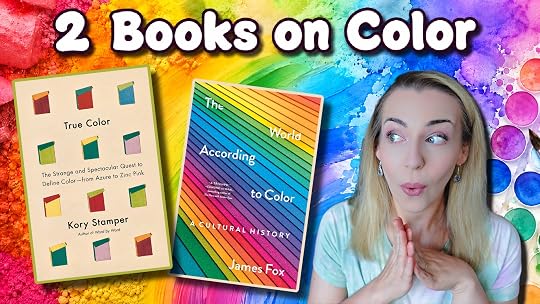
Click here to hear more of my thoughts on this book - and one other book on color that you may like better than this one - over on my BookTube channel, abookolive!

March 15, 2026
I enjoyed this book, mostly, but like other reviewers have mentioned this is not really a book about color. Color is discussed, but the central focus of the book is the minutia of office political drama during the creation of Merriam-Webster’s third edition. There were numerous interesting stories about color names, advertising, chemistry, and anthropology sprinkled throughout, but Stamper got in the weeds for a few chapters about the back-and-forth of different personalities in the new dictionary creation in the mid-20th-century. Kudos to Stamper, though, for including oft-ignored information about the contributions of women during this period. I’m definitely going to grab a copy of Word by Word!
Many thanks to Netgalley for the advance copy.
Many thanks to Netgalley for the advance copy.

June 22, 2026
Oscillates between “fascinating” and “exhausting.”
Fascinating:
· As soon as I thought about how I would define a color, any color, I wanted to know how lexicographers went about doing it. (How would you define “purple”? “Eggplant-colored”? But there’s such a thing as a cream-colored [uh-oh: “cream”] eggplant, and also the purple of most familiar eggplants is dark, so what about brighter/lighter purples? How are you going to define those? Et cetera.)
· The practice of lexicography, because I’m an amateur language geek and surely etymologies would feature somehow. Right? Right??
· Kory Stamper has worked as a lexicographer and immediately manifests a sense of humor. Qualifications!
· History! For example, the rise of clothing catalogues and with them creative color names.
· How many discrete color names are there, anyway, and if “hibiscus,” for example, is a color name, then how do you decide which shade that has been labeled “hibiscus” is the one you’re using as Standard Hibiscus?
· Office drama. Old-fashioned office correspondence (if you’re not touched by someone’s delicately phrased explanation that they’re behind on their work because they have suffered a “nervous breakdown,” I don’t know what to tell you).
· Surprisingly many women color scientists, owing to the combination platter of “new field” + “ladies are naturally sensitive to color.”
Exhausting:
· There are so, so many sentences like this: “When Godlove wrote in 1953 to the NBS colorimetrist Kenneth Kelly to ask if the ISCC-NBS committee had finished all the Munsell notations for the charts—Merriam would need them—Kelly was baffled as to why he couldn’t just wait until the NBS had properly reviewed, set, and published the new notations.”
Yes, we have learned that the NBS is the National Bureau of Standards, and a bit about what the NBS does (and that is not the subject of my complaint here). Ditto what “ISCC” stands for, though I could no longer tell you. But once you’re in the weeds of whether the ISCC-NBS committee had finished all the Munsell notations, you urgently want a machete with which to cut your way out.
So in spite of being a language geek, in spite of being lexicography-curious, and in spite of the fact that Kory Stamper is genuinely funny, I struggled to finish “True Color.” I can’t call it a bad book, because it isn’t, but I also think most general readers should go in expecting to do some skimming. Thanks to Knopf and NetGalley for the ARC.
Fascinating:
· As soon as I thought about how I would define a color, any color, I wanted to know how lexicographers went about doing it. (How would you define “purple”? “Eggplant-colored”? But there’s such a thing as a cream-colored [uh-oh: “cream”] eggplant, and also the purple of most familiar eggplants is dark, so what about brighter/lighter purples? How are you going to define those? Et cetera.)
· The practice of lexicography, because I’m an amateur language geek and surely etymologies would feature somehow. Right? Right??
· Kory Stamper has worked as a lexicographer and immediately manifests a sense of humor. Qualifications!
· History! For example, the rise of clothing catalogues and with them creative color names.
· How many discrete color names are there, anyway, and if “hibiscus,” for example, is a color name, then how do you decide which shade that has been labeled “hibiscus” is the one you’re using as Standard Hibiscus?
· Office drama. Old-fashioned office correspondence (if you’re not touched by someone’s delicately phrased explanation that they’re behind on their work because they have suffered a “nervous breakdown,” I don’t know what to tell you).
· Surprisingly many women color scientists, owing to the combination platter of “new field” + “ladies are naturally sensitive to color.”
Exhausting:
· There are so, so many sentences like this: “When Godlove wrote in 1953 to the NBS colorimetrist Kenneth Kelly to ask if the ISCC-NBS committee had finished all the Munsell notations for the charts—Merriam would need them—Kelly was baffled as to why he couldn’t just wait until the NBS had properly reviewed, set, and published the new notations.”
Yes, we have learned that the NBS is the National Bureau of Standards, and a bit about what the NBS does (and that is not the subject of my complaint here). Ditto what “ISCC” stands for, though I could no longer tell you. But once you’re in the weeds of whether the ISCC-NBS committee had finished all the Munsell notations, you urgently want a machete with which to cut your way out.
So in spite of being a language geek, in spite of being lexicography-curious, and in spite of the fact that Kory Stamper is genuinely funny, I struggled to finish “True Color.” I can’t call it a bad book, because it isn’t, but I also think most general readers should go in expecting to do some skimming. Thanks to Knopf and NetGalley for the ARC.

June 23, 2026
I LOVED her first book about the history of the dictionary but this was a flop for me. I like history, I like dictionaries, and I like colors, but this felt like it was just going to drag on forever with stories that were unrelated to anything. I liked the idea of the book; just not the book itself. 2 stars even

August 12, 2026
I learned a lot about the creation of Merriam-Webster’s second/third and a medium amount about colour. Enjoyed!

April 7, 2026
Interesting at times, but largely exhausting.
This is, at its heart, a book about lexicography rather than a book about color. I had hoped for something that felt more like a lexicographer’s history of how colors got their names, but this far more focused on the philosophical approach to naming and defining colors.
It’s interesting in theory, but feels a bit like the mind-bendy nonsense that is often offered up in poorly run Intro to Philosophy college courses, a sort of jumped up obfuscation that is designed to teach you a capital L Lesson that mostly leaves you feeling tired, annoyed, and not much better informed than you were before being forced to play Russian Roulette with language.
We get very little history of color and its naming conventions here, which is disappointing. I felt like I was having to work a lot harder to understand this than I anticipated, but somehow also learning a lot less than I expected.
There are also a lot of digressions into dictionary history, something we’ve gotten a LOT of in recent nonfiction. It takes up a lot of real estate here in a book that is supposed to be focused on a specific segment of lexicography.
Even the humor here is exhausting. It isn’t that Stamper is never funny. She is, but the tone is very schtick-ish, and it gets old fast, and often feels like a try-hard attempt to offset all the linguistic gymnastics with…more linguistic gymnastics dressed in a slightly different outfit.
In all, there are parts of this that are fascinating, and the research is certainly sound. But it’s tiring to read with little payoff in exchange, and not exactly as advertised.
*I received an ARC of this book in exchange for an honest review.*
This is, at its heart, a book about lexicography rather than a book about color. I had hoped for something that felt more like a lexicographer’s history of how colors got their names, but this far more focused on the philosophical approach to naming and defining colors.
It’s interesting in theory, but feels a bit like the mind-bendy nonsense that is often offered up in poorly run Intro to Philosophy college courses, a sort of jumped up obfuscation that is designed to teach you a capital L Lesson that mostly leaves you feeling tired, annoyed, and not much better informed than you were before being forced to play Russian Roulette with language.
We get very little history of color and its naming conventions here, which is disappointing. I felt like I was having to work a lot harder to understand this than I anticipated, but somehow also learning a lot less than I expected.
There are also a lot of digressions into dictionary history, something we’ve gotten a LOT of in recent nonfiction. It takes up a lot of real estate here in a book that is supposed to be focused on a specific segment of lexicography.
Even the humor here is exhausting. It isn’t that Stamper is never funny. She is, but the tone is very schtick-ish, and it gets old fast, and often feels like a try-hard attempt to offset all the linguistic gymnastics with…more linguistic gymnastics dressed in a slightly different outfit.
In all, there are parts of this that are fascinating, and the research is certainly sound. But it’s tiring to read with little payoff in exchange, and not exactly as advertised.
*I received an ARC of this book in exchange for an honest review.*

October 13, 2025
Netgalley ARC- Ms. Stamper has a very interesting writing style which was fun to read. I alternatively found myself laughing and saying Huh? There were parts where the history got a bit bogged down. It wasn't quite about the color names as much as about defining words and how we perceive versus know colors but overall it was a very decent read.

April 11, 2026
This originally appeared at The Irresponsible Reader. If you like this post, you might like others on that site. Consider checking it out!
---
WHAT'S TRUE COLOR ABOUT?
Have you ever had trouble describing a color to someone? Strange sea creatures, sunsets, a (hopefully) food stain on a shirt, paint on a wall? It's not easy. For some of us more than others, I'm sure (I'm at the weak end)—but it's not that easy.
Now, try to imagine doing it not for a friend or paint clerk—but for the thousands or more that might read your description (read: definition) in a dictionary or other reference work.
Stamper points to two significant markers in the development of these definitions. The first is that prior to the First World War, Germany was the world's biggest source of commercial dyes. During the War, two things happened—first, those plants became weapons factories (and learning how easy that was is a bit disconcerting), and second, places like the U.S. had to start producing their own. And if, say, two different suppliers understood a tint of green differently—the camouflage they provided to the Army in Europe could have significant consequences.
The other is a little less dramatic, but no less impactful. When people in the U.S. started making oleomargarine in the 1800s, dairies were upset about them coloring it to look like butter—this resulted in legal battles, and eventually, the U.S. Congress weighed in.
These two things began efforts in the U.S. to codify colors, dyes, hues, and whatnot into some sort of standard.
Fast-forward to when Kory Stamper is editing Merriam-Webster's website (and from her description, this is not an easy job), when she came across some odd color definitions. The wording was odd, the definitions themselves were puzzling—where did these come from?
Thus begins this story about the attempts to define colors—in a way that satisfies diverse audiences like artists, scientists, and general readers—during the development of their Second and Third Unabridged Dictionaries. Stamper tells the story of putting these dictionaries together, some of the editors who worked on them—and worked with outside consultants like I. H. Godlove (and his wife and colleagues) and others to craft these definitions.
It's a book of human drama, academic politics, technological limitations, and the limits of human language and understanding.
WHY DID I PICK THIS UP? WHY DID I KEEP READING?
I picked this up because I enjoyed Stamper's earlier book Word by Word: The Secret Life of Dictionaries and because I was intrigued by the question—how do you define a color? I also hoped to pick up some tips to help me with that. Spoiler: I did not. But I don't care. This was better. It's also encouraging to know that even professional definers struggle.
Why did I keep reading? There's just so much trivia—especially in the beginning, so many strange little facts you pick up along the way—for example (taken from the publisher's description, because I hate to ruin stuff like this) "did you know that the word 'puke' used to refer to a fashionable shade of reddish-brown before it was associated with vomit?"
But more importantly, I was just fascinated by the way these editors and experts went about putting together these dictionaries—the differences in approach between the two—and so on. Stamper can make what one might think is dry and dusty history come alive and fill it with humanity.
Readers of Nero Wolfe will learn that he wasn't the only one who had problems with the Third Unabridged Dictionary—although most derided it in reviews or newspaper articles, rather than burning it page by page in their fireplace.
SO, WHAT DID I THINK ABOUT TRUE COLOR?
I was, again, fascinated by the people she focused on to tell her story. I wanted to talk to people about them—I'd like to learn more about them and their work.* Her following up with the Godlove family's living relatives so we could get more insight into the people behind the work was a wonderful touch.
Like her previous book, True Color will disabuse many of what they imagine the behind-the-scenes of Dictionary production is like. You will read about one of the worst bosses around, for example. Stress, overwork, burnout, crazy turnover, rampant misogyny (okay, you might have guessed that given the time periods), tiny budgets, and more. It turns out that Dictionaries are put together by human beings, not beings of pure intellect.
Also, I cannot say enough about Stamper's use of language. It will not come as a surprise that someone who works on dictionaries has a way with words—she has ready access to all the best ones, after al—but to see it in action is something else. Stamper's rich vocabulary is on full display here, and she crafts it beautifully.
* I will not—particularly about their work, I wouldn't understand it. But I wanted to.
Disclaimer: I received this eARC from Knopf via NetGalley in exchange for this post, which contains my honest opinion—thanks to both for this.
---
WHAT'S TRUE COLOR ABOUT?
Have you ever had trouble describing a color to someone? Strange sea creatures, sunsets, a (hopefully) food stain on a shirt, paint on a wall? It's not easy. For some of us more than others, I'm sure (I'm at the weak end)—but it's not that easy.
Now, try to imagine doing it not for a friend or paint clerk—but for the thousands or more that might read your description (read: definition) in a dictionary or other reference work.
Stamper points to two significant markers in the development of these definitions. The first is that prior to the First World War, Germany was the world's biggest source of commercial dyes. During the War, two things happened—first, those plants became weapons factories (and learning how easy that was is a bit disconcerting), and second, places like the U.S. had to start producing their own. And if, say, two different suppliers understood a tint of green differently—the camouflage they provided to the Army in Europe could have significant consequences.
The other is a little less dramatic, but no less impactful. When people in the U.S. started making oleomargarine in the 1800s, dairies were upset about them coloring it to look like butter—this resulted in legal battles, and eventually, the U.S. Congress weighed in.
These two things began efforts in the U.S. to codify colors, dyes, hues, and whatnot into some sort of standard.
Fast-forward to when Kory Stamper is editing Merriam-Webster's website (and from her description, this is not an easy job), when she came across some odd color definitions. The wording was odd, the definitions themselves were puzzling—where did these come from?
Thus begins this story about the attempts to define colors—in a way that satisfies diverse audiences like artists, scientists, and general readers—during the development of their Second and Third Unabridged Dictionaries. Stamper tells the story of putting these dictionaries together, some of the editors who worked on them—and worked with outside consultants like I. H. Godlove (and his wife and colleagues) and others to craft these definitions.
It's a book of human drama, academic politics, technological limitations, and the limits of human language and understanding.
WHY DID I PICK THIS UP? WHY DID I KEEP READING?
I picked this up because I enjoyed Stamper's earlier book Word by Word: The Secret Life of Dictionaries and because I was intrigued by the question—how do you define a color? I also hoped to pick up some tips to help me with that. Spoiler: I did not. But I don't care. This was better. It's also encouraging to know that even professional definers struggle.
Why did I keep reading? There's just so much trivia—especially in the beginning, so many strange little facts you pick up along the way—for example (taken from the publisher's description, because I hate to ruin stuff like this) "did you know that the word 'puke' used to refer to a fashionable shade of reddish-brown before it was associated with vomit?"
But more importantly, I was just fascinated by the way these editors and experts went about putting together these dictionaries—the differences in approach between the two—and so on. Stamper can make what one might think is dry and dusty history come alive and fill it with humanity.
Readers of Nero Wolfe will learn that he wasn't the only one who had problems with the Third Unabridged Dictionary—although most derided it in reviews or newspaper articles, rather than burning it page by page in their fireplace.
SO, WHAT DID I THINK ABOUT TRUE COLOR?
I was, again, fascinated by the people she focused on to tell her story. I wanted to talk to people about them—I'd like to learn more about them and their work.* Her following up with the Godlove family's living relatives so we could get more insight into the people behind the work was a wonderful touch.
Like her previous book, True Color will disabuse many of what they imagine the behind-the-scenes of Dictionary production is like. You will read about one of the worst bosses around, for example. Stress, overwork, burnout, crazy turnover, rampant misogyny (okay, you might have guessed that given the time periods), tiny budgets, and more. It turns out that Dictionaries are put together by human beings, not beings of pure intellect.
Also, I cannot say enough about Stamper's use of language. It will not come as a surprise that someone who works on dictionaries has a way with words—she has ready access to all the best ones, after al—but to see it in action is something else. Stamper's rich vocabulary is on full display here, and she crafts it beautifully.
* I will not—particularly about their work, I wouldn't understand it. But I wanted to.
Disclaimer: I received this eARC from Knopf via NetGalley in exchange for this post, which contains my honest opinion—thanks to both for this.

April 17, 2026
In the mid-20th century Merriam Webster put out two massive unabridged dictionaries. This is primarily the story of how they included "color" in those books. I never would have guessed that this was a big deal, but there were thousands of entries on color - mostly on different shades. How in the world do you explain "azure" (from the title), for example, with words alone?! Different dictionary and color experts had numerous, strongly held, ideas about how this ought to be done.
I love to read a book about a subject I knew nothing about. I'm going to think about color and about dictionaries in a whole new way! And I hope I'm not making this sound dry, because "True Color" includes many human stories and I chuckled often as I read.
I love to read a book about a subject I knew nothing about. I'm going to think about color and about dictionaries in a whole new way! And I hope I'm not making this sound dry, because "True Color" includes many human stories and I chuckled often as I read.

July 17, 2026
I would have never imagined that I would call a non-fiction book, a book about the history of dictionaries and color, a favorite read of the year. But there is no other way around it. I enjoyed this book greatly and I would actually sit down and read again with pleasure. Turns out that working on a dictionary is full of drama.

May 27, 2026
I just can't get through this one, which is a shame since I love books on color.
This book has genuinely made me mad from the get-go, which is why it was a DNF for me. Not because it was poorly written, or had false information- but because it is a book about color with hardly ANY visual examples of said colors being discussed. I can forgive it in the preface but in Chapter 1 Chasing Rainbows the only visual example being a raccoon chart of the concept of perception...is horrendous, especially with the other written examples used.
I don't mind a wordy or ramble-ly writing style (in fact I tend to like it because it is more personable), so in these in-depth descriptions of mixing color that creates a muddy color or to how not everyone perceives the same "color" when looking at certain colors - maybe show examples??? Ones certain came to mind, but it would be nice (and expected) to have visuals of color in a book about color.
This book has genuinely made me mad from the get-go, which is why it was a DNF for me. Not because it was poorly written, or had false information- but because it is a book about color with hardly ANY visual examples of said colors being discussed. I can forgive it in the preface but in Chapter 1 Chasing Rainbows the only visual example being a raccoon chart of the concept of perception...is horrendous, especially with the other written examples used.
I don't mind a wordy or ramble-ly writing style (in fact I tend to like it because it is more personable), so in these in-depth descriptions of mixing color that creates a muddy color or to how not everyone perceives the same "color" when looking at certain colors - maybe show examples??? Ones certain came to mind, but it would be nice (and expected) to have visuals of color in a book about color.

July 12, 2026
Odd book, a small bit about the science of color, a larger bit about the crazy happenings at Merriam-Webster for the 2nd and 3rd editions of the Unabridged as they worked with outside consultants on color name definitions, and the largest bit was really how in general those dictionaries were put together in the first half of the 20th century. All mixed in with biographical looks at some of the main players, and a lot of wry and idiosyncratic humor from the writer.

May 2, 2026
3.5 stars.
A combination history of color name standardization, detailed history of the process of publishing Webster's Third Unabridged Dictionary, and mini-biographies of I.H. Godlove, the main color scientist that worked on defining for The Third. There were some sloggy bits that focused a bit too much of one or the other of the above, but overall it was an interesting deep dive into both dictionary publishing and color naming.
A combination history of color name standardization, detailed history of the process of publishing Webster's Third Unabridged Dictionary, and mini-biographies of I.H. Godlove, the main color scientist that worked on defining for The Third. There were some sloggy bits that focused a bit too much of one or the other of the above, but overall it was an interesting deep dive into both dictionary publishing and color naming.

August 10, 2026
TLDR words are inadequate in describing colors
this was a very well researched history on the third edition of merriam-webster’s dictionary and the great lengths experts went to understand how to define color, less so a dive into the science of color itself (which is what i wanted & thought it would be)
this was a very well researched history on the third edition of merriam-webster’s dictionary and the great lengths experts went to understand how to define color, less so a dive into the science of color itself (which is what i wanted & thought it would be)

August 30, 2026
Way more narrative and about dictionaries than I’d expected but still a success for me. Super interesting subject and written in a voice that felt really similar to my own. Felt like I was reading a book that I could have written (provided I dedicated years of research etc. (&c!)). So excited to be pedantic about the wine-dark sea.

June 27, 2026
Having loved the author’s previous book (Word by Word: The Secret Life of Dictionaries), I eagerly picked this up. And was not disappointed. She really speaks to my inner word nerd! And her sense of humor is delightful. Excellent audio narration by the author.

June 26, 2026
not entirely sure what I expected but this wasn’t exactly it!
way more about merriam webster and dictionaries than I expected from the title but I also didn’t really look into it at all. interesting, regardless!
way more about merriam webster and dictionaries than I expected from the title but I also didn’t really look into it at all. interesting, regardless!

July 22, 2026
Full of interesting bits and written in an engaging voice - you can tell the author is a lover of language. Does drag a bit towards the middle.

Review of advance copy received from Publisher
Trying to Name the Rainbow
Kory Stamper’s “True Color” and the beautiful, doomed effort to make perception hold still
By Demetris Papadimitropoulos | March 21st, 2026
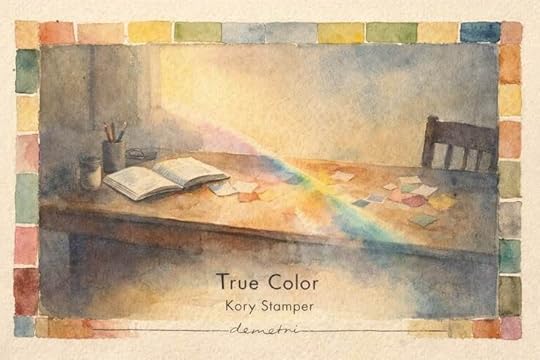
A desk, a spill of spectral light, and the hush of recent labor – this image holds the book’s central tension in place for a moment, as if language, art, and classification might yet persuade color to stay still.
Color feels self-evident until someone asks you to define it. Then it wriggles. Is blue a wavelength, a sensation, a social agreement, a paint chip, a piece of sky, a memory of sky, or simply the name we keep fastening to a recurring visual event? As someone who has spent a lifetime making and looking at art, I felt that instability less as a philosophical puzzle than as a familiar studio fact. Color is never merely surface. It carries heat, appetite, weather, ceremony, grief. “True Color” begins inside that wobble and has the good sense not to tidy it up too quickly.
Kory Stamper starts with a lexicographer’s private delight: the gloriously odd color definitions in “Webster’s Third,” full of “begonia,” “fiesta,” and the immortal “sea pink.” From that oddity she builds a larger, stranger history of what happens when scientists, editors, bureaucrats, manufacturers, and marketers all try to pin an unruly thing to a serviceable scheme. The book’s subject is color, certainly, but its deeper subject is translation under pressure – between perception and language, between expert precision and ordinary speech, between the authority institutions want and the approximations people can actually use.
That doubleness gives the book its snap. A more dutiful version of this project might have settled for attractive arcana: old dye charts, strange dictionary entries, committees with grandiose titles, dead men with severe views on olive drab. Stamper gives us the dead men, and some of them are so earnest they verge on self-parody. But she keeps asking the harder question beneath the charm: what does it mean to define something that refuses to hold still? Each domain wants color fixed in its own way. The physicist wants measurement. The dictionary editor wants words that can survive daylight. The wartime manufacturer wants a standard that can be reproduced before the war ends. The pharmacist would prefer not to guess what “reddish green” means. The artist already knows that two blues can begin quarrelling on a canvas long before either one submits to a chart.
The book ranges widely, but its lines of force stay clear. Stamper begins with the original nuisance of color itself: what seems obvious to the eye turns slippery the minute physics, biology, neurology, psychology, and language all enter the room and begin politely disagreeing. From there she moves into the industrial and wartime histories that made standardization urgent. Synthetic dyes, grading systems, camouflage, and supply chains turn color from adornment into infrastructure. The National Bureau of Standards starts trying to define hues for everything from uniforms to denture teeth. Merriam-Webster, meanwhile, attempts something even touchier: to produce authoritative color definitions that are scientifically respectable without becoming unreadable. Into that breach steps Isaac Godlove, a chemist, color theorist, amateur artist, and one-man argument for the value of intelligent mediation. Later the frame widens again to include Philip Gove’s remaking of “Webster’s Third,” the moral panic that followed its publication, and, most crucially, the overdue return of Margaret Godlove from the margins to the center of the story. By then the question is no longer whether color can be fully defined. The book has answered that already. It cannot. The better question is why we keep trying, and what those attempts reveal about the way knowledge is made, used, sold, and misassigned.
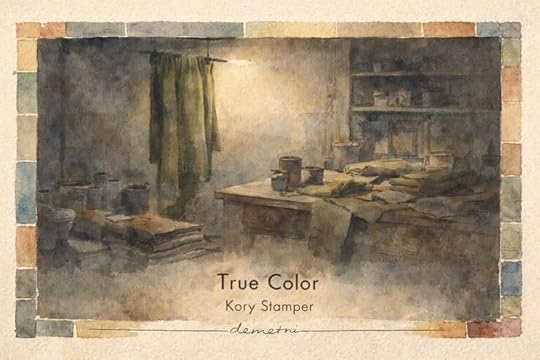
Here color loses any claim to innocence, becoming a wartime problem of manufacture and survival – a murky green-brown burdened with all the pressure of getting the visible world exactly, urgently right.
Stamper’s prose is what keeps all this from thickening into specialist paste. She has a knack for making a difficult idea behave just long enough for a reader to see it from several sides. Her analogies do real labor. An orange, a raccoon, a patch of paint, a war uniform, a dictionary slip: she keeps turning abstraction into something you can point at. The sentence music is supple without turning mannered. She likes a medium-length explanatory run followed by a quick dry snap; she knows when a joke will carry an argument farther than solemnity; and she has the good manners to let a sentence end before it congratulates itself. Even the wit has a method. It is not there to sugar the science. It is there to expose the vanity of any system that thinks it has finally cornered reality. When she dismisses “dark weak orange” as a “dark, weak pile of garbage,” the line is funny, but it is also exact: the joke tells you more about unusable precision than a paragraph of dutiful explanation could.
Just as importantly, Stamper never confuses fluency with simplification. She can translate Irwin Priest’s contempt for everyday color names, the officious ambitions of color science, or the production snarls at Merriam into prose that never seals the reader out. But she does not sand away the remainder. She explains clearly without pretending the problem has become simple. That distinction gives the book much of its authority. Plenty of explanatory nonfiction achieves clarity by shaving off difficulty. Stamper does something harder. She arranges the difficulty, lets you feel its edges, and then shows why the edges matter. A term that looks settled turns unstable. A standard that looks rigorous turns unusable. A dictionary entry that first appears absurd reveals a crooked but serious attempt to make visual knowledge verbal.
The structure is more cunning than it first appears. There are no formal parts, but the book is carefully staged. Early chapters establish the instability of color across perception, language, and science. Middle chapters drag that instability into institutions – committees, correspondence, production schedules, budgets, dictionaries. Later chapters turn the same logic back on the people doing the work. That delayed re-centering of Margaret Godlove is one of Stamper’s smartest moves. It forces a retrospective correction. Earlier chapters do not become false, exactly, but they become suddenly half-blind. The story of Isaac’s brilliance is also the story of a woman measuring chips, converting them into notation, organizing pockets, finishing definition work, and being paid a stenographer’s wage while the official record kept looking elsewhere. At that point the book’s argument about classification sharpens at once. Systems do not merely sort colors. They sort labor, prestige, and who gets seen.
This is where “True Color” becomes more than an ingenious history of standardization. It becomes a book about how people make the world legible without ever fully taming it. The clearest emblem comes when Godlove pushes back against ugly pseudo-precision like “dark weak orange” and returns to the ordinary word “brown.” That is not a retreat from rigor. It is rigor chastened by use. A system that cannot meet its users where they live is not more exact; it is merely more self-impressed. Stamper is superb on this point. The world reaches us twice, the book suggests: first through perception, then through the systems we build to stabilize perception. For me, as a lifelong artist, this is where the book bit deepest. It never treats color as trivial surface or as a puzzle best left to laboratories and committees. It understands color as something mixed, judged, remembered, stained into the hand, carried in the eye. Artists learn early that color is relational before it is theoretical. A gray goes warm because of the red beside it. A blue can look bruised in one light and ceremonial in another. Stamper does not romanticize that instability, but she respects it. The charts matter. So does the eye lifting from them.
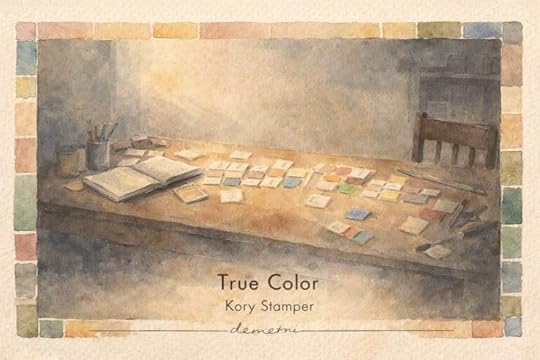
A quiet work surface of chips, paper, and measured care, this image honors the hidden labor that made systems legible while history kept looking past the hands that ordered them.
Its second great feat is moral as well as intellectual: it changes who the story belongs to. Margaret Godlove’s emergence is not a dutiful contemporary correction bolted onto an older narrative. It reorders the narrative itself. Stamper shows, persuasively and without melodrama, that Margaret was not a helpmate hovering politely at the edge of her husband’s work. She was doing the work – measuring, organizing, converting, refining, making the color system usable off the page, later helping produce the glossy chips that gave the ISCC-NBS standard a practical life beyond theory, and finally completing, decades later, the visual supplement the original standard lacked. Stamper wisely does not overheat this material. She lets the wages, records, tasks, and absences do the accusing. The effect is stronger for being so controlled. By the time Margaret comes fully into view, the whole book has acquired a second subject: not only how color is standardized, but how intellectual history keeps mislabeling the people who make its standards possible.
The clearest weakness is structural. Now and then “True Color” returns to its best insight without raising the stakes enough to justify the extra lap. The central idea – that color resists stable definition, and that every attempt to fix it reveals fresh instability – is a rich one, and Stamper proves it early. She extends it compellingly through war, manufacturing, lexicography, medicine, labor history, and public argument. But in the final third, a few stretches of editorial weather and institutional procedure soften the pressure. These chapters are not empty. They are often sharp, occasionally very funny in a paper-cut sort of way, and full of useful friction. Still, they can feel more cumulative than dramatic. The book begins to recontextualize more than it escalates. The slackening is real, even if it comes from the book refusing a tidier lie. A cleaner book might have moved faster. It would also have been less true to its own subject, which keeps showing that no standard arrives all at once, neatly, or with the decency to end on cue.
Yet the lack of a fake crescendo is one of the things that makes the book trustworthy. Stamper knows a project like this cannot end in perfect triumph without betraying its own argument. The late material on the overlong, underfunded, stop-start afterlife of the ISCC-NBS standard sharpens rather than resolves the book’s question. One of the best late observations comes from an admirer of the standard who loves it partly because so much work went into something that, on the surface, “didn’t go anywhere.” That lands first as a joke and then as the book’s sternest truth. These systems do go somewhere, of course. They harden into habit. They shape products, dictionaries, judgments, and ways of seeing. But they do not arrive at perfection. They become serviceable, then influential, then partial again.
The book’s afterlife beyond its subject is obvious enough that it does not need to wave for attention. Stamper is writing about dictionaries, dyes, charts, and committees, yet the book speaks naturally to larger arguments about standards, expertise, shared language, and invisible labor. It also understands something many current debates still resist: description is never neutral, but neither is it surrender. To describe the world as it is used, seen, and spoken is not to give up on rigor. It is to admit that rigor without legibility is a private hobby. That insight gives the book its reach. “True Color” feels not reactive but diagnostic – a study of the recurring human urge to build systems sturdy enough to help and humble enough to fail.
For me, “True Color” settles at 93/100, which on a blunt Goodreads scale means 5 stars: not flawless, but excellent in a way that lasts. The difference is worth keeping. Stamper has written a book that looks genial, behaves rigorously, and turns out to be more daring than it first appears. It knows that dictionaries are made by committees and temperaments as much as by principles, that standards are never merely technical, and that the distance between assistant and author is often only the distance history was too lazy to measure correctly.
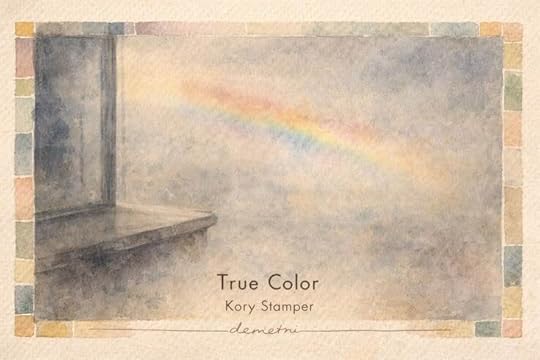
At the edge of the review, color loosens back into atmosphere – no longer pinned to chart or definition, but returning to the fugitive, luminous uncertainty the book never tries to conquer.
The book ends exactly where it should: not with color mastered, but with color still slipping the knot. That turns out not to be a defeat, or not only that. “True Color” is finally about the human compulsion to keep reaching anyway – with spectrophotometers, painted cards, glossy chips, definitions so specific they nearly blush, one more effort to say what blue is without merely pointing at the sky. By the last page, Stamper has made even approximation feel luminous. The rainbow remains where it always was – untouchable, shifting, faintly insolent – and all our careful systems look beautiful not because they capture it, but because they know they won’t.
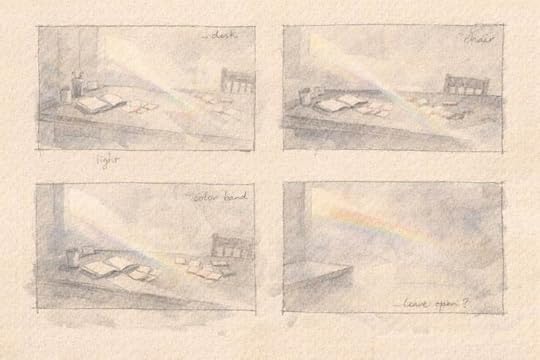
These first small studies test the painting’s balance of stillness, asymmetry, and pressure, searching for a composition that could hold the book’s argument without explaining it too literally.
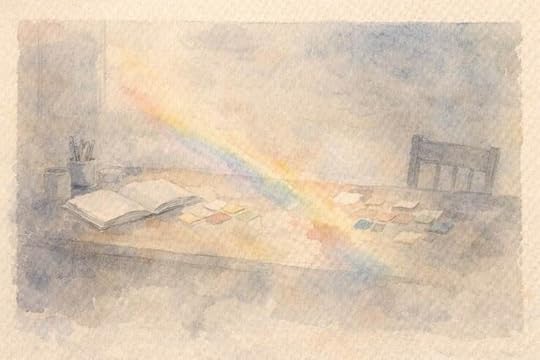
At this stage the image begins to breathe – structure, light, and the first fragile movement of color emerging together before the final atmosphere settles across the page.
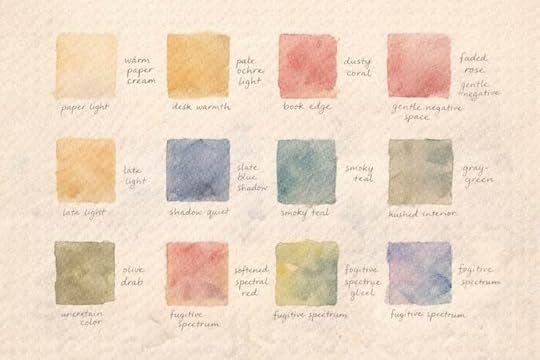
This palette study works through the book’s visual logic in miniature, testing how muted papers, olive shadows, and slipping spectral notes might carry tension without losing restraint.
All watercolor illustrations by Demetris Papadimitropoulos.
Kory Stamper’s “True Color” and the beautiful, doomed effort to make perception hold still
By Demetris Papadimitropoulos | March 21st, 2026
A desk, a spill of spectral light, and the hush of recent labor – this image holds the book’s central tension in place for a moment, as if language, art, and classification might yet persuade color to stay still.
Color feels self-evident until someone asks you to define it. Then it wriggles. Is blue a wavelength, a sensation, a social agreement, a paint chip, a piece of sky, a memory of sky, or simply the name we keep fastening to a recurring visual event? As someone who has spent a lifetime making and looking at art, I felt that instability less as a philosophical puzzle than as a familiar studio fact. Color is never merely surface. It carries heat, appetite, weather, ceremony, grief. “True Color” begins inside that wobble and has the good sense not to tidy it up too quickly.
Kory Stamper starts with a lexicographer’s private delight: the gloriously odd color definitions in “Webster’s Third,” full of “begonia,” “fiesta,” and the immortal “sea pink.” From that oddity she builds a larger, stranger history of what happens when scientists, editors, bureaucrats, manufacturers, and marketers all try to pin an unruly thing to a serviceable scheme. The book’s subject is color, certainly, but its deeper subject is translation under pressure – between perception and language, between expert precision and ordinary speech, between the authority institutions want and the approximations people can actually use.
That doubleness gives the book its snap. A more dutiful version of this project might have settled for attractive arcana: old dye charts, strange dictionary entries, committees with grandiose titles, dead men with severe views on olive drab. Stamper gives us the dead men, and some of them are so earnest they verge on self-parody. But she keeps asking the harder question beneath the charm: what does it mean to define something that refuses to hold still? Each domain wants color fixed in its own way. The physicist wants measurement. The dictionary editor wants words that can survive daylight. The wartime manufacturer wants a standard that can be reproduced before the war ends. The pharmacist would prefer not to guess what “reddish green” means. The artist already knows that two blues can begin quarrelling on a canvas long before either one submits to a chart.
The book ranges widely, but its lines of force stay clear. Stamper begins with the original nuisance of color itself: what seems obvious to the eye turns slippery the minute physics, biology, neurology, psychology, and language all enter the room and begin politely disagreeing. From there she moves into the industrial and wartime histories that made standardization urgent. Synthetic dyes, grading systems, camouflage, and supply chains turn color from adornment into infrastructure. The National Bureau of Standards starts trying to define hues for everything from uniforms to denture teeth. Merriam-Webster, meanwhile, attempts something even touchier: to produce authoritative color definitions that are scientifically respectable without becoming unreadable. Into that breach steps Isaac Godlove, a chemist, color theorist, amateur artist, and one-man argument for the value of intelligent mediation. Later the frame widens again to include Philip Gove’s remaking of “Webster’s Third,” the moral panic that followed its publication, and, most crucially, the overdue return of Margaret Godlove from the margins to the center of the story. By then the question is no longer whether color can be fully defined. The book has answered that already. It cannot. The better question is why we keep trying, and what those attempts reveal about the way knowledge is made, used, sold, and misassigned.
Here color loses any claim to innocence, becoming a wartime problem of manufacture and survival – a murky green-brown burdened with all the pressure of getting the visible world exactly, urgently right.
Stamper’s prose is what keeps all this from thickening into specialist paste. She has a knack for making a difficult idea behave just long enough for a reader to see it from several sides. Her analogies do real labor. An orange, a raccoon, a patch of paint, a war uniform, a dictionary slip: she keeps turning abstraction into something you can point at. The sentence music is supple without turning mannered. She likes a medium-length explanatory run followed by a quick dry snap; she knows when a joke will carry an argument farther than solemnity; and she has the good manners to let a sentence end before it congratulates itself. Even the wit has a method. It is not there to sugar the science. It is there to expose the vanity of any system that thinks it has finally cornered reality. When she dismisses “dark weak orange” as a “dark, weak pile of garbage,” the line is funny, but it is also exact: the joke tells you more about unusable precision than a paragraph of dutiful explanation could.
Just as importantly, Stamper never confuses fluency with simplification. She can translate Irwin Priest’s contempt for everyday color names, the officious ambitions of color science, or the production snarls at Merriam into prose that never seals the reader out. But she does not sand away the remainder. She explains clearly without pretending the problem has become simple. That distinction gives the book much of its authority. Plenty of explanatory nonfiction achieves clarity by shaving off difficulty. Stamper does something harder. She arranges the difficulty, lets you feel its edges, and then shows why the edges matter. A term that looks settled turns unstable. A standard that looks rigorous turns unusable. A dictionary entry that first appears absurd reveals a crooked but serious attempt to make visual knowledge verbal.
The structure is more cunning than it first appears. There are no formal parts, but the book is carefully staged. Early chapters establish the instability of color across perception, language, and science. Middle chapters drag that instability into institutions – committees, correspondence, production schedules, budgets, dictionaries. Later chapters turn the same logic back on the people doing the work. That delayed re-centering of Margaret Godlove is one of Stamper’s smartest moves. It forces a retrospective correction. Earlier chapters do not become false, exactly, but they become suddenly half-blind. The story of Isaac’s brilliance is also the story of a woman measuring chips, converting them into notation, organizing pockets, finishing definition work, and being paid a stenographer’s wage while the official record kept looking elsewhere. At that point the book’s argument about classification sharpens at once. Systems do not merely sort colors. They sort labor, prestige, and who gets seen.
This is where “True Color” becomes more than an ingenious history of standardization. It becomes a book about how people make the world legible without ever fully taming it. The clearest emblem comes when Godlove pushes back against ugly pseudo-precision like “dark weak orange” and returns to the ordinary word “brown.” That is not a retreat from rigor. It is rigor chastened by use. A system that cannot meet its users where they live is not more exact; it is merely more self-impressed. Stamper is superb on this point. The world reaches us twice, the book suggests: first through perception, then through the systems we build to stabilize perception. For me, as a lifelong artist, this is where the book bit deepest. It never treats color as trivial surface or as a puzzle best left to laboratories and committees. It understands color as something mixed, judged, remembered, stained into the hand, carried in the eye. Artists learn early that color is relational before it is theoretical. A gray goes warm because of the red beside it. A blue can look bruised in one light and ceremonial in another. Stamper does not romanticize that instability, but she respects it. The charts matter. So does the eye lifting from them.
A quiet work surface of chips, paper, and measured care, this image honors the hidden labor that made systems legible while history kept looking past the hands that ordered them.
Its second great feat is moral as well as intellectual: it changes who the story belongs to. Margaret Godlove’s emergence is not a dutiful contemporary correction bolted onto an older narrative. It reorders the narrative itself. Stamper shows, persuasively and without melodrama, that Margaret was not a helpmate hovering politely at the edge of her husband’s work. She was doing the work – measuring, organizing, converting, refining, making the color system usable off the page, later helping produce the glossy chips that gave the ISCC-NBS standard a practical life beyond theory, and finally completing, decades later, the visual supplement the original standard lacked. Stamper wisely does not overheat this material. She lets the wages, records, tasks, and absences do the accusing. The effect is stronger for being so controlled. By the time Margaret comes fully into view, the whole book has acquired a second subject: not only how color is standardized, but how intellectual history keeps mislabeling the people who make its standards possible.
The clearest weakness is structural. Now and then “True Color” returns to its best insight without raising the stakes enough to justify the extra lap. The central idea – that color resists stable definition, and that every attempt to fix it reveals fresh instability – is a rich one, and Stamper proves it early. She extends it compellingly through war, manufacturing, lexicography, medicine, labor history, and public argument. But in the final third, a few stretches of editorial weather and institutional procedure soften the pressure. These chapters are not empty. They are often sharp, occasionally very funny in a paper-cut sort of way, and full of useful friction. Still, they can feel more cumulative than dramatic. The book begins to recontextualize more than it escalates. The slackening is real, even if it comes from the book refusing a tidier lie. A cleaner book might have moved faster. It would also have been less true to its own subject, which keeps showing that no standard arrives all at once, neatly, or with the decency to end on cue.
Yet the lack of a fake crescendo is one of the things that makes the book trustworthy. Stamper knows a project like this cannot end in perfect triumph without betraying its own argument. The late material on the overlong, underfunded, stop-start afterlife of the ISCC-NBS standard sharpens rather than resolves the book’s question. One of the best late observations comes from an admirer of the standard who loves it partly because so much work went into something that, on the surface, “didn’t go anywhere.” That lands first as a joke and then as the book’s sternest truth. These systems do go somewhere, of course. They harden into habit. They shape products, dictionaries, judgments, and ways of seeing. But they do not arrive at perfection. They become serviceable, then influential, then partial again.
The book’s afterlife beyond its subject is obvious enough that it does not need to wave for attention. Stamper is writing about dictionaries, dyes, charts, and committees, yet the book speaks naturally to larger arguments about standards, expertise, shared language, and invisible labor. It also understands something many current debates still resist: description is never neutral, but neither is it surrender. To describe the world as it is used, seen, and spoken is not to give up on rigor. It is to admit that rigor without legibility is a private hobby. That insight gives the book its reach. “True Color” feels not reactive but diagnostic – a study of the recurring human urge to build systems sturdy enough to help and humble enough to fail.
For me, “True Color” settles at 93/100, which on a blunt Goodreads scale means 5 stars: not flawless, but excellent in a way that lasts. The difference is worth keeping. Stamper has written a book that looks genial, behaves rigorously, and turns out to be more daring than it first appears. It knows that dictionaries are made by committees and temperaments as much as by principles, that standards are never merely technical, and that the distance between assistant and author is often only the distance history was too lazy to measure correctly.
At the edge of the review, color loosens back into atmosphere – no longer pinned to chart or definition, but returning to the fugitive, luminous uncertainty the book never tries to conquer.
The book ends exactly where it should: not with color mastered, but with color still slipping the knot. That turns out not to be a defeat, or not only that. “True Color” is finally about the human compulsion to keep reaching anyway – with spectrophotometers, painted cards, glossy chips, definitions so specific they nearly blush, one more effort to say what blue is without merely pointing at the sky. By the last page, Stamper has made even approximation feel luminous. The rainbow remains where it always was – untouchable, shifting, faintly insolent – and all our careful systems look beautiful not because they capture it, but because they know they won’t.
These first small studies test the painting’s balance of stillness, asymmetry, and pressure, searching for a composition that could hold the book’s argument without explaining it too literally.
At this stage the image begins to breathe – structure, light, and the first fragile movement of color emerging together before the final atmosphere settles across the page.
This palette study works through the book’s visual logic in miniature, testing how muted papers, olive shadows, and slipping spectral notes might carry tension without losing restraint.
All watercolor illustrations by Demetris Papadimitropoulos.

August 20, 2026
We’re so back This is gonna get me out of my reading slump so good ty Nina for the rec

August 13, 2026
Other reviewers cited the “tedious workplace dramas” as bogging this one down. I’m going to be honest in that those kept me reading. How can precision work not be rife with scandal?

May 22, 2026
As I was reading this delightfully eccentric book I had in my mind the image of my grandmother's copy of this behemoth. Her copy sat on a low bookshelf within reach of two Selectric typewriters in her home office. I logged hours and hours reading through that thing.
What I didn't appreciate about Webster’s Third New International Dictionary was how much time such a book takes to make. We're talking multiple decades to define all the words and then edit those definitions into something that fits the house style and is efficient as possible. Efficiency means more defined words can be crammed into the book!
Another thing I didn't appreciate until reading Stamper's book was how much influence the people who were hired to work on the book had on the modern color language I use as an artist. Hue, saturation, value — even those simple sounding words took on their meanings only recently. Even the color cube is a recent invention, though much older than computers even though computers are where most people run into them now.
Anyway, a thoroughly enjoyable book that took me about a month of lunches and dinners to read. It's not actually that long, I was just savoring it.
https://pussreboots.com/blog/2026/com...
What I didn't appreciate about Webster’s Third New International Dictionary was how much time such a book takes to make. We're talking multiple decades to define all the words and then edit those definitions into something that fits the house style and is efficient as possible. Efficiency means more defined words can be crammed into the book!
Another thing I didn't appreciate until reading Stamper's book was how much influence the people who were hired to work on the book had on the modern color language I use as an artist. Hue, saturation, value — even those simple sounding words took on their meanings only recently. Even the color cube is a recent invention, though much older than computers even though computers are where most people run into them now.
Anyway, a thoroughly enjoyable book that took me about a month of lunches and dinners to read. It's not actually that long, I was just savoring it.
https://pussreboots.com/blog/2026/com...

April 9, 2026
Bottomline: Mine not to reason why, mine but to read and die.
This was, without exaggeration, my most anticipated book of 2026. I had been awaiting its arrival for the better part of a year, and, in a serendipitous twist of fate, it was scheduled to release on my birthday. I could've hardly hoped for a more felicitous gift from the cosmos! Did it meet my astronomical expectations? No. Was it a bad book, then? Certainly not. What follows may be a long review, but much like its subject, I promise it won’t be devoid of color.
Ever since I devoured her book Word by Word (part lexicographical memoir, part behind-the-scenes exposé of dictionary-making), I became an ardent aficionado of Kory Stamper. There are authors one admires, others one respects, and then there are those rare few one adores. Stamper, for me, belongs emphatically to the last category. Her prose possesses an understated, hilarious wit. Her language sparkles like cut crystal catching oblique sunlight. Her quirky, delightfully eccentric idiolect is nothing short of addictive. I found myself checking for updates on her next work with the whimsical irregularity of a long-term investor peeking at a dormant portfolio.
A decade in the making, True Color opens with a compelling account of wartime exigencies that necessitated the standardization of color. From there, Stamper leads us through a kaleidoscope of topics - synthetic dyes, urine colorwheels as diagnostic tools (yup, that's a thing), and protracted legal skirmishes over butter vs. margarine, where color became the unlikely battleground. She introduces us to four categories of color (basic, intrinsic, associative, and fancy), how to make sense of them and why they are divided so.
At first, the book ostensibly deals with the pedantic minutiae of word-nerds battling over hairsplitting pabulum. Not complaining, it's a relief from 'heavy' books I generally opt for. This kind of low-stakes drama slowly grows on you. Even the chapter titles are idiomatically color-coded: Out of the Blue, Silver Bullet, Greenhorn, Yellow Brick Road, Red Tape, Gold Standard, Red Hot, etc.
But... (and there is always a 'but', isn’t there?) Everything I just praised is largely confined to the opening chapters. Chapter 3 onwards, the book undergoes an abrupt tonal metamorphosis. Look, if you promise water, give me water. Even if you hand me a chocolate then, disappointment is inevitable. However delicious it tastes, that was never part of the bargain. It doesn’t take long for True Color to reveal its… well, true color.
Part of the blame rests with me. The subtitle, 'The Strange and Spectacular Quest to Define Color from Azure to Zinc Pink' should have been a clue. It's only after you start reading that you realise how heavily it leans on the word 'define'. It's a book about colors, yes, but it's more of a book about defining colors, about dictionaries. Is that bad? No, but it's not what I was expecting. For months, I'd been anticipating reveling in a book that'll drown me in utterly fascinating facts about colors. This was something else.
The shock of that revelation was yet to fully sink in when the book took another U-turn and turned into a biography of the color scientist I.H. Godlove. The man was a brilliant, zealous and tragically overworked Colorimetrist and Color Curator. His terrific life-story is to die for. Trust me, it'll be money and time well-spent, but again.. This is simply not what I signed up for. Maybe Stamper should've released this book under a different name. Ceteris paribus, I am sure it would've landed a spot in my top five picks of the year.
It further devolves into part office-politics drama, part meditation on the soul-sapping rigors of lexicography. By this point, I was beginning to lose interest and question my existence when it takes yet another turn, this time for good. Almost miraculously, it rights itself.
The narrative circles back to the wondrous world of color. We are treated to explorations of color psychology and its (mis)use in fashion forecasting, as well as the systemic constraints imposed upon women color scientists in the mid-20th century. Only if there were more such lesser-known tidbits about color!
A small but curious aside - every writer has a lexical signature, their pet words, consciously or otherwise. Stephen King fans are familiar with his overuse of 'chambray', Stephenie Meyer had 'chagrin', Jeffrey Archer doubled down on 'nonchalantly', Rowling loved 'hardly'. Stamper, ever the lexicographer, seems fond of 'picayune' and 'boondoggle', deploying them with such frequency I began to wonder how it passed the editor's table unscathed. It’s not a flaw, merely a signature - but a conspicuous one.
On a more personal note, I remain unconvinced by the very premise of defining colors. Why attempt to imprison something inherently visual within the rigid confines of language? Consider a definition such as 'a strong pink that is yellower than carnation rose, but slightly lighter than sea pink, with moderate chromaticity but dark saturation.' First of all, what in the name of slightly lighter, but moderately dark Hell is 'sea pink'? I have a hard time imagining simple descriptions such as 'yellowish brown' or 'greenish violet', and you expect me to understand this fresh VistaVision glory of a definition? God knows I am BIG on words! But if someone like me finds this entire exercise futile, you know we've got a problem. After reading the book, I know now how defining a color can literally mean the difference between life and death, but still. There's a thing called Internet. Just google it, dude!
This is not a book for everyone. It's the sort of book that you'd either fall head over heels for, or ignore out of hand. My expectations played a spoilsport, but you know what you are getting into. If this stuff sounds like music to your ears, feel free to dive in. Even if it doesn't, I'd recommend you to read Stamper's Word by Word. Authors like Kory Stamper are hard to come by. If it takes becoming one of Lord Tennyson's unquestioning soldiers to admire her, then so be it.
This was, without exaggeration, my most anticipated book of 2026. I had been awaiting its arrival for the better part of a year, and, in a serendipitous twist of fate, it was scheduled to release on my birthday. I could've hardly hoped for a more felicitous gift from the cosmos! Did it meet my astronomical expectations? No. Was it a bad book, then? Certainly not. What follows may be a long review, but much like its subject, I promise it won’t be devoid of color.
Ever since I devoured her book Word by Word (part lexicographical memoir, part behind-the-scenes exposé of dictionary-making), I became an ardent aficionado of Kory Stamper. There are authors one admires, others one respects, and then there are those rare few one adores. Stamper, for me, belongs emphatically to the last category. Her prose possesses an understated, hilarious wit. Her language sparkles like cut crystal catching oblique sunlight. Her quirky, delightfully eccentric idiolect is nothing short of addictive. I found myself checking for updates on her next work with the whimsical irregularity of a long-term investor peeking at a dormant portfolio.
A decade in the making, True Color opens with a compelling account of wartime exigencies that necessitated the standardization of color. From there, Stamper leads us through a kaleidoscope of topics - synthetic dyes, urine colorwheels as diagnostic tools (yup, that's a thing), and protracted legal skirmishes over butter vs. margarine, where color became the unlikely battleground. She introduces us to four categories of color (basic, intrinsic, associative, and fancy), how to make sense of them and why they are divided so.
At first, the book ostensibly deals with the pedantic minutiae of word-nerds battling over hairsplitting pabulum. Not complaining, it's a relief from 'heavy' books I generally opt for. This kind of low-stakes drama slowly grows on you. Even the chapter titles are idiomatically color-coded: Out of the Blue, Silver Bullet, Greenhorn, Yellow Brick Road, Red Tape, Gold Standard, Red Hot, etc.
But... (and there is always a 'but', isn’t there?) Everything I just praised is largely confined to the opening chapters. Chapter 3 onwards, the book undergoes an abrupt tonal metamorphosis. Look, if you promise water, give me water. Even if you hand me a chocolate then, disappointment is inevitable. However delicious it tastes, that was never part of the bargain. It doesn’t take long for True Color to reveal its… well, true color.
Part of the blame rests with me. The subtitle, 'The Strange and Spectacular Quest to Define Color from Azure to Zinc Pink' should have been a clue. It's only after you start reading that you realise how heavily it leans on the word 'define'. It's a book about colors, yes, but it's more of a book about defining colors, about dictionaries. Is that bad? No, but it's not what I was expecting. For months, I'd been anticipating reveling in a book that'll drown me in utterly fascinating facts about colors. This was something else.
The shock of that revelation was yet to fully sink in when the book took another U-turn and turned into a biography of the color scientist I.H. Godlove. The man was a brilliant, zealous and tragically overworked Colorimetrist and Color Curator. His terrific life-story is to die for. Trust me, it'll be money and time well-spent, but again.. This is simply not what I signed up for. Maybe Stamper should've released this book under a different name. Ceteris paribus, I am sure it would've landed a spot in my top five picks of the year.
It further devolves into part office-politics drama, part meditation on the soul-sapping rigors of lexicography. By this point, I was beginning to lose interest and question my existence when it takes yet another turn, this time for good. Almost miraculously, it rights itself.
The narrative circles back to the wondrous world of color. We are treated to explorations of color psychology and its (mis)use in fashion forecasting, as well as the systemic constraints imposed upon women color scientists in the mid-20th century. Only if there were more such lesser-known tidbits about color!
A small but curious aside - every writer has a lexical signature, their pet words, consciously or otherwise. Stephen King fans are familiar with his overuse of 'chambray', Stephenie Meyer had 'chagrin', Jeffrey Archer doubled down on 'nonchalantly', Rowling loved 'hardly'. Stamper, ever the lexicographer, seems fond of 'picayune' and 'boondoggle', deploying them with such frequency I began to wonder how it passed the editor's table unscathed. It’s not a flaw, merely a signature - but a conspicuous one.
On a more personal note, I remain unconvinced by the very premise of defining colors. Why attempt to imprison something inherently visual within the rigid confines of language? Consider a definition such as 'a strong pink that is yellower than carnation rose, but slightly lighter than sea pink, with moderate chromaticity but dark saturation.' First of all, what in the name of slightly lighter, but moderately dark Hell is 'sea pink'? I have a hard time imagining simple descriptions such as 'yellowish brown' or 'greenish violet', and you expect me to understand this fresh VistaVision glory of a definition? God knows I am BIG on words! But if someone like me finds this entire exercise futile, you know we've got a problem. After reading the book, I know now how defining a color can literally mean the difference between life and death, but still. There's a thing called Internet. Just google it, dude!
This is not a book for everyone. It's the sort of book that you'd either fall head over heels for, or ignore out of hand. My expectations played a spoilsport, but you know what you are getting into. If this stuff sounds like music to your ears, feel free to dive in. Even if it doesn't, I'd recommend you to read Stamper's Word by Word. Authors like Kory Stamper are hard to come by. If it takes becoming one of Lord Tennyson's unquestioning soldiers to admire her, then so be it.

July 6, 2026
Up pops the biologist to say that it’s not quite that simple, because without the right combination of photoreceptors in the retina, a healthy retina, a solid optic nerve, a clear lens and healthy cornea, yadda yadda yadda—without the complex mechanisms of the human eye, we wouldn’t perceive any of that light as color. And before the physicist can argue, a neurologist peers around the corner to say that color is a sensation generated by our brains to interpret the neural signals from the retina caused by light, and so, really, color can’t happen independent of human cognition. You turn to leave and a psychologist blocks your exit and, as they push you back into the room and the horror-film music begins, tells you that the psychophysical sensation known as color is dependent upon the other color sensations your brain is interpreting at the same time, the language you assign to that sensation, and whether you are synesthetic. But how can you know, you say, voice rising into a shrill, that all of this works the same way in each person? They crowd in and you begin to hyperventilate: Everyone’s brain is different, so how can we know that the blue I see is the blue everyone else sees? The room goes dark. No one can see your face turn pale; color is a function of light.
Very engaging and informative read from the dictionary perspective of color, so could drag a little bit with the politics and history of how a dictionary is made, but overall worth it!
How did the NBS decide which color was the ideal color, the color de la color? Scientifically, of course. No eyeballing here—they measured. Using the technology available to them—everything from Maxwell spinning discs, which looked like a multicolor mechanical top on its side that, when spun at high speeds, would cause your eyes and brain to visually blend the colors on that top into one composite color, which could then be matched to a sample, to newer photometers, which measured the strength and wavelength of light reflected from a surface—they studied and recorded the minute variations in color for the thing to be measured, from the highest-quality stuff to samples that were just above garbage. They narrowed the range of “acceptable” color variations from toward the top of the quality scale until they had an ideal color—the average of all the best-quality goods they were measuring. Then they printed those standards under exacting color tolerances and sold them to industry graders (and, for those with moolah, producers). And they were popular. A color standard was the difference between a flush year and bankruptcy.
Priest’s whine that color names are “weird and fanciful” is only half true. Many common color names do have a logic to them, but it’s a logic built on human experience and not some scientific nomenclature. There are four main types of color names. We’ve got the basic color categories—the first colors that we learn as toddlers, the main color buckets into which all other colors get dumped. Generally speaking, that’s red, orange, yellow, green, blue, purple, brown, pink, gray, white, and black. Beyond the basic color terms, there are color names that some scholars call intrinsic. These are color names based on something in real life—plants, foods, gems, animals, earth. “Lime” is (supposedly) the color of limes; “daffodil” is the color of daffodil flowers; “burnt umber” is the color of a type of earth from Umbria (baked), and “raw sienna” is the color of a type of earth from Siena (raw); “cardinal” is the red of the bird; “mummy” is the brown of the pyramid denizen.
They ran an experiment where he gave a number of English speakers (mostly students) from Australia, England, and the United States five minutes to write down all the single-word color names they could think of (so “blue” was fine, but “baby blue” was not). He got about 270 responses, tallied them, and ended up with a list of about 203 color names, which he sorted by different variables. You can cross-section an entire language’s speakers depending on their color names. Green-Armytage found, for instance, that only Americans listed “cranberry” as a color name, and only Australians listed “mulberry.” Your field of study or work plays a part: Architecture students named colors derived from built environments and materials (copper, granite, lead, oak); design students listed “magenta” and “cyan,” two colors used in printing; painters named “ocher,” “sienna,” “umber,” “vermilion,” all of which are the names of fine-art colors or pigments; the members of the West Australian Quilters Association named colors that came from fashion and textiles, like “beige,” “cerise,” “burgundy,” “aubergine” (or “eggplant,” if you’re a member of an American quilters’ guild).
Very engaging and informative read from the dictionary perspective of color, so could drag a little bit with the politics and history of how a dictionary is made, but overall worth it!
How did the NBS decide which color was the ideal color, the color de la color? Scientifically, of course. No eyeballing here—they measured. Using the technology available to them—everything from Maxwell spinning discs, which looked like a multicolor mechanical top on its side that, when spun at high speeds, would cause your eyes and brain to visually blend the colors on that top into one composite color, which could then be matched to a sample, to newer photometers, which measured the strength and wavelength of light reflected from a surface—they studied and recorded the minute variations in color for the thing to be measured, from the highest-quality stuff to samples that were just above garbage. They narrowed the range of “acceptable” color variations from toward the top of the quality scale until they had an ideal color—the average of all the best-quality goods they were measuring. Then they printed those standards under exacting color tolerances and sold them to industry graders (and, for those with moolah, producers). And they were popular. A color standard was the difference between a flush year and bankruptcy.
Priest’s whine that color names are “weird and fanciful” is only half true. Many common color names do have a logic to them, but it’s a logic built on human experience and not some scientific nomenclature. There are four main types of color names. We’ve got the basic color categories—the first colors that we learn as toddlers, the main color buckets into which all other colors get dumped. Generally speaking, that’s red, orange, yellow, green, blue, purple, brown, pink, gray, white, and black. Beyond the basic color terms, there are color names that some scholars call intrinsic. These are color names based on something in real life—plants, foods, gems, animals, earth. “Lime” is (supposedly) the color of limes; “daffodil” is the color of daffodil flowers; “burnt umber” is the color of a type of earth from Umbria (baked), and “raw sienna” is the color of a type of earth from Siena (raw); “cardinal” is the red of the bird; “mummy” is the brown of the pyramid denizen.
They ran an experiment where he gave a number of English speakers (mostly students) from Australia, England, and the United States five minutes to write down all the single-word color names they could think of (so “blue” was fine, but “baby blue” was not). He got about 270 responses, tallied them, and ended up with a list of about 203 color names, which he sorted by different variables. You can cross-section an entire language’s speakers depending on their color names. Green-Armytage found, for instance, that only Americans listed “cranberry” as a color name, and only Australians listed “mulberry.” Your field of study or work plays a part: Architecture students named colors derived from built environments and materials (copper, granite, lead, oak); design students listed “magenta” and “cyan,” two colors used in printing; painters named “ocher,” “sienna,” “umber,” “vermilion,” all of which are the names of fine-art colors or pigments; the members of the West Australian Quilters Association named colors that came from fashion and textiles, like “beige,” “cerise,” “burgundy,” “aubergine” (or “eggplant,” if you’re a member of an American quilters’ guild).

Review of advance copy received from Netgalley
I have a child who is allergic to nonfiction--not all kinds of books, just nonfiction. (We read to them until they made it to high school, every night, all of Harry Potter and Tolkien, and one time I read "Oranges" by John McPhee, and this child still resents me for that, so you get the idea.) I told her I was reading a book about color, and she said, "Why?"
"Well. it's not about color. It's about how you define color in a dictionary."
"Oh, my God, why would you want to read that?"
Reader, she had a point.
If you look at the cover, and the title, you would think--anyone would think--that this was a book about color. It is not. If you read the subtitle, the word "define" appears, and that gives the game away. This is about how you define what color is in a dictionary. Specifically, how they defined color in two dictionary editions in the mid-twentieth century. And the book is that way because the author is a lexicographer, and she has unlimited access to the Merriman-Webster archives, which is the source for most of the book, and that is why the book is the way it is and if you are going to read this book you need to know that ahead of time because otherwise you are going to be dreadfully disappointed.
At some level, I think, most people can understand the difficulty that the long-ago lexicographers of yore had in defining color. I mean, think of a color, any color you like, and try to figure out how you would put it in the dictionary. I am right this second looking at the next book I have to review, which is TWELVE MONTHS by Jim Butcher, and it has a glowy fiery yellow sigil in the background. What color is that? It's yellow, but it's not buttercup-yellow or mustard-yellow or goldenrod or any other sort of shade like that, it's more golden than anything else, but a very yellowy gold, if that makes sense, and if you are reading this review (thank you for reading this far) you will get the idea that there is difficulty in defining that. And the printing process being what it is, well, you can't just print out a blob of color, because that's difficult to do, and expensive, and...
And, well, why would you want to do that? You know what "yellow" is already, you don't need to go to the dictionary to figure that out, I mean, you've known what "yellow" is your whole life. But if you are writing a dictionary (an unabridged dictionary!), you can't just leave words out because everyone knows what that means. You have to have some way to define things.
So, you know, I get it. And if there had been a laser-like focus on color and how color was defined at, let's say, the length of a long magazine article, it would have been okay. That is not this book. Because there is a stretch in this book, a very long stretch, where the author explores the transition between the second edition of the dictionary, and the third edition of the dictionary, and the personalities and the HR decisions that went into setting up the team that was writing the third edition, and none of this (I can't stress this enough) has anything to do with color, and the purpose of all of this is to set up the idea that one of the senior staff was, hmm, how to say this, not the sort of person you would want to work for. And then when the narrative turns back to color, you get paragraphs like this:
His work on the Third was a source of frustration or confusion for his friends at the NBS, though, who couldn't understand why the lexicographers wer second-guessing a system based on scientific principles, and why they were dictating that science move at the pase of publishing, when obviously any scientist knows it's the opposite. When Godlove wrote in 1953 to the NBS colorimetrist Kenneth Kelly to ask if the ISCC-NBS committee had finished all the Munsell notation for the charts--Merriman would need them--Kelly was baffled as to why he couldn't just wait until the NBS had property reviewed, set, and published the new notations.
And it goes on like that, for pages, and other than a little bit of good-natured ribbing by the author aimed towards her long-ago lexicographer subjects, that is what you are going to get.
I did not finish this book (this is about 60% of the way through, which is about where I stopped) and absent a sudden recurrence of insomnia I am probably not going to finish it. I gave it four stars because it is, absolutely, one hundred percent, the single best book that was ever written or that is ever going to be written about how color was defined in mid-century American dictionaries. Why anyone would want to read that is, sadly, well beyond me.
"Well. it's not about color. It's about how you define color in a dictionary."
"Oh, my God, why would you want to read that?"
Reader, she had a point.
If you look at the cover, and the title, you would think--anyone would think--that this was a book about color. It is not. If you read the subtitle, the word "define" appears, and that gives the game away. This is about how you define what color is in a dictionary. Specifically, how they defined color in two dictionary editions in the mid-twentieth century. And the book is that way because the author is a lexicographer, and she has unlimited access to the Merriman-Webster archives, which is the source for most of the book, and that is why the book is the way it is and if you are going to read this book you need to know that ahead of time because otherwise you are going to be dreadfully disappointed.
At some level, I think, most people can understand the difficulty that the long-ago lexicographers of yore had in defining color. I mean, think of a color, any color you like, and try to figure out how you would put it in the dictionary. I am right this second looking at the next book I have to review, which is TWELVE MONTHS by Jim Butcher, and it has a glowy fiery yellow sigil in the background. What color is that? It's yellow, but it's not buttercup-yellow or mustard-yellow or goldenrod or any other sort of shade like that, it's more golden than anything else, but a very yellowy gold, if that makes sense, and if you are reading this review (thank you for reading this far) you will get the idea that there is difficulty in defining that. And the printing process being what it is, well, you can't just print out a blob of color, because that's difficult to do, and expensive, and...
And, well, why would you want to do that? You know what "yellow" is already, you don't need to go to the dictionary to figure that out, I mean, you've known what "yellow" is your whole life. But if you are writing a dictionary (an unabridged dictionary!), you can't just leave words out because everyone knows what that means. You have to have some way to define things.
So, you know, I get it. And if there had been a laser-like focus on color and how color was defined at, let's say, the length of a long magazine article, it would have been okay. That is not this book. Because there is a stretch in this book, a very long stretch, where the author explores the transition between the second edition of the dictionary, and the third edition of the dictionary, and the personalities and the HR decisions that went into setting up the team that was writing the third edition, and none of this (I can't stress this enough) has anything to do with color, and the purpose of all of this is to set up the idea that one of the senior staff was, hmm, how to say this, not the sort of person you would want to work for. And then when the narrative turns back to color, you get paragraphs like this:
His work on the Third was a source of frustration or confusion for his friends at the NBS, though, who couldn't understand why the lexicographers wer second-guessing a system based on scientific principles, and why they were dictating that science move at the pase of publishing, when obviously any scientist knows it's the opposite. When Godlove wrote in 1953 to the NBS colorimetrist Kenneth Kelly to ask if the ISCC-NBS committee had finished all the Munsell notation for the charts--Merriman would need them--Kelly was baffled as to why he couldn't just wait until the NBS had property reviewed, set, and published the new notations.
And it goes on like that, for pages, and other than a little bit of good-natured ribbing by the author aimed towards her long-ago lexicographer subjects, that is what you are going to get.
I did not finish this book (this is about 60% of the way through, which is about where I stopped) and absent a sudden recurrence of insomnia I am probably not going to finish it. I gave it four stars because it is, absolutely, one hundred percent, the single best book that was ever written or that is ever going to be written about how color was defined in mid-century American dictionaries. Why anyone would want to read that is, sadly, well beyond me.

August 1, 2026
Largely a history of the publication of Merriam Webster's Third New International Dictionary (published in 1961), but through the lens of the definitions of color.
Our author, a lexicographer herself, noticed some strange things about the way color is described in the book. Which led her down many paths, not least of which is the concept of color itself, and the language surrounding it.
"Look out over a river and unhook your brain from the word 'river' for a second. Just look at this one spot that is not water, you are not looking at water, and tell me what colors you see: yellow and gray and green and white. Now tell me what color the river is, and you will say 'blue,' because water is canonically, unswervingly blue. But why? The river is blue because water is blue. If you have survived high school science, you may start burbling about wave-lengths and reflectance and say the color of the sky has something to do with it, I think? Like the rainbow, there's physical stuff that happens to make water blue. But why, I ask, is a glass of water clear and not blue? And then we both stare back out, moderately dissatisfied, at this big muddy streak of water that is definitely not blue."
Retreating to the less conceptual world, we learn about industrial color creation in Germany, leading the way before WW II. German manufacturing of color involved dangerous chemicals that were weaponized, such as chlorine gas (makes a yellow dye). The war led to color shortages in America which had been importing from Germany. This jumpstarted color science and technology here.
This new science leant itself to new, more precise categorization and language, which of course blends into the world of lexicography.
Over at Merriam Webster the color definitions were just part of a gargantuan effort to put out the third edition. Strong personalities in the editorial room were warring with retirements of the old guard. They needed someone to lead the charge, and chose Philip Gove, a taskmaster with little skill at managing all of the editors underneath him. It was a roiling mess. With lots of employee turnover.
During the process of creating the dictionary we meet more characters including Edward Oakes (not chosen to lead the editorial team even though he had long experience with the company and was more or less good with people, and whose stress during the project led him to early retirement), I.H. Godlove (a color scientist whose health struggles interrupted his passionate work as a consultant for the dictionary), and Margaret Godlove (wife of I.H. who had an undergraduate degree in chemistry, but was unable to work in science industry due to sexism, and yet whose work assisting I.H. and then taking over the project once his health failed was invaluable).
There's a lot of discussion of scientific accuracy vs. common usage when describing colors
Is that color a dark reddish brown or a dark weak orange?
There's marketing language in catalogs of the day: what colors are Goldflake, Sugarpine, and Wood Iris?
There's the psychology of color and color theory in art.
The narrative does get bogged down in technical language at times, but we do have the author's snarky voice as a tour guide giving footnotes and asides:
"Were I a jerk (and I am)..."
Did you know the third edition of Webster's Dictionary was controversial? Well it was. Excoriated in the press, it seems. Too scientific in places while including slang terms in others. What of the purity of the English language? Think of the children!
Not a book for everyone, but if you like lexicography or color definitions, take a look.
Our author, a lexicographer herself, noticed some strange things about the way color is described in the book. Which led her down many paths, not least of which is the concept of color itself, and the language surrounding it.
"Look out over a river and unhook your brain from the word 'river' for a second. Just look at this one spot that is not water, you are not looking at water, and tell me what colors you see: yellow and gray and green and white. Now tell me what color the river is, and you will say 'blue,' because water is canonically, unswervingly blue. But why? The river is blue because water is blue. If you have survived high school science, you may start burbling about wave-lengths and reflectance and say the color of the sky has something to do with it, I think? Like the rainbow, there's physical stuff that happens to make water blue. But why, I ask, is a glass of water clear and not blue? And then we both stare back out, moderately dissatisfied, at this big muddy streak of water that is definitely not blue."
Retreating to the less conceptual world, we learn about industrial color creation in Germany, leading the way before WW II. German manufacturing of color involved dangerous chemicals that were weaponized, such as chlorine gas (makes a yellow dye). The war led to color shortages in America which had been importing from Germany. This jumpstarted color science and technology here.
This new science leant itself to new, more precise categorization and language, which of course blends into the world of lexicography.
Over at Merriam Webster the color definitions were just part of a gargantuan effort to put out the third edition. Strong personalities in the editorial room were warring with retirements of the old guard. They needed someone to lead the charge, and chose Philip Gove, a taskmaster with little skill at managing all of the editors underneath him. It was a roiling mess. With lots of employee turnover.
During the process of creating the dictionary we meet more characters including Edward Oakes (not chosen to lead the editorial team even though he had long experience with the company and was more or less good with people, and whose stress during the project led him to early retirement), I.H. Godlove (a color scientist whose health struggles interrupted his passionate work as a consultant for the dictionary), and Margaret Godlove (wife of I.H. who had an undergraduate degree in chemistry, but was unable to work in science industry due to sexism, and yet whose work assisting I.H. and then taking over the project once his health failed was invaluable).
There's a lot of discussion of scientific accuracy vs. common usage when describing colors
Is that color a dark reddish brown or a dark weak orange?
There's marketing language in catalogs of the day: what colors are Goldflake, Sugarpine, and Wood Iris?
There's the psychology of color and color theory in art.
The narrative does get bogged down in technical language at times, but we do have the author's snarky voice as a tour guide giving footnotes and asides:
"Were I a jerk (and I am)..."
Did you know the third edition of Webster's Dictionary was controversial? Well it was. Excoriated in the press, it seems. Too scientific in places while including slang terms in others. What of the purity of the English language? Think of the children!
Not a book for everyone, but if you like lexicography or color definitions, take a look.
Review of advance copy received from Netgalley
True Color by Kory Stamper
True Color: The Strange and Spectacular Quest to Define Color is an account of how the complexity of color was translated into language. It addresses the reasons that led to the need for a standard nomenclature for color. And how, like the tower of Babel, this attempt at a universal language was fraught with obstacles.
I went into to this read with no expectation other than to learn something new and I did!
It is not the easiest read, but far from dull. In the course of completing “the Third” (Merriam-Webster’s dictionary withparticular focus on color definitions) there was suicide, cancer, explosions, long feuds (by letter), abused/overworked employees, departmental infighting, credit stealing, and a failed hostile takeover are all a part of the tale. Ever heard of Pneumonoultramicroscopicsilicovolcanoconiosis? You will! As the book progressed, I was grateful for my science background to help keep me afloat with all the vocabulary.
If you are civilian to the world of color (like me) – I advise skipping the preface. Go back to it after you’ve finished – it will make sense then. The first chapters do an excellent job of pulling the reader in with global history and humor. Concerns ranged from the visibility of gas clouds during chemical warfare, to the color of margarine being anything but yellow. It was easy to grasp how capitalism continued to drive the pursuit of the Third long after World War I.
You learn about the the key players in the lexicography of color: Priest, Carhart, Godlove, Gove, Oakes, Driscoll, Nickerson, Martin, and Noss. Despite pouring decades of knowledge and work into the project, numerous women went underpaid and uncredited.
You will learn tidbits of how a wide array of industries such as: fashion, food, pharmaceuticals, horticulture, art, and advertising require a language for color. And ultimately how limiting language is compared to the boundless imagination of the human mind. Color is in a unique experience to every individual. Influenced not only by their biological sight, but also by their education, and personal experiences.
Much of the writing in True Color is visual and vibrant. A few of my favorite passages are:
“Dyeing killed”
“You will see the nanostructures in question swirling inside each of the feather’s barbules and be lost in a thousand cathedral windows of atomic color:” (Reviewer: be still my nerdy heart – lol)
“the appropriate response was to throw yourself under the erudite wheels of lexicography and be anonymously crushed”
“tens of thousands of entries to wheedle out of these petty dictators of their tiny academic islands”
I have no background in the language or history of color. I’m a complete novice at make-up. I don’t even watch home décor or make-over shows. My only regular interaction with color (besides online clothes shopping) is when I select the design for my manicure every three weeks. But I know that color matters to me. It greatly influences my mood, and how I select what I spend my money on (see my shelf of special editions with sprayed edges, lol).
I found the middle of this book laborious. Lots of the same terminology and names being repeated over and over. I felt as fatigued at the editors of the Third. I most enjoyed learning about the women who had been omitted from the original published dictionary. Most notably Margaret Noss, Dorothy Nickerson, and Anne Driscoll.
I rated True Color 3.5 stars
Thank you to NetGalley and Knopf for this ARC in exchange for an honest review. All opinions are my own.
True Color: The Strange and Spectacular Quest to Define Color is an account of how the complexity of color was translated into language. It addresses the reasons that led to the need for a standard nomenclature for color. And how, like the tower of Babel, this attempt at a universal language was fraught with obstacles.
I went into to this read with no expectation other than to learn something new and I did!
It is not the easiest read, but far from dull. In the course of completing “the Third” (Merriam-Webster’s dictionary withparticular focus on color definitions) there was suicide, cancer, explosions, long feuds (by letter), abused/overworked employees, departmental infighting, credit stealing, and a failed hostile takeover are all a part of the tale. Ever heard of Pneumonoultramicroscopicsilicovolcanoconiosis? You will! As the book progressed, I was grateful for my science background to help keep me afloat with all the vocabulary.
If you are civilian to the world of color (like me) – I advise skipping the preface. Go back to it after you’ve finished – it will make sense then. The first chapters do an excellent job of pulling the reader in with global history and humor. Concerns ranged from the visibility of gas clouds during chemical warfare, to the color of margarine being anything but yellow. It was easy to grasp how capitalism continued to drive the pursuit of the Third long after World War I.
You learn about the the key players in the lexicography of color: Priest, Carhart, Godlove, Gove, Oakes, Driscoll, Nickerson, Martin, and Noss. Despite pouring decades of knowledge and work into the project, numerous women went underpaid and uncredited.
You will learn tidbits of how a wide array of industries such as: fashion, food, pharmaceuticals, horticulture, art, and advertising require a language for color. And ultimately how limiting language is compared to the boundless imagination of the human mind. Color is in a unique experience to every individual. Influenced not only by their biological sight, but also by their education, and personal experiences.
Much of the writing in True Color is visual and vibrant. A few of my favorite passages are:
“Dyeing killed”
“You will see the nanostructures in question swirling inside each of the feather’s barbules and be lost in a thousand cathedral windows of atomic color:” (Reviewer: be still my nerdy heart – lol)
“the appropriate response was to throw yourself under the erudite wheels of lexicography and be anonymously crushed”
“tens of thousands of entries to wheedle out of these petty dictators of their tiny academic islands”
I have no background in the language or history of color. I’m a complete novice at make-up. I don’t even watch home décor or make-over shows. My only regular interaction with color (besides online clothes shopping) is when I select the design for my manicure every three weeks. But I know that color matters to me. It greatly influences my mood, and how I select what I spend my money on (see my shelf of special editions with sprayed edges, lol).
I found the middle of this book laborious. Lots of the same terminology and names being repeated over and over. I felt as fatigued at the editors of the Third. I most enjoyed learning about the women who had been omitted from the original published dictionary. Most notably Margaret Noss, Dorothy Nickerson, and Anne Driscoll.
I rated True Color 3.5 stars
Thank you to NetGalley and Knopf for this ARC in exchange for an honest review. All opinions are my own.

June 9, 2026
The book is, by and large, what it says: the “spectacular quest to define color,” at least for the most part, except for two big exceptions, one delightful, one less so. It also provides, though—it cannot be ignored—an important historical reälignment concerning the contributions of women to color in lexicography and the sciënces in general, increasing its importance.
Most of the book, then, is like a color-specific version of The Professor and the Madman, sometimes with certain lexicographers and specialists cast 1:1 as the professor and/or the madman. This part got *very* in the weeds at times, but what more do you want from a book with this title. I would say this part was more about the people involved than actually what it took to define color, but people do like narratives about people.
The delightful diversion was a book, primarily the first and last chapters, but also sprinkled thruöut, about the linguistics of color, which is obviöusly fascinating stuff that you can certainly find elsewhere. Stamper is such a wry, engaging narrator (both in her writing “voice” and in her voice-voice), though, that those sections really pulled me in (similar stylistic appeal to Amanda Montell for me, then), and I was sorry to see them go.
The less delightful diversion, though, was when the book forgot it wasn’t just the Webster’s equivalent of The Professor and the Manman, especially in the chapter dedicated to introducing Gove, in which color is not mentioned once, as well as a large chunk of a later chapter. There are, of course, excuses to be made for this sort of thing—I mentioned when reading The Bad-Ass Librarians of Timbuktu that if you’re gonna have a diversion away from your thesis statement, tell the reader. Stamper could’ve told us “to understand what happened with color in ‘the third,’ I’ve gotta first spin the tale of the man who changed everything at Merriam—we’ll get back to the color stuff soon, I promise.” She didn’t, so because the off-dictionary color stuff was so delightful, and because she spared no details about the process of making a dictionary, the whole book took on a newer, less interesting thesis of “how did Merriam make their 3rd unabridged, with the majority of examples coming from color terminology.”
Overall, I want this same book, preserving Stamper’s chummy voice, keeping (or even increasing) the off-topic color tidbits, and either condesnsing or at least justifyïng-in-advance the off-topic lexicographical tidbits.
Most of the book, then, is like a color-specific version of The Professor and the Madman, sometimes with certain lexicographers and specialists cast 1:1 as the professor and/or the madman. This part got *very* in the weeds at times, but what more do you want from a book with this title. I would say this part was more about the people involved than actually what it took to define color, but people do like narratives about people.
The delightful diversion was a book, primarily the first and last chapters, but also sprinkled thruöut, about the linguistics of color, which is obviöusly fascinating stuff that you can certainly find elsewhere. Stamper is such a wry, engaging narrator (both in her writing “voice” and in her voice-voice), though, that those sections really pulled me in (similar stylistic appeal to Amanda Montell for me, then), and I was sorry to see them go.
The less delightful diversion, though, was when the book forgot it wasn’t just the Webster’s equivalent of The Professor and the Manman, especially in the chapter dedicated to introducing Gove, in which color is not mentioned once, as well as a large chunk of a later chapter. There are, of course, excuses to be made for this sort of thing—I mentioned when reading The Bad-Ass Librarians of Timbuktu that if you’re gonna have a diversion away from your thesis statement, tell the reader. Stamper could’ve told us “to understand what happened with color in ‘the third,’ I’ve gotta first spin the tale of the man who changed everything at Merriam—we’ll get back to the color stuff soon, I promise.” She didn’t, so because the off-dictionary color stuff was so delightful, and because she spared no details about the process of making a dictionary, the whole book took on a newer, less interesting thesis of “how did Merriam make their 3rd unabridged, with the majority of examples coming from color terminology.”
Overall, I want this same book, preserving Stamper’s chummy voice, keeping (or even increasing) the off-topic color tidbits, and either condesnsing or at least justifyïng-in-advance the off-topic lexicographical tidbits.
Displaying 1 - 30 of 159 reviews