

What do you think?

空の怪物アグイー [Sora no kaibutsu Aguī]
六〇年安保以後の不安な状況を背景に“現代の恐怖と狂気”を描く表題作ほか「不満足」「スパルタ教育」「敬老週間」「犬の世界」など。
287 pages, Paperback Bunko
First published March 1, 1972
About the author
Kenzaburō Ōe
233 books1,753 followersKenzaburō Ōe (大江 健三郎) was a major figure in contemporary Japanese literature. His works, strongly influenced by French and American literature and literary theory, engages with political, social and philosophical issues including nuclear weapons, social non-conformism and existentialism.
Ōe was awarded the Nobel Prize in Literature in 1994 for creating "an imagined world, where life and myth condense to form a disconcerting picture of the human predicament today."
Ōe was awarded the Nobel Prize in Literature in 1994 for creating "an imagined world, where life and myth condense to form a disconcerting picture of the human predicament today."
Ratings & Reviews
Friends & Following
Create a free account to discover what your friends think of this book!
Community Reviews
Displaying 1 - 18 of 18 reviews

August 26, 2025
Humanity always revolves around guilt, grief, dogma, loss and bereavement. Through this one-way journey from the onset of civilization, humanity has come a long way, but the basic features of humanity remain same or if we dive deep into our societal psychology, we may find the influence of our dogmas, myths, and culture. No matter what, if we look it from a broad point of view, ignoring the complexities go on in our society, we would agree that humanity has evolved over the years in devising mechanism of dealing with grief, loss and loss; and also that we have far more (or less) intelligent (if may be otherwise if we look at emotional intelligence) in devising ways and means to acknowledge and thereby accept an unjust act. If we dig in further into human psyche, we may encounter a quite intriguing problem that do we really understand what is just or unjust or what about the basic principle of justice, what is the premise on which the idea of justice based, doesn’t affect by our culture, traditions and dogma? And if we go further on this road often less traversed, the very foundation of justice gets shaken, and the universality of the idea goes for a toss.
The next fascinating issue which raises its head out of obscurity of human emotions and looks into your eyes is grief. How do we deal with grief? Often, we find ourselves struggling with a critical and generally heart-wrenching dilemma of finding solace through grief, it is broadly accepted that there is no right way to experience and accept bereavement, for different people react differently to it. But is it difficult to deal with guilt and grief that we often forget the very idea of reality? The sense of guilt frequently fuels us with the feeling of remorse but at times the weight of guilt could be so overwhelming in our soul that we lose the sense of reality and imagination. The human brain generally works in a pattern, by and large we may say we proceed from accepting the act to going through irrefutable guilt and thereby to the resolution of grief arisen out of it. However, on some occasions, human brain struggles to resolve the grief, and it affects our psyche in unforeseeable ways, so much so that the thin line which divides reality and hallucination gets blurred and it also sends a razor-sharp reminder about the fragility of human mind.
Mental health has been one of those gloomy and contradictory facets of humanity that are ordinarily kept under the carpet as if they may reveal the darkest secrets of human psychology. It is usually seen that mental health has been a stigma irrespective of any society we may take, even so-called progressive societies fail to do their due course here though we have made significant progress in this regard over the last few centuries. Traditionally, it has been observed that problems related to mental health often find themselves colliding with the stubborn walls of culture, customs, stigma and dogma, and annihilates into nothingness. In the story, the father, D, succumbs to traditional Japanese pressures and prejudices against raising a mentally disabled child so that the existence of his child becomes a burden. The story presents a bleak view of what D’s life gets reduced to because of the tragic decision he takes about his child, through eyes of the narrator who is hired by the father of D to look after on his aimless wanderings through Tokyo.
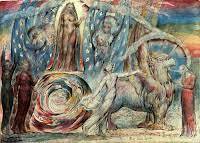
source
The tragic decision to let child move toward the frail and unholy path towards death pervades the soul of D with immense guilt and shame, the quantum of guilt is so overwhelming that his brain gives up to cope with it. The composer D cuts his ties with normalcy, and therefore this world, and transcends to another world wherein some domineering and mythic being takes hold of his life. The entire existence of D becomes suspended between reality and imagination wherein the narrator finds it hard to ascertain the veracity of the claims raised by D. The story revolves around the guilt comes to light because of the responsibility of man as a parent towards raising a mentally disabled child and the parent takes solace in the comforting though agitated existence of hallucination or supernatural as he could not handle the probing questions this guilt and remorse raise in the real world.
If it is being observed objectively, then we may realize that though it is known and understood that we have to move on in life over the grief and guilt, however, we find it difficult to nudge ourselves over the loss of someone we love (and more so if we are the reason of the loss) as if our own beings get stuck at that moment itself and gets suspended there in space-time continuum. And why should we move on? Why not let death sink us into it? It reminds me of The Body Artist by Don DeLillo and Everything Passes by Gabriel Josivopoci as both books portray our grieving mechanism as to how we deal with grief, loss and guilt.
The story questions the very nature of reality in a sense that do we have capacity and capability to differentiate reality from imagination or hallucination? Is it as we conceive it, it befalls upon us or something else, something else? Is it so that reality becomes too powerful for us to handle? What we absorb as real, does it really happen in the fabric of space-time at that instant or are we concocting it out of thin air. This essentially means that our version of reality depends upon our perception which is limited by our ability to discern things, Jean-Paul Sartre mentioned that We have to deal with human reality as a being which is what it is not, and which is not what it is. We know that the way we have moved from classical thought to modernism, then to post-modernism, made us truthful to the vagaries and ambiguities of human existence which gives some rays of hope, as we learned to look beyond the illusion of creating something solid and perpetual and to move towards the human condition, even though it means to create something illogical or silly. But that seemingly illogical or silly existence we carve out in our fantasy and imagination acts as a grief dealing mechanism and gradually becomes our reality.

source
The story offers a powerful and critical portrayal of complex relationship between a parent and a mentally challenged child amidst societal pressure through the blend of realism with surrealism, though the story remains silent on the right of that child to exist and his existence is depicted here passively through the lens of his father. It explores the concept of coming to terms with birth of a mentally challenged child and facing the challenges of raising the one.
The story also touches upon the inability of our language to communicate which forces us to find a way to express our grief by devising an alternate reality by obliterating the very premise of loss. It challenges us over our past choices as they keep on haunting us by rising time and again from the dark recesses of memory and tormenting our present and thereby driving us mad due to the rumination over the choices which may appear poor in the aftermath. It therefore confronts our very notion of ‘free will’. The generally accepted idea of gratitude is examined in the story as men often show regard towards life after paying a dear price. The author ends the story on tantalizing note by infusing the elements of surrealism and fantasy in reality, forcing you to think whether D creates the fantastical being out of his consciousness or the being is part of a continuum of consciousness.
The next fascinating issue which raises its head out of obscurity of human emotions and looks into your eyes is grief. How do we deal with grief? Often, we find ourselves struggling with a critical and generally heart-wrenching dilemma of finding solace through grief, it is broadly accepted that there is no right way to experience and accept bereavement, for different people react differently to it. But is it difficult to deal with guilt and grief that we often forget the very idea of reality? The sense of guilt frequently fuels us with the feeling of remorse but at times the weight of guilt could be so overwhelming in our soul that we lose the sense of reality and imagination. The human brain generally works in a pattern, by and large we may say we proceed from accepting the act to going through irrefutable guilt and thereby to the resolution of grief arisen out of it. However, on some occasions, human brain struggles to resolve the grief, and it affects our psyche in unforeseeable ways, so much so that the thin line which divides reality and hallucination gets blurred and it also sends a razor-sharp reminder about the fragility of human mind.
Mental health has been one of those gloomy and contradictory facets of humanity that are ordinarily kept under the carpet as if they may reveal the darkest secrets of human psychology. It is usually seen that mental health has been a stigma irrespective of any society we may take, even so-called progressive societies fail to do their due course here though we have made significant progress in this regard over the last few centuries. Traditionally, it has been observed that problems related to mental health often find themselves colliding with the stubborn walls of culture, customs, stigma and dogma, and annihilates into nothingness. In the story, the father, D, succumbs to traditional Japanese pressures and prejudices against raising a mentally disabled child so that the existence of his child becomes a burden. The story presents a bleak view of what D’s life gets reduced to because of the tragic decision he takes about his child, through eyes of the narrator who is hired by the father of D to look after on his aimless wanderings through Tokyo.
source
The tragic decision to let child move toward the frail and unholy path towards death pervades the soul of D with immense guilt and shame, the quantum of guilt is so overwhelming that his brain gives up to cope with it. The composer D cuts his ties with normalcy, and therefore this world, and transcends to another world wherein some domineering and mythic being takes hold of his life. The entire existence of D becomes suspended between reality and imagination wherein the narrator finds it hard to ascertain the veracity of the claims raised by D. The story revolves around the guilt comes to light because of the responsibility of man as a parent towards raising a mentally disabled child and the parent takes solace in the comforting though agitated existence of hallucination or supernatural as he could not handle the probing questions this guilt and remorse raise in the real world.
If it is being observed objectively, then we may realize that though it is known and understood that we have to move on in life over the grief and guilt, however, we find it difficult to nudge ourselves over the loss of someone we love (and more so if we are the reason of the loss) as if our own beings get stuck at that moment itself and gets suspended there in space-time continuum. And why should we move on? Why not let death sink us into it? It reminds me of The Body Artist by Don DeLillo and Everything Passes by Gabriel Josivopoci as both books portray our grieving mechanism as to how we deal with grief, loss and guilt.
The story questions the very nature of reality in a sense that do we have capacity and capability to differentiate reality from imagination or hallucination? Is it as we conceive it, it befalls upon us or something else, something else? Is it so that reality becomes too powerful for us to handle? What we absorb as real, does it really happen in the fabric of space-time at that instant or are we concocting it out of thin air. This essentially means that our version of reality depends upon our perception which is limited by our ability to discern things, Jean-Paul Sartre mentioned that We have to deal with human reality as a being which is what it is not, and which is not what it is. We know that the way we have moved from classical thought to modernism, then to post-modernism, made us truthful to the vagaries and ambiguities of human existence which gives some rays of hope, as we learned to look beyond the illusion of creating something solid and perpetual and to move towards the human condition, even though it means to create something illogical or silly. But that seemingly illogical or silly existence we carve out in our fantasy and imagination acts as a grief dealing mechanism and gradually becomes our reality.
source
The story offers a powerful and critical portrayal of complex relationship between a parent and a mentally challenged child amidst societal pressure through the blend of realism with surrealism, though the story remains silent on the right of that child to exist and his existence is depicted here passively through the lens of his father. It explores the concept of coming to terms with birth of a mentally challenged child and facing the challenges of raising the one.
The story also touches upon the inability of our language to communicate which forces us to find a way to express our grief by devising an alternate reality by obliterating the very premise of loss. It challenges us over our past choices as they keep on haunting us by rising time and again from the dark recesses of memory and tormenting our present and thereby driving us mad due to the rumination over the choices which may appear poor in the aftermath. It therefore confronts our very notion of ‘free will’. The generally accepted idea of gratitude is examined in the story as men often show regard towards life after paying a dear price. The author ends the story on tantalizing note by infusing the elements of surrealism and fantasy in reality, forcing you to think whether D creates the fantastical being out of his consciousness or the being is part of a continuum of consciousness.

August 30, 2025
5★
"As for the overall impression, there was something canine about the man. He wore flannel trousers and a sweater with stripes like fleas. His shoulders were a little stooped, his arms outlandishly long."
The man described above was once the narrator's employer. The narrator wears a patch over one eye, the reason for which he explains at the end of his short story.
When he was eighteen, just a poor student needing a job, his uncle introduced him to a banker who was looking for a companion for his twenty-eight-year-old son, a composer.
Why?
The banker asked our narrator if he'd seen the film "Harvey", in which James Stewart's character insists that a six-foot tall white rabbit follows him everywhere. The narrator smiled, remembering how much he'd enjoyed the comedy (as did I, many years ago), but the banker didn't smile. Instead, he said his son's delusions are that he is living with a monster.
Intriguing? Yes, and to a young fellow needing a job, this sounds like pretty easy money. But the composer isn't quite what he expected.
"I remember feeling vaguely troubled by the idea of an adult nearly thirty years old (in fact, the composer was twenty-‐eight when he hired me, my present age), working out a theme for the harmonica, I suppose because my own harmonica had become my little brother's property when I had entered elementary school."
But off they went, walking through the city, the composer often looking up in the air or behind himself. It was a little disconcerting, as was his general behaviour in public.
"One thing I did notice: the composer ignored the people who passed us on the street even when they greeted him. As if he himself did not exist, as if the people who approached with hellos and how-‐are-‐yous were registering an illusion which they mistook for him, my employer utterly ignored all overtures to contact."
Strange indeed, and after they returned home, the nurse was just leaving the house and reluctantly revealed a bit.
" 'He says a fat baby in a white cotton nightgown. Big as a kangaroo, he says. supposed to be afraid of dogs and policemen and it comes down out of the sky. He says its name is Aghwee! Let me tell you something. If you happen to be around when that spook gets hold of him, you'd better just play dumb, you can't afford to get involved. Don't forget, you're dealing with a looney! And another thing, don't you take him anyplace funny, even if he wants to go. On top of everything else, a little gonorrhea is all we need around here!' "
This began a little slowly, but once I actually met "D", as the composer is referred to, I really enjoyed it. It put an entirely new perspective on the composer's life and made me think of the many and varied cultural beliefs around the world.
This was written in 1972 and translated from the original Japanese. The author won the 1994 Nobel Prize for Literature, so obviously the rest of his work must be pretty impressive. I found this one quite special.
It's another from the Goodreads Short Story Club Group, which you can join here:
https://www.goodreads.com/group/show/...
You can download a pdf of this story free here. Incidentally It converted to an epub very nicely in spite of the pictures and insets.
http://www.sonic.net/~tabine/2019/SAA...
I hope you give it a try.
"As for the overall impression, there was something canine about the man. He wore flannel trousers and a sweater with stripes like fleas. His shoulders were a little stooped, his arms outlandishly long."
The man described above was once the narrator's employer. The narrator wears a patch over one eye, the reason for which he explains at the end of his short story.
When he was eighteen, just a poor student needing a job, his uncle introduced him to a banker who was looking for a companion for his twenty-eight-year-old son, a composer.
Why?
The banker asked our narrator if he'd seen the film "Harvey", in which James Stewart's character insists that a six-foot tall white rabbit follows him everywhere. The narrator smiled, remembering how much he'd enjoyed the comedy (as did I, many years ago), but the banker didn't smile. Instead, he said his son's delusions are that he is living with a monster.
Intriguing? Yes, and to a young fellow needing a job, this sounds like pretty easy money. But the composer isn't quite what he expected.
"I remember feeling vaguely troubled by the idea of an adult nearly thirty years old (in fact, the composer was twenty-‐eight when he hired me, my present age), working out a theme for the harmonica, I suppose because my own harmonica had become my little brother's property when I had entered elementary school."
But off they went, walking through the city, the composer often looking up in the air or behind himself. It was a little disconcerting, as was his general behaviour in public.
"One thing I did notice: the composer ignored the people who passed us on the street even when they greeted him. As if he himself did not exist, as if the people who approached with hellos and how-‐are-‐yous were registering an illusion which they mistook for him, my employer utterly ignored all overtures to contact."
Strange indeed, and after they returned home, the nurse was just leaving the house and reluctantly revealed a bit.
" 'He says a fat baby in a white cotton nightgown. Big as a kangaroo, he says. supposed to be afraid of dogs and policemen and it comes down out of the sky. He says its name is Aghwee! Let me tell you something. If you happen to be around when that spook gets hold of him, you'd better just play dumb, you can't afford to get involved. Don't forget, you're dealing with a looney! And another thing, don't you take him anyplace funny, even if he wants to go. On top of everything else, a little gonorrhea is all we need around here!' "
This began a little slowly, but once I actually met "D", as the composer is referred to, I really enjoyed it. It put an entirely new perspective on the composer's life and made me think of the many and varied cultural beliefs around the world.
This was written in 1972 and translated from the original Japanese. The author won the 1994 Nobel Prize for Literature, so obviously the rest of his work must be pretty impressive. I found this one quite special.
It's another from the Goodreads Short Story Club Group, which you can join here:
https://www.goodreads.com/group/show/...
You can download a pdf of this story free here. Incidentally It converted to an epub very nicely in spite of the pictures and insets.
http://www.sonic.net/~tabine/2019/SAA...
I hope you give it a try.

August 31, 2025
“Should I pretend to believe in ‘him,’ or would that be a mistake? Was I dealing with a raving madman, or was the composer just a poker-faced humorist trying to have some fun with me?”
How do you react to delusions, grief, and possible suicidal ideation in another person? This strange (and strangely-translated) Japanese story takes a tragi-comic route. It is partially inspired by the author’s own emotions at having a child who nearly died in infancy and who was subsequently a composer who was probably neurodivergent. Is it a blessing or a curse to see the ghost of the dear-departed?
It opens with a 28-year old narrator, recently nearly blinded in one eye:
“I see two worlds perfectly superimposed, a vague and shadowy world on top of one that's bright and vivid.”
He recalls his first job, ten years earlier, when “time shifted” for him. A wealthy businessman hired him as the companion of his son, a 28-year old composer who was having a breakdown, triggered by the death of his infant son and subsequent divorce.
In particular, D (the composer), often sees “a fat baby in a white cotton nightgown. Big as a kangaroo” called Aghwee, which was the only thing his child said before “it” died. The companion is uncomfortable when D sees and interacts with Aghwee, but otherwise enjoys his role, though it involves a few strange outings and acting as go-between for D with his ex-wife and his estranged mistress.
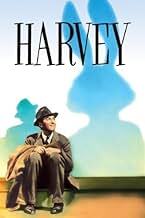
Image: The father likens his son’s condition to the film, Harvey, where James Stewart sees a giant rabbit (Source)
It ends with how he came to be hit in the eye with a stone, and why that has made him reinterpret his memories of D and Aghwee.
Time
We all have moments when it felt as if the world stopped, we know exactly where we were and what we were doing, and nothing was the same thereafter, whether the sudden death of a loved-one or the collapse of the Twin Towers. D says:
“‘I'm not living in present time anymore, at least not consciously. Do you know the rule that governs trips into the past in a time machine? For example, a man who travels back ten thousand years in time doesn't dare do anything in that world that might remain behind him. Because he doesn't exist in time ten thousand years ago and if he left anything behind him there the result would be a warp, infinitely slight maybe but still a warp, in all of history from then until now, ten thousand years of it. That's the way the rule goes, and since I'm not living in present time, I mustn't do anything here in this world that might remain or leave an imprint.’”
That last sentence is a powerful metaphor for grief, but is muddied by time travel and the grandfather paradox.
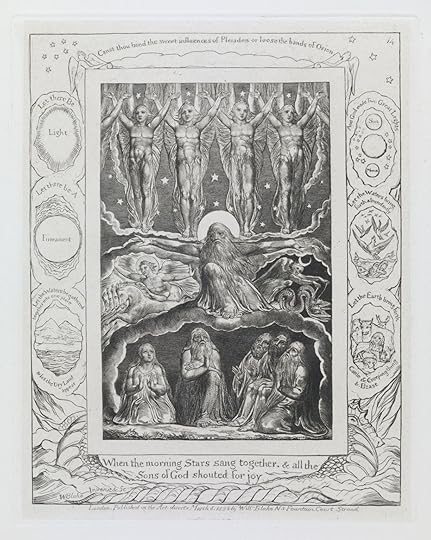
Image: William Blake’s etching, ‘When the Morning Starts Sang Together’, mentioned in the story (Source)
What’s not to like?
Deep trauma can be explored with a light touch, but this felt unpleasant from the off: mean and trivialising. But there were glimpses of tenderness and empathy, and the transcendent understanding at the end rescued it for me.
Nevertheless, it’s peppered with demeaning descriptions of women: they’re unnamed, but described by their relationship to a man, and either ugly (the ex-wife has pyorrhea and is “pudgy, tomato-faced… [and] too round and overweight to achieve dignity”) or over-sexualised (the ex-mistress plies the 18-year old with strong drink and asks about heavy petting). However, that’s very like Haruki Murakami, and I tend to forgive him. See “Murakami’s portrayal of women” in my review of Kafka on the Shore, HERE.
Quotes
• “The dark and snowy pattern of the sky ripped open and the stately light of a Spanish pieta made my employer's blood glisten like silly fat.”
• Aghwee’s name is described as “mushy” four times.
• “When I was in high school I had played flute. I never learned to play well but I did develop a habit of thrusting out my upper lip the way a tapir does.”
Short story club
I read this in Black Water 2: More Tales of the Fantastic, by Alberto Manguel, from which I’m reading one story a week with The Short Story Club, starting 24 March 2025.
You can read this story HERE.
You can join the group here.
How do you react to delusions, grief, and possible suicidal ideation in another person? This strange (and strangely-translated) Japanese story takes a tragi-comic route. It is partially inspired by the author’s own emotions at having a child who nearly died in infancy and who was subsequently a composer who was probably neurodivergent. Is it a blessing or a curse to see the ghost of the dear-departed?
It opens with a 28-year old narrator, recently nearly blinded in one eye:
“I see two worlds perfectly superimposed, a vague and shadowy world on top of one that's bright and vivid.”
He recalls his first job, ten years earlier, when “time shifted” for him. A wealthy businessman hired him as the companion of his son, a 28-year old composer who was having a breakdown, triggered by the death of his infant son and subsequent divorce.
In particular, D (the composer), often sees “a fat baby in a white cotton nightgown. Big as a kangaroo” called Aghwee, which was the only thing his child said before “it” died. The companion is uncomfortable when D sees and interacts with Aghwee, but otherwise enjoys his role, though it involves a few strange outings and acting as go-between for D with his ex-wife and his estranged mistress.
Image: The father likens his son’s condition to the film, Harvey, where James Stewart sees a giant rabbit (Source)
It ends with how he came to be hit in the eye with a stone, and why that has made him reinterpret his memories of D and Aghwee.
Time
We all have moments when it felt as if the world stopped, we know exactly where we were and what we were doing, and nothing was the same thereafter, whether the sudden death of a loved-one or the collapse of the Twin Towers. D says:
“‘I'm not living in present time anymore, at least not consciously. Do you know the rule that governs trips into the past in a time machine? For example, a man who travels back ten thousand years in time doesn't dare do anything in that world that might remain behind him. Because he doesn't exist in time ten thousand years ago and if he left anything behind him there the result would be a warp, infinitely slight maybe but still a warp, in all of history from then until now, ten thousand years of it. That's the way the rule goes, and since I'm not living in present time, I mustn't do anything here in this world that might remain or leave an imprint.’”
That last sentence is a powerful metaphor for grief, but is muddied by time travel and the grandfather paradox.
Image: William Blake’s etching, ‘When the Morning Starts Sang Together’, mentioned in the story (Source)
What’s not to like?
Deep trauma can be explored with a light touch, but this felt unpleasant from the off: mean and trivialising. But there were glimpses of tenderness and empathy, and the transcendent understanding at the end rescued it for me.
Nevertheless, it’s peppered with demeaning descriptions of women: they’re unnamed, but described by their relationship to a man, and either ugly (the ex-wife has pyorrhea and is “pudgy, tomato-faced… [and] too round and overweight to achieve dignity”) or over-sexualised (the ex-mistress plies the 18-year old with strong drink and asks about heavy petting). However, that’s very like Haruki Murakami, and I tend to forgive him. See “Murakami’s portrayal of women” in my review of Kafka on the Shore, HERE.
Quotes
• “The dark and snowy pattern of the sky ripped open and the stately light of a Spanish pieta made my employer's blood glisten like silly fat.”
• Aghwee’s name is described as “mushy” four times.
• “When I was in high school I had played flute. I never learned to play well but I did develop a habit of thrusting out my upper lip the way a tapir does.”
Short story club
I read this in Black Water 2: More Tales of the Fantastic, by Alberto Manguel, from which I’m reading one story a week with The Short Story Club, starting 24 March 2025.
You can read this story HERE.
You can join the group here.

December 3, 2025
The Short story Club
A strange and poignant story exploring the overwhelming feeling of guilt that becomes a driving force in a person's life. To ease the pain he has to live in a partly imaginary world he he has created for himself. It is also a story about how deeply other people's lives can influence us and make us grow.
A strange and poignant story exploring the overwhelming feeling of guilt that becomes a driving force in a person's life. To ease the pain he has to live in a partly imaginary world he he has created for himself. It is also a story about how deeply other people's lives can influence us and make us grow.

September 19, 2025
A strange novella or short story about the externalization of trauma — or is it?
The narrator is not particularly likeable; in fact his behaviour and judgements are actually sometimes objectionable.
I found it hard to work my way into the world of this text, and had to force my way through — thus the low rating.
The narrator is not particularly likeable; in fact his behaviour and judgements are actually sometimes objectionable.
I found it hard to work my way into the world of this text, and had to force my way through — thus the low rating.
September 3, 2025
I think this story suffered in translation. A worthwhile idea told within an otherwise forgettable somewhat disjointed story, but of great significance to the author wrt his personal experience.

October 6, 2019
Esta obra es la primera que leo de Kenzaburo. Magnifica historia, me llevo una sensacion agradable y seguro buscaré más de este autor.

April 24, 2020
A beautiful story of a disturbed man. The point of view of a young 18-year old makes it even more disturbing as through him the reader makes the journey of discovery and understanding.
December 31, 2025
The title reminds me of Brautigan - the third part of the triumvirate of writers who spoke to me so compellingly of masculinity in my university years
Grief; loss; futility of purpose; and yet he finds stillness. Peace.
It’s heart wrenching when the source of the imaginary friend, of the ghost is made and it grows from there
Shame is such a feature of his work and it’s something I find real solace in that he both understands and experiences shame and has the courage to share it
“Do you know a poem called shame by Chua Nakahara? Listen to the second verse:
the mournful sky
high branches tangle
Teems with dead baby souls;
I blinked and saw
above the distant fields
fleece knit into a dream
of mastodons”.
The ending is perfect - the emotion and futility of life. It reveals a cleverly literary misdirection -that the opening paragraphs of the Novela were not the story: not literally. His eye injury was completely unimportant but there was something in there about the metaphor of seeing the world differently and closing one eye so that he didn’t have to confront it which does resonate at the end.
“With my good eye I watched my dripping blood draw in the dirt in the street as though magnetically. It was then that I sensed a being I knew and missed leave the ground behind me like a kangaroo and soar into the teary blue of the sky that retained its winter brittleness. Goodbye Agu I heard myself whispering in my heart. And then I knew that my hatred of those frightened children had melted away and that time had filled my sky during those 10 years with figures that glowed with an ivory white light. I suppose not all of them were purely innocent. When I was wounded by those children and sacrificed my sight in one eye, so clearly a gratuitous sacrifice, I had been endowed if only an instant with the power to perceive a creature that had descended from the height of my sky”
Grief; loss; futility of purpose; and yet he finds stillness. Peace.
It’s heart wrenching when the source of the imaginary friend, of the ghost is made and it grows from there
Shame is such a feature of his work and it’s something I find real solace in that he both understands and experiences shame and has the courage to share it
“Do you know a poem called shame by Chua Nakahara? Listen to the second verse:
the mournful sky
high branches tangle
Teems with dead baby souls;
I blinked and saw
above the distant fields
fleece knit into a dream
of mastodons”.
The ending is perfect - the emotion and futility of life. It reveals a cleverly literary misdirection -that the opening paragraphs of the Novela were not the story: not literally. His eye injury was completely unimportant but there was something in there about the metaphor of seeing the world differently and closing one eye so that he didn’t have to confront it which does resonate at the end.
“With my good eye I watched my dripping blood draw in the dirt in the street as though magnetically. It was then that I sensed a being I knew and missed leave the ground behind me like a kangaroo and soar into the teary blue of the sky that retained its winter brittleness. Goodbye Agu I heard myself whispering in my heart. And then I knew that my hatred of those frightened children had melted away and that time had filled my sky during those 10 years with figures that glowed with an ivory white light. I suppose not all of them were purely innocent. When I was wounded by those children and sacrificed my sight in one eye, so clearly a gratuitous sacrifice, I had been endowed if only an instant with the power to perceive a creature that had descended from the height of my sky”

August 28, 2025
Death, grief, remorse, blame, impotence, anger, visions, myth-making, danger, self-annihilation, passion, compassion.
All in a mere 27 pages!
What a powerful long short-story this was. I've spent the last several days being haunted by it.
In the story, the narrator is a young man, 28 years old, telling a series of events when he was 18, hired to be a companion to an up-and-coming Japanese composer. His job is to once a week accompany the composer. "D," on walks around Tokyo, visiting sites as per D's pleasure. There had been a scandal involving D after the death of his first born child from which he has not emotionally recovered. Indeed, he has begun having hallucinations of the dead child, even having conversations. Ten years later, the narrator is recounting his experience with D, culminating in a shocking death.
Author Kenzaburō Ōe had a son born with a brain hernia, and like the character D, the doctors suggested to Ōe and his wife that they let the child die. Instead, they opted for surgery. Their son, Hikari Ōe, has grown up to be a chamber music composer of some fame but remains severely autistic, mostly mute. Author Ōe was awarded the Nobel prize in no small part in honor of his novel A Personal Matter which has the similar theme of a child born with extreme health challenges.
Another interesting parallel between this story and Ōe's real life is that he wrote this story when his son was only 6 months old who ultimately also became a composer like the protagonist in the story, mastering not spoken language but musical language. How oddly coincidental.
I am certain that there must be some losses in translation from not only the Japanese language but from the Japanese culture to an English-reading Westerner. Yet, it still shone and burned into my mind. It is direct in tone, feeling even somewhat flat, one could be easily deceived by that directness.
Its wow is the subtlety in which it covers the vast ground of the human condition.
Read with The Short Story Club group. You can join here: https://www.goodreads.com/group/show/...
All in a mere 27 pages!
What a powerful long short-story this was. I've spent the last several days being haunted by it.
In the story, the narrator is a young man, 28 years old, telling a series of events when he was 18, hired to be a companion to an up-and-coming Japanese composer. His job is to once a week accompany the composer. "D," on walks around Tokyo, visiting sites as per D's pleasure. There had been a scandal involving D after the death of his first born child from which he has not emotionally recovered. Indeed, he has begun having hallucinations of the dead child, even having conversations. Ten years later, the narrator is recounting his experience with D, culminating in a shocking death.
Author Kenzaburō Ōe had a son born with a brain hernia, and like the character D, the doctors suggested to Ōe and his wife that they let the child die. Instead, they opted for surgery. Their son, Hikari Ōe, has grown up to be a chamber music composer of some fame but remains severely autistic, mostly mute. Author Ōe was awarded the Nobel prize in no small part in honor of his novel A Personal Matter which has the similar theme of a child born with extreme health challenges.
Another interesting parallel between this story and Ōe's real life is that he wrote this story when his son was only 6 months old who ultimately also became a composer like the protagonist in the story, mastering not spoken language but musical language. How oddly coincidental.
I am certain that there must be some losses in translation from not only the Japanese language but from the Japanese culture to an English-reading Westerner. Yet, it still shone and burned into my mind. It is direct in tone, feeling even somewhat flat, one could be easily deceived by that directness.
Its wow is the subtlety in which it covers the vast ground of the human condition.
Read with The Short Story Club group. You can join here: https://www.goodreads.com/group/show/...

November 18, 2025
I really didn’t like the first story about the search for the escaped mental hospital patients, and I ended up putting off reading the rest for a couple months. I’m really glad I picked this back up cause every story other than that one and the Portuguese one were excellent. I wasn’t expecting any comedy out of these, but the story with the college kids lying to a dying man about the world being a utopia now was absolutely hilarious throughout. I enjoyed the cult photographer story and how outlandish the events are. I had read Aghee previously in English so it was cool to re-read as I love that story.

February 28, 2021
Dositej
Beograd, 1989.
Preveo Dejan Razić
Jezično govoreći tekst je relativno jednostavan, no gradi kvalitetne scene te prikazuje ok unutarnje monologe.
Autodijegetički pripovjedač.
Sadržajno govoreći ovo je jedna od boljih stvari koje u zadnje vrijeme pročitah.ž
Dylandogovski, psihološka fantastika.
Užasno dobra karakterizacija likova.
Odličan kraj.
Pročitajte ovo!
¡Hasta luego mis murcielagos!
Beograd, 1989.
Preveo Dejan Razić
Jezično govoreći tekst je relativno jednostavan, no gradi kvalitetne scene te prikazuje ok unutarnje monologe.
Autodijegetički pripovjedač.
Sadržajno govoreći ovo je jedna od boljih stvari koje u zadnje vrijeme pročitah.ž
Dylandogovski, psihološka fantastika.
Užasno dobra karakterizacija likova.
Odličan kraj.
Pročitajte ovo!
¡Hasta luego mis murcielagos!

December 27, 2025
My first Oe, and the surreal, absurdist nature of the story reminds me more than a little of Murakami. Here Oe probes some consequential themes of loss and grief, along with faith and belief, and although I can't say I entirely understand what is going on in the story, I intend to read more Oe in the future.
++++++++++++++++++++++
Read for my GR short story group
++++++++++++++++++++++
Read for my GR short story group

March 29, 2026
i really loved this book of Raymond Carver influenced short stories from a great Japanese writer.

August 24, 2025
In the end, this one was middle of the road (which can be a bad place to be).


July 13, 2011
შესანიშნავი მოთხრობები იყო. განსაკუთრებით ბოლო ორი მომეწონა.

August 18, 2016
პირველი ორის წაკითხვა ღირს, დანარჩენი - მეჰ
Displaying 1 - 18 of 18 reviews