

What do you think?
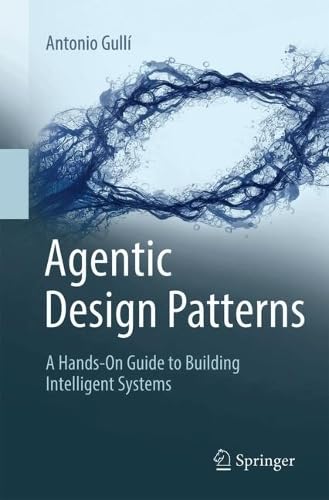
Agentic Design Patterns: A Hands-On Guide to Building Intelligent Systems
This book is a practical resource designed to help developers master the art of building sophisticated AI agents. As artificial intelligence evolves from simple reactive programs to autonomous entities capable of understanding context and making complex decisions, this book provides the essential Design Patterns and proven techniques needed to construct intelligent systems effectively. Each of the 21 Design Patterns represents a fundamental building block for creating agents that can perceive their environment, make informed decisions, and execute actions autonomously.
Agentic Design A Hands-On Guide to Building Intelligent Systems is structured as a comprehensive hands-on guide, with each chapter dedicated to a single agentic pattern. Within each chapter, you will find a detailed pattern overview, practical applications and use cases, one or more hands-on code example, and key takeaways for quick review. From foundational concepts such as Prompt Chaining and Tool Use to advanced topics like Multi-Agent Collaboration and Self-Correction, readers will gain practical knowledge they can immediately apply. While the chapters build on each other, you can also use the book as a handy reference, jumping to patterns that address your specific challenges.
To provide a tangible "canvas" for the code examples, this guide utilizes three prominent agent development LangChain and its extension LangGraph, which offer a flexible way to build complex operational sequences; Crew AI, which provides a structured framework for orchestrating multiple agents; and the Google Agent Developer Kit (Google ADK), which offers tools for building, evaluating, and deploying agents. By showcasing examples across these tools, you will gain a broad understanding of how these patterns can be applied in any technical environment.
Building effective agentic systems requires more than just a powerful language model; it demands structure and design. Agentic patterns provide reusable, battle-tested solutions to common challenges, much like design patterns in software engineering. They offer a common language that makes an agent's logic clearer, more maintainable, and more robust. By the end of this journey, you will possess both the theoretical understanding and the practical skills to implement these 21 essential patterns, enabling you to build more intelligent, capable, and autonomous systems on your chosen development canvas.
Agentic Design A Hands-On Guide to Building Intelligent Systems is structured as a comprehensive hands-on guide, with each chapter dedicated to a single agentic pattern. Within each chapter, you will find a detailed pattern overview, practical applications and use cases, one or more hands-on code example, and key takeaways for quick review. From foundational concepts such as Prompt Chaining and Tool Use to advanced topics like Multi-Agent Collaboration and Self-Correction, readers will gain practical knowledge they can immediately apply. While the chapters build on each other, you can also use the book as a handy reference, jumping to patterns that address your specific challenges.
To provide a tangible "canvas" for the code examples, this guide utilizes three prominent agent development LangChain and its extension LangGraph, which offer a flexible way to build complex operational sequences; Crew AI, which provides a structured framework for orchestrating multiple agents; and the Google Agent Developer Kit (Google ADK), which offers tools for building, evaluating, and deploying agents. By showcasing examples across these tools, you will gain a broad understanding of how these patterns can be applied in any technical environment.
Building effective agentic systems requires more than just a powerful language model; it demands structure and design. Agentic patterns provide reusable, battle-tested solutions to common challenges, much like design patterns in software engineering. They offer a common language that makes an agent's logic clearer, more maintainable, and more robust. By the end of this journey, you will possess both the theoretical understanding and the practical skills to implement these 21 essential patterns, enabling you to build more intelligent, capable, and autonomous systems on your chosen development canvas.
470 pages, Paperback
Published October 31, 2025
Ratings & Reviews
Friends & Following
Create a free account to discover what your friends think of this book!
Community Reviews
Displaying 1 - 10 of 10 reviews

February 9, 2026
I picked this up in early 2026 as someone working in the field, and it already felt dated. The core problem isn’t the content itself — the topics covered are relevant and the landscape of agentic design patterns is mapped out reasonably well. The problem is everything around it.
The repetition is maddening. Every concept is explained in the chapter intro, elaborated in the body, restated in the conclusion, and then again in a “key takeaways” section and an “at a glance” section, AND a visual summary. You really do not need all of these. Take Chapter 3 (Parallelization): the intro tells you “parallel execution allows independent tasks to run at the same time, significantly reducing the overall execution time.” The At a Glance section restates: “By running these independent tasks at the same time rather than one after another, this pattern drastically reduces the total execution time.” The Key Takeaways repeat: “Parallelization is a pattern for executing independent tasks concurrently to improve efficiency.” And the Conclusion closes with: “The parallelization pattern is a method for optimizing computational workflows by concurrently executing independent sub-tasks.” That is the same sentence four times. It reads like a high schooler who didn’t get the memo that you choose either a collection of theses or a conclusion — you don’t do both, let alone four variations. Maybe the author figured that in the age of LLMs degrading everyone’s attention span to goldfish levels, the only way to get a point across is brute repetition. The book could be a quarter of its length and lose nothing.
And substance is already in short supply. This is a lookup table of design patterns — here are things you can do — with zero guidance on when or why to choose one over another. The routing chapter lays out four implementation strategies (LLM-based, embedding-based, rule-based, and ML classifier-based) but never discusses the trade-offs between them in a real system. When is embedding similarity worth it over a simple rule? At what scale does a trained classifier pay off? You won’t find out here. And some of it is just insulting — I don’t think you need to tell a software engineer to use parallel workflows when the task can be parallelized. The visualizations are equally useless; they don’t show enough architectural detail to actually inform a design decision. This book offers zero actionable architectural advice.
The tone is baffling. Most of it reads like it was written for someone who has never touched a codebase — and then Chapter 9 casually drops PPO’s clipping mechanism and DPO’s preference optimization as though reinforcement learning from human feedback is just another simple building block. It breezes through both in a few paragraphs without ever mentioning the computational costs of RLHF, the difficulty of collecting quality preference data, or the many ways these processes blow up in practice. It’s a worthwhile topic to include in a book like this, but not sandwiched in as just another easy pattern alongside prompt chaining and routing.
So who is this actually for? It’s way too shallow for a software engineer, let alone an ML/AI engineer. Is the target audience the CEO who wants a taste of how agentic systems work without any of the depth? Because for developers, this book offers extremely little. If you’re an engineer, just read the chapter titles — those are the important components of any agentic system. If you don’t know what MCP or A2A is, skim one of the three textual summaries. Don’t bother with the diagrams.
When I started reading, I asked myself “was this written by GPT-4?” By the end of the book I’d revised that estimate downward — this reads more like GPT-3.5 or a small open-source model. The relentless verbosity, the mechanical structure, the way every chapter restates itself four times in slightly different words. Not really worth anyone’s time.
The repetition is maddening. Every concept is explained in the chapter intro, elaborated in the body, restated in the conclusion, and then again in a “key takeaways” section and an “at a glance” section, AND a visual summary. You really do not need all of these. Take Chapter 3 (Parallelization): the intro tells you “parallel execution allows independent tasks to run at the same time, significantly reducing the overall execution time.” The At a Glance section restates: “By running these independent tasks at the same time rather than one after another, this pattern drastically reduces the total execution time.” The Key Takeaways repeat: “Parallelization is a pattern for executing independent tasks concurrently to improve efficiency.” And the Conclusion closes with: “The parallelization pattern is a method for optimizing computational workflows by concurrently executing independent sub-tasks.” That is the same sentence four times. It reads like a high schooler who didn’t get the memo that you choose either a collection of theses or a conclusion — you don’t do both, let alone four variations. Maybe the author figured that in the age of LLMs degrading everyone’s attention span to goldfish levels, the only way to get a point across is brute repetition. The book could be a quarter of its length and lose nothing.
And substance is already in short supply. This is a lookup table of design patterns — here are things you can do — with zero guidance on when or why to choose one over another. The routing chapter lays out four implementation strategies (LLM-based, embedding-based, rule-based, and ML classifier-based) but never discusses the trade-offs between them in a real system. When is embedding similarity worth it over a simple rule? At what scale does a trained classifier pay off? You won’t find out here. And some of it is just insulting — I don’t think you need to tell a software engineer to use parallel workflows when the task can be parallelized. The visualizations are equally useless; they don’t show enough architectural detail to actually inform a design decision. This book offers zero actionable architectural advice.
The tone is baffling. Most of it reads like it was written for someone who has never touched a codebase — and then Chapter 9 casually drops PPO’s clipping mechanism and DPO’s preference optimization as though reinforcement learning from human feedback is just another simple building block. It breezes through both in a few paragraphs without ever mentioning the computational costs of RLHF, the difficulty of collecting quality preference data, or the many ways these processes blow up in practice. It’s a worthwhile topic to include in a book like this, but not sandwiched in as just another easy pattern alongside prompt chaining and routing.
So who is this actually for? It’s way too shallow for a software engineer, let alone an ML/AI engineer. Is the target audience the CEO who wants a taste of how agentic systems work without any of the depth? Because for developers, this book offers extremely little. If you’re an engineer, just read the chapter titles — those are the important components of any agentic system. If you don’t know what MCP or A2A is, skim one of the three textual summaries. Don’t bother with the diagrams.
When I started reading, I asked myself “was this written by GPT-4?” By the end of the book I’d revised that estimate downward — this reads more like GPT-3.5 or a small open-source model. The relentless verbosity, the mechanical structure, the way every chapter restates itself four times in slightly different words. Not really worth anyone’s time.

October 28, 2025
This is not life changing book and big chunk of the patterns are quite obvious. But it's nice to have them summarized in one place. It's a modern toolbox that needs to be studied and internalized.
The book follows the style Springer books: short, dry and to the point. If you skip all code examples (which are pretty simple and easy to understand), the book reads like a long blog post, and can be finished in 1-2 sittings.
Disclaimer: this is the first book I've read on designing agents. So I might update my review after reading more book in this topic.
The book follows the style Springer books: short, dry and to the point. If you skip all code examples (which are pretty simple and easy to understand), the book reads like a long blog post, and can be finished in 1-2 sittings.
Disclaimer: this is the first book I've read on designing agents. So I might update my review after reading more book in this topic.
April 12, 2026
I bought this book thinking it was going to be like the GoF (the Software Engineering classic about design patterns)
It is not.
It is not only the suspicious use of the word delve. Multiple times.
It is not only the lack of editorial review, with jumps in font size in the middle of code listing, paragraphs that are clearly joined or as in page 339, a print with clearly wrong identation.
It is not a third section that even if it is midly interesting, it is not about Agentic design patterns.
It is lack of substance. The listing of characteristics with a bullet points and headings and what not but nothing really meaty. The repetition of patterns that are really similar but in theory are not the same but there is no mention to the other pattern.
The nothing-content. You can see I'm angry. Both about the money. But also about the time lost.
I don't really care if this was AI "assisted" (clearly it was) or not. I've seen "copy-pasted content" before AI.
Agentic development is probably on its early days. But to me this is not the definitive book.
It is not.
It is not only the suspicious use of the word delve. Multiple times.
It is not only the lack of editorial review, with jumps in font size in the middle of code listing, paragraphs that are clearly joined or as in page 339, a print with clearly wrong identation.
It is not a third section that even if it is midly interesting, it is not about Agentic design patterns.
It is lack of substance. The listing of characteristics with a bullet points and headings and what not but nothing really meaty. The repetition of patterns that are really similar but in theory are not the same but there is no mention to the other pattern.
The nothing-content. You can see I'm angry. Both about the money. But also about the time lost.
I don't really care if this was AI "assisted" (clearly it was) or not. I've seen "copy-pasted content" before AI.
Agentic development is probably on its early days. But to me this is not the definitive book.

April 4, 2026
Patterns themselves are ok. But not the way the book is compiled. Too much of unnecessary repeating of the same idea every chapter. Plain monochromic code listings wout pure tabulation is a shame. Interesting fact that the most easy to read chapter was the one with explanations of reasoning behind the scenes of major LLM models provided by those models - clean and crisp.
Make it 100-150 pages long handbook and that’s would be a good one for beginning of 2026.
Make it 100-150 pages long handbook and that’s would be a good one for beginning of 2026.

September 15, 2026
Good content but superficial
. This book is an introductory book, great for those that want to jump in to all these topics.
I read the AI Engineering book and it set the bar super high. I expected this book to be similar in depth but it isn’t.
I’m not saying it is a bad book, only saying that I expected a more profound analysis and perspective.
Strongly recommended if you are new in all these topics.
. This book is an introductory book, great for those that want to jump in to all these topics.
I read the AI Engineering book and it set the bar super high. I expected this book to be similar in depth but it isn’t.
I’m not saying it is a bad book, only saying that I expected a more profound analysis and perspective.
Strongly recommended if you are new in all these topics.
August 7, 2026
It could have been written in a single blog post to be honest. It is too verbose for its purpose. This is not an engineering book of design patterns. To design a successful agentic system, what you really need is the domain expert who can translate their strategy to agentic workflows, not “design patterns”, frameworks or pages of code.
Read
April 20, 2026Amazing book, very practical and hands on.
April 20, 2026
Great reference! Still relevant (for now)
June 8, 2026
All what you need for Agentic AI
Eager to delve into the realm of Agentic AI?
21+ chapters of focused insight, covering every facet you'd encounter within Agentic AI.
Eager to delve into the realm of Agentic AI?
21+ chapters of focused insight, covering every facet you'd encounter within Agentic AI.
April 29, 2026
A good book that provides the broad strokes of the the current state of the system with some insightful snippets.
You can read my cliffsnotes https://blog.danwald.me/agentic-desig...
You can read my cliffsnotes https://blog.danwald.me/agentic-desig...
Displaying 1 - 10 of 10 reviews