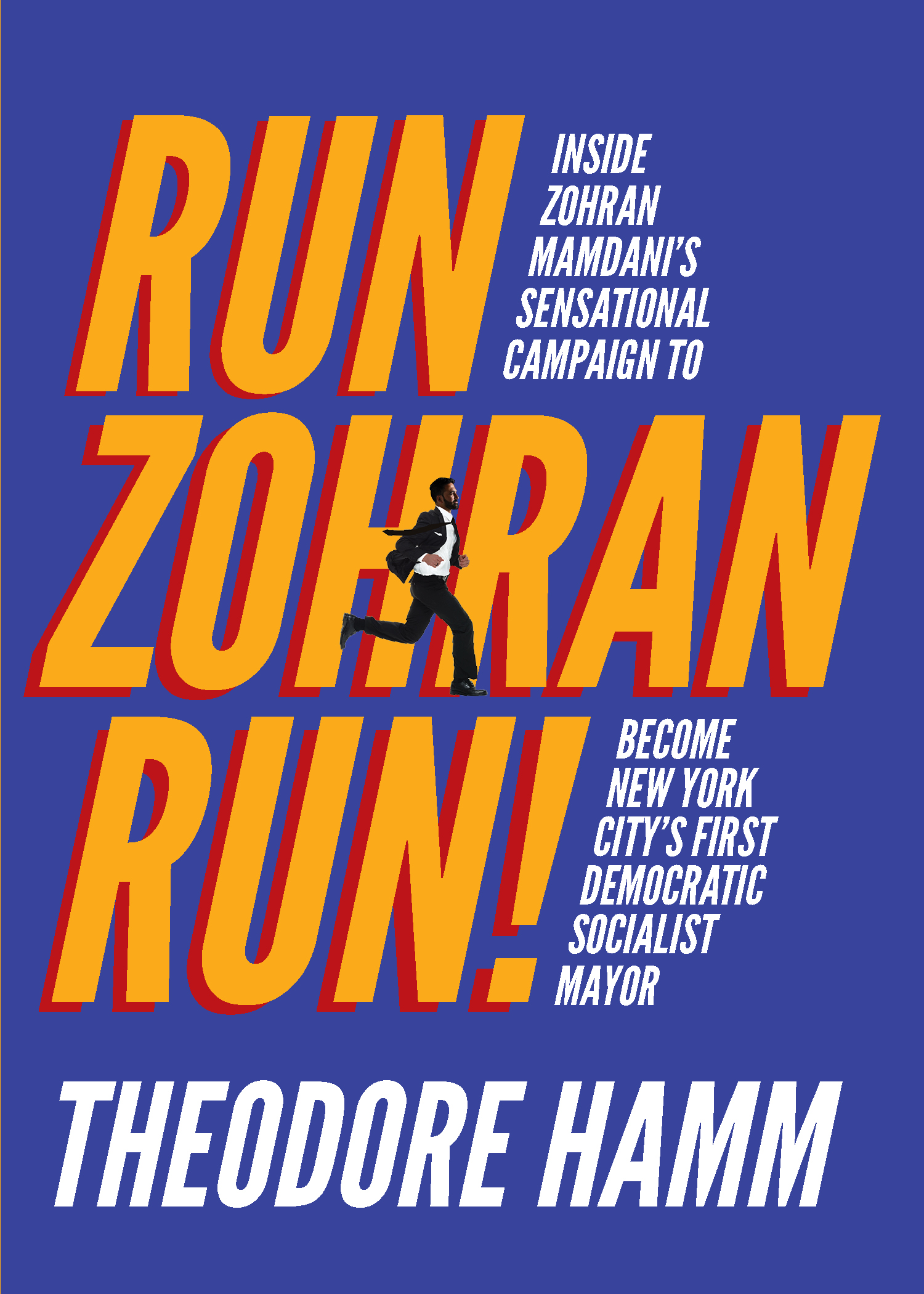
Grounded in firsthand knowledge of an insurgent campaign, Run Zohran Run! charts the unexpected rise of Zohran Mamdani and his victory in New York City’s 2025 Mayoral Democratic primary.
Mamdani’s straightforward platform—a rent freeze, free buses, universal childcare, and city-run grocery stores—cut through the noise of mainstream politics and resonated with working-class voters struggling in an increasingly unaffordable city.
A 33 year-old immigrant who openly identifies as a democratic socialist, Mamdani drew in Muslim and South Asian voters historically sidelined in city politics. His robust support for Palestinian rights upended traditional politics in New York City, where even the most liberal elected officials refuse to criticize Israel.
The campaign faced relentless institutional resistance—attacks from the New York Times, the New York Post, and vitriol from disgraced former governor Andrew Cuomo and former mayor Michael Bloomberg—but it also demonstrated how Left campaigns can be won.
Whether plunging into the icy water of Coney Island on New Year’s Day to promote a rent freeze or letting a Knicks' fan spin a multi-colored basketball on his head at an NBA game, Mamdani's innovative and theatrical campaign captured the public. At the same time, a massive ground operation led by the Democratic Socialists of America mobilized tens of thousands of volunteers to knock on more than 1.5 million doors.
As fast-paced and compelling as its subject, Run Zohran Run! reveals how a charismatic candidate and a vibrant grassroots campaign ended a New York dynasty and set the stage for the city’s most progressive mayor yet.
this drew my eye in my public library so I gave it a go
This book contains an impressive amount of quotes, excerpts and facts— but the majority of the time feels like an overwhelming info-dump of names, roles, and obscure references rather than a cohesive underdog story
Though I enjoyed Hamm's punchy, entertaining writing style, I did find the book lacking in terms of analysis. As others have noted, it does feel very much like a collection of disorganized anecdotes and names (often confusingly) dropped one after the other, more so than the cohesive analytical narrative of Mamdani's campaign I expected it to be. The summary on the book's first page says "As fast-paced and compelling as its subject, "Run Zohran Run!" reveals how a charismatic candidate and a vibrant grassroots campaign ended a New York dynasty and set the stage for the city's first democratic socialist mayor." The text was certainly insightful in that regard, but I do not think Hamm did the best job possible at conveying this trajectory to the reader. If Hamm publishes a follow-up book now that Zohran has actually become NYC mayor, I hope he will incorporate a much stronger political/social analytical perspective and maybe a more organized/chronological narrative of Mamdani's campaign, while retaining his engaging voice and insider stories. For me, this incorporation would include more insight into how Zohran's upbringing and how he maintains his education/principles in practice as a politician (maybe I'm only saying this because I took one of Mahmood Mamdani's classes a few years ago and found it quite formative for building my academic career, but I still think a careful and thorough assessment Zohran's values in practice is a really important topic to cover). I do look forward to the post-election edition of this book, and hope Hamm will take readers' feedback into account.
A thorough and interesting enough account of the legendary victory and an unlikely political campaign that led to the biggest upset in NY city politics.
There are some political books that *explains* campaigns (though this more of a 228 page article…) Run Zohran Run captures a mood and a feeling. And more importantly, for my context, how to create one.
Zohran Mamdani, his team, and his message, is a machine of optimism. At a time when so much politics feels exhausted, cynical and stodgy, this campaign understood something vital: people will work, volunteer, organise and believe if you give them something bigger than themselves to belong to. A proud, energetic “we”. Not fragmented grievance politics. Not endless technocratic jargon. A movement.
The brilliance of the campaign was its simplicity. Rent freezes. Free travel. Free childcare. Real issues affecting real people, communicated in language ordinary people actually use. Three-word slogans. Clear framing. Digestible ideas. Easy to repeat, easy to understand, easy to rally behind. In modern politics, clarity is not a luxury; it is survival. Just ask the ailing Starmer government…
The book gives a good account for communication and political branding. Mamdani’s team understood instinctively that politics today is visual, emotional and immediate. Long policy documents do not move people. Sharp videos do. Strong graphics do. Bold colours do. Humour does. Human interaction does. The campaign saturated the media environment not by waiting for permission to be heard, but by forcing itself into the conversation every single day.
What really impressed me, however, was the positivity. The campaign was attacked constantly, particularly by entrenched political and financial interests, but rather than retreating into bitterness, it weaponised optimism. Every criticism reinforced the idea that this was a candidate challenging a tired political machine that many people already blamed for the city’s problems. The campaign understood an important truth of modern politics: if the establishment fears you loudly enough, people begin to wonder whether you might actually matter.
There are leadership lessons everywhere in this book. Build broad coalitions. Speak in the language people actually speak. Understand culture as much as policy. Create momentum deliberately. Meet people where they are — literally and proverbially. Saturate the information space. And above all else, never underestimate the power of energy. Politics is often presented as a battle of ideas. Increasingly, it is also a battle of vitality versus fatigue.
Mamdani comes across as something increasingly rare in public life: a disruptor who believes in people. Not a politics of anger for anger’s sake, but one rooted in participation, humour, confidence and hope. A campaign smiling in the face of hostility.
Also, any politician mixing Arsenal and cricket references into the operation was probably always going to get my attention.
This reads far more like a long-form article, at times repetitive, than a comprehensive analysis of the campaign. While providing insight into the election process, Hamm is immensely biased, and refers to politicians as a “salty demagogue” and “laughingstock” while insisting on calling Zohran “the insurgent candidate” and Cuomo “Mario’s son” throughout the book. If you’re able to look past the bias (or view it as a funny editorial choice), as well as ignore some heavy repetition, the book is a fun, albeit simplistic, narrative of how Zohran Mamdani made history for New York City and reinvigorated the Democratic party.
A no-holds-barred, first draft of a remarkable history of NYC in the person of ZM! Here’s a quote from N plus 1 that sums up this book; “In other words, public stupidity can be great business for private knowledge. (Earlier this week, bond traders piled into US treasuries—on the basis of privately collected, non-BLS jobs data.) To begin to resist the reign of fatuity, Davies says, we must start by understanding why certain forms of “sabotage and stupidity” are “not only tolerated but valued by contemporary capitalism.””. Of course the billion dollar question is what are the power elites so fearful of? What Hamm does very well in the book is show how the NY Post AND the NY Times both fear ZM and how they, and their underwriters, are actively framing things to prevent his election.
An absolutely brilliant book. If you want to know why Zohran Mamdani won the New York mayoral election then you simply have to read this book. Theodore Hamm explains brilliantly why this socialist campaigner was able to defeat the odds to beat the forces of reaction by mobilising tens of thousands of ordinary New Yorkers as part of his campaign for change. The book and the movement it describes is rich with lessons for socialists and the left in Britain. It needs to be read by anyone with an interest in radical social change. An essential read.
Can’t say I learned anything major but this did reaffirm what I thought I understand about the race for mayor. My problems with this book are with the lack of adherence to a timeline. Being that this is a historical retelling of Mandanis campaign I thought we’d be reviewing chronologically, in stead there was no real through line.
A decent story of the history of Zohran Mamdani’s primary campaign. I liked the extensive use of footnotes. But I would have liked more discussion of the other democratic primary candidates, besides mayor Adams and Cuomo.
If you know nothing about the race and the timeline, it's good. I was searching for a more in depth analysis of his campaign in strategy and was disappointed to find out it barely gets mentioned...