

What do you think?
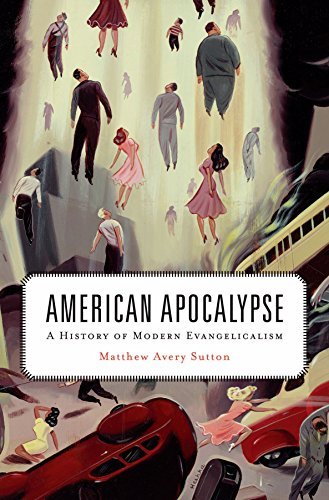
American Apocalypse: A History of Modern Evangelicalism
In the first comprehensive history of American evangelicalism to appear in a generation, Matthew Sutton shows how charismatic Protestant preachers, anticipating the end of the world, paradoxically transformed it. Narrating the story from the perspective of the faithful, he shows how apocalyptic thinking influences the American mainstream today.
476 pages, Kindle Edition
First published November 3, 2014
Ratings & Reviews
Friends & Following
Create a free account to discover what your friends think of this book!
Community Reviews
Displaying 1 - 30 of 53 reviews

April 27, 2026
“American evangelicalism is thriving in the twenty-first century. While nineteenth century premillennialists would most likely fail to recognize their spiritual great-grandchildren, white evangelicals have achieved much of what they set out to do since World War II. While they still claim at times to be a persecuted minority, in reorienting their movement and linking their faith with the major social and political issues of the era, they have accomplished more than most ever dreamed possible. Evangelicals have helped to make and break presidential candidates, influenced US foreign policy, and shaped the debates on the most important social and cultural issues of our time. In terms of religion, they have moved from provocative outsiders to consummate insiders…”
- Matthew Avery Sutton, American Apocalypse: A History of Modern Evangelicalism
The eventual return of Jesus Christ is a central component of Christianity. Since the day of Jesus’s death, his followers have been awaiting the Second Coming. This has spawned an entire cottage industry of novels, religious tracts, movies, and television shows speculating about what this event might look like. Because of this, there is a lot about the Second Coming that is profoundly hokey, including a list of wildly off-base estimates that stretch back for centuries.
Leaving aside much of what pervades popular culture, there has been a somewhat more serious effort to nail down the timing of Jesus’s next visit. To that end, two major propositions have developed among Christians in the United States, both of them starting with a cryptic – though gripping passage – from Revelation 20:1-5, in which the souls of martyrs come back to life and reign “with Christ for a thousand years.”
The first of these theories is relatively optimistic. It is called postmillennialism, and suggests that Christians have a thousand-year period to help prepare the world for Jesus’s reappearance.
The second is quite a bit grimmer. Premillennialists believe that prior to Jesus’s dramatic comeback, the world must undergo a tribulation, in which everything essentially goes to hell. At this point, Jesus will transport the faithful to heaven while everyone else has to suck lemons. Premillennialism is closely linked to Christian fundamentalism, which – among other things – believes in the literalness of the Bible.
The worldview of premillennialists uncomfortably combines doomy-darkness, unempirical certainty, and no small amount of arrogance in presupposing the outcome of any salvation-based judgments. Despite this, premillennialism has fully emerged into the mainstream, with tens of millions of adherents. In competent – if not exactly scintillating – style, Matthew Avery Sutton’s American Apocalypse shows how this once-fringy interpretation of the Book of Revelation became so predominant.
***
Given its title, it is no surprise that American Apocalypse concentrates on millennial movements within the United States. This is a long history, but one that Sutton shortens by focusing mainly on the transformation of evangelicalism during the twentieth century. In particular, he dates the true start of the modern movement to the calamity of the First World War. This makes practical sense, for one did not have to squint super hard to see that the end times might have arrived in the form of bombed-over landscapes, machine guns, and poison gas.
From there, Sutton moves right on down the timeline. He covers the Depression Era, when evangelicals began to insert themselves into debates regarding the role of the federal government in the national economy, and more than a few decided that Franklin D. Roosevelt was the antichrist, the New Deal a trick of Satan, and Social Security numbers the mark of the beast. Later, Sutton describes how the Second World War – and especially the culminating explosion of two atomic bombs – gave a huge boost to the movement. He further notes how the Cold War allowed evangelicals to scale to unprecedented heights, with a tailor-made good/evil competition with an officially atheistic state.
American Apocalypse concludes at the Reagan Administration, with premillennialism in the ascendant, and the President of the United States borrowing heavily from its lexicon.
***
It is probably worth noting that the evangelicals covered here are mostly white. This is because the premillennial movement has an unfortunate reputation when it comes to race. Nevertheless, Sutton takes some time to weave a few threads regarding the role of black Christian churches into the overall tapestry.
***
There is an inherent tension in premillennialism regarding what a person can – or even should – do in a doomed world. As Sutton notes, early premillennialists practiced social withdrawal. They were not interested in policymaking because improvement on earth did not matter. To the contrary, their faith hinged on the inevitable catastrophes that must occur.
The shift away from this viewpoint is the main theme that Sutton follows from beginning to end. Over time, premillennialists first dipped their toes into the political process, then later jumped into the deep end. During Prohibition, evangelicals supported temperance and lobbied against “wets” who were willing to support its repeal. When the film industry expanded, they worked hard for a production code. In schools they fought the teaching of evolution. By the end of the Second World War, they had fully embraced electoral politics
Sutton’s narrative coalesces around a number of influential figures, with thumbnail sketches of Billy Sunday, Billy Graham, Lyman Stewart, Harold John Ockenga, and S. Frank Norris. These men – and many others – had the ability to direct the votes of countless Americans, and they used it. Far from leaving the world as it was, they sought to make it conform to their specific beliefs.
Along the way, evangelicals built for themselves a home in the Republican Party, embracing unlikely figures such as the philandering Warren G. Harding, and making more than a few ethical compromises to achieve their ends.
***
At less than four-hundred pages of text, American Apocalypse is relatively brief, especially with all the ground it tries to cover. Sutton does a good job of connecting the dots, hitting the important points, and generally keeping things moving along at a good pace. It is, all things considered, a fine book. Yet fine is as far as I can go. This is not a dry theological discourse, but neither did it really capture my full and undivided attention.
Part of this response is an inexplicable combination of my mood, my temperament, the position in which I was sitting while I read it, the alignment of the stars, and other variables that has no bearing on how this book may or may not work for you. Partly, though, I think that Sutton’s concision comes at a cost. Though he does a good job laying out the sequence of events, he does not afford himself the space to really explore why things happened as they did. More specifically, I wish he had spent more time with the leaders mentioned above, to determine what drove them, and to make them really come alive. It is sometimes difficult to discern whether they were true believers or simply salesmen.
***
Faith is an important part in the lives of many. I do not begrudge anyone their beliefs, for we all need a framework to make sense of life, especially when it is at its most senseless. When beliefs become the basis for public policy, however, they are open for critique. The most trenchant criticism of premillennialists is that they have been consistently wrong for over a century. All their predictions and prophecies have failed, to the extent that they mostly keep those guesses to themselves now. Despite this record, evangelicals have found themselves in the most inner circles of power, with no sign of erosion any time soon.
- Matthew Avery Sutton, American Apocalypse: A History of Modern Evangelicalism
The eventual return of Jesus Christ is a central component of Christianity. Since the day of Jesus’s death, his followers have been awaiting the Second Coming. This has spawned an entire cottage industry of novels, religious tracts, movies, and television shows speculating about what this event might look like. Because of this, there is a lot about the Second Coming that is profoundly hokey, including a list of wildly off-base estimates that stretch back for centuries.
Leaving aside much of what pervades popular culture, there has been a somewhat more serious effort to nail down the timing of Jesus’s next visit. To that end, two major propositions have developed among Christians in the United States, both of them starting with a cryptic – though gripping passage – from Revelation 20:1-5, in which the souls of martyrs come back to life and reign “with Christ for a thousand years.”
The first of these theories is relatively optimistic. It is called postmillennialism, and suggests that Christians have a thousand-year period to help prepare the world for Jesus’s reappearance.
The second is quite a bit grimmer. Premillennialists believe that prior to Jesus’s dramatic comeback, the world must undergo a tribulation, in which everything essentially goes to hell. At this point, Jesus will transport the faithful to heaven while everyone else has to suck lemons. Premillennialism is closely linked to Christian fundamentalism, which – among other things – believes in the literalness of the Bible.
The worldview of premillennialists uncomfortably combines doomy-darkness, unempirical certainty, and no small amount of arrogance in presupposing the outcome of any salvation-based judgments. Despite this, premillennialism has fully emerged into the mainstream, with tens of millions of adherents. In competent – if not exactly scintillating – style, Matthew Avery Sutton’s American Apocalypse shows how this once-fringy interpretation of the Book of Revelation became so predominant.
***
Given its title, it is no surprise that American Apocalypse concentrates on millennial movements within the United States. This is a long history, but one that Sutton shortens by focusing mainly on the transformation of evangelicalism during the twentieth century. In particular, he dates the true start of the modern movement to the calamity of the First World War. This makes practical sense, for one did not have to squint super hard to see that the end times might have arrived in the form of bombed-over landscapes, machine guns, and poison gas.
From there, Sutton moves right on down the timeline. He covers the Depression Era, when evangelicals began to insert themselves into debates regarding the role of the federal government in the national economy, and more than a few decided that Franklin D. Roosevelt was the antichrist, the New Deal a trick of Satan, and Social Security numbers the mark of the beast. Later, Sutton describes how the Second World War – and especially the culminating explosion of two atomic bombs – gave a huge boost to the movement. He further notes how the Cold War allowed evangelicals to scale to unprecedented heights, with a tailor-made good/evil competition with an officially atheistic state.
American Apocalypse concludes at the Reagan Administration, with premillennialism in the ascendant, and the President of the United States borrowing heavily from its lexicon.
***
It is probably worth noting that the evangelicals covered here are mostly white. This is because the premillennial movement has an unfortunate reputation when it comes to race. Nevertheless, Sutton takes some time to weave a few threads regarding the role of black Christian churches into the overall tapestry.
***
There is an inherent tension in premillennialism regarding what a person can – or even should – do in a doomed world. As Sutton notes, early premillennialists practiced social withdrawal. They were not interested in policymaking because improvement on earth did not matter. To the contrary, their faith hinged on the inevitable catastrophes that must occur.
The shift away from this viewpoint is the main theme that Sutton follows from beginning to end. Over time, premillennialists first dipped their toes into the political process, then later jumped into the deep end. During Prohibition, evangelicals supported temperance and lobbied against “wets” who were willing to support its repeal. When the film industry expanded, they worked hard for a production code. In schools they fought the teaching of evolution. By the end of the Second World War, they had fully embraced electoral politics
Sutton’s narrative coalesces around a number of influential figures, with thumbnail sketches of Billy Sunday, Billy Graham, Lyman Stewart, Harold John Ockenga, and S. Frank Norris. These men – and many others – had the ability to direct the votes of countless Americans, and they used it. Far from leaving the world as it was, they sought to make it conform to their specific beliefs.
Along the way, evangelicals built for themselves a home in the Republican Party, embracing unlikely figures such as the philandering Warren G. Harding, and making more than a few ethical compromises to achieve their ends.
***
At less than four-hundred pages of text, American Apocalypse is relatively brief, especially with all the ground it tries to cover. Sutton does a good job of connecting the dots, hitting the important points, and generally keeping things moving along at a good pace. It is, all things considered, a fine book. Yet fine is as far as I can go. This is not a dry theological discourse, but neither did it really capture my full and undivided attention.
Part of this response is an inexplicable combination of my mood, my temperament, the position in which I was sitting while I read it, the alignment of the stars, and other variables that has no bearing on how this book may or may not work for you. Partly, though, I think that Sutton’s concision comes at a cost. Though he does a good job laying out the sequence of events, he does not afford himself the space to really explore why things happened as they did. More specifically, I wish he had spent more time with the leaders mentioned above, to determine what drove them, and to make them really come alive. It is sometimes difficult to discern whether they were true believers or simply salesmen.
***
Faith is an important part in the lives of many. I do not begrudge anyone their beliefs, for we all need a framework to make sense of life, especially when it is at its most senseless. When beliefs become the basis for public policy, however, they are open for critique. The most trenchant criticism of premillennialists is that they have been consistently wrong for over a century. All their predictions and prophecies have failed, to the extent that they mostly keep those guesses to themselves now. Despite this record, evangelicals have found themselves in the most inner circles of power, with no sign of erosion any time soon.

August 14, 2024
The history of Fundamentalism/Evangelicalism carries a two-fold fascination for me. The necessity of understanding the origins and mind-set of what is both one of the more powerful and most regressive groups influencing American politics is a primary reason for my interest. But I also have a more personal reason. I was raised in one of the more virulent Fundamentalist sects, the son of a Fundamentalist minister, and educated from middle school on in Fundamentalist church schools. I was taught that we were the only true Christians, and that our dogmas and beliefs were those of the original, pure, first century Church of believers, preserved by a mysterious faithful remnant through the ages. Since leaving this sect behind as a young adult, I’ve focused on studying the actual history of this movement that so shaped my formative years.
Matthew Avery Sutton’s American Apocalypse: A History of Modern Evangelicalism is focused (as its title implies) on the movement’s American history. Beyond a cursory mention he really doesn’t go into the Irish and English roots of the movement in the 1820s and ‘30s among the Plymouth Brethren. (For a detailed history of these origins, read Donald Harman Akenson’s Exporting the Rapture.) Instead, he focuses on the growth of the movement from around the time of the American Civil War. But he explicitly points out the movement’s modern origins, writing:
”While proponents often identified Fundamentalism as the ‘Old Time Religion,’ or as the conservative faith, there was very little traditional or conservative about it. Fundamentalist were not trying to conserve something from the past, but were instead savvy religious innovators.”
Sutton builds his history around the Fundamentalist innovative, apocalyptic doctrines, commonly identified as Dispensationalism, or Premillennialism. While acknowledging that Fundamentalists might not consider these core doctrines, he points out that they served as a type of shibboleth, a sure and easy identifier of who is indeed a Fundamentalist:
”Premillennialism served as the proxy for underlying methodological and hermeneutical differences. Fundamentalists belief in the imminent Second Coming grew out of their more foundational faith in the centrality and historicity of Jesus’s work, as well as in the literal accuracy of the Biblical texts.”
Contrary to many earlier treatments of Fundamentalism, Sutton finds little historical significance in the infamous Scopes Monkey Trial. He doesn’t see it as particularly central to the movement at the time, and denies that it had any dampening effect on Fundamentalists participation in public affairs over the next few decades. Instead, he emphasizes the importance of the First World War in establishing Fundamentalism as a viable and lasting American creed:
”The war had transformed what might otherwise have remained a somewhat obscure theological conviction on the fringes of Protestant life into a major force. It verified in a way that nothing else could that Pre-Millennialist doomsday senecios and their implications for current affairs had to be taken seriously.”
Throughout his history, the author emphasizes how Fundamentalism has always been, not just a doctrine or creed, but a movement intent on controlling the levers of power and shaping the culture:
”Fundamentalists created a different kind of morally infused American politics, one that challenged the long, democratic tradition of pragmatic governance by compromise and consensus. Theirs was a politics of apocalypse.”
”The faithful helped lay the foundations for post war religious mobilization. They perfected the anti-state, pro-market world view that subsequent generations of Evangelicals and other religious activists adopted and used to shape American politics.”
As Sutton moved his history into the post Second World War era, he chronicles how the movement rebranded as Evangelicals and made overtures to be less intimidating to American culture. He goes into some depth on the work of Billy Graham, who was finally able to take the movement into the halls of power, as he became a friend and advisor to presidents. From there the movement became increasingly political, with the formation of the Moral Majority in the late ‘70s, with the Reverend Jerry Falwell instructing Christians ”to get people saved, to get them baptized, and to get them registered to vote.” And finally, with the election of Fundamentalist-favored candidate Ronald Reagan, the movement had arrived.
”A century in the making, American Evangelical Apocalypicism had penetrated the highest echelons of power.”
Sutton wraps up his history with details of just how much this once obscure sect has permeated both modern American culture and politics. He concludes:
”Fundamentalists began on the margins of American religious life where they represented a schismatic alternative to mainstream Christianity. Their Evangelical descendants now oversee what is arguably the most powerful religious movement in the United States, and one of the most powerful around the globe.”
Matthew Avery Sutton’s American Apocalypse: A History of Modern Evangelicalism is focused (as its title implies) on the movement’s American history. Beyond a cursory mention he really doesn’t go into the Irish and English roots of the movement in the 1820s and ‘30s among the Plymouth Brethren. (For a detailed history of these origins, read Donald Harman Akenson’s Exporting the Rapture.) Instead, he focuses on the growth of the movement from around the time of the American Civil War. But he explicitly points out the movement’s modern origins, writing:
”While proponents often identified Fundamentalism as the ‘Old Time Religion,’ or as the conservative faith, there was very little traditional or conservative about it. Fundamentalist were not trying to conserve something from the past, but were instead savvy religious innovators.”
Sutton builds his history around the Fundamentalist innovative, apocalyptic doctrines, commonly identified as Dispensationalism, or Premillennialism. While acknowledging that Fundamentalists might not consider these core doctrines, he points out that they served as a type of shibboleth, a sure and easy identifier of who is indeed a Fundamentalist:
”Premillennialism served as the proxy for underlying methodological and hermeneutical differences. Fundamentalists belief in the imminent Second Coming grew out of their more foundational faith in the centrality and historicity of Jesus’s work, as well as in the literal accuracy of the Biblical texts.”
Contrary to many earlier treatments of Fundamentalism, Sutton finds little historical significance in the infamous Scopes Monkey Trial. He doesn’t see it as particularly central to the movement at the time, and denies that it had any dampening effect on Fundamentalists participation in public affairs over the next few decades. Instead, he emphasizes the importance of the First World War in establishing Fundamentalism as a viable and lasting American creed:
”The war had transformed what might otherwise have remained a somewhat obscure theological conviction on the fringes of Protestant life into a major force. It verified in a way that nothing else could that Pre-Millennialist doomsday senecios and their implications for current affairs had to be taken seriously.”
Throughout his history, the author emphasizes how Fundamentalism has always been, not just a doctrine or creed, but a movement intent on controlling the levers of power and shaping the culture:
”Fundamentalists created a different kind of morally infused American politics, one that challenged the long, democratic tradition of pragmatic governance by compromise and consensus. Theirs was a politics of apocalypse.”
”The faithful helped lay the foundations for post war religious mobilization. They perfected the anti-state, pro-market world view that subsequent generations of Evangelicals and other religious activists adopted and used to shape American politics.”
As Sutton moved his history into the post Second World War era, he chronicles how the movement rebranded as Evangelicals and made overtures to be less intimidating to American culture. He goes into some depth on the work of Billy Graham, who was finally able to take the movement into the halls of power, as he became a friend and advisor to presidents. From there the movement became increasingly political, with the formation of the Moral Majority in the late ‘70s, with the Reverend Jerry Falwell instructing Christians ”to get people saved, to get them baptized, and to get them registered to vote.” And finally, with the election of Fundamentalist-favored candidate Ronald Reagan, the movement had arrived.
”A century in the making, American Evangelical Apocalypicism had penetrated the highest echelons of power.”
Sutton wraps up his history with details of just how much this once obscure sect has permeated both modern American culture and politics. He concludes:
”Fundamentalists began on the margins of American religious life where they represented a schismatic alternative to mainstream Christianity. Their Evangelical descendants now oversee what is arguably the most powerful religious movement in the United States, and one of the most powerful around the globe.”

February 3, 2015
Matthew Avery Sutton has composed a thoroughly researched treatment of the history of fundamentalism and evangelicalism in America and its connections to the modern day “religious right” which figures so prominently in American political discourse. Though appreciative of the earlier works in the field, this book seeks to replace rather than supplement such classics as Marsden’s Fundamentalism and American Culture and Sandeen’s The Roots of Fundamentalism. Of these two, Sandeen’s influence is stronger because, like him, Sutton believes that premillennialism and apocalyptic prophecy were (and are) the distinguishing features of movement. His work proposes two key points of departure from Marsden and the generally accepted picture of the rise of fundamentalism. (These two are a combination of four themes Sutton identifies on xiii-xv.)
First, Sutton emphasizes the role that World War One played in galvanizing and energizing early Premillennialists. The massive international conflict, he argues, provided a sense of urgency to the newly fashioned eschatology of writers like William Blackstone, and made premillennial theories much more plausible to thousands in Britain and North America. The Great War destroyed much of the optimism of the progressive era and postmillennial eschatologies that had accompanied it. At the same time, the this-worldly emphasis of the Social Gospel Movement combined with liberal theories of biblical interpretation imported from Germany and transformed much of mainstream American Protestantism into a religion unrecognizable to many conservative Christians. The instability in global politics and in liberal turn in Protestant theology led to fear and unease among many traditional Christians. Premillennialism provided both an explanation of these unsettling events and also a hope for a glorious future beyond them. Without the First World War, Premillennial theology may have been nothing more than an unusual but not particularly relevant idea in American religion. But with the War, suddenly Blackstone’s predictions of a downward spiral into the time of tribulation felt both prescient and important.
Moreover, debates about patriotism and commitment to the war effort gave rise to the earliest evangelical forays into political action. Though fundamentalist did not have a unified position regarding American entrance into the war, they came together in opposition to communism and suspicion of Wilson’s League of Nations by the end of it. Sutton’s answer as to how the poor and rural fundamentalists of the country came to be political allies of wealthy businessmen in Chicago and New York is communism. Both groups hated and feared Marxist theory with its atheism and opposition to capitalism. Moreover, several significant business leaders were true believers in premillennialism and gave of their time, money, and influence to spread its message.
Second, following Sandeen, Sutton rejects the idea that Fundamentalism was ever characterized by a period of retreat from public life and influence. Significantly, he diminishes the importance the Scopes Monkey Trial of 1925. Unlike Marsden, Sutton believes that the trial did little to alter the trajectory of the early evangelical movement and did not prompt a retreat from public political life for fundamentalism. Though it captured national attention and dealt with an issue about which many fundamentalists cared deeply, the only significant legacy of the case for fundamentalists was the changing of their name. Antievolutionism was and is a typical characteristic of fundamentalists and evangelicals, but, Sutton argues, it is not the animating force of the movement that premillennialism is.
Because the Scopes trial is minimized, Sutton rejects the idea of a “rise-fall-rise” narrative for fundamentalism in America. Rather, he sees a steady continuity between the late 19th century and the early 1950s. Citing strong, outspoken, and explicitly religious and premillennial critiques of Al Smith’s presidential bid in 1928 and Roosevelt’s New Deal during the depression era, Sutton argues that evangelicalism has been politically engaged since its very beginnings.
Sutton’s rejection of the theory of “fundamentalist retreat” lies at the center of his book and Sutton provides convincing support for his argument. His analysis of early culture wars in the 1920s and 30s along with fundamentalist political activity during the New Deal era is especially persuasive on this point. The ideological forbearers of Jerry Falwell and James Dobson were actively engaged in the culture wars long before the 1960s. Evangelical opposition to Hollywood morality and liberal politics were firmly in place before the 1950s. This basic continuity between early fundamentalists and post-war evangelicals, Sutton argues, means that the movement should be seen as one consistent and growing presence in American politics throughout the 20th century.
Sutton’s earlier work on Aimee Semple McPhearson lies behind much his research for this work as well as providing the ground for a subplot that he weaves throughout his narrative – the feminist and African-American connections to fundamentalism. At times, as in his discussion of the rise of influential female ministers, this material feels relevant to the overall thrust of the book; at other times, these excursuses seem disconnected and out of place. Nevertheless, Sutton’s treatment of women and minorities (primarily African-Americans, but also Catholics, Native Americans, and Jews) keeps the book connected to the wider American experience surrounding the rise of evangelicalism. The book provides a detailed history of fundamentalism’s conflict with modern theological liberalism and 20th Century American Catholicism. It regularly touches on the way that African-Americans, women, and other minority groups reacted to fundamentalism as well as providing a wealth of data, quotations, and interesting anecdotes from within the evangelical community. However, it is quite clear that Sutton’s overriding purpose is to show what Evangelicalism is in the early 21st Century. Thus, the typical talking points of contemporary political debate show up throughout the book – sometimes clarifying, sometimes distracting from Sutton’s historical treatment of evangelicalism’s early years.
Though the book is not an attack on Evangelicalism, Sutton’s is not exactly a sympathetic presentation of the movement either. Frequently negative ideas and attitudes typical of the larger American society are presented as particularly fundamentalist positions, and Sutton has a habit of naming Evangelical leaders’ motives without demonstrating evidence in support of his claims. However, the primary critique of his work lies in his claim that premillennialism is the defining characteristic of the evangelical movement. Though he presents a compelling case for his position, Sutton is honest enough to regularly list the exceptions and counterexamples to his argument. It is difficult to accept his claim that premillennialism is at the heart of fundamentalism when the topic is never even addressed in The Fundamentals despite great efforts on the publishers part to have it included. Nor was premillennial eschatology at the heart of the revivalist preaching of Billy Sunday and Billy Graham. Rather, what animated these massive, and perhaps most significant efforts was the concept of a personal spiritual conversion and an ensuing relationship with Jesus. Evangelicalism is so diverse and even chaotic a movement that one ought to be suspicious of any single element of its character being elevated to the position of primacy. Rather, the picture that emerges from Sutton’s detailed description of the movement is a cluster of beliefs and attitudes which rise and fall in importance depending on the cultural situation surrounding evangelicals. Nevertheless, Sutton’s work remains an impressive and helpful overview of evangelical history and deserves attention from all students of the field. His emphasis on apocalypticism, even if it is exaggerated, nevertheless brings to light an often overlooked or misunderstood aspect of the modern evangelical movement.
First, Sutton emphasizes the role that World War One played in galvanizing and energizing early Premillennialists. The massive international conflict, he argues, provided a sense of urgency to the newly fashioned eschatology of writers like William Blackstone, and made premillennial theories much more plausible to thousands in Britain and North America. The Great War destroyed much of the optimism of the progressive era and postmillennial eschatologies that had accompanied it. At the same time, the this-worldly emphasis of the Social Gospel Movement combined with liberal theories of biblical interpretation imported from Germany and transformed much of mainstream American Protestantism into a religion unrecognizable to many conservative Christians. The instability in global politics and in liberal turn in Protestant theology led to fear and unease among many traditional Christians. Premillennialism provided both an explanation of these unsettling events and also a hope for a glorious future beyond them. Without the First World War, Premillennial theology may have been nothing more than an unusual but not particularly relevant idea in American religion. But with the War, suddenly Blackstone’s predictions of a downward spiral into the time of tribulation felt both prescient and important.
Moreover, debates about patriotism and commitment to the war effort gave rise to the earliest evangelical forays into political action. Though fundamentalist did not have a unified position regarding American entrance into the war, they came together in opposition to communism and suspicion of Wilson’s League of Nations by the end of it. Sutton’s answer as to how the poor and rural fundamentalists of the country came to be political allies of wealthy businessmen in Chicago and New York is communism. Both groups hated and feared Marxist theory with its atheism and opposition to capitalism. Moreover, several significant business leaders were true believers in premillennialism and gave of their time, money, and influence to spread its message.
Second, following Sandeen, Sutton rejects the idea that Fundamentalism was ever characterized by a period of retreat from public life and influence. Significantly, he diminishes the importance the Scopes Monkey Trial of 1925. Unlike Marsden, Sutton believes that the trial did little to alter the trajectory of the early evangelical movement and did not prompt a retreat from public political life for fundamentalism. Though it captured national attention and dealt with an issue about which many fundamentalists cared deeply, the only significant legacy of the case for fundamentalists was the changing of their name. Antievolutionism was and is a typical characteristic of fundamentalists and evangelicals, but, Sutton argues, it is not the animating force of the movement that premillennialism is.
Because the Scopes trial is minimized, Sutton rejects the idea of a “rise-fall-rise” narrative for fundamentalism in America. Rather, he sees a steady continuity between the late 19th century and the early 1950s. Citing strong, outspoken, and explicitly religious and premillennial critiques of Al Smith’s presidential bid in 1928 and Roosevelt’s New Deal during the depression era, Sutton argues that evangelicalism has been politically engaged since its very beginnings.
Sutton’s rejection of the theory of “fundamentalist retreat” lies at the center of his book and Sutton provides convincing support for his argument. His analysis of early culture wars in the 1920s and 30s along with fundamentalist political activity during the New Deal era is especially persuasive on this point. The ideological forbearers of Jerry Falwell and James Dobson were actively engaged in the culture wars long before the 1960s. Evangelical opposition to Hollywood morality and liberal politics were firmly in place before the 1950s. This basic continuity between early fundamentalists and post-war evangelicals, Sutton argues, means that the movement should be seen as one consistent and growing presence in American politics throughout the 20th century.
Sutton’s earlier work on Aimee Semple McPhearson lies behind much his research for this work as well as providing the ground for a subplot that he weaves throughout his narrative – the feminist and African-American connections to fundamentalism. At times, as in his discussion of the rise of influential female ministers, this material feels relevant to the overall thrust of the book; at other times, these excursuses seem disconnected and out of place. Nevertheless, Sutton’s treatment of women and minorities (primarily African-Americans, but also Catholics, Native Americans, and Jews) keeps the book connected to the wider American experience surrounding the rise of evangelicalism. The book provides a detailed history of fundamentalism’s conflict with modern theological liberalism and 20th Century American Catholicism. It regularly touches on the way that African-Americans, women, and other minority groups reacted to fundamentalism as well as providing a wealth of data, quotations, and interesting anecdotes from within the evangelical community. However, it is quite clear that Sutton’s overriding purpose is to show what Evangelicalism is in the early 21st Century. Thus, the typical talking points of contemporary political debate show up throughout the book – sometimes clarifying, sometimes distracting from Sutton’s historical treatment of evangelicalism’s early years.
Though the book is not an attack on Evangelicalism, Sutton’s is not exactly a sympathetic presentation of the movement either. Frequently negative ideas and attitudes typical of the larger American society are presented as particularly fundamentalist positions, and Sutton has a habit of naming Evangelical leaders’ motives without demonstrating evidence in support of his claims. However, the primary critique of his work lies in his claim that premillennialism is the defining characteristic of the evangelical movement. Though he presents a compelling case for his position, Sutton is honest enough to regularly list the exceptions and counterexamples to his argument. It is difficult to accept his claim that premillennialism is at the heart of fundamentalism when the topic is never even addressed in The Fundamentals despite great efforts on the publishers part to have it included. Nor was premillennial eschatology at the heart of the revivalist preaching of Billy Sunday and Billy Graham. Rather, what animated these massive, and perhaps most significant efforts was the concept of a personal spiritual conversion and an ensuing relationship with Jesus. Evangelicalism is so diverse and even chaotic a movement that one ought to be suspicious of any single element of its character being elevated to the position of primacy. Rather, the picture that emerges from Sutton’s detailed description of the movement is a cluster of beliefs and attitudes which rise and fall in importance depending on the cultural situation surrounding evangelicals. Nevertheless, Sutton’s work remains an impressive and helpful overview of evangelical history and deserves attention from all students of the field. His emphasis on apocalypticism, even if it is exaggerated, nevertheless brings to light an often overlooked or misunderstood aspect of the modern evangelical movement.

May 10, 2022
I found this book through the Throughline history podcast when they did an episode on the history of evangelicalism. As someone who was raised evangelical, I am always curious to learn more about my spiritual heritage. I can still remember my parents getting magazines about Bible prophecy in the mail and thinking it was weird. Reading this book helped me understand that evangelical theology and premillenialism (the belief that Jesus will return before a time of tribulation) have a long history and are closely intertwined.
A lot of the book was slow-paced. I tired of the structure of each chapter where the author would make a point, and then insert quote upon quote from different figures in history as evidence of the point. It read like some of my college research papers.
That being said, it did help me put the current evangelical movement into a wider context, one going back over 100 years. It was interesting to track the evolution of premillenial/fundamentalist/evangelical beliefs from a fringe sect of Christianity to the cultural force they have become today. The shift around World War II from a movement that was largely apolitical to a driving force for the GOP was enlightening. It also helped me to see that there has already been precedent for the Trump/evangelical alliance in the presidency of Warren Harding, another evangelical champion who was himself not terribly religious or even moral. It also helped me understand the unspoken distrust in my family towards "mainstream" Christianity, that distrust is part of a larger historical tension between progressive Christianity and more conservative theology. I also appreciated that the author included African American perspectives on evangelicalism and how they often diverged from the majority white narrative.
Overall it was a worthwhile read, if a bit of a slog.
A lot of the book was slow-paced. I tired of the structure of each chapter where the author would make a point, and then insert quote upon quote from different figures in history as evidence of the point. It read like some of my college research papers.
That being said, it did help me put the current evangelical movement into a wider context, one going back over 100 years. It was interesting to track the evolution of premillenial/fundamentalist/evangelical beliefs from a fringe sect of Christianity to the cultural force they have become today. The shift around World War II from a movement that was largely apolitical to a driving force for the GOP was enlightening. It also helped me to see that there has already been precedent for the Trump/evangelical alliance in the presidency of Warren Harding, another evangelical champion who was himself not terribly religious or even moral. It also helped me understand the unspoken distrust in my family towards "mainstream" Christianity, that distrust is part of a larger historical tension between progressive Christianity and more conservative theology. I also appreciated that the author included African American perspectives on evangelicalism and how they often diverged from the majority white narrative.
Overall it was a worthwhile read, if a bit of a slog.

April 15, 2021
to this book, Dr. Sutton helpfully defines the various terms he uses to describe different groups within modern evangelicalism.
“I use the general term ‘evangelical’ to refer to Christians situated broadly in the Reformed and Wesleyan traditions who over the last few centuries have emphasized the centrality of the Bible, the death and resurrection of Jesus, the necessity of individual conversion, and spreading the faith through missions. I use the more specific term ‘radical evangelicals’ to refer to those from both the Wesleyan holiness and Higher Life Reformed traditions who in the post-Civil War period aggressively integrated apocalyptic ideas into their faith…. ‘fundamentalists’…describe the network of white, Anglo-American radical evangelicals who in the 1910s established a distinct, definable, interdenominational apocalyptic movement. By the 1940s, many of the men and women who had built the fundamentalist movement determined that the label ‘fundamentalist’ was doing more harm than good, so they dropped it. They replaced ‘fundamentalist’ with ‘evangelical.’”
He also references Pentecostals in his book. “Pentecostalism, like fundamentalism, grew out of radical evangelicalism in the late nineteenth and early twentieth centuries. Pentecostals’ emphasis on the ‘baptism with the Holy Spirit, an emotional experience that occurred after conversion, usually associated with speaking in tongues and other divine gifts, distinguished them from their fundamentalist peers…. By the early 1940s they had joined together to craft the modern evangelical movement. It is important to take seriously the history that made a Pentecostal-fundamentalist alliance possible, as well as the ways that Pentecostalism and fundamentalism overlapped in the early decades of the twentieth century.
“The majority of this book necessarily focuses on elite white fundamentalists and evangelicals….”
He wryly quotes Jerry Falwell as explaining that “a fundamentalist is an evangelical who is angry about something.”
The subject matter of this book is important, as all of us today should be aware of how the mostly white and largely male-led evangelical movement has come to such prominence in contemporary politics, especially because of its close association with the Republican Party. Precisely because of their success in supporting political candidates who espouse views similar to theirs, and their insistent demand that judges and justices nominated and approved by Republicans must pass their standards of “righteousness,” the United States now has a Supreme Court dominated by right-wing jurists and a Republican Party that is increasingly ideological, fundamentalist in outlook, ruthlessly uncompromising, and increasingly a de facto partner with the nationalist far right.
This book was also very difficult for me to read because its pages are filled with the ideology and rhetoric that I find so very distasteful: the insistent polarization in how they frame issues, the bitter, often ugly, words they use in denouncing those they regard as “enemies” or “sinners,” and their inability and unwillingness to consider others’ views repeatedly wore me down so that I would have to put the book down for a while for a needed period of mental refreshment.
The “fault,” if there be one, is not that of the author’s but, rather, is integral to who these people have become.
As a historian, I am familiar with the religious wars that so characterized the early modern period that followed the upheavals of the Reformation. As I read this book I realized that such battles between and among religious groups, as well as their insistence on a worldview framed by religious belief rather than informed by science and knowledge, are still being waged and, as was the case in the wars between Catholic and Protestant nations several centuries ago, the ultimate aim is to gain control of the state in order to enforce their religious views on others.
This last point, of course, is never stated so explicitly, but it is nonetheless real.
How evangelical fundamentalists came to such a close association with the Republican Party
Dr. Sutton also notes how fundamentalist and modern evangelists have been steadily moving closer to the Republican Party beginning in the early 20th century.
Part of the reason, but by no means the only one, is that the origins of fundamentalism are more of a rural and Southern phenomenon than an urban and northern one. Thus, very early, we find evidence of a general contempt for urban life as inevitably leading to a life of laziness, drunkenness, criminality, and debauchery. And, Lord knows, if that is what you are looking for in cities you will not be disappointed. But this also requires special viewing lenses which filter out evidence to the contrary or, at the least, make it clear that such vices and low behavior are not the degeneracy of all who live in cities.
In the early 20th century, the fact that Teddy Roosevelt so enthusiastically embraced reforms that sought to reform monopolies that crushed the “little guys,” championed “cleaning up” cities, and exposing corruptions in state and local governments led to many fundamentalists cheering him on for such reform efforts.
And because rural and Southern folks have always been among the first to express fear of and resentment towards immigrants, fundamentalists easily came to look upon efforts by working people to gain power sufficient to compel owners and businesses to meet their legitimate demands for higher wages, better working conditions, and fewer hours with suspicion, since most would-be union members were either urban and/or recent immigrants. Moreover, some of the most vocal – and press-covered – labor leaders were not only recent immigrants but socialists, too. The importance of private property, coupled with the “natural right” of property owners to protect their property, also led them to more easily understand the push-back of business owners – almost always supported by various levels of government, including the police – in response to labor demands.
By the time of the New Deal most of them also came to see in Roosevelt a person following a semi-socialist and big-state agenda that they believed threatened the “American way.” They were amenable, instead, to the near-fascist responses of people like Huey Long and Father McLaughlin.
Later on, they cheered on men like Joseph McCarthy as he went after the supposed infiltration of the US government by Communists. The Cold War, Vietnam, and Nixon’s appeal to law-‘n-order led them ever closer to the Republicans, as they had regarded the “loss of China” as an indication of “weakness” that was the legacy of FDR and Truman.
With the eruption of the “culture wars” in the ‘70s onward they saw the Republican Party as the one calling for policies most in line with their beliefs, especially as sexual and gender issues were foremost among their concerns. The differing positions of the Democratic and Republican Parties on abortion, homosexuality, and transgender persons made it all the easier to associate themselves with the latter on almost every issue.
As over the past 30 years, the Republicans became even more identified with rural and Southern states, and as the Democrats proved more willing to welcome and speak for feared “others” while insisting on the important contributions that cities and their inhabitants brought to the country, a de facto “marriage” between the Republicans and evangelicals came to be.
With the success they achieved in the Trump administration by getting so many very conservative judges and justice appointed, they now hope that these same persons will assist them in overturning legislation that supports diversity and government activism on behalf of America’s majority.
This effort to make the religious understanding of some nonetheless able to set the standards by which all must conform is exactly the kind of danger the Founders hoped to block when, in the First Amendment, they prohibited any form of establishing a religion.
They had learned from history – from the religious wars following the Reformation through the earlier experiments of many colonies in favoring one form of Christianity over others – that this was always a very dangerous thing.
In addition to grappling with conspiracy theorists, right-wing terrorists, white and populist nationalists, we must understand the threat this potential theocracy poses for our democratic republic and insist that the will of the true majority must be respected over and against efforts to impose any religious interpretations on the rest of us.
The Challenge: How best to respond to a world that is unjust and cruel?
While the vast majority of Americans are neither fundamentalists nor evangelicals, this country used to be thought of as one of the most “religious” in the world. Of course, exactly what this meant in practice has long been disputed.
Americans used to be among the most faithful in church, mosque, and synagogue attendance, as well as ranking high among other nations in the percentage of people who attested that they “believed in God.” However, it is “good Christians” who also drove the original inhabitants of this continent from their homelands and imposed chattel slavery on Black people for centuries. The ascendency of white evangelism is one more sign that the people of the United States have yet to confront – and resolve – the contradictions that have been foundational to our country from the very beginning.
Succumbing to a theocratic-based government is not an effort to become truly one nation for all but must be seen as yet another push-back insisting that some people are more equal and deserving than others.
“I use the general term ‘evangelical’ to refer to Christians situated broadly in the Reformed and Wesleyan traditions who over the last few centuries have emphasized the centrality of the Bible, the death and resurrection of Jesus, the necessity of individual conversion, and spreading the faith through missions. I use the more specific term ‘radical evangelicals’ to refer to those from both the Wesleyan holiness and Higher Life Reformed traditions who in the post-Civil War period aggressively integrated apocalyptic ideas into their faith…. ‘fundamentalists’…describe the network of white, Anglo-American radical evangelicals who in the 1910s established a distinct, definable, interdenominational apocalyptic movement. By the 1940s, many of the men and women who had built the fundamentalist movement determined that the label ‘fundamentalist’ was doing more harm than good, so they dropped it. They replaced ‘fundamentalist’ with ‘evangelical.’”
He also references Pentecostals in his book. “Pentecostalism, like fundamentalism, grew out of radical evangelicalism in the late nineteenth and early twentieth centuries. Pentecostals’ emphasis on the ‘baptism with the Holy Spirit, an emotional experience that occurred after conversion, usually associated with speaking in tongues and other divine gifts, distinguished them from their fundamentalist peers…. By the early 1940s they had joined together to craft the modern evangelical movement. It is important to take seriously the history that made a Pentecostal-fundamentalist alliance possible, as well as the ways that Pentecostalism and fundamentalism overlapped in the early decades of the twentieth century.
“The majority of this book necessarily focuses on elite white fundamentalists and evangelicals….”
He wryly quotes Jerry Falwell as explaining that “a fundamentalist is an evangelical who is angry about something.”
The subject matter of this book is important, as all of us today should be aware of how the mostly white and largely male-led evangelical movement has come to such prominence in contemporary politics, especially because of its close association with the Republican Party. Precisely because of their success in supporting political candidates who espouse views similar to theirs, and their insistent demand that judges and justices nominated and approved by Republicans must pass their standards of “righteousness,” the United States now has a Supreme Court dominated by right-wing jurists and a Republican Party that is increasingly ideological, fundamentalist in outlook, ruthlessly uncompromising, and increasingly a de facto partner with the nationalist far right.
This book was also very difficult for me to read because its pages are filled with the ideology and rhetoric that I find so very distasteful: the insistent polarization in how they frame issues, the bitter, often ugly, words they use in denouncing those they regard as “enemies” or “sinners,” and their inability and unwillingness to consider others’ views repeatedly wore me down so that I would have to put the book down for a while for a needed period of mental refreshment.
The “fault,” if there be one, is not that of the author’s but, rather, is integral to who these people have become.
As a historian, I am familiar with the religious wars that so characterized the early modern period that followed the upheavals of the Reformation. As I read this book I realized that such battles between and among religious groups, as well as their insistence on a worldview framed by religious belief rather than informed by science and knowledge, are still being waged and, as was the case in the wars between Catholic and Protestant nations several centuries ago, the ultimate aim is to gain control of the state in order to enforce their religious views on others.
This last point, of course, is never stated so explicitly, but it is nonetheless real.
How evangelical fundamentalists came to such a close association with the Republican Party
Dr. Sutton also notes how fundamentalist and modern evangelists have been steadily moving closer to the Republican Party beginning in the early 20th century.
Part of the reason, but by no means the only one, is that the origins of fundamentalism are more of a rural and Southern phenomenon than an urban and northern one. Thus, very early, we find evidence of a general contempt for urban life as inevitably leading to a life of laziness, drunkenness, criminality, and debauchery. And, Lord knows, if that is what you are looking for in cities you will not be disappointed. But this also requires special viewing lenses which filter out evidence to the contrary or, at the least, make it clear that such vices and low behavior are not the degeneracy of all who live in cities.
In the early 20th century, the fact that Teddy Roosevelt so enthusiastically embraced reforms that sought to reform monopolies that crushed the “little guys,” championed “cleaning up” cities, and exposing corruptions in state and local governments led to many fundamentalists cheering him on for such reform efforts.
And because rural and Southern folks have always been among the first to express fear of and resentment towards immigrants, fundamentalists easily came to look upon efforts by working people to gain power sufficient to compel owners and businesses to meet their legitimate demands for higher wages, better working conditions, and fewer hours with suspicion, since most would-be union members were either urban and/or recent immigrants. Moreover, some of the most vocal – and press-covered – labor leaders were not only recent immigrants but socialists, too. The importance of private property, coupled with the “natural right” of property owners to protect their property, also led them to more easily understand the push-back of business owners – almost always supported by various levels of government, including the police – in response to labor demands.
By the time of the New Deal most of them also came to see in Roosevelt a person following a semi-socialist and big-state agenda that they believed threatened the “American way.” They were amenable, instead, to the near-fascist responses of people like Huey Long and Father McLaughlin.
Later on, they cheered on men like Joseph McCarthy as he went after the supposed infiltration of the US government by Communists. The Cold War, Vietnam, and Nixon’s appeal to law-‘n-order led them ever closer to the Republicans, as they had regarded the “loss of China” as an indication of “weakness” that was the legacy of FDR and Truman.
With the eruption of the “culture wars” in the ‘70s onward they saw the Republican Party as the one calling for policies most in line with their beliefs, especially as sexual and gender issues were foremost among their concerns. The differing positions of the Democratic and Republican Parties on abortion, homosexuality, and transgender persons made it all the easier to associate themselves with the latter on almost every issue.
As over the past 30 years, the Republicans became even more identified with rural and Southern states, and as the Democrats proved more willing to welcome and speak for feared “others” while insisting on the important contributions that cities and their inhabitants brought to the country, a de facto “marriage” between the Republicans and evangelicals came to be.
With the success they achieved in the Trump administration by getting so many very conservative judges and justice appointed, they now hope that these same persons will assist them in overturning legislation that supports diversity and government activism on behalf of America’s majority.
This effort to make the religious understanding of some nonetheless able to set the standards by which all must conform is exactly the kind of danger the Founders hoped to block when, in the First Amendment, they prohibited any form of establishing a religion.
They had learned from history – from the religious wars following the Reformation through the earlier experiments of many colonies in favoring one form of Christianity over others – that this was always a very dangerous thing.
In addition to grappling with conspiracy theorists, right-wing terrorists, white and populist nationalists, we must understand the threat this potential theocracy poses for our democratic republic and insist that the will of the true majority must be respected over and against efforts to impose any religious interpretations on the rest of us.
The Challenge: How best to respond to a world that is unjust and cruel?
While the vast majority of Americans are neither fundamentalists nor evangelicals, this country used to be thought of as one of the most “religious” in the world. Of course, exactly what this meant in practice has long been disputed.
Americans used to be among the most faithful in church, mosque, and synagogue attendance, as well as ranking high among other nations in the percentage of people who attested that they “believed in God.” However, it is “good Christians” who also drove the original inhabitants of this continent from their homelands and imposed chattel slavery on Black people for centuries. The ascendency of white evangelism is one more sign that the people of the United States have yet to confront – and resolve – the contradictions that have been foundational to our country from the very beginning.
Succumbing to a theocratic-based government is not an effort to become truly one nation for all but must be seen as yet another push-back insisting that some people are more equal and deserving than others.

June 29, 2018
The author knows what Evangelicalism is and defines it well in the introduction. He then goes on to talk about the history of a slice of Evangelicalism that is enamored with the apocalypse. If it was subtitled something like "A History of the usage of the Apocalypse in American Evangelicalism" I would rate it much higher. To get a credible treatment of Evangelicalism you must go elsewhere.

September 28, 2019
UPDATE, 10/9/2021 – This is still a good book, and really well done at integrating premillennial dispensationalism into the story of fundamentalism. Looking at it more critically, I'm not sure Sutton sells me on the idea that p.d. is the, um, fundamental aspect of fundamentalism. As an example, Churches of Christ are generally amillennial in their eschatological outlook, but are certainly fundamentalist by any commonsense definition of the term. Likewise, Sutton's labels for evangelicals and fundamentalists seem too accepting of the preferred nomenclature of his subjects, which is less of a problem for people long dead, but more of one when the post-war "evangelical" label is essentially a fundamentalist PR rebranding campaign.
+++++++++
A fairly breezy and comprehensive look at the history of evangelicalism through the lens of its most distinctive belief: the imminent end of the world. Sutton does a good job of showing the centrality of premillennial dispensationalism (i.e., rapture-tribulation eschatology) to the worldview and eventually political activism of fundamentalism-turned-evangelicalism, especially when it comes to explaining how the notion that God will soon remove all Christians and destroy the world actually spurred them to political involvement rather than pushed them away from it.
The book gets weaker as it goes, particularly in the last chapter, which skims over the past 50 years and could have slowed down a bit. It also tries hard not to leave behind (see what I did there?) African American evangelicals, whose beliefs did not differ all that much theologically from white evangelicals – but certainly differed quite a bit when it came to identifying the ills and solutions of American society. But despite this effort, it's hard not to feel like the sections discussing black evangelicalism are tacked on rather than integrated into the whole of the book.
Sutton's overall emphasis, however, is dead-on; American evangelicalism cannot be understood without understanding the apocalypticism that undergirds its theological and political assumptions. And once you understand this trait, you understand how little changed between the fundamentalism of the early 20th century and rebranded evangelicalism that emerged after World War II. Evangelicalism, I've argued, is simply fundamentalism with better PR – or as George Marsden once put it, "a fundamentalist is an evangelical who is angry about something." American Apocalypse rightly emphasizes the bright-line continuity of these movements: their shared belief that the rapture is continually just around the corner, that world events are conspiring to raise up the Antichrist, and that conservative politics are the most effective way to save the world ahead of time.
Whether those beliefs are correct or helpful is another question, but understanding them is vitally important for understanding modern American politics – perhaps important for preventing an, ahem, American apocalypse.
+++++++++
A fairly breezy and comprehensive look at the history of evangelicalism through the lens of its most distinctive belief: the imminent end of the world. Sutton does a good job of showing the centrality of premillennial dispensationalism (i.e., rapture-tribulation eschatology) to the worldview and eventually political activism of fundamentalism-turned-evangelicalism, especially when it comes to explaining how the notion that God will soon remove all Christians and destroy the world actually spurred them to political involvement rather than pushed them away from it.
The book gets weaker as it goes, particularly in the last chapter, which skims over the past 50 years and could have slowed down a bit. It also tries hard not to leave behind (see what I did there?) African American evangelicals, whose beliefs did not differ all that much theologically from white evangelicals – but certainly differed quite a bit when it came to identifying the ills and solutions of American society. But despite this effort, it's hard not to feel like the sections discussing black evangelicalism are tacked on rather than integrated into the whole of the book.
Sutton's overall emphasis, however, is dead-on; American evangelicalism cannot be understood without understanding the apocalypticism that undergirds its theological and political assumptions. And once you understand this trait, you understand how little changed between the fundamentalism of the early 20th century and rebranded evangelicalism that emerged after World War II. Evangelicalism, I've argued, is simply fundamentalism with better PR – or as George Marsden once put it, "a fundamentalist is an evangelical who is angry about something." American Apocalypse rightly emphasizes the bright-line continuity of these movements: their shared belief that the rapture is continually just around the corner, that world events are conspiring to raise up the Antichrist, and that conservative politics are the most effective way to save the world ahead of time.
Whether those beliefs are correct or helpful is another question, but understanding them is vitally important for understanding modern American politics – perhaps important for preventing an, ahem, American apocalypse.

February 10, 2015
First off - the cover is amazing!
I don't know if Matthew Avery Sutton or the publisher titled the book, but a better subtitle would have been "A History of Modern Premillennialism" as the movement typically associated with evangelicalism (the mid-20th century generation including Carl F.H. Henry, Harold Ockenga, Billy Graham, et al. doesn't show up until the last quarter of the book - and important figures such as Francis Schaeffer don't show up at all - and overall the pace between the Cold War to the present is more condensed than Sutton's careful attention given to the First World War and the interwar periods).
As another reviewer (Tim) points out, despite Sutton's attempts to present a more inclusive picture of fundamentalism than predecessors such as George Marsden and Joel Carpenter, Sutton's attempt at diversity is essentially limited to African-Americans and, representing women, Aimee Semple McPherson (the subject of Sutton's earlier book).
"American Apocalypse" spans from about the late 1870s to the present, though again, the 1910s-1950 receive the most space. Sutton attempts to demonstrate how premillennialism, a belief in Christ's imminent return, shaped how fundamentalists interpreted global events and engaged with culture; at times, these fundamentalists would strive to create the best possible society while also confidently asserting that Armageddon was just over the horizon. Sutton draws upon an impressive array of primary sources and I found that there were a few anecdotes that were interesting, such as Mussolini's fascination with how fundamentalists perceived him to be the Antichrist. Unlike the typical notion that the 1925 Scopes trial was the pivotal event of the fundamentalist movement, Sutton instead sees the First World War as the primary event (xiii). Like Brendan Pietsch, Sutton notes that fundamentalists, like modernists, used modern methods of classification (p. 15-16). On page 40 Sutton discusses Billy Sunday and his populist appeal and down-to-earth vernacular. Interestingly, Sutton shows that one prominent fundamentalist, Henry Stough, seemed to believe that the first human being was a "hermaphrodite," a perspective seemingly shared by current erudite scholars such as Iain Provan (p. 143). Additionally, on pages 145-46 Sutton notes that although in the first half of the 20th century, fundamentalists were generally silent on abortion, when they DID speak out they strongly opposed it. Although Sutton sees conservative Protestantism as inherently driven by premillennialism, I don't quite find the claim so convincing as he does, especially when he notes that The Fundamentals (1910-15) didn't tackle premillennialism nor did the National Association of Evangelicals since it was trying to cast as wide a net as possible. I think I would still consider myself on the side of Marsden, Carpenter, et al., though Sutton's book is a welcome and important new publication in the history of American fundamentalism.
I don't know if Matthew Avery Sutton or the publisher titled the book, but a better subtitle would have been "A History of Modern Premillennialism" as the movement typically associated with evangelicalism (the mid-20th century generation including Carl F.H. Henry, Harold Ockenga, Billy Graham, et al. doesn't show up until the last quarter of the book - and important figures such as Francis Schaeffer don't show up at all - and overall the pace between the Cold War to the present is more condensed than Sutton's careful attention given to the First World War and the interwar periods).
As another reviewer (Tim) points out, despite Sutton's attempts to present a more inclusive picture of fundamentalism than predecessors such as George Marsden and Joel Carpenter, Sutton's attempt at diversity is essentially limited to African-Americans and, representing women, Aimee Semple McPherson (the subject of Sutton's earlier book).
"American Apocalypse" spans from about the late 1870s to the present, though again, the 1910s-1950 receive the most space. Sutton attempts to demonstrate how premillennialism, a belief in Christ's imminent return, shaped how fundamentalists interpreted global events and engaged with culture; at times, these fundamentalists would strive to create the best possible society while also confidently asserting that Armageddon was just over the horizon. Sutton draws upon an impressive array of primary sources and I found that there were a few anecdotes that were interesting, such as Mussolini's fascination with how fundamentalists perceived him to be the Antichrist. Unlike the typical notion that the 1925 Scopes trial was the pivotal event of the fundamentalist movement, Sutton instead sees the First World War as the primary event (xiii). Like Brendan Pietsch, Sutton notes that fundamentalists, like modernists, used modern methods of classification (p. 15-16). On page 40 Sutton discusses Billy Sunday and his populist appeal and down-to-earth vernacular. Interestingly, Sutton shows that one prominent fundamentalist, Henry Stough, seemed to believe that the first human being was a "hermaphrodite," a perspective seemingly shared by current erudite scholars such as Iain Provan (p. 143). Additionally, on pages 145-46 Sutton notes that although in the first half of the 20th century, fundamentalists were generally silent on abortion, when they DID speak out they strongly opposed it. Although Sutton sees conservative Protestantism as inherently driven by premillennialism, I don't quite find the claim so convincing as he does, especially when he notes that The Fundamentals (1910-15) didn't tackle premillennialism nor did the National Association of Evangelicals since it was trying to cast as wide a net as possible. I think I would still consider myself on the side of Marsden, Carpenter, et al., though Sutton's book is a welcome and important new publication in the history of American fundamentalism.

March 22, 2021
I don't envy Matthew Avery Sutton's task here, which is to craft an engaging narrative, which he does, about a miserable, small-minded, colorless group of leaders, who identified any important national or world development as either a sign of Christ's coming and a harbinger of the apocalypse, and therefore to be desired, or a sign of the anti-Christ's coming and a harbinger of the apocalypse, and therefore to be deplored.
The result is that any effort to challenge inequality, be it labor standards, unions, regulations, anti-trust, social security, national healthcare, women's rights, civil rights and racial integration is a totalitarian principle and therefore heralds the coming. of the Anti-Christ.
If I have a critique, it is that the book is heavily front-loaded, and, compared to that level of detail, it breezes through the second half of the twentieth century. I was legitimately surprised and disappointed that the narrative broke with the turn of the century, especially because it begins in the 1880s, if not a bit before that. It deals in broad strokes with the 21st century in an epilogue, but I suppose that is left for another book to fill out.
Other notes: I laughed when, over the course of one paragraph, a young Billy Graham gradually revised his figures of the coming apocalypse, which was always a few years farther off than he had anticipated. Naturally he also chided other evangelical leaders for "setting dates."
Also, prominent Anti-Christs of the first half of the 20th century: Kaiser Wilhelm, Alf Landon, Al Smith, Franklin Delano Roosevelt, Stalin, Mussolini, several popes. Prominent signs of the imminent apocalypse: WWI, The League of Nations, WWII, the establishment of Israel, the Korean War, the Vietnam War, credit, the rise of the Soviet Union, the fall of the Soviet Union, the invasion of Kuwait, the rise of Vladimir Putin, 9/11.
The result is that any effort to challenge inequality, be it labor standards, unions, regulations, anti-trust, social security, national healthcare, women's rights, civil rights and racial integration is a totalitarian principle and therefore heralds the coming. of the Anti-Christ.
If I have a critique, it is that the book is heavily front-loaded, and, compared to that level of detail, it breezes through the second half of the twentieth century. I was legitimately surprised and disappointed that the narrative broke with the turn of the century, especially because it begins in the 1880s, if not a bit before that. It deals in broad strokes with the 21st century in an epilogue, but I suppose that is left for another book to fill out.
Other notes: I laughed when, over the course of one paragraph, a young Billy Graham gradually revised his figures of the coming apocalypse, which was always a few years farther off than he had anticipated. Naturally he also chided other evangelical leaders for "setting dates."
Also, prominent Anti-Christs of the first half of the 20th century: Kaiser Wilhelm, Alf Landon, Al Smith, Franklin Delano Roosevelt, Stalin, Mussolini, several popes. Prominent signs of the imminent apocalypse: WWI, The League of Nations, WWII, the establishment of Israel, the Korean War, the Vietnam War, credit, the rise of the Soviet Union, the fall of the Soviet Union, the invasion of Kuwait, the rise of Vladimir Putin, 9/11.

December 11, 2014
The theme of this book emerges when apocalypticism is found to be the key for the ideological connection between evangelicalism and republicanism: all nations are going to concede their power in the End Times to a totalitarian political leader who is going to be the Antichrist, and governmental consolidation of power must be critically looked upon under this light.
Sutton explains: "If you believe you’re living in the last days and you believe you’re moving towards that [Antichrist] event, you’re going to be very suspicious and skeptical of anything that seems to undermine individual rights and individual liberties, and anything that is going to give more power to the state."
Yet their apocalyptic theology makes them more active not less. The second part of this book is to explain why. According Jesus' parable that depicts God as a king who goes away to another kingdom and entrusted his servants with talents for wise investment, we are the disciples instructed to “occupy” until Jesus returns.
The author says he trying to de-center the Scopes trial as not that substantial of a moment in the history of evangelicalism. White fundamentalist evangelicals never withdrew or disengaged from culture.
As for African Americans, it was a different kind of discussion. For them, thinking through apocalyptic theology was happening in the context of a long black liberation tradition, so they put a lot of emphasis, for instance, on a verse in Psalms that talks about a great leader coming out of Abyssinia or Ethiopia. There was a sense in which Jesus’s return was the coming of a black liberator to right different wrongs with a different kind of peace and a different kind of justice.
A fuller review of the book edited by Daniel Silliman
http://religiondispatches.org/its-the...
Sutton explains: "If you believe you’re living in the last days and you believe you’re moving towards that [Antichrist] event, you’re going to be very suspicious and skeptical of anything that seems to undermine individual rights and individual liberties, and anything that is going to give more power to the state."
Yet their apocalyptic theology makes them more active not less. The second part of this book is to explain why. According Jesus' parable that depicts God as a king who goes away to another kingdom and entrusted his servants with talents for wise investment, we are the disciples instructed to “occupy” until Jesus returns.
The author says he trying to de-center the Scopes trial as not that substantial of a moment in the history of evangelicalism. White fundamentalist evangelicals never withdrew or disengaged from culture.
As for African Americans, it was a different kind of discussion. For them, thinking through apocalyptic theology was happening in the context of a long black liberation tradition, so they put a lot of emphasis, for instance, on a verse in Psalms that talks about a great leader coming out of Abyssinia or Ethiopia. There was a sense in which Jesus’s return was the coming of a black liberator to right different wrongs with a different kind of peace and a different kind of justice.
A fuller review of the book edited by Daniel Silliman
http://religiondispatches.org/its-the...

July 7, 2026
This book traces the history of American evangelicalism, with a strong emphasis on fundamentalism, and shows how a loose network of radical, largely white premillennial Protestants moved from the margins of U.S. Protestantism in the late nineteenth century to the heart of American religious and political life by the end of the twentieth century.
The author draws on letters, sermons, prophetic charts, radio scripts, and other archival materials, arguing that the defining issue of “fundamentalism” was not primarily anti-evolution polemic but a militant apocalypticism: the conviction that Christ’s return was imminent, that history was divided into dispensations (thus dispensationalism), and that contemporary events, of which there were some pretty major ones in the 20th century, were signs of the approaching Tribulation and Antichrist.
The author correctly shows the influence of John Nelson Darby and C. I. Scofield in bringing about this theological shift. Their role in the emergence of dispensationalism is well known. But he also looks carefully atBilly Sunday, Charles Fuller, Billy Graham, Jerry Falwell, Hal Lindsey, and Tim LaHaye to show how dispensational premillennialism shaped evangelical responses to the New Deal, communism, civil rights, gender and sexuality, and U.S. foreign policy, especially toward Israel.
Sutton demonstrates that this eschatological framework gave evangelicals a sense of embattlement, moral absolutism, and urgency that propelled them into mass media, institution-building, and ultimately the corridors of power under presidents from Roosevelt’s antagonists to Reagan and the Bushes. He shows, also, how they coalesced around the right wing, and were disappointed with Carter's alternative very Christian theological view that did not allow them to take control of the agenda. That, to me, tells us a lot about why there is a "religious right" in America at all.
Sutton shows how the same premillennial imagination still animates a major bloc in contemporary American politics (which might seem obvious to look at - but the point is it didn't come from nowhere). He shows that apocalyptic theology has long framed politics as a cosmic struggle between good and evil. Sutton describes the uncompromising style, conspiratorial fears, and intense policy activism that mark today’s right-wing evangelical politics. In this sense, American Apocalypse is not just a history of theology but a window onto the eschatological narratives that continue to structure American partisanship, culture-war conflicts, and debates over the nation’s divine destiny.
He could always have said more. Kenneth Hagee on Israel, for instance, could have been explored more - showing how Hagee has moved beyond, say, Reagan's belief that the apocalypse is coming, but he would not be the one to hasten it. It seems to me that a current that could be explored more is those American teachers who want to do just that and whose political involvement must be seen through that lens. But this book provides the description of the lens. Perhaps it is for political scientists, and not historians, to look through it.
The author draws on letters, sermons, prophetic charts, radio scripts, and other archival materials, arguing that the defining issue of “fundamentalism” was not primarily anti-evolution polemic but a militant apocalypticism: the conviction that Christ’s return was imminent, that history was divided into dispensations (thus dispensationalism), and that contemporary events, of which there were some pretty major ones in the 20th century, were signs of the approaching Tribulation and Antichrist.
The author correctly shows the influence of John Nelson Darby and C. I. Scofield in bringing about this theological shift. Their role in the emergence of dispensationalism is well known. But he also looks carefully atBilly Sunday, Charles Fuller, Billy Graham, Jerry Falwell, Hal Lindsey, and Tim LaHaye to show how dispensational premillennialism shaped evangelical responses to the New Deal, communism, civil rights, gender and sexuality, and U.S. foreign policy, especially toward Israel.
Sutton demonstrates that this eschatological framework gave evangelicals a sense of embattlement, moral absolutism, and urgency that propelled them into mass media, institution-building, and ultimately the corridors of power under presidents from Roosevelt’s antagonists to Reagan and the Bushes. He shows, also, how they coalesced around the right wing, and were disappointed with Carter's alternative very Christian theological view that did not allow them to take control of the agenda. That, to me, tells us a lot about why there is a "religious right" in America at all.
Sutton shows how the same premillennial imagination still animates a major bloc in contemporary American politics (which might seem obvious to look at - but the point is it didn't come from nowhere). He shows that apocalyptic theology has long framed politics as a cosmic struggle between good and evil. Sutton describes the uncompromising style, conspiratorial fears, and intense policy activism that mark today’s right-wing evangelical politics. In this sense, American Apocalypse is not just a history of theology but a window onto the eschatological narratives that continue to structure American partisanship, culture-war conflicts, and debates over the nation’s divine destiny.
He could always have said more. Kenneth Hagee on Israel, for instance, could have been explored more - showing how Hagee has moved beyond, say, Reagan's belief that the apocalypse is coming, but he would not be the one to hasten it. It seems to me that a current that could be explored more is those American teachers who want to do just that and whose political involvement must be seen through that lens. But this book provides the description of the lens. Perhaps it is for political scientists, and not historians, to look through it.

November 13, 2023
the more cultural history i read, the more i wonder if i need to be a social historian. this is a fantastic read and pulls through the thread of apocalyptic theology and ideology in 20th century america. sutton shows so much important transformation from fundamentalism to evangelicalism while also showing the continuity between the movements. but throughout the book, i was so hungry to read about what structural and material considerations would influence these christians to frame their apocalypticism in the way they did. it’s not a given that the end of the world looks like evolution being taught in schools: so what motivated this framing? this isn’t even a gripe with the book, just a different perspective i want to read now.

September 24, 2021
Pretty good up past WWII, and then I think other books better fill in the gaps in the history. Not a starter text imo.

December 30, 2021
Sutton is an amazingly clear and interesting communicator about the history of Evangelicalism. His positions are balanced and fair, and I would be confident in suggesting anything he writes.
June 2, 2026
Predicting the rapture is very bad theology but very good for business.

August 2, 2015
I grew up in fundamentalist schools and churches, and as I'm looking to get back to church, though definitely not a fundamentalist one, I've begun reading about the history behind what I was taught. Growing up in fundamentalist circles, it was easy for me to think that what I was being taught about the world was the answer. A tidy, packaged answer to the complexities of the world. An answer regardless of time. Most movement's methods of indoctrination relay a story of the past and how the movement was a vital part of world history. I received that, but only as it regarded the isolated history of that particular brand of fundamentalism. Sutton's book delves into a wide array of fundamentalists, many of which those I grew up under would disavow. Many would be called apostates. So I read this book with great interest, hoping to learn more about the history of the faith that has been handed down to me.
As a thorough academic exploration, this book is well worth the read. Sutton approaches the subject as an outsider, and though he maintains his objective, academic distance from his subject, it's clear he's viewing the history of fundamentalism/evangelicalism through a modern point of view. He discusses race and how fund./evang. believers and leaders largely ignored, and sometimes fought against, black Christians and the civil rights movement as a whole. This is worthy of study and critique, but it was one of the instances in which Sutton, from his perch (which any academic study of anything provides the researcher), made the argument without making the argument, leaving the reader to assume that the author assumes that the argument has been made once and for all. Perhaps. But Sutton does it so often, most notably in using the loaded term "radical" to describe premillennial fundamentalists/evangelicals. What makes them radical? That word is used so often, and so often by one group to vilify another, that even the use of it is suspect. Words like radical do their purpose when they're properly argued, supported by evidence, with all the subjectivity removed, as much as possible. I'm no fan of fundamentalists, but there's better, less assumptive, more precise words to use to describe them. Especially if the movement has had so much affect on so many areas of society, in America and across the world. I am more interested in reading books of praise and critique of fundamentalists, but I'm glad I read this one. Even if I found it frustrating at times that the academic voice gave Sutton cover for his own points of view.
One thing that Sutton did very well was crafting a narrative around what is really a decentralized movement. He goes into how that movement became centralized in the last 30+ years, but for most of fund./evang. Christianity's history, there wasn't much cohesion between people of similar beliefs. I saw that growing up, how churches with similar beliefs refused to fellowship because of one or two differences. So many churches operated in isolation (being independent from any diocese or synod is a central fund./evang. tenet) and so many did not have the types of leaders that produced things - like letters, books, magazines, larger group membership, and other forms of documentation. So it seems as if Sutton consistently draws on just a few names and publications. It may seem as if the breadth of his research is narrow. But that is only because of the nature of his subject.
I'm very curious what those who never stepped foot in a fund./evang. church think about this book. The leaders and members of these churches come off as bonkers in Sutton's book. Maybe that's accurate. But it'd be a shame to read this book in that way because that would blind one to the truth about this movement - that for good or ill, it has become an amazingly powerful entity in our society, and it's ideas have infiltrated even secular society. So even if you have nothing to do with fund./evang. thinking, it still affects you. Just watch the 2016 presidential race unfold and you'll see the pervasiveness and importance of Sutton's subject.
As a thorough academic exploration, this book is well worth the read. Sutton approaches the subject as an outsider, and though he maintains his objective, academic distance from his subject, it's clear he's viewing the history of fundamentalism/evangelicalism through a modern point of view. He discusses race and how fund./evang. believers and leaders largely ignored, and sometimes fought against, black Christians and the civil rights movement as a whole. This is worthy of study and critique, but it was one of the instances in which Sutton, from his perch (which any academic study of anything provides the researcher), made the argument without making the argument, leaving the reader to assume that the author assumes that the argument has been made once and for all. Perhaps. But Sutton does it so often, most notably in using the loaded term "radical" to describe premillennial fundamentalists/evangelicals. What makes them radical? That word is used so often, and so often by one group to vilify another, that even the use of it is suspect. Words like radical do their purpose when they're properly argued, supported by evidence, with all the subjectivity removed, as much as possible. I'm no fan of fundamentalists, but there's better, less assumptive, more precise words to use to describe them. Especially if the movement has had so much affect on so many areas of society, in America and across the world. I am more interested in reading books of praise and critique of fundamentalists, but I'm glad I read this one. Even if I found it frustrating at times that the academic voice gave Sutton cover for his own points of view.
One thing that Sutton did very well was crafting a narrative around what is really a decentralized movement. He goes into how that movement became centralized in the last 30+ years, but for most of fund./evang. Christianity's history, there wasn't much cohesion between people of similar beliefs. I saw that growing up, how churches with similar beliefs refused to fellowship because of one or two differences. So many churches operated in isolation (being independent from any diocese or synod is a central fund./evang. tenet) and so many did not have the types of leaders that produced things - like letters, books, magazines, larger group membership, and other forms of documentation. So it seems as if Sutton consistently draws on just a few names and publications. It may seem as if the breadth of his research is narrow. But that is only because of the nature of his subject.
I'm very curious what those who never stepped foot in a fund./evang. church think about this book. The leaders and members of these churches come off as bonkers in Sutton's book. Maybe that's accurate. But it'd be a shame to read this book in that way because that would blind one to the truth about this movement - that for good or ill, it has become an amazingly powerful entity in our society, and it's ideas have infiltrated even secular society. So even if you have nothing to do with fund./evang. thinking, it still affects you. Just watch the 2016 presidential race unfold and you'll see the pervasiveness and importance of Sutton's subject.

July 31, 2017
Such an important book to understand how the conservative Christian Evangelicals got us here.

July 13, 2015
“American Apocalypse: A History of Modern Evangelicalism” is not without its flaws. The prose can be plodding and often lacks the type of anecdotes that make history books enjoyable. However, I’m still inclined to give the book a good review, because it sets out to answer – or at least illuminate – the exact question I expect from a sociopolitical/religious/history book:
Where are we, and how did we get here?
For instance, why do the more outspoken Christians overwhelmingly go with one political party over the other? Why are so many who profess to follow the teachings of Christ also fervently pro-war? How have such beliefs actually shaped domestic and foreign policy?
“American Evangelism” is a study of the movement that, in short order, began as “premillennialism,” then became “fundamentalism,” then became “evangelicalism.” Although each movement is somewhat different, all of them share the same precept: Christians who interpret the Bible literally, believe the apocalypse and second coming will occur in their lifetimes, and take an absolutist, anti-compromise approach to faith and politics.
Sutton’s narrative takes the reader through all the greatest hits of this movement: its founders, its early stars (Billy Sunday, Aimee Semple McPherson), the Scopes trial, WWII, the apocalypse-obsessed ‘70s, the rise of Billy Graham and the evangelicals’ favorite president: Ronald Reagan.
Although a good chunk of “American Apocalypse” is dry and academic (I guess to be expected from a book on the Harvard/Belknap label), it picks up impressively as the narrative gets closer to the times in which we live (the ‘70s section recalls the cultural critiques of historian Rick Pearlstein [“Nixonland,” “The Invisible Bridge”], which I consider high praise).
Hence, “American Apocalypse” IS a payoff, but do go in knowing that the reader is expected to work for it.
Where are we, and how did we get here?
For instance, why do the more outspoken Christians overwhelmingly go with one political party over the other? Why are so many who profess to follow the teachings of Christ also fervently pro-war? How have such beliefs actually shaped domestic and foreign policy?
“American Evangelism” is a study of the movement that, in short order, began as “premillennialism,” then became “fundamentalism,” then became “evangelicalism.” Although each movement is somewhat different, all of them share the same precept: Christians who interpret the Bible literally, believe the apocalypse and second coming will occur in their lifetimes, and take an absolutist, anti-compromise approach to faith and politics.
Sutton’s narrative takes the reader through all the greatest hits of this movement: its founders, its early stars (Billy Sunday, Aimee Semple McPherson), the Scopes trial, WWII, the apocalypse-obsessed ‘70s, the rise of Billy Graham and the evangelicals’ favorite president: Ronald Reagan.
Although a good chunk of “American Apocalypse” is dry and academic (I guess to be expected from a book on the Harvard/Belknap label), it picks up impressively as the narrative gets closer to the times in which we live (the ‘70s section recalls the cultural critiques of historian Rick Pearlstein [“Nixonland,” “The Invisible Bridge”], which I consider high praise).
Hence, “American Apocalypse” IS a payoff, but do go in knowing that the reader is expected to work for it.

August 27, 2017
Accessible, insightful, and informative, this history of the American Evangelical movement emphasizes the interest in the final days that has marked much of the development of this school of thought. Sutton draws out the early roots of the late nineteenth century, showing how a pressing concern about the imminent return of Christ marked the early days of this way of thinking. Since this emphasis had not been one of the enduring themes of Christianity, those who shared it were drawn together in their understanding of the Bible as a roadmap for the future.
Sutton skillfully ties this in with political developments, showing how both sides recognized that they could gain from each other. Some ideas that were originally liberal shifted to conservative over time and the early democratic leanings became republican. More and more stressing laissez faire capitalism, the Evangelicals parted ways with the social gospel which they helped spark. The poor were an opportunity for churches to live out their mission rather than deserving government assistance. Using the Bible to back up political ideology, the Evangelicals never lost track of the end times.
Showing how Fundamentalism itself developed and how it splintered into various interpretations, Sutton indicates that not all Evangelicals share the outlooks we tend to think they do today. The history is more complex and nuanced than it is often presented as being.
The treatment here goes up through the end of last century—history requires some distance for making accurate observations. Proclaimed early on as a movement that would never thrive, Evangelicalism/Fundamentalism has instead emerged as the most powerful political religious bloc in the current day. We ignore them at our own peril.
This last angle is taken up a bit more on my blog post about this book: Sects and Violence in the Ancient World.
Sutton skillfully ties this in with political developments, showing how both sides recognized that they could gain from each other. Some ideas that were originally liberal shifted to conservative over time and the early democratic leanings became republican. More and more stressing laissez faire capitalism, the Evangelicals parted ways with the social gospel which they helped spark. The poor were an opportunity for churches to live out their mission rather than deserving government assistance. Using the Bible to back up political ideology, the Evangelicals never lost track of the end times.
Showing how Fundamentalism itself developed and how it splintered into various interpretations, Sutton indicates that not all Evangelicals share the outlooks we tend to think they do today. The history is more complex and nuanced than it is often presented as being.
The treatment here goes up through the end of last century—history requires some distance for making accurate observations. Proclaimed early on as a movement that would never thrive, Evangelicalism/Fundamentalism has instead emerged as the most powerful political religious bloc in the current day. We ignore them at our own peril.
This last angle is taken up a bit more on my blog post about this book: Sects and Violence in the Ancient World.

January 30, 2015
This is a book every Christian today would do well to read. We sometimes think the prophecy we see splashed on television and written in contemporary books is something new and exciting. Evangelical Christians have been predicting the return of Jesus for decades, trying to match unfolding events with prophecy - and have been wrong every time. Sutton does a good job of pointing that out. Reading this book will give one a sense of the long story, not just what is happening today in the world of Christian prophecy.
See my complete review at http://bit.ly/15OYK9O.
See my complete review at http://bit.ly/15OYK9O.
February 1, 2016
I'm no expert on evangelicalism, so I can't really comment on the value of this book for those with a greater knowledge of the movement, but I found this book consistently interesting and enlightening. It certainly seems important to me to understand the history and ideology of one the most influential social milieus/movements of the 20th and early 21st century, especially in light of the way various manifestations of fundamentalism (Christian, Muslim, etc.) continue to impact our world in both subtle and more obvious ways. Recommended.
June 16, 2019
I don't know how much I would call this a history of "Evangelicalism" because it's actually more of a history of a very specific component of evangelicalism -- premileenial expectation, which emerged after evangelicalism had already become an active force in American life in the 18th and 19th centuries. The book also gets quite breakneck in its last chapters-- after lingering extensively on prewar millennial expectations (which are FASCINATING) the book gets us from Eisenhower to Obama in about a chapter. It would have been helpful to slow down.

March 22, 2026
An excellent history of Evangelicalism focused on the 1910s to the 1940s (and with the last fifth of the book covering more recent history up to the early 2000s), "American Apocalypse" emphasizes the importance of premillennialism to modern Christian fundamentalists and Evangelicals. Sutton demonstrates how premillennial teachings first elaborated in the late nineteenth century came to be seen as part of the fundamentals of Christianity to the fundamentalists and how a focus on the apocalypse was seemingly vindicated by World War I, World War II, and the Cold War.
Events themselves seemed to confirm some Evangelical interpretations of prophecy, while interpretations that did not hold up were mostly papered over. Evangelicals who interpreted Biblical prophecy as speaking about Russia and Germany, for example, were vindicated, though the breaking apart of the Soviet-German alliance during World War II went against these interpretations.
Sutton also demonstrates how patriotism played a divisive role among Christians, as fundamentalists during World War I often leaned towards isolationism - instead, the Christian nationalists of this era were more commonly liberal Christians. During World War II and afterwards, however, Evangelicals increasingly came to see the United States as an important instrument of God in the end times, with patriotism increasingly seen as a duty in religious terms.
But the most important part of the book, in my opinion, is that it explains much of later religious and political history. While the book focuses on the 1910s through the 1940s, rather than the later 1970s-1980s formation of the Religious Right, it demonstrates that the political entanglements of Evangelicalism dated back to the 1940s. Sutton also shows how the uncompromising, apocalyptic rhetoric of Evangelicals itself gave rise to the increasingly divisive black-and white culture warrior ethos that eventually found its home in the GOP after the 1970s-80s ideological realignment. This mentality unfortunately continues today in the Trump era.
An important book for understanding an important element of modern Evangelicalism, "American Apocalypse" likewise helped me reflect on the influence of apocalyptic thought in my own earlier life and in my church, the Church of Jesus Christ of Latter-day Saints. Just as fundamentalists interested themselves in geopolitics because they saw geopolitics as a sign of the end times, so my own interests in geopolitics initially started, as a teenager, in a more simplistic interest in how geopolitics (especially after 9/11) might be linked to apocalyptic prophecy. Sutton shows how such an interest, while potentially leading to a disinterest in the public and the political since the end is near anyways, has actually often led to the opposite instead: an increased interest in political influence and public affairs.
Events themselves seemed to confirm some Evangelical interpretations of prophecy, while interpretations that did not hold up were mostly papered over. Evangelicals who interpreted Biblical prophecy as speaking about Russia and Germany, for example, were vindicated, though the breaking apart of the Soviet-German alliance during World War II went against these interpretations.
Sutton also demonstrates how patriotism played a divisive role among Christians, as fundamentalists during World War I often leaned towards isolationism - instead, the Christian nationalists of this era were more commonly liberal Christians. During World War II and afterwards, however, Evangelicals increasingly came to see the United States as an important instrument of God in the end times, with patriotism increasingly seen as a duty in religious terms.
But the most important part of the book, in my opinion, is that it explains much of later religious and political history. While the book focuses on the 1910s through the 1940s, rather than the later 1970s-1980s formation of the Religious Right, it demonstrates that the political entanglements of Evangelicalism dated back to the 1940s. Sutton also shows how the uncompromising, apocalyptic rhetoric of Evangelicals itself gave rise to the increasingly divisive black-and white culture warrior ethos that eventually found its home in the GOP after the 1970s-80s ideological realignment. This mentality unfortunately continues today in the Trump era.
An important book for understanding an important element of modern Evangelicalism, "American Apocalypse" likewise helped me reflect on the influence of apocalyptic thought in my own earlier life and in my church, the Church of Jesus Christ of Latter-day Saints. Just as fundamentalists interested themselves in geopolitics because they saw geopolitics as a sign of the end times, so my own interests in geopolitics initially started, as a teenager, in a more simplistic interest in how geopolitics (especially after 9/11) might be linked to apocalyptic prophecy. Sutton shows how such an interest, while potentially leading to a disinterest in the public and the political since the end is near anyways, has actually often led to the opposite instead: an increased interest in political influence and public affairs.

September 6, 2017
Mr. Sutton's 'American Apocalypse' is a dispassionate overview of the evangelical doomsayers movement since its stirring shortly after the Civil War. The book will not be offensive to either believers or nonbelievers. The same can't be said about this review. The book does not delve into the nuances of Revelation interpretations nor does it dwell very long on backgrounds of the movement's movers and shakers. Mr. Sutton focuses on how the fundamentalists' thinking evolved as different major events unfolded. None of the evangelical leaders are questioned about their faith. He believes all the people covered in the book are authentic adherents. One thing is certainly consistent throughout the hundred-fifty-plus years covered in this baby, the Chicken Littles ALL believed they were going to be alive to see good ole Jesus's second curtain call.
I was raised Catholic but have been agnostic since the early 1990s. What Mr. Sutton's work reaffirms to me is the ability of religious prognosticators to pull countless theories out of their backsides, claim to their followers its divine chocolate pudding, and not only do the believers eat it up, they come back for more helpings. I found the book fascinating because of the eagerness of people wanting to believe major events are true signs pointing to God's upcoming Smackdown Extraordinaire. Nothing is viewed as a coincidence. Mr. Sutton covers how fundamentalist/evangelicals/whatevers have viewed events such as the sinking of the Titanic, World War I, the Great Depression, the New Deal, World War II, the rise of Italy's Mussolini, the rise of the USSR, the Atomic Bomb, the formation of the United Nations, and the founding of Israel as biblical signs. The book focuses mostly on white male fundamentalism but does explain a little about the very different perspective as viewed by African-American evangelicals.The author correctly states that lack of success in the culture wars does not dampen their enthusiasm. They see everything through this lens. The moral stakes are always high. They have harsh reactions to modernism.
For evangelists it's good versus evil. Compromise is a sin.They yearn for vindication. It's zealotry, people, and immune to rational thought. End-of-Days believers are never going away and their idea of a discussion is "my way or the highway, Jack." At the very least, Mr. Sutton's well-written work will help give you some context as to why many current Congressional Republicans are incapable of compromising with Democrats. For many, it's a holy war because of their supporters. 'American Apocalypse' is a very fair presentation... unlike my review. I might as well go pack my bag for Satantown.
I was raised Catholic but have been agnostic since the early 1990s. What Mr. Sutton's work reaffirms to me is the ability of religious prognosticators to pull countless theories out of their backsides, claim to their followers its divine chocolate pudding, and not only do the believers eat it up, they come back for more helpings. I found the book fascinating because of the eagerness of people wanting to believe major events are true signs pointing to God's upcoming Smackdown Extraordinaire. Nothing is viewed as a coincidence. Mr. Sutton covers how fundamentalist/evangelicals/whatevers have viewed events such as the sinking of the Titanic, World War I, the Great Depression, the New Deal, World War II, the rise of Italy's Mussolini, the rise of the USSR, the Atomic Bomb, the formation of the United Nations, and the founding of Israel as biblical signs. The book focuses mostly on white male fundamentalism but does explain a little about the very different perspective as viewed by African-American evangelicals.The author correctly states that lack of success in the culture wars does not dampen their enthusiasm. They see everything through this lens. The moral stakes are always high. They have harsh reactions to modernism.
For evangelists it's good versus evil. Compromise is a sin.They yearn for vindication. It's zealotry, people, and immune to rational thought. End-of-Days believers are never going away and their idea of a discussion is "my way or the highway, Jack." At the very least, Mr. Sutton's well-written work will help give you some context as to why many current Congressional Republicans are incapable of compromising with Democrats. For many, it's a holy war because of their supporters. 'American Apocalypse' is a very fair presentation... unlike my review. I might as well go pack my bag for Satantown.

August 20, 2023
Of all people who have tried to boil Evangelicalism down to a single driving factor, I think Sutton comes the closest to hitting the mark. I don't think you can actually make apocalyptic premillennialism the sine qua non of Evangelicalism, but Sutton certainly argues persuasively that it was and is a powerful force. The idea that Western decline (along with various other events) signals the end of times and the imminent return of Christ has held sway in the United States for pretty much the whole 20th century, and really took hold with all of the chaos that took place during the first half of that century.
Because Sutton focuses almost exclusively on the apocalypticism of his subjects, he has a good working definition for fundamentalist/evangelical. However, his tight focus also paints a very narrow picture, one which is helpful for what it is, but should be considered to be comprehensive. Because he never addressed the topic, I wonder how he would define people like R. C. Sproul and J. I. Packer who are usually lumped in as "evangelical" who never held to premillennial apocalypticism.
There are times where Sutton seems to exhibit an apparent disdain for his subjects. He is clearly no friend to their politics, and that seems to lead him to frame them as naive at times. He also made some sweeping statements about the views and attitudes of evangelicals/fundamentalists that I'm not sure his sources could fully support. Overall, still very much a worthwhile read.
Because Sutton focuses almost exclusively on the apocalypticism of his subjects, he has a good working definition for fundamentalist/evangelical. However, his tight focus also paints a very narrow picture, one which is helpful for what it is, but should be considered to be comprehensive. Because he never addressed the topic, I wonder how he would define people like R. C. Sproul and J. I. Packer who are usually lumped in as "evangelical" who never held to premillennial apocalypticism.
There are times where Sutton seems to exhibit an apparent disdain for his subjects. He is clearly no friend to their politics, and that seems to lead him to frame them as naive at times. He also made some sweeping statements about the views and attitudes of evangelicals/fundamentalists that I'm not sure his sources could fully support. Overall, still very much a worthwhile read.

May 23, 2020
This is a respectful recapturing of something that many people, the author included, must think is batshit. In all of 374 pages, neither a hint of hatred towards Evangelicals, nor a satirical take on any of the beliefs they hold and promote. It’s a book of American history covering roughly 1880 to 2001, with a microscope diligently trying to keep focus on the interface between the fundamentalist/ evangelical movement and the malleable course of events that have brought us to what is America now.
I grew up in a premillennialist fever dream. As nuanced as this book is, it still very definitely showed me (in a lot of cases for the first time) the buttresses that were built by the movement to counter the forces of questions that should not be asked. So, even with that, and while the author is very respectful and kind toward the people involved in all this praying and prophesying--I still found it more terrifying than eye-opening. Evangelicals have been able to alter the course of history--because eschatology is fun. And the chaos/ no-tomorrow-all-is-futile kind of living, isn’t.
I grew up in a premillennialist fever dream. As nuanced as this book is, it still very definitely showed me (in a lot of cases for the first time) the buttresses that were built by the movement to counter the forces of questions that should not be asked. So, even with that, and while the author is very respectful and kind toward the people involved in all this praying and prophesying--I still found it more terrifying than eye-opening. Evangelicals have been able to alter the course of history--because eschatology is fun. And the chaos/ no-tomorrow-all-is-futile kind of living, isn’t.

September 24, 2019
Wow, this book is comprehensive. Sutton's history here is fascinating, though tinged by a rather clear and wry sense of his own political inclinations that seeps in throughout the narrative. What can't be denied, though, is the thoroughness with which he makes the case for just how fundamentalism sprouted, grew, and in a sense took over the American religious and political landscape. The anecdotes and characters of the story are, like most religious histories, very colorful, and made for some really intriguing, interesting reading. My main complaint with the book is that it's overly long, and the history really is bogged down in the founding years of the fundamentalist movement, such that later chapters feel repetitive and then rushed, with only passing coverage granted to contemporary expressions of fundamentalist ideas. With all that in mind, though, the book was still an engaging read, and worth it for the deep exploration that Sutton's own research enables.

July 12, 2024
In this book, Sutton delivers a well-researched and compelling argument for the impact of apocalyptic evangelicalism on American culture. Drawing on a vast selection of primary sources, Sutton lays out a clear thesis and backs it with detailed analysis. Two critiques stood out to me as I read this very thorough history. Because Sutton relies heavily on premillennialism in his definition of radical evangelicalism, it is unclear how amillennial evangelicals fit into the landscape of American fundamentalism, despite sharing so many similarities in perspective and theology. The author also clearly underplays the role of the civil rights movement (and the backlash that resulted from desegregation) in the political and ideological formation of the religious right, a dynamic that persists with tragic effects today. Overall, this book is an important read for scholars of intellectual and religious history and a must-read for evangelicals themselves.

January 24, 2023
pretty slow and kind of dry when it comes to readability (and the timelines were all over the place in the back half) but worth it if you're into this kind of thing! sutton is super thorough in sketching the self-perpetuating nature of apocalyptic ministry and there are a few juicy anecdotes. say what you will about prewar evangelical preachers but noooooo one is using adjectives like those guys anymore

May 23, 2023
Evenhanded History of American Evangelicalism
This was a fascinating, interesting, provocative book on the last 150 years of the Evangelical Church and the influence of Premillennial, primarily dispensational, eschatology has had shaping the church and the culture. My one criticism is his lack of including non-dispensational or Reformed conservative churches into the mix. In reading this book they just do not exist.
This was a fascinating, interesting, provocative book on the last 150 years of the Evangelical Church and the influence of Premillennial, primarily dispensational, eschatology has had shaping the church and the culture. My one criticism is his lack of including non-dispensational or Reformed conservative churches into the mix. In reading this book they just do not exist.
Displaying 1 - 30 of 53 reviews