

What do you think?
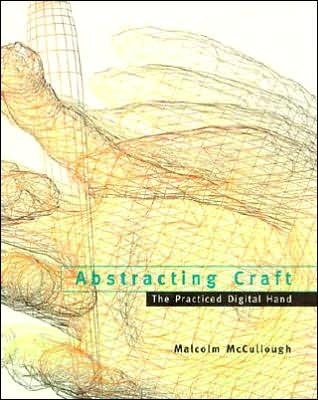
Abstracting Craft: The Practiced Digital Hand
The love of making things need not be confined to the physical world —electronic form giving can also be a rewarding hands-on experience. In this investigation of the possibility of craft in the digital realm, Malcolm McCullough observes that the emergence of computation as a medium, rather than just a set of tools, suggests a growing correspondence between digital work and traditional craft.
Personal and conversational in tone, with examples and illustrations drawn from a variety of disciplines, Abstracting Craft shows that anyone who gives form with software, whether in architecture, painting, animating, modeling, simulating, or manufacturing, is practicing personal knowledge and producing visual artifacts that, although not material, are nevertheless products of the hands, eyes, and mind.
Chapter by chapter, McCullough builds a case for upholding humane traits and values during the formative stages of new practices in digital media. He covers the nature of hand-eye coordination; the working context of the image culture; aspects of tool usage and medium appreciation; uses and limitations of symbolic methods; issues in human-computer interaction; geometric constructions and abstract methods in design; the necessity of improvisation; and the personal worth of work.
For those new to computing, McCullough offers an inside view of what the technology is like, what the important technical issues are, and how creative computing fits within a larger intellectual history. Specialists in human-computer interaction will find an interesting case study of the anthropological and psychological issues that matter to designers. Artificial intelligence researchers will be reminded that much activity fails to fit articulable formalisms. Aesthetic theorists will find a curiously developed case of neostructuralism, and cultural critics will be asked to imagine a praxis in which technology no longer represents an authoritarian opposition. Finally, the unheralded legions of digital craftspersons will find a full-blown acknowledgment of their artistry and humanity.
Personal and conversational in tone, with examples and illustrations drawn from a variety of disciplines, Abstracting Craft shows that anyone who gives form with software, whether in architecture, painting, animating, modeling, simulating, or manufacturing, is practicing personal knowledge and producing visual artifacts that, although not material, are nevertheless products of the hands, eyes, and mind.
Chapter by chapter, McCullough builds a case for upholding humane traits and values during the formative stages of new practices in digital media. He covers the nature of hand-eye coordination; the working context of the image culture; aspects of tool usage and medium appreciation; uses and limitations of symbolic methods; issues in human-computer interaction; geometric constructions and abstract methods in design; the necessity of improvisation; and the personal worth of work.
For those new to computing, McCullough offers an inside view of what the technology is like, what the important technical issues are, and how creative computing fits within a larger intellectual history. Specialists in human-computer interaction will find an interesting case study of the anthropological and psychological issues that matter to designers. Artificial intelligence researchers will be reminded that much activity fails to fit articulable formalisms. Aesthetic theorists will find a curiously developed case of neostructuralism, and cultural critics will be asked to imagine a praxis in which technology no longer represents an authoritarian opposition. Finally, the unheralded legions of digital craftspersons will find a full-blown acknowledgment of their artistry and humanity.
309 pages, Hardcover
First published March 15, 1997
Ratings & Reviews
Friends & Following
Create a free account to discover what your friends think of this book!
Community Reviews
Displaying 1 - 5 of 5 reviews
August 18, 2026
ahead of its time; great chapters on hand, craftsmanship, and tools; it helped me solidify my stance in general, but also brought back a little bit of optimism for a better digital future. maybe we're not there yet

May 25, 2020
An amazingly insightful book that felt slightly ahead of its time.
This entire review has been hidden because of spoilers.
December 5, 2016
The best tools feel like extensions of the hand--or of the mind. When a craftsman shapes material with a tool, the tool is not the locus of his attention, the work is--or should be. A tool that we have to pay attention to--or that we have to shift attention away from work to operate, is a poor tool. McCullough attacks this question of how digital tools can be an extension, and not an interruption, of our work. With digital mediums we are manipulating bits, not atoms. How may tacit and kinesthetic knowledge find a useful place in digital creation and control? Tools too often "get in the way," rather than multiplying effort. There is much here to apply to the tools we create as well as the tools we use. This book is a very thoughtful treatment of the road to technological craftsmanship.

December 16, 2013
An incredible book about our relationship to digital media and how we as creators can transition from digital literacy into digital mastery. This book is important to me for many reasons: 1. It solidified my notions about understanding digital media as a material and 2. how can we think about craftsmanship in a post digital era.
February 2, 2008
A book about the base concepts behind craftsmanship and medium, brought forward to the debate over digital design tools and methodology.
Displaying 1 - 5 of 5 reviews