

What do you think?
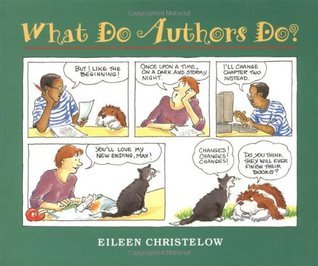
What Do Authors Do?
A sprightly text and colorful illustrations follow two creative people-and a talkative dog and cat-through the writing process step by step, from the inspiration for a story to the satisfaction of sharing the book with readers. Eileen Christelow based this instructive picture book on questions children asked during her classroom talks around the country. Simple enough for young children to understand, and with the entertainment value of fiction, "What Do Authors Do?" is children's nonfiction at its best.
40 pages, Paperback
First published January 1, 1995
About the author
Eileen Christelow
74 books53 followersEileen Christelow is an acclaimed American author and illustrator of children’s books, best known for her beloved Five Little Monkeys series. Beginning with Five Little Monkeys Jumping on the Bed, a playful retelling of the classic nursery rhyme, the series has captivated generations of young readers with its humor and rhythmic storytelling. Over the course of her career, Christelow has published more than 30 books, encompassing both fiction and nonfiction, and many inspired by her surroundings in Vermont, her family life, and even her dog, Emma.
Born in Washington, D.C. in 1943, Christelow spent her formative years in Connecticut and briefly in Japan, where she attended the American School in Tokyo. She studied architecture at the University of Pennsylvania, a discipline that would influence her later work in design and illustration. After working for several years as a freelance photographer, she turned her focus to writing and illustrating picture books while raising her daughter in California. Her earliest works, Henry and the Red Stripes and Mr. Murphy’s Marvelous Invention, were published by Clarion Books in the early 1980s.
Christelow’s books often celebrate storytelling, curiosity, and mischief, appealing to children and educators alike. Titles like What Do Authors Do?, What Do Illustrators Do?, and Vote! provide engaging nonfiction content for young readers, while others such as Letters From a Desperate Dog and The Great Pig Escape draw on humorous real-life scenarios. Her works have received numerous accolades and several Five Little Monkeys titles have been translated into Spanish and Chinese.
She continues to live and work in East Dummerston, Vermont, in a home designed by her husband, where she draws inspiration from the natural beauty of the state. Christelow remains a cherished voice in children’s literature, with a lasting legacy of entertaining and educating young readers.
Born in Washington, D.C. in 1943, Christelow spent her formative years in Connecticut and briefly in Japan, where she attended the American School in Tokyo. She studied architecture at the University of Pennsylvania, a discipline that would influence her later work in design and illustration. After working for several years as a freelance photographer, she turned her focus to writing and illustrating picture books while raising her daughter in California. Her earliest works, Henry and the Red Stripes and Mr. Murphy’s Marvelous Invention, were published by Clarion Books in the early 1980s.
Christelow’s books often celebrate storytelling, curiosity, and mischief, appealing to children and educators alike. Titles like What Do Authors Do?, What Do Illustrators Do?, and Vote! provide engaging nonfiction content for young readers, while others such as Letters From a Desperate Dog and The Great Pig Escape draw on humorous real-life scenarios. Her works have received numerous accolades and several Five Little Monkeys titles have been translated into Spanish and Chinese.
She continues to live and work in East Dummerston, Vermont, in a home designed by her husband, where she draws inspiration from the natural beauty of the state. Christelow remains a cherished voice in children’s literature, with a lasting legacy of entertaining and educating young readers.
Ratings & Reviews
Friends & Following
Create a free account to discover what your friends think of this book!
Community Reviews
Displaying 1 - 30 of 33 reviews
April 9, 2011
This is good to use for children in fourth and fifth grade. They can read about the process authors go through. This will help children understand the steps writers go through. Also they are not the only one having a difficult time writing. This book also show how hard authors work to have their books published. Reading this helps readers appreciate books even more.

October 24, 2017
When I was in elementary school, Eileen Christelow came to my school and gave a presentation on being an author. I was the grandchild of a librarian and had two bookworms for parents, so my mom told me that if I had a chance to get signed books, then I needed to take advantage of it. So she got me a signed copy of this book. It was my first signed book EVER. I was so proud.
I poured over this book so many times as a kid that I think I could probably still recite it from memory. I had never really seen the process behind what went into making a book, and I found it so fascinating. I was a big bookworm, but I hadn't really considered HOW a book was made, just that I loved them. This book made it suddenly concrete for me that, oh, huh, *I* could be an author if I wanted to be. So I started making books.
This book was the first step on my path to becoming a published author myself. I'm not entirely sure how quickly I would have found writing without this book. It made the whole process so magical, and I think about it every time another one of my books is published. Thank you so much, Eileen, for opening my eyes to the wonderful world of being able to create books, rather than just reading them.
I poured over this book so many times as a kid that I think I could probably still recite it from memory. I had never really seen the process behind what went into making a book, and I found it so fascinating. I was a big bookworm, but I hadn't really considered HOW a book was made, just that I loved them. This book made it suddenly concrete for me that, oh, huh, *I* could be an author if I wanted to be. So I started making books.
This book was the first step on my path to becoming a published author myself. I'm not entirely sure how quickly I would have found writing without this book. It made the whole process so magical, and I think about it every time another one of my books is published. Thank you so much, Eileen, for opening my eyes to the wonderful world of being able to create books, rather than just reading them.
January 23, 2023
It is funny how there is a book all about what authors do. Christelow puts a comedic comic touch to this book. She writes and draws up silly scenarios after giving short sentences about what authors actually do. Her illustrations are bright, detailed, and very kid friendly. This book draws attention to many ages and I think can be appreciated by everyone.
In the classroom, this book would be a great read-aloud activity when the class is learning about writing. It is funny but also would allow kids to understand what it takes to be an author.
Overall, great short book.
In the classroom, this book would be a great read-aloud activity when the class is learning about writing. It is funny but also would allow kids to understand what it takes to be an author.
Overall, great short book.
May 5, 2023
A bit overly educational for a children's book but you know what, the title says it all so can't really complain. And it's cool to have a book my existential dread of staring at a blank page can connect with
January 12, 2018
Christelow does a great job of showing the iterative nature of writing and publishing.
Read
January 21, 2021yygdfgtf

May 28, 2021
Shows how word are so important in storytelling.

May 8, 2025
Great book for elementary students learning about the book writing process.

August 20, 2026
Read to my students.
February 12, 2015
What Do Authors Do? is a book that combines a story with comic book illustrations. It's an interesting read and describes the process that authors have to go through when writing and publishing a book of any sort. The book begins with how a writer gets an idea for a book and then goes through how they develop it. It then discusses how authors have to find a publisher and how people around them help them edit and rewrite the book. This process reminded me a lot of the process that Ms. Patsi Trollinger discussed in class. It seemed to be exactly what she went through when publishing her own books. After the book has been discovered by a publisher, a whole other process begins where the author has to wait for the book to be published and distributed and it seems to take a very long time to get a book on a shelf. This book was very intriguing, but I am not sure it would interest younger children. I think that this type of book would appeal to children in fourth grade and above just due to how long it is compared to other children's picture books. There is a lot going on in the illustrations and in the text that is all over the page. It definitely keeps the reader interested, but it might be too complicated or too distracting for anyone who is younger. I love that this story that it tells is one that is informational and true. It takes a nonfictional process and turns it into a fun story. This kind of list can be difficult to write up and intrigue an audience, but I think the author and illustrator of this book did a great job!

April 14, 2013
This book, in comic format, tells the story of two friends seeing their pets chase each other, being inspired, then going through the process of writing a book each. The cat owner writes a picture book, while the dog owner writes a chapter book. With their pets by their side (and making observations to the reader and each other the whole time), each goes through different steps of the writing process. It shows them struggle with a beginning, going through editing, proofreading the final copy, and eventually examining their finished products.
The images offer a comedic touch to the book. It is a sympathetic and honest examination of the writing process that authors actually go through, which could easily help children understand that stories don't spring fully-formed from the minds of their creators. The illustration is simple, with pleasantly toned watercolor used.
I would love to share this before beginning writers' workshop groups with 3rd through 5th grade students.
The images offer a comedic touch to the book. It is a sympathetic and honest examination of the writing process that authors actually go through, which could easily help children understand that stories don't spring fully-formed from the minds of their creators. The illustration is simple, with pleasantly toned watercolor used.
I would love to share this before beginning writers' workshop groups with 3rd through 5th grade students.

Read
March 11, 2011AWESOME book! this was a great book to read to students who are learning the importance of writing. Although this book is slightly long for a read aloud you could stop and have the students practice what they have just heard in the book. I felt like this was such a wonderful book because it shows the student what every author goes through, I remember when I was learning how to write I wouldn't edit my paper because I thought "real" authors did not need to do that and I am sure that there are many students in your classroom feel the same way. This book is a wonderful book that will encourage students to want to write like an author!

April 20, 2010
This is an interesting book that describes in detail the process that a children's author has to follow in order to publish a book. It talks of the inspiration, the writing, the vast amounts of editing, the publishing and finally the selling of the story. It is a good way to teach young, inspiring authors about the process. I like that it is honest that often publishers will reject a story idea and that it takes patience and perseverence to be successful.
February 21, 2013
This book is an informative and interesting way to present to readers the process authors go through and what they do in order to publish a piece of work. It goes over how authors may get their inspiration, writer's block, researching for more information, rejection, collaboration with illustrators, and much more. I think this story is a very extensive and valuable resource when introducing the writing process to students because it's written in a way that is accessible to children.

February 3, 2008
Christelow's book explains the work of an author in an easy to follow comic/text format. The work of an author is presented in a realistic and non-romanticized fashion - rejection letters and bad reviews are featured- and the simplicity of the text and detailed illustrations allow for a greater range of audience.

January 14, 2015
This book should be in every classroom to help students understand that good authors and illustrators make many drafts and revisions before something is published. So many students I talk with feel that they will never be good writers and artists because they cannot produce perfect pictures and prose on the first draft. We need to teach our children persistence, patience and endurance!

March 16, 2008
Her following two authors from idea to publication works for me because she focuses on the idea of getting it write, and how hard it is, and how great it is when it finally comes together. I especially liked her focus on revision.

August 17, 2011
I think this book could have been a lot better than it was. It ended up being a little silly and very juvenile. I wasn't a big fan of the illustrations either. Overall, may be a good read for primary grades, but I think older readers would roll their eyes.
September 27, 2011
I liked the process explanations--it was detailed and realistic. I did not like the writing--it was so rote. Sentences were almost all subject-verb, similar length. So, ideas were good; writing was not so much.
January 28, 2012
A great book for understanding different writing techniques. It also covers how a book is written and published. This book follows two authors who are writing about the same incident, but see if from two different view points. The stories are completely different.

May 21, 2008
excellent read before you begin to write or before an author study
June 28, 2008
A picture book detailing the very long process authors go through from coming up with ideas to hopefully getting their manuscript published. This book was written in somewhat of a comic strip format.

July 1, 2009
Fun look at what the writing process is like for two authors.
July 10, 2011
Can't wait to use this to open my writers' workshop this fall!

Read
September 1, 2011Very cool comic style writing book. Can use to show students how writers come up with ideas and the writing process.

September 15, 2011
Love this book --as a reading teacher, I read this book and talked about author's purpose.
June 18, 2012
I would use this book. I like how it shows the children the true process of what it takes for authors to write the books they know and love.

April 3, 2013
Similar in format to her book, "Vote!" Students will enjoy the illustrations and comments from the pets of the authors in the illustrations.

Read
April 24, 2013This book is great for fluency. Not only so, it has lots of great vocabulary.
August 21, 2013
This book taught us what it takes to write a book.
Displaying 1 - 30 of 33 reviews