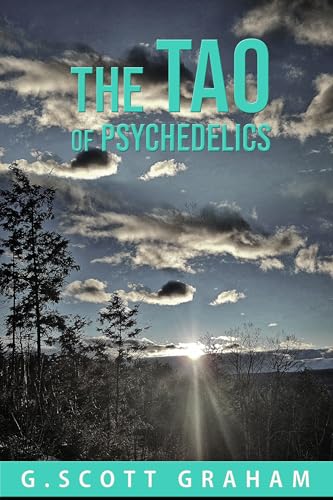
The Tao of Psychedelics is not a book you read once — it’s a book you return to, again and again, as the journey unfolds. Structured around 120 Taoist-style reflections — 60 before the psychedelic experience and 60 after — this book invites you into presence, psychological flexibility, and deep inner listening. Every reading is a daily companion that prepares your heart, your body, and your mind to engage fully with the medicine — and to live meaningfully in its wake.
In the preparation phase, these short poetic chapters help you quiet the noise, soften control, clarify intention, and grow the internal skills that matter awareness, openness, and embodied presence. In the integration phase, they offer grounding insight and emotional honesty — guiding you to stay connected with what you discovered, long after the ceremony ends.
Whether you’re preparing for your first psychedelic experience or integrating your tenth, The Tao of Psychedelics offers a rare kind of not advice, but wisdom. Not instruction, but invitation. Not certainty, but alignment.
Each entry draws from Acceptance and Commitment Therapy, somatic psychology, and Taoist paradox — while staying grounded in nature, humility, and the universal rhythms of transformation. You’ll find yourself breathing deeper, noticing more, and stepping back into your life with a sense of rooted clarity.
This book stands powerfully on its own — but when paired with Psychedelic Preparation Sixty Days to Engagement and Psychedelic Integration Sixty-Day Journal & Transcendence Blueprint, it becomes part of a complete system to prepare, engage, and integrate with intention, courage, and grace.
If you're seeking not just a trip, but a transformation — The Tao of Psychedelics is your guide.
G. Scott Graham is an existential handyman — fixing what’s broken, realigning what’s off-kilter, and helping people rebuild their lives with meaning, purpose, and the occasional strip of duct tape. He’s also an author, career coach, business coach, and psychedelic support coach based in Boston, Massachusetts.
Scott is driven to help clients follow their “true azimuth” — a direction distinct from “true north.” It’s not about chasing some universal ideal. It’s about identifying what genuinely matters to you. It’s about recognizing the forces that pull your life off course and learning how to adjust so you still arrive where your heart wants to go. When you're 90 and looking back, your life should feel like it was truly yours — filled with pride, purpose, and meaning. No regrets.
When he’s not coaching people to be their very best, Scott runs a nonprofit farm animal rescue and lives what he teaches. He does Tough Mudders, teaches Sun 73 Tai Chi, paddleboards with his dogs Groot and Rocket, and camps in State Parks across New England whenever he can. His daily spiritual practice is grounded in anāpānasati, vipassanā, and mettā-bhāvanā meditation. A firm believer in service as the heart of a life well-lived, Scott also volunteers as an EMT instructor, firefighter, and Master Gardener in his community.
In his "free time," he writes books.
Number fifty-five on his bucket list is to write 100 books before he dies, so you will see a lot here in the coming years!
G. Scott Graham has a lot of interests so he is not pinned down to only a few types of books!
Check out Scott's photos! And be sure and follow him to stay up to date when he publishes his next book!
As an advance reader of The Tao of Psychedelics, I found myself returning again and again to the same realization: this is not a book to read once. It is a companion to live with. G. Scott Graham has created something rare — a poetic yet practical guide that walks beside the psychedelic journey from preparation through integration, without ever pretending to lead it.
Structured as a sequence of short, contemplative reflections, the book invites a slow, intentional rhythm. It leans on Taoist sensibility, somatic presence, and values-based action rather than clinical models or spiritual bypass. Each piece is tightly honed — often no more than a page — yet layered with enough psychological insight and existential depth to warrant revisiting.
As someone who works in integration professionally, I appreciated the way this ARC resists oversimplification. It does not chase peak experiences or offer prescriptive fixes. Instead, it helps the reader build capacity for ambiguity, discomfort, and presence — which is, after all, the actual work of integration. Graham is especially skillful at weaving in themes of embodiment, emotional honesty, and non-reactivity without losing the lyrical quality that makes this book so immersive.
The Tao of Psychedelics is not a clinical manual, but it is deeply supportive of clinical goals. It models the kind of grounded, values-aligned engagement we hope to foster in our clients and ourselves. A remarkable contribution to the field — and one I’ll be recommending long after this advance copy has been dog-eared beyond recognition.