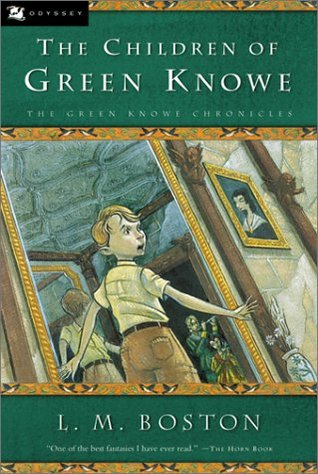
In the beginning of Lucy M. Boston's wonderful children's book, The Children of Green Knowe (1954), seven-year-old Toseland (pet name Tolly) travels by train through the flooded British countryside to spend his Christmas holidays with his great-grandmother Mrs. Oldknow in her old castle-like house Green Noah (true name Green Knowe). Tolly is a lonely and imaginative boy, Mrs. Oldknow a solitary and imaginative old lady, and they hit it off immediately, encouraging each other's fancies and treating each other with mutual respect and affection.
Green Knowe is a fascinating house, with a long history going back to the crusades, and although Tolly has never been there before, he feels that he has come home, and Mrs. Oldknow greets him, "Ah, so you've come back!" The manor is filled with objects redolent of history and love and magic: a doll's house that duplicates the entire manor house; a rocking horse with real horse's hair; a life-like wooden Japanese mouse (that may come alive when Tolly is asleep); mirrors that double the treasures of the house and make them more vivid and mysterious; and a painting of two boys and a girl and their mother and grandmother, Tolly's ancestors from the seventeenth century.
The children in the painting seem to watch Tolly, their eyes tracking him as he moves across the room. When, desperate for friends and siblings, Tolly closes his eyes to go to sleep, he begins hearing the children riding the rocking horse, pattering bare foot on the wooden floor, turning the pages of a book, and whispering and laughing in corners, but everywhere he looks they have just vanished. Despite Mrs. Oldknow's advice to be patient, Tolly feels flashes of exquisite frustration. Will he ever see the children? Do they even exist? Are they only figments of his and Mrs. Oldknow's imaginations, elements of their game of wish fulfillment? Tolly's dreams and daydreams bring the children tantalizingly closer. And the more stories he hears about them from his great-grandmother and the more he explores the house and its secrets, the closer he comes to (perhaps) seeing them while awake.
The novel depicts the magical influence of the past on the present when the meeting of a potent place and a sensitive person is intensified by art, knowledge, desire, imagination, and love, such that objects and figures from the past persist beyond their eras and enter and change the lives of people in the present. This can be very moving, as when Mrs. Oldknow calls Tolly Toby, the pet name of both her own son (who died during WWI) and of the eldest boy in the painting (who died over 300 years ago), because the three boys fuse in her heart and mind and hence in the "real" world. Tolly accepts being called Toby without any indignation. After all, he has come home.
Boston has an artist's eye for detail and a magician's manner with words and mood, as in the following moments.
Tolly's seeing Mrs. Oldknow for the first time: “She had short silver curls and her face had so many wrinkles it looked as if someone had been trying to draw her for a very long time and every line put in had made the face more like her. She was wearing a soft dress of folded velvet that was as black as a hole in darkness.”
Tolly nearly seeing the children: "Perhaps it was only the wind, but there seemed to be some movement. A great deal was going on out of sight."
Tolly "sneezing in the dust of centuries."
Snow falling: "The snow was piling up on the branches, on the walls, on the ground, on St. Christopher's face and shoulders, without any sound at all, softer than the thin spray of fountains, or falling leaves, or butterflies against a window, or wood ash dropping, or hair when the barber cuts it. Yet when a flake landed on his cheek, it was heavy. He felt the splosh but could not hear it."
Mrs. Oldknow and Tolly playing and singing a cradlesong, "while, four hundred years ago, a baby went to sleep."
Through the main story of Tolly coming home and trying to get to know the children of Green Knowe, Boston weaves a plot featuring a curse and an inimical old yew tree cut into the shape of Noah. Her use of a gypsy witch and her horse thief son as convenient villains in the past is the only problem I have with the novel. But that political incorrectness was not unusual for the 1950s when Boston wrote The Children of Green Knowe. And for the most part the novel is delightful--magical, humorous, scary, joyful, sad, and beautiful.