Preeminent researcher and professor of the psychology of kindness Dr. Gillian Sandstrom reveals how making connections with strangers leads to positive shifts in our everyday lives.
Do you ever feel lonely, even in a crowd? Do you feel anxious or worried about what others think of you, or struggle to make friends? You are not alone. But the truth is, opportunities for positive connection and community are all around you.
In this groundbreaking book, Dr. Gillian Sandstrom reveals that by talking to strangers, we can unlock more joy, curiosity, and goodwill every day. In an age when loneliness is a social health crisis and harmful behaviors like groupthink increase our perception of distance and polarization, this transformational guide explains the benefits of stretching our perceived limits and connecting with our fellow humans,
Increased happiness and wellbeing
Improved social skills and self-esteem
Reduced anxiety and social biases
Expanded connections and social circles
Combining powerful scientific findings with stories from her own life, Dr. Sandstrom offers us a new vision of a life well lived, when we have the courage to reach out and simply say, “hello.”
Gillian Sandstrom is an associate professor of psychology at the University of Sussex, where she conducts research on minimal social interactions between strangers and teaches a class called Social Connection and Disconnection. Her research interests also include kindness and well-being, and she is the director of the Sussex Centre for Research on Kindness. Gillian holds a PhD in psychology from the University of British Columbia, an MA in psychology from Ryerson (now Toronto Metropolitan) University and a BMath in computer science from the University of Waterloo. Her writing has appeared in Harvard Business Review and Scientific American, and her research has been featured in major media outlets in the US (e.g., The New York Times, The Washington Post, The Wall Street Journal), the UK (e.g., The Guardian, BBC News), and around the world.
I really enjoyed this book! I've been a big fan of Dr. Sandstorm's work for a while now, so I might be biased. Nevertheless, I thought this was a great example of the balance of science and personal storytelling that makes for a great pop-psych book!
The People We Keep Mistaking for Scenery On Gillian Sandstrom’s “Once Upon a Stranger,” and the ordinary encounters that make a life feel less mute, less private, and more human By Demetris Papadimitropoulos | March 24th, 2026
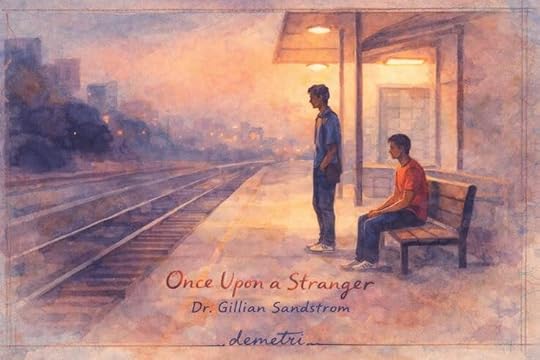
Two strangers wait beneath station light at dusk, not yet speaking, while the charged space between them holds the central promise of “Once Upon a Stranger” – that an ordinary public moment may be only one small act of courage away from becoming newly, quietly human.
The little lie at the center of “Once Upon a Stranger” is the one many of us tell ourselves just before we speak. The stranger beside us in line does not want to talk. The person on the train will think we are odd. The cashier would prefer a transaction, not a sentence. If we do begin, we will stall; if we stall, the silence will ring; if the silence rings, the whole thing will feel faintly humiliating. Gillian Sandstrom’s smart, companionable book is built on the claim that this private script is usually wrong. Her real subject is not small talk in the belittling sense, nor sociability as lifestyle branding, but social miscalibration – our habit of predicting awkwardness, indifference, or rejection where experience more often yields interest, relief, amusement, and, now and then, consequence.
Sandstrom, an associate professor of psychology at the University of Sussex, studies brief interactions between strangers, and “Once Upon a Stranger” turns that specialty into a broader argument about daily public life. The fairy-tale title is not cute by accident. She wants to restore a sense of possibility to encounters that contemporary life has taught many of us to treat as either inefficient or vaguely menacing. She begins with her father, a virtuoso talker to strangers whose ease once mortified his daughter, and with her own younger self, shy enough to let her suitcase disappear from a flight rather than press the call button and speak to a flight attendant. From there the book proceeds by a series of brisk corrections. Why do we avoid strangers? What, exactly, do we fear will happen if we speak? What actually happens? What do these encounters give us besides a few exchanged words? By the time we reach the appendix, with its prompts, tactics, and graded exercises, the book has shifted from explanation to invitation. The reader is no longer merely being told that stranger-talk can be good for you. The reader is being nudged, with notable tact, toward trying it.
The foundational correction arrives early with the “liking gap,” the finding that people in conversation tend to believe they made a worse impression than they did. We notice the clumsy phrase, the pause a beat too long, the joke that lands somewhere south of triumph. Our partner notices, more simply, that the exchange felt good. Sandstrom gives this inner saboteur a name – Sid. The device is slightly cornier than the book strictly needs, but it earns its keep. Sid is the voice that tells us we are failing in real time, and one of the pleasures of “Once Upon a Stranger” is watching Sandstrom marshal study after study showing that Sid is, in technical language, full of it. Conversations with strangers are less awkward than predicted, less likely to end in rejection than feared, and more enjoyable than the anxious mind permits in advance. Sandstrom is particularly good at translating research back into recognizable life. She does not merely cite findings. She rephrases them as felt experience: you worry too much; people like you more than you think; the conversation is not nearly as doomed as the little prosecutor in your head insists.
What keeps the book from becoming a pile of agreeable findings is its braid of study and story. Sandstrom is not sprinkling anecdotes over data like parsley over potatoes. She is showing how a social worldview gets built, then revised. A lawyer’s midlife career change becomes a puzzle piece that helps her imagine leaving computer programming for psychology. A woman at a hot dog stand, with whom she barely even speaks, becomes part of the fragile social weave that helps her feel she belongs during an uneasy return to school. A former classmate glimpsed at the opera later becomes her husband. A conversation in a conference lobby helps set in motion the chain that leads to a new job. Sandstrom does not pretend that every interaction with a stranger is secretly life-changing. Quite the opposite. Her point is that most are not. But if you never enter the encounter, you never receive the fact, the recommendation, the joke, the useful angle of vision, the small flare of confidence, the seed.
Those seeds matter because Sandstrom is less interested in the dazzling exception than in what repeated, low-stakes contact slowly does to a person. Her recurring metaphors – seeds, puzzle pieces, threads, strings, skeleton keys, rosebushes – do not all carry equal imaginative weight, but they do give the book an internal language for scale. The strongest is probably the “skeleton key” of Chapter 6, where talking to strangers becomes not simply one social skill among others but practice in tolerating discomfort. The gain is not just conversational ease. It is learning how to survive uncertainty, how to ask for something, how to risk looking foolish, how to hear no without converting it into a verdict on one’s entire personhood. By the time Sandstrom describes putting up her hand at a conference, complimenting a speaker, cheekily suggesting he invite her back to give a talk, and later asking his advice about a job, the point is clear. A person who has practiced small acts of public courage has also, perhaps without quite noticing, been training for other doors.
The prose serves this project well. Sandstrom writes like a researcher who has met the people in her own data and has no wish to bludgeon the reader with terminology. Her sentences are clear, flexible, and well-paced. The diction is plain without going dead. She has a neat instinct for the lightly comic aside and knows when a parenthesis can take the starch out of instruction. The tone is warm, mildly self-mocking, and alert to embarrassment without becoming precious about it. This is not the kind of book that depends on verbal pyrotechnics, and it would be a worse one if it were. Its chief stylistic virtue is hospitality. Sandstrom makes the reader feel accompanied rather than managed, which is exactly the right quality in a book trying to make the social world seem less forbidding. Still, readability is not quite the same as distinction. The language is often charming, occasionally funny, and consistently lucid, but only intermittently memorable at the sentence level. The book lingers less because it offers great lines than because the ideas and examples keep clicking together with persuasive force.
Its formal design is similarly double-edged. On the one hand, the structure is admirably clear. Sandstrom begins with barriers – awkwardness, boredom, rejection, judgment – then moves through no-strings-attached disclosure, learning, creativity, weak ties, being seen, and kindness, before ending with a direct appeal to practice. Each chapter knows its job. The appendix matters because it confirms that the book is not merely descriptive or consoling; it wants to alter conduct. On the other hand, the same design also exposes a limit. Sandstrom is often re-proving the same insight from a new angle rather than genuinely complicating it. We predict too much awkwardness. We underestimate other people’s kindness. We are too harsh on ourselves. Small interactions matter more than we think. These are strong claims. They are also repeated often enough that the argument occasionally loses voltage. The book gains trust by repetition and loses some surprise by the same method.
What makes “Once Upon a Stranger” more than a buoyant self-help manual is its sense of scale. Many books about connection speak in the register of friendship, romance, family, community, or social breakdown. Sandstrom chooses a smaller unit. She asks what happens if we take seriously interactions so slight we barely know how to count them: the barista who recognizes us, the bus driver we thank, the stranger who smiles at the right moment, the fellow traveler who offers advice, the dog owner whose pet becomes a conversational bridge. She keeps insisting on a point that sounds modest until one realizes how much follows from it: the ordinary is not where meaning goes to die. Passing recognitions, fleeting chats, and half-accidental encounters are not scraps left over after real life has happened elsewhere. They are part of what a day feels like from the inside. Sandstrom is especially persuasive on the force of being seen. The hot dog lady who helps her belong on campus, the Tate Modern volunteers who make visitors feel more connected to art, the woman with the telephoto lens on Brighton pier with whom she shares the silence and awe of a starling murmuration – these scenes do more than charm. They steadily upgrade things we habitually downgrade.
This is the point at which the book becomes more interesting than its pitch. Sandstrom is not merely arguing that small talk is pleasant, nor even that strangers can become important. She is arguing that many of us have quietly reduced other people to background scenery. Once that thought takes hold, the book’s examples stop feeling like cheerful evidence and start feeling like an argument about what public life is for. A stranger is not only a possible future friend, source of information, or opportunity. A stranger is part of the medium through which a day acquires texture, friction, surprise, recognition, relief. To lose those contacts is not just to become lonelier in a broad epidemiological sense. It is to inhabit a thinner world.
The present tense of the book is easy to feel because Sandstrom is describing a world already thinned by screens, remote routines, online shopping, and the private kingdom of the phone. Why bother fumbling through a moment of human awkwardness when a device can route, order, pay, recommend, and distract? Sandstrom does not answer that question with moral panic. She is not trying to guilt readers into a rustic cult of face-to-face virtue. She likes convenience too. Her point is subtler and stronger: efficiency has hidden costs, and one of them is social atrophy. A life designed to minimize friction may also minimize chance, novelty, and low-level fellow feeling. In that sense “Once Upon a Stranger” sits near “The Power of Strangers” and “Consequential Strangers,” though Sandstrom is less reportorial than the former and less sociological than the latter. Her scale is closer to the skin. She wants to know what a day feels like when it contains more human acknowledgment and less private bracing.
A further virtue is that Sandstrom never mistakes sociability for extrovert triumph. She remains recognizably introverted throughout – overstimulated by crowds, happier one-on-one than in a roomful of mingling, fully capable of preferring a sofa, a book, and a cup of tea to a social event. This matters because it prevents the book from turning sociability into a moral performance. Her claim is not that everyone should become a dazzling public improviser. It is that one can remain anxious, private, and occasionally overwhelmed and still enlarge one’s life through small acts of outwardness. The social self, in her account, does not need to become ravenous. It only needs to stop assuming defeat before it opens its mouth.
The central limitation is less literary than social, but it matters. Sandstrom sometimes treats public space as more evenly navigable than it is. She acknowledges safety concerns, distinguishes friendliness from flirtation with care, and advises readers to choose safe, public, low-risk settings. But these acknowledgments remain secondary to a broader assumption: for most readers, most of the time, strangers are available as benign opportunity. That is true often enough to make the book useful. It is not true evenly enough to make its optimism universal. Who gets to treat public life as mild experiment rather than calculation is not evenly distributed. Gender, race, class, disability, geography, and local norms all shape that difference. The omission does not sink the book, but it does set a boundary around its generosity. Sandstrom’s correction to social pessimism is persuasive; it is not equally portable.
Still, the book’s best insight survives that caveat. Sandstrom’s most original claim is not that strangers can become friends, lovers, or life-changing helpers, though sometimes they do. It is that even when they do not become anything larger, they matter. That is a harder argument to make, and a more valuable one. Plenty of books celebrate relationships once they become legible as relationships. Sandstrom is interested in the unstable, almost embarrassing category that comes before that – the nodding acquaintance, the barista bump, the shared joke in a queue, the smile that interrupts a spiral of private distress. She is writing about a level of experience many writers skip over because it appears too slight. Her achievement is to show that it is not slight at all.
I would place “Once Upon a Stranger” at 80/100, or 4 out of 5 stars: a genuinely strong book, even if it is more useful and perceptive than startling or profound. Its repetitions blunt some of its edge; its optimism smooths over some asymmetries it ought to press harder on. But its clarity, coherence, and humane intelligence are real. More important, it understands something many books about connection only announce. Isolation is not only a condition. It is also, at times, a reading error. We decide too early that nothing much will happen. Sandstrom does not promise revelation. She does something better and smaller. She makes the social world look less mute. By the end, the next person in line is not a future soulmate, not a miracle, not even necessarily a conversation. They are simply no longer part of the furniture.
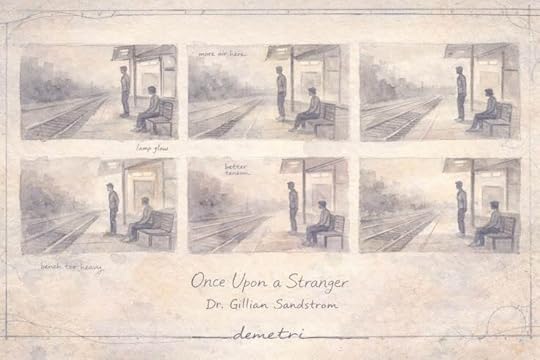
Early compositional studies testing distance, balance, and silence – the search for a structure spacious enough to let two ordinary figures, and the charged interval between them, carry the emotional argument of “Once Upon a Stranger.”
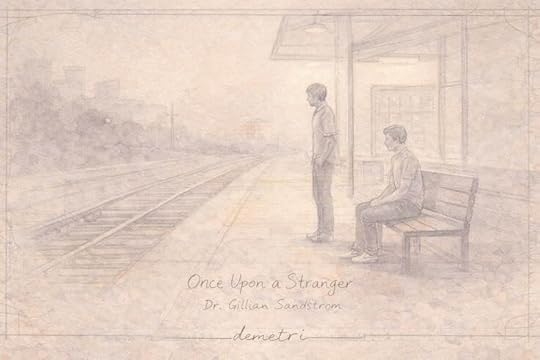
The first quiet architecture of the image – platform lines, bench, figures, and negative space lightly set in place before atmosphere arrives, showing how the painting’s feeling begins as proportion and restraint.
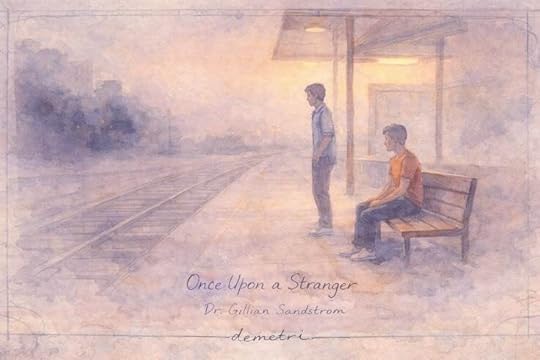
The scene beginning to breathe – cool dusk tones and the first pool of amber station light turning a skeletal drawing into a lived emotional weather of hesitation, nearness, and possible contact.
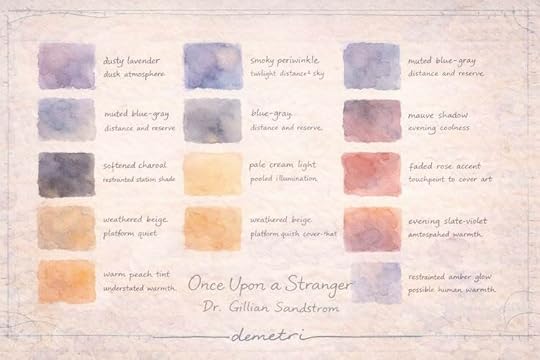
A record of the painting’s emotional palette – blue-gray reserve, smoky violet distance, and softened amber warmth worked out in advance so the final image could feel less illustrated than inwardly lit.
All watercolor illustrations by Demetris Papadimitropoulos.
Good message, but it could have been a magazine article or podcast episode. Parts of it were quite repetitive. Read this for the Longevity Book Club (virtual session with the author). 2-1/2 stars; it did give me some things to think about but could have benefited from tighter editing.
Fascinating book. Kids these days are told, “Don’t talk to strangers.” But Sandstrom, a psychologist who has spent years studying how people interact with strangers, believes speaking to people we encounter on the bus, in line at the store or wherever we go, instead of staring at our phones, is a skill we need to cultivate. It can bring us new friends, new ideas, valuable information, and happiness. She offers anecdotes from her own connections with strangers and advice for how to start conversations with people you don’t know. I highlighted many passages and have tried out a couple of her techniques. I do have a few qualms. She does not fully address the risks that come with speaking to people you don’t know, the "stranger danger" of people who might respond negatively or even violently. But overall, I do recommend this book.
Even though I study connection, I learned so much more from this book. Sandstrom does a great job debunking the idea that interactions with strangers are "lesser" than conversations with intimates, or that the value of talking to a stranger comes from the possibility that they'll potentially become a bff eventually. Instead, she argues that even if that discussion is a fleeting moment-it's still endlessly meaningful. I thought that was so beautiful- to accept the ephemeral.
Some other things I learned: 1. Talking to strangers can help us deal with uncertainty because it's awfully uncertain. It can also remind us of "possibility its self" 2. Strangers can be wiser than our more intimate ties because they have a third party perspective. 3. People are actually more comfortable being vulnerable with strangers than people they are really close to. 4. Strangers are open to talking to us about 90% of the time.
I'm convinced that strangers are special to all of us (even though we don't even know them!).
This book is fantastic and life-changing. I mean this seriously. It explains and then teaches you a simple practice you can incorporate in your daily behavior that can lead to a variety of wonderful results.
To be fair, I have a bit of bias -- I read and commented on the book as it was being written -- but that doesn't change the fact that this behavior really can change your life. Gillian describes the impressive science behind talking to strangers, including her own clever work, but interweaves that with stories of the many ways in which talking to strangers has changed the trajectory of her life (despite being an introvert herself). She also gives many suggestions for how to go about integrating this practice into your daily life, and allays every fear you may have about getting started. On top of all of that, the book is funny and a delight to read. I have been personally inspired by Gillian's stories and suggestions, and have been talking to strangers in my everyday life as well, with great results.
What an amazing book! Gillian’s blend of storytelling and data makes a compelling case for why we should say “Hi,” or “I like your shoes,” or “Have you hiked this before?” These small conversations genuinely help create a more joyful, connected life.
Full disclosure: I’ve known Gillian for years, so I wanted to like the book - and I loved it. I’ve already bought multiple copies, and I’ve asked my teens to read the first few chapters. As a fundraiser who loves talking to people (I’m definitely more like her dad), I’m also bringing this book to my next meeting with a land trust board. I sometimes run sessions on reaching out, calling donors, and engaging with attendees at AGMs, and this book speaks directly to all the unspoken reasons we hesitate to reach out (that pesky SID) while showing how talking to strangers enriches our lives and theirs.
In an increasingly disconnected world, where we don’t need to ask for directions anymore, this book feels like something we should all read.
I chose to read this book because I have been wanting to improve my ability to talk and listen to new people, even though I am an introvert and an often awkward conversationalist. The book does talk a lot about the actual scientific effects of talking to strangers, so I skimmed/skipped through much of this and read the appendix that shared different ways of talking to strangers (which is what I was actually looking to learn).
This in an open revelatory book. I encountere strangers often and are never disapppoined by who and what I discover. I urge you all to go out and uncover the joy, love, and kindness that exists in our world.
THis is part of a suite of book I have read over the past month I expect to help grow and develop the richness in my life.
I love the concept of this book and have already put a few of Sandstrom’s ideas into use. She seems like a warm and genuine person. But the book was so repetitive and obvious-stating that, as another reviewer said, it could have been an article or a podcast. I would have liked more depth and less fluff.
I picked this book on a whim. I wanted to listen to an audio book and it was available. I am so happy I did. The book is a very inspiring read and I am currently practicing many of the techniques recommended in the book.
Dr. Sandstrom presents both anecdotal and research-study evidence about how learning to and then making a practice of talking to strangers can enrich your own life and improve society in general. Appended are a "how-to" section and resources. 158.2
As an introvert this book did convince me to chat with people I see and be curious about them. I would say I’m becoming good at approaching people although judging successful interactions is saying something about people rather than you.
As a self help junkie, I really wanted to like this book, but I could only make it 20% through before giving up. This book could’ve been a 5 minute article.
A great guide for folks who are trying to work on small talk. I'm more of an extrovert so some of it doesn't work for me but I will use some skills and concepts for work.