

What do you think?
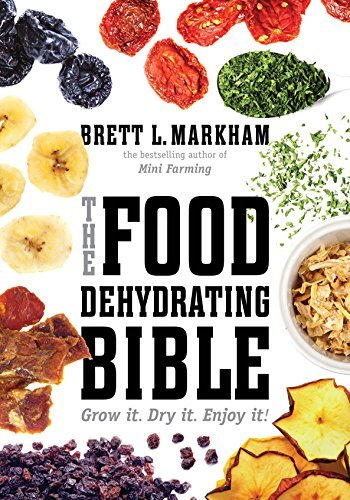
The Food Dehydrating Bible: Grow it. Dry it. Enjoy it!
Bestselling author of the Mini Farm series, self-sufficiency expert Brett Markham turns his attention to the timeless art of food dehydrating.An avid food dryer for years, Brett walks you through the simple steps for dehydrating everything from traditional classics like apples and jerky to more unusual fare. Whether you’re following a raw food lifestyle or looking for new ways to make the most of your garden’s produce, this is an inside look at all aspects of dehydrating.The Food Dehydrating Bible • Straightforward, easy easy-to to-follow instructions• Dozens of recipes• Diagrams• One hundred color photographs• And more!This is a must-have manual for beginners and dehydrating gurus alike!Skyhorse Publishing, along with our Good Books and Arcade imprints, is proud to publish a broad range of cookbooks, including books on juicing, grilling, baking, frying, home brewing and winemaking, slow cookers, and cast iron cooking. We’ve been successful with books on gluten-free cooking, vegetarian and vegan cooking, paleo, raw foods, and more. Our list includes French cooking, Swedish cooking, Austrian and German cooking, Cajun cooking, as well as books on jerky, canning and preserving, peanut butter, meatballs, oil and vinegar, bone broth, and more. While not every title we publish becomes a New York Times bestseller or a national bestseller, we are committed to books on subjects that are sometimes overlooked and to authors whose work might not otherwise find a home.
145 pages, Kindle Edition
First published July 29, 2014
About the author
Brett L. Markham
11 books24 followersBrett L. Markham is an engineer, third-generation farmer, and polymath. Using the methods explained in his book, he runs a profitable, Certified Naturally Grown mini farm on less than half an acre. Brett works full time as an engineer for a broadband ISP and farms in his spare time. He lives in New Ipswich, New Hampshire.
Ratings & Reviews
Friends & Following
Create a free account to discover what your friends think of this book!
Community Reviews
Displaying 1 - 8 of 8 reviews

May 30, 2023
A fairly straightforward book about dehydrating fruits, vegetables, meat and even bread and cakes.I've done a bit of dehydrating with a small commercial unit and it seemed to take an inordinate amount of power to dehydrate even small quantities of fruit. (oh,,,the other issue is that what starts off was a case of mangoes reduces to a very small plastic bag of the dried fruit. It's a very practical book with some good recommendations....like just use wide mouthed sealable storage jars for the dried products. They are cheaper than vacuum bags and will last well enough for all practical purposes. I also leant red that I should be pre-treating my fruits and vegetables by blanching and treating with ascorbic acid (Vitamin C) or other products such as Potassium metabisulfite. This givers a better coloured product and reduces bacteria etc that may spoil the product. Markham is pretty clear on the fact tht his dried vegetables and dried meats are probably best when used in soups and similar dishes. He has also helpfully included a lot of recipes which I will probably never try and he's includes instructions for making your own large dehydrator. (I don't think I'll be bothering). One of his throw away tips is that he will frequently take vegetables that are not going to get used from the refrigerator and run them through the dehydrator. This way he saves the fruit or vegetables and builds up a great store of dehydrated products over time. I was surprised at the length of time that he claims dehydrated product can be used (10-15 years for products vacuum packed and stored below 10 degrees C.). Though, as he says, you have to think about the cost of running a refrigerator of 10 years if you plan on doing this.
An interesting book. Does what it sets out to do. Would have been enhanced by better quality (and more) colour photos). I give it three stars.
An interesting book. Does what it sets out to do. Would have been enhanced by better quality (and more) colour photos). I give it three stars.

February 16, 2022
I've been wanting to get a dehydrator but I've dragged my feet on the idea because I wasn't sure what I was getting myself into. This book was very detailed and helpful in getting all my questions answered, even adding a few that I hadn't thought of. I liked how Markham broke down the types of dehydrating, challenges that could come up, and provided instructions and recipes. I find that it was also helpful to refer to other works that he's written. I am more prepared to get a dehydrator than I was before. I even bookmarked a few recipes that I will be referring back to. If you are thinking of dehydrating and need to either learn about preparation, temperature, and time, or you need to know what fruits, vegetables, meat, and herbs can be dehydrated, this is the book for you.

Read
November 27, 2020Maybe "Bible" is a bit of an exaggeration.
January 6, 2023
ASIC rather than comprehensive.
January 1, 2023
This is in the middle range of the several books I've read about dehydrating food. It is fairly basic and had minimal photos, at least the ebook version. There are recipes included and a chapter on building your own dehydrator—which I wasn't expecting and I might try, the author made it seem very doable. I think I would have liked a bit more instruction about specific items to dry: raspberries and pineapples, perhaps? The author mentioned an apple/corer/peeling device that he uses and I wished he'd have specified it by name. All in all, a good basic book on the topic.

January 15, 2021
This is a very good book for dehydrator newbies and really puts thing in perspective, the reason I didn’t give it five stars for the lack of pictures and more useful recipes. However, I do have to say that the instant food recipes were fantastic.
March 26, 2016
This is a great book about dehydrating food, it covers pretty much everything you'd want to know about the subject.

September 5, 2017
I expected a lot more from this. one of the first things I discovered is it is against dehydrating watermelon. in my experience that is one of the best things to dehydrate. the stuff comes out like candy. maybe it's not practical for food storage but it sure makes a so so melon amazing. so I guess I had little respect for the book after that. I also had a hard time believing a whole chapter on dehydrating bread and cake was necessary, including recipes. I wanted more charts and more organization for quick reference on more basic foods like fruits and vegetables specifically, since the subtitle says "grow it dry it enjoy it." I'm not growing cake ingredients or meat, another chapter's topic. very misleading title and very incomplete book.
Displaying 1 - 8 of 8 reviews