Jump to ratings and reviews
Rate this book

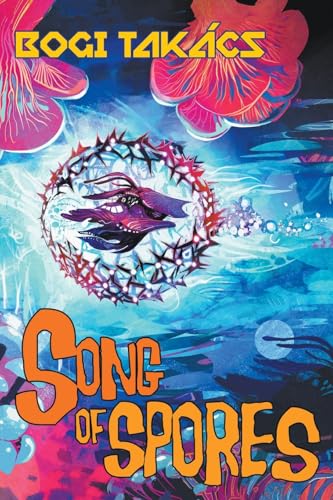
Song of Spores

Rate this book
Hugo Award winner Bogi Takács spins a tale of adventure, mystery, and political intrigue in space. Plus sentient fungus!

Three experienced counterintelligence operatives from Alliance Treaty Enforcement are on a mission to find the source of shapeshifting infiltrators within Alliance space. Will the gruff Ereni commander, the Chasidic Jewish shapeshifter, and the cynical insectoid grandma be able to work together? Or will their differences drive them apart before they can reach their goal?

Not to mention dealing with the sentient spaceship and symbiotic pilot, who only signed on to provide transportation, not to be eaten by giant space fungus. Are they even on the right side of history when everything comes crashing down?

Can the galaxy possibly survive? This is weird space opera at its finest!

216 pages, Paperback

Published November 4, 2025

1 person is currently reading
138 people want to read

About the author

Bogi Takács

64 books659 followers
Bogi Takács is a Hungarian Jewish author who writes short-form speculative fiction, poetry, nonfiction and weird unclassifiables. Eir work has been published in a variety of venues like Clarkesworld, Strange Horizons, Apex, Lightspeed and more.

Ratings & Reviews

What do you think?
Rate this book

Friends & Following

Create a free account to discover what your friends think of this book!

Community Reviews

5 stars
5 (22%)
4 stars
7 (31%)
3 stars
7 (31%)
2 stars
3 (13%)
1 star
0 (0%)
Displaying 1 - 17 of 17 reviews
Profile Image for Bogi Takács.
Author 64 books659 followers
Read
August 11, 2025
I wrote it! This is the updated, expanded version of the webserial I was doing for the Broken Eye Books patreon. Novel-length & with many unexpected turns; also with queer, trans, intersex characters. Coming November 2025! (G-d willing, but there are already advance copies. Let me know if you're interested!)
Profile Image for Silvana.
1,341 reviews1,247 followers
January 27, 2026
2.5 stars. It is a mixed bag for me, I quite liked the space opera elements - space fungus and sentient planets - and the diversity -not often we have both intersex and trans characters at the same time. There's even some magic which makes this a true genrebending novel, and not strictly weird scifi. Yet, the plotting and pace were uneven/choppy and some of the internal monologue felt overdrawn. Still glad I read it, though, if the plotting's better I am interested to read more of this world.
Profile Image for Sam.
428 reviews32 followers
November 22, 2025
Disclaimer: I received an ebook-copy from the author.

This mystery/space opera follows a group of investigators as they are called to a space station to investigate a potential case of sabotage. Genderfluid, bigender, jewish shapeshifter Dovber/Dovra, intersex nonbinary pilot Mawu, insectoid and soon-to-retire Alliance Counterintelligence officer Hlaz-mlan and member of Ereni security Anayāun find themselves caught up in something much bigger than a simple act of sabotage as they are infected with a sapient space spore and the agency they work for attempts to destroy them in order to cull the spread. Part of the story is also set on Eren, a planet I already got to know about in Takac’s short stories in Power to Yield and Other Stories. It was really interesting to return to the planet and see it through fresh eyes and different perspectives, this time that of a prospective immigrant and a member of the culture, who through psychic connection is tasked with speaking with and for another group altogether.
I really enjoyed how the various perspectives in the main group switched around, which allowed me to understand the perspective of each character better and it was interesting to see how they influenced each other’s actions and thought about the other characters.
I also loved the way shapeshifting was employed in this narrative, functioning as a form of gender affirming care for the genderfluid character, that allowed Dovber/Dovra to express his or her identity as it changed and in a variety of ways as well as be better at his or her job instead of the thing that “caused” the genderfluidity.
One final thing I quite liked were the aspects of communication and language, how various ways of communicating (verbal, through sign language and telepathic) were portrayed and they were really intriguing to read, especially since a rather big part of the story is about communicating needs and desires and possibly forming alliances. People with different cognotypes are present, as well as people who make decisions in groupminds
All in all, this is a really interesting sci-fi story that examines religion, queerness and neurodiversity and I would recommend it to fans Bogi Takác’s other works, if you enjoyed A Half-Built Garden by Ruthanna Emrys, especially for its slower paced communicative aspects and discussions of how to proceed as a society and enjoy dense sci-fi worlds that give readers plenty of worldbuilding to dig into.

TW: infection, attempted murder, discussion of mass murder, state violence, transphobia, weapons of mass destruction
Profile Image for Kaa.
624 reviews71 followers
February 15, 2026
3.5 stars, rounded up. I've been hoping for an Ereni-universe book since reading Power to Yield and Other Stories, and I enjoyed Song of Spores even if I felt it left me with more questions about the universe than I started with. There are a lot of appealing elements for me in this book: the science-fantasy feel, the exploration of multiple types of sentience, the political angle, the nuanced relationships between characters, the focus on queer and trans experiences across different cultural groups, and the overall depiction of cultural variation in a space opera setting. However, I did feel that the pacing was inconsistent, sometimes moving very quickly and sometimes getting delayed by unexpected detours. I also struggled with the ending, both in the choice of POV for that section and the speed with which everything was wrapped up. Overall, however, this was a book I was eager to return whenever I picked it up again, and this is still a universe I'd like to see more stories in.

I received a free eARC of the book from Netgalley.
Profile Image for Mel.
3,544 reviews222 followers
December 23, 2025
I loved this! The characters especially. An insectoid grandmother. Two trans characters, one Jewish, one intersex both from oppressive religious planets. An over mind that wasn't part of the insectoid race. Sentient mushroom hive minds. And a great space adventure. Definitely recommended for all queer SFF fans! (And straight people should read it too)
Profile Image for Siavahda.
Author 2 books330 followers
January 16, 2026
*I received this book for free from the publisher via NetGalley in exchange for an honest review. This does not affect my opinion of the book or the content of my review.*

I love the premise of this, the worldbuilding is WONDERFUL, and I really like most of the main cast (and suspect the ones I don’t adore yet would grow on me if I kept reading).

My issue is the prose, especially the dialogue. Quite often, there are sentences that sound jarring or clunky; the writing rhythm stops and starts a lot. The lack of contractions in the dialogue makes all the conversations sound very forced, unnatural, even among characters who are supposed to be close or friendly.

But that would be more trouble than that was worth.


The above is a pretty excellent example of what I mean by clunky phrasing – it’s not wrong, not grammatically incorrect or anything like that, but it makes me twitch because using ‘that’ instead of ‘it’ makes the sentence ping as odd.

Before this, Hlaz-mlan only felt fear and anger, but now, she was also positively vindictive.


I just think this is a really awkward way of saying what you mean. ‘Positively vindictive’ isn’t great, but the ‘also’ makes it worse, as does the comma after ‘now’.

These walls were grown, bent into shape in the time of her great-grandparents, carefully preserved and periodically reglazed. This was the first time someone would lash at the walls violently, cause destruction.


I included the first sentence for context, but the second one…eesh. Again, really clunky phrasing. ‘lash at the walls violently’?

Mlhlh-af sounded like he was molting. It was definitely not the season for that nor his turn so soon after another molting.


‘so soon after his previous molt’ would have been infinitely better.

“I could have jumped us out–” Mawu restarted.


‘Restarted’? In context, the character Mawu is saying something they’ve already said/been trying to argue, but why would you phrase it like that?

If you don’t have any problems with these quotes, then I hope you pick up this book, because it’s really great, and if the prose weren’t making me twitch I’d probably love it dearly! Alas, it IS making me twitch, so I’m going to stop at 23%.
Profile Image for Peter.
713 reviews27 followers
December 28, 2025
A team of Counterintelligence operatives share a sentient starship, including a genderfluid Jewish shapeshifter, an insectoid alien captain, an operative on loan from another culture with strong cultural inhibitions against lying, and their pilot, who is not actually an operative but has the ability to jump the ship and passengers across space to where ever their missions need them. What starts as a routine job to uncover a potential spy and saboteur turns weird when it turns out to be some previously unknown variety of fungal life that spreads through spores and that the counterintelligence team is spreading... but the life form is also intelligent and as such must be dealt with as a person, even if what it seems to want is to consume everything it finds. Some of their superiors want to merely destroy the threat, even if it means sacrificing any operative sent to encounter it.

I was able to read an advanced ebook edition of this for free via Netgalley, with implied expectation of a review. I don't think this affected my reactions, but full disclosure either way.

A bit of a mixed bag for me, sometime for things that are simply not to my tastes in science fiction. I did like the basic set of characters and the problem they're dealt with. I found myself particularly interested in some of the exploration of gender and how that conflicts with their more conservative upbringing, where even being a shapeshifter can lead to dysmorphia if the shape they' need to use isn't what they feel, and I enjoyed reading about the growing bond between them and the young pilot. There's some cool worldbuilding elements as well with different characters and societies, and as I said, I thought the basic plot had some cool potential to it.

Apparently the book was originally written in serialized form over Patreon, and it shows in terms of the plot meandering a little and not feeling tightly plotted and structured. This isn't necessarily a bad thing, but it does to tonal shifts as sometimes it's a straightforward spy op, then suddenly turns to n emergency, then first contact, then occasionally we dip into a little character bit where one character's sharing another around the homeland and then it swings back to one of the other styles again... all with the same set of characters. It still mostly works, but throughout I found myself not sure where the story was going and finding some element I liked just getting moved aside and perhaps never gotten back to as we shift gears again.

The other issue I had was with genre, and my own tastes within it. Mostly the book I'd classify as science fiction. Space Opera of course, but that's a wide spectrum that can run from mostly adhering to the laws of physics except maybe for a made up FTL system and a few other speculative technologies, right to science fantasy, and I generally like the more sci-fi oriented much more, and except for one element the book seems like it's on that side. Even the shapeshifting element is described in a context that makes perfect sense from a sci-fi concept. But there is that one element, and it's a biggie. It's enough of an element that... well, to use the example that's probably the most easily understandable, it's like The Force in Star Wars. In terms of its place within the narrative - like the Force, if you took this element out, much of the plot could still be salvaged but you'd need different motivations and some major scenes would need a lot of explanation or have to be removed entirely. It's also very much like the Force in that apparently it's some inborn quality some people have better control of or access to than others, and it can do outright magical things from our perspective. In fact, if you put "long distance space teleportation" into the Force's toolkit (and I'm sure someone in the expanded universe probably has, but here it's the primary feature people use it for) you almost might as well just imagine it actually IS the Force by another name. Unfortunately, for me, The Force is the thing about Star Wars I like least and so in this book, the similar element is the thing that, for me, makes it a much less interesting book than it might otherwise have been.

That said, it doesn't ruin the book, I still had fun with it and the author's definitely got potential and I'd like to see more from em. I might even want to read more if em did something more with these particular characters and this world. It just didn't quite hit the bullseye with my personal tastes, but still found enough in there that I'm glad I checked it out. I'd probably give it a flat 3 stars, which sometimes I feel sounds low but is a standard 'liked it' score by my reckoning.
Profile Image for Laura.
611 reviews43 followers
December 29, 2025
Song of Spores follows a multi-species team of counterintelligence operatives who are rather unlikely – described as ‘ragtag’ – as well as their pilot, whose consciousness is linked to that of the sentient ship. What begins as an investigation into what might be sabotage takes numerous twists and turns and ultimately becomes a story about power, the dynamics of large organizational entities (including but not limited to minds of a planetary scale), and communication across difference.

I picked this up on the basis of having really enjoyed the author’s short fiction. I liked a lot about it – the diverse representation shines, complex themes are well handled despite the novel’s short length, and the characters are memorable. There is a solid balance between character development and forward plot momentum. It’s a fun read that asks some interesting questions.

This is a novel that was originally published in serial form over the course of several years. I think that the elements that didn’t quite work for me may derive from this. There were a few segments that felt like unnecessary detours that could’ve been left out, and in a few places the shifts from one scene to the next felt disjointed. There were a few concepts in the world-building that I would’ve liked to have a better grasp of.

Content warnings: transphobia, queerphobia, colonization, mentions of war

Thank you to Bogi Takács, Broken Eye Books, & NetGalley for providing me with an ARC to review.
Profile Image for Amanda.
672 reviews9 followers
November 5, 2025
This has a kind of incomplete feel to it, with chapters—and sometimes even scenes—not seeming organically connected to each other. The characters also have that unfinished quality, reading more like a couple of traits stuck together instead of fully realized characters.

I do think the story is interesting and there's the potential for something really good, but I think it needs a rewrite to make it shine.

Received via NetGalley.
Profile Image for Ian Mond.
782 reviews128 followers
Read
December 9, 2025
My review of this delightful, entertaining, sentient fungus inspired novel can be found in the November 2025 issue of Locus.
Profile Image for Ailey | Bisexual Bookshelf.
350 reviews96 followers
March 9, 2026
Thank you to NetGalley and the publisher for the eARC. This book was published in the US by Broken Eye Books in November 2025.

Some science fiction invites you to learn the rules of its world before anything else happens. Song of Spores by Bogi Takács does the opposite. The novel opens in motion and trusts the reader to catch up. At first I felt slightly unmoored by the density of its worldbuilding, but that feeling soon became part of the book’s rhythm. This is a story about navigating unfamiliar systems, and the reading experience mirrors that process.

The novel follows an unusual crew sent to investigate a suspicious incident on the isolationist planet Hidi-Nivay. Among them is Dovber, a trans Jewish shapeshifter who often presents as his feminine self, Dvora, even while negotiating religious expectations that complicate how and when she can inhabit that identity. Alongside him are Mawu, an intersex jump pilot with telepathic abilities; Hlaz-mlan, an operative with a non-human body template; and Anayāun, an Ereni whose cognition is shaped by participation in a collective groupmind. Their investigation leads them to a sentient fungal entity called Mushroom Rock, whose presence transforms the mission into a strange and urgent first contact situation.

Takács builds the narrative through dialogue and philosophical exchange. Characters debate the ethics of political institutions, question the logic of expansion and extraction, and test what accountability means when responsibility is shared across systems or collectives. Those questions deepen once Mushroom Rock enters the story. Communication becomes the central tension, as the crew must learn to interpret a consciousness that speaks through borrowed language, telepathic signals, and unfamiliar cognitive frameworks.

What stayed with me most is how the novel refuses narrow assumptions about bodies, minds, and identity. Few characters resemble conventional humans, and that choice feels intentional rather than decorative. Takács imagines a universe where neurodiversity, collective consciousness, and shifting embodiments are ordinary features of life rather than deviations from it.

At its heart, Song of Spores is an adventurous and surprisingly playful read. The book asks a simple but challenging question: what would it take to truly understand someone whose way of being in the world is nothing like your own? For me, the answer the novel offers is patient curiosity and a willingness to rethink the assumptions we carry about bodies, minds, and belonging. I love this answer almost as much as I love Takács’s books.

📖 Read this if you love: politically engaged science fiction, strange, imaginative space opera, stories that explore neurodivergence, collective consciousness, and unconventional forms of communication, or speculative fiction that interrogates institutions and power.

🔑 Key Themes: Communication Across Cognitive Difference. Collective Responsibility and Accountability, Queer and Trans Embodiment, First Contact and Cross-Species Ethics, Expansion, Extraction, and Ecological Harm, Reimagining Community Beyond the Human.
Profile Image for Clara Ward.
Author 11 books33 followers
August 28, 2025
Enjoy space exploration with different cognotypes and groupminds! I loved the modern twists on old space opera standards (e.g. differing prime directives and quoting others culture’s texts as a means to communicate). Several social observations were as relevant to this moment as to any far future (although the afterward points out they were timely during writing, three to eight years ago, and also in Communist-era Hungary). Overall, there’s lots to think about and revel in, with my main complaint being that I’d like more time with the characters, so I appreciate the author hinting “if I ever write a sequel…”
Profile Image for A.
420 reviews16 followers
November 14, 2025
I had really high hopes for this book. I've heard great things about the author and I love a queer scifi novel. However for such a short book, there were several POVs and it felt disjointed for that. I had a difficult time following what was happening. I usually enjoy books that throw you in and expect you to figure out the world building, but between the complex world building and disjointed narrative I was struggling. I stopped reading this at about 50%.
Profile Image for Kait.
50 reviews14 followers
February 22, 2026
Fantastic!!! For me reading this followed both fiction and non-fiction on the general topics of plant intelligence, fungal intelligence and different kinds of minds. I'd previously read some of the author's shorter works and was excited to immerse myself in some of their world-building in a longer piece. This was rewarding on all fronts. A fun but thought-provoking romp.
Profile Image for Georgann .
1,067 reviews34 followers
January 21, 2026
The very odd character names kept me from liking it much as I started, altho I did get used to them. Such odd things kept happening that I couldn't seem to understand. It was weird, even for sci-fi.
2,501 reviews53 followers
March 9, 2026
Absolutely absurdist, but in the fun way. You get the story of an attempt to find an infiltration source that involves three members of the galactic authorities and how their own nonconformities make the entire situation even more absurd. Fun read over the last little while.
Displaying 1 - 17 of 17 reviews