X-Factor's part in the "X-Cutioner's Song Saga" sets them against X-Force while the life of mutual mentor Professor X hangs in the balance The mutant teams finally rally to the same side, only to be outnumbered by three-times the scheming as Apocalypse, Stryfe, and Mister Sinister vie to see who can kill them first The Horsemen, the Mutant Liberation Front, and the Dark Riders are all in on a wild battleride leading to the Moon and a turning point in mutantdom's destiny All this plus jousting in Genosha, trips into our heroes' deepest psyches and final battle with the deadliest enemies X-Factor's never heard of Guest-starring the X-Men, Doc Samson, and more Collects X-Factor #84-89, Annual #8
Peter Allen David (aka David Peters), often abbreviated PAD, was an American writer of comic books, novels, television, films, and video games. His notable comic book work includes an award-winning 12-year run on The Incredible Hulk, as well as runs on Aquaman, Young Justice, SpyBoy, Supergirl, Fallen Angel, Spider-Man, Spider-Man 2099, Captain Marvel, and X-Factor.
His Star Trek work included comic books and novels such as the New Frontier book series. His other novels included film adaptations, media tie-ins, and original works, such as the Apropos of Nothing and Knight Life series. His television work includes series such as Babylon 5, Young Justice, Ben 10: Alien Force and Nickelodeon's Space Cases, which he co-created with Bill Mumy.
David often jokingly described his occupation as "Writer of Stuff", and he was noted for his prolific writing, characterized by its mingling of real-world issues with humor and references to popular culture, as well as elements of metafiction and self-reference.
David earned multiple awards for his work, including a 1992 Eisner Award, a 1993 Wizard Fan Award, a 1996 Haxtur Award, a 2007 Julie Award, and a 2011 GLAAD Media Award.
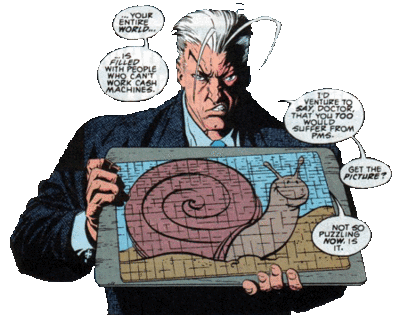
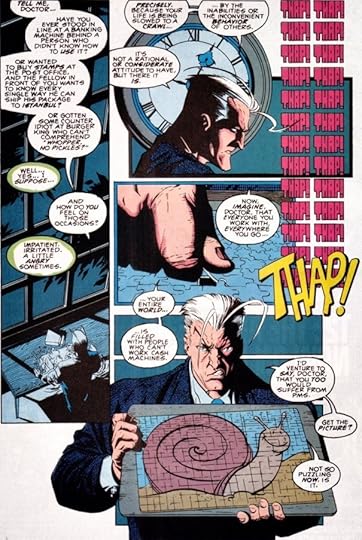
I could write about X-Men: X-Cutioner's Song and X-Factor's role in it. I could reflecy on the debut of Ramson in the flesh. But really this is all about X-Factor (1986-1998) #87 'Xaminations where Doc Samson gives each member of the team time to talk, after all they've been through. It is beyond genius, beyond quality, Rahne and her issues with authority, Pietro and him trying line in a world that feels like it runs in slow-mo to a speedster like him; Polaris and her' past; Guido's secret origin and secret pain; and Jamie on never being not alone, all paced and toned perfectly! Overall 8 out of 12 for the volume. 2017, 2015 and 2010 read
The end of Peter David's great first run on X-Factor. It's a somewhat abrupt end, to be sure, as he jumped ship (or was pushed) halfway through a story arc, which is a shame. It's still definitely worth a read, though.
Was fairly well enjoying it - until the part where the team takes turns sitting on Doc Samson's psych couch to fill an issue. It's a well written issue except for Lorna Dane's turn on Samson's couch. You'd think she'd want to talk about being mind-controlled by Malice for a year or so. But, no.
David can't seem to find anything better for her to talk to Samson about so she talks about how worried she is about her own appearance and body weight. That she wants to be sexy. Worries over it. Lacks confidence over it. It's basically a misogynistic cop-out with a screwed up reason to debut her very revealing (and ugly) new super-hero costume. It's also makes no sense for the character. It's all about sexing her up for the (male) reader.
Um... what? This is the oldest X-men female. Only Jean Grey is her senior on the team. She's very intelligent. University educated. It's very insulting.
I've enjoyed Peter David's work so far but this has really turned me off it. I hope it's a one off bad day thing for him.
Updated: November 16th 2016 I've collected some floppies beyond the collected editions. Past the Peter David run. Have started reading them. Contrary to popular wisdom, I'm enjoying the post-David run much, much more than I did the David run. Art is better also. It's a shame it is not collected into books. Some remarkable twists and turns occur. I'd like to read the whole series to the end of the run at issue 149 but need to find a few more floppies to fill in gaps yet. Enjoyable once again.
You should know that half of this book are part of the "X-cutioner's song" cross-over and that they are not very comprehensible/interesting out of context, apart from Jae Lee's drawing.
So what's left? One brilliant issue where the members of X-Factor individually see a shrink on Val's orders and 2 others cut into 2 halves: X-Factor on their way to Genosha nicely illustrated by Joe Quesada and a pointless half on Quicksilver and Crystal abominably trashed by Chris Batista.
So 1 very good, 2 average and 3 unusable-> not recommended
"X-Aminations", la storia in cui Doc Samson psicanalizza il gruppo, è un piccolo gioiello. In tre pagine Peter David rivela i motivi dietro al caratteraccio di Quicksilver. Geniale.
This marks the end of the first Peter David run on X-factor and his work with other artists than Stroman: Jae Lee, Joe Quesada, and Chris Batista. First off, David and Jae Lee do great work on "X-Cutioner's Song Saga," although Peter David's wit is sidelined by the needs of the crossover and Lee's art is more severe than Stroman's or the other artists in the "X-Cutioner's Song Saga" who were more influenced by Liefeld and Jim Lee. Yet somehow Jae Lee's heavily inked and chiaroscuro-laden art feels stylized enough to be in the spirit of Stroman's work. While it wasn't recognized as such as at time, until Batista confirms X-factor to the Jim Lee-inspired house style of the X-books, X-factor was doing the most interesting things both in writing and in art. However, it also felt aimed at older teens than the other books of the x-line and less given to the Claremont-inspired soap opera. Sadly, however, if you don't find the other books in the "X-Cutioner's Song Saga" or buy a separate trade of it, the three issues included in this collection will feel both unfinished and even more incoherent than they originally were.
After the X-Cutioner's Song, we see more vignettes and character driven work introduced by Peter David. Doc Samson's couch issue is fascinating, although Peter David doesn't seem to know exactly what to do with Lorna Dane. Something I had noticed interestingly as his run continued to hospitalize her or ignore being mind-controlled by Malice, etc. Doc Samson primarily leads to an even more sexualized costume for Lorna whose primary concern with Doc Samson is her sexiness. Given her relationship with Havoc and other issues, this is a real cop-out.
While Peter David's run with the Genosha plotline finally gets to explore Rahne's fallout over it as it bubbles up from her exposure to X-force in the prior book and 90s pop cultural references flood Rahne's dreamscape. However, by end of the plot, Skip Dietz takes over and this is a decline in quality, the end of the sitcom feel of the Peter David run, and Chris Batista's art seems rushed and trying to get X-factor more inline with X-book house style. It's disappointing, but also since it is difficult to find the mid-to-late 90s X-factor books, it hard for me to comment on if later writers like Lobdell and Dietz really change course.
Cuarto y último tomo que recopila la primera etapa de X-Factor (vol. I) de Peter David, serie que retomaría bocha de años después con un nuevo volumen (III, creo) y un planteo muy distinto pero igual de entretenido.
Aunque este volumen de Factor-X cubre los números 84 a 89, yo voy a ampliar un poco el contenido, y voy a hablar del 84 al 91, de nuevo para dejarlo justo antes de la siguiente saga, Atracciones Fatales. Ya antes de la Canción del Verdugo Larry Stroman había dejado la serie, y Jae Lee se haría cargo de ella solo durante dicha saga, así que de vuelta a la relativa normalidad, tendríamos como nuevo dibujante a Joe Quesada, que se estrenaba con uno de los números más conocidos de la colección, la visita del equipo al psicólogo Leonard Samson, un personaje recurrente de la franquicia de Hulk, en la que podíamos ver cómo los personajes iban pasando y se iban abriendo más o menos ante Doc Samson, lo que nos permitía ir atisbando los problemas de Rahne con las figuras paternas, las dudas de Kaos, los complejos de Mercurio, la realidad tras la sonrisa de Fortachón, el drama tras Madrox y los problemas de percepción sobre su cuerpo de Lorna, abocada a una enfermedad alimentaria que, con la salida de David de la colección no mucho después, se iría perdiendo.
De vuelta a su continuidad, Factor-X tuvo que solucionar el tema de los X-Patriados, los refugiados políticos de Genosha que habían aparecido en el puerto de NY poco antes de la Canción del Verdugo, y que ahora, junto a Factor-X, iban a regresar a la isla, donde Factor-X iba a encontrarse con el nuevo régimen post Magneto (recordemos que Magneto había atacado Genosha en los primeros números de X-Men), y mientras investigan que Genosha sea realmente un lugar seguro, tendrán que hacer frente a las primeras pinceladas del Virus del Legado, que afectaba sobre todo a los mutados... y del que Jamie Madrox resultaría contagiado.
Peter David dejaría la serie en mitad de esta saga, y tendrían que ser sustituidos por Scott Lobdell, con lo que de pronto la colección perdió todo su sentido del humor y todo lo que la hacía especial, convirtiéndose en una serie X más que Quesada no tardaría en abandonar también, lo que haría que incluso a nivel gráfico, sin los estilos peculiares de Stroman o Lee, o la espectacularidad de Quesada, quedaba reducida a una serie más.
after finishing peter david's saga on x-factor, i completely understand why he left but moreso, i understand why he returned in the 2000s what started out as an x-title separate, individual from the other 90s x-titles, with it's own identity and tone that was just such a breath of fresh air in the beginning, eventually just became crossover fodder for the bad part of 90s x-men, and peter david is not the one to blame for that (it's why he left) and it's why i almost dropped this series. i'm going to be honest, i didn't finish this. i couldn't get past the first issue, nor did i see any point to. much like the last volume, half of this book was a big crossover event, but it's only the peter david issues, so from a 12 part event, this book only contains parts 2, 6 and 10 with walls of text before, after and inbetween explaining what went on in the other parts... yeah no thanks, especially considering those issues become more x-men than x-factor, with the team on the damn title barely being featured. it's easy to see why peter david left very shortly after this and it's legitimately a shame because the issues following that dreadful event are legitimately great. issue 87 might be one of peter david's best issues, as it's an excellent character study with all that classic peter david charm. and the rest of the x-patriots storyline being continued after being rudely interrupted by all these crossovers, was genuinely engaging, especially with those little quicksilver side stories showing his relationship with medusa but then, just as the book gets going, it's over. no ending, it just stops in the middle, with another wall of text explaining what happened after, since peter david had stopped writing for the title at that point due to creative differences, returning months later for an annual, and then years later for a fresh start on the title. in the end, the original peter david x-factor run is something i can only describe as restrained greatness.
Artwork: Very good story: Above average. It ranged from the team seeking aftercare to us seeing how un-alright the team is and how alright the big boss sees them to be. It was alright.
A very abrupt ending to the original Davis run. It was plagued with crossovers and tie ins and then just ended. The last story (the annual) wraps it up sorta nicely though.
Wrapping up Peter David's first run on one of his defining books, this is a perfect illustration of why I don't normally give star ratings. The first three issues here are drawn from the godawful crossover X-Cutioner's Song, which was all about Cable (the stereotypically nineties guy with the muscles, pouches and ridiculously big gun) and his even more nineties nemesis Stryfe (his hat looks like the logical endpoint of razor manufacturers' determination always to add one more blade). The art is by Jae Lee, who today produces work so luminously gorgeous and art deco-tinged that it almost made Before Watchmen bearable - and by the third issue we get glimmers of that modern style; for the most part, alas, he seems to have spent the nineties doing what looks like a painfully unnecessary hybrid of Rob Liefeld and John Hicklenton. David does his best to give the script a bit of character, but in amongst this much bollocks there are limits to what he can achieve. Still, at least the fill-in pages are probably less painful than the omitted chapters from the era's other X-books. But! Immediately after that, we get Quesada coming on for much more bubbly art, and the absolute classic issue of the run, the one where Doc Samson comes in as team shrink and Quicksilver explains why he always acts like such an arse. In its own quiet way, it has as good a claim as Miracleman or The Authority to have expanded the palette of superhero comics; it's also very funny. And then we get a couple of issues of good, but not great, superhero soap opera and one utterly stupid (in the good sense) final showdown to close us out. It is, in short, all over the bloody shop.
What the hell. Peter David's initial run on X-Factor ends on weird note... the first couple issues in this collection are absorbed into nineties' X-Event X-Cutioner's Song (which is one of those classic hero vs. hero crossovers where nobody tries to explain anything) leading X-Factor to become guest stars in their own book. But then P.A.D. recovers the ball with one of the greatest X-issues ever written... X-Aminations! In which X-Factor goes to therapy! It's funny, it's dramatic, it's chock-a-block full of great character moments... this one issue is worth the price of admission alone. The rest is just extra fun stuff. Check it out. 5/5
This book suffers from including just pieces of a thoroughly mediocre crossover ("The X-Cutioner's Song" aka we're out of good X-related titles) as well as two issues where Peter David seems to have already checked out (which occurred just before he left the title). Plus, the art in the last few issues just doesn't hold up, especially compared to the beautiful insanity of the earlier Larry Stroman art. The only redeeming value is the issue where X-Factor goes to the psychiatrist. Unsarcastically, it's the best issue of Peter David's first run on the comic.
Not the best way to end his first run with this series, as there's some clunkers in here; three issues of an X crossover and the Genosha plotline never really worked for me. However, there's also some great stories in here; the single issue where the team see Doc Samson is excellent, and I have plenty of time for Quicksilver's subplot.