

What do you think?

The Year of Fear: Machine Gun Kelly and the Manhunt That Changed the Nation
It's 1933 and Prohibition has given rise to the American gangster--now infamous names like Bonnie and Clyde and John Dillinger. Bank robberies at gunpoint are commonplace and kidnapping for ransom is the scourge of a lawless nation. With local cops unauthorized to cross state lines in pursuit and no national police force, safety for kidnappers is just a short trip on back roads they know well from their bootlegging days. Gangster George "Machine Gun" Kelly and his wife, Kathryn, are some of the most celebrated criminals of the Great Depression. With gin-running operations facing extinction and bank vaults with dwindling stores of cash, Kelly sets his sights on the easy-money racket of kidnapping. His rich oilman, Charles Urschel. Enter J. Edgar Hoover, a desperate Justice Department bureaucrat who badly needs a successful prosecution to impress the new administration and save his job. Hoover's agents are given the sole authority to chase kidnappers across state lines and when Kelly bungles the snatch job, Hoover senses his big opportunity. What follows is a thrilling 20,000 mile chase over the back roads of Depression-era America, crossing 16 state lines, and generating headlines across America along the way--a historical mystery/thriller for the ages. Joe Urschel's The Year of Fear is a thrilling true crime story of gangsters and lawmen and how an obscure federal bureaucrat used this now legendary kidnapping case to launch the FBI.
304 pages, Hardcover
First published September 8, 2015
Ratings & Reviews
Friends & Following
Create a free account to discover what your friends think of this book!
Community Reviews
Displaying 1 - 30 of 70 reviews

October 17, 2025
"In the remarkable ninety days since Berenice Urschel woke [Justice Dept. adminstrator] J. Edgar Hoover from his sleep with her urgent call about her husband's kidnapping, Hoover had achieved what three months earlier would have been thought of as impossible: [law enforcement] captured and convicted the perpetrators of the most notorious kidnapping since the Lindbergh baby abduction." -- on page 228
The Year of Fear - title inspired by U.S. President Franklin Roosevelt's infamous inauguration speech quote of "the only thing we have to fear, is fear itself" in January 1933 - examines the incident and aftermath that helped establish the foundation for the Federal Bureau of Investigation. During the waning days of Prohibition but also firmly in the midst of the Great Depression, organized and/or career criminals resorted to an increasing number of kidnappings to make quick and easy cash. One such occurrence was the Saturday evening abduction of oil executive Charles Urschel from his Oklahoma City home in the summer of '33. The plot was carried out by ex-convict 'Machine Gun' Kelly and planned by his scheming and shady wife Kathryn, with Urschel was held captive for a week until a $200,000 ransom was secured for his release. While the Kellys and their co-conspirators might have earlier made a clean getaway into those back roads and backwaters of the midwestern U.S., they soon ran afoul of some innovative new strategies recently put into motion by the Justice Department, especially its young Bureau of Investigation director J. Edgar Hoover. Author Urschel - no relation to the kidnap victim - details the events in this very good true crime / history narrative, although I did not find it quite as compelling as the excellent The Kidnap Years by David Stout, which covered a number of notable snatchings that happened with alarming regularity during the 1930's.
The Year of Fear - title inspired by U.S. President Franklin Roosevelt's infamous inauguration speech quote of "the only thing we have to fear, is fear itself" in January 1933 - examines the incident and aftermath that helped establish the foundation for the Federal Bureau of Investigation. During the waning days of Prohibition but also firmly in the midst of the Great Depression, organized and/or career criminals resorted to an increasing number of kidnappings to make quick and easy cash. One such occurrence was the Saturday evening abduction of oil executive Charles Urschel from his Oklahoma City home in the summer of '33. The plot was carried out by ex-convict 'Machine Gun' Kelly and planned by his scheming and shady wife Kathryn, with Urschel was held captive for a week until a $200,000 ransom was secured for his release. While the Kellys and their co-conspirators might have earlier made a clean getaway into those back roads and backwaters of the midwestern U.S., they soon ran afoul of some innovative new strategies recently put into motion by the Justice Department, especially its young Bureau of Investigation director J. Edgar Hoover. Author Urschel - no relation to the kidnap victim - details the events in this very good true crime / history narrative, although I did not find it quite as compelling as the excellent The Kidnap Years by David Stout, which covered a number of notable snatchings that happened with alarming regularity during the 1930's.

January 21, 2016
Very interesting, but very textbook. Not much more than this happened followed by this followed by this etc. without much more outside of the events of the story (not sure I am describing this well, but it stood out a lot compared to other non-fiction I have read)
For history buffs, for mafia buffs, for true crime buffs I think this quick read about one of America's most notorious criminals will be well received.
I just found this sweet poster from a 1950s movie starring Charles Bronson (his first film). The quote made me LOL
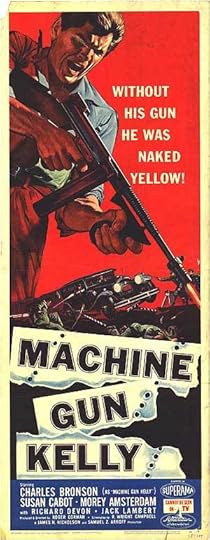
For history buffs, for mafia buffs, for true crime buffs I think this quick read about one of America's most notorious criminals will be well received.
I just found this sweet poster from a 1950s movie starring Charles Bronson (his first film). The quote made me LOL

October 4, 2015
The author of "The Year of Fear", Joe Urschel, wrote the story of Machine Gun Kelly's kidnapping of Charles Urscel, a rich oil tycoon who by the way was no relation to the author, and subsequent capture of Kelly by the US Federal government. What an interesting coincidence between author and character. J. Edgar Hoover was able to get a national police force (FBI) established by catching Kelly. BUT, he could not have caught Kelly in the short amount of time he was able to, if Kelly had not let Urschel go after the ransom was paid, or without the high level of intelligence of Urschel who even though blind folded for 8 days, was able to help the federal agents find the location where he had been held by his near perfect memory and clues he intentionally left. Hoover, and FDR needed to catch Kelly badly; Hoover to save his job and FDR to build confidence in his presidency, as he had just started his first term. Great story and well written account of bad and good guys in what was still the Wild West in the 1920's and 30's. The author made it clear the Kelly was not the man his reputation maintains, and he didn't do or say many of the things he was accused of.

August 9, 2015
My first win of a Goodreads Advanced Readers Copy is a good one! A solid 4 Star account of "Machine Gun" Kelly's kidnapping of Charles Urschel, one of the most famous crimes of the day---that I had not ever heard of. This story is at the heart of many events that will be familiar to us all:
-The rise of J Edgar Hoover
-The transformation of the FBI into a premier law enforcement agency
-The start of massive growth of federal criminal law
-The building of Alcatraz prison
-The use of propaganda by an aggressive Roosevelt administration
-Scientific criminal investigation, the predecessor of today's CSI, NCIS, etc
The title is a bit misleading. The crime at the heart of the book, the Urschel kidnapping, is only 90 days from the day of the snatch to the end of the Kelly trial. Joe Urschel manages to make it seem much more protracted and tells the story of Hoover, the FBI, the criminals of the day, the feeling in the country (many didn't mind the banks getting hit because they were the agents of foreclosure) and the new Democratic administration, ready to take advantage of any crisis to extend their power. Hoover needed a success to survive and he drove the action from afar.
George Kelly comes off as an intelligent, thoughtful person in many ways. His wife Kathryn is portrayed as the brains behind the operation and may have been. She does not want to let Charles Urschel go free after the ransom is paid. George does because he wants to do more kidnappings and no one will pay if they kill the first hostage. Charles Urschel is a unique captive and is crucial to solving the crime. His story is very good.
How "Machine Gun" Kelly got his name was a hoot. Some other characters you will enjoy hearing about.
Recommended!
-The rise of J Edgar Hoover
-The transformation of the FBI into a premier law enforcement agency
-The start of massive growth of federal criminal law
-The building of Alcatraz prison
-The use of propaganda by an aggressive Roosevelt administration
-Scientific criminal investigation, the predecessor of today's CSI, NCIS, etc
The title is a bit misleading. The crime at the heart of the book, the Urschel kidnapping, is only 90 days from the day of the snatch to the end of the Kelly trial. Joe Urschel manages to make it seem much more protracted and tells the story of Hoover, the FBI, the criminals of the day, the feeling in the country (many didn't mind the banks getting hit because they were the agents of foreclosure) and the new Democratic administration, ready to take advantage of any crisis to extend their power. Hoover needed a success to survive and he drove the action from afar.
George Kelly comes off as an intelligent, thoughtful person in many ways. His wife Kathryn is portrayed as the brains behind the operation and may have been. She does not want to let Charles Urschel go free after the ransom is paid. George does because he wants to do more kidnappings and no one will pay if they kill the first hostage. Charles Urschel is a unique captive and is crucial to solving the crime. His story is very good.
How "Machine Gun" Kelly got his name was a hoot. Some other characters you will enjoy hearing about.
Recommended!

October 4, 2023
Machine Gun Kelly - best gangster name ever ! His marketing department, his wife! created and employed it.
1932 - the Fear Year, the economic depression, crime was the headlines.
The fledgeling FBI guided by its new leader J Edgar Hoover, was inexperienced and there were few laws that gave it any power to deal with kidnapping, which, hard to imagine today, was a widespread, cottage industry. Any family of any means worried about the threat of getting a ransom note regarding a loved one. The Lindbergh baby abduction and murder led the 1932 headlines. Many kidnappings were successful and many ended up with a dead captive.
Author Urschel does an interesting if routine relaying the tale of MG Kelly’s most infamous kidnapping of a wily, Oklahoma oilman, and how it created a reason for the empowering of a federal police force, the FBI.
The Author was the director of the National Law Enforcement museum. He uses a lot of news stories, letters between criminals and other documentation which, while add authenticity, bog down the story. Having access to all this information most likely inspired this book, but doesnt explain that some of the photos are just stock footage of the era.
A good read if you are new to the genre. For a more spirited telling and much better photos, I’d suggest ’Gangster Tour of Texas’ by Baker.
1932 - the Fear Year, the economic depression, crime was the headlines.
The fledgeling FBI guided by its new leader J Edgar Hoover, was inexperienced and there were few laws that gave it any power to deal with kidnapping, which, hard to imagine today, was a widespread, cottage industry. Any family of any means worried about the threat of getting a ransom note regarding a loved one. The Lindbergh baby abduction and murder led the 1932 headlines. Many kidnappings were successful and many ended up with a dead captive.
Author Urschel does an interesting if routine relaying the tale of MG Kelly’s most infamous kidnapping of a wily, Oklahoma oilman, and how it created a reason for the empowering of a federal police force, the FBI.
The Author was the director of the National Law Enforcement museum. He uses a lot of news stories, letters between criminals and other documentation which, while add authenticity, bog down the story. Having access to all this information most likely inspired this book, but doesnt explain that some of the photos are just stock footage of the era.
A good read if you are new to the genre. For a more spirited telling and much better photos, I’d suggest ’Gangster Tour of Texas’ by Baker.

September 25, 2015
A barn burner. George “Machine Gun” Kelly may be the main character, but this is a great look at America in the early 1930s when Prohibition has given rise to gangsters and G-men. Bank robberies at gunpoint are becoming common place, and a new crime – kidnappings for ransom (“the snatch racket”; think Lindbergh’s baby) – is sweeping the nation. In steps newly appointed J. Edgar Hoover with a mission dictated by FDR to clean up this national crime wave. Arresting and prosecuting Kelly and his companions becomes the first case to test new federal laws – and the FBI’s effectiveness – in dealing with criminals who cross state lines to avoid capture. This little-known story – often overshadowed by Chicago’s Al Capone – is a well-written, bloody portrait of America at a crucial turning point in its history.

July 31, 2015
What a ride this book is! I’ve always been interested in the time of Prohibition and beyond when gangsters held many cities in their grip. Prohibition always seemed so completely un-American to me, the idea that the government should decide whether citizens could drink alcohol or not.
But this book centers on the time when Prohibition was about to end and gangsters such as Machine Gun Kelly were facing the extinction of their gin running operations and looking for other ways to fund their lifestyles. There were of course bank robberies but even that source was beginning to dry up.
The local police couldn’t cross state lines to pursue the culprits and there was no national police force to back them up. It’s at this time that J.Edgar Hoover, a Justice department bureaucrat came on the scene.
Gangsters were beginning to use kidnapping as a way to make money. But it was George Kelly and his wife Kathryn who decided to aim high and set a scheme to kidnap oil tycoon Charles Urschel. It is this case that ultimately gives birth to the FBI.
This was a crime book that reads like fiction and kept me turning the pages. The author describes both George and especially Kathryn in great detail and I felt that I understood the personalities of these two very unscrupulous and dangerous gangsters. The manhunt for these two made for a very gripping story.
I would recommend this book to anyone interested in a true picture of Depression-era gangster Machine Gun Kelly and the birth of the FBI. It’s a fast read and you won’t be disappointed.
But this book centers on the time when Prohibition was about to end and gangsters such as Machine Gun Kelly were facing the extinction of their gin running operations and looking for other ways to fund their lifestyles. There were of course bank robberies but even that source was beginning to dry up.
The local police couldn’t cross state lines to pursue the culprits and there was no national police force to back them up. It’s at this time that J.Edgar Hoover, a Justice department bureaucrat came on the scene.
Gangsters were beginning to use kidnapping as a way to make money. But it was George Kelly and his wife Kathryn who decided to aim high and set a scheme to kidnap oil tycoon Charles Urschel. It is this case that ultimately gives birth to the FBI.
This was a crime book that reads like fiction and kept me turning the pages. The author describes both George and especially Kathryn in great detail and I felt that I understood the personalities of these two very unscrupulous and dangerous gangsters. The manhunt for these two made for a very gripping story.
I would recommend this book to anyone interested in a true picture of Depression-era gangster Machine Gun Kelly and the birth of the FBI. It’s a fast read and you won’t be disappointed.
November 28, 2015
When George " Machine Gun" Kelly and his gang captured oil magnate Joe Urschel Sr. they not only ignited a madcap manhunt but also altered the course of American law enforcement history. Federal law enforcement and what would be known as the FBI under J. Edgar Hoover was largely toothless at the time. Agents didn't even carry weapons and Hoover's job was in peril. That all changed with a spate of kidnappings on the heels of the famous Lindbergh Kidnapping. Members of wealthy families were often abducted and held for ransom, as was Urschel mentioned above. With a public outcry for intervention and the sanction of FDR, the feds were given greater muscle and latitude in pursuing the criminals.
In describing the exciting chase and eventually capture of Kelly in prose that reads like a novel, the author shows how it elevated Hoover to national prominence and how he was be the unassailable agency dictator for the ensuing decades. The effects would also spill over into the movie industry, where Hoover would use the levers of power to alter how criminals and law enforcement would be portrayed. Police (and particularly the FBI) would be shown in a much more favorable light and crooks would lose some of their anti-hero luster.
Kelly was eventually apprehended and the trial was stacked against him and his accomplices, leading to the certain guilty verdicts, regardless of their role in the kidnapping. His confinement leads the reader down another entertaining trail of the narrative. Alcatraz had recently opened and Kelly and some other high profile prisoners were transported via a lengthy and unpleasant train ride to their destination. Once he settled in at the new maximum security prison, Kelly would join the notorious Al Capone in establishing the Alcatraz Prison band featuring Capone on banjo and Kelly on drums.
The book has a number of such delightful anecdotes, is fast-paced and never loses the momentum, and is deft at exploring the many implications of this watershed crime story in American criminal annals.
In describing the exciting chase and eventually capture of Kelly in prose that reads like a novel, the author shows how it elevated Hoover to national prominence and how he was be the unassailable agency dictator for the ensuing decades. The effects would also spill over into the movie industry, where Hoover would use the levers of power to alter how criminals and law enforcement would be portrayed. Police (and particularly the FBI) would be shown in a much more favorable light and crooks would lose some of their anti-hero luster.
Kelly was eventually apprehended and the trial was stacked against him and his accomplices, leading to the certain guilty verdicts, regardless of their role in the kidnapping. His confinement leads the reader down another entertaining trail of the narrative. Alcatraz had recently opened and Kelly and some other high profile prisoners were transported via a lengthy and unpleasant train ride to their destination. Once he settled in at the new maximum security prison, Kelly would join the notorious Al Capone in establishing the Alcatraz Prison band featuring Capone on banjo and Kelly on drums.
The book has a number of such delightful anecdotes, is fast-paced and never loses the momentum, and is deft at exploring the many implications of this watershed crime story in American criminal annals.

September 5, 2020
A man walks in to the Library of Congress, and types his last name into the LOCs searchable database -- the 1982 version of a Google search. He comes up with 1 hit: A man named Charles Urschel, who was a kidnap victim of none other than Machine Gun Kelly. Needless to say, the author is mesmerized by this story, and his intellectual curiosity becomes the basis of this book. (I'm a sucker for stuff like this.)
In the 1930s, the Urschel kidnapping was the biggest kidnapping case since the Lindburgh's baby case. It was also the first kidnapping case the FBI would handle from start to finish. They screw this case up, and it's bye-bye Federal police force. Added to this mix, is Machine Gun Kelly & his captivating wife Kathryn, who decide to go into the kidnapping racket, because banks are getting harder to hit, & the payoffs aren't as big as they used to be. What you get, is a story straight out of Hollywood. In fact, the Urschel trial, would be the 1st ever Federal trial to have cameras in the courtroom. (This wouldn't happen again in a Federal court until the 1990s.)
While the book does have a tendency to get repetitive in places, it's a fascinating look into the 1930s War on Crime, and some of the more infamous actors in that War. All in all, a good read that'll take you to a different time. And couldn't we all use a bit of that right now.
In the 1930s, the Urschel kidnapping was the biggest kidnapping case since the Lindburgh's baby case. It was also the first kidnapping case the FBI would handle from start to finish. They screw this case up, and it's bye-bye Federal police force. Added to this mix, is Machine Gun Kelly & his captivating wife Kathryn, who decide to go into the kidnapping racket, because banks are getting harder to hit, & the payoffs aren't as big as they used to be. What you get, is a story straight out of Hollywood. In fact, the Urschel trial, would be the 1st ever Federal trial to have cameras in the courtroom. (This wouldn't happen again in a Federal court until the 1990s.)
While the book does have a tendency to get repetitive in places, it's a fascinating look into the 1930s War on Crime, and some of the more infamous actors in that War. All in all, a good read that'll take you to a different time. And couldn't we all use a bit of that right now.

December 15, 2018
I'd heard about Machine Gun Kelly and his wife years ago in Bloodletters and Badmen, but didn't know the whole story. Thought I would check this out when I saw it at the library.
It's an exciting tale about the kidnapping, and it takes place near a few of my old stomping grounds in Oklahoma and North Texas.
Unfortunately, the telling is only average. The kidnapping portions are good, simply because of the subject matter. Urschel was a badass, and they definitely picked the wrong guy to kidnap. But after he was returned, I found my interest straying. More could have been done to liven it up, I think.
It's an exciting tale about the kidnapping, and it takes place near a few of my old stomping grounds in Oklahoma and North Texas.
Unfortunately, the telling is only average. The kidnapping portions are good, simply because of the subject matter. Urschel was a badass, and they definitely picked the wrong guy to kidnap. But after he was returned, I found my interest straying. More could have been done to liven it up, I think.

July 10, 2024
I first heard about this book when the author was interviewed on the Most Notorious podcast. I was so pleased to find it in recorded book format - not only was the story absorbing but the reader was great.
I’m not a gangster history person but this just brought the 1930s period alive.
I’m not a gangster history person but this just brought the 1930s period alive.

September 15, 2015
An interesting and novelistic telling of a reign of terror in the American heartland during the darl years of the Depression of the 1930's.
The terror came fron bandits who ran wild, robbing banks almost at will, shooting up small towns, taking hostages and killing bystanders. Then, inspired, if that is the word, by the infamous Lindbergh kidnapping they branch out into kidnapping as a lucrative sideline. Soon, the wealthy came to fear every stranger's gaze. Once the upper class complained , the policians noticed, as they never did when it was some small hayseed town being robbed. Big names were taken and big ransoms demanded, and lots of press generated.
One of the problems was that the nation lacked any real crime information network that could inform and coordinate law enforcement. Moreover, the was no single law agency that had power to reach across state line to pursue and arrest the bad guys.
The FBI was primarily an information- gathering agency, whose unarmed agents were considered untried , incompetent desk cops by the men located where the bullets were likely to fly. In fact, the boss of the FBI, J.Edgar Hoover was barely holing on to his job as the FDR administration took over Washington. The reader will learn that Hoover' was throughly disliked by FDR, hated by Mrs. R. ( Hoover 's early days in the Bureau were marked by vigorous arrests of people considered to be leftward politically.) and disdained by other New Dealers as a bit too, uh, prissy. ( the author notes Hoover's prancing walk and preference for dandified , handsome assistants)
One thing Hoover could do was to see ans seize an opportunity to turn the Bureau into the indisposable law-enforcement arm of the federal government. First, he needed the cause, and he found it in the crime wave in the midland, where criminals operated across state lines with near impunity. New laws were enacted giving the FBI power to act. Swcond, , the way the thieves andkidnappers sprayed bullets around got the FBI authorized to carry guns. And third, the attention some of the crooks garnered by publicly preening and sneering at the cops,making themselves out as " Robin Hoods" , allowed Hoover to pick out and focus on the10 most wanted list for special attention.
One of these was George MacineGun Kelly. Most of the book tells about the rise and fall of Kelly. Many of his exploits were, like Robin Hood, mythical, built up by his wife almost as his personal public relations flack, but he was an expert bank robber and kidnapper. Not one to shoot up a bank he nevertheless got the reputation of being able to write his name either a Tommy Gun, thanks to his wife. And it was this notoriety that led to his .downfall.
This is the most interesting part of the book, of course. As noted in the beginning of my review, the book is written almost like fiction in an easy ,interesting and fluid style.the facts, robberies, kidnappings, harried escapes and wild shootouts of those days are written in epic style. Corrupt cops, politicians, deadl- eyed killers with a badge hunting down feral killers make exciting reading
For fans of those thrilling days of real life desperadoes, this book will entertain and inform. A few pictures, none gory.
The terror came fron bandits who ran wild, robbing banks almost at will, shooting up small towns, taking hostages and killing bystanders. Then, inspired, if that is the word, by the infamous Lindbergh kidnapping they branch out into kidnapping as a lucrative sideline. Soon, the wealthy came to fear every stranger's gaze. Once the upper class complained , the policians noticed, as they never did when it was some small hayseed town being robbed. Big names were taken and big ransoms demanded, and lots of press generated.
One of the problems was that the nation lacked any real crime information network that could inform and coordinate law enforcement. Moreover, the was no single law agency that had power to reach across state line to pursue and arrest the bad guys.
The FBI was primarily an information- gathering agency, whose unarmed agents were considered untried , incompetent desk cops by the men located where the bullets were likely to fly. In fact, the boss of the FBI, J.Edgar Hoover was barely holing on to his job as the FDR administration took over Washington. The reader will learn that Hoover' was throughly disliked by FDR, hated by Mrs. R. ( Hoover 's early days in the Bureau were marked by vigorous arrests of people considered to be leftward politically.) and disdained by other New Dealers as a bit too, uh, prissy. ( the author notes Hoover's prancing walk and preference for dandified , handsome assistants)
One thing Hoover could do was to see ans seize an opportunity to turn the Bureau into the indisposable law-enforcement arm of the federal government. First, he needed the cause, and he found it in the crime wave in the midland, where criminals operated across state lines with near impunity. New laws were enacted giving the FBI power to act. Swcond, , the way the thieves andkidnappers sprayed bullets around got the FBI authorized to carry guns. And third, the attention some of the crooks garnered by publicly preening and sneering at the cops,making themselves out as " Robin Hoods" , allowed Hoover to pick out and focus on the10 most wanted list for special attention.
One of these was George MacineGun Kelly. Most of the book tells about the rise and fall of Kelly. Many of his exploits were, like Robin Hood, mythical, built up by his wife almost as his personal public relations flack, but he was an expert bank robber and kidnapper. Not one to shoot up a bank he nevertheless got the reputation of being able to write his name either a Tommy Gun, thanks to his wife. And it was this notoriety that led to his .downfall.
This is the most interesting part of the book, of course. As noted in the beginning of my review, the book is written almost like fiction in an easy ,interesting and fluid style.the facts, robberies, kidnappings, harried escapes and wild shootouts of those days are written in epic style. Corrupt cops, politicians, deadl- eyed killers with a badge hunting down feral killers make exciting reading
For fans of those thrilling days of real life desperadoes, this book will entertain and inform. A few pictures, none gory.

August 7, 2015
I received this book for free from a Goodreads giveaway. I found it to be very well researched, well organized and well written. It brings to life one of the most notorious gangsters of the 1930's and gives the reader a view of who George "Machine Gun" Kelly was and how he actually and unwittingly helped to create the FBI and made J. Edgar Hoover famous.
As someone with a B.A. in American History, I found it very interesting, in that it gave a different view of the Prohibition Era gangster's that one sees in the movies. It gives the true story of how just widespread and out of control the lawlessness was during this time in American History; and thus, how it led to Alcatraz and the Federal Bureau of Investigation's reputations being born. Yet, at the same time, it also shows how J. Edgar Hoover may have had good intentions in mind of having federal lawmen; he did not always use the correct means to achieve them or his enduring legacy as the Director of the FBI.
I would highly recommend this book to anyone who wants to learn more of what it was really like during this era in American History; both the good and the bad.
As someone with a B.A. in American History, I found it very interesting, in that it gave a different view of the Prohibition Era gangster's that one sees in the movies. It gives the true story of how just widespread and out of control the lawlessness was during this time in American History; and thus, how it led to Alcatraz and the Federal Bureau of Investigation's reputations being born. Yet, at the same time, it also shows how J. Edgar Hoover may have had good intentions in mind of having federal lawmen; he did not always use the correct means to achieve them or his enduring legacy as the Director of the FBI.
I would highly recommend this book to anyone who wants to learn more of what it was really like during this era in American History; both the good and the bad.

Read
September 13, 2015 I just finished this book, and it was a great read. Tells of the advent of the FBI during the depression era. Machine Gun Kelly was the catalyst, kidnapping was the money maker for the gangsters. It's based on actual events, using testimony of those still surviving today, news paper stories and correspondence between the players. It tells of the king of the oil men, Tom Slick, and his trusted accountant, Charles F. Urschel, who was kidnapped by Kelly, at the request of Kelly's money hungry wife. It's a timepiece depicting the 30's depression era, it's gangsters, and the lawmen tasked with stopping them. J. Edgar Hoover, politically driven, endeavors to insert Federal jurisdiction because local authorities are being overwhelmed once the bandits cross state lines.The infamous Alcatraz was the result of these gangsters exploits and Machine Gun Kelly ended up there. Letters from Kelly to Hoover, and his wife, and the man he kidnapped, show an intelligent man, contrasting his thug life. I would recommend this book to anyone interested in a historical romp through the 30's, with all it's colorful characters.
August 14, 2015
In the 1930's, when bootlegging became unnecessary and banks didn't have enough money to make bank robbery worth the risk, gangsters turned to kidnapping. Local police could not cross state lines to pursue kidnappers and were likely to be in cahoots with the criminals. In 1933 a federal kidnapping law changed this and Joe Urschel's kidnapping became the first to be solved and prosecuted under the new law.
“Machine Gun” Kelly and his wife Kathryn were colorful characters—charming, good-looking and fond of elegant clothing and expensive cars. J. Edgar Hoover was a beleaguered and maligned civil servant, disliked by many powerful people. Due to Hoover’s doggedness, their fortunes were reversed. In THE YEAR OF FEAR, author Joe Urschel combines their compelling stories with American history, creating a fascinating true crime book.
“Machine Gun” Kelly and his wife Kathryn were colorful characters—charming, good-looking and fond of elegant clothing and expensive cars. J. Edgar Hoover was a beleaguered and maligned civil servant, disliked by many powerful people. Due to Hoover’s doggedness, their fortunes were reversed. In THE YEAR OF FEAR, author Joe Urschel combines their compelling stories with American history, creating a fascinating true crime book.

August 16, 2015
George and Kathryn Kelly were in the banking business{?!} in Boulder Colorado, a twelve hour commute from their home in Fort Worth. George spent a lifetime as a bootlegger. Since his release from prison in February of 1930, Kelly has made a career of robbing banks. >>>>>>>>>>>>>>>>>>> J. Edgar Hoover at age 36 was the Director of the U.S. Dept. of Justice Bureau of Investigation. His teams investigation of the lindbergh baby kidnapping had been a laughable failure. When he was awakened by a phone call from Berenice Urschel reporting the kidnapping of her husband, it would turn his life around. THIS IS THE STORY OF THEIR ENTWINED TUMULTUOUS LIVES. A Page Turner. THANK YOU GOODREADS FIRSTREADS FOR THIS FREE BOOK!!!!!

September 1, 2015
An excellent discussion of the events in 1933 surrounding the kidnapping of Charles Urschel by George "Machine Gun" Kelley and the role of J. Edgar Hoover. There is some early biographical data on the major players as well as there ultimate fates. The attitudes of the Kelley gang and Hoover are discussed as well as Hoover's willingness to break the law to gain and hold power. This is a good historical read of the gangster years of the Great Depression. My copy was a free review copy through Goodreads.com.
September 28, 2015
Learned how the FBI was started and it's tainted past. Kelly's trial has a sham and the judge should have never been allowed to be the judge because he was a friend of the victim. The judicial system was more corrupt back in the 30's than it is now. Also police brutality and corruption were worse back then than even now. I don't want to sound to much like a liberal, but Kelly was indeed a bad guy and needed to be locked up. The more things change the more they stay the same.

January 4, 2016
interesting times and circumstances, but this book is mostly about the earliest days of the FBI and. J Edgar Hoover's heavy-handed, publicity-seeking hand therein ... no real "fear" or crime drama, as Kelly's threat was really overblown ... I'd call this book a not-so-near miss

March 20, 2016
Interesting subject but the author spends too much time transcribing the trial record when he should be writing.
Worth a skim not a read.
Worth a skim not a read.
September 15, 2017
In the United States today, there is certainly a high level of anxiety (obsession? hysteria?) about terrorism. Back in the 1930s, there was that same level of interest and fear about kidnapping. Gangsters were the 1930s version of ISIS, and the Lindbergh kidnapping/murder was the 1930s version of September 11.
In 1933, criminals realized that they could no longer rely on two dependable cash cows: Bank robbery and bootlegging. The Dust Bowl and the Great Depression sucked cash out of the banks. A smaller potential for loot shifted the risk/reward of bank jobs. Bootlegging was about to dry up as it became clear that Prohibition was going to end.
The underworld, including George (Machine Gun) Kelly and his wife, Kathryn Kelly, turned to kidnapping and ransom from wealthy families as a lower risk/higher reward way to make a living. (By the way, it's a shame that sexism in criminology has denied us the pleasure of Kathryn's company. What a desperado (desperada?) she was!)
Anyway, George and Kat had the misfortune to kidnap one Charles Urschel, an Oklahoma oil man with incredible powers of observation (despite being blindfolded), a cool head that contained a great memory, and lots of guts.
Their misfortune was compounded when the kidnapping came to the attention of a mediocre federal bureaucrat with a genius for self-promotion: J. Edgar Hoover. Hoover recognized that the Urschel kidnapping was his opportunity to build a crime-fighting empire with himself in charge. By publicizing his efforts, often inaccurately, Hoover was able to convince a frightened public that he had the answers to the scourge of kidnapping, and the FBI became the premier crime-fighting organization in the country.
Joe Urschel (the author, no relation to Charles), recounts the events in a style that meanders backwards and forwards in time and wanders far afield. (What is an account of Wiley Post's flight around the world doing here?) But the characters, who seem to be auditioning for a Dashiell Hammett novel, are charming. You have to love a dimwitted kidnapper whose nom de guerre is "Potatoes." And even knowing the outcome, the story is suspenseful.
In 1933, criminals realized that they could no longer rely on two dependable cash cows: Bank robbery and bootlegging. The Dust Bowl and the Great Depression sucked cash out of the banks. A smaller potential for loot shifted the risk/reward of bank jobs. Bootlegging was about to dry up as it became clear that Prohibition was going to end.
The underworld, including George (Machine Gun) Kelly and his wife, Kathryn Kelly, turned to kidnapping and ransom from wealthy families as a lower risk/higher reward way to make a living. (By the way, it's a shame that sexism in criminology has denied us the pleasure of Kathryn's company. What a desperado (desperada?) she was!)
Anyway, George and Kat had the misfortune to kidnap one Charles Urschel, an Oklahoma oil man with incredible powers of observation (despite being blindfolded), a cool head that contained a great memory, and lots of guts.
Their misfortune was compounded when the kidnapping came to the attention of a mediocre federal bureaucrat with a genius for self-promotion: J. Edgar Hoover. Hoover recognized that the Urschel kidnapping was his opportunity to build a crime-fighting empire with himself in charge. By publicizing his efforts, often inaccurately, Hoover was able to convince a frightened public that he had the answers to the scourge of kidnapping, and the FBI became the premier crime-fighting organization in the country.
Joe Urschel (the author, no relation to Charles), recounts the events in a style that meanders backwards and forwards in time and wanders far afield. (What is an account of Wiley Post's flight around the world doing here?) But the characters, who seem to be auditioning for a Dashiell Hammett novel, are charming. You have to love a dimwitted kidnapper whose nom de guerre is "Potatoes." And even knowing the outcome, the story is suspenseful.

January 26, 2019
A Review of the Audiobook
Published in 2015 by Macmillan Audio.
Read by Jeremy Bobb.
Duration: 9 hours, 4 minutes.
Unabridged.
In the early years of the Great Depression, kidnapping became a fairly common crime, especially in the Midwest. It was viewed by some as a safer alternative to bank robberies, especially since unsuspecting victims were often not armed.
The most famous kidnapping of the era was the Lindbergh baby case. It ended tragically, but did result in a Federal anti-kidnapping law. That law got its first test when George "Machine Gun Kelly" Barnes and his wife Kathryn planned the kidnapping of oil tycoon Charles F. Urschel (no relation to the author of this book, but he admits to initially researching the topic due to the victim having the same last name as his). Urschel was taken from his home in Oklahoma to a farm in Texas. The moment they crossed the border, the kidnapping became a federal crime.
Machine Gun Kelly started out his career as a bootlegger, but his new wife Kathryn wanted more for him. She bought him his machine gun at a pawn shop and made him practice with it. She gave him his nickname and bragged to everyone that he was so adept with his machine gun that he could spell his own name out as he fired it. With that, a relative small-timer acquired a catchy name and a reputation that would eventually secure him a place in the public's imagination.
The Urschel kidnapping became the first major case of the fledgling FBI (it wasn't even called the FBI yet) and it's new director, J. Edgar Hoover. Hoover's men cracked the case fairly quickly (Urschel was a tremendous help - he worked very hard to remember everything that he could while he was kidnapped and even participated in a raid) and conducted a nation-wide manhunt for Machine Gun Kelly and his wife. When Kelly surrendered it was widely reported that he shouted, "Don't shoot, G-Men! Don't shoot, G-Men!" and forever gave FBI agents that nickname.
Kelly left another legacy as well...
Read more at: https://dwdsreviews.blogspot.com/2019...
Published in 2015 by Macmillan Audio.
Read by Jeremy Bobb.
Duration: 9 hours, 4 minutes.
Unabridged.
In the early years of the Great Depression, kidnapping became a fairly common crime, especially in the Midwest. It was viewed by some as a safer alternative to bank robberies, especially since unsuspecting victims were often not armed.
The most famous kidnapping of the era was the Lindbergh baby case. It ended tragically, but did result in a Federal anti-kidnapping law. That law got its first test when George "Machine Gun Kelly" Barnes and his wife Kathryn planned the kidnapping of oil tycoon Charles F. Urschel (no relation to the author of this book, but he admits to initially researching the topic due to the victim having the same last name as his). Urschel was taken from his home in Oklahoma to a farm in Texas. The moment they crossed the border, the kidnapping became a federal crime.
Machine Gun Kelly started out his career as a bootlegger, but his new wife Kathryn wanted more for him. She bought him his machine gun at a pawn shop and made him practice with it. She gave him his nickname and bragged to everyone that he was so adept with his machine gun that he could spell his own name out as he fired it. With that, a relative small-timer acquired a catchy name and a reputation that would eventually secure him a place in the public's imagination.
The Urschel kidnapping became the first major case of the fledgling FBI (it wasn't even called the FBI yet) and it's new director, J. Edgar Hoover. Hoover's men cracked the case fairly quickly (Urschel was a tremendous help - he worked very hard to remember everything that he could while he was kidnapped and even participated in a raid) and conducted a nation-wide manhunt for Machine Gun Kelly and his wife. When Kelly surrendered it was widely reported that he shouted, "Don't shoot, G-Men! Don't shoot, G-Men!" and forever gave FBI agents that nickname.
Kelly left another legacy as well...
Read more at: https://dwdsreviews.blogspot.com/2019...
July 16, 2023
3.75
(When did "kidnapper" become the standard spelling? Urschel's primary sources use "kidnaper.")
It's a high wire act to balance the focus on the main subjects v giving background information of key players and events. How much background does the reader need? How much is necessary to understand the motivations of key side players? Add to that the reality that each reader comes to the book with a varying degree of familiarity, so their needs for background info shifts.
In addition, how does an author maintain credibility? How much should be relegated to footnotes and how much should have original materials included?
Urschel and his editors must answer these questions. Sometimes they stay on the high wire and sometimes they fell off, for me, anyway.
Overall, it was interesting and informative.
My primary observation is that the title and the blurb give a false impression of the text, to the writer's detriment.
First, as Urschel clearly states, it was 18 months, not a year.
Second, the nation seems enthralled, not fearful. The only fearful people seem to be Hoover for his job and rich men who might be kidnapped. Everyone else is afraid of the Dust Bowl and the Depression (rightly so). Urschel (the survivor, not the author) and his family seem admirably stoic about the whole thing.
Third, a better title might have been "Men Who Made the FBI" as that covers Kelly, Hoover, a multitude of agents, most of the press, Cummings, and FDR. It is a far less histrionic and more accurate title. At least readers would not begin with a false impression of the book.
(When did "kidnapper" become the standard spelling? Urschel's primary sources use "kidnaper.")
It's a high wire act to balance the focus on the main subjects v giving background information of key players and events. How much background does the reader need? How much is necessary to understand the motivations of key side players? Add to that the reality that each reader comes to the book with a varying degree of familiarity, so their needs for background info shifts.
In addition, how does an author maintain credibility? How much should be relegated to footnotes and how much should have original materials included?
Urschel and his editors must answer these questions. Sometimes they stay on the high wire and sometimes they fell off, for me, anyway.
Overall, it was interesting and informative.
My primary observation is that the title and the blurb give a false impression of the text, to the writer's detriment.
First, as Urschel clearly states, it was 18 months, not a year.
Second, the nation seems enthralled, not fearful. The only fearful people seem to be Hoover for his job and rich men who might be kidnapped. Everyone else is afraid of the Dust Bowl and the Depression (rightly so). Urschel (the survivor, not the author) and his family seem admirably stoic about the whole thing.
Third, a better title might have been "Men Who Made the FBI" as that covers Kelly, Hoover, a multitude of agents, most of the press, Cummings, and FDR. It is a far less histrionic and more accurate title. At least readers would not begin with a false impression of the book.

August 5, 2017
Joe Urschel went to the Library of Congress and did what many of us might do: he searched the library data base for his last name. Imagine his surprise when it turned up the name of one of America's most famous kidnapping victims.
In the resulting book, he details the kidnapping of Charles Urschel (no relation, it turns out) in an entertaining, well-written book that captures the flavor of the times when bad men were revered, when kidnapping was becoming a cottage industry in the US and when the FBI was being formed.
Along the way, we get to meet Machine Gun Kelly, his manipulative wife, J. Edgar Hoover, the kidnapping victim and the lawmen who cracked the case. And we get a detailed view of the creation of Alcatraz and how the nation's worst criminals were secretly moved there.
It is a good book, probably closer to a 4.0 than a 3.0.
In the resulting book, he details the kidnapping of Charles Urschel (no relation, it turns out) in an entertaining, well-written book that captures the flavor of the times when bad men were revered, when kidnapping was becoming a cottage industry in the US and when the FBI was being formed.
Along the way, we get to meet Machine Gun Kelly, his manipulative wife, J. Edgar Hoover, the kidnapping victim and the lawmen who cracked the case. And we get a detailed view of the creation of Alcatraz and how the nation's worst criminals were secretly moved there.
It is a good book, probably closer to a 4.0 than a 3.0.
August 6, 2017
I found this book both informative and engaging. America during the 1920's and 30's is one of my favorite eras to read about, and this one didn't disappoint. Mr. Urschel did an excellent job of researching the crime wave in the American mid-west, and also presented the various perspectives of all parties. The book centers on the manhunt for Machine Gun Kelly gang as a result of the kidnapping of a wealthy Oklahoma City oil magnate. This, coming on the heels of a new kidnapping law enacted based on the Lindbergh case and the country being in need of a federal law enforcement division. The ensuing trial was the first to be telecast and was quite the news of the time. I highly recommend this book to al those interested in the amazing crime craze during those years. Also interesting information presented on Hoover towards the end, not one of my favorites in the annals of history.

May 29, 2020
I've become quite interested in mobster gangland reading through several good books. This was another one. It's funny how different a lot of these individuals were compared to the stories and reputations carried on by popular culture and media. Machine Gun Kelly is a perfect example. A well written account of the incident that made him infamous. And a lesson that sometimes reputations are larger than reality. Plus, the more of these books I read and become familiar with these gangsters, the more interesting these books get because so many of them are intertwined. So when reading about them I have better understanding of everything and everyone. A great book and interesting story that is well written and entertaining. If'n you haven't done any reading on gangland/mobster history, you may wanna give it a try.

December 5, 2021
The book surrounds the exploits of George Kelly and his wife Katherine, specifically the kidnapping of Charles Urschel, an Oklahoma oil man. The author goes in detail about the times, the "Depression" and the "Dust Bowl" and how it gave rise to the desperate characters, such as these. He portrays Machine Gun Kelly is a hen-pecked- lug with a machine gun and Katherine as a manipulative-narcissist. But the true villain in this story is J. Edgar Hoover, who brings a whole new definition to self-preservation-at any-cost. It was a good read that was easy and entertaining. Great for any history or biography buffs.

June 5, 2018
I really enjoyed this book. I have a number of connections personally, or through family, with many of the locations. It connected some events together, like the shooting at Union Station in KC. It has inspired me to do some further research in the connection between family that lived and worked in Cushing, OK. Overall it’s a well organized snapshot into a period of American history that we are familiar with, but there’s so much more.

June 22, 2018
It is an interesting read, correlates with another non-fiction book from around the same time #killingthemoomflowers. It gives quite a lively picture of why gangsters were popular and how the perspectives changed and who changed them; it also vividly describes the desperation of Great Depression and exerts of the book should read in schools about. Quite an easy read for a non-fiction too, which is always a plus.

January 25, 2017
Fascinating book about organized crime in America in the 1930's and 40's and the birth of the FBI as a federal agency.
On a purely personal note, this book had way too many names to remember. I get it that it's non-fiction, but still, there were really an exceptionally large number of names to try to remember.
On a purely personal note, this book had way too many names to remember. I get it that it's non-fiction, but still, there were really an exceptionally large number of names to try to remember.
Displaying 1 - 30 of 70 reviews