Gilgamesh is considered one of the masterpieces of world literature, and although previously there have been competent scholarly translations of it, until now there has not been a version that is a superlative literary text in its own right. Acclaimed translator Stephen Mitchell's lithe, muscular rendering allows us to enter an ancient masterpiece as if for the first time, to see how startlingly beautiful, intelligent, and alive it is. His insightful introduction provides a historical, spiritual, and cultural context for this ancient epic, showing that Gilgamesh is more potent and fascinating than ever.
Gilgamesh dates from as early as 1700 BCE -- a thousand years before the Iliad. Lost for almost two millennia, the eleven clay tablets on which the epic was inscribed were discovered in 1853 in the ruins of Nineveh, and the text was not deciphered and fully translated until the end of the century. When the great poet Rainer Maria Rilke first read Gilgamesh in 1916, he was awestruck. "Gilgamesh is stupendous," he wrote. "I consider it to be among the greatest things that can happen to a person."
The epic is the story of literature's first hero -- the king of Uruk in what is present-day Iraq -- and his journey of self-discovery. Along the way, Gilgamesh discovers that friendship can bring peace to a whole city, that a preemptive attack on a monster can have dire consequences, and that wisdom can be found only when the quest for it is abandoned.
Stephen Mitchell was educated at Amherst College, the Sorbonne, and Yale University, and de-educated through intensive Zen practice. He is widely known for his ability to make old classics thrillingly new, to step in where many have tried before and to create versions that are definitive for our time. His many books include The Gospel According to Jesus, The Second Book of the Tao, two books of fiction, and a book of poetry.
Mitchell’s Selected Poetry of Rainer Maria Rilke has been called “the most beautiful group of poetic translations [the twentieth] century has produced.” William Arrowsmith said that his Sonnets to Orpheus “instantly makes every other rendering obsolete.” His Book of Job has been called “magnificent.” His bestselling Tao Te Ching, Bhagavad Gita, and Gilgamesh—which are not translations from the original text, but rather poetic interpretations that use existing translations into Western languages as their starting point—have also been highly praised by critics, scholars, and common readers. Gilgamesh was Editor’s Choice of The New York Times Book Review, was selected as the Book Sense 2004 Highlight for Poetry, was a finalist for the first annual Quill Award in poetry. His translation of the Iliad was chosen as one of the New Yorker’s favorite books of 2011. He is a two-time winner of the Harold Morton Landon Translation Award from the Academy of American Poets.
His books for young readers include The Wishing Bone, winner of the Lee Bennett Hopkins Poetry Award as the best book of poetry for children published in the United States in 2003, and Jesus: What He Really Said and Did, which was chosen by the American Library Association’s Booklist as one of the top ten religious books for children in 2002.
He is also coauthor of two of his wife Byron Katie’s bestselling books: Loving What Is and A Thousand Names for Joy. www.thework.com
I read this because my roommate's drone-building lizard man situationship from Arizona stole her copy directly off her bookshelf, so I had to know what the hype was about. Needless to say, The Epic of Gilgamesh is about as wild as that backstory.
It oscillates between being hilariously absurd (i.e. protagonist having sex for 7 days straight at the top of the poem) to incredibly beautiful and deeply moving. It was also a lot more homoerotic than I anticipated, which always helps. Stephen Mitchell's translation was very accessible and easy to read, and his introduction (which I would recommend reading after the poem itself) was both humorous and insightful. Humanity really did peak with literature on the first try.
The concept of rating The First Book with any number of stars is absurd so I won't. I will say that I started this mostly bc I thought it would be fun to read The First Book but it was genuinely wonderful and a delight to read. After I finished the enormity of reading something this ancient hit me and I got extremely overwhelmed with emotion and had to cry for a while about it. Thinking about how it begins with an invitation to the reader to imagine walking along the walls of a long destroyed city and even thinking about how that reader was intended to be those living thousands of years ago. Then I went back to read the introduction to learn more about it as a text and about this version of it, which is not a direct translation of the original Akkadian, but rather more of a translation through time of an ancient story to something more digestable to a modern reader. I think that Stephen Mitchell has clearly done enormous amounts of research and put so much love and care into this and I am very glad he did.
A unique read which honestly was mostly done for the sake of curiosity.
The genres for me made this story far more interesting. I am baffled that this book is read in school for some because it is crazy graphic, and slightly cultish too. The fact that its considered non fiction led to a fun little experiment to try and decipher what part of these stories could have been something that the previous civilization just misunderstood to be the case versus what was just make belief moral stories. Im kind of glad ended up reading the Stephen Mitchell version despite it taking some artistic expression in how the story goes, though in all fairness I wasnt aware of the case when I started reading, because as someone who needs some level of closure, Id be annoyed as heck if part of the poems/tablets/story just got discontinued because the rock was missing.
A feral man learns to be human from a devotional sex worker and in turn goes on to humanise a demigod, who is incidentally shown to be the more dangerous of the two.
This is an excellent translation if you want to enjoy the Gilgamesh epic as a functional piece of literature rather than as a matter of academic curiosity. Mitchell emphasises readability, drawing on related works to fill in gaps in the surviving cuneiform tablets. I don't always agree with his choices, most egregiously when he introduces a speculative reference to domestic violence that contradicts an earlier line, but in general I think he achieves his aim. What emerges is a powerful tale about what it takes – and costs – to be fully human.
Mitchell does not read Akkadian, so he is working from other translations. However, he has clearly researched deeply and provides extensive notes to explain his choices, as well as an introduction, glossary and bibliography. Unfortunately in the Kindle version the endnotes are not hyperlinked, so a paper version may be a better choice.
I read the book for the "Older Queer Books" prompt in the Queer Reads Bracket challenge. The implication of a sexual relationship between Gilgamesh and Enkidu is pretty clear in the main body of the text if you're familiar with Ancient Near Eastern literature, and the notes make the potential for such a reading explicit. Mitchell does not discuss this in his introduction, but nor does he tease out other themes in great detail; as the reader, you are trusted to draw your own conclusions.
This is the world's oldest known recorded story, and it's a great one.
This version of the book begins with many pages of analysis by the author. I had the foresight to skip this part and dive directly into the story. The story itself is fascinating as it illuminates the ancient culture to the reader, but also because it is relevant to today as it deals with topics that are timeless, such as friendship, respect, death, and consequences.
The analysis, which I thankfully read after I had read the story, was also excellent as it gave all sorts of insight into the meaning of all aspects of the story.
it’s hard to rate a book that was written centuries ago in ancient mesopotamia. there’s nothing to make you feel more pretentious than judging things written on clay tablets !
it feels like an injustice to judge by the standards of the big 25.
the message was mind swirling, but i’m left wondering if something was lost in translation
It’s honestly wild realizing this is the oldest story we have—and somehow it still feels familiar. What’s even crazier is that it was lost for centuries, yet so many stories clearly trace back to it. You can see its influence everywhere once you read it.
The themes of friendship, loss, mortality, and the search for meaning feel timeless. Gilgamesh’s grief after Enkidu’s death and his desperate attempt to escape death itself are things we still write about today. The flood story alone made me pause and think about how many later myths and religions echo this exact narrative.
Reading Gilgamesh feels like finding the root of storytelling. It’s not just ancient—it’s foundational. A reminder that humans have been asking the same questions since the very beginning.
This is the only translation of Gilgamesh I’ve ever read, so can’t compare it to other translations.
But honestly, I really loved this story. It’s not told in as grand or poetic a style as The Odyssey or modern stories, but it really packs a punch in terms of the depth and humanness of its message. This story really drove home for me that the people in ancient civilizations were far from being dumb, barbaric idiots as I feel we have a tendency to believe in today’s society. People were ultimately wrestling with the same themes and questions as us back then, and that really comes through in this story.
The age and influence of this story is also kinda mind-boggling to think about, considering it is literally the oldest known epic, and predates (by a long ways) all of Greek mythology, the Hebrew Bible, and any other text most people are familiar with. The parallels with the Hebrew Bible are also so interesting and striking.
I also love a story with good character development, and Gilgamesh definitely encompassed that. Especially when compared to other “Hero’s Journey” characters, he grows to show a lot of depth, but also, importantly, vulnerability, which can be so absent in these types of stories.
In my epics era. I love that humans have been writing for so long, I love that we can read stories from people who lived so long ago, I love that we can figure out that myths were based on real people. Humans are cool.
One of my favorite details of this book is that when the poet Rainer Maria Rilke read the Epic of Gilgamesh he wrote, “Gilgamesh is stupendous! I […] consider it to be among the greatest things that can happen to a person. From time to time I tell it to people. I tell the whole story, and every time I have the most astonished listeners.”
Gilgamesh is indeed a story made for telling, with its repetitions that aid memory, and its vivid images. I have also told parts of the story to some of my friends. One of them said, “What kind of acid were these ancient people taking?”
Exactly. It’s wild. It’s familiar, since it deals with universal themes, yet strange, because it’s the product of a foreign culture. Parts of it are laughable in their strangeness, and then it becomes profoundly moving.
I had read about the Epic of Gilgamesh before, but this is the first version where I have read the text straight through, and I thought it was very good. The language is simple, so it is easily readable, easily understandable, yet it is, as I said, vivid and moving.
And so, because the story is made for telling, I am going to tell you, my friends, the whole thing. But this is only the short version, and leaves out all kinds of cool details.
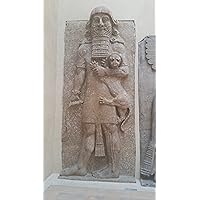
Gilgamesh is king of the city of Uruk, of great-walled Uruk, as it is always referred to in the story. They were apparently very proud of their walls. Gilgamesh is a magnificent specimen of a man: tall, handsome, strong, brave, and all that, but he is cruel to his people. He crushes the young men. He uses the young women.
The people cry out to the gods, and the gods are moved. Their plan is to make a man who is Gilgamesh’s equal, to be a foil for him, and that will take care of the problem. I never would have thought of that, not in a million years. I would have thought of restraining Gilgamesh in some way, or teaching him a lesson in compassion, but I wouldn’t have thought that he lacked a best buddy. That is the beginning of the strangeness of Gilgamesh.
The man they make is Enkidu, and he roams around naked with the wild beasts. And Enkidu is civilized through sex. Shamhat, a temple prostitute who has sex with men to honor the goddess Ishtar, is sent to seduce him. She and Enkidu have sex nonstop for seven days straight. When that’s over the animals run away from Enkidu.
Shamhat leads him back to Uruk, introducing him to the comforts of clothing, and bathing, and bread, and beer. When they reach Uruk, Gilgamesh is on his way to deflower the virgin bride who has just gotten married, because that was what he always did. Enkidu blocks his way. They fight in the street. Gilgamesh wins the fight, and then, bam, best friends forever.
Gilgamesh and Enkidu have two great adventures together. One is that they kill the monster Humbaba in the cedar forest. They weren’t supposed to do that, because Humbaba had been placed in the forest as a kind of big scary Lorax so they people wouldn’t cut down all the trees. But they did kill Humbaba, and they also cut down a whole bunch of trees.
The second adventure is that the goddess Ishtar fell in love with Gilgamesh and asked him to marry her. Gilgamesh rebuffed her rudely, saying she has a history of dumping her lovers, which is apparently true. Angry Ishtar sent down the Bull of Heaven to kill Gilgamesh, and instead Gilgamesh and Enkidu kill the Bull of Heaven and taunt Ishtar some more.
For all this disrespect, the gods decree that either Enkidu or Gilgamesh must die, and it is Enkidu. He sickens and wastes away. Gilgamesh goes crazy in his grief, and decides he needs to find out how to achieve eternal life.
Only one man has ever become immortal, Utnapishtim, who survived the great flood. Afterwards the gods made him immortal, but made him live at the end of the world. To get there Gilgamesh has to run through the tunnel under the earth that the sun travels through to get from the place where it sets to the place where it rises again. Gilgamesh has twelve hours to get through the tunnel, all in complete darkness, before the sun comes back and burns him up. The first ultramarathon.
Gilgamesh finds Utnapishtim, and Utnapishtim tells his whole story. And he tells Gilgamesh, sorry, despite my one-off situation, becoming immortal is impossible.
A Gilgamesh is leaving, all sad, Utnapishtim’s wife says, “Wait. Best we can do is a return to your youth, if you dig up a specific plant from the bottom of the ocean.” Gilgamesh gets the plant, but on the way home, a snake steals the plant. End of story. Well, actually, it ends with “But the city of Uruk really does have amazing walls.”
It is soo cool that this is one of the oldest books of literature that we have. This version was written more as a prose. The first half of the book is a retelling of the Gilgamesh story and the second half is the authors notes about translation, a brief explanation of the whole book again, but detailing the meaning behind some of the stories. I thoroughly enjoyed getting to know the history of this text in lieu of reading “There are Rivers in the Sky”. 🎧Audio: 4/5 🕵🏼♀️Content and proof: I appreciate that the author took so much time to read all the different translations of this story and make a prose of it. It was easy to follow and I understood the whole story. I generally like to read as close to the original as I can but I actually really appreciated this authors take on the story. One day I may read one of the versions he mentioned as his study material. 🫡Action and use: some of the cool take away that the author gave as part of his description of the story was the role of females. The beginning starts with a bit of a creation story and a becoming mortal. It is done through basically a week of sex (which I found shocking initially) but after the author described the possible cultural reasons for this it made sense. Sex was viewed as more of a creative function and something that was a socializing force. It is how enkidu becomes a mortal and his mind becomes more aware. He becomes wiser and gains a broader understanding.
The next interesting part and the start of the Intrigue with the tablets from Nineveh was because of its account of the flood. This predates the Bible and was pretty much the same account. As I thought about that, I was more excited by it than trying to make it fit within the narrative I have heard. It’s wonderful to challenge your thinking and I really appreciated the beauty of this rendition of the Gilgamesh story. 📝Writing Style and readability: because this was written as a prose it was easy to follow and I appreciated the depth that the author gave to considering the words he used to describe parts of the story ❎Content warnings: sex, killing, and death 🏃🏼Pace: fast
This entire review has been hidden because of spoilers.
I’m read this version of The Epic of Gilgamesh alongside Sophus Helle’s new translation, and I preferred the latter.
Mitchell has adapted his from an existing translation, but in doing so, has simplified the language and added in quite a bit more repetition than the original seems to have.
Repetition is an important part of the telling, which would have primarily been oral in Sumerian and Babylonian times, but Mitchell’s version loses a lot of nuance and much of the grandeur of the original, rendering the repetition frustrating rather than powerful.
Mitchell also omits how much of the original text is missing (and still being found!) through damage to the various clay tablets it was written on through the centuries. He does this for flow, but I felt a lot was lost because of it.
In Helle’s direct translation, he includes where sections of text are missing, which gives the reader indications of where there would have been a longer speech, missing plot points or story details. Because Mitchell omits this, his version can seem abrupt or overdramatic at times where it wouldn’t have been in the original.
If you are interested in getting the broad brush strokes of Gilgamesh in a simple and accessible way, Mitchell’s version is ideal, but if you are looking for a true representation of the epic with richer language and characterisation, I would thoroughly recommend Helle’s new translation.
As for the tale itself, it is timeless in its themes of friendship, loss, power, and sacrifice. Quite incredible for a story that is 4000 years old!
This blows my mind: 5000 years ago - before the Iliad and the Bible - human beings huddled around the fire and while a bard told them the epic of Gilgamesh. The same one I just listened to on audiobook.
In it, King Gilgamesh, the human son of 2 gods, grows up, and through relationship with another, becomes a better king.
Being 2/3 divine - a mortal with Gods as parents - Gilgamesh has gotten arrogant and tyrannical toward the people of Urek. When they cry out asking the Gods to temper the unruly brat, the Gods create Enkidu, a "friend/rival" for Gilgamesh to "balance", himself against; a "wild man" for him to fight, befriend, love, and lose - that good old struggle with mortality.
I was not at all familiar with this story - which, again, was one of the first stories human beings passed from person to person - but I was trying to read Emily Wilson's "Inanna" and realized I didn't have enough background to fully appreciate her characters. Now that I get the story, I'm excited to go back to Inanna and try again.
The author's extended essay on Gilgamesh (after his translation of the work itself) is super interesting. The overt sexuality in these Greek myths is so interesting. I was delighted with Shamat being told to have sex with Enkidu - and happily doing so - FOR SEVEN DAYS in order to "civilize" him.
Again, if you choose to consume this early human story, do get the audiobook and listen to it the way it was meant to be received.
Well, I will need to go through this one again. It moves so quickly that I know I missed a great many details and connections along the way. I think next time I will read a little about the poem first so that I know more of what to look for as I go.
Even on a first pass, though, there is clearly a lot here worth coming back to. Friendship, glory, mortality, grief, and man’s inability to escape death are all sitting right on the surface, and I suspect there is much more underneath that I simply did not catch.
I am also not sure Stephen Mitchell’s version is the one I want to use next time. At points it felt needlessly crass, though I do not yet know enough to say how much of that belongs to the original and how much belongs to the translator. Another reason to come back with a different translation and better preparation.
As this is a bit outside my comfort zone, i was surprised at how much I enjoyed this story. The poem is not terribly long, and this version is intentionally written to be accessible to modern readers. I don't know exactly how much it differs from more scholarly translations, but I'm not a scholar, and this was perfect for me.
George Guidall is, as always, an exceptional narrator.
The included essay is almost as long as the poem itself, but worth reading. Interestingly, my ebook copy has the essay at the front of the book, while the audiobook has it at the end. I read the essay first, and while you could say it spoiled some plot points, it gave some cultural context that helped as i went through the poem.
Something really special about reading a story that people 3000+ years ago would’ve also enjoyed. As the intro explains, this isn’t a direct, academic translation, it uses the direct, academic translations and then further ‘translates’ it into how it would’ve sounded to native speakers when it was originally performed. The result is a beautiful story about dealing with grief and how to move on from such a loss. Very comforting to know that humans 3000+ years ago were also worried about this, turns out what has always mattered to humanity is other people.
P.S anyone who doesn’t think that Gilgamesh and Enkidu were gay lovers can fight me.
A fascinating read of an ancient tale. I read the entire book including the introductory commentary and the original text. It's so interesting to glimpse the beginnings of tales and the influences that this work had on generations of authors, even if they aren't aware. Though I am pretty sure George R. R Martin drew some inspiration from this tale - there were a couple of details that struck me as similar to Game of Thrones, such as the city of Uruk itself and the treatment of the high priestesses, just as one example. That might be just because I just finished Knight of the Seven Kingdoms? Either way, I recommend this book to anyone who is a student of history or classic literature.
I read this my sophomore year of high school and now again my freshman year of college. Both times I didn’t really enjoy it. This is most likely due to the fact that I read it for school rather than my own personal pleasure, however it could also be because it’s not up my alley of things I usually read, or it could be a mix of both. What I’m trying to get here is my personal rating is 1 ⭐️ but take this with a grain of salt.
Read the oldest bromance ever told as part of a buddy-read ‘pre-Katabasis’ syllabus. Having just read Beowulf, it was interesting to have that fresh in my mind, since Mitchell makes comparisons in his introduction.
Some highlights for me were the prophetic dreams (particularly the first), the “not circular but spiral” nature of the epic, thinking Gilgamesh dissing Ishtar would make a great duet in a song, and “wow, should I read the Bible?!?”
not until i read elif shafak’s there are rivers in the sky, i knew about gilgamesh. a bit if embarrassment since it is the oldest story ever written, but better late than never.
listened to the audio book and i like both the story and the essay. the brilliance of our predecessors thousand years ago never ceases to amaze me.
The written word is so cool, because now I can say I've read the same story as a shifty merchant who sold inferior copper 3,500 years ago.
This version was much more accessible than direct translations of other epics I've read, which was nice. I read the poem first, flipping to the footnotes as I read, and was particularly struck by the similarity of Gilgamesh with some stories from the Bible.
Audio. Since this is the only version I've experienced this far, I'm not sure how the translation conveys the original text, but the story, the characters, the depth, wow. I will look for other versions. I appreciated the history and connect provided in the intro and translator's notes.
In my ratings,3= average. I’d give this 3.5. The book presents an easy and very clear version of the ancient story and an analysis of it. I enjoyed both, but if you’re going to read it, I recommend you start with the story and read the analysis after (opposite to the book).
This translation was pretty cool, essay afterword was also good had some salient points, didn’t glorify bad behavior, and was much more progressive an analysis I expected from something written in 2004
This was a pretty decent translation of the epic. Overall Gilgamesh is a pretty weird and confusing story so I don’t know if I can give it 5 stars LOL. But it truly is a classic and I was able to understand it well.