In New Orleans a rare bookdealer is forced to track down an infernal atlas dragged from hell itself and now stashed in the swamps of the bayou. A dive bartender picks up a phone left behind after a brawl and is pulled into a waking nightmare. On a sea voyage, a decadent group of diabolists are intent on an audience with the Devil himself. Across six tales The Atlas of Hell takes us to the fringe of sanity, the limit of infernal ambition, and the very border of our reality. Nathan Ballingrud has earned a reputation as one of the leading voices in contemporary horror fiction and in The Atlas of Hell he shows us the deepest and darkest recesses of his imagination. Ballingrud probes the wounds that are the human condition and peels back the skin to reveal the monstrous and miraculous beneath. From the author of North American Lake Monsters, this is a collection for readers unafraid to gaze into the abyss and meet the eyes of what stares back.
I'm the author of North American Lake Monsters: stories, coming from Small Beer Press in July 2013. I'm currently at work on my first novel and several more short stories. I live with my daughter in Asheville, NC.
Been looking forward to this book from the moment I finished the last Nathan Ballingrud collection, a few years back. And I read my copy of 'Wounds' right after the book arrived. One evening and the following morning was all it took and I didn't want the stories to end.
As with Nathan's first collection, I couldn't leave this one alone. Genuinely entertaining horror containing all of the dread and hideous aesthetics of the best in the field.
The final novella - 'The Butcher's Table' - is new to this collection and a work of the imagination that gave me genuine awe, bringing Conrad, Tolkien and early Barker to my mind. I'm still thinking about the portrayal of hell that has the epic feel of the classic depictions, the hells of Milton and Dante. A story worth twice the price of the hardback alone.
Wounds: Six Stories From The Border Of Hell is brutal, gorey, vivid, imaginative, had many genuinely creepy moments, and is probably my new favorite short story collection of all time. The prose was fascinating and kept me wanting to read more, but also had me stopping every now and then to think at the imagery conjured.
My favorite story is definitely the first- The Atlas Of Hell. In it, a man is forced to track down a stolen hellish relic, and madness ensues. This story especially was just insane and featured some really intense imagery. I had to just stare into space and let the scenes play out in my head, it was that good.
I also really loved the creep factor of The Maw, a pretty short story that gave major Silent Hill vibes.
The Visible Filth and The Devils Table were the longest stories of the collection, both coming in at around 100 pages, and were disturbing, thought provoking, and again had some really intense and unique sequences and thought provoking themes.
The other two, The Diabolist and Skullpocket were still solid and I really enjoyed them, but they didn't hit as hard as the others.
Still, this was everything to me and I will definitely be coming back to this collection often. I feel like most of the collections I've read have been more literary horror, but this was a crazy hellish joyride and I loved every second of it!!
There are two unifying themes throughout the six stories in the spellbinding collection. The first should be obvious from the title: Hell. All of these stories in some way deal with a person having a hellish encounter. Sometimes this involves demons, other times it’s a little less obvious. What makes it fascinating thought is that while each story works well on an individual basis, they create a something of a tapestry when viewed together, creating something like a mythology of Hell. Little things mentioned in one story, are brought back in another, or the origin of an item shown in one story is explained in another. It’s fascinating, and makes the collection better that each individual story would be.
The second theme is far less obvious from plot descriptions, but it’s love. Each of these, in a very twisted fashion, is a love story. As one of our narrators explains, hell’s favorite emotion is love, as people will go to such great lengths for it. This theme is easily the most terrifying aspect of the book, because it adds to the hints of Hell’s true nature and adds an easily relatable aspect to the incomprehensible.
As I try to do with all short story collections I review, I will do a brief mini-review for each story as well as a rating.
The Atlas of Hell – This one is a very creative noir/horror combo that feels like something Clive Barker would have written. It focuses on a rare book dealer who is stuck working for some mobsters who are looking for the Atlas of the title, after a small time crook starts making a huge profit by selling artifacts from Hell. It's a story with some disturbing imagery, but really succeeded in how unique some of its ideas were presented (the atlas itself is truly unique). 4/5 stars
The Diabolist – This one is... different. It takes a rather strange narration route, in that it is a first person narrator, but the narrator is speaking to the reader the entire time as if they are a specific character in the story. It's not as good as the first story, but again I'm impressed with the ideas at play here. It focuses on a young girl whose father dies and when she explores his basement lab, she finds that he summoned an imp from the “Love Mills” of Hell. 3/5 stars
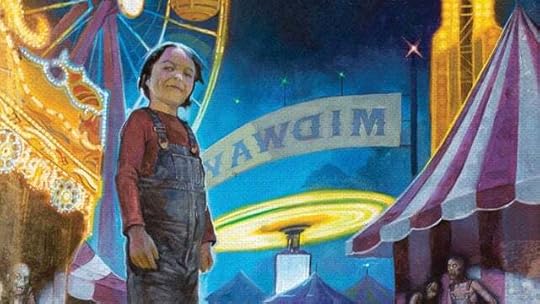
Skullpocket – I loved this story, but I imagine it will be easily the most hit or miss story for readers in the collection. It’s written in a simpler style than the previous stories, trying to imitate an almost Young Adult reading level. It focuses on fourteen children who are invited to a ghoul’s home where he will be throwing a festival. There, one of his servants tells the children how this yearly festival began so many years before. The story is child friendly at first, making it shocking after the previous two tales, but then the narration will interject a few comments that take away from that child friendliness, making it a bit of a mood whiplash dissection of YA stories. 4.5/5 stars
The Maw – While I had enjoyed every story prior to this, The Maw was the first one that genuinely creeped me out. This one has some truly disturbing imagery and some shocking scenes. It reminds me somewhat of a sci-fi novel I read years ago called “Roadside Picnic.” Both stories involves people who go into a dangerous territory that few can comprehend, to pull out items of value. In this case though it is homeless children, who go into a demon-infested city, trying to find items the refugees left behind. The imagery is terrifying and the idea that the demons never try to leave their territory, just build upon it only adds to the horror as you read on. This one could have been a five star read, but I was a little disappointed by the ending. 4/5 stars.
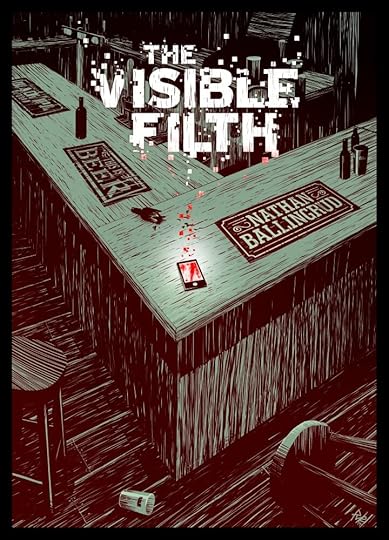
The Visible Filth – After The Maw reminded me that yes, this was a horror collection intended to scare the reader, The Visible Filth pretty much still sucker punched me, and then kicked me when I was down. This one is an EXTREMELY disturbing story about a bartender who one night finds a cellphone in his bar after a fight. He begins receiving strange messages on the phone from someone who claims there is “something there" with him and sends him pictures of pieces falling out of him. As he begins looking through the phone, he finds a series of pictures and videos… and I will not spoil a thing that happens from there. This one is shocking and brilliantly plotted. Some of these stories ended a touch on the abrupt side, or left me with questions… this one is damn near perfect. 5/5 stars
The Butchers Table – The final is also the longest tale, at over 100 pages. Unlike the previous stories, which all took place in modern day, this one feels like something of an R rated Pirates of the Caribbean. It follows a young Satanist, in love with the daughter of a cannibal priest, and how they intend to journey to Hell on a pirate ship and be married on its shores… the story is as batshit crazy as it sounds and is very enjoyable. The visuals of Hell presented in this story are stunning, and some of the landscape described strangely beautiful (I particularly liked the mountain/cave which is the corpse of an angel, with wounds in the chest forming the mouth of the cave). It also features one of the most disturbing creatures presented in these stories with the Carrion Angels. Of them I will say no more. A solid 4/5 stars
As you can see from my descriptions, most of the stories are rated highly and fairly close together. They are all consistently entertaining and as I mentioned before, they work together as a whole in a way that improves upon the entire work. I give this one a recommendation to all horror fans and a solid 4/5 stars.
But for those curious, I’ll close with a ranking of the stories from best to worst (in my opinion):
The Visible Filth Skullpocket The Atlas of Hell The Butcher’s Table The Maw The Diabolist
"Oh, how I would love to go to a place made only for screams.”
Initial Thoughts
I've had Wounds:six stories from the border of hell sat on my TBR for quite some time now. I eventually picked it up because I wanted to intersperse it with some educational reading on philosophy. Well that didn't go quite according to plan. Let me tell you why.
Wounds is made of four short stories of pretty decent size and two novellas. One of the novellas, “The Visible Filth,” has been adapted into a movie titled wounds and I think this is the reason that this collection was given its name to tie them together. What was it originally to be called...Atlas of Hell. Believe me that would be a far more apt title.
"I remember, viscerally and immediately, the giddy terror that filled me when I was that boy, seventy years ago, summoned by a dream of a monster to a monster’s house."
The author himself, Nathan Ballingrud, is new to the horror scene having published one other collection before this called North American Lake Monsters. I really need to try some different authors and move away from King, Straub, McCammon and Simmons who I tend to stick to like they're crack cocaine. Plus Ballingrud is a single dad taking care of his daughter, much like myself, so I felt a certain affinity with him from the start.
The Stories
As I've said before, this is a collection of six stories that share a common theme and mythology that flows seamlessly throughout. Starting with...
Atlas of Hell - 4/5
This one is a mix of hard boiled, nourish crime fiction mixed with the occult. It actually reminded me a lot of Angel Heart staring Mickey Rourke. A backstreet bookseller, with mob connections, is "persuaded" to go on the hunt for a nefarious book located deep in the Louisiana bayou. It's a strong opening and one establishes a dark, brooding tone for what's to follow.
The Diabolist - 3/5
A daughter discovers her father shortly after he passes away, and decides to take a look in his laboratory for the first time. Inside is all manner of occult items amongst her finger paintings. Ballingrud uses his personal experience, along with a particularly unusual narrator, to add some originality and heart to the narrative. Even so it was the shortest and probably weakest story. Still good though and I think that suggests what I thought of the overall quality of the collection.
Skull pocket - 3.5/5
This one was a slow burn of a short story. At least in comparison to the other entries. It was also Ballingrud at his most creative and humourous, without upsetting the overall tone. In it he tells a strange tale of a smal town that plays host to a carnival run by ghouls. Very Something Wicked this Way Comes. The story takes off when the young ghouls decide to break the rules set by their elders. As usual, when an author gets really imaginative it tends not to land with me as I much prefer violence and darkness. But some readers will absolutely eat this up and perhaps rate it the best.
The Maw 4.5/5
The Maw was certainly the most brutal and nasty story of the bunch. In this one hell has broken out into our world and a 17-year-old girl is hired by an elderly man to guide him through the decimated streets of Hollow City as they search for his dog. It's now occupied by some truly terrifying entities that are only to happy to tear your soul apart. I absolutely loved this one.
"All life is a mass of wriggling grubs, awaiting the transformation to the form in which it will greet the long and quiet dark."
The Visible Filth 5/5
What can I say about this one? When a nasty fight breaks out in a seedy bar, Bartender Will is left cleaning up the mess. When finds a mobile phone the narrative goes on an absolute rollercoaster into pure darkness. Now that's my type of rollercoaster!
The central character of Will is morally grey and doesn’t seem to have anything going for him. This story is full of unsavoury characters and if you've read any of my Donald Ray Pollock or Joe Abercrombie reviews you know that's right in my ballpark. Some dark and disturbing messages start appearing on the aforementioned mobile that drags Will kicking and screaming into a terrifying nightmare that has to be read to be believed. Although this story is the most grounded in reality it still has some horrifyingly, warped stuff thrown in.
Absolutely brilliant! It does not get better than this...
The Bloody Table 6/5
...or does it? Devil worshippers, cannibalism, romance, mystery, pulse pounding adventure and, best of all, pirates! This bad boy has it all and then some.
Martin Dunwood is a member of the Candlelight Society, a bit of a gentleman's club for Satan worshippers. The story gets started when meets a group of pirates to make a deal to commence a dark and dastardly journey to find an atlas of Hell. Being a somewhat refined and cultured chap he soon finds himself in the company of thieves, murderers and cannibals on the Butcher’s Table, which is the ship taking them over to the dark side.
The general unpleasantness of the characters, rivetting plot, intense action and captivating setting makes this one of the best novellas I've read. I had to give "the Visible Filth" top marks and I liked this one more, hence the very special mark.
The Writing
What separates the great horror authors from the average, run of the mill, cheap shock horror authors? Great writing. And Nathan Ballingrud is a fantastic writer no question about it. He uses some gorgeously dark descriptions for some of the most disturbing acts. His dialogue, pacing, imagery all out of the top draw.
"He watched a cleaver rise and fall, over and over again, lifting bright red arcs into the air. He saw a stunned human face pressed against the bars of a metal cage. He heard a shriek so piercing that it launched him from sleep, upright in his swinging cot at some unknowable black hour of the night, panting and listening. He heard only the sound of the waves against the hull, the groan of wood straining against the deep. He closed his eyes again, and if he dreamed further, it was only of the abyss."
He sucked me into his world and had me fully immersed. He's created some very unique landscape and made them very real and given them a distinct, nightmarish quality that you dear reader will love.
Final Thoughts
In case you can't tell, I've been blown away by this one. Stuff the educational reading, this is where it's at. I was left speechless by the absolute quality of what I just read. That's right before I started to write this never ending review.
What makes this bunch of stories even better is there are subtle connection and an overriding theme that runs through each. Were talking about Hell and it's corrupting influence when it invades our world.
Ballingrud reuses names of locations and weaves in his own mythology, creating a cohesive environment for each narrative to exist in. It really impressed me and sets this one apart from the competition.
Bottom line - there's a new name in horror fiction and it's Nathan Ballingrud. Do what you have to do and get him moved up your TBR. That's an order! Cheers.
These stories emerge from the depths of mutated pyches, scarring the mind with indelible artistic configurations produced by the mutilation of accepted life forms. From the most remote corners of the abyss come sounds that can only be produced by torn and broken lives. These surfacing beings have been transformed into formidable and awe-inspiring atrocities. Beware the siren, as the song that emerges is as deadly as it is beautiful.
Nathan Ballingrud's Wounds is the best book I've read this year.
It's not a competition, art isn't a race, but Nathan Ballingrud has won and I'm popping the champagne in advance.
I mean ...god damn.
If you love horror and you enjoy reading, this guy should be on every single one of your radars. He has the intensity of a Cormac McCarthy, the symbolic power of an Alejandro Jodorowsky, the assaulting poetic imagination of a Phil Tippett and the monstrous humanity of a Guillermo del Toro.
He's a total package nightmare machine.
This book has the most vivid imagery I have ever read in a novel. And I just read Naked Lunch. I don't know if Nathan's publishers lined the pages with Dimethylsulfoxide or something, because when I read this book I could taste the imagery.
Taste it.
There's vivid and then there's realistic and then there's whatever the hell WOUNDS is doing.
I felt the ashes in my mouth when a character is slammed face-first into a bunch of cigarette butts. I could feel the close humidity of a swamp on my skin as I passed by plants with human faces and terrified eyes budding on the lines of Virginia creepers. I could smell the decay and electricity in the air in a room with a living corpse with wounds that were a gate for a celestial being. I could hear hundreds of colonies of cockroaches and maggots buzzing under the floor-boards. Singing a melancholy tune as a ghoul with a patchwork skull and a borrowed tongue mourned their lost romance to a girl with a head that blossomed open like a flower. I could see and feel the heat radiating off of the shores of hell itself as I watched my ship approach the monolithic body of a dead angel splayed across the landscape of a nightmare.
Wounds is a collection of six short stories that are connected and yet stand alone. And this collection is magnificent. Hallucinatory. It speaks in a voice that I recognise my from PTSD night terrors. These stories have the artistry of a Dark Souls and old school Clive Barker. A sort of obsidian fantasy style that isn't 'grim' or 'dark', but instead is gleeful and bright and insane and obscene.
Imagination like daggers of black glass forged in the mouth of a volcano.
I've mentioned this before, but there's an old, cheap criticism that says real horror is never seen. That what's inside the head of the audience is scarier than anything an artist or writer could ever visualise.
In the case of a lot of artists and writers that is true. In the case of Nathan Ballingrud? No. It is absolutely not true. Imagination wise, I am not in his league. I am not batting for his team. I am in a completely different sport.
If we all had the imagination of Nathan Ballingrud we wouldn't need video games or 600 million dollar CGI blockbusters. If we all had dreams this large and immersive we would not need the world itself. Our entertainment industry would collapse and the owners of Disney would be out on the street with a tin-cup begging for change and sandwiches.
We would be a race of strange dreamers throwing ourselves into apocalypses in a field of flowers and tasting personal and planetary Armageddon in every drop of beer. Our cars would rust out in their parking lots as we danced into the midnight hour to the song of our inner horror.
It would be a glorious utopia. But it is not one that currently exists. Unfortunately. Perhaps in time and with sufficient genetic modification it might be possible.
But at the moment we have to rely on visionaries like Nathan Ballingrud to play the pied piper and lead us like lemmings through the thickets of hell. To build maps written in human flesh to guide us to the sights and tourist hot spots of our broken souls. To show us the humanity in the worst of places and ideas, and the immense celestial power in our fragile mortality.
We need visionary artists and writers to teach us to listen to the songs hidden in our trauma. The glorious cacophony that pours from our busted lips and broken hearts. To show us the music waiting to be born in our WOUNDS.
Now. Empty your pockets for Nathan Ballingrud.
11.5/10
Yes, this book has broken free from my rating system. Because art is chaos and magic and cannot be contained.
Six stories of terror, all of them more or less tightly connected to the concept of "hell", and none could have written them better than Nathan Ballingrud.
From an actual map of hell, to found footage horror on a lost phone, an imp from hell summoned to replace a deceased loved one, to more complex narration structures that require universe-building such as The Maw or the dark fantasy tale Skullpocket in which children interact with actual demon-creatures - Ballingrud's imagination as well as writing expertise know no bound.
My highlights were The Diabolist which is told from the mouth of a creature of hell connecting to the daughter of the magician who summoned her, as well as The Maw, in which an unlikely couple, an older guy and a young survivor of a hellish world in which creatures roam houses to butcher people, go searching something very precious.
Atmosphere, chills, tension, it's all here, and yet each story is so different, Ballingrud's range so wide that it's in itself eerie how well and versatile he can write. I can't believe I've let this sit on my shelf for years (but finally picked it up now for my Mount TBR reading challenge).
Nathan Ballingrud's North American Lake Monsters was an excellent debut collection, but Wounds took his writing to the next level. You can see his increased confidence; he's gone from writing extraordinary events happening to ordinary people in ordinary places, to creating his own world, and placing these stories on it's fringes. It's not until the last story that it truly comes together, but when it does you see the entirety of the story of this collection; it's a really well executed revelation.
The horror here isn't taking it easy, either - these are the kind of stories that could list Clive Barker or maybe Poppy Z. Brite in their influences. There's moments of body horror, which I'm usually not a fan of - but the way it's presented and the bizarro context made it work. Don't get me wrong - it's still horrifying, strongly so, it's just that it never feels jarring or out of place.
Nathan Ballingrud has made an impression with his horror, and between his two collections it's not hard to see why. I'll be looking forward to what he brings out next - even if I'm looking from between my fingers.
001 - "The Atlas Of Hell" (2014) 030 - The Diabolist" (2014) 049 - "Skullpocket" (2014) 089 - "The Maw" (2017" 108 - "The Visible Filth" (2015) 178 - "The Butchers Table" (original to this collection) 277 - Acknowledgments
How can I communicate the darkness of this book? "Sacs gravid with ochre liquid," "tooth-spangled pinwheel of limbs," or how about "meaty exhalations?" I must admit I don't read much horror but I make an exception for this author. He is truly one of the best.
Unlike the author's previous story collection, North American Lake Monsters, which I always thought centered humanity inside of emotional and fantastical horrors, this story collection takes humans where they should not be (turn back!) The stories contain evil depths and hellish landscapes, with creatures who have traded humanity for power or access or knowledge, or worse - the pleasure of death and destruction. I expect to have carrion angel related nightmares.
I previously read two of these stories in other publications (I own a novella of The Visible Filth and a short story collection that includes The Atlas of Hell.) It was very pleasing to discover how the final story in this collection - The Butcher's Table - connects to The Atlas of Hell. . And now I need sunlight, some lemonade, maybe a puppy?
The Butcher’s Table by Nathan Ballingrud ★★★★★ Hideous beauty, confronting and objectionable grace - everything I ever wanted from Clive Barker.
The Visible Filth ★★★★☆ A bartender finds a cell phone with gruesome images that infect his life and those around him. You never find out if it’s Heaven or Hell at play but salvation is viewed as a life less ordinary.
The Atlas of Hell ★★★★☆ A gangster makes a bookbinder with experience in dark magic go after a map of hell in the Bayou. If I had not already read one of Ballingrud’s tales of hell this would have been shockingly weird.
The Diabolist ★★★½☆ A lonely woman tries to use her fathers dark arts to bring him back. The love that finds her is not the one she called.
Skullpocket ★★★½☆ A town is taken over by The Church the Maggot. It’s just as unpleasant as it sounds.
The Maw ★★★½☆ A lonely man hires a young girl to take him through hell ravaged lands to find his dog.
I don’t believe I’ve ever read such a disturbing collection of Horror outside of Lovecraft at his darkest or Craig Zahler at his most vicious.
The best story in this Anthology from Hell or at least the one I enjoyed the most was ”The Visible Filth” followed by ”The Maw”, ”The Diabolist” and ”The Atlas Of Hell”.
There was powerful prose at play in ”Skullpocket” and almost intolerable gore and violence in this hellish anthology’s epic tale of Satanists and Cannibalism and Pirates that sail the seas of Hell, ”The Butcher’s Table”.
These tales are intense and unsettling and unforgettable. The author, Nathan Ballingrud, is an unusually gifted writer. The depictions of everyday people faced with indescribably hellish horrors intruding uninvited into their realities (with the exception of ”The Butcher’s Table” where the principals find the object of their journey) is absolutely ingenious.
I can’t wait to read what the author has in store for us all next.
Nathan Ballingrud makes for one hell of a tour guide along the border separating life on Earth from eternal damnation. His collection, Wounds, brings together six stories all about the permeation between these two realms.
“The Atlas of Hell” kicks things off in remarkably strong fashion. Ballingrud delivers a work of Bayou noir that sees a rare book dealer pressed into service by his mob associates into recovering the atlas of Hell. There’s loads of terrific imagery here, and I flat-out loved the concept of Ballingrud’s “astronauts” from Hell. The atlas itself was totally unlike anything I had expected, and the author exhibits a knack for overturning expectations over the course of Wounds’ other stories. There were a few elements I wish were explored a bit more deeply, such as a briefly glimpsed lake monster. It’s a minor quibble, to be sure, but also a positive in its own right as I immediately wanted more!
“The Diabolist” follows the teenage daughter of a recently deceased occultist and her discovery of his misdeeds. We get a wonderfully unique narrator, and Ballingrud again subverts expectations with the particular choices he’s made here. “Skullpocket” was really the only story in Wounds that I didn’t much care for, and it felt a bit too Young Adult for me. It does have some nifty concepts, though, involving a small town and the literal monsters that live next door, the history of which is relayed to a group of children gathered to celebrate a ghouls deathday. It’s a mostly light-hearted, Gaiman-esque affair and a bit of midpoint palette cleanser before Wounds gets back to reveling in the darkness.
“The Maw” features a small town of a different sort, one that has been utterly devastated by the denizens of Hell who have crossed the border and driven out any traces of humanity. Mix, a teenage girl, agrees to help Oscar navigate the suddenly foreign terrain, acting as a coyote/tour guide as she smuggles him into this dangerous wasteland in search of his lost dog. Ballingrud, again, proves to be a master of imagery, and the work of his Surgeons is truly nightmarish stuff.
“The Visible Filth” is an incredibly potent story! Bartender Will finds a cell phone forgotten by a patron, and then makes the mistake of answering a text message on it. Darkness permeates this story the whole way through, and Ballingrud plays with our expectations of violence as the mental states of various characters shift in response to Will’s discovery of, and subsequent obsession with, this cell phone. There’s plenty of grisly imagery throughout, as well some hair-raising moments of pure haunting dread, such as a computer monitor broadcasting the image of a tunnel and what lurks inside. This one really got under my skin, and it’s a story that lingers well after you’ve finished reading it thanks to its ambiguities.
“The Butchers Table” ends Wounds on a high note as Ballingrud takes us back in time to the Colonial era, where a group of Satanists have boarded a pirate ship setting sail across the border into Hell itself, where they hope to dine with their Dark Lord. Once again, Ballingrud provides some great imagery, especially the finale’s dining hall, and while not all loose ends are tied up oh so neatly, he does bring the overarching story twisting throughout each of Wounds’ stories full circle.
As I noted above, permeability is key here and Ballingrud injects certain narrative strands in one story to be revisited later. Each of these six stories function well enough on their own, but when taken as a whole we’re presented with a richer tapestry and a fresh mythology on the nature of Hell on Earth that encompasses occult and cosmic horror, as well some dashes of fantasy here and there. The border separating us from Hell is highly diffuse, but thankfully the potent horrors pouring through are of the most engaging and entertaining sort. You might want to schedule a trip there soon.
[Note: I received an advance reading copy of this title from the publisher, Saga Press.]
I basically inhaled Nathan Ballingrud’s first collection, “North American Lake Monsters” (https://www.goodreads.com/review/show...), earlier this month, and I was still craving more of this man’s dark, weird work. So I ordered a copy of “Wounds” and waited by the mailbox until it showed up and immediately cracked it open.
The theme of this collection is Hell, and while many authors have explored the subject before, my own readings on the topic have been limited to Dante (https://www.goodreads.com/review/show...). Let me tell you, this is no touristy stroll with Virgil! Because Ballingrud, unlike Dante, is not there to preach at you: he is here to scare your socks right off. So he doesn’t simply describe Hell, he also tells you why and how his characters end up there…
“The Visible Filth” was the basis for the movie “Wounds”, which I watched immediately after wrapping up “North American Lake Monsters”; and it was amazingly weird, disturbing and strangely human – and I couldn’t wait to read the original material (to which I must say, it is very faithful). The novella is the heart of this collection, and I found it to be a perfect horror story: a bartender finds a cellphone left behind by a customer after a brutal bar fight and absentmindedly takes it home - and the text messages he starts getting and the pictures he finds on it derail his life in a horrifying way. The character of Will, an unwilling participant in a Hellish experiment, is very finely drawn, and how real he feels makes his story just as heartbreaking as it is creepy. Just for that story alone, the book is well worth adding to one's library.
The collection is bookended by two loosely connected stories, "The Atlas of Hell" and "Butcher's Table", and I loved how gritty and original they were. In the first story, a rare book dealer must retrieve a particularly dangerous book from the bayou outside of New Orleans for a crime boss, and the second is the most hair-raising pirate tale I've ever read.
"The Diabolist", "Skullpocket" and "The Maw" are strange and well-crafted little stories but they didn't have me as glued to the page as the other three - hence the 4 star rating for the overall collection. But do not let that deter you: Ballingrud has an amazing gift for bringing together the strangest horror elements and the most visceral human emotions, especially love, but also grief, greed, loneliness and despair to make his stories rich and upsetting.
If you enjoy literary horror, this is an author you should absolutely be reading.
WOUNDS: Six Stories from the Border of Hell [2019] By Nathan Ballingrud My Review Two Stars**
I purchased this book because I thought I would like it. Usually, I am a decent judge but just not this time. I say that because this 2-Star rating should be viewed through the prism of my reading only the first two stories in this novel before making the call that the author and his style simply do not fall within the parameters of my reading preferences in the horror genre.
The first story (“The Atlas of Hell”) was certainly colorful with its rich descriptive prose of a Hellscape in the Louisiana bayou. A small-time crook with a somewhat working moral compass somehow managing to open a gateway to Hell is an interesting concept. The main characters consisted of a cruel mob moss, his sociopathic lackey, and an unsympathetic dabbler in the black arts. I rated this well-written individual story three stars.
The second story in the collection was (“Diabolist”). Loosely translated I believe this is a devil worshipper. However, the “Diabolist” was Dr. Timothy Benn, described as a “metaphysical pathologist” and a “theomancer.” This gentleman had died of presumably natural causes and his daughter Allison was the main (human) character in the tale. Her dead father was a seer of sorts, and I am not sure about the metaphysical pathologist part. In any case this story simply did not resonate with me on any level. The author is talented with descriptive prose, and his creative imagination would go unchallenged by me. I rated the story 1. I could not picture myself proceeding to story number three.
I averaged the two ratings, gave the book two stars, and admitted to myself I had read enough. The Novella in this book of short stories (“The Visible Filth”) is being filmed and was or will be a motion picture. Ballingrud’s work is evidently not for me, but I am a real outlier here. Ratings would suggest that far more readers either judged better about what they would like or otherwise are fans of this fellow’s works. Either way, I only offer my two cents worth about my “sampling” this novel.
“NEW TO ME” AUTHOR I TRIED SIMPLY NOT IN SYNC WITH MY PARTICULAR PREFERENCES IN HORROR GENRE
Mr. Ballingrud is a gifted writer with a boundless imagination, and I respect his willingness to experiment. In five of these six stories, Mr. Ballingrud had dispensed with the standard horror trope of a character's hapless descent into evil and instead presents the evil as a fait accompli with which all the characters are already familiar. But the sixth story, "The Visible Filth," employs this shopworn technique, and demonstrates exactly why it's so shopworn: when there's no sense of revelation or discovery in a horror story, the genre gets deathly dull. "Skullpocket" is forty pages of exposition -- exposition about ghouls discovering a taste for human flesh, but exposition nonetheless. Neither major character in "The Maw" is interesting enough to make us care whether or not they'll survive their trip into the city neighborhood which has become a demon-haunted slaughterhouse. And "The Butcher's Tale" supposedly takes place on the borderline of Hell and Earth, but is actually on the frontier between and bathos, with cannibalism, Satan worship, mass murder and patricide all becoming so mundane that "the banality of evil" takes on an entirely different meaning. And all of this Gothic excess is only coarsened by the inclusion of "The Visible Filth," the most conventional horror story in this collection, and the best by about a light year as we join Will, a clueless New Orleans bartender, on his hapless descent into ultimate evil. Thus do we learn that Mr. Ballingrud can build suspense as well as any writer in the genre, and that some for of psychological realism is necessary to make horror genuinely scary. The good Mr. Ballingrud most likely learned that lesson from Stephen King, and would do well to remember it in the future.
This was a great collection of stories, all with a connecting theme, Hell. Although as with most collections there are some which are better than others, for the most part they were all beautifully written and conjured up many a hellish image in my mind. I also loved that as I progressed through the stories I noticed more and more connecting points from story to story. This added another aspect to the collection and is testament to how well crafted this collection is. I'd definately recommend this to some friends, even though it isn't a book which will appeal to all.
I've said before that short stories are usually not a winner for me. But short stories collections is usually harder for me to enjoy but this one was different. A good creepy read in small doses
i liked ballingrud's first collection a lot, but the story "the atlas of hell" (included in this volume) just makes my entire head vibrate wildly every time that i read it. a truly terrifying story... i mean there's a real, true, unearthly power to it and I can't even begin to understand where it comes from or how it works or why i'm responding to it so strongly. And then the other 5 stories are just as good-- maybe better?? I hope he writes 50 more of these.
Nathan Ballingrud's debut collection North American Lake Monsters was one of the best things I read in 2014. I was surprised that a first collection would be so polished and confident but there is no denying it - Ballingrud's writing is something special.
His second collection, Wounds, more than lives up to the high standards set by NALM. Six lengthy stories, consisting of five reprints from anthologies and one original to the collection. I had only read two of the five reprints previously, and unless you are a weird fiction hound of the first order, I doubt you have read them all either. I loved and greatly enjoyed them all, even the two I had already read.
My favorite story, though, is the one original. "The Butcher's Table" is full of intrigue and adventure, pirates and demons, love and hate. It was a ton of fun with an unexpected poignancy that made my eyes a little leaky. Gothic action horror at its finest.
Ballingrud takes his time writing his stories, and I'm glad he does. I hope we don't have to wait another six years for his next collection, but if we do, I have no doubt it will be worth every second.
5 bloody stars for 'The Butcher’s Table'. What a ride! It has the imagery of nightmares translated into words.
'The Atlas of Hell' is technically a story following up on 'The Butcher's Table'. I reread it after I realised this and it gave it a whole new (better) layer. 4.5 stars.
'The Visible Filth' scared the crap out of me. 4.5 stars.
'The Maw' was good but had a weird, unsatisfying ending. Loved the creepy atmosphere, though. 3 stars.
'Skullpocket' felt a bit like a collaboration between Neil Gaiman and Clive Barker, 2 of my favourite authors. Somehow, it didn't manage to hold my attention throughout the audio version. I might try actually reading it to see if that makes it better, enjoyment-wise. 2.5 stars for now.
'The Diabolist'. This one was okay. Short but/and not very satisfying. 2 stars.
This collection definitely pushes me towards reading more of Ballingrud. The guy has one sick imagination ♥️.
Uzun süredir beni bu kadar doyuran, sertliğinden ödün vermeyip bir taraftan da tüm yaşananları normal bir şeymiş gibi sunan bir eserle tanışmadım. Bir dram filmi düşünün ama evren Hellraiser. O derece ürkütücü ama bir o kadar da kabullenilmiş. İçinde sizi "Ohaa!" dedirtecek öyküler, novellalar, kurgular, o kurguların içine özenle ve ünik şekilde kakılmış karakter üretimleri var. Açıkcası çok beğendim. bu arada kapağın hakkını vereyim; kitabı harika özetliyor.
This collection contains five previously published stories and one brand new novella: “The Atlas of Hell” (2014), “The Diabolist” (2014), “Skullpocket” (2014), “The Maw” (2017), “The Visible Filth” (2015), and “The Butcher’s Table” (2019). Note: prior to reading this collection, I hadn’t previously read any of these pieces.
“The Atlas of Hell”
Jack is just a sweet used book seller who used to deal with some unsavory characters…or is he? This story is so much fun – Jack is roped into helping out some thugs “just one more time” as they search for the atlas of Hell. Don’t worry, that isn’t a spoiler, I’m always quite careful. I really enjoyed this one; a sense of adventure combines with hellish terrors, tentacles, and plenty of deception and gore. It left me hurrying to turn the page to see what else Ballingrud had in store for me.
“The Diabolist”
After this one, I really started to see the thread Ballingrud uses to weave these stories into a comprehensive collection. This time we hear the story from an unlikely narrator. Who this is is revealed early on, but I won’t tell you here…this is a fun discovery to make. I really enjoyed this one, I liked “Atlas” a little better, but again I found myself tearing through to the next one.
“Skullpocket”
Oh my goodness – when I finished this one I KNEW I had found one of my favorites. It is bizarre, unique, and just a beautiful story. This one deals with ghouls who have their own “city” and annual fair; the tale deals with explaining how things came to be and where they might go from here. This one? I’d read an entire novel or novel series built around this world. Loved every piece of it.
“The Maw”
This is a quiet tale of love and loss in a world gone to Hell. Literally. One of the shortest tales, it still packs a punch and is a strong middle to the collection. Sometimes in collections I find the stories kind of lag in the middle, not so here. Ballingrud also cements his ability to write as if one is experiencing his story on the big screen. No horrific detail is spared and he truly is able to build entire worlds in just a few pages. Definitely tugged at my heart strings.
“The Visible Filth”
Ohhhhh. This one. This one is right up there with “Skullpocket” for me. A more realistic world, to be certain, wonderful characters, and a premise that is at once familiar yet completely fresh. Will is just a bartender who wants to live his life in series of unplanned moments – just a laid back guy. He reminded me of some of the people I hung with in my own college years. Things go down in the bar one night and he ends up with a cell phone that is not his own. A cell phone he REALLY should’ve left alone. I’ll leave it at that. This story is also being developed for film; I am curious to see how they will interpret the nuances of the story.
“The Butcher’s Table”
As noted above, this novella is previously unpublished. It takes place years ago in a time of pirates and darkness. Of the six, I didn’t connect with this one as much. This is definitely just down to personal taste – the writing is still beautiful, the premise unique, and the characters are developed. One of my favorite parts of this one was the content – meaning Ballingrud goes dark here – darker (I think) than any of the others in the collection.
All of these stories deal with, in some way, the veil or border between this reality and Hell, as noted in the title. But it’s more than just throwing together some stories about hellish things and travelling, the author uses similar themes, some intriguing “easter eggs”, if you will, throughout almost every story. In fact, the last story (and a few others) do this quite well and I thoroughly enjoy the elegant way in which these discoveries are presented.
Looking for a few gripping tales to enjoy this spring and summer? This one fits the bill if you like your horror smooth, visceral, and altogether hellish.
A grotesque, disturbing cornucopia of horror delights. Every single story here reminded me of why I love the horror genre, and this was, quite honestly, one of the best horror collections I’ve ever had the pleasure to read.
Scattered thoughts written under the influence (of this book, which I just finished): I loved this. Tore through it in days. Read it at night, on breaks, when I should have been working, whenever. It might not be for you, being weird as shit and dark as hell; but it's certainly for me.
I've been vaguely aware of Ballingrud's first book for years. North American Lake Monsters has lived in my wishlist for ages, in part because everyone else seemed to love it, but also because the cover drew me in immediately: it looked delicately strange, somehow, but distinctly classy; the kind of detached weirdness you might find at the outer edge of NYRB's catalogue. I knew nothing about Wounds before I stumbled across its Amazon page, but I quickly realized it was by the same author. The cover here suggested something entirely different, something distinctly horrific; the tension between the presentation of the two books somehow grabbed my attention, and I couldn't tell you why. On a whim, I bought it and immediately dug in.
True to its cover, Wounds is very much a collection of horror stories. While it's plenty literary in its aspirations and execution, there's a willingness to plunge past the barriers of good taste and reader comfort, which casts it more squarely as genre fiction, more so than I expected. If you warped back to Borders in 1991, this would definitely live in the "Horror" aisle, maybe with an Abyss logo on the spine. Genre or no, Ballingrud's prose is off the charts. And there's a depth of invention that burrows into your skull and bursts out the back, upending genre conventions and shitting on expectations, all in the best way.
Yes, the theme is Hell. As in the home of Satan, the Burning Prince; land of the damned and undying; unintended destination of many, promised land for a few twisted seekers. This unifying thread loosely binds the stories together, with a smattering of reoccurring elements and ideas spread throughout the book, particularly in the first and last stories. Despite the theme, there's an insane range of styles and tones on display. We have deadly serious modern horror, absurdist kitsch, gothic horror, surrealistic nightmares, even a touch of bizarro fiction. At times I found myself thinking of Laird Barron, Clive Barker, Paul Tremblay, Brian Evenson (just a whiff), and maybe even Jeremy Robert Johnson (whenever we swerve deep into the weird). If all that sounds disorienting and disjointed, well... it would be if Ballingrud didn't have such a deft hand.
There's an overstuffed novella about pirates and cannibals and angels at the gates of hell that I can't even begin to describe. There's one about a Louisiana bartender who finds a cellphone, and it could be from an entirely different author, like a Koji Suzuki story smothered in southern decay; it's told with a steadier cadence, reining in the excess but delivering a sharp thrust to the gut by the end anyway. Some of these tales roar like a blast furnace. Others yawn wide, letting the horror swirl like an intangible force before swallowing every last shaft of light, and you with it.
My favorite story by a mile shrugs all that aside to take a different turn. It's at turns the silliest thing here, the most lovingly stylized, and perhaps the darkest of them all. "Skullpocket" feels like Mervyn Peake gone pitch black, left to moulder in his grave until Brian McNaughton unearths him for a graveyard feast in October Country. We get history overlaid with loss, a non-linear mystery built off a macabre caricature of horror, all given a loving glow by the magic of actual feeling. Imagine Gormenghast-ly delights with the epic rot of Throne of Bones, and if that sounds absurd, it absolutely is--and it will still break your heart.
Speaking of heart: that's what brings it all back home. There's a richly beating heart at the core of every story, a penetrating melancholy that suffuses even the most ridiculous imagery with emotional weight. The imagery is fantastic, yes, but the pain is real. Gather round, ghouls and boys: it doesn't get much better than this.
The most fun I ever had standing at the Border of Hell! This collection of four short stories and two novellas is just bizarre, insane, wild, hilarious, disgusting, irresistible, pitch black but at the same time enlightened by the flames of hell. I´m sure this one won´t be for everyone but Wounds might be my favourite horror collection since Clive Barker´s Books of Blood - which is as well high praise as an appropriate comparison in my opinion. Ballingrud really throws his readers into one strange scenario after another and you need to be completely open for his mind bending parallel universes - otherwise this trip through cities inhabited by ghouls or adventures on a pirate ship to hell (yes, that´s right) might just irritate you. Or as one character asks: "Are you ready for Skullpocket?" No, I won´t give away what that term is about! Since I enjoyed this book cover to cover I don´t have complaints about any fillers, but I will name the two novellas "The Invisible Filth" (which was made into the faithful but underrated Netflix horror mood piece Wounds starring Armie Hammer and Dakota Johnson) and "The Butcher´s Table" as outstanding stories.
In the introduction that he was kind enough to add to the hardcover reissue of my first collection, Never Bet the Devil & Other Warnings, Nathan Ballingrud wrote, "Orrin Grey is a writer who reminded me of things about myself, and about our haunted world, that I'd forgotten. He reminded me of my first loves, and he taught me that they can - no, that they should - still be honored. For that, I will always be in his debt."
If I had even the smallest hand in helping to usher into existence any of the stories contained in Wounds, a book in which, through six stories at once seemingly unrelated and intimately related nonetheless, Ballingrud charts a new vision of Hell as pure and potent as anything conjured by Dante or Barker, then I'll count it among the better achievements in my life to date.
Okay so this stands to be my favorite story collection I’ve read so far. Hands down. I do love me a good exploration of the underworld though lol. Which is exactly what these stories all were in a way. While also being unique from one another.
The stories:
The atlas of hell- an occult book keeper is sent on a mission by some shady people, to find a book deep in the bayou with a link to hell attached to it. I really liked this. It was atmospheric and surreal. Loved the setting as a whole. Felt very eldritch almost. 4.5/5. It was pretty short so I of course wanted more. Not a bad thing!
The Diabolist- a young girl finds out her occultist dad died and she finally gets to go into his lab. Heavy on grief and loneliness with a shocking ending which also felt pretty eldritch lol. 4/5. You’re also in the perspective of an entity. Which in some ways led to me feeling like it may have went over my head a bit. It was weirdly beautiful though. Did not expect that.
Skullpocket- 14 kids are invited to a yearly fair thrown by a very strange and spooky (read nonhuman) man, and are told the history of the fair and town beforehand. This almost read like a Tim burton claymation. Like I could totally see him picking it up, though it is arguably darker than his stuff. But there was love and major Jack and sally vibes which surprised me. The ending was disturbing and there were def some gross scenes though. When you find out what skullpocket actually is it was almost funny but def disturbing as well lol. A slow burn but I really liked it. My description does not do it justice. 4.5/5.
The maw- a girl guides an older man on the search for a loved one through a city ravaged by apocalyptic beings. I liked it. I thought the imagery was great. Reminded me of the last of us or resident evil. Maybe even silent hill. In tone, and atmosphere mainly. somewhat in creatures (but vaguely). More so In likeness of the latter of the 3. Very bleak but also captivating. 4/5!
The visible filth- a bartender finds a phone after a bar fight with hellish imagery on it. This one has a movie adaption called “wounds” hence the title of the collection. This was probably my least favorite, at 3.75/5. But I still liked a lot of the imagery and the concept. It was a story with a message. I just didn’t like the character we followed too much.
The butchers table- a diabolist (occultist) and a group of pirates, journey together to the shores of hell, in search of an atlas. But all of them have their own motives. This one was bleak and didn’t end how I wanted. But I have to admit it was still a 6/5 story. It was truly captivating, the imagery was definitely dark and dare I say hellish. Cannibals, hell, nightmarish creatures, pirates, gore, the ocean. Absolutely amazing. Will be sticking with me for a while as I’ve never read anything like it.
—- I will for sure be reading more from Mr. Ballingrud though. His writing is superb and it’s not often I enjoy even the concept of every story in a collection, let alone like them all as much as I did.
I can’t wait to see what else this author has in store for me!
Rahatsız edercesine iyi bir kitap. C. Barker ve H.P. Lovecraft sevenlerin beğeneceğini düşüyorum. Tuhaf olduğu kadar çekici bir eser. Karakterler de bir o kadar tuhaf ama bir insandan beklenebileceği gibi duygusallar. Yazar kendine bir Cehennem mitosu oluşturmuş ve her öykünün bu mitosa ufak tefek göndermeleri mevcut.
İlk öykü Cehennem Atlası: Jack Oleander isimli bir tuhaf kitapçının bir o kadar tuhaf olan Cehennem Atlası’nı bulmaya çalışmasını okuyoruz. Tabii ki bu görevi isteyerek kabul etmiyor. Yanında bir insan azmanı Patrick de var.
İkinci öykü Efsuncu: Allison isimli bir kızın babası öldükten sonra onun çalışma bodrumuna girmesiyle ve yeşil sıvı dolu bir tankın içindeki sesle konuşması ile başlıyor.
Üçüncü öykü Kafakovuk: Jonathan Wormcake’in Larva Kilisesi rahiplerinden biriyle Öcükondu’da buluşması ve 14 çocuk ile Kafakovuk Panayırının kutlanması ve bu panayırın geçmişine ışık tutmasını anlatıyor.
Dördüncü öykü Gırtlak: Bir şeylerin olduğu ve sisle kaplanmış Oyuk Şehre Mix isimli bir kızın ve ihtiyar bir adamın ziyaretini okuyoruz. Ziyaret sebebi ise ihtiyarın Maria isimli köpeğinin oraya kaçması.
Beşinci öykü Görünür Pislik: Will isimli bir barmenin barda çıkan kavga sonucunda bulduğu telefonu açması ve içindeki dehşet verici şeylere bakmasıyla hayatının altüst olmasını okuyoruz.
Altıncı öykü Kasap Masası: Mum Işığı Cemiyeti’nden Martin Dunwood, onu korumakla görevli Şişko Gully, Yamyam Rahip Benson Cobb, rahibin kızı ve aynı zamanda Martin Dunwood’un aşığı Abel Cobb ve son olarak bunların olduğu geminin kaptanı Toussand’ın hep birlikte Cehennemdeki Ziyafete gitmesini okuyoruz. Tabii ki başka karakterler ve her karakterin kendine özgü amacı mevcut. Kitabın son ve en iyi öyküsü. Hatta novellası.