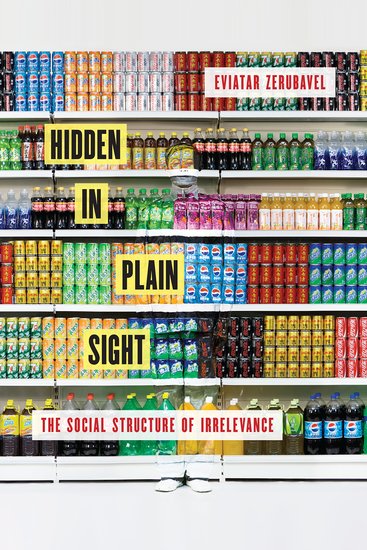
Many of us take for granted that what we perceive is a completely accurate representation of the world around us. Yet we have all had the experience of suddenly realizing that the keys or glasses that we had been looking for in vain were right in front of us the whole time. The capacity of our sense organs far exceeds our mental capabilities, and as such, looking at something does not guarantee that we will notice it. Our minds constantly prioritize and organize the information we take in, bringing certain things to the foreground, while letting others - that which we deem irrelevant - recede into the background. What ultimately determines what we perceive, and what we do not?
In this fascinating book, noted sociologist Eviatar Zerubavel argues that we perceive things not just as human beings but as social beings. Drawing on fascinating examples from science, the art world, optical illusions, and all walks of life, he shows that what we notice or ignore varies across cultures and throughout history, and illustrates how our environment and our social lives - everything from our lifestyles to our professions to our nationalities - play a role in determining how we actually use our senses to access the world. A subtle yet powerful examination of one of the central features of our conscious life, this book offers a way to think about all that might otherwise remain hidden in plain sight.
This is the main idea, in every situation there are background and fore ground delineated by physiological, psychological and sociological difference of the observer. The foreground is image (idea) that are under attendance and the background is the surrounding environment of that image.
This compendium of category errors is one of the most unintelligent books I’ve ever read. Fortunately it’s very short. The argument is that people direct their attention in ways that cause them to miss (or not see) the spaces between things or the background — and that they are compelled to do this by social, political, parental, professional, moral, customary, and peer pressures, and sometimes even by their genetics. So surgeons focus on the area they’re operating on, accountants focus on numbers, readers focus on letters. Page after page is filled with gems like “A black cat in a coal bin is difficult to see. A black cat on a snow bank is hard to miss.” (P. 24) This is the epigraph to Chapter 3, and is attributed to someone. The uninterrupted obviousness of Zerubavel’s examples might not be so tiresome if he actually offered any insights into human perception. But there’s none of that. Instead he occasionally provides a transparently thin veneer of scientific jargon, as in: “In theorizing the phenomenology of this process, it may be useful . . . to invoke the metaphor of a searchlight.” (P. 24) Yes, that metaphor really helps the reader understand the “phenomenology” of this difficult subject. Or — maybe it would be better to say that people always pay attention to somethings and not to others. Indeed, the pseudo-scientific language dissolves into trivia. The reader learns that “The psychological as well as biological foundations of human attention notwithstanding, it is nevertheless the attentional traditions, conventions, norms, and habits we internalize during our attentional socialization that often determine what we come to notice and ignore.” The conclusion? “We thus learn, for example, that whereas its author’s last name is particularly relevant for finding a book in a bookstore, the color of its jacket is not[.]” (P. 64) True as this may be, it’s not informative to someone who can read a book. Zerubavel occasionally intersperses the boringly obvious with statements that leave the reader shaking his or her head. Early in the book, he says that the term “fiction” is a “marked mental construct,“ while “non-fiction” is “unmarked” and therefore “only implicit.” Since the word “fiction” was first used to describe a literary genre long after many other non-fiction genres had been named — epic, history, letter, oration, philosophy — Zerubavel really should have done some homework before offering a dissertation the use of the word. But notwithstanding the extensive notes at the end of the book, nothing in the text suggests a critical intelligence at work.
Well-written and easily understood, no jargon-laden, with a clear structure and rich biography, this book is an excellent introduction to the topic of sensory and social perception - what we perceive but omit as well. We tend to organize our perceptions by distinguishing between a figure and a background. Our way of noticing and valuing particular (physical, mental, ethical, political, etc.) elements of our world is determined by inherent biological constraints but - and this is extremely important - can be revised, at least partially (for a better future).
Eviatar Zerubavel, sociologist, gives his take on how socialization can effect what you recognize and what you notice while not noticing other aspects. He does a great job articulating the comparison with pictures, and using psychologically to explain it. He excels at explaining what irrelevant means in regards to sociology.
This entire review has been hidden because of spoilers.
This was one of the books recommended for one for my MLIS classes (we often are assigned to read a book from a list, and then do a paper or project on the book) - this was not the one I chose to do the project, but it still intrigued me, and so, I added it to my wishlist...and now I have a copy.
A deceptively simple idea is given expert consideration in this book on how we perceive things. Learning to see the difference between a "figure" and a "background," is culturally determined yet utterly pervasive. This little book, which is amply illustrated, shows how what we see is often determined by how we're taught to see. There is some theory included since it is an academic book, but that doesn't detract from the several "aha" moments experienced while reading it. I sense that people might become more aware observers after reading this book. So many of the truths contained here are counterintuitive that it is a surprising study to read.