

What do you think?

Floodlines: The new novel from the author of Guapa
Set between London and Baghdad, Saleem Haddad’s brilliant second novel is a sweeping, multigenerational tale of art, exile, memory, and the enduring legacies of war.
In the summer of 2014, three long estranged Iraqi-British sisters are pulled back into each other’s orbit by the rediscovery of their late father’s long-lost paintings. Beautiful, elusive Zainab; embittered, practical Mediha; and headstrong, queer Ishtar each lay claim to their father’s legacy—an artistic and personal inheritance entwined with betrayal, exile, and a homeland they no longer recognize.
As the sisters fight to preserve, erase, or repurpose the past, Zainab’s estranged son Nizar, a war correspondent haunted by trauma and heartbreak, returns to the family fold. With the reemergence of buried memories comes a reckoning, and the family is forced to confront the personal and political betrayals that tore them apart.
Spanning continents and decades—from 1950s Baghdad to contemporary London, from the Tigris River to Yemeni refugee camps—Floodlines is at once an intimate family drama and, in its scope, a modern epic. It is a rare novel that bridges the historic and the immediate and a heartfelt meditation on what it means to belong, to create, to endure.
In the summer of 2014, three long estranged Iraqi-British sisters are pulled back into each other’s orbit by the rediscovery of their late father’s long-lost paintings. Beautiful, elusive Zainab; embittered, practical Mediha; and headstrong, queer Ishtar each lay claim to their father’s legacy—an artistic and personal inheritance entwined with betrayal, exile, and a homeland they no longer recognize.
As the sisters fight to preserve, erase, or repurpose the past, Zainab’s estranged son Nizar, a war correspondent haunted by trauma and heartbreak, returns to the family fold. With the reemergence of buried memories comes a reckoning, and the family is forced to confront the personal and political betrayals that tore them apart.
Spanning continents and decades—from 1950s Baghdad to contemporary London, from the Tigris River to Yemeni refugee camps—Floodlines is at once an intimate family drama and, in its scope, a modern epic. It is a rare novel that bridges the historic and the immediate and a heartfelt meditation on what it means to belong, to create, to endure.
327 pages, Kindle Edition
First published February 12, 2026
About the author
Saleem Haddad
8 books332 followersSaleem Haddad was born in Kuwait City to an Iraqi-German mother and a Palestinian-Lebanese father.
His first novel, Guapa, was published in 2016, receiving critical acclaim from The New Yorker, The Guardian, and others, and was awarded both a Stonewall Honour and the 2017 Polari First Book Prize.
He has also published a number of short stories, including for the Palestinian sci-fi anthology Palestine +100. He also writes for film and television; his directorial debut, Marco, premiered in March 2019 and was nominated for the 2019 Iris Prize for ‘Best British Short Film’. His work has been supported by institutions such as Yaddo and the Literarisches Colloquium Berlin.
He is currently based in Lisbon, with roots in London, Amman, and Beirut
His first novel, Guapa, was published in 2016, receiving critical acclaim from The New Yorker, The Guardian, and others, and was awarded both a Stonewall Honour and the 2017 Polari First Book Prize.
He has also published a number of short stories, including for the Palestinian sci-fi anthology Palestine +100. He also writes for film and television; his directorial debut, Marco, premiered in March 2019 and was nominated for the 2019 Iris Prize for ‘Best British Short Film’. His work has been supported by institutions such as Yaddo and the Literarisches Colloquium Berlin.
He is currently based in Lisbon, with roots in London, Amman, and Beirut
Ratings & Reviews
Friends & Following
Create a free account to discover what your friends think of this book!
Community Reviews
Displaying 1 - 30 of 141 reviews

April 5, 2026
3.5 stars
Powerful novel that follows an Iraqi family across generations. I appreciated that Saleen Haddad wrote about the conflict that can come between three siblings and how that personal conflict can coincide with differences in political ideologies/worldviews. Floodlines as a whole does a nice job addressing the intersection of art, neocolonialism, and resistance.
The main reason this book gets a slightly lower rating for me is that I felt that by the middle of the book, the political messages took precedent over the character voice/dialogue/development. The political messages are super important, though to me it seemed that some of the tightness of the prose, especially when it came to the characters’ interactions with one another and within themselves, dissipated. Would still recommend though especially for folks who may not mind a more discursive writing style!
Powerful novel that follows an Iraqi family across generations. I appreciated that Saleen Haddad wrote about the conflict that can come between three siblings and how that personal conflict can coincide with differences in political ideologies/worldviews. Floodlines as a whole does a nice job addressing the intersection of art, neocolonialism, and resistance.
The main reason this book gets a slightly lower rating for me is that I felt that by the middle of the book, the political messages took precedent over the character voice/dialogue/development. The political messages are super important, though to me it seemed that some of the tightness of the prose, especially when it came to the characters’ interactions with one another and within themselves, dissipated. Would still recommend though especially for folks who may not mind a more discursive writing style!

August 2, 2026
Ostensibly, Floodlines is about three Iraqi-British sisters, who are not getting along. They've been expats/immigrants for many years, two of them settled in the UK, one in Dubai. Their feelings about their homeland are complicated. Their Iraqi father was a famous artist, long dead. Their British mother, Bridget, also an artist, is now in her eighties, reaching the last chapter of her life.
As it's the case with most families, there are grudges, regrets, guilt and a whole lot of feelings. The sisters are artists themselves, with different levels of success.
Haddad did a splendid job interspersing the sisters' parents lives in 1950s Bagdad and later with the women's memories and their histories, and their current lives.
There is so much packed in this book, in less than 400 pages, which is quite the accomplishment.
Heritage, destiny, art, legacy, colonialism, imperialism, relationships, belonging - this novel had it all. It's definitely going to be among my favourite reads of 2026.
Highly recommended.
As it's the case with most families, there are grudges, regrets, guilt and a whole lot of feelings. The sisters are artists themselves, with different levels of success.
Haddad did a splendid job interspersing the sisters' parents lives in 1950s Bagdad and later with the women's memories and their histories, and their current lives.
There is so much packed in this book, in less than 400 pages, which is quite the accomplishment.
Heritage, destiny, art, legacy, colonialism, imperialism, relationships, belonging - this novel had it all. It's definitely going to be among my favourite reads of 2026.
Highly recommended.
February 8, 2026
Floodlines completely fascinated me. This was my first experience reading Saleem Haddad, but it will certainly not be my last. This is an easy five-star read and, in my view, a novel everyone should read, especially given our current geopolitical moment and the fractures shaping our world today.
Floodlines is a multigenerational family and historical drama that truly feels epic. Spanning continents and decades, it is inspired by Salim Haddad’s great-uncle, the Iraqi modernist painter Jewad Selim, and carries the weight of both personal and national history on every page.
At its centre are three estranged sisters, Zainab, Ishtar, and Mediha, forced to confront their father’s legacy, once one of Iraq’s most celebrated artists, and the buried secrets entwined with his work. Through them, each character is compelled to face their own story as it is engraved into the fractured history of their homeland.
This novel grapples with loss, displacement, family, art, and the deep wounds of neocolonialism. It asks how individual and collective identities are shaped by memory and heritage, and how we live in the tension between preserving the past and carrying hope for the future. How do you bear the weight of history when the past itself is broken?
Through each character, we follow the history of Iraq, its culture, its soul, its grief, its fragmentation, and its enduring spirit.
Art and cultural inheritance sit at the heart of this novel. As Haddad himself describes it, this is about “the role of art in times of rupture.”
Zainab’s son, Nizar, a war correspondent haunted by both past and present, becomes a powerful lens through which the novel examines trauma, queerness, longing, and the burden of family legacy. Throughout, the story holds a constant tension: tradition versus future, history versus modernity, resistance versus hope.
The dialogue is sharp, charged, and deeply moving. And beneath it all runs a haunting question: at what cost do we fight for home and legacy when they have been blown apart by those in power? Do we truly own our home?
This book taught me so much. It sent me down paths of research into Iraq’s history and geography, and the author’s years of work and research are felt on every page.
James Baldwin’s words, used as the epigraph, perfectly capture the soul of this novel:
“People are trapped in history, and history is trapped in them.”
Floodlines is a multigenerational family and historical drama that truly feels epic. Spanning continents and decades, it is inspired by Salim Haddad’s great-uncle, the Iraqi modernist painter Jewad Selim, and carries the weight of both personal and national history on every page.
At its centre are three estranged sisters, Zainab, Ishtar, and Mediha, forced to confront their father’s legacy, once one of Iraq’s most celebrated artists, and the buried secrets entwined with his work. Through them, each character is compelled to face their own story as it is engraved into the fractured history of their homeland.
This novel grapples with loss, displacement, family, art, and the deep wounds of neocolonialism. It asks how individual and collective identities are shaped by memory and heritage, and how we live in the tension between preserving the past and carrying hope for the future. How do you bear the weight of history when the past itself is broken?
Through each character, we follow the history of Iraq, its culture, its soul, its grief, its fragmentation, and its enduring spirit.
Art and cultural inheritance sit at the heart of this novel. As Haddad himself describes it, this is about “the role of art in times of rupture.”
Zainab’s son, Nizar, a war correspondent haunted by both past and present, becomes a powerful lens through which the novel examines trauma, queerness, longing, and the burden of family legacy. Throughout, the story holds a constant tension: tradition versus future, history versus modernity, resistance versus hope.
The dialogue is sharp, charged, and deeply moving. And beneath it all runs a haunting question: at what cost do we fight for home and legacy when they have been blown apart by those in power? Do we truly own our home?
This book taught me so much. It sent me down paths of research into Iraq’s history and geography, and the author’s years of work and research are felt on every page.
James Baldwin’s words, used as the epigraph, perfectly capture the soul of this novel:
“People are trapped in history, and history is trapped in them.”
August 2, 2026
A powerful, meandering family saga about grief, memory, broken promises, and the secrets we keep.

Read
August 4, 2026«Cada uma destas personagens tem motivações claras e bem justificadas — mesmo que não concordemos com elas —, e, por mais que as suas atitudes nos enervem, não temos como as odiar. E não temos como as odiar precisamente porque vão fazer-nos lembrar as nossas próprias famílias, das dinâmicas a que nos habituámos a assistir.»
Review completa em: https://ritadanova.substack.com/p/flo....
Review completa em: https://ritadanova.substack.com/p/flo....

March 3, 2026
Breathtaking. Will be one of those novels that will sit with me for a long time afterwards.
July 21, 2026
yeahhhh this was Good!
each sister was somehow an archetype and represented a different way to cope with estrangement but still felt real and complex.
ultimately, was confused was Mediha didn’t tell her story from her own POV, why her character felt so neglected and a bit vilified even w the darkness introduced. messy but good
each sister was somehow an archetype and represented a different way to cope with estrangement but still felt real and complex.
ultimately, was confused was Mediha didn’t tell her story from her own POV, why her character felt so neglected and a bit vilified even w the darkness introduced. messy but good
Review of advance copy received from Netgalley
A multi-generational novel, Floodlines mainly focuses on the turbulent relationship between three Iraqi-British sisters (Ishtar, Zainab, and Mediha) as they navigate displacement, war, violence, love, family secrets, and more throughout their lives.
This is one the best books I’ve ever read! It is so beautifully written and powerfully haunting in its descriptions. The book opens with the perspective of Nizar, the son of Zainab. He is a war journalist living in London, but has recently started doing sex work. Through his pov, we come to understand how his past and his identity have shaped his relationships. A lot of his pov is him reflecting on his past relationship with a man named Alfie. These moments were really heartbreaking to read, evident through Nizar’s own fervent heartbreak.
Throughout the book we also get Zainab’s and Ishtar’s perspectives, as well as their mother’s, Bridget’s. In all these povs, we come to understand the family better and how each perspective tells the same story but with different perceptions and feelings. I thought this was so well done and I was really invested in each character’s thoughts and memories. I also loved the descriptions of Baghdad. So many of the character’s thoughts are them reflecting on how they remember Baghdad; the streets they walked, the places they lived, the jobs they went to. Later, they reflect on its many changes, both known and unknown; how wars, foreign intervention, and colonialism have changed the landscapes of not just Baghdad, but Iraq as a whole. The perfect way to describe this novel would be “nostalgia.” And while the characters are nostalgic of the past, they are also running away from it.
In general, I loved the story, and I loved the characters, even though they could be frustrating at times (one in particular made me angry). Haddad did an amazing job at representing both the good and bad parts of them. These characters are not perfect; they have made mistakes and hurt others. Life is complex and people contain multitudes and I love when books tackle that unflinchingly, which is what Floodlines does.
This is truly a wonderful book and I’m so grateful to have gotten an ARC for it (thank you Europa Press and Netgalley)! Floodlines releases February 12! 🩷
This is one the best books I’ve ever read! It is so beautifully written and powerfully haunting in its descriptions. The book opens with the perspective of Nizar, the son of Zainab. He is a war journalist living in London, but has recently started doing sex work. Through his pov, we come to understand how his past and his identity have shaped his relationships. A lot of his pov is him reflecting on his past relationship with a man named Alfie. These moments were really heartbreaking to read, evident through Nizar’s own fervent heartbreak.
Throughout the book we also get Zainab’s and Ishtar’s perspectives, as well as their mother’s, Bridget’s. In all these povs, we come to understand the family better and how each perspective tells the same story but with different perceptions and feelings. I thought this was so well done and I was really invested in each character’s thoughts and memories. I also loved the descriptions of Baghdad. So many of the character’s thoughts are them reflecting on how they remember Baghdad; the streets they walked, the places they lived, the jobs they went to. Later, they reflect on its many changes, both known and unknown; how wars, foreign intervention, and colonialism have changed the landscapes of not just Baghdad, but Iraq as a whole. The perfect way to describe this novel would be “nostalgia.” And while the characters are nostalgic of the past, they are also running away from it.
In general, I loved the story, and I loved the characters, even though they could be frustrating at times (one in particular made me angry). Haddad did an amazing job at representing both the good and bad parts of them. These characters are not perfect; they have made mistakes and hurt others. Life is complex and people contain multitudes and I love when books tackle that unflinchingly, which is what Floodlines does.
This is truly a wonderful book and I’m so grateful to have gotten an ARC for it (thank you Europa Press and Netgalley)! Floodlines releases February 12! 🩷
December 30, 2025
I really loved this multi-generational family drama based around 3 sisters & their extended family of artists from Iraq. Dealing with loss, exile, displacement, memory, hope and sisterly drama.
The inheritance of their late fathers paintings brings up long buried secrets and traumas that can't be ignored. I liked seeing the history of Iraq through a family perspective; the estranged sisters have to deal with their shattered links to each other and to their country, both transformed by tragedy.
The weight of history and the transformation of memories is heavy but the hope for something else glimmers. We can only live so long in stasis before we have to flow on. Art and the river will show us the way; the path of the future threads away before us, full of hope even with the inevitable uncertainty of its future flooding.
I really enjoyed this exceptional novel, the voices are beautiful, authentic, moving and extremely hopeful. Now need to read his other novel.
Thanks to netgalley and the publisher for an e-arc for my honest review.
The inheritance of their late fathers paintings brings up long buried secrets and traumas that can't be ignored. I liked seeing the history of Iraq through a family perspective; the estranged sisters have to deal with their shattered links to each other and to their country, both transformed by tragedy.
The weight of history and the transformation of memories is heavy but the hope for something else glimmers. We can only live so long in stasis before we have to flow on. Art and the river will show us the way; the path of the future threads away before us, full of hope even with the inevitable uncertainty of its future flooding.
I really enjoyed this exceptional novel, the voices are beautiful, authentic, moving and extremely hopeful. Now need to read his other novel.
Thanks to netgalley and the publisher for an e-arc for my honest review.

April 15, 2026
Floodlines is an entrancing mix of family secrets, tensions between sisters, art, war, displacement, and love set in a land I have never visited but that i feel I know. Exiles looking for home and looking for hope and putting themselves back together on that dirty ancient river. I found myself procrastinating finishing the book because I didn't want it to end... the final journey was worth the wait.

August 2, 2026
(A special shoutout to Jouja for putting this book on my radar and for ultimately making Iraq next in my personal series of 'reading my way around the world.')
I was spellbound by this read in large part because of how Haddad characterizes the three sisters and their wildly different relationships with Iraq and its heritage. One who reads virtually every ill of the Arab world as downstream of Western interference. One who turns the critique inward on Iraq itself, vilifying the place as a whole and who leans largely into the Western train of thought. And one who sits in the middle, holding onto the more 'beautiful' aspecrs of their heritage, but who's role as an informant in the old regime complicates a fully clean read as the 'moderate' sister. The book centers around their competing strategies for handling their heritage: repurposing, erasing, and preserving the past.
This easily could have been a story about three sisters, but having Nizar(Zainab's son), and Bridget (their mother) in the mix shows the intergenerational complexities of how the trauma of empire, war, and inherited history is metabolized across time. I appreciated Haddad's balance of referring to Nizar's identity as a queer man, and elaborating on the challenges he faced navigating a relationship with someone who didn't carry the same culturally inherited trauma, without making that the central narrative of the book (while also adding some unhinged and hilarious lines around it that offer comedic relief).
I don't think I've had so many annotations where something Haddad wrote reminded me of something in my life, or I could at least visually put myself at the Ottolenghi in Shoreditch as easily as the markets in Satwa.
I was spellbound by this read in large part because of how Haddad characterizes the three sisters and their wildly different relationships with Iraq and its heritage. One who reads virtually every ill of the Arab world as downstream of Western interference. One who turns the critique inward on Iraq itself, vilifying the place as a whole and who leans largely into the Western train of thought. And one who sits in the middle, holding onto the more 'beautiful' aspecrs of their heritage, but who's role as an informant in the old regime complicates a fully clean read as the 'moderate' sister. The book centers around their competing strategies for handling their heritage: repurposing, erasing, and preserving the past.
This easily could have been a story about three sisters, but having Nizar(Zainab's son), and Bridget (their mother) in the mix shows the intergenerational complexities of how the trauma of empire, war, and inherited history is metabolized across time. I appreciated Haddad's balance of referring to Nizar's identity as a queer man, and elaborating on the challenges he faced navigating a relationship with someone who didn't carry the same culturally inherited trauma, without making that the central narrative of the book (while also adding some unhinged and hilarious lines around it that offer comedic relief).
I don't think I've had so many annotations where something Haddad wrote reminded me of something in my life, or I could at least visually put myself at the Ottolenghi in Shoreditch as easily as the markets in Satwa.

April 30, 2026
This book was devastating in so many different ways. I loved all of the characters and the messy fun sad family dynamics. Reallly really good scene setting with descriptions of the Tigris River and returning to a place after you’ve been away for a long time. Broke my heart over and over again!!!!

December 3, 2025
This was a fascinating novel for many reasons. It deals with modern Iraq, bi-cultural families, queerness, interfamily dynamics, and the importance of art in the Arab world.
At first I was tempted to put the book down, since the vicious arguments between three sisters were disturbingly real (and very depressing). Also, the author writes without telling us who is speaking, which can get pretty confusing. With four main female characters, it takes some effort to figure out the dialogue. I'm not sure why the author chose to punctuate this way, but I wish he hadn't.
Which brings us to the topic of a man writing from four female viewpoints (plus one male viewpoint). I didn't realize the author was a gay man until after finishing the book. That explained why a few of the females' issues felt just a bit off to me (for example, the lifelong trauma of a miscarriage, when numerous healthy children came afterwards). But for the most part, he got inter-sister rivalry right.
A lot of the book is about the importance of art. All of the main characters are artists, some very famous and some not. The deceased father of the family was one of Iraq's most prominent artists. In the afterward, we learn that he was a real person, as was his wife, and the novel is loosely based on his life and family. Not being all that knowledgeable about art myself, a lot of the artsy discussions went over my head. But the parts about the intersections of colonial and Middle East art were fascinating.
The discussions about the Iraqi diaspora were wonderful. I really enjoyed learning about the longing for a homeland that no longer exists, how emigres feel displaced their entire lives, and how this defines their personalities. The characters ended up living in many different countries, over many periods of turmoil in the Arab world, and all of this rang true.
Some the secrets/reveals felt a bit stretched to me. But it all came together nicely in the end. I enjoyed one character becoming obsessed with the myth of Gilgamesh and wanting to float an old-style ark down the Tigris River. I wasn't sure about the details of all this (boating in Iraq while ISIS is on the rampage, for instance), but it was interesting to say the least.
The author really poured his heart and soul into this book, which I admire. I learned so much. It wasn't always easy reading, jumping around frequently between voices, and participating in witnessing deep family arguments. But once hooked, I couldn't put it down.
The writing is elegant:
"It is difficult to love an artist. They are selfish creatures. An artist might lie, cheat, and steal with the belief they are creating something more important than a single life. To love an artist, you must have an even stronger belief in the power of art. An artist's lover lives with the heat and smoke of the fire, but the light falls elsewhere."
Thanks the NetGalley and the publisher for an advance review copy.
At first I was tempted to put the book down, since the vicious arguments between three sisters were disturbingly real (and very depressing). Also, the author writes without telling us who is speaking, which can get pretty confusing. With four main female characters, it takes some effort to figure out the dialogue. I'm not sure why the author chose to punctuate this way, but I wish he hadn't.
Which brings us to the topic of a man writing from four female viewpoints (plus one male viewpoint). I didn't realize the author was a gay man until after finishing the book. That explained why a few of the females' issues felt just a bit off to me (for example, the lifelong trauma of a miscarriage, when numerous healthy children came afterwards). But for the most part, he got inter-sister rivalry right.
A lot of the book is about the importance of art. All of the main characters are artists, some very famous and some not. The deceased father of the family was one of Iraq's most prominent artists. In the afterward, we learn that he was a real person, as was his wife, and the novel is loosely based on his life and family. Not being all that knowledgeable about art myself, a lot of the artsy discussions went over my head. But the parts about the intersections of colonial and Middle East art were fascinating.
The discussions about the Iraqi diaspora were wonderful. I really enjoyed learning about the longing for a homeland that no longer exists, how emigres feel displaced their entire lives, and how this defines their personalities. The characters ended up living in many different countries, over many periods of turmoil in the Arab world, and all of this rang true.
Some the secrets/reveals felt a bit stretched to me. But it all came together nicely in the end. I enjoyed one character becoming obsessed with the myth of Gilgamesh and wanting to float an old-style ark down the Tigris River. I wasn't sure about the details of all this (boating in Iraq while ISIS is on the rampage, for instance), but it was interesting to say the least.
The author really poured his heart and soul into this book, which I admire. I learned so much. It wasn't always easy reading, jumping around frequently between voices, and participating in witnessing deep family arguments. But once hooked, I couldn't put it down.
The writing is elegant:
"It is difficult to love an artist. They are selfish creatures. An artist might lie, cheat, and steal with the belief they are creating something more important than a single life. To love an artist, you must have an even stronger belief in the power of art. An artist's lover lives with the heat and smoke of the fire, but the light falls elsewhere."
Thanks the NetGalley and the publisher for an advance review copy.

March 12, 2026
so profound and well thought out
April 1, 2026
When we think of displacement-the one often forced by a bald eagle flying over a resourceful land and people, ready to democratise the air, the land, the water, everything in sight-we tend to think of physical relocation. But as the characters in Floodlines know, you can never fully relocate; the place you grow up in holds you in a tight grip (or embrace), and you-following Newton’s third law-also hold it in your hearts and minds, refusing to let it sneak away. And God forbid, if you are an artist, your longing can torment you in even more myriad ways, by making your hopeful brushstrokes full of cynical breaks and pauses; the chokehold of the memories expands to every aspect of your life.
We follow the Mathloum family-parents Bridget and Haydar, and their daughters (Ishtar, Zainab, Mediha), and Zainab’s son Nizar. All of them are experiencing three time periods at the same time: the heavy winds of the past, the burden of responsibility in the present, and the concern about the future, making a three-dimensional prison around them. Saleem Haddad beautifully shows what effects such triple anxiety can have on people, especially when every generation is not only dealing with it, trying to break free from it, but oftentimes passing on a multiplied sense of captivity. The characters try to stand firm on the ground, not willing to let the global, imperial challenges shake them, even though the ground under them doesn’t just move; it is violently bombed, mercilessly altered to become unrecognisable. This kind of bombardment can be disorienting; the characters often forget who they are, where they belong, and that is when art provides them with that ability to return home. It allows them to accept, process, and understand the imperfections in their decisions all along, and make peace with the fact that the past can’t be restored to the perfection of the memories they hold. And it also enables them to see each other-their fellow family members-as people who didn’t have a ready-made template to help them deal with the beast of forced displacement, and every new attempt to break free of this generational turbulence will be full of mistakes-unforgivable, but understandable.
Stunning work by Saleem Haddad!
We follow the Mathloum family-parents Bridget and Haydar, and their daughters (Ishtar, Zainab, Mediha), and Zainab’s son Nizar. All of them are experiencing three time periods at the same time: the heavy winds of the past, the burden of responsibility in the present, and the concern about the future, making a three-dimensional prison around them. Saleem Haddad beautifully shows what effects such triple anxiety can have on people, especially when every generation is not only dealing with it, trying to break free from it, but oftentimes passing on a multiplied sense of captivity. The characters try to stand firm on the ground, not willing to let the global, imperial challenges shake them, even though the ground under them doesn’t just move; it is violently bombed, mercilessly altered to become unrecognisable. This kind of bombardment can be disorienting; the characters often forget who they are, where they belong, and that is when art provides them with that ability to return home. It allows them to accept, process, and understand the imperfections in their decisions all along, and make peace with the fact that the past can’t be restored to the perfection of the memories they hold. And it also enables them to see each other-their fellow family members-as people who didn’t have a ready-made template to help them deal with the beast of forced displacement, and every new attempt to break free of this generational turbulence will be full of mistakes-unforgivable, but understandable.
Stunning work by Saleem Haddad!
April 7, 2026
I loved really everything about this book although the chapter told from the dying elderly mother’s (Bridget) point of view really sticks with me. Her perspective shows up at a time in the story when you don’t think about her except from the point of view of her three daughter’s own perspectives about the burden of caring for her and their own tortured pasts. It’s in the middle of the book.
Up until this one chapter, the sister’s stories as well as the stories told by Nizar, Bridget’s only grandson are compelling and modern, mixed into livelihoods / lives pursued in the Middle East and London. The sisters are artists descended from an Iraqi father and British mother who rose to prominence as famous artists themselves but whose legacy has been muted by history; Nizar is a war journalist despondent over what’s he’s seen and how it has no place or existence in his city life. There are many complicated threads and all are interesting.
The novel reveals world and family histories in the midst of a war zone and is unfathomable. Our government drops the bombs that ultimately destroy the lives of the inhabitants. When and how will we pay for these crimes?
Up until this one chapter, the sister’s stories as well as the stories told by Nizar, Bridget’s only grandson are compelling and modern, mixed into livelihoods / lives pursued in the Middle East and London. The sisters are artists descended from an Iraqi father and British mother who rose to prominence as famous artists themselves but whose legacy has been muted by history; Nizar is a war journalist despondent over what’s he’s seen and how it has no place or existence in his city life. There are many complicated threads and all are interesting.
The novel reveals world and family histories in the midst of a war zone and is unfathomable. Our government drops the bombs that ultimately destroy the lives of the inhabitants. When and how will we pay for these crimes?
Read
July 5, 2026Took me forever to read this book so I don’t know if I can properly review but it could have been shorter in my opinion and the POV changes made it difficult for me to connect. There were some really great lines in here especially towards the beginning. I would read something else by the author I think.
August 30, 2026
A first 5 star review from me in a longgg, long time. Wow. This book is so revolutionary in its storytelling, I was left bursting with wisdom as me and my partner drove to the shops talking about death and grief, and how pointless it all feels. Yet, it is within this pointlessness that every point exists, it is through art, love and pain that our lives come to mean something, in this we are free. Floodlines is a river weaving between grief, art, trauma and the lives of three estranged British-Iraqi sisters, each with individual opposing ideas of their Iraqi roots. All characters are stubborn and fierce in their feelings, inherited surely from their father who was a culture shifting artist and their head-strong mother, who had to keep it all together. Set mainly against the backdrop of 2014 Iraq, a time of mass military violence - a fragmented country that brings the sisters back together, a home to them, a birth-place of everything they are. Touching on themes of queerness - belonging - disillusionment - trauma and finally acceptance, I will recommend this book to every person I know.
"Art will not save us. It will not magically make things right. But art can make us feel just a little bit better, just a little less alone." - Layla AlAmmar
"Art will not save us. It will not magically make things right. But art can make us feel just a little bit better, just a little less alone." - Layla AlAmmar
March 16, 2026
4.5 rounded up

April 29, 2026
Floodlines is a multi-generational novel set predominantly in 2014. The blurb doesn’t do this novel justice as the story is much more complex than the blurb suggests. It deals with heavy subjects, including the effects of trauma and loss on family dynamics. The pacing in the middle was a bit slow in my opinion (which is why I have deducted a star), but I read this novel in the course of several weeks as my commuting book, and I never not felt like picking it up.
May 2, 2026
really enjoyed the act of reading this book. I love a family of interesting characters and I love a book that tickles my sociology brain
May 24, 2026
This book is soooo ambitious in scope and pulls it off beautifully. Could tell I was going to love it from page 1
March 18, 2026
The journey through the lanes of old Baghdad coinciding with the current chaos, shaping hallucinations and grief was beautifully depicted in the book. I think this book touches the core of being alive. Seen from the lens of an artist, Haddad is very efficient about the way he makes the character very realistic and trying to escape the cage of suffering.
The historical relevances are on point, and you see the dark face of colonialism, capitalism and communism altogether. The best part is author’s inspiration from a real-life artist and his self immersion, which gives an insight to the complex mind of the inhabitant of the world defined with the term “diaspora”. I loved the epiphanies, the regrets, and the schizophrenic flashbacks which gave the work its true artistic nature.
The historical relevances are on point, and you see the dark face of colonialism, capitalism and communism altogether. The best part is author’s inspiration from a real-life artist and his self immersion, which gives an insight to the complex mind of the inhabitant of the world defined with the term “diaspora”. I loved the epiphanies, the regrets, and the schizophrenic flashbacks which gave the work its true artistic nature.

July 18, 2026
Ugh this lost me in so many places. I’m going to see him do a book talk in Athens on Wednesday so wanted to love it as much as I loved Guapa.. alas…

May 25, 2026
This book was ass.
For starters, everyone is horrible. I don't even care about spoiling. I know the point of the book is that everyone's horrible and way too caught up in the past, but they're horrible to the point that I don't even root for any of them. Zainab was a government informer who believes in Gulf country propaganda. Ishtar is a lunatic who believes in tankie propaganda. Mediha is cruel and commits sadist elder abuse. Nizar blames his white boyfriend for every problem and refuses to let him have an ounce of joy. The lesson of the book is to forgive yourself but honestly everything the characters did was so horrible that the lesson of reconnecting with your culture in a truthful manner falls flat. What the lesson should be is that you can create your own culture and you don't have to forgive people. You just have to find joy.
I'm not pro psychiatry, but every character was mentally ill in a clinical way (coming from someone who suffers from severe mental illness) and that should've been addressed.
As a book that claims to be about Iraq and Iraqi culture I barely know anything new on it other than Mesopotamia. Everyone discusses it, but it's seldom described in reality. It makes me feel icky. I do find it interesting that the theme is people trying to find themselves in a 'dying' Arab world and in the ashes of a country's destruction but there is nothing more profound than that, just various debates on issues in the Arab World where nothing profound is said.
they also let the mom be redeemed when she let all of her daughters be abused and molested by an evil uncle.
Just skip this one it's really bad.
For starters, everyone is horrible. I don't even care about spoiling. I know the point of the book is that everyone's horrible and way too caught up in the past, but they're horrible to the point that I don't even root for any of them. Zainab was a government informer who believes in Gulf country propaganda. Ishtar is a lunatic who believes in tankie propaganda. Mediha is cruel and commits sadist elder abuse. Nizar blames his white boyfriend for every problem and refuses to let him have an ounce of joy. The lesson of the book is to forgive yourself but honestly everything the characters did was so horrible that the lesson of reconnecting with your culture in a truthful manner falls flat. What the lesson should be is that you can create your own culture and you don't have to forgive people. You just have to find joy.
I'm not pro psychiatry, but every character was mentally ill in a clinical way (coming from someone who suffers from severe mental illness) and that should've been addressed.
As a book that claims to be about Iraq and Iraqi culture I barely know anything new on it other than Mesopotamia. Everyone discusses it, but it's seldom described in reality. It makes me feel icky. I do find it interesting that the theme is people trying to find themselves in a 'dying' Arab world and in the ashes of a country's destruction but there is nothing more profound than that, just various debates on issues in the Arab World where nothing profound is said.
they also let the mom be redeemed when she let all of her daughters be abused and molested by an evil uncle.
Just skip this one it's really bad.
This entire review has been hidden because of spoilers.
June 16, 2026
Contrary to a lot of the positive reviews for the book I just felt so…confused. Each chapter is labeled as “2014” but the actual content of the book jumps back and forth between the 1950’s and the present day so I was never reallyyyy sure where I was in the characters’ storyline. After the initial conflict was introduced, I feel like the author then just dumped a lot of backstory and political commentary, which lost me. And then, by the end, I didn’t really understand what the conclusion to the conflict actually was. And a huge part of the plot is seemingly the distant son coming back into the family fold, yet I feel like he was talked about so little? I was excited by the idea of a multigenerational story but overall I was very unsatisfied.
April 26, 2026
4.5 Stars: The first 75 pages of this book had me thinking we were in store for one of my top 5 books of all time. The writing is so beautiful and so emotional. I haven’t read a family as real and visceral since Zadie Smith’s On Beauty. I think the momentum slowed for me after the first 100 pages, but it’s still a brilliant work

February 5, 2026
An Ark Made of Paintings and Mud: Why “Floodlines” Turns the Tigris Into a Family, a Battlefield, and a Blueprint for Hope
By Demetris Papadimitropoulos | February 5th, 2026
Watercolor Piece by Demetris Papadimitropoulos
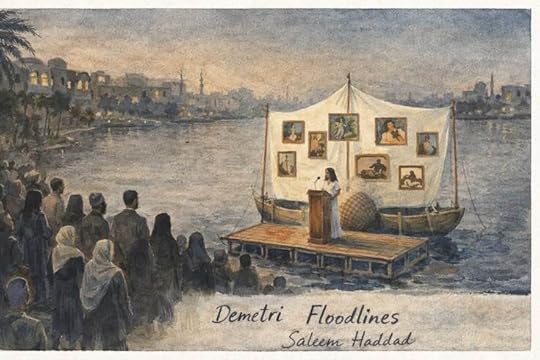
A dusk-lit Tigris-bank crowd watches Ishtar deliver her launch speech in “Floodlines,” unveiling the makeshift “ark” – a flotilla/sail hung with the family’s recovered paintings – as Baghdad’s water becomes both stage and archive.
In “Floodlines,” Saleem Haddad sends a family down a river that refuses to stay a metaphor. The Tigris is water and waste, memory and muscle; it is a corridor of myth and a ledger of modern policy. It is also, in Haddad’s hands, a testing ground for an old question that has recently become unavoidably contemporary: when the past is a wound and the future is a forecast, what, exactly, is hope supposed to do?
The novel’s engine is a piece of art that wants to be a vessel. Ishtar, an Iraqi artist based in London, returns to the region in 2014 to build an ark-like structure from three traditional Mesopotamian boats – the round guffa, the reed-and-tire kalak, and the narrow meshouf. Her plan is part homage, part provocation: to stitch together craft traditions that colonial borders and modern war have pulled apart, then sail south as if the river might still function as a shared artery rather than a sequence of checkpoints and polluted bends. The journey begins in the north, near Hasankeyf, where the threat of inundation hovers like a curse, and she recruits a small, unlikely crew: Murat, a boatman whose village is itself facing erasure; Nizar, her nephew, whose intelligence and impatience make him both collaborator and irritant; and, later, Abu Rashid, a marsh man whose presence carries the authority of a lived ecology.
Haddad structures “Floodlines” like a braided current. Chapters move between named perspectives – Ishtar, her sister Zainab, their mother Bridget, and other figures orbiting the family – and between temporal strata that arrive the way memories do: not as orderly exposition, but as a flood triggered by smell, texture, a street corner, a sentence you have been avoiding. The narrative toggles from the riverbank to a rainy Scottish cottage, from Dubai’s engineered gleam to Baghdad’s checkpoint labyrinth, and back again, until the reader begins to feel the book’s central argument in the body: that displacement is not a one-time event but a permanent weather system.
Zainab’s strand begins far from the river. She has built a life in the Gulf selling polished “heritage” objects – trinkets of Iraqi-ness that can be bought, worn, and displayed without touching the mud that produced them. Her estrangement has been lucrative, which is its own kind of shame. When she travels to Scotland to confront Mediha, the sister who stayed closer to the raw ore of their family history, the trip carries the nervous energy of a heist. Bridget is declining; her memory is unreliable; the house is a museum of domestic disrepair – medication schedules, spoiled food, odd hoards, an air of damp grief. Zainab intends to retrieve the family’s paintings, which Mediha has been guarding like contraband. She also intends, less cleanly, to retrieve a version of herself that does not feel like an accessory to other people’s fantasies.
Meanwhile Ishtar’s expedition, set in October 2014, is a logistical fever dream. Boats break. Tires puncture. Goat skins rot. Funding evaporates. The river itself is a series of armed negotiations: checkpoints with their own ecosystems, slogans painted onto barriers, men in civilian cars carrying rifles, children and older women approaching vehicles to beg. Baghdad, when Ishtar arrives, is at once recognizable and unrecognizable. She books a luxury hotel that feels like a fortress and then walks out into streets where the old coordinates – home, school, bridge, market – have been rewritten by invasion, sanctions, sectarian violence, and the anxious improvisations of survival. In one of the novel’s most devastating sequences, she searches for her family home and finds absence where a room used to be, the psychic equivalent of stepping into thin air.
It is in these sequences that Haddad shows his gift for rendering a city as a palimpsest. He is attentive to the way aesthetics persist even in militarized ruin – painted doves on concrete, neon signage, the insistence of art seeping into the most mundane structures of control. He knows how to make the sensory do intellectual work. Petrol and sewage mingle with the smell of wet earth; a childhood memory arrives not as nostalgia but as survival technique. Even the gaudiness of the hotel lobby becomes part of the book’s moral inventory: who gets to be insulated, who pays for the insulation, and what insulation does to the soul.
If Ishtar supplies the novel’s heat, Nizar supplies its pressure. Queer, hyperliterate, sharpened by a different generation of exile, he is wary of the way “telling stories” can become another form of taking. He begins as the dutiful witness, the one who can turn fragments into narrative and narrative into meaning. Then Haddad reveals the quieter violence inside that role: the temptation to use other people’s pain as fuel, the hunger for a coherent explanation that would make betrayal legible. Nizar’s needling questions land like stones thrown into water you thought you knew. He can see, sometimes more clearly than Ishtar can, that art-making in a disaster zone can flirt with the very extraction it claims to resist.
Watercolor Piece by Demetris Papadimitropoulos
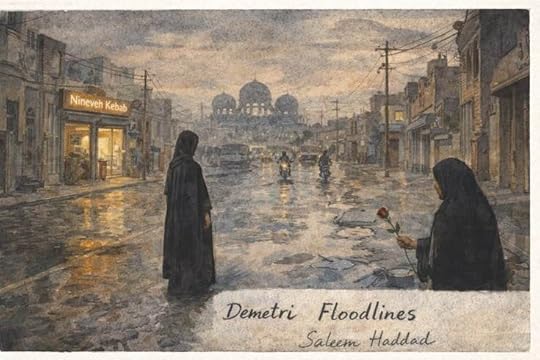
In a rain-slick Baghdad street under the glowing “Nineveh Kebab” sign, Ishtar—wrapped in an abaya and makeshift hijab—buys a single rose and pauses in disoriented grief as she realizes her childhood neighborhood’s anchor has shifted and her family home has been demolished.
The river journey intensifies this logic. As the expedition moves south, the waters slow and thicken. Debris gathers. Pollution becomes intimate: brackish taste on the tongue, algae film, sickness that arrives as cramps and fever. Haddad’s environmental consciousness is not decorative; it is narrative propulsion. He is acutely attentive to how ecological breakdown and infrastructural collapse become daily tasks – finding clean water, negotiating a barrage, washing clothes without poisoning your skin. The novel treats water not as a scenic element but as a moral material. Every gulp and rinse becomes a question: who controls the flow, who gets clean, who is forced to ingest history in its most literal form?
Myth, here, is not ornamentation. “The Epic of Gilgamesh” threads through the novel as both mirror and argument, a refrain that insists the present is not new, only newly arranged. Haddad uses the epic the way some writers use music: to establish rhythm, to thicken meaning, to remind the reader that the questions modernity treats as novel – what lasts, what is lost, what a person can build against death – were asked first in a place that contemporary geopolitics has tried to turn into a cautionary tale. The ark Ishtar imagines is not only biblical; it is Mesopotamian, older than the borders that later tried to freeze the region into manageable shapes. In Haddad’s telling, myth is less escape than pressure test: can the old stories still hold the weight of the new damage?
The novel’s most audacious convergence comes when the private plot and the public project finally meet. Zainab brings Bridget and the paintings to Baghdad. The family constructs an ark-like artwork: boats arranged into a circular bloom, canvases pinned to cloth like sails, the river itself conscripted as gallery space. They stage an event that is part exhibition, part ritual, part protest, part family séance. It is the sort of set piece that could easily topple into symbolism, and Haddad keeps it human by letting the scene remain messy: people arguing about logistics, about safety, about who is allowed to speak; strangers arriving with their own grief; siblings fighting in the corners while the city watches, curious and suspicious and hungry for something that is not a headline.
Bridget’s emergence at the Baghdad launch is staged with a novelist’s sense of crowd physics. Haddad lets the old binaries – public and private, art and survival – collapse in real time as this aging painter, widowed and half-feral with grief, steps into a microphone and becomes something like a conduit for the city’s long conversation with itself. She speaks in the language she has avoided for decades, corrects a name that has been cynically altered, insists that any light worth making casts a shadow, and refuses the audience’s desire for a clean redemption narrative. For a moment, the book turns into a portrait of what it means to age inside history: to have your memory betray you, and to speak anyway; to have your body fail, and to offer the body as witness.
It is also here that Haddad’s writing most clearly bears his signature, the blend of confession and critique that readers of his earlier novel “Guapa” will recognize. He is a novelist who thinks in the open. At its best, the effect is exhilarating: the mind and the body in the same room, the essay and the scene interleaving like reeds. At its weakest, the open thinking can tilt into the declarative, paragraphs that feel like beautifully composed position statements. The novel occasionally strains to name every implication of its own imagery, as if afraid the reader might miss the stakes. But “Floodlines” is also, on some level, a book about refusing euphemism. Its impatience with soft language is part of its moral posture.
The family story is equally unwilling to soften. Haddad is sharp on the way families distribute roles as survival governance. One sister becomes the responsible one, another the creative one, another the difficult one; a mother becomes both refuge and engine of harm; silence becomes domestic policy, enforced for the supposed sake of keeping everyone alive. When that silence breaks, the novel handles trauma with notable care. It does not sensationalize violation; it traces its echoing consequences: modesty that is not prudishness but negotiated ceasefire with the body, dread of being seen, the way an entire household can collude in quiet because speech would fracture the fragile scaffolding of daily life. The book insists that what happens in a country happens in a kitchen, and vice versa.
As the expedition continues, the book deepens into travelogue and reckoning. The crew camps in bomb craters and discovers tank tracks in mud; they wash themselves in water they do not trust. They pass villages where hospitality survives as insistence, where strangers bring tea and stew because movement itself has become a luxury. The novel lingers on encounters that feel like micro-ethics: a Sabaean-Mandaean temple where water is central to ritual and exile is mapped onto the availability of clean shallows; arguments about whether rebuilding is duty or denial; moments of levity that do not cancel grief but keep it from becoming total. The river becomes a moving committee meeting in which everyone is negotiating what it means to stay, to leave, to return, to claim.
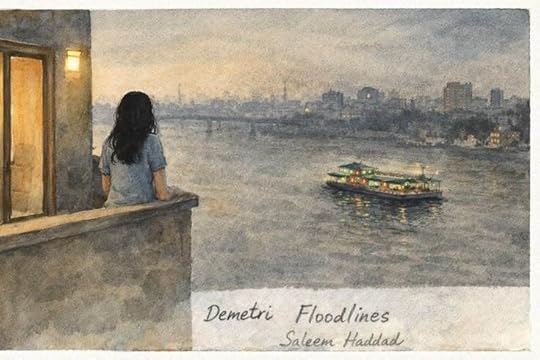
Watercolor Piece by Demetris Papadimitropoulos
Ishtar stands on the Babylon Hotel balcony in Baghdad, watching the grey Tigris and the lit “Floating Restaurant” drift below – a hushed first reckoning with her return and the river journey she’s about to attempt.
What makes “Floodlines” feel urgent now is not only its portrait of Iraq, though that portrait is devastating and specific. It is the novel’s insistence that the crises we label separately – climate catastrophe, imperial violence, diaspora, cultural heritage loss, the politics of memorialization – are in fact one braided system. A river is a supply line, a border, a myth, a dumping ground, a childhood memory, a route of escape, a site of prayer. Read the book alongside the ongoing news of water scarcity, contested borders, displaced populations, and the long afterlife of foreign interventions, and its central image sharpens: the river is a record of what power does, and a reminder that the consequences flow downhill.
Haddad is attentive, too, to the way catastrophe edits culture. The novel keeps returning to the question of museums: what do you archive when the destruction is ongoing, when the ruins are not past but present tense? “Floodlines” answers by treating art as a portable institution – a tarp strung like a sail, paintings fastened to cloth, a river turned into procession. He also has a satirist’s ear for official language: the way “concern” and “international community” can become floating sentence fragments.
Haddad’s closest literary kin are writers who understand that history is not background but weather – Ahmed Saadawi’s “Frankenstein in Baghdad,” Sinan Antoon’s “The Baghdad Eucharist,” and Hisham Matar’s “The Return.” Like those books, “Floodlines” is less interested in tidy plot than in the lived texture of aftermath: how a person carries a country inside the body.
The question, then, is whether “Floodlines” earns its metaphors. Does the ark hold? Does the river carry more than it can bear? In the end, Haddad’s triumph is not that he resolves the family’s fractures, but that he refuses to let any one framework swallow the others. The ecological narrative does not absolve the personal. The personal does not shrink the political. The myth does not anesthetize the material. The material – brackish water, petrol-soaked air, mud that smells like childhood, the exhausted logistics of moving through a place that has been repeatedly invaded by both armies and ideologies – keeps insisting on itself, and the book keeps honoring that insistence.
There are places where the ambition strains its vessel. Some secondary figures appear primarily to represent positions in a debate, then fade. The intelligence is so close to the surface that mystery sometimes thins; you can feel the author assembling his evidence. But even that evidence-making has its own beauty. Haddad writes with a lyric insistence that turns inventory into music, and he trusts the reader to sit inside contradiction: nostalgia that is both comfort and lie; “heritage” that is both preservation and packaging; return that is both healing and reopening.
In the closing movement, as the expedition reaches Qurna, the point where the rivers meet after their long estrangement, the book finds a hard-earned tenderness. There is no perfect restoration, no return to an unbroken home. There is only provisional coherence – bodies rowing in rhythm, strangers offering food, a mother briefly oriented by return, sisters sitting together as the sky changes color. The novel treats these moments not as consolation prizes but as the actual substance of a life. The grand narratives – nation, progress, exile, redemption – fall away, and what remains is a quieter claim: that continuity is something you build in fragments, and that fragments can still be enough to keep you afloat.
For a book so saturated with loss, “Floodlines” is surprisingly generous. It asks its characters, and its readers, for something harder than outrage: compassionate precision. Not the forgiveness that erases wrongdoing, but the understanding that allows a person to see how damage reproduces itself – and how it might, with effort, be interrupted. It is why, despite the occasional overexplanatory passage, I’d rate the novel 91 out of 100: not for offering easy hope, but for showing hope as a radical discipline practiced in full view of the flood.
By Demetris Papadimitropoulos | February 5th, 2026
Watercolor Piece by Demetris Papadimitropoulos
A dusk-lit Tigris-bank crowd watches Ishtar deliver her launch speech in “Floodlines,” unveiling the makeshift “ark” – a flotilla/sail hung with the family’s recovered paintings – as Baghdad’s water becomes both stage and archive.
In “Floodlines,” Saleem Haddad sends a family down a river that refuses to stay a metaphor. The Tigris is water and waste, memory and muscle; it is a corridor of myth and a ledger of modern policy. It is also, in Haddad’s hands, a testing ground for an old question that has recently become unavoidably contemporary: when the past is a wound and the future is a forecast, what, exactly, is hope supposed to do?
The novel’s engine is a piece of art that wants to be a vessel. Ishtar, an Iraqi artist based in London, returns to the region in 2014 to build an ark-like structure from three traditional Mesopotamian boats – the round guffa, the reed-and-tire kalak, and the narrow meshouf. Her plan is part homage, part provocation: to stitch together craft traditions that colonial borders and modern war have pulled apart, then sail south as if the river might still function as a shared artery rather than a sequence of checkpoints and polluted bends. The journey begins in the north, near Hasankeyf, where the threat of inundation hovers like a curse, and she recruits a small, unlikely crew: Murat, a boatman whose village is itself facing erasure; Nizar, her nephew, whose intelligence and impatience make him both collaborator and irritant; and, later, Abu Rashid, a marsh man whose presence carries the authority of a lived ecology.
Haddad structures “Floodlines” like a braided current. Chapters move between named perspectives – Ishtar, her sister Zainab, their mother Bridget, and other figures orbiting the family – and between temporal strata that arrive the way memories do: not as orderly exposition, but as a flood triggered by smell, texture, a street corner, a sentence you have been avoiding. The narrative toggles from the riverbank to a rainy Scottish cottage, from Dubai’s engineered gleam to Baghdad’s checkpoint labyrinth, and back again, until the reader begins to feel the book’s central argument in the body: that displacement is not a one-time event but a permanent weather system.
Zainab’s strand begins far from the river. She has built a life in the Gulf selling polished “heritage” objects – trinkets of Iraqi-ness that can be bought, worn, and displayed without touching the mud that produced them. Her estrangement has been lucrative, which is its own kind of shame. When she travels to Scotland to confront Mediha, the sister who stayed closer to the raw ore of their family history, the trip carries the nervous energy of a heist. Bridget is declining; her memory is unreliable; the house is a museum of domestic disrepair – medication schedules, spoiled food, odd hoards, an air of damp grief. Zainab intends to retrieve the family’s paintings, which Mediha has been guarding like contraband. She also intends, less cleanly, to retrieve a version of herself that does not feel like an accessory to other people’s fantasies.
Meanwhile Ishtar’s expedition, set in October 2014, is a logistical fever dream. Boats break. Tires puncture. Goat skins rot. Funding evaporates. The river itself is a series of armed negotiations: checkpoints with their own ecosystems, slogans painted onto barriers, men in civilian cars carrying rifles, children and older women approaching vehicles to beg. Baghdad, when Ishtar arrives, is at once recognizable and unrecognizable. She books a luxury hotel that feels like a fortress and then walks out into streets where the old coordinates – home, school, bridge, market – have been rewritten by invasion, sanctions, sectarian violence, and the anxious improvisations of survival. In one of the novel’s most devastating sequences, she searches for her family home and finds absence where a room used to be, the psychic equivalent of stepping into thin air.
It is in these sequences that Haddad shows his gift for rendering a city as a palimpsest. He is attentive to the way aesthetics persist even in militarized ruin – painted doves on concrete, neon signage, the insistence of art seeping into the most mundane structures of control. He knows how to make the sensory do intellectual work. Petrol and sewage mingle with the smell of wet earth; a childhood memory arrives not as nostalgia but as survival technique. Even the gaudiness of the hotel lobby becomes part of the book’s moral inventory: who gets to be insulated, who pays for the insulation, and what insulation does to the soul.
If Ishtar supplies the novel’s heat, Nizar supplies its pressure. Queer, hyperliterate, sharpened by a different generation of exile, he is wary of the way “telling stories” can become another form of taking. He begins as the dutiful witness, the one who can turn fragments into narrative and narrative into meaning. Then Haddad reveals the quieter violence inside that role: the temptation to use other people’s pain as fuel, the hunger for a coherent explanation that would make betrayal legible. Nizar’s needling questions land like stones thrown into water you thought you knew. He can see, sometimes more clearly than Ishtar can, that art-making in a disaster zone can flirt with the very extraction it claims to resist.
Watercolor Piece by Demetris Papadimitropoulos
In a rain-slick Baghdad street under the glowing “Nineveh Kebab” sign, Ishtar—wrapped in an abaya and makeshift hijab—buys a single rose and pauses in disoriented grief as she realizes her childhood neighborhood’s anchor has shifted and her family home has been demolished.
The river journey intensifies this logic. As the expedition moves south, the waters slow and thicken. Debris gathers. Pollution becomes intimate: brackish taste on the tongue, algae film, sickness that arrives as cramps and fever. Haddad’s environmental consciousness is not decorative; it is narrative propulsion. He is acutely attentive to how ecological breakdown and infrastructural collapse become daily tasks – finding clean water, negotiating a barrage, washing clothes without poisoning your skin. The novel treats water not as a scenic element but as a moral material. Every gulp and rinse becomes a question: who controls the flow, who gets clean, who is forced to ingest history in its most literal form?
Myth, here, is not ornamentation. “The Epic of Gilgamesh” threads through the novel as both mirror and argument, a refrain that insists the present is not new, only newly arranged. Haddad uses the epic the way some writers use music: to establish rhythm, to thicken meaning, to remind the reader that the questions modernity treats as novel – what lasts, what is lost, what a person can build against death – were asked first in a place that contemporary geopolitics has tried to turn into a cautionary tale. The ark Ishtar imagines is not only biblical; it is Mesopotamian, older than the borders that later tried to freeze the region into manageable shapes. In Haddad’s telling, myth is less escape than pressure test: can the old stories still hold the weight of the new damage?
The novel’s most audacious convergence comes when the private plot and the public project finally meet. Zainab brings Bridget and the paintings to Baghdad. The family constructs an ark-like artwork: boats arranged into a circular bloom, canvases pinned to cloth like sails, the river itself conscripted as gallery space. They stage an event that is part exhibition, part ritual, part protest, part family séance. It is the sort of set piece that could easily topple into symbolism, and Haddad keeps it human by letting the scene remain messy: people arguing about logistics, about safety, about who is allowed to speak; strangers arriving with their own grief; siblings fighting in the corners while the city watches, curious and suspicious and hungry for something that is not a headline.
Bridget’s emergence at the Baghdad launch is staged with a novelist’s sense of crowd physics. Haddad lets the old binaries – public and private, art and survival – collapse in real time as this aging painter, widowed and half-feral with grief, steps into a microphone and becomes something like a conduit for the city’s long conversation with itself. She speaks in the language she has avoided for decades, corrects a name that has been cynically altered, insists that any light worth making casts a shadow, and refuses the audience’s desire for a clean redemption narrative. For a moment, the book turns into a portrait of what it means to age inside history: to have your memory betray you, and to speak anyway; to have your body fail, and to offer the body as witness.
It is also here that Haddad’s writing most clearly bears his signature, the blend of confession and critique that readers of his earlier novel “Guapa” will recognize. He is a novelist who thinks in the open. At its best, the effect is exhilarating: the mind and the body in the same room, the essay and the scene interleaving like reeds. At its weakest, the open thinking can tilt into the declarative, paragraphs that feel like beautifully composed position statements. The novel occasionally strains to name every implication of its own imagery, as if afraid the reader might miss the stakes. But “Floodlines” is also, on some level, a book about refusing euphemism. Its impatience with soft language is part of its moral posture.
The family story is equally unwilling to soften. Haddad is sharp on the way families distribute roles as survival governance. One sister becomes the responsible one, another the creative one, another the difficult one; a mother becomes both refuge and engine of harm; silence becomes domestic policy, enforced for the supposed sake of keeping everyone alive. When that silence breaks, the novel handles trauma with notable care. It does not sensationalize violation; it traces its echoing consequences: modesty that is not prudishness but negotiated ceasefire with the body, dread of being seen, the way an entire household can collude in quiet because speech would fracture the fragile scaffolding of daily life. The book insists that what happens in a country happens in a kitchen, and vice versa.
As the expedition continues, the book deepens into travelogue and reckoning. The crew camps in bomb craters and discovers tank tracks in mud; they wash themselves in water they do not trust. They pass villages where hospitality survives as insistence, where strangers bring tea and stew because movement itself has become a luxury. The novel lingers on encounters that feel like micro-ethics: a Sabaean-Mandaean temple where water is central to ritual and exile is mapped onto the availability of clean shallows; arguments about whether rebuilding is duty or denial; moments of levity that do not cancel grief but keep it from becoming total. The river becomes a moving committee meeting in which everyone is negotiating what it means to stay, to leave, to return, to claim.
Watercolor Piece by Demetris Papadimitropoulos
Ishtar stands on the Babylon Hotel balcony in Baghdad, watching the grey Tigris and the lit “Floating Restaurant” drift below – a hushed first reckoning with her return and the river journey she’s about to attempt.
What makes “Floodlines” feel urgent now is not only its portrait of Iraq, though that portrait is devastating and specific. It is the novel’s insistence that the crises we label separately – climate catastrophe, imperial violence, diaspora, cultural heritage loss, the politics of memorialization – are in fact one braided system. A river is a supply line, a border, a myth, a dumping ground, a childhood memory, a route of escape, a site of prayer. Read the book alongside the ongoing news of water scarcity, contested borders, displaced populations, and the long afterlife of foreign interventions, and its central image sharpens: the river is a record of what power does, and a reminder that the consequences flow downhill.
Haddad is attentive, too, to the way catastrophe edits culture. The novel keeps returning to the question of museums: what do you archive when the destruction is ongoing, when the ruins are not past but present tense? “Floodlines” answers by treating art as a portable institution – a tarp strung like a sail, paintings fastened to cloth, a river turned into procession. He also has a satirist’s ear for official language: the way “concern” and “international community” can become floating sentence fragments.
Haddad’s closest literary kin are writers who understand that history is not background but weather – Ahmed Saadawi’s “Frankenstein in Baghdad,” Sinan Antoon’s “The Baghdad Eucharist,” and Hisham Matar’s “The Return.” Like those books, “Floodlines” is less interested in tidy plot than in the lived texture of aftermath: how a person carries a country inside the body.
The question, then, is whether “Floodlines” earns its metaphors. Does the ark hold? Does the river carry more than it can bear? In the end, Haddad’s triumph is not that he resolves the family’s fractures, but that he refuses to let any one framework swallow the others. The ecological narrative does not absolve the personal. The personal does not shrink the political. The myth does not anesthetize the material. The material – brackish water, petrol-soaked air, mud that smells like childhood, the exhausted logistics of moving through a place that has been repeatedly invaded by both armies and ideologies – keeps insisting on itself, and the book keeps honoring that insistence.
There are places where the ambition strains its vessel. Some secondary figures appear primarily to represent positions in a debate, then fade. The intelligence is so close to the surface that mystery sometimes thins; you can feel the author assembling his evidence. But even that evidence-making has its own beauty. Haddad writes with a lyric insistence that turns inventory into music, and he trusts the reader to sit inside contradiction: nostalgia that is both comfort and lie; “heritage” that is both preservation and packaging; return that is both healing and reopening.
In the closing movement, as the expedition reaches Qurna, the point where the rivers meet after their long estrangement, the book finds a hard-earned tenderness. There is no perfect restoration, no return to an unbroken home. There is only provisional coherence – bodies rowing in rhythm, strangers offering food, a mother briefly oriented by return, sisters sitting together as the sky changes color. The novel treats these moments not as consolation prizes but as the actual substance of a life. The grand narratives – nation, progress, exile, redemption – fall away, and what remains is a quieter claim: that continuity is something you build in fragments, and that fragments can still be enough to keep you afloat.
For a book so saturated with loss, “Floodlines” is surprisingly generous. It asks its characters, and its readers, for something harder than outrage: compassionate precision. Not the forgiveness that erases wrongdoing, but the understanding that allows a person to see how damage reproduces itself – and how it might, with effort, be interrupted. It is why, despite the occasional overexplanatory passage, I’d rate the novel 91 out of 100: not for offering easy hope, but for showing hope as a radical discipline practiced in full view of the flood.
September 22, 2026
This books is criminally underrated. I loved this! I was initially drawn to it because it had such a beautiful cover (I’m a very big believer in judging a book by its cover), but the story-telling was even more beautiful. I’ve been trying to read more global fiction, and more from up-and-coming authors, so this was the perfect intersection.
This novel is about multiple generations of a somewhat-estranged Iraqi family that’s thrust into conflict over the father’s paintings. Once a renowned artist, they battle over his legacy and how much of the past they want to keep buried. The epigraph by James Baldwin is a perfect illustration of the book’s central message: “people are trapped in history and history is trapped in them”.
Through the different members of this family, we see how history can shape our lives in different ways. Even after they’ve long left, the events in Iraq — whether it be the war, its aftermath, or Saddam’s regime leading up to it — considerably impact who they are as people and how they approach the world. I tend not to enjoy stories told from different perspectives. This one was told by five different characters, but I think it added to the story this time. I was equally invested in each of their points of view and I think it added a layer of nuance that couldn’t be achieved otherwise.
I will say however there are two concerns I have with this book that made me waver between a 4 and a 5 star (still very likely that I change my mind on this rating). Firstly — and the lesser of the two offenses — Haddad seems to completely abandon the character of Nizar after Part 1. He starts off as a quintessential part of the story, being one of my favorite characters to read about. However, as the book progresses, he’s relegated to nothing more than a background character. My biggest issue with the book tho is the ending (Part 4). This novel has so much power all throughout, but the ending kinda neutered that. It’s like Haddad wanted to tie everything together in a neat bow, but I don’t think that’s necessarily what the story needed. This entire novel is about a dysfunctional family and towards the end they just become normal and ordinary. I also feel he trusted the reader less towards the end and some parts were unrealistic. Pretty disappointing.
Nevertheless, absolutely amazing overall. I haven’t read book that completely engulfed me since Kingfisher, and that was a while ago. This was a great return.
This novel is about multiple generations of a somewhat-estranged Iraqi family that’s thrust into conflict over the father’s paintings. Once a renowned artist, they battle over his legacy and how much of the past they want to keep buried. The epigraph by James Baldwin is a perfect illustration of the book’s central message: “people are trapped in history and history is trapped in them”.
Through the different members of this family, we see how history can shape our lives in different ways. Even after they’ve long left, the events in Iraq — whether it be the war, its aftermath, or Saddam’s regime leading up to it — considerably impact who they are as people and how they approach the world. I tend not to enjoy stories told from different perspectives. This one was told by five different characters, but I think it added to the story this time. I was equally invested in each of their points of view and I think it added a layer of nuance that couldn’t be achieved otherwise.
I will say however there are two concerns I have with this book that made me waver between a 4 and a 5 star (still very likely that I change my mind on this rating). Firstly — and the lesser of the two offenses — Haddad seems to completely abandon the character of Nizar after Part 1. He starts off as a quintessential part of the story, being one of my favorite characters to read about. However, as the book progresses, he’s relegated to nothing more than a background character. My biggest issue with the book tho is the ending (Part 4). This novel has so much power all throughout, but the ending kinda neutered that. It’s like Haddad wanted to tie everything together in a neat bow, but I don’t think that’s necessarily what the story needed. This entire novel is about a dysfunctional family and towards the end they just become normal and ordinary. I also feel he trusted the reader less towards the end and some parts were unrealistic. Pretty disappointing.
Nevertheless, absolutely amazing overall. I haven’t read book that completely engulfed me since Kingfisher, and that was a while ago. This was a great return.
Displaying 1 - 30 of 141 reviews