“Schott’s animated account moves at a fast clip, is full of colorful anecdotes, and will delight animal lovers of all stripes.” — Publishers Weekly, starred review
Sharing the stories of 22 different animal healers and veterinarians from across eras and continents, Dr. Schott examines the always fascinating, often unexpected, and sometimes hilarious veterinary methods employed to treat all manner of creatures. From healing dogs and horses to gorillas and even dragons, at the heart lies the evolution of the human-animal bond, which has been more cyclical than linear.
James Herriot will be familiar to many people, but most of the other featured vets will be new. They range from Palakapya, who treated fighting elephants in India almost 3,000 years ago, to Dr. Louis Camuti, who had the first feline house call practice anywhere, tending to the cats of celebrities in mid-twentieth century Manhattan Whether you have a passion for animals, the history of the medical sciences, or just quirky history, this light-hearted exploration of the empathetic relationship between man and beast will entertain and delight.
Philipp was born in Germany in 1965. A year later his family emigrated to Canada. Philipp grew up in Saskatoon, regularly returning to Germany to visit. He studied biology the University of Saskatchewan before switching to veterinary medicine. After graduation he moved to Winnipeg with his classmate and future wife, Lorraine. Except for a year taken to backpack around the world, Philipp was at the same Winnipeg small animal clinic since 1990 until he retired from active practice in 2025 to allow more time for writing.
His writing began with a travel blog and then a veterinary blog. His first book, "The Accidental Veterinarian", a collection of non-fiction stories from his practice, was published by ECW Press in 2019. It became a Canadian bestseller and was translated into five languages. Two sequels followed. He has also written historical fiction based on his father's experiences in Nazi Germany ("The Willow Wren") and a history of veterinary medicine ("Heal the Beasts").
In addition, Philipp has been writing an acclaimed series of cozy-ish mysteries featuring Dr. Peter Bannerman, a veterinarian and amateur detective. So far there has been "Fifty-Four Pigs", "Six Ostriches", "Eleven Huskies", and "Three Bengal Kittens".
He and Lorraine live in a creaky old house on the river with two children and several pets. Although writing, hobbies, and his family keep him busy, he spends as much time outdoors as he can. He's a particular fan of long-distance walking, having completed the West Highland Way, the Hadrian's Wall Path, the Laugavegur in Iceland, and the Inca Trail, among others. He also enjoys tracking his walks around Winnipeg as virtual walks, including a 2300 km trek from The Shire to Mordor. This taught him how sturdy those hobbits really were.
Thanks to NetGalley and the Publisher for providing me with this brief but intriguing history of humans' connection with animals through the ages. The author is a Canadian veterinarian and writer. I enjoyed his three previous works of fiction,' The Dr. Bannerman Mysteries ', and have his 'Accidental Vet' books on my list. These are based on incidents in his career. He writes with wit, wisdom and empathy.
This book's format and tone were unusual. He uses a conversational style, speaking directly to the reader with humorous asides. The reader does not need much knowledge of science or medicine to relax and enjoy his engaging conversations. Each chapter begins with a fictional anecdote featuring a historic animal healer, then gives some facts about the care of animals at that time. He discusses the relationship of man and beasts through the ages, and in many countries. Some of the so-called cures were bizarre and shocking. Disease was believed to be due to evil spirits, bad air, or the punishment of an owner by the gods, by sickening and killing his livestock. He warns the reader when an upcoming section may be disturbing because it deals with the suffering of animals, giving the reader a chance to avoid it. The Church and some philosophers in Medieval times insisted that animals lacked a soul, and many remedies, research, and learning by dissecting were forbidden. Scientific teachings declined in Europe, but at the same time, medical and scientific thought flourished in Arab countries.
Going back in history, we learn that the early healers treated animals for practical purposes, mainly horses and livestock, and later working dogs. Early veterinarians were known by their specialty, followed by the word leech. Thus, the titles of horse-leech or cow-leech. The keeping of animals as companions or pets was scarcely known, except possibly by the wealthy. As ordinary people began to acquire small animals as pets, they became beloved family members. This coincided with the opening of veterinary schools, animal clinics, and hospitals, where pets became the main patients of modern veterinarians. With the contagious germ theory, antibiotics, and the development of vaccines, human and animal medical treatment made great strides.
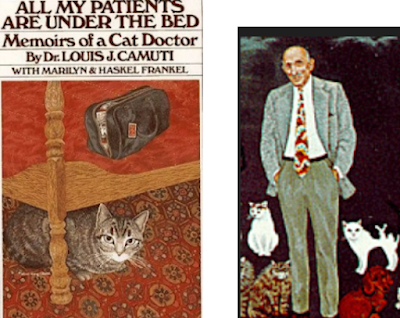
Throughout the book, we learn interesting facts and meet many significant people. Some facts will interest any reader. He mentions that 3,000 years ago, Indian fighting elephants were treated for their injuries. The horrifying fact that 12,000 horses were killed in a single day during the Battle of Waterloo is heartbreaking. James Herriot and others who established vet hospitals, taught veterinary skills, and opened clinics are mentioned. As small animal clinics became widespread, some veterinarians became specialists working with specific animals. Dr. Camuti specialized in treating cats in New York City and did house calls for over 60 years. He wrote a book about his practice titled ' All My Patients Are Under the Bed'. Readers will find ancient drawings and engravings depicting early cures, and later fascinating paintings and photos of noted veterinarians and their work. Publication is due July 08/2025.
Heal The Beasts is an exploration of the history of veterinary medicine by Canadian veterinarian and author, Philipp Schott. He takes his reader back some fourteen thousand years, introducing a pup whose bones, found in the same burial as human bones, indicate it was treated for distemper. Yes, that long ago, people were caring for their animals.
But if the idea of fourteen millennia of veterinary history seems daunting, fear not! As he hops all over the globe, Schott presents the interesting tidbits of how Veterinary medicine came to be, and he prefaces each chapter with a fictional vignette that illustrates the point of including that particular person.
He describes how the motive for treatment fluctuates between practical, emotional and spiritual, often being a mixture of two or three of these, and tells us “Much as in ancient times, throughout the Middle Ages veterinary medicine was a hodgepodge, with a few sound practices mixed into a breathtaking range of unsound ones.”
Thus, for example: “When “murrain” struck flocks of sheep in medieval England, it was common practice to gather the sheep to listen to a priest read the appropriate curative psalms to them.”
He also notes that in early publications, treatments are generally “the expected mix of the useful, the useless, and the downright bizarre”, many of which he describes for the reader’s entertainment. Not until the Enlightenment, was everything “thrown open to question and inquiry. Reason was replacing superstition. Science was replacing theology” and some healers “saw more similarities than differences between the maladies of humans and animals.”
More recent history even brings up some names with which the reader may be familiar. Certainly, the statistics are, at times, mind-boggling. Informative, fascinating, and often entertaining. This unbiased review is from an uncorrected proof copy provided by NetGalley and ECW Press
If you can write a history or biography of salt, screws or the colour indigo, then why not Veterinary Science? So wonders veterinarian, writer and avowedly non-professional historian Phillip Scott. And his method for telling this history is through 40 potted biographies and snapshot stories of animal doctors throughout the ages. Schott fancies himself as a storyteller, which is the book's selling point and its weakness.
Most of the chapters here start with an animal problem to be solved by the nascent vet (the term veterinarian doesn't really come into use until the 19th century). How can we solve the excess horse deaths in battle, how do we make lambing safer, my dog has no nose.... But also, for colour, Schott delves deeply into the imagined day-to-day life of his subjects. This gives the book colour, but considering half of his subjects are known merely by name and what they wrote, and there is a solid number who are wholly made up to stand for a scientific leap, it sometimes gets a bit weird that they're worrying about what is for dinner. It is clearly the part Schott enjoys the most, and he never promises a rigorously dry history, but it still feels kind of odd.
Heal The Beasts is like that all over. It works pretty well as a history, but its adherence to its structure means that it often feels like organizational advances are missed. There is a good discussion on the changing nature of the profession, from basic wartime inventory care to modern animal cancer treatments. But its insistence on staying light and resembling a very samey short story compilation does eventually feel like a weakness.
Having read and enjoyed Philipp Schott's mystery series, it was a given that I'd read his recounting of the history of veterinary medicine, and how it advanced as humans themselves began empathizing with other animals.
Schott uses humour, short stories and conversational English making this an easy to digest work. He opens each of his chapters in a different time period, giving us a hypothetical tale of a healer caring for a type of animal(s). He then follows this by showing us the rudimentary medical knowledge of the time and how it was applied in the care of these animals. There are numerous treatments that are shocking, cruel by our standards, and sometimes just plainly weird and wrong. Thankfully, Schott uses sensitivity and care when describing these, which is critical in making this an accessible and readable history.
Once humans began domesticating various animals, keeping them healthy was critical to ensure food and money for their owners, even though animals were treated very much as tools. Of course, cultures never stand still, and neither does the human need to learn and understand, and with this evolution came a better understanding of the creatures we share the planet with, and their needs. Schott describes how for centuries people felt animals felt no pain, which is frankly absurd, and how this attitude has changed, though it has taken millennia for it to take root. Schott reminds us of this, citing the staggering numbers of animals who have died in the service of humans, including during wars, and also compares and contrasts attitudes about animals in different cultures, based on their usefulness to humans.
Schott does mention Alf Wight, a.k.a.James Herriot, because no mention of veterinary care in the West can fail to mention the delightful stories of that man's experiences treating the farm animals, and the occasional small animals, in the English countryside. There were other small animal veterinarians elsewhere, and Schott mentions one, Dr. Louis Camuti, whose practice in New York City, starting in 1933 and lasting for many years, specialized in treating cats, and his gentle approach to some of his skittish patients.
This was a captivating and informative book, and if you are at all interested in veterinary science and its evolution, this is a good place to start with dipping your toe into its history.
Thank you to Netgalley and to ECW Press for this ARC in exchange for my review.
A fact-filled history of our treatment of animals, through sickness and health In Heal the Beasts author and veterinarian Philipp Schott has written an impressive history of his profession from the earliest days of animal care. The book also follows humans’ relationships with animals and the role animals have played in individual lives and society. Each chapter is centered around a particular animal healer or veterinarian and opens with an extended vignette about that person and their experiences. This is followed by a broader discussion of that page in history. The tone of the book often reminded me more of conversation than a written work, and like many conversations it was fascinating and engaging. Each chapter was full of facts and descriptions about animals, their care, and various historical figures who were animal lovers (or not!). I learned that twelve thousand horses died in one day at the Battle of Waterloo. Rene Descartes described animals as “automata, mere machines”; on the other hand, Voltaire said that “one must never have observed animals in order not to distinguish among them the different voices of need, suffering, joy, fear, love, anger and all their affections”. The medieval European Christian church forbade dissecting animals or studying their diseases, but the Arabs did pursue the subject. On the other hand, the world’s first veterinary school opened about 1761, but humans did not get their first dental school until 1840. I learned about “attenuation”, the practice of passing a disease through another species in order to weaken it and make treatment in the first species possible. The recently deceased Pope Francis hinted that animals might be able to go to heaven! I could go on and on but will not. You will have to dip into Heal the Beasts to learn more! I suggest a chapter or two at a time for maximum enjoyment. I received an advance review copy of Heal the Beasts from NetGalley and the publisher.
As a future vet (I'll be off to vet school this september if my a-levels go well!), this immediately piqued my interest. Before reading, I knew absoluely nothing about the history of veterinary medicine, but this book definitely helped remedy that! I really enjoyed the structure of considering one particular historical figure at a time and delving into how their life reflected the state of veterinary medicine at the time. It gave a really nice sense of progression and some of the people mentioned really were incredible. Take Maria von Maltzan for example: one of the first female vets, treated people's animals for free and also saved many lives during the holocaust by smuggling jewish people out of the country in furntiture. I wish her autobiography was translated in English. I also appreciated the variety of people mentioned: this isn't eurocentric retelling. There are figures and stories of veterinary medicine from all over the world. The style of 'fictionalised' short stories before each discussion of the history was unusual and took getting used to, but gave the book something unique and special to make it much more engaging. The conversational tone won't be for everyone, but I really enjoyed it- it felt a bit like I was sitting in an auditorium listening to a talk! I think my only complaint is that it was too short! It felt very much like a 'snapshot' view, which is valid for this kind of book but I was defintely hungering for more at the end. Ah well, to the 'further reading' section I go! This is definitely worth a read if you're at all interested in veterinary medicine or just our relationship with animals as a whole. I've definitely come away with a lot of facts and information that I'll be quoting at my family throughout the coming months (whether they like it or not!).
Thank you to NetGalley for providing me an ARC of this book for an honest review. All opinions are my own.
I never thought I'd be so engrossed in a little nonfiction book about the history of veterinary medicine, but this one caught my attention and held it! The story-esque introductions to each chapter set up the information in a fun and easy-to-digest way, while the rest of the chapter provided information that was not too technical for this layperson to follow and understand.
Schott has such an engaging writing style and presents information in such a good way for your everyday reader. That being said, this is a great educational book too, and I could definitely see it used in introductory animal science courses and hope professors and the like see that potential as well!
Absolutely facinating! The evolution of veterinary medicine and science through the ages from the use of herblore and some rather suspect practices through to the development of veterinary schools and a more scientific approach. I like the little story at the start of each chapter which the author uses to illustrate the historical references in that chapter. The collection of pictures and photos at the end was really interesting. The author explains things clearly without overdoing the medical jargon and shows how each of the 'pioneers' in the field moved the profession forward. A very interesting read. Thanks to Netgalley, ECW Press, and Philipp Schott for the free ARC. All opinions are my own.
I was hoping in my heart of hearts for the next James Herriot, and this isn’t that book. It is a relatively interesting survey of the history of the veterinary arts. I found it dry in parts, and absorbing in parts — and I got several more titles to try out of it. Oddly I liked the modern section best. I haven’t seen anything like this before, and I think it’s a good book to have in the world.
Author Philipp Schott is a semi-retired veterinarian who has operated a small animal practice in Winnipeg, Canada since 1990. Schott is also the author of several non-fiction books, 'The Willow Wren', and the 'Dr. Bannerman vet' mystery series.
Author Philipp Schott
'Heal the Beasts' is a non-fiction book about the history of veterinary medicine, and though Schott is not a professional historian, he writes, "I have a passion for history, a passion for veterinary medicine, and a passion for storytelling." Schott notes this is not a textbook, but rather an idiosyncratic telling of veterinary medicine's stories across history.
At 232 pages, the book provides a brief glimpse of the slow advancement of veterinary practices over the millennia. Schott begins many chapters with a fictional veterinary anecdote related to the era, which adds a nice fanciful touch.
*****
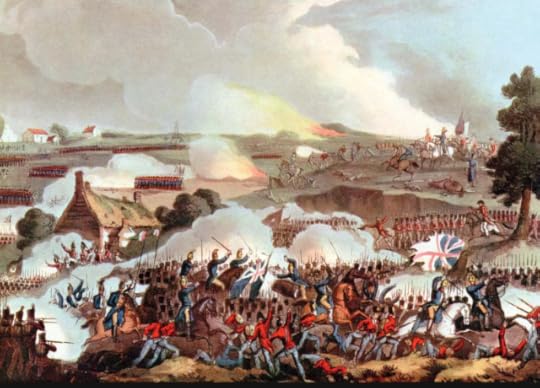
Historically, animals were mostly valued for their usefulness to people - as beasts of burden; for protection; for hunting; to ride to battle; for meat, etc. As an example, when 12,000 horses died in one day at the Battle of Waterloo in 1815, the concern was more about the expense of losing so many equines - and the difficulty of replacing them - than about the suffering of the unfortunate creatures.
The Battle of Waterloo
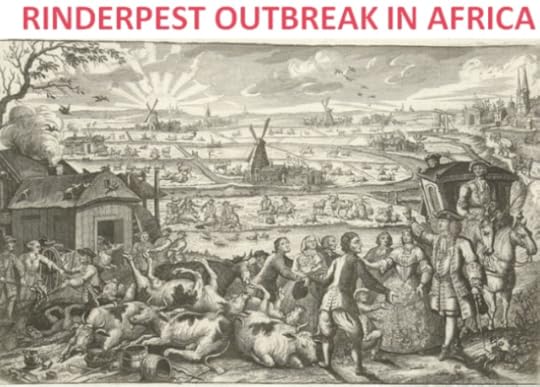
Another example is the rinderpest disease that devastates cattle, which was known as far back as ancient Egypt. When rinderpest wiped out herds of cattle in medieval Europe, people starved.
Depiction of a rinderpest epidemic
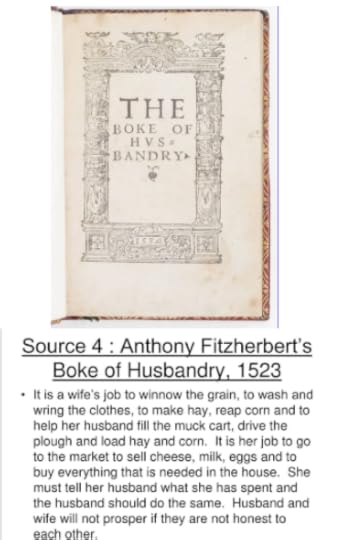
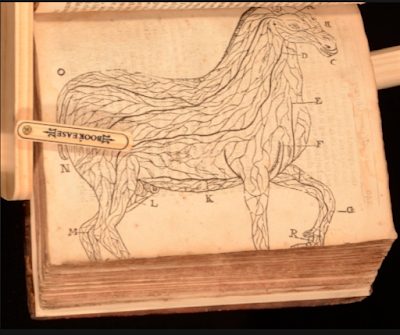
Financial losses related to sick and dying beasts resulted in the emergence of 'animal practitioners' of every stripe, many of whom were not helpful. For instance, Anthony FitzHerbert's 'Boke of Husbandry', written in the 1500s, recommends a poultice of 'feitergrasse' for chronic respiratory disease in cows.
Anthony FitzHerbert's Boke of Husbandry (which has all kinds of advice)
The nascent veterinary profession wasn't born in the middle ages however. Healers have been around since ancient times, when 'shamans' used plants and other natural substances to make potions and pastes for ailing people. Schott cites an instance of yarrow and chamomile being found on the tooth of a Neanderthal woman with a dental abscess. Such medicines were used for animals as well, especially creatures important to the group.
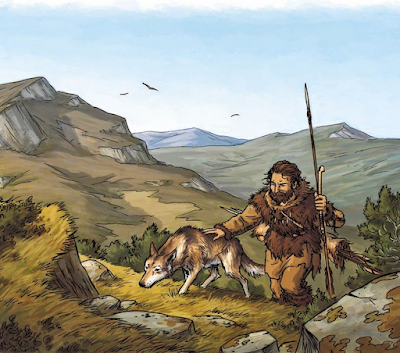
Paleolithic man with his hunting dog
In ancient China, both acupuncture and herbal remedies were being used for animals by 2000 BCE; in ancient Egypt, texts called the Kahum Papyri, written around 1900 BCE, listed treatments for cattle, dogs, cats, birds, and fish; in ancient India, a text called the Hastyayurveda, written around 1800 BCE, described elephant diseases and their treatment; and Vegetius of the Roman Empire fashioned remedies for lame horses in the late 300s CE.
Section of the veterinary papyrus of the Kahun Papyri
Schott cites a long string of early veterinary practitioners from around the world, most of whose treatments and surgeries were ineffective. In large part, this stemmed from lack of knowledge of animal anatomy and physiology. As an example, Aristotle (284-322 BCE) was an assiduous dissector, and when he couldn't find gonads in eels, the sage declared eels couldn't reproduce, and arose spontaneously out of mud.
Moving on to medieval Europe, animal practitioners used an array of often futile treatments, such as herbs, holy water, blood-sucking leeches, talismans, amulets, magical coins, charmed stones, incantations, live frogs pushed down the throat, live cats rubbed across the back, and more. A tome called the Leechbook (leech means doctor) even laid out a treatment for livestock bloat caused by elves. Schott notes, "I could fill this entire book with the weird and wondrous ways of the medieval cow-leech, horse-leech, and dog-leech."
Markham's Maister-Peece Containing All Knowledge Belonging to the Smith, Farrier, or Horse-Leech, Touching the Curing of All Diseases in Horses
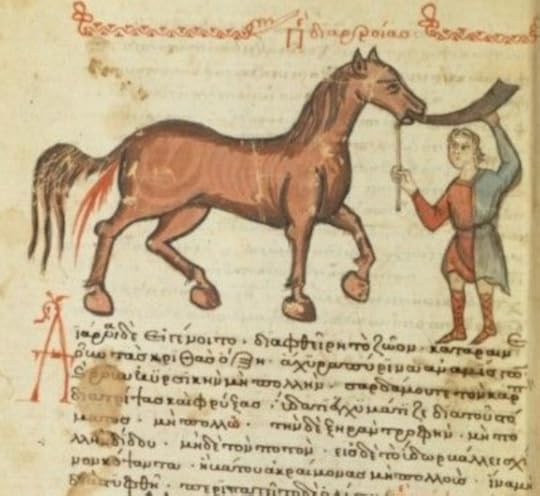
Practitioner in the Middle Ages drenching a horse (pouring medicine dissolved in water down the horse's throat)
Old-time animal doctors didn't limit themselves to providing external treatments and pouring potions down animals' throats. Some early veterinarians performed surgeries - without anesthetics - and Schott describes several operations in detail, advising, "Don't try this at home."
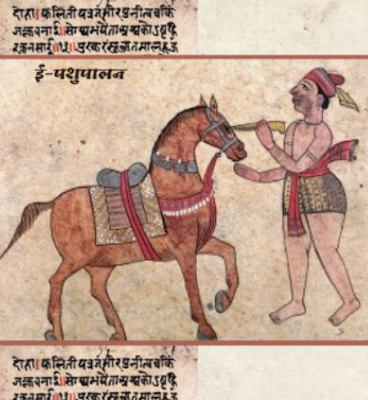
An eye operation on a horse in India
Schott notes, "The bottom line in all the foregoing was that the European Middle Ages, as in the ancient world that preceded it, saw very progress in medicine, whether human or veterinary, though not for lack of trying...Animals were extremely valuable...A single cow could represent most of a peasant's wealth...Every effort would have been made to keep these animals in good health and treat their afflictions, but the knowledge was simply lacking." Until the 18th century, veterinary medicine was a "potpourri of theories and remedies largely based on superstition, tradition, and anecdotal observation...which did more harm than good."
Medieval Magic Veterinarian
However, in the 1700s, objective science was starting to emerge, and Claude Bourgelet (1712 - 1779) is often cited as the 'Father of Veterinary Medicine.' Bourgelet created the world's first two veterinary schools in France, and there were soon veterinary schools all over Europe. These institutions taught things like anatomy, physiology, general medicine, medicinal plants, splinting, and bandaging.
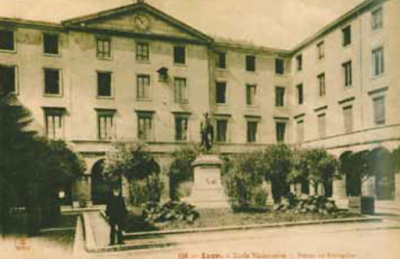
L'Ecole vétérinaire de Lyon - the world's first veterinary school
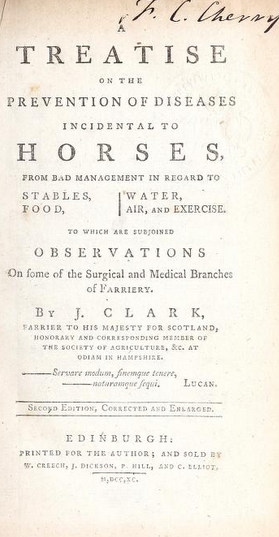
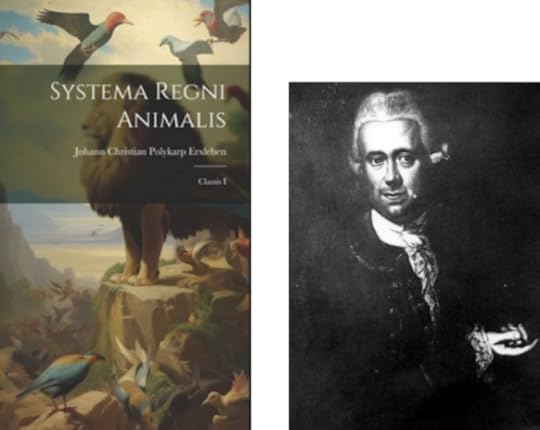
Schott proceeds to discuss 'heroes' who helped advance veterinary medicine, citing James Clark -a Scottish farrier who penned several treatises used as textbooks in the late 1700s; and Johann Christian Polycarp Erxleben - who founded Germany's first veterinary college in 1770, and emphasized scientific principles and hands-on practice for students.
Treatise on horses by James Clark
Johann Christian Polycarp Erxleben and one of his veterinary books
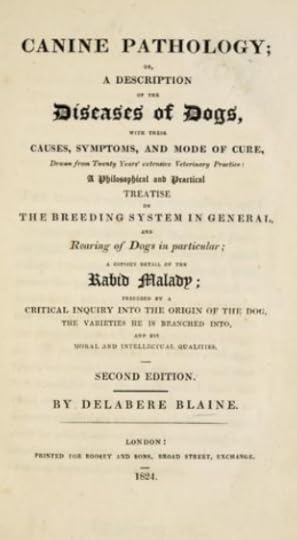
By the 19th century, veterinary medicine was advancing more rapidly, and starting to focus on 'pets' as well as economically important creatures like horses and cattle. This is evidenced by veterinarians like Delamere Blaine, who called himself 'the very father of canine medicine.' Delamere published several books about diseases and treatments for canines, and opened one of the first small animal clinics in the world.
Book about dog medicine by Delamere Blaine, published in the 1817
Advancement in veterinary science includes things like: anesthetics (1847) - which makes surgery easier; rabies vaccine (1885) - which protects dogs from the deadly disease; antibiotics (1928) - used to treat infections; etc. As a generalization, Schott lauds the expansion of basic care for animals worldwide, with many more vaccines; many more simple, humane procedures; and many more effective and affordable medicines.
A dog getting a rabies shot
Schott observes that veterinary medicine underwent its greatest crisis in the 20th century. In 1911, veterinarian' was a fancy synonym for 'horse doctor.' Though veterinarians did treat other species, especially food animals (cows, pigs, lambs, sheep, chickens, etc.) - and to a lesser extent, dogs - most veterinarians dealt with equines. Then cars were invented, and veterinarians were flummoxed. Veterinary schools closed and doom was predicted!
Of course this didn't happen because veterinarians largely morphed into pet doctors, treating dogs and cats with miscellaneous other species thrown in. (Note: I once took my parakeet to the emergency night clinic.)
A parakeet visiting the veterinarian
Over the course of the narrative, Schott gives credit to many people who had an impact on the veterinary profession. He also singles out some 'special mentions', including:
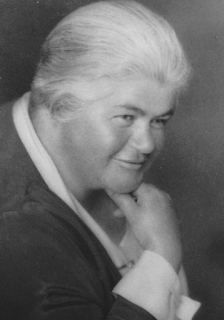
Dr. Belle Bruce Reid (b. 1883) - an Australian who became the first woman in the world to officially register as a veterinarian;
Dr. Belle Bruce Reid
Dr. Luis Camuti (b. 1893) - the first veterinarian to specialize in cats;
Dr. Luis Camuti and his book
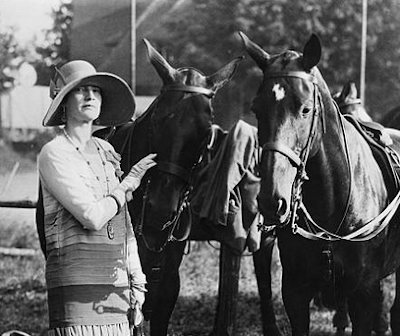
Countess Maria Helene von Maltzan (b. 1909) - a Polish veterinarian who helped smuggle Jews out of Germany during WWII;
Countess Maria Helene von Maltzan
Dr. Gladys Kalema-Zikusoka (b. 1970) - an African wildlife veterinarian who treats gorillas;
Dr. Gladys Kalema-Zikusoka
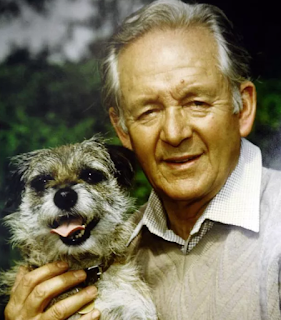
Alf Wight (b. 1916), also known as James Herriot, who's famous for his All Creatures Great and Small books and the television series of the same name.
Alf Wight (aka James Herriot)
Though not all-encompassing, the book is a fascinating peek at the history of veterinary medicine, with great pictures to illustrate the narrative. My major quibble would be that some sections skip around in time, but Schott usually has a reason tor tackling subjects out of order. Highly recommended.
Thanks to Netgalley, Philipp Schott, and ECW Press for a copy of the book.
I was searching through NetGalley (still trying to get my ratio to 95%) when I came across "Heal the Beasts" by Philip Schott. And I was immediately intrigued by it for no easily discernible reason. This is a (very abridged) history of veterinary medicine, from ancient times to today. The formatting is simple: the author sets of up a little scene of a character caring for animals. Then gives the true facts behind that person (or the kind of people that person represented) and the reasoning behind their actions. And I loved that formatting.
As someone with a Bachelors in History, I get iffy when people start fictionalizing in historic accounts, because it's so easy for the average person to take it at face value. But the format works wonders here, as the author would cite the specific sources he used to come up with what they were saying or doing. And he admitted when he couldn't be sure if that specific event had taken place. It was more a way to demonstrate veterinary tactics in a narrative, before the dryer information took over.
Although the information wasn't that dry. The author seemed to understand exactly what kind of little facts someone on the outside of the profession would be interested in. Like the fact that the man who first used the term "veterinarian" in a document also provided testimony in a witch trial (fuck that guy.) Or the fact that English vets were called by the type of animal they helped, followed by the word "leech." Like cow-leech or dog-leech. You can tell a non-fiction is good when you suddenly have a pile of trivia you want to unload on someone.
What I particularly enjoyed was the level of compassion the author had for the people caring for animals throughout history. True, some of the treatments were completely absurd. But he pointed out when there was actual scientific basis for the treatment (like how wine has antiseptic properties) and how they were doing the best they could. But also called out when the early vets weren't the best people (again, fuck that guy.)
I was happy that the book featured a much more global approach to animal care. From India to the Indigenous peoples of North America. It focused on how all peoples of all times and cultures had reasons to want to care for animals in their own way. It gave the book a very warm vibe.
The only real downside was the jumping around nature of the narrative. Trying to fit such a giant amount of history and culture in a very short book (the NetGalley copy was 220 pages) made for a lot of jumping around in year and place. It made thing more difficult to follow in a grander narrative sense, though I'm not sure how this could have been smoothed out without narrowing the focus.
All in all, a great nonfiction for animal and weird-history lovers alike!
Philipp Schott has dedicated his life to the world of animals. A veterinarian and someone who has written extensively about the world of animals, his books resonate with a passionate realism for keeping animals healthy, while showcasing stories about those in this profession. With his latest book HEAL THE BEASTS, he takes us on a vast history tour, telling us about veterinary medicine from many centuries past, leading up to more current times. It really is most enlightening, as we find the world of dealing with animals in its infancy, and how that treatment has evolved. There are more than twenty individuals noted in the book, people who have looked into the animal world, coming up with solutions and methods of dealing with both simplistic and quite sophisticated concerns. Each of the chapters begins with a proposed animal concern that has been looked into from many angles, leading to a solution, even if primitive on some occasions. It sets the stage for even more insight about that individual and their ideas and theories on how to deal with animal issues. In one chapter called Oswald, there are treatments for night goblins which were three stones inside a swallow’s gizzard. There was also a treatment proposed for treating bloat in livestock caused by elves. There is also proposals for the use of herb, holy water, and leeches, along with talismans and amulet that would ward off illness in man and beast. There is mention of the oldest veterinary school in the United States. It is noted as the Iowa State College of Veterinary Medicine in Des Moines. It came a decade and a half after the Civil War. There incidentally were only 50 college educated vets in the entire United States during the War, most of them in private practice. There are so many fascinating stories in this enlightening book, including Dr. Elinor McGrath who practiced in South Side Chicago. She appears to be the first female veterinarian on record. Many did not trust a female vet, but she proved to be more than capable in her work. We also meet Dr. Louis Camuti, who seems to be the first veterinarian specializing in cats. He even went to actress Olivia de Haviland’s house to treat her Siamese cat Ding Dong, who was not well and hid quite well so people could not find him. He began his practice in Manhattan in 1933. No matter what chapter you turn to, you will be intrigued and fascinated by the various individuals who dedicated their life and knowledge to the animal world. It will give a new appreciation for those past and more recently dedicated their knowledge and life to animal welfare around the world.
This is the sort of book that would have been absolutely one of my favorites back in Middle School/High School. An introductory historical introduction to veterinary medicine? Yes, please. Chinese, Indian, Irish and other cultural practices? A lot of horses? Yes, and yes. Kick ass female vets, one of whom had a pet monkey? Oh yes. The book is both the worst and the best kind of interesting, in that I was constantly bugging other people to tell them the interesting bits of history I’d just read. And to the credit of the book, even they were interested.
Moments such as rinderpest, a cattle plague, so virulent that it was suggested the infected animals be put down immediately in graves covered in quicklime — which was only eradicated in 2011. Or how one rabies cure had people place the freshly plucked bottom of a rooster on the cut. The founding of schools, the questionable folk medicines and how they slowly gave way to more effective, scientifically proven ones, it’s all well and cheerfully explained.
One thing I did appreciate that the author took a moment to warn readers about some paragraphs of animal suffering and death that might be difficult for sensitive readers. I read all of them, and they are — especially the first one — truly horrific, but skipping them doesn’t diminish the book in any way. The tone is conversational, friendly, and approachable, and I enjoyed the author’s voice as well as their sense of humor.
However, they also begin each chapter with a fictionalized moment of some person or other healing, caring for, or dealing with animals that I wasn’t a fan of. I didn’t think they were necessary to the book itself, and when I come back for a re-read, I will probably skip them. Still, that’s really my one and only nitpick for the whole book.
Thank you so much to Net Galley and the publisher for the ARC!
I am a big fan of author Philipp Schott's veterinarian sleuth series and that drew me to this book. I knew it would be a mix of fiction and nonfiction. In fact, most of the illustrative fictional stories that lead into the chapters integrated well with the history facts and once I got to the Renaissance era when popes worried about the spread of cattle disease I settled into the book pretty well. And the initial eye opening segment about the 1815 Battle of Waterloo and the toll it took on the horses used in combat: horrifying but gripping.
As a lay reader not involved in the sciences or veterinary medicine, I found the first third of the book (before the pope section), when care and remedies were so hit and miss, and then the genesis of schools of veterinary medicine, a bit dry and hard going. But I persisted and I am glad I did, really enjoying the chapters after the profession started branching out more into pets as well as farm animals. For instance, I never knew there were vets who specialized in just one species of pet, like cats, and the practicality of cat house calls. Schott also highlights the growing presence of female practitioners and even weaves in a jaunt to the forests of Africa.
Another segment I really enjoyed: that Yorkshire vet made world famous by a popular television series(now two!) and how he and his colleague cohort bridged the gap to widespread use of penicillin, antibiotics and the preventive treatments used today. The photos and illustrations at the end were a good feature too.
Not a quick read for me but it was informative and does a good job illustrating the way care about and for animals has evolved over centuries.
Thanks to ECW Press and NetGalley for sharing a complimentary advance copy of the book; this is my voluntary and honest opinion.
Veterinarian Philipp Schott brings us another charming book, Heal the Beasts: A Jaunt Through the Curious History of Veterinary Arts. My thanks go to NetGalley and ECW Press for the invitation to read and review. This book is for sale now.
In his trademark style, Schott provides veterinary history through a series of brief vignettes. My favorite deals with Manvir, the constipated elephant. And with that, a word of caution: there’s plenty of gross material here, as one might expect; be advised in case, like me, you are fond of reading and eating simultaneously.
Among other things, we see a series of firsts—for example, Dr. Elinor McGrath was the first veterinarian in the world to perform tonsillectomies in dogs, in 1888. Chicagoans, be proud! The ancient Egyptians tended to spoil their pets every bit as much as many of us do today, and it was a crime to mistreat an animal.
There are also some fictional anecdotes and myths woven into the narrative, and I am not a fan of this, particularly since they are interspersed with factual material within the same chapter. My first preference would be to have everything here be nonfiction, but failing that, for goodness’ sake, separate out the fictional material. Put a little border around those anecdotes or something, don’t just drop them into the middle of true information!
That aside, I like this collection. Most animal lovers will enjoy it, but it would be especially nice to have in veterinary office or hospital waiting rooms. Recommended to those that love their pets—or other people’s.
I just finished the advance read copy of Heal the Beasts by Philipp Schott, and my biggest question is ... How many books should I purchase?
My neighbor is a veterinarian and I drove her to an eye doctor appointment a couple weeks ago. I told her I was reading this book and that she probably learned much of the history when she was studying. And she said "no, not really". And my cousin's daughter just finished her vet tech internship. And a good friend has a friend who is a vet. And I might like a hard copy of this one; I loved the acknowledgements and additional reading.
Heal the Beasts: A Jaunt Through the Curious History of the Veterinary Arts dedicates a chapter to 22 veterinarians through the ages.
I really love Philipp Schott's writing since he wrote Willow Wren. I think I've read all but one book that he has written since. I'm a huge fan of his writing; I love those little dry zingers that he slips in. Additionally there are several pages of pictures to add further interest.
I really enjoyed Heal the Beasts, even read the parts that made me cringe a little.
Many thanks to NetGalley and ECW Press for approving my request to read the advance read copy of Heal the Beasts in exchange for an honest review. Approx 260 pages. Publication date is July 8, 2025.
“It is often the case that the history of one thing mirrors the history of many things.”
Heal the Beasts was an interesting and entertaining read. Through fictionalized anecdotes, the author made us travel through time and space and witness Veterinary Medicine’s birth, growth and evolution. As a former vet and someone who loves History of Sciences, I particularly enjoyed that journey. With each little anecdote (based on facts, but adapted in short stories) we learn a concept and can see how Animal Health preoccupied humans since the dawn of time. Each chapter is completed with a discussion and an explanation, to show how Human and Animal Medicine were (are) linked since forever and how each helped the other to evolve. I also particularly liked the way the author decided to add empathy to the relationships between human and animals, providing some extra thinking to us by the addition of references (texts and painting). This is a thing many should remember nowadays in our relationship with other species. All along, the author keeps things simple, though, and vulgarizes his subject as much as he adds some storytelling, which makes this book easy to read for everyone, no matter their background.
Thank you to the author and ECW press for the eARC sent via NetGalley. My opinions are my own.
I loved Dr. Schott's idea for Heal the Beasts but was disappointed in the execution. In the introduction he references other mono-thematic histories and his desire to do the same for veterinary medicine, with the goal of demonstrating the evolution of human's empathy for animals—a worthy effort. Each chapter opens with a story that Dr. Schott invented based on historical occurrences. Again, an interesting idea that shows Dr. Schott's creative side (Schott is also the author of novels), yet I found these stories somewhat forced and fanciful. The book is very much a history beginning from 12,205 BCE and passing through the ages to reach present day, reading at times like an entry in an encyclopedia, at other times, however, veering off in digressions and asides spurred by the mention of a curious figure. I struggled to see a clear link from one chapter to the next that would illustrate the evolution he described in the introduction. He states the sentiments and changes he'd like us to see but it felt more like I was being told what to think rather than being shown that evolution and left to draw my own conclusions. I did appreciate that he brought forth lesser known veterinarians and women vets in particular. My niece is a veterinarian and I believe she, and her colleagues, would find Heal the Beasts interesting, general readers, less so.
What a lovely surprise this book is! I was expecting a dry text book about the development of animal medicine, but found instead a delightful 'jaunt' through animal and human history.
Each chapter starts with a little story based on historical evidence, about how humans treated animals. Starting from prehistory and using paintings, archaeological and written evidence, the history moves chronologically to the modern day veterinary surgeons. Referred to originally as an art, the examples move through scenarios including constipated elephants to gorilla specialists and tries to explain why women now outnumber men as vets.
The introductory stories are a joy to read and the early ones reminded me of fables. Full of information, anecdotes, beliefs as well as practicalities, the book doesn't rely on inaccessible science or medical terms, making it something anyone can easily read and indulge in. It is organised well, engaging with plenty of wit and insight to fascinating and bizarre ideas about medicine.
Recommended to anyone who has the slightest interest in animals, history or quirky books. Will make a stunning gift. Love this.
This is an interesting if slightly brief look at how veterinary medicine has developed over history, thanks to various pioneers. Each chapter features a particular person and starts with an imagined scene featuring that person providing care to an animal. Then it explains some of the history of the time and how some of the knowledge or procedures compare to today (some things don’t change because they just work!). However sometimes I found that the focus person of the chapter didn’t feature very much - McGrath being the one I noticed most. The story featured her and there were maybe a few paragraphs but then Schott said not much was documented about her and he started talking about two other female vets…?
However, the tone of writing, the stories, the research were all good and this will serve as an interesting introduction to anyone with an interest in history and science. A list of further reading is provided at the back of the book for deeper exploration.
I received a free ARC copy of this via NetGalley and the publishers in return for an unbiased review.
Heal the Beasts is a well-written, well-researched, engaging history of veterinary medicine. Exploring humankind's connection to "beasts" and the desire to provide them care, first for practical reasons, then for more emotional ones, Dr. Schott tells the stories of 22 different animal healers and veterinarians spanning centuries and continents. Some of the early treatments are astonishing now that we know better! Dr. Schott draws parallels between the evolution of human and animal medicine and shows how, over time, veterinary medicine went from a field of mostly shysters to becoming a respected field based in science. Written in a conversational, storytelling tone, Dr. Schott makes the information interesting and easy to follow, and his sense of humor shines through. I highly recommend reading all the way to the end, including the Sources and Further Reading, which includes numerous images relevant to the stories told in the main text, annotated with Dr. Schott's droll comments and observations.
Later in the year, I would likely not complete this book. However, at this point in the year, I try to finish most of the books I read. It was not bad. There were lots of interesting historical facts in the development of veterinary medicine, It felt like a more technical version of Lorne Green’s New Wilderness (For the younger generation, Lorne Greene had the most popular nature show). The highly technical parts of each story caused the interesting concept to be somewhat boring. I am sure that those in the field would very much enjoy the development of how to care for animals, however, it was just okay for me. One interesting part of the book were the stories that highlighted the fact that this profession was dominated by men. In fact, in one story, we saw that people did not trust female vets. However, as time has progressed, we now know that the profession is actually dominated by females now.
This is not something I'd normally read, but I'm a big fan of Philipp Schott's Dr. Bannerman mystery series about a fictional veterinarian, so I was intrigued when I saw he wrote a veterinary history book.
It took me a while to get into this one as it is in chronological order from ancient history to modern history and I found some of the early parts to be a bit dry, but I ended up enjoying it overall.
The author did a great job at summarizing how animal care evolved through different historical eras in different parts of the world, and the contributions made by individuals at each time.
This is not a book for everyone, but it is great for any animal-loving history buffs. It's very informative with bits of humour throughout.
An easy-to-read, interesting and entertaining history of veterinary medicine from early times to present day, and how animals have evolved to being members of the family. I enjoy Philipp Schott's writing, especially his fictional works. I was taken in by his passion for history and his love of animals. There must have been so much involved in researching and whittling down, as well as imagining various fictional encounters along the way. I can see this book taking a place on many a cottage bookshelf, folks flipping through the pages, and then sitting down and being drawn into another time, while being educated and informed. I especially enjoyed the more recent tales of Winnie the bear, and James Herriott.
If you enjoy animals, and learning about the past of veterinary medicine, you may enjoy this!
In this engaging book, Canadian vet Philipp Schott takes on a tour of veterinary practice through the ages. His writing style is informal and chatty as he describes the unusual, often bizarre practices of animal care from the middle-ages into the more scientific approach we have today. He has illustrated the information with short, entertaining fictional tales to demonstrate what might have happened in the time period. He also discusses the advent of veterinary training and how animal care has changed over time from that of individual farm animals to that of herds as well as to the care of cats and dogs and other pets that we are all now familiar with. It’s a short book that can be read in one or two sittings or dipped into over a few days for maximum enjoyment.
With thanks to ECW Press via Netgalley for a copy to read.
Philipp Schott has not disappointed with this extraordinary well researched book, we travel with him as he discovers how animals came into humans lives thousands of years ago and also uncovers interesting facts about when veterinary science became a science.
Some of the facts had me gasping in shock - horses on the battlefields - killed in the millions.
I found this book very easy to read, thanks to Philipp Schott brilliant writing. Full of astonishing archeological findings linking animals to humans.
I also listened to the audible version and loved the narrator, who was precise and spoke beautifully.
A thoroughly enjoyable book, by a Canadian veterinarian with a sly sense of humour. It is well researched and entertaining with a brief story at the beginning of each chapter, fiction but based on the events to be described, which gives a nice introduction to the following historical narrative. Don't miss the photographs and their captions - in my advance copy these are at the end of the book, hopefully the final publication will have them in the middle.
Philipp Schott has written other books, notably the Accidental Veterinarian which I enjoyed as well.
I am a Philipp Schott fan, plain and simple. At this point, I have read nearly all of his "memoirs" of stories from his practice as well as a couple of his novels. I find him to be an engaging writer, of both fiction and non-fiction, and has a dry humor that I appreciate. This book was no different. What could be considered dry subject matter was presented interestingly, with a short vignette opening up each chapter. I loved the organization of the book, and even the choice of the word "jaunt" as part of the title, as that is exactly what it felt like. Starting from ancient history and working his way through to the most recent century, Schott hit the highlights of how far veterinary medicine has come and, in some cases, how certain practices carried out today are just more refined versions of what has been done for hundreds of years. I always appreciate a well-researched collection of informational non-fiction, especially when it is presented in an interesting way, and this one is no exception.
I loved this book. Dr. Schott writes with a conversational tone and with lots of humour. I liked how he introduced each era of veterinary medicine with an illustrative story; this helped put everything into context. Even the acknowledgments were worth reading. I think this book will be a great read for anyone interested in the history of science, including the history of medicine. Thank you to Netgalley and ECW Press for the advance reader copy.
The history of veterinary medicine is a very interesting topic to me and there was lots of fascinating adjacent historical information covered. However, I dont see this being a book that a lot of people would be drawn to, although it was written in a way that would be easily accessible to the layperson. I would advise anyone considering this book to give it a try. I received this ARC from Netgalley for my honest review.